
The real SEO question is not whether link building or content marketing matters more, but which one should get your next dollar, hour, and hire first. Content should lead when your site lacks ranking assets, and link building should lead only when strong pages already exist but cannot break into page one. One builds relevance, the other builds authority, and you rarely have the budget to chase both at full speed at once.
This guide compares the two across SEO impact, speed, cost, scalability, durability, and risk, then gives you a direct verdict by business scenario. Read it as a prioritization decision, not a popularity contest.
What Link Building and Content Marketing Actually Do in SEO
Link building and content marketing solve two different problems: one builds authority, the other builds relevance. Treating them as rivals misses the point, because a site usually lacks one far more than the other at any given moment.
Link building is the process of earning relevant backlinks from other sites, and those links increase your domain’s authority and a page’s ceiling for how high it can rank. Content marketing is the process of creating and optimizing pages that match search intent, build topical depth, and convert the traffic they attract. Content gives you something worth ranking. Links help that asset win in a crowded search result.
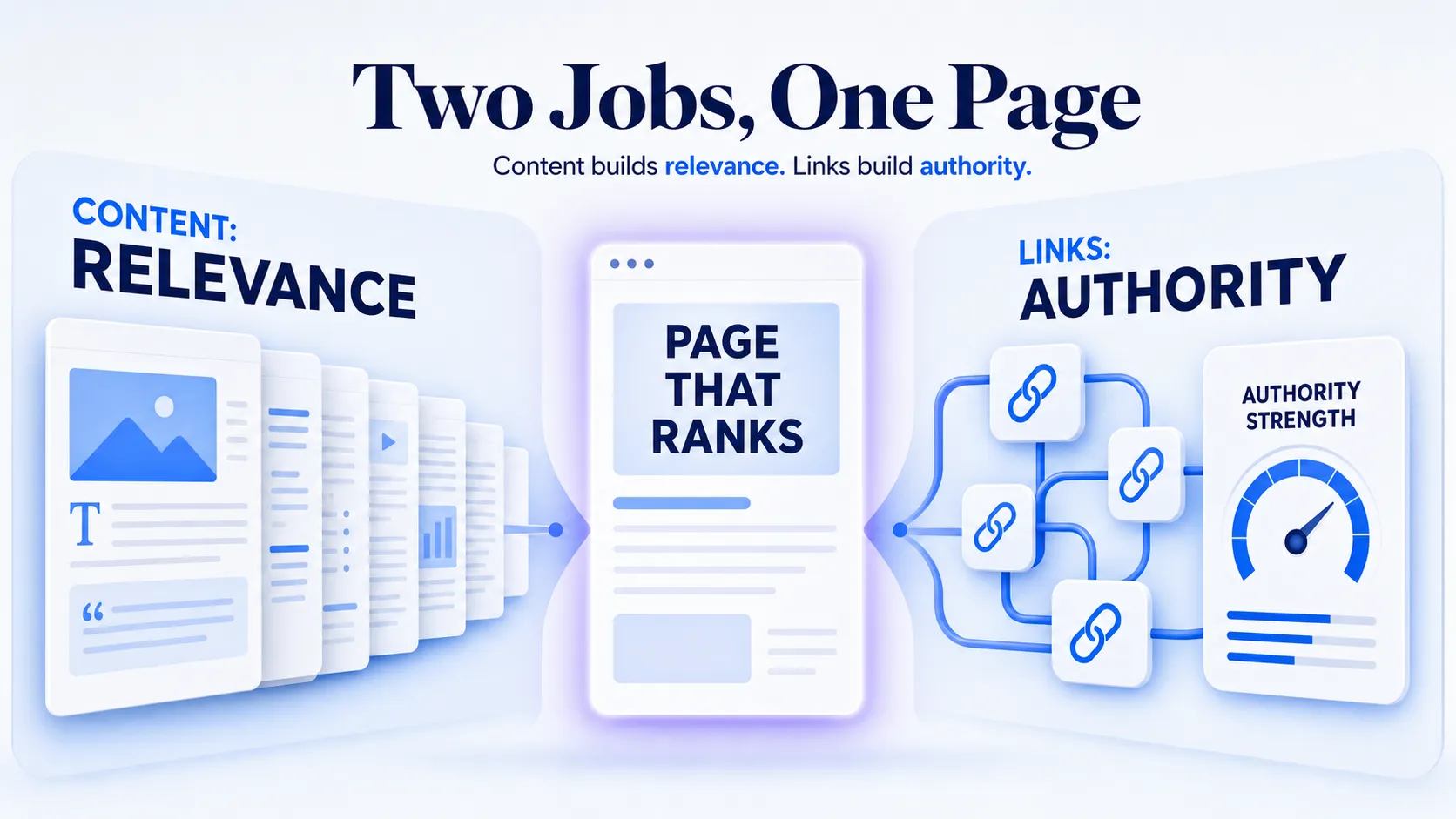
This is not a “which is better” argument. It is a question about what the site currently lacks. In what we see across audits, pages with thin content rarely move until they earn authority, and strong pages with no topical depth often stall even after a clean link campaign. The diagnosis comes first.
One clarification matters before the comparison. Digital PR and unlinked brand mentions sit next to link building, but they are not the same thing. Digital PR earns coverage and links through newsworthy stories, while unlinked mentions are citations of your brand that have no link yet. If you want the distinction between earned citations and earned links, brand mentions versus backlinks covers where each one pulls weight.
The Criteria Used to Judge Each Strategy
Before picking a winner per scenario, you need a fixed set of criteria to judge both tactics against. Each criterion answers one practical question, so the decision stays grounded in outcomes rather than preference.
The seven criteria are SEO impact, speed to results, cost, scalability, durability, dependency on other assets, and best-fit scenario. The table below shows the directional read on each. Content usually wins on asset creation and compounding, while link building usually wins on authority acceleration.
| Criterion | Content Marketing | Link Building |
|---|---|---|
| Primary SEO impact | Relevance, intent match, topical depth | Authority, ranking ceiling |
| Speed to results | Slower, compounds over months | Faster on pages that already deserve to rank |
| Cost driver | Research, production, optimization | Prospecting, outreach, quality control |
| Scalability | Repurposing and a growing asset library | Repeatable systems and templates |
| Durability | Pages keep attracting traffic and links | Links keep lifting sitewide authority |
| Dependency | Needs promotion to be seen | Needs a strong page to point at |
| Best fit | Sites short on ranking assets | Sites with assets that lack authority |
Here is the one-row takeaway to hold through the rest of this guide. If the site has no strong assets, content creation comes first. If the assets already exist but lack authority, link building deserves the budget. Picture a brand-new site with zero backlinks against an established site whose pages rank on page two but cannot crack the top ten. Those two sites need opposite first moves.
SEO Impact and Time to Results
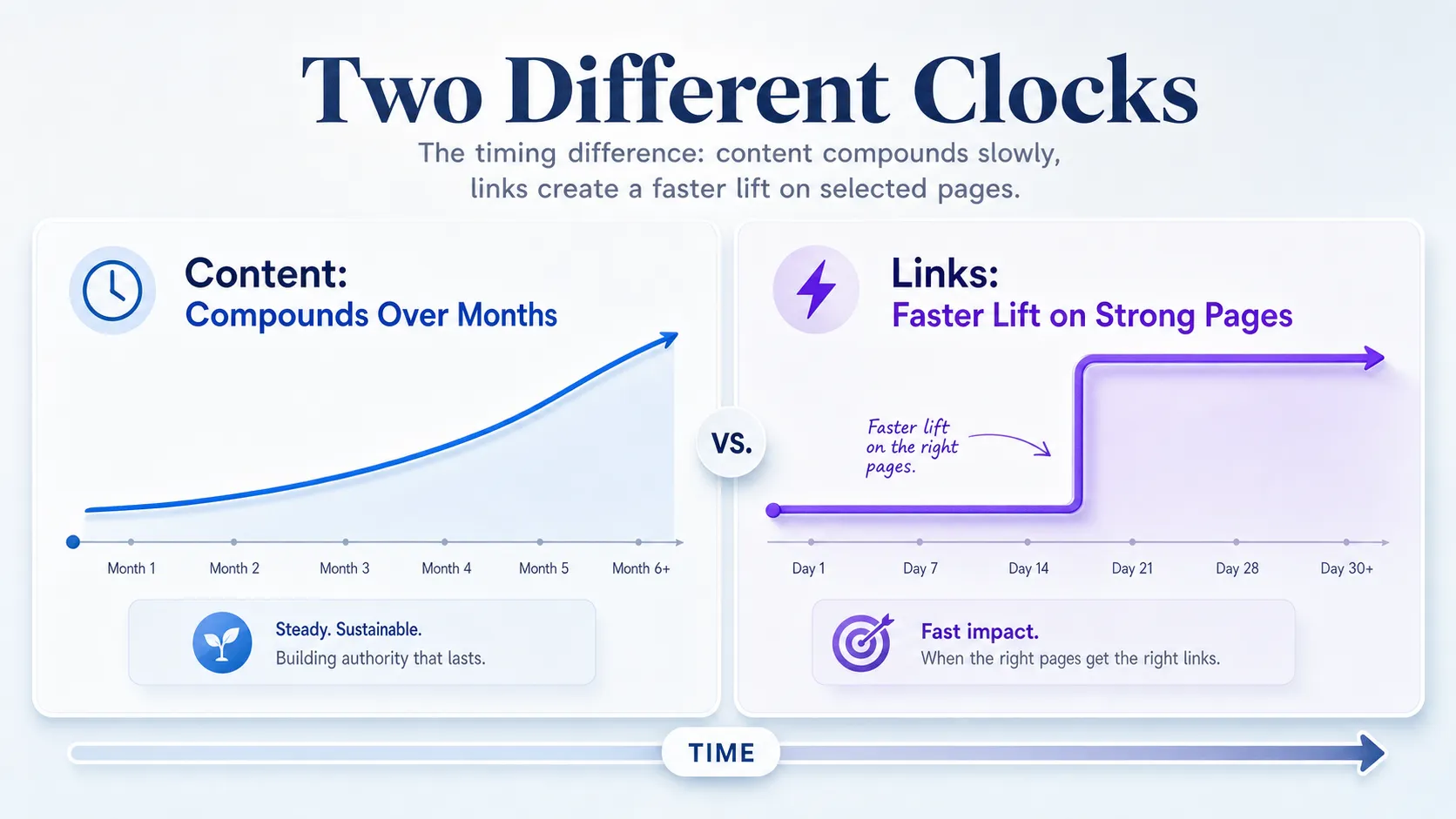
Content marketing and link building both lift rankings, but through different mechanisms and on different clocks. Content marketing improves topical relevance, intent match, and semantic coverage, which lets a site rank for more queries over time. Link building increases authority and raises the ranking ceiling for pages that are already relevant.
Content can rank without many links in low-competition niches. In crowded results, it usually cannot, no matter how good the page is. Links can move a page faster, but only when that page is already strong enough to deserve visibility. Point authority at a weak page and you waste it.
The time-to-results gap is real. Content compounds slowly, often over several months, as it earns rankings, internal links, and natural references. Link building can create a faster lift on a specific target page when the content already exists and the page is competitive. If you need movement this quarter on a page that already converts, links are the lever.
The practical rule cuts through most debates. If a page is stuck because Google does not trust the site enough, links help. If a page is stuck because it does not answer the query well enough, content fixes it. The most common failure we see is teams pushing weak pages with links before the content is actually aligned to search intent. The link spend evaporates because the page never deserved to rank in the first place. For the mechanics of doing the link side well, how to do link building in 2026 walks through prospecting and qualification.
Cost, Scalability, and Long-Term Value
Effectiveness is only half the decision. The other half is efficiency: what each strategy costs to run, how cleanly it scales, and how long its value lasts. The two have very different cost stacks.
Content marketing carries the cost of research, briefing, writing, editing, design, on-page optimization, and promotion. Link building carries the cost of prospecting, list building, outreach, relationship management, placement review, and quality control. Neither is cheap when done well. Both get expensive fast when done badly.
| Dimension | Content Marketing | Link Building |
|---|---|---|
| Main cost stack | Research, briefing, writing, editing, optimization, promotion | Prospecting, outreach, relationship management, placement review |
| How it scales | Repurposing, internal linking, a growing asset library | Outreach systems, templates, repeatable prospecting, quality standards |
| Long-term value | Keeps attracting traffic, links, and conversions | Keeps supporting multiple pages and sitewide authority |
| Failure economics | Strong content with no promotion is an underused asset | Cheap links to weak pages are wasted spend |
Content scales through repurposing, internal linking, and building a publishable asset library you can point campaigns at later. Link building scales through systems: repeatable prospecting, outreach templates, and placement quality standards. The operational difference is that one produces a reusable asset, while the other distributes authority across the site.
Long-term value runs in parallel. A strong content asset can keep attracting traffic, links, and conversions for years. Quality backlinks can keep supporting multiple pages and lift domain-wide authority well past the month they were earned. The agency pattern worth internalizing: cheap links to weak pages are wasted spend, and strong content sitting without promotion is an underused asset. Both failures are common, and both are avoidable.
Risk, Dependency, and Failure Modes
Lean too hard on either tactic and you create a predictable failure state. Naming both failure modes is the fastest way to avoid the wrong tradeoff.
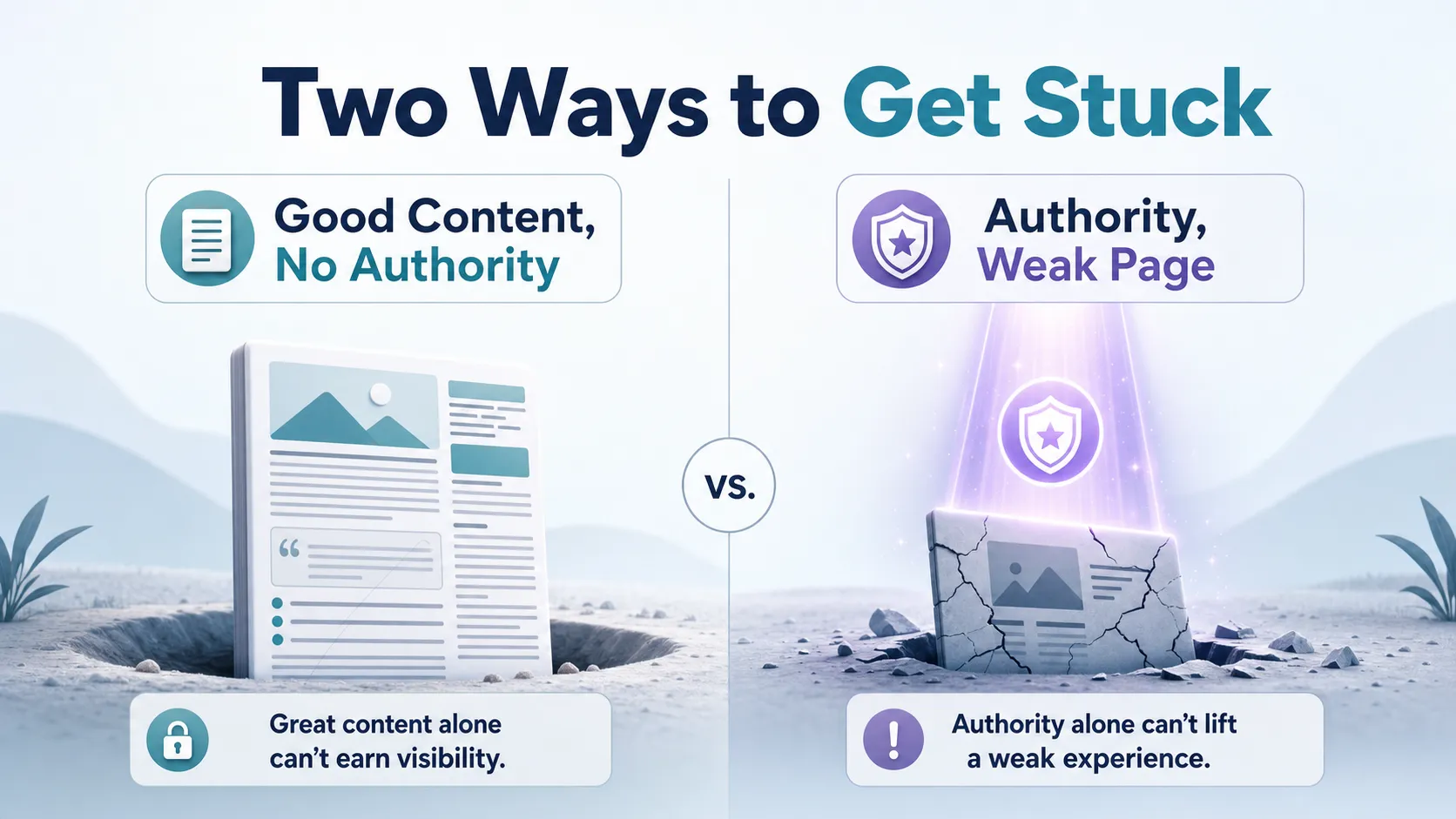
Content-only SEO produces a familiar pattern: lots of publishing, little authority, slow rankings, and underdistribution. The pages are good, but nobody links to them and Google never trusts the domain enough to rank them in competitive results. The library grows while the traffic stays flat.
Link-only SEO produces the opposite problem: authority pointed at pages that are thin, off-intent, or weak at converting demand. The links land, the rankings barely move, and the few visitors who arrive bounce because the page does not answer their question.
The dependency trap connects both. Content without promotion often becomes invisible, and link building without the right page architecture often improves the wrong URL. There is also a quality risk worth naming: low-quality, manipulative link building can create short-lived gains and long-term cleanup work. The safer rule is simple. Every link campaign should point to a page with clear intent, strong copy, and a conversion path.
We see teams ask for links to pages that are not yet strong enough to deserve ranking, or to pages that never had a conversion purpose in the first place. Fix the page before you fund the links. If you are deciding whether to hire help for the link side, a link building consultant who delivers should push back on exactly this.
Which One to Prioritize First, by Use Case
The right first move depends on where your site sits today. Here is the direct recommendation by scenario, so you can decide what to fund next.
- New site: Start with content. The site needs ranking assets, topical coverage, and crawlable pages before any authority work can compound. Links pointed at a site with nothing worth ranking go nowhere.
- Competitive niche or new category page: Run a hybrid, but make content the base and focus link building on the single highest-value page. Spreading links thin across a weak content set wastes the budget.
- Limited budget: Content first when there are no strong pages yet. Switch to link building when you already have pages with clear commercial intent and strong on-page fit that just need authority to rank.
- Fast-growth launch: Use both, but concentrate links on one hero page rather than spreading effort across the whole site. One page that ranks beats five that almost rank.
- Established brand with a content library: Lead with link building as the amplifier, especially for pages sitting on page two or three that already match intent and convert.
The decision rule underneath all five: content creates the asset, link building amplifies it, and your first priority depends on whether the site currently lacks relevance or authority. The question to ask in your next planning meeting is blunt. Do we need more content, or do we need to push the content we already have? For established sites with strong pages, editorial link building options are usually where the amplification budget goes, and turning unlinked mentions into links is often the cheapest authority you can earn.
Frequently Asked Questions
Should I start with content or link building?
Start with content if your site lacks strong, intent-matched pages, and start with link building if you already have pages that deserve to rank but sit below the top ten. The deciding factor is whether the bottleneck is relevance or authority. A new site almost always needs content first, because there is nothing worth linking to yet.
Can content marketing replace link building for SEO?
No, content marketing cannot fully replace link building in competitive results, because relevance alone rarely outranks authoritative competitors. In low-competition niches, great content can rank with very few links. In crowded commercial categories, the page still needs authority to break through, and that authority comes from links.
Which is better for a new website, backlinks or content?
Content is better for a new website. A new site needs crawlable, intent-matched pages before authority work can do anything, because links pointed at a thin site have nothing worthwhile to support. Build the asset base first, then earn links to the pages that show clear commercial value once they exist.
Does link building work without new content?
Link building works without new content only when the existing pages are already strong and aligned to search intent. If a page that already converts is stuck on page two, links can lift it without writing anything new. If the page is thin or off-intent, links will not save it, and the spend is wasted.
How long does it take to see results from content marketing vs link building?
Content marketing usually takes several months to compound, while link building can lift a strong target page faster, sometimes within weeks. The speed gap exists because content has to earn trust and topical depth over time, whereas links act on a page that already deserves to rank. Neither produces overnight results in a competitive niche.
Audit your strongest pages first, then put your link-building budget behind the content that can actually win. Content creates the asset and links amplify it, so the honest answer to “which one” is “whichever your site lacks right now.” Diagnose the gap before you spend, because the wrong first move is not just slow, it is wasted. Book a strategy call and see whether your pages need more relevance or more authority next.