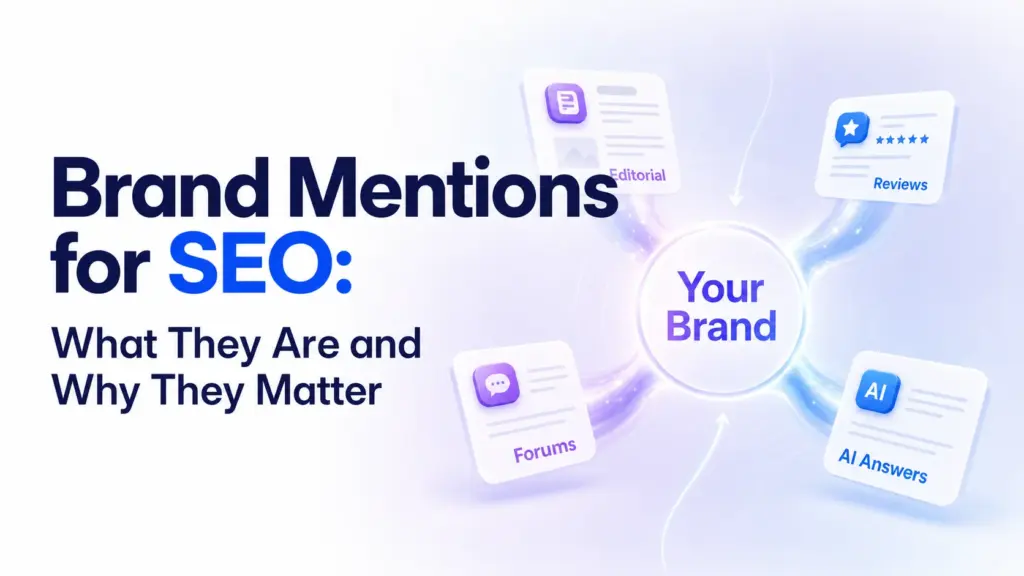

Brand mentions for SEO still matter, but they work as trust and entity signals first, not as a replacement for backlinks. A brand mention is any online reference to your company, product, service, founder, or branded entity, whether or not it carries a hyperlink.
Search engines and AI systems use these references to figure out who you are, what category you belong in, and whether you deserve to show up. That is the real job a mention does. It does not pass link equity the way a backlink does, and it does not override weak content or thin technical SEO. What it does is help machines build a clearer, more confident picture of your brand as a known entity.
What Brand Mentions for SEO Actually Are
A brand mention is any online reference to a company, product, service, founder, or branded entity, written in text that other people or systems can read. It can sit inside a blog post, a news article, a forum thread, a review, a social post, or an AI-generated answer. The reference is the mention. The link, when present, is a separate signal layered on top.
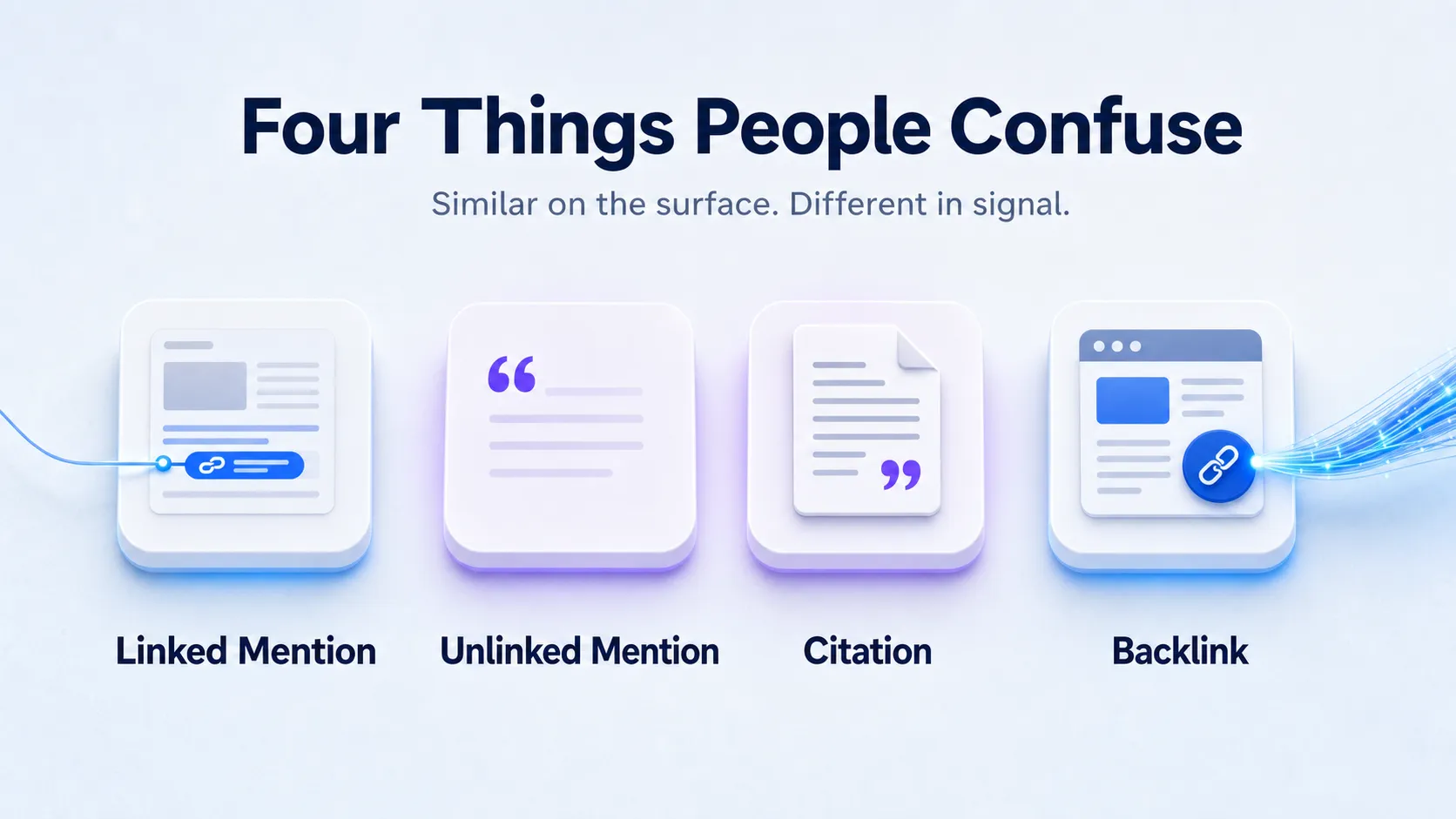
The cleanest way to hold the difference is to separate the reference from the link, and the link from the credit.
| Term | What it is | What it signals |
|---|---|---|
| Linked mention | Your brand named in text with a clickable hyperlink | Both an entity reference and link equity |
| Unlinked mention | Your brand named in text with no hyperlink | An entity reference and trust, no link equity |
| Citation | Your brand referenced as a source an engine relies on | Credibility for a specific claim or answer |
| Backlink | A hyperlink pointing to your site, branded or not | Link equity and a navigational path |
AI-generated mentions are the newer category. These are brand references that appear inside answers from systems like Google AI Overviews, ChatGPT, Gemini, or Perplexity. The engine names your brand in its response, sometimes with a source link and sometimes without one. That naming is still a mention, and it still shapes how often a brand gets surfaced next time.
A branded keyword is different again. That is what a person types into search when they look for you by name, not a reference someone else published. Mentions can grow branded keyword demand, but the two are not the same thing.
Here is the practitioner pattern worth holding onto: the same mention can be valuable or useless depending on the words around it. A bare name drop in an off-topic list does almost nothing. The same brand named inside a sentence that states the category, the use case, and a reason to trust it gives an engine real material to work with.
Why Brand Mentions Still Matter for SEO
Brand mentions matter because they build the trust and entity signals search engines and AI systems use to decide who gets surfaced. When credible sources reference your brand, you stop being an unknown string of text and start being a recognized entity tied to a category. That recognition is the groundwork everything else sits on.
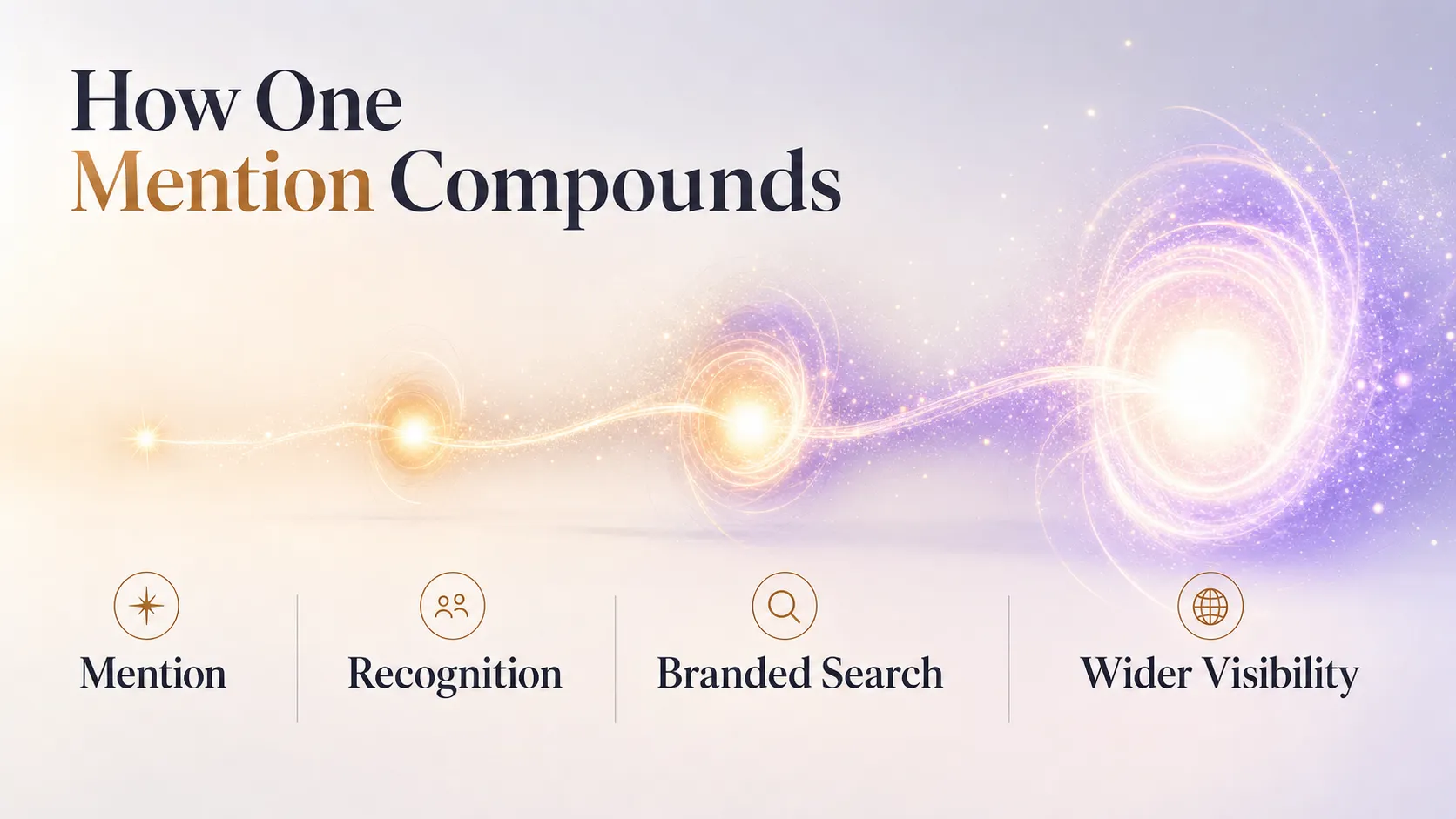
Repeated mentions teach engines that your brand belongs to specific topics. Name your brand often enough alongside a category and the engine connects the two, which is the heart of building authority as a recognized entity. That topical association is what lets a model decide your brand is a sensible answer to a category question.
Mentions also feed branded search demand. When more people read about you in places they already trust, more of them search your name directly later. Branded queries are one of the cleaner signals that a brand is gaining traction, and they often move before non-brand rankings do. That ordering matters when you measure results.
In AI search and answer engines, mentions on relevant, authoritative pages improve the odds a brand gets named or cited in a generated response. The pattern is consistent: the more a brand appears in the right context across credible sources, the more readily models reach for it. The connection between mentions and visibility in AI search is where a lot of current attention sits.
The nuance has to stay honest. Mentions support SEO outcomes, they do not override them. Here is the split worth keeping in view.
| What mentions can influence | What mentions cannot do alone |
|---|---|
| Entity recognition and topical association | Rank a thin or low-quality page |
| Trust and reputation signals | Replace the link equity a backlink passes |
| Branded search demand | Fix broken technical SEO |
| Odds of being named in AI answers | Guarantee a citation in any single answer |
How Search Engines and AI Interpret Brand Mentions
Search engines and AI systems interpret a mention by extracting the named entity, reading the context around it, then deciding how much weight the source deserves. The brand name alone is just text. The meaning comes from everything wrapped around it.
The process runs in a rough sequence, and each stage adds or removes confidence.
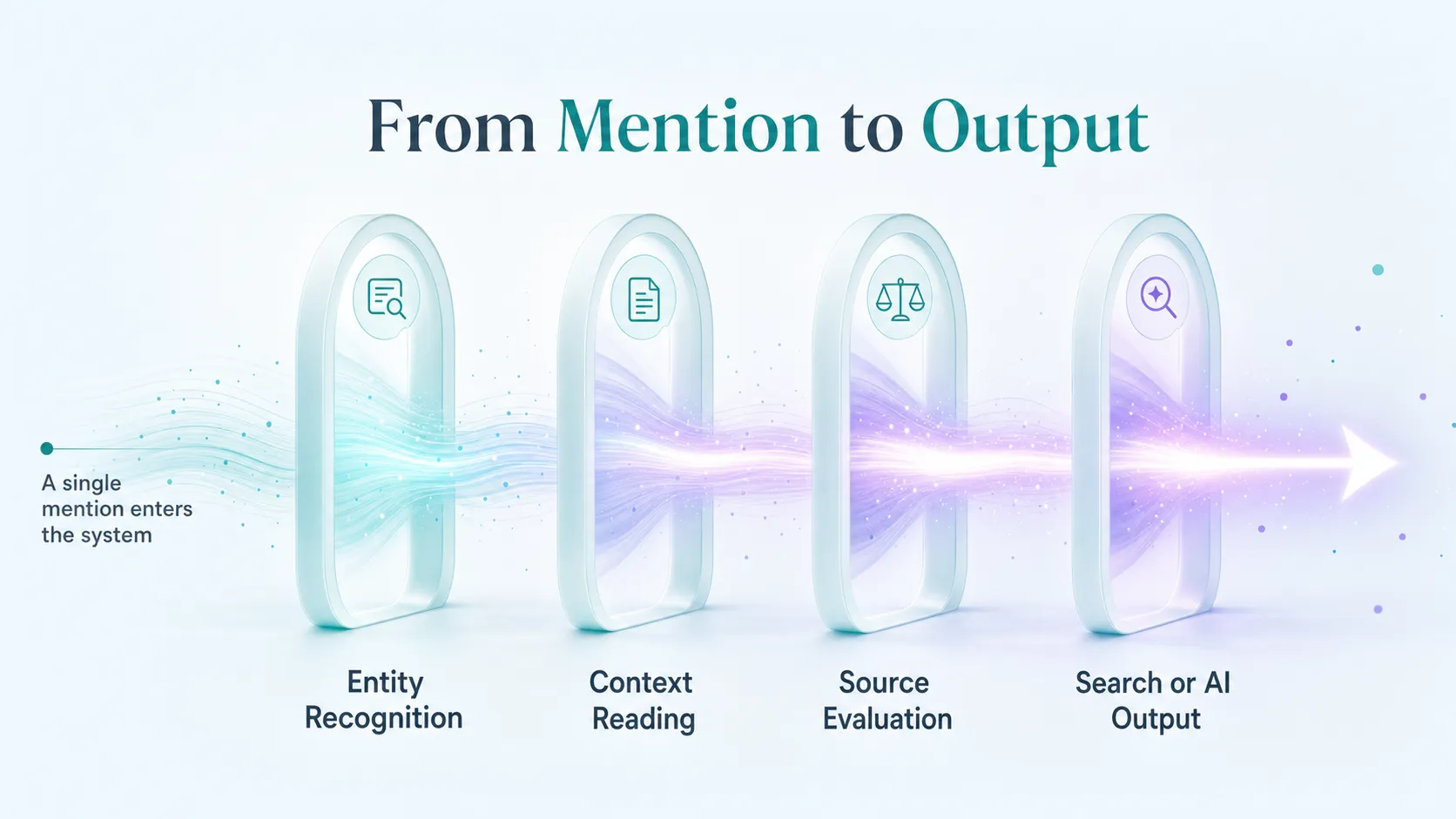
First, the system pulls named entities off the page. It identifies that a specific brand, person, product, or topic is present and links each to a known reference where one exists. This is how a brand name gets tied to a brand entity rather than treated as a random word.
Second, natural language processing reads what the mention means. NLP, the field that lets machines parse and understand human text, looks past whether the name appears and works out what is being said about it. A sentence calling your tool the best option for a use case reads very differently from one listing it as a complaint.
Third, entity systems like the Google Knowledge Graph connect your brand to related concepts, categories, and attributes. The Knowledge Graph is the structured map of entities and the relationships between them. The more consistent your mentions, the more confidently those connections form.
Fourth, sentiment and context get weighed. A positive review, a neutral listicle, and a negative complaint are not equivalent inputs. Tone shapes the reputation picture, which is why sentiment reading sits inside this evaluation rather than off to the side.
Fifth, AI systems run their own source selection and retrieval before naming a brand in an answer. They decide whether a source is worth pulling from, then whether your brand belongs in the response. Where the mention lives feeds this directly. An editorial article, a high-trust review, a forum thread, and a thin product page do not carry equal weight.
The field pattern: mentions are strongest when they sit next to category terms, problem statements, and buyer-intent language, not when they appear as bare name drops. A brand named beside the exact problem it solves gives the model a reason to connect the two. The deeper mechanics of how brand mentions work in AI search follow this same logic.
The Main Types of Brand Mentions and Their SEO Impact
Brand mentions split into a few practical categories, and the ones that matter most for SEO are relevant third-party references on credible sources with strong topical context. Not every mention pulls the same weight, so sorting them is the first real step toward judging your own profile.
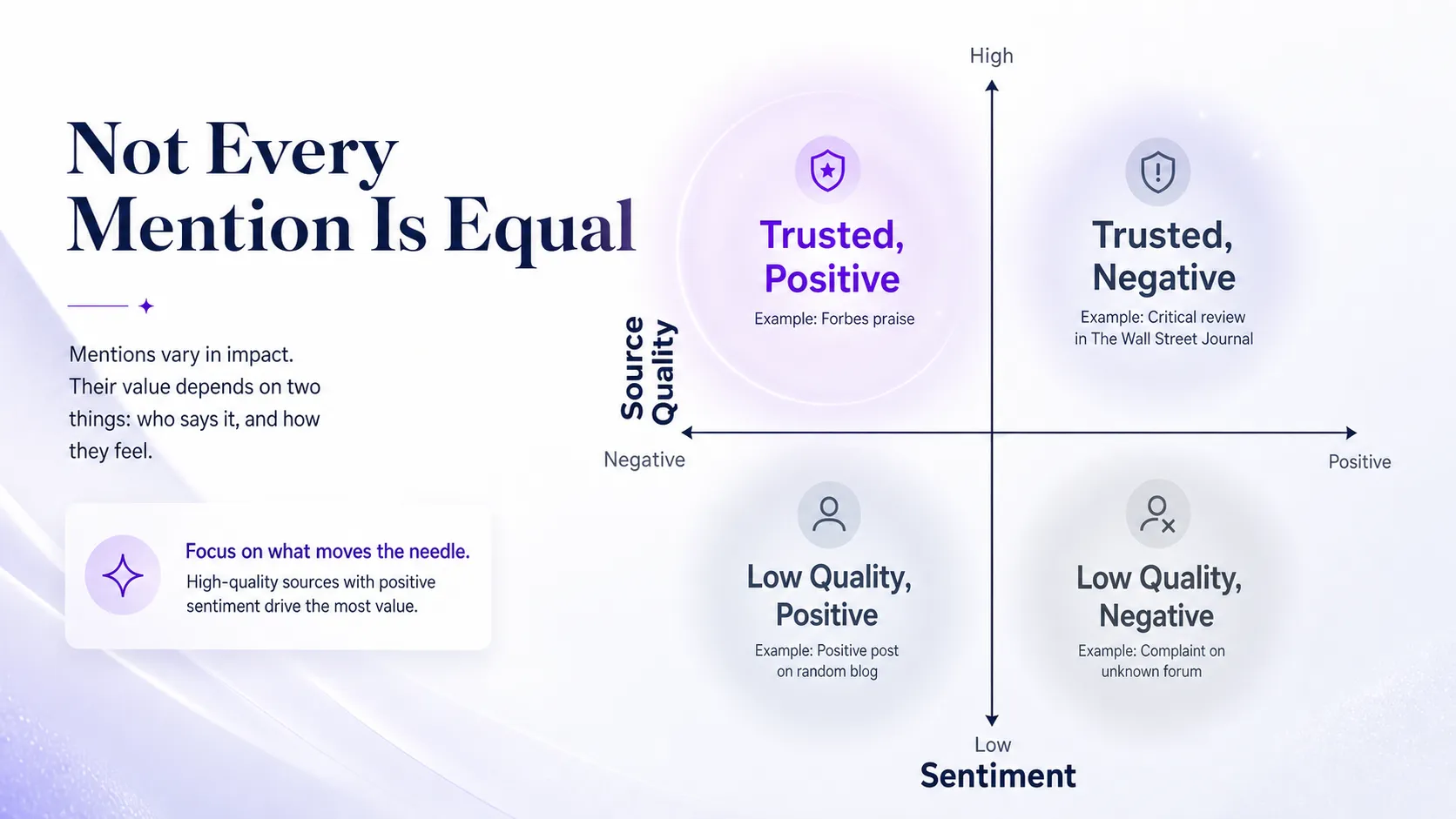
Use this as a working comparison while you audit what you have.
| Mention type | What it looks like | Typical SEO weight |
|---|---|---|
| Linked, high-authority | Editorial reference with a link on a trusted site | Strong: entity, trust, and link equity together |
| Unlinked, high-authority | Named in a credible article, no link | Strong on trust and entity, no link equity |
| Review and forum | Named in reviews, Reddit, Quora, or community threads | Useful for sentiment and AI source selection |
| Social | Named in posts on social platforms | Light direct weight, helps demand and discovery |
| Low-quality or spammy | Named in thin, irrelevant, or scraped pages | Minimal, sometimes a reputation drag |
Sentiment cuts across all of these. A positive mention builds trust, a neutral listicle places you in a category, and a negative mention can chip at the reputation picture even when it does not move a ranking. Treat the three as different inputs, because the engines do.
Unlinked mentions deserve special attention. They are often the easiest to turn into links, since the author already named you and a polite ask can add the hyperlink. That conversion is a real benefit, but it is a secondary one. The unlinked mention already does entity and trust work on its own, which is why finding unlinked brand mentions is worth doing even when no link ever follows.
The field insight that survives most audits: the best mentions are rarely the loudest. A single placement from the right source, in the right topic, with clear context outperforms a pile of bare name drops on pages no engine trusts.
Common Mistakes When Evaluating Brand Mentions
The fastest way to misread your own brand mentions is to treat them all as equal and assume volume equals value. Most flawed mention strategies trace back to a handful of repeatable errors. Here are the ones worth correcting before you build a program around them.
Treating Every Mention as the Same
The myth is that a mention is a mention. The reality is that source quality, relevance, and context decide almost everything. A reference on a high-trust industry page does more than a hundred mentions on scraped directories. Sorting by quality is the first job, not an afterthought.
Assuming Mentions Alone Drive Rankings
The myth is that enough mentions will rank a page or force an AI citation. The reality is that mentions support recognition and trust, but they sit alongside content quality, links, and technical SEO. A brand with strong mentions and a weak site still struggles. Mentions remove friction, they do not do the whole job.
Chasing Volume Over Relevance
The myth is that more mentions always beat fewer. The reality is that relevance and authority outweigh raw count every time. Ten mentions on credible, on-topic sources move the needle more than a thousand off-topic ones. Counting mentions without weighting them produces a number that looks good and means little.
Ignoring Unlinked Mentions
The myth is that a mention without a link is worthless. The reality is that unlinked mentions still carry entity and trust value, and many can be converted into links. Skipping them leaves both signals and easy link wins on the table.
Overlooking Reputation Risk
The myth is that mentions only help. The reality is that negative or false mentions shape how engines and people read your brand, even when they do not directly move a ranking. Watching sentiment is part of the job, not a separate one.
Tracking Without a Baseline or Source Tiers
The most common audit failure is a brand with plenty of mentions and almost none from relevant sources or with useful topical context. Teams pull a raw count, feel reassured, and never sort by source tier or measurement goal. Without a baseline and a tier system, the number tells you nothing about whether the program is working. Setting up a structured view of mentions across web and AI surfaces, including how to track brand mentions across AI search platforms, is what turns the count into something you can act on.
Where This Leaves Your Brand Mention Strategy
Brand mentions are a supporting authority signal, not a standalone ranking hack. They help engines and AI systems recognize your brand, connect it to a category, and trust it enough to surface it. They do that work best when links, strong content, PR, and clean technical SEO are all pulling in the same direction.
Focus on relevance, consistency, and source quality over raw volume. A handful of well-placed mentions in the right context beats a flood of name drops nobody credible published. And watch the signals that actually move: branded search, referral traffic, unlinked mentions worth converting, and whether your brand shows up in AI answers.
The brands winning here are building a repeatable authority system, not chasing one-off publicity. Use brand mentions to support that system, not to replace it.
What the Research Shows About Brand Mentions and SEO
Direct proof that mentions lift Google rankings is thin. The strongest data measures AI search visibility, where mentions track closely with being named:
- Google’s ranking search results patent, granted in 2014, describes counting “implied links” (references to a site that aren’t hyperlinks) alongside ordinary links when adjusting rankings. A patent doesn’t prove Google uses the method, but it shows its engineers designed rankings that can count unlinked mentions.
- Ahrefs’ study of AI Overview brand visibility factors covered 75,000 brands. Branded web mentions had the strongest correlation with AI Overview visibility, at 0.664. Backlinks scored 0.218.
- Ahrefs then extended the analysis in a December 2025 study of top brand visibility factors across ChatGPT, AI Mode and AI Overviews. Branded web mentions correlated at 0.66 to 0.71 across all three, and YouTube mentions were stronger still, at about 0.737.
- Brands in the top 25% for web mentions averaged 169 AI Overview mentions, over 10 times the 14 averaged by the next quartile down.
These are correlations, not proof that mentions cause visibility. Brands that get mentioned a lot also tend to be bigger and better known. Still, the pattern holds on every platform Ahrefs measured: the brands AI answers name are the ones the web already talks about.
How to Build Brand Mentions for SEO in 2026
Building brand mentions is primarily an off-site discipline. You are creating conditions for other publishers, journalists, analysts, and communities to reference your brand by name in independently written content.
- Earn editorial coverage with original data. Pitch proprietary research, case studies, or expert commentary to industry publications. A brand cited as a primary source earns a higher-quality entity mention than a name drop in a listicle — and original data generates secondary mentions as others cite your findings.
- Pursue roundup and comparison inclusion. “Best of” lists and comparison articles in your category generate high-frequency, contextually relevant mentions at scale. These are also the most common source type cited in AI-generated answers about your category.
- Convert unlinked mentions into backlinks. When someone already mentions your brand without a link, a polite outreach email can often convert that entity signal into full link equity. Tools like Ahrefs Content Explorer surface unlinked mentions systematically.
- Build presence in communities AI systems index. Reddit threads, LinkedIn discussions, Quora answers, and niche forums generate AI-readable mentions when your brand is cited as an expert recommendation. These channels feed directly into AI retrieval systems.
- Earn analyst and review platform citations. G2, Capterra, and TrustRadius create high-authority mention environments. One citation in a G2 category comparison generates dozens of secondary mentions as buyers quote it in their own research and share it with colleagues.
The shortest path on a new or recovering domain: editorial outreach to industry publications first, roundup inclusion second, community presence third. If this process feels too resource-intensive to run internally, done-for-you brand mention building is what BrandMentions.link is built for — outreach, placement, and tracking handled as a managed service.
Frequently Asked Questions
What are brand mentions for SEO?
Brand mentions for SEO are online references to your company, product, service, or founder, with or without a hyperlink. They help search engines and AI systems recognize your brand as a known entity tied to a category, which supports trust, reputation, and visibility. They are not the same as backlinks and do not pass link equity, but they shape how confidently a brand gets surfaced.
Do unlinked brand mentions help SEO?
Yes, unlinked brand mentions help SEO by building entity and trust signals even without a hyperlink. When a credible source names your brand in relevant context, it tells engines that real sources are talking about you. The added bonus is that unlinked mentions are often the easiest references to convert into links later with a simple outreach ask.
Are brand mentions the same as backlinks?
No, brand mentions and backlinks are different signals. A backlink is a hyperlink that points to your site and passes link equity. A brand mention is any text reference to your brand, which may or may not include a link. A linked mention is both at once, but an unlinked mention works purely as an entity and trust signal with no link equity attached.
How do search engines interpret brand mentions?
Search engines extract your brand as a named entity, use natural language processing to read what the mention says about it, then connect it to related topics through entity systems like the Knowledge Graph. They also weigh sentiment and the quality of the source. A positive mention on a trusted page carries far more weight than a bare name drop on a thin one.
Do brand mentions matter in AI search results?
Yes, brand mentions matter in AI search because models use source selection and context to decide which brands to name in their answers. When your brand appears across relevant, authoritative pages in clear topical context, the odds of being named or cited go up. No single mention guarantees a citation, but a consistent pattern of credible mentions improves how often models reach for your brand.
Brand mentions earn their keep when you treat them as one input in a broader authority system, not as a switch that flips rankings on. Build them through relevant placements, watch the signals that move first, and let the recognition compound. Want to see how often AI engines already name your brand and where the gaps are? Book a strategy call and start from a real baseline.