
If your team needs more links but cannot afford wasted spend, the real question is not whether link building matters, but who should own the work. Neither model wins in every case: in house usually wins on control and brand alignment, while outsourced usually wins on speed and scale. The right answer depends on your budget, your existing bandwidth, how fast you need volume, and how much oversight your brand or industry demands. This comparison breaks both models down across the same criteria, then gives you a verdict by business situation so you can decide without guessing.
What In House vs Outsourced Link Building Means
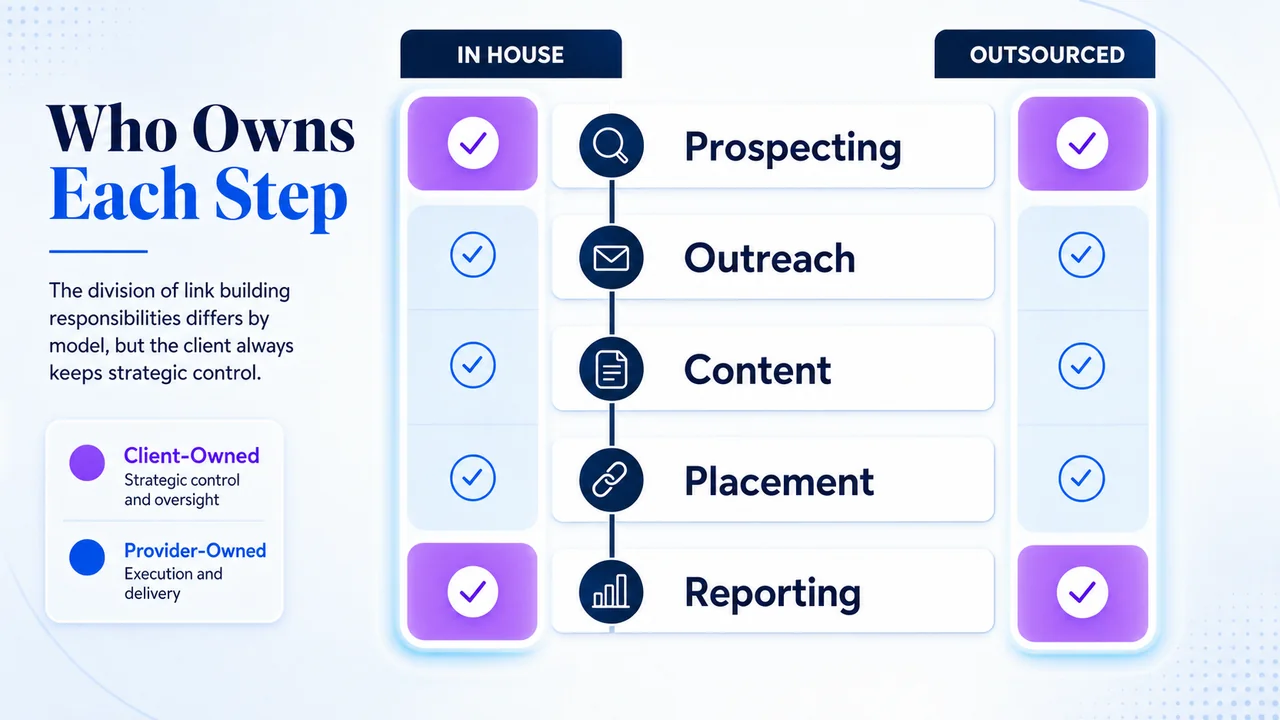
In house link building means internal staff handle the full cycle: prospecting, outreach, qualification, content coordination, and placement follow-up. Outsourced link building means an agency, consultant, or external team runs all or most of that work for you. The split is about operating structure, not about doing SEO differently.
The most common confusion is assuming outsourced means hands-off. It does not. Even with a vendor running outreach, you still control target lists, anchor text rules, brand-safety standards, and KPI alignment. The provider executes; you set the guardrails and approve the output.
Both models can produce strong, editorial placements or low-quality spam. Quality follows process maturity, clear briefs, and vetting, not ownership alone. An untrained internal hire chasing volume can build a riskier profile than a disciplined agency, and a cheap vendor can do more damage than a careful in house team.
A third option sits between them: the hybrid model, where strategy and approvals stay internal while execution gets outsourced. It resolves most of the trade-offs, and this comparison returns to it after the criteria are clear. For a deeper look at the buy-versus-build math behind any visibility function, the breakdown of agency versus in-house team cost covers the same tension applied to AI visibility.
How to Judge the Two Models
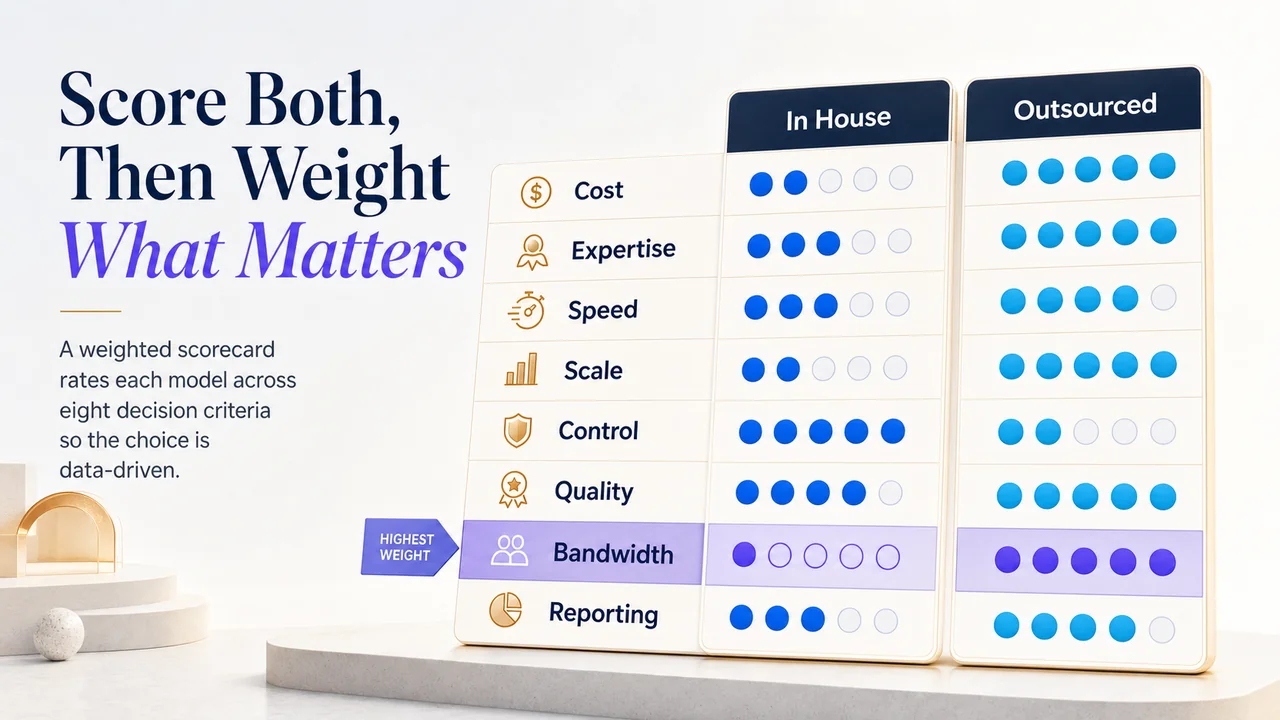
Score both models against eight criteria so the verdict feels objective rather than promotional. Rate each model 1 to 5 on every criterion, then weight the ones that matter most to your stage. A model that wins only on price but loses badly on control or quality is usually the wrong choice.
- Cost: total spend including hidden overhead, not just the headline rate.
- Expertise: depth of outreach experience and publisher relationships.
- Speed to first link: how fast placements start landing.
- Scalability: how easily volume grows when demand rises.
- Control: oversight of targets, anchors, messaging, and placement quality.
- Quality and risk: exposure to spammy or irrelevant links.
- Internal bandwidth: how much management attention the work consumes.
- Reporting and measurement: visibility into what was built and what it moved.
The best model changes the moment one criterion becomes non-negotiable. A regulated brand that cannot risk an off-message placement weights control above everything. A startup launching a new product weights speed and scale. Read every verdict below through your own stage, not a universal ranking.
Cost, Hiring, and Time to Launch
In house tends to be cheaper at high, sustained volume across multiple domains with shared tooling, while outsourcing is cheaper for low-to-moderate volume, short campaigns, or teams with no existing outreach function. The headline rate rarely tells the real story, because the cheapest option on paper often loses once hiring delays, tool costs, and management time are counted.
| Cost factor | In House | Outsourced |
|---|---|---|
| Core cost | Salary plus benefits for one or more link builders | Monthly retainer or per-link pricing |
| Recruitment and onboarding | Hiring time, ramp, and training cost | Short onboarding, no recruitment |
| Tools | Outreach and SEO tool subscriptions you buy | Bundled into the provider’s fee |
| Content support | Internal writers or freelancers | Often included or priced as an add-on |
| Management overhead | Ongoing manager time to direct the team | Briefing, approvals, and account reviews |
| Time to first link | Weeks to months while you hire and train | Days to weeks once briefed |
The ramp-time gap is the most underrated cost. Hiring a skilled link builder, equipping them, and waiting for their first placements can eat a full quarter. A vetted agency with live publisher relationships starts outreach almost immediately, which matters when a launch window or competitive gap will not wait.
Per-link and retainer pricing each carry their own math. Retainers suit ongoing programs with predictable monthly volume; per-link suits sporadic needs or topping up a specific page. If you are weighing a single expert hire against external execution, the guide to hiring a link building consultant covers what a strong individual hire should deliver before you commit to a salary.
Expertise, Quality, and Risk
In house teams understand brand nuance, internal stakeholders, and product messaging better than any outside team can on day one. Outsourced teams bring outreach systems, publisher relationships, niche pattern recognition, and the speed that comes from doing this work daily across many accounts. The trade is depth of brand knowledge against depth of outreach craft.
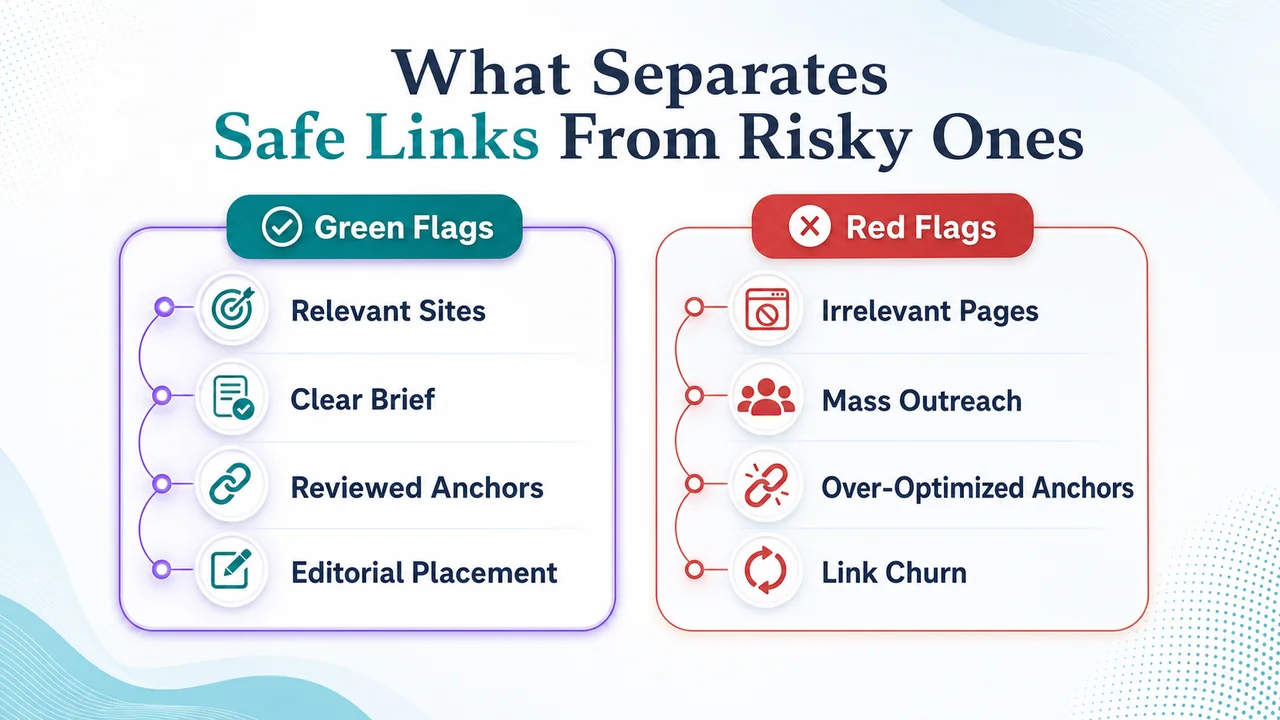
The quality risks look the same in both models: irrelevant placements, spammy outreach, over-optimized anchors, link churn, and weak editorial standards. Neither model is automatically safer. Most quality failures trace back to unclear briefs and weak approval systems, not to whether the person doing outreach sits at your desk or a vendor’s.
Good governance closes the gap. Set explicit target-site rules, an anchor-text policy that limits exact-match usage, a content review step before anything goes live, and a fixed reporting cadence. With those in place, a strong vendor produces output as clean as a strong internal team. Without them, both models drift toward whatever is fastest, which is usually whatever is riskiest. For the placement types worth prioritizing, the breakdown of contextual link building approaches shows what a relevant editorial link looks like in practice.
Control, Scalability, and Internal Bandwidth
In house gives you direct control over outreach tone, target selection, anchor text, and stakeholder coordination. Outsourcing trades some of that immediacy for reduced day-to-day workload, but only if your briefs and review cycles are tight enough to prevent drift. Loose briefs plus an external team is the fastest route to off-brand placements.
Scaling works differently in each model. Growing in house volume means hiring and training more people, which is slow and adds management load. Growing outsourced volume usually means expanding the retainer or campaign scope, which is faster but can reduce strategic flexibility if the provider runs a templated process.
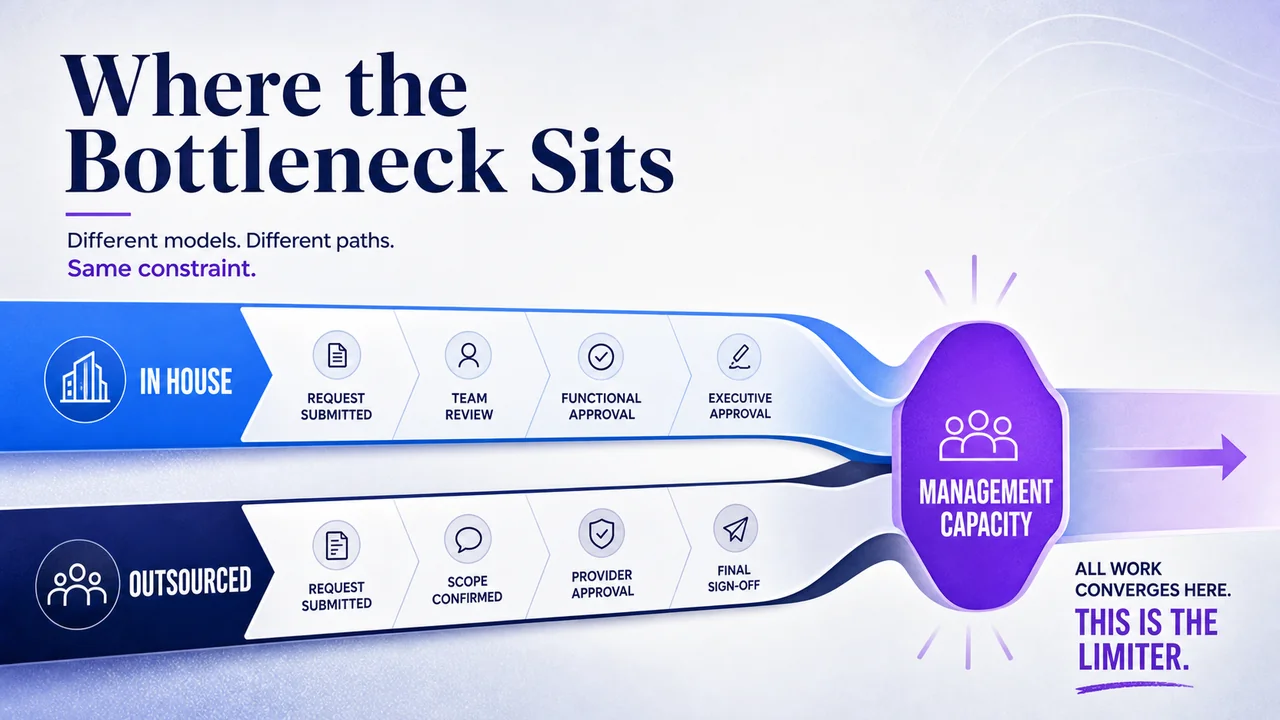
Internal bandwidth is the hidden cost buyers miss. Link building competes with content production, digital PR, technical SEO, and strategy work for the same finite attention. Even outsourced programs need briefing, approvals, and oversight, so the real constraint is rarely headcount. It is management capacity, the hours a senior person can spend directing and reviewing the work.
Controlled industries and brand-sensitive campaigns need tighter oversight regardless of who executes. In those cases, you keep approval authority internal even when an external team handles the outreach legwork. That structure points straight at the hybrid model.
Which Model Fits Your Business Situation
The right choice maps to your stage, your headcount, and how much control your brand demands. Here is the verdict by use case, stated plainly.
| Business situation | Best-fit model | Why |
|---|---|---|
| Startup or lean team | Outsource or hybrid | Speed and resource efficiency matter more than building an internal function from scratch |
| Mature in house SEO team | In house, strategy-led | Brand control, cross-functional alignment, and custom messaging are already strengths worth keeping |
| Fast-growth team or launch | Outsource | Rapid volume and quick market coverage outweigh slow internal hiring |
| Regulated or reputation-sensitive brand | In house or tightly governed hybrid | Approval control and message accuracy cannot be loosened |
| Multi-domain or enterprise program | Internal strategy, external execution | Volume and coordination both run high, so split the roles |
Notice the pattern: pure in house wins cleanly only for mature teams with brand control as a hard requirement, and pure outsourcing wins cleanly for speed-driven launches with no existing function. Everything in the middle leans hybrid. If you are evaluating external partners, the buyer’s guide to B2B link building agencies covers the questions and red flags that separate strong providers from volume mills.
See where AI answers put your brand
Twenty minutes with a senior strategist: where the major engines point buyers in your category, who gets named instead of you, and a straight read on what a programme would change.
Book a strategy callThe Hybrid Model and a Decision Rule You Can Use
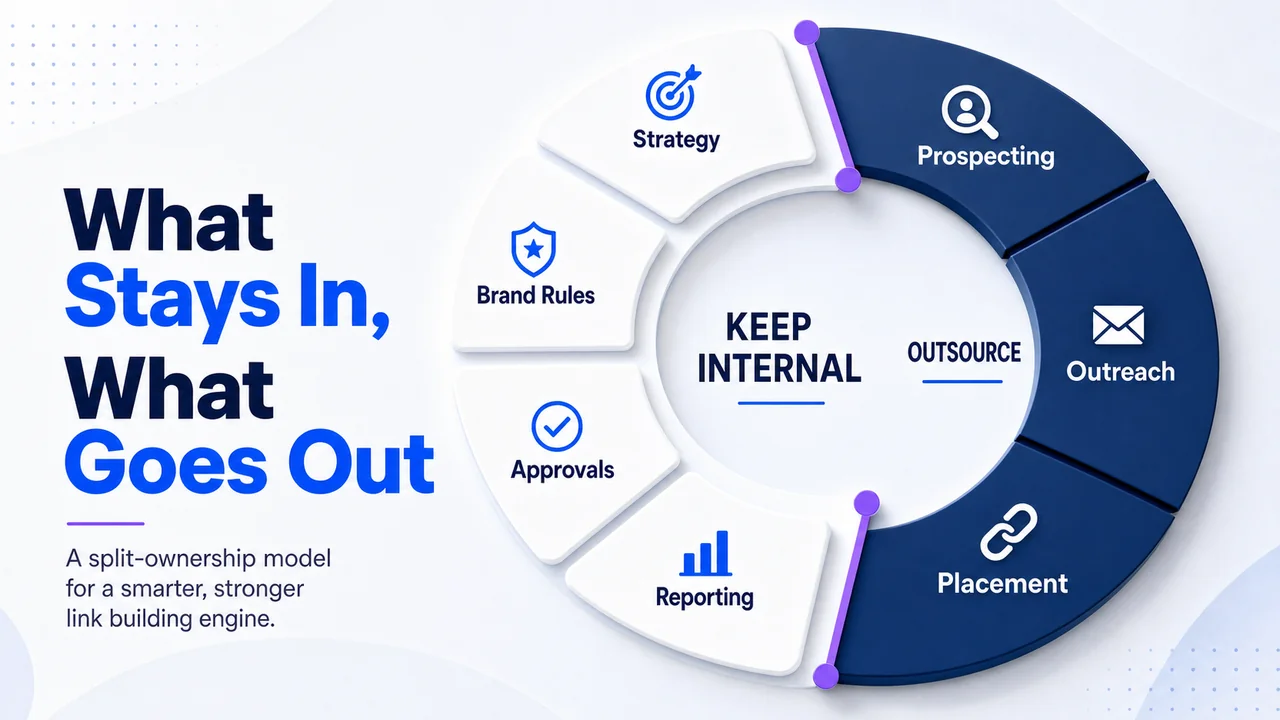
The hybrid model keeps strategy, brand rules, approvals, and reporting in house while outsourcing prospecting, outreach, and placement volume. You own the direction; the provider owns the legwork. It beats a pure model whenever you need control but lack time, or need scale but want quality oversight, which describes most growing teams.
The decision rule is short. Choose in house when control and institutional knowledge matter most. Choose outsourcing when speed and scale matter most. Choose hybrid when both matter, which is the situation most teams are actually in once they look honestly at their bandwidth and their brand requirements.
One practical sequence works well: start outsourced for speed while your internal processes are still forming, then bring strategic ownership in house once those processes are proven and your team has capacity. Agencies that run programs for other companies can structure this handoff cleanly, which is part of why white-label link building exists as a category. For the underlying tactics either model executes, the practitioner walk-through of how to do link building covers the methods worth running regardless of who owns them.
Frequently Asked Questions
Is it better to build links in house or outsource link building?
It depends on which criterion is non-negotiable for you. In house wins on control, brand alignment, and institutional knowledge, while outsourcing wins on speed to first link and scalability. For most growing teams, a hybrid model that keeps strategy internal and outsources execution beats either pure option.
How much does outsourced link building cost compared with hiring internally?
The cost comparison turns on volume and duration, not just the sticker price. An internal hire carries salary, benefits, recruitment, tools, and ongoing management time, which makes sense at high sustained volume. Outsourcing replaces all of that with a retainer or per-link fee, which is usually cheaper for low-to-moderate volume or short campaigns. Always count hiring delays and tool costs before calling in house the cheaper route.
What are the risks of outsourcing link building?
The main risks are irrelevant or spammy placements, over-optimized anchors, link churn, and losing visibility into what was actually built. These risks are controllable. Set target-site rules, an anchor-text policy, a content review step, and a fixed reporting cadence, and vet any provider for niche experience and manual outreach before signing.
Can you use both in house and outsourced link building at the same time?
Yes, and that combination is the hybrid model. You keep strategy, brand rules, approvals, and reporting internal while a provider handles prospecting, outreach, and placement volume. It gives you control where it matters and scale where you lack capacity, which is why most teams that have run both eventually settle here.
When does it make sense to hire a link builder internally?
Hire internally when you have sustained, high volume across one or more domains, when brand control is a hard requirement, and when you have the management capacity to direct and review the work. A regulated brand or a mature SEO team with strong cross-functional alignment gets the most value from an internal hire, because the institutional knowledge compounds over time.
Choosing the Model That Fits Your Stage
The honest reality is that this is a resourcing decision dressed as a strategy debate. Control and institutional knowledge point in house; speed and scale point outsourced; the gap between them, where most teams live, points hybrid. Score both models on the eight criteria, weight the one you cannot compromise on, and the answer stops being ambiguous. Need a clear decision? Map your in house, outsourced, and hybrid options against your budget, timeline, and control needs with a short strategy audit.