
Should you pay for link building as an ongoing retainer or as a fixed project? Retainers suit steady link velocity and evolving strategy, while projects suit one-time campaigns, launches, or budget-capped needs. A retainer is a recurring monthly agreement for continuous link acquisition. A project is a fixed-scope campaign with a defined start, end, and deliverable set. The right pick depends on whether your SEO goals need momentum that compounds or a single, contained push. This guide compares both on cost, control, speed, quality, and best-fit use cases so you can decide without guessing.
Retainer vs Project Link Building: What’s the Real Difference?
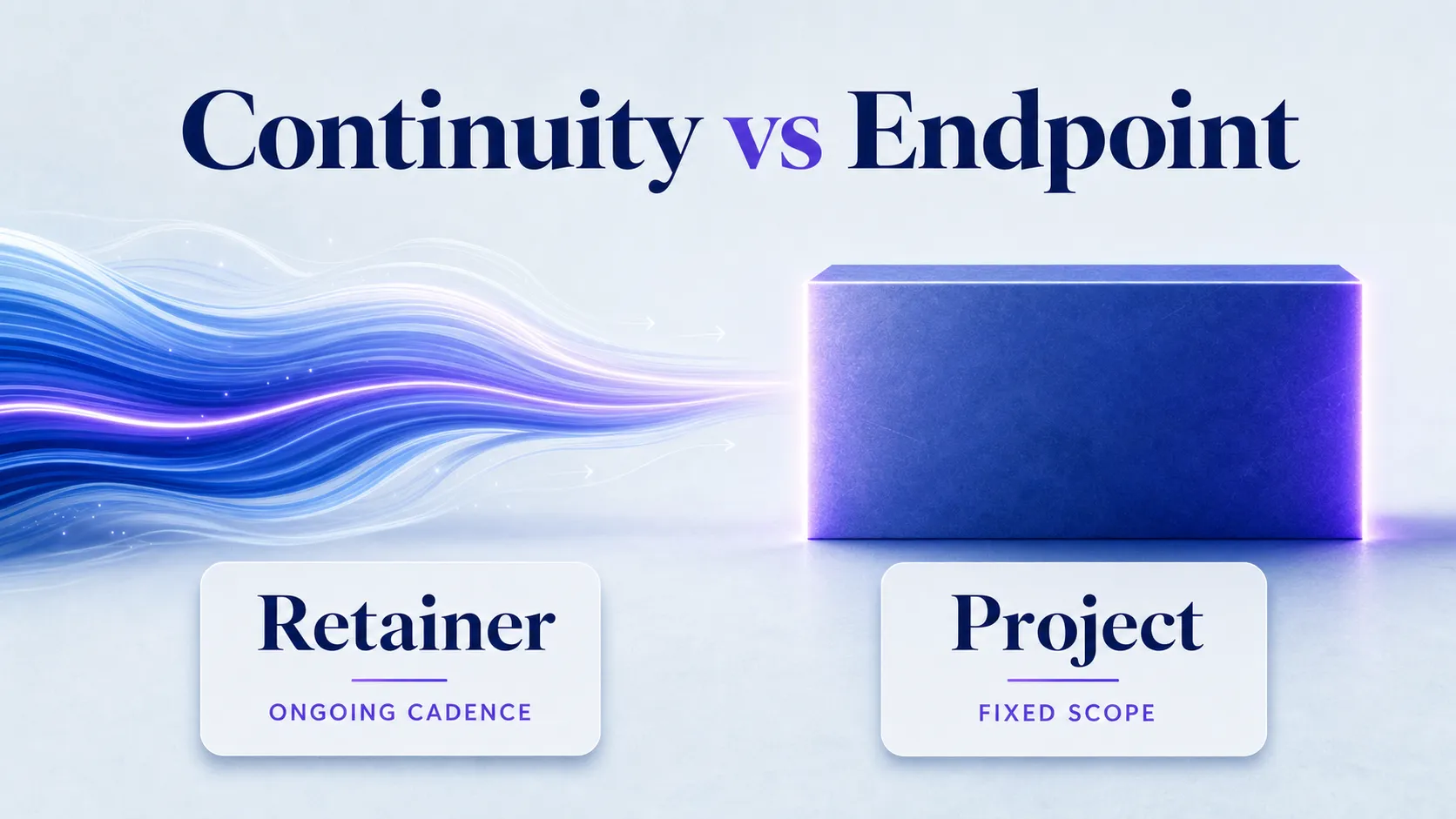
The core difference is continuity. A retainer keeps a team acquiring links month after month against a moving strategy, while a project delivers an agreed number of links and then ends.
With a retainer, the agency plans for cadence. They build prospect lists that last, refine outreach templates over weeks, and adjust targets as publisher responses come in. The unit of work is a month, not a milestone.
A project works the opposite way. You agree the scope up front, say 15 editorial placements on sites above a set authority threshold, and the engagement closes when those links land. Everything is optimized for finishing the defined output, not for keeping the pipeline warm.
This is not just a billing choice. It changes who owns the strategy, how quickly work adapts, and what “done” even means. Before you weigh price, decide whether your need is one-time or ongoing. That single answer settles most of the debate. If you are still deciding whether to bring this work in-house or hand it off, the tradeoffs in how to vet and budget outsourced link building apply to both models.
Cost and Budget Predictability
Retainers create predictable monthly spend, and projects create a fixed total you approve once. Both give certainty, but of different kinds, and neither is automatically cheaper.
A retainer smooths cost into a steady line item. Finance teams like it because forecasting is simple: the same number every month. That predictability helps you plan content, hiring, and reporting around a known link budget.
A project is easier to approve for a one-off need because the total is capped before you sign. You know the ceiling. There is no open-ended commitment, which makes it the safer choice when you are testing whether link building moves your numbers at all.
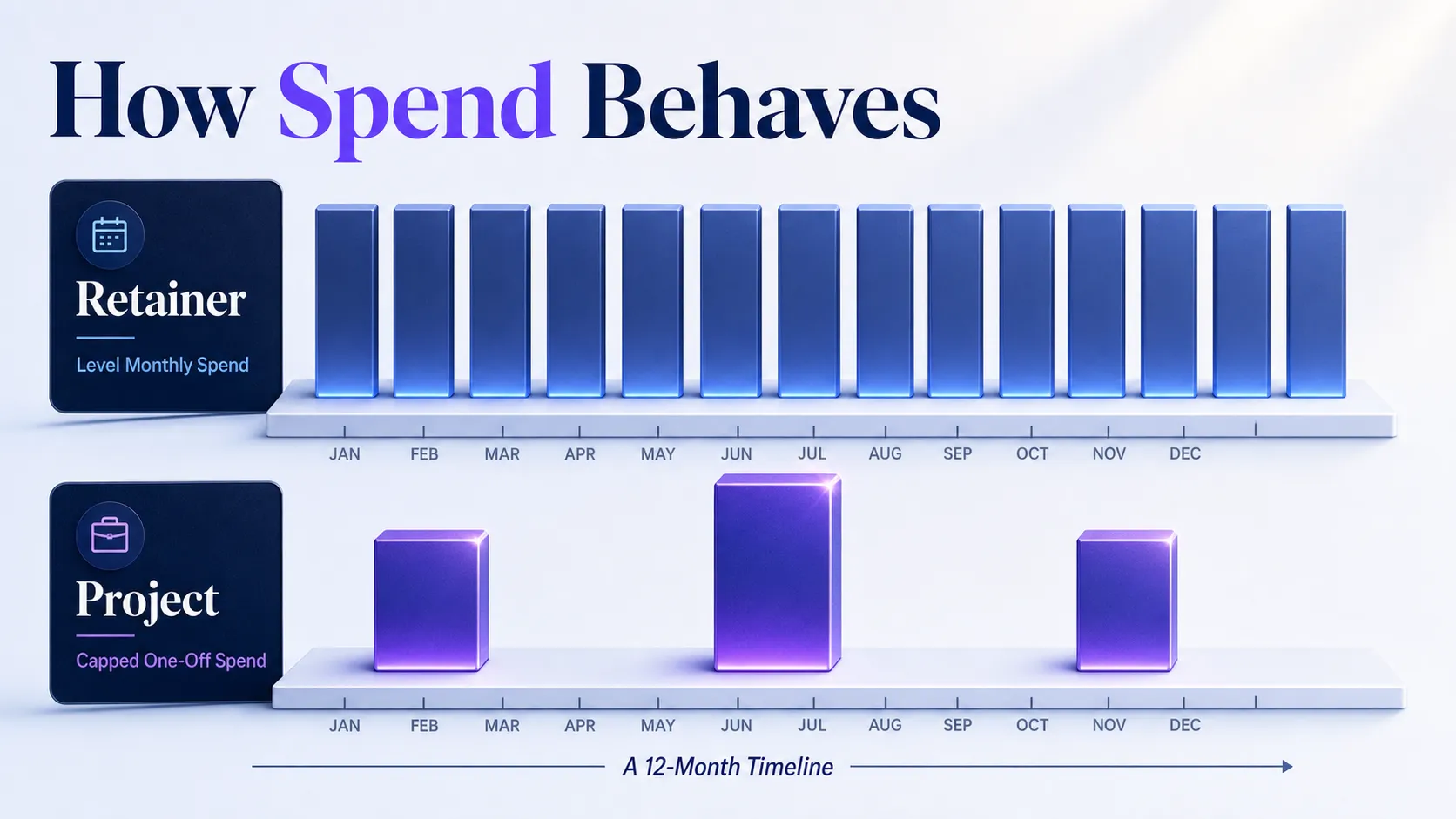
Here is the trap most buyers fall into. Budget predictability is not the same as lower cost. A retainer can look expensive next to a single project, yet come out more efficient once the work runs for many months, because setup and learning costs get amortized. A project can look cheap, then quietly cost more if you keep re-upping campaign after campaign.
Compare total annual spend, not the monthly sticker. Marketing usually cares about the cost to hit a link goal, while finance cares about the smoothness of the line. Model both before you choose.
| Factor | Retainer | Project |
|---|---|---|
| Spend shape | Level monthly amount | Capped one-time total |
| Approval | Ongoing commitment | Single sign-off |
| Best cost fit | Sustained, multi-month work | One defined push |
| Hidden risk | Paying through slow months | Re-buying campaigns adds up |
Scope, Deliverables, and Control
Project work gives you tighter control, and retainers give you more agility. That is the central tradeoff in how scope is defined and managed.
A project usually has a fixed endpoint and a clearly listed set of deliverables. You know exactly what you are getting: the link count, the site criteria, the timeline. Nothing shifts unless you file a change order. That rigidity is a feature when you need to lock outcomes and defend a budget internally.
A retainer stays adaptable. If a high-value publisher opens up mid-month, the team can chase it without renegotiating the contract. Priorities move as targets, opportunities, and results change. You trade some certainty for the ability to respond.
Scope creep gets handled differently in each. In a project, extra work becomes a change order or an add-on with its own price. In a retainer, extra work is absorbed by re-prioritizing inside the same monthly scope, so something else gets pushed back rather than billed separately.
The practical reality of link building rewards agility more than most buyers expect. Prospect quality shifts, response rates swing week to week, and publisher opportunities appear on their own schedule. A rigid project scope written in month one can look wrong by month two. If control matters most, take the project. If you expect the plan to evolve, the retainer fits better.
Speed to Launch and Link Velocity
Projects can launch faster for a narrow goal, but retainers win for sustained link velocity month after month. Speed has two meanings here, and they point in different directions.
A tightly defined project with simple approvals can move quickly out of the gate. There is one target, one scope, one green light. When the objective is a burst of activity around a launch, that focus is an advantage.
The catch is momentum. A project produces a spike, then stops when the scope ends. Your backlink pace drops back to zero the day the last link lands. For SEO goals that depend on compounding activity, that cliff undoes some of the gain.
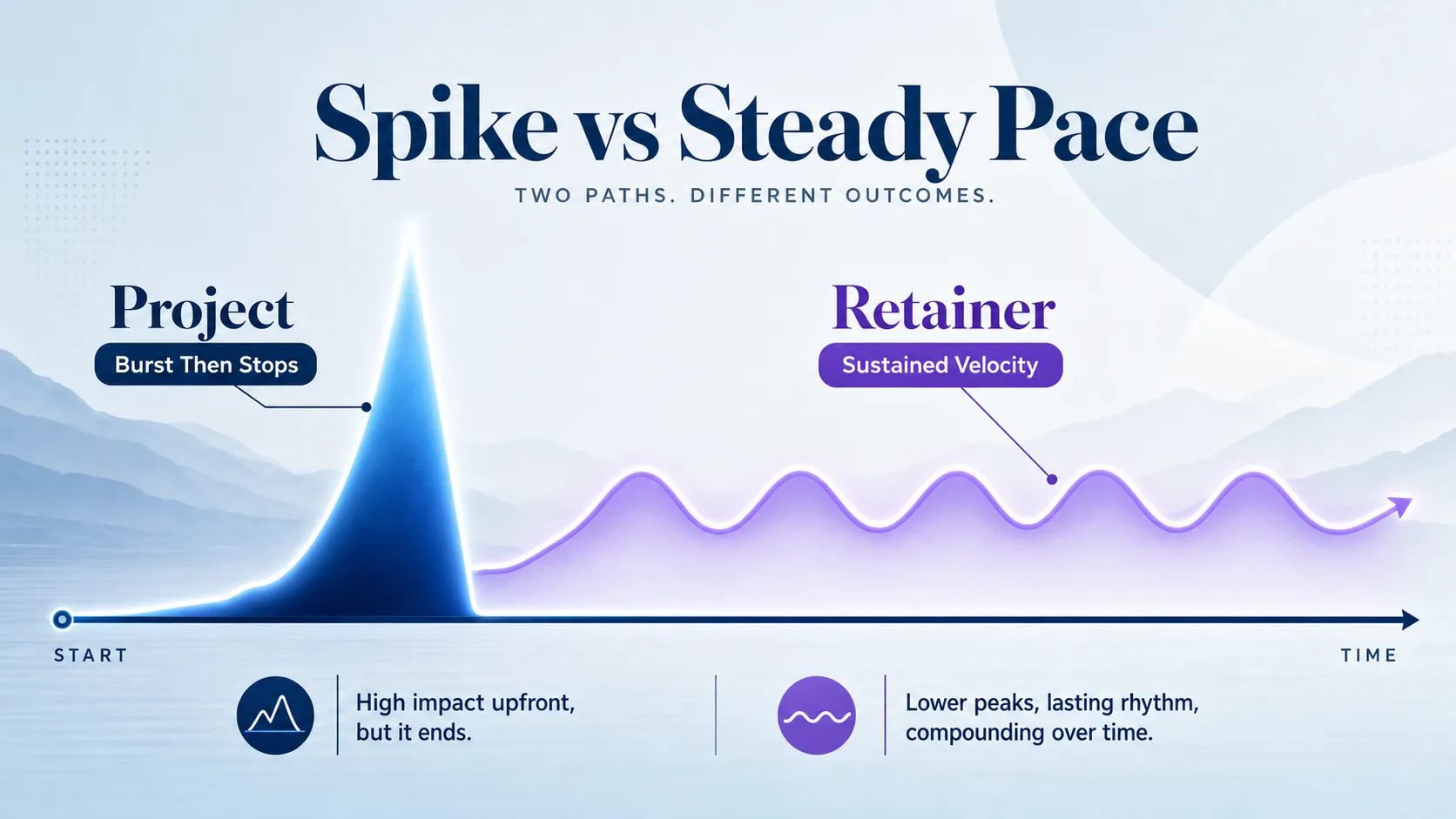
Measure speed as two things: time to first link and the ability to keep links coming. A project can win the first and lose the second. When your growth depends on a rising, uninterrupted acquisition cadence, the retainer is usually the better fit because it keeps outreach, follow-up, and placement management running without a restart.
Quality, Strategy, and Long-Term Outcomes
Retainers tend to lift link quality and strategy over time, while projects work best when the objective is narrow and the plan is already clear.
A retained team learns your site, your niche, and your priority pages. That accumulated knowledge shows up in the work: sharper prospect lists, better publisher fit, smarter anchor planning, and fewer wasted outreach attempts after a few months. The relationship compounds.
Project work can still hit hard when the goal is contained and the strategy is set before kickoff. If you already know which pages need authority and which publishers you want, a project executes that plan cleanly without paying for an open-ended relationship.
The weakness of projects is context reset. Each new engagement often starts cold, so the niche learning from the last campaign does not carry forward. That limits the compound gains you get from one team refining its approach over many months.
Quality is never guaranteed by the model alone. A weak retainer beats nothing, and a strong project beats a lazy retainer. But retainer relationships make it easier to sustain editorial standards, filter prospects tightly, and keep earned links contextually relevant as the work matures. If your strategy is settled and finite, a project is fine. If it will keep evolving, the retainer protects quality better. The broader case for prioritizing links over other channels sits in this comparison of link building versus content marketing.
Risk, Flexibility, and Best-Fit Use Cases
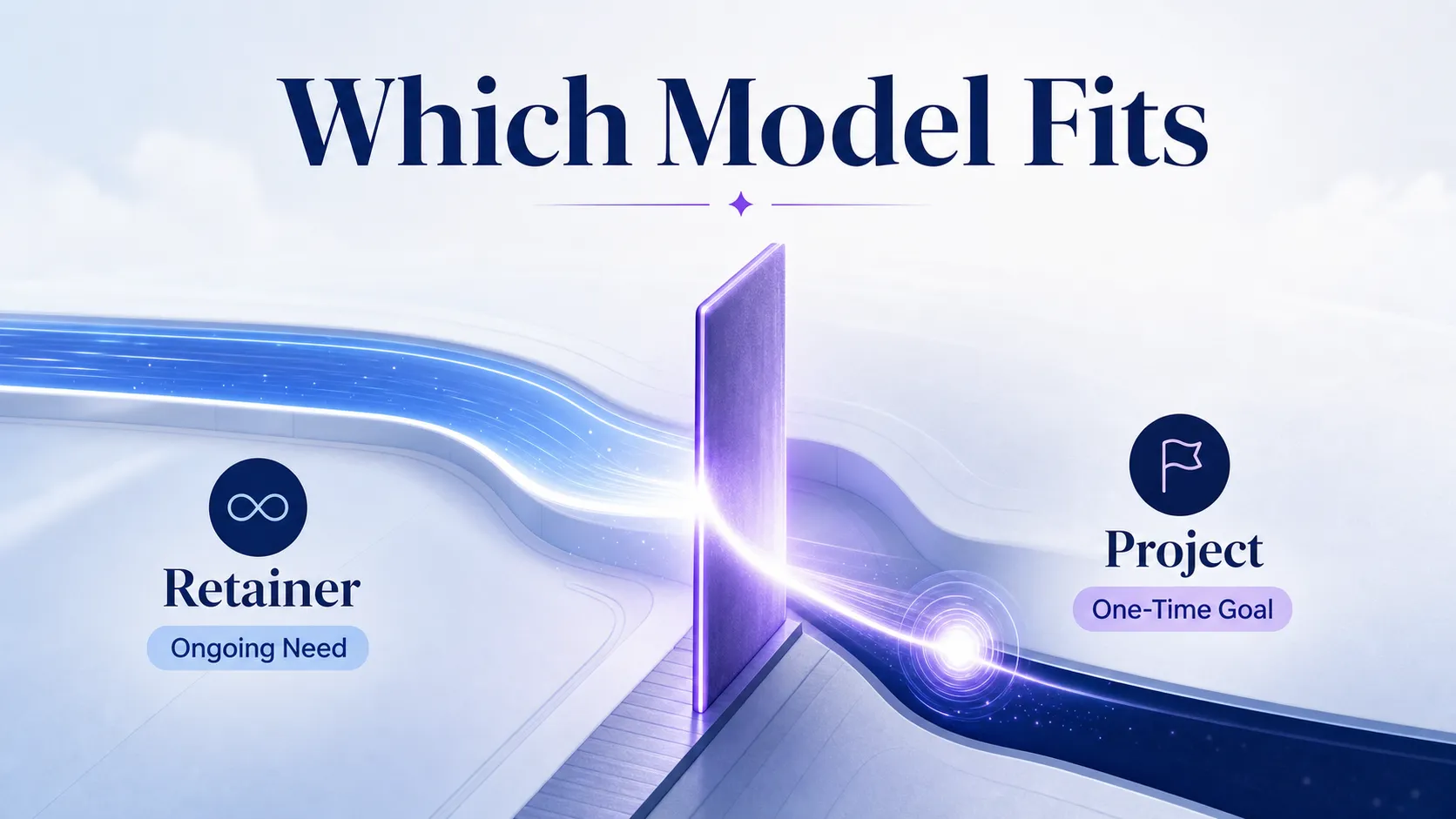
Retainers carry more commitment risk, and projects carry less because they end cleanly. Your business stage, internal bandwidth, and campaign goal decide which risk profile fits.
A retainer assumes ongoing need. If that need is real, the commitment pays off through continuity. If it is uncertain, you may pay through slow months for work you cannot fully use. A project caps that risk: the engagement closes, and you owe nothing more.
Internal capacity matters just as much as budget. A team with limited bandwidth often prefers a retainer, so an outside team owns the continuity of outreach and follow-up. A team that only needs a launch push, a single campaign, or a low-commitment test usually prefers a project. The same in-house-versus-external tension shows up in the in-house versus outsourced link building comparison.
| Buyer situation | Budget | Urgency | Flexibility need | Better model |
|---|---|---|---|---|
| Startup testing fit | Capped | Moderate | Low | Project first |
| Startup with repeatable growth | Steady | Ongoing | High | Retainer |
| Enterprise with constant demand | Planned | Ongoing | High | Retainer |
| Agency needing stable fulfillment | Recurring | Ongoing | Medium | Retainer |
| Agency covering overflow | Variable | Spiky | Low | Project |
Agencies buying white-label support face this same split. A retainer gives stable, behind-the-scenes fulfillment for baseline client demand, while a project covers overflow or a special campaign without a standing commitment. The mechanics of that arrangement live in this overview of white-label link building services for agencies.
So Which Should You Choose?
Match the model to your dominant need, not to whichever looks cheaper on a single invoice. The rule is simple once you name whether the work is ongoing or one-time.
Choose a retainer if you need steady monthly link building, ongoing content support, and long-term SEO growth. Choose a project if you need a defined campaign, a launch push, or one-time authority building.
Pick a retainer when:
- You want predictable link velocity that keeps building.
- You expect the strategy to evolve as results come in.
- You want one team learning your niche over time.
Pick a project when:
- You need a fixed budget with a hard ceiling.
- You have a clear endpoint and defined deliverables.
- You want to test an agency before committing further.
Hybrid approaches work too. Many buyers start with a project to test fit, then convert to a retainer once the strategy proves out. If you are still weighing which provider structure suits you, the tradeoffs in choosing between an agency and a freelancer or between an agency and a marketplace feed directly into this decision. Whatever you choose, let the primary model follow your main business need.
See where AI answers put your brand
Twenty minutes with a senior strategist: where the major engines point buyers in your category, who gets named instead of you, and a straight read on what a programme would change.
Book a strategy callFrequently Asked Questions
Is a link building retainer better than a project?
A retainer is better for ongoing link velocity and evolving strategy, while a project is better for one-time campaigns. Neither is universally superior. A retainer compounds through accumulated niche knowledge and steady acquisition, but it assumes a continuing need. A project caps risk and cost for a defined goal. The right answer depends on whether your work is recurring or finite.
Is project-based link building cheaper?
Project-based link building is often cheaper in the short term because the total is fixed and capped. But it can cost more over a year if you keep re-buying campaigns. Say you run three separate projects across twelve months to keep links flowing. The combined spend, plus the setup and learning cost that resets each time, can exceed a steady retainer that amortizes those costs across every month.
How long should a link building retainer last?
A link building retainer usually needs at least a few months to show compounding results, since prospect lists, outreach refinement, and publisher relationships all improve with time. Most buyers commit to an initial period, then continue month to month once the pace and quality are proven. Ending too early sacrifices the accumulated niche knowledge that makes a retainer worth its premium.
Can you start with a project and switch to a retainer?
Yes, and it is one of the smartest ways to buy. A project lets you test an agency’s outreach quality, communication, and placement standards at a capped cost. If the work proves out, converting to a retainer keeps the same team building on what they already learned about your site and niche, so you skip a second cold start.
What should be included in a link building retainer agreement?
A link building retainer agreement should define monthly scope, minimum quality standards for placements, reporting cadence, how re-prioritization is handled, and the commitment length with exit terms. Spell out the site criteria you expect, how out-of-scope work is treated, and what a successful month looks like. Clear terms prevent the vague, drifting scope that undermines many retainer relationships.
Your engagement model should follow your link velocity goals, budget certainty, and need for strategic continuity, not just the cheapest line on a proposal. Name whether your need is ongoing or one-time, and the choice usually makes itself. See where your brand stands in AI search and get a free visibility audit to ground that decision in real data.