
If you have budget for one outside partner to build links, the real question is not who quotes the lowest fee, but who delivers safe, durable placements at the volume you actually need. Hire a freelancer when your scope is narrow, your budget is tight, and you can spare the oversight; hire an agency when you need scalable monthly delivery, layered quality control, and lower operational risk. A freelance link builder gives you direct access to the person doing the work.
A link building agency gives you a team that can split outreach, content, and quality assurance across specialists. The right answer depends on your monthly link target, your risk tolerance, and how much of the work you can manage internally.
What You Are Really Comparing
A link building agency is a team-based service that handles prospecting, outreach, content, quality control, and account management under one roof. A freelancer is a solo specialist who executes the work directly, usually with lower overhead and a single point of contact.
The label matters less than what each model changes for you: total cost, link safety, how fast a campaign can grow, and how much coordination lands on your own desk. Most bad purchases happen when buyers compare monthly fees before they compare management time and link quality.
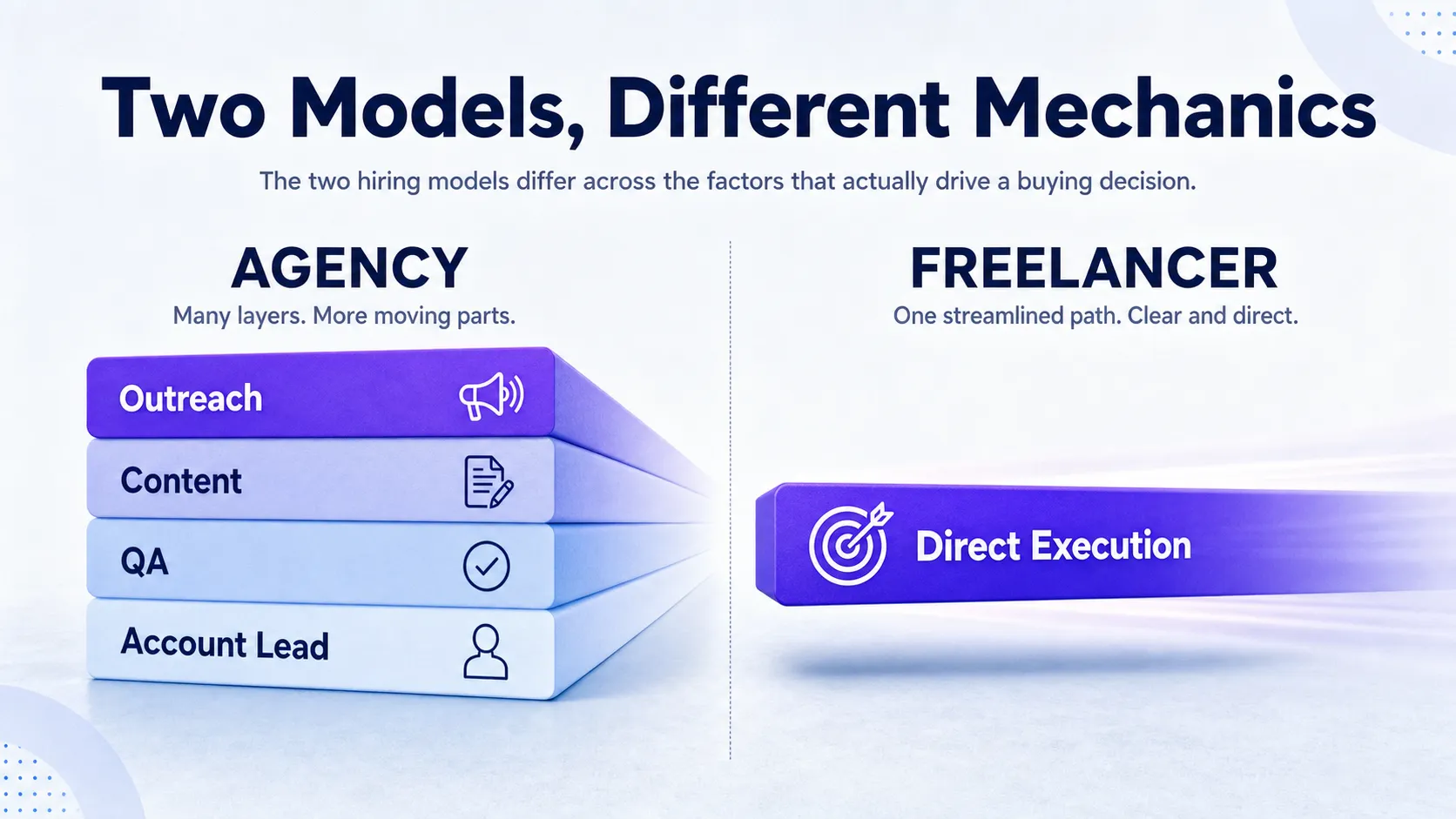
Use these criteria to judge both options consistently through the rest of this comparison: pricing and total cost, quality and link safety, scalability, communication and workflow, expertise, and accountability. The table below sets the baseline.
| Factor | Link building agency | Freelancer |
|---|---|---|
| Structure | Team with defined roles | One person handling everything |
| Best fit | Ongoing, scalable programs | Narrow, tightly scoped work |
| Quality control | Built-in review layers | Depends on the individual |
| Continuity risk | Lower, work is shared | Higher, single point of failure |
| Buyer oversight needed | Less, account manager coordinates | More, you manage direction |
| Onboarding speed | Slower, more structured | Faster to start |
If your campaign is a one-time push of a handful of relevant links, the freelancer column probably wins. If you need links every month for the next year without babysitting the work, the agency column starts to pay off. The decision between handling links in-house or outsourcing them sits next to this one, and the same tradeoffs apply.
Pricing and Total Cost of Ownership
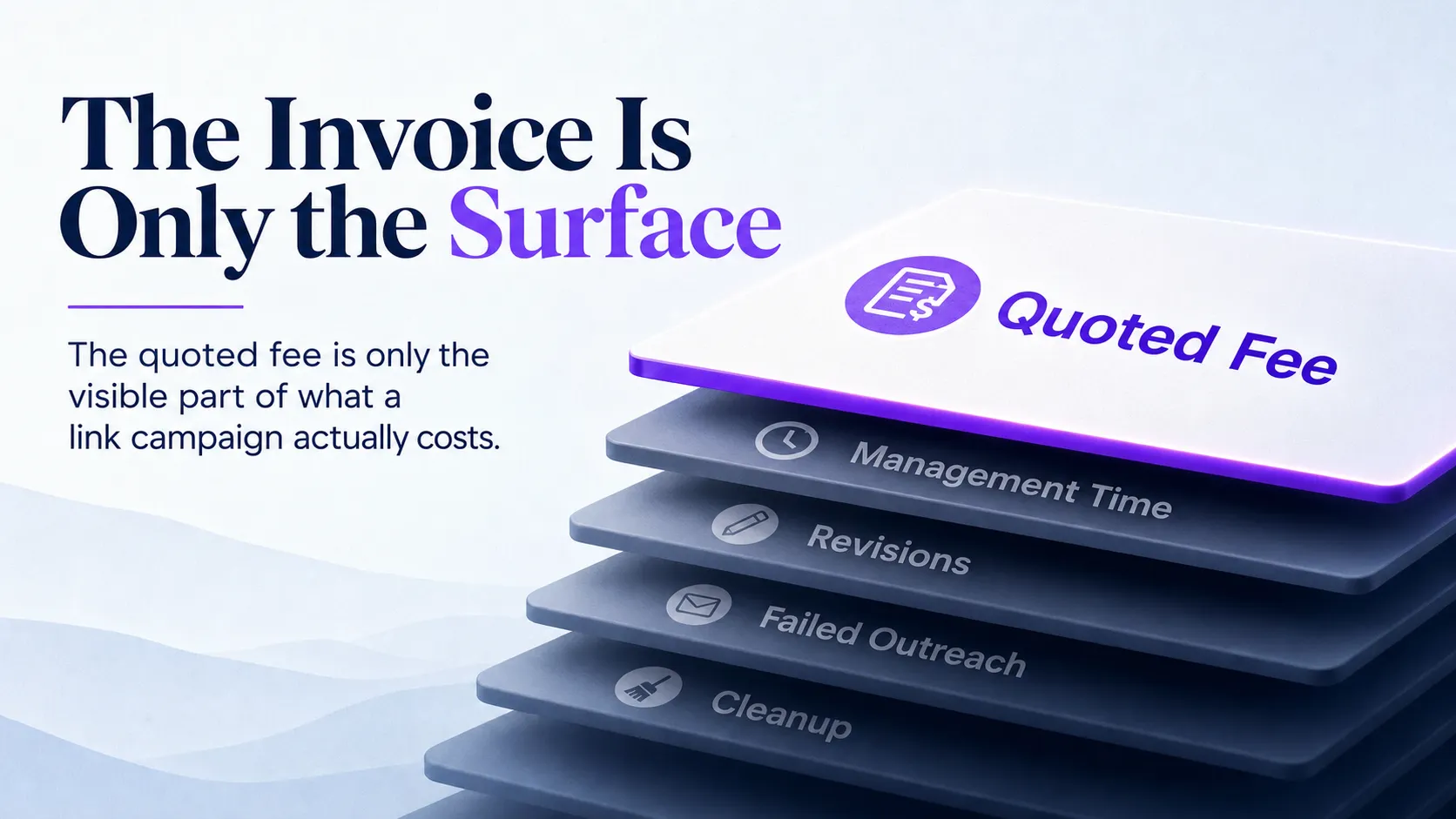
The cheapest invoice is rarely the lowest total cost. What you pay a provider is only part of the spend. The rest is the management time, the revision cycles, and the cleanup when a placement lands on a weak or irrelevant site.
Freelancers and agencies price across the same four structures: hourly, project-based, monthly retainer, and fixed link packages. The published ranges differ sharply by model.
| Pricing model | Freelancer | Agency |
|---|---|---|
| Hourly | $50 to $150 | $100 to $300 |
| Project-based | $500 to $5,000 | $2,500 to $30,000+ |
| Monthly retainer | $500 to $2,500+ | $3,000 to $15,000+ |
Agency pricing usually folds in team labor, quality assurance, reporting, and someone whose job is to keep the campaign on track. Freelancer pricing often covers execution only. The briefing, the follow-up, the replacement of a placement that fell through, and the deeper reporting frequently fall back on you.
The Hidden Costs Buyers Forget
The line item on the invoice hides four real costs that decide your true spend: briefing and feedback time, revision cycles, failed outreach, and cleanup after irrelevant placements. A freelancer at half the monthly rate can cost more than an agency once you count the hours you spend chasing updates and re-explaining the brief.
This is where the cheapest provider becomes expensive. When outreach fails quietly and you only notice at the end of the month, you have paid for time, not links. For buyers weighing budget against output, the most affordable link building options are the ones that minimize rework, not the ones with the lowest sticker price.
Quality, Risk, and Link Safety
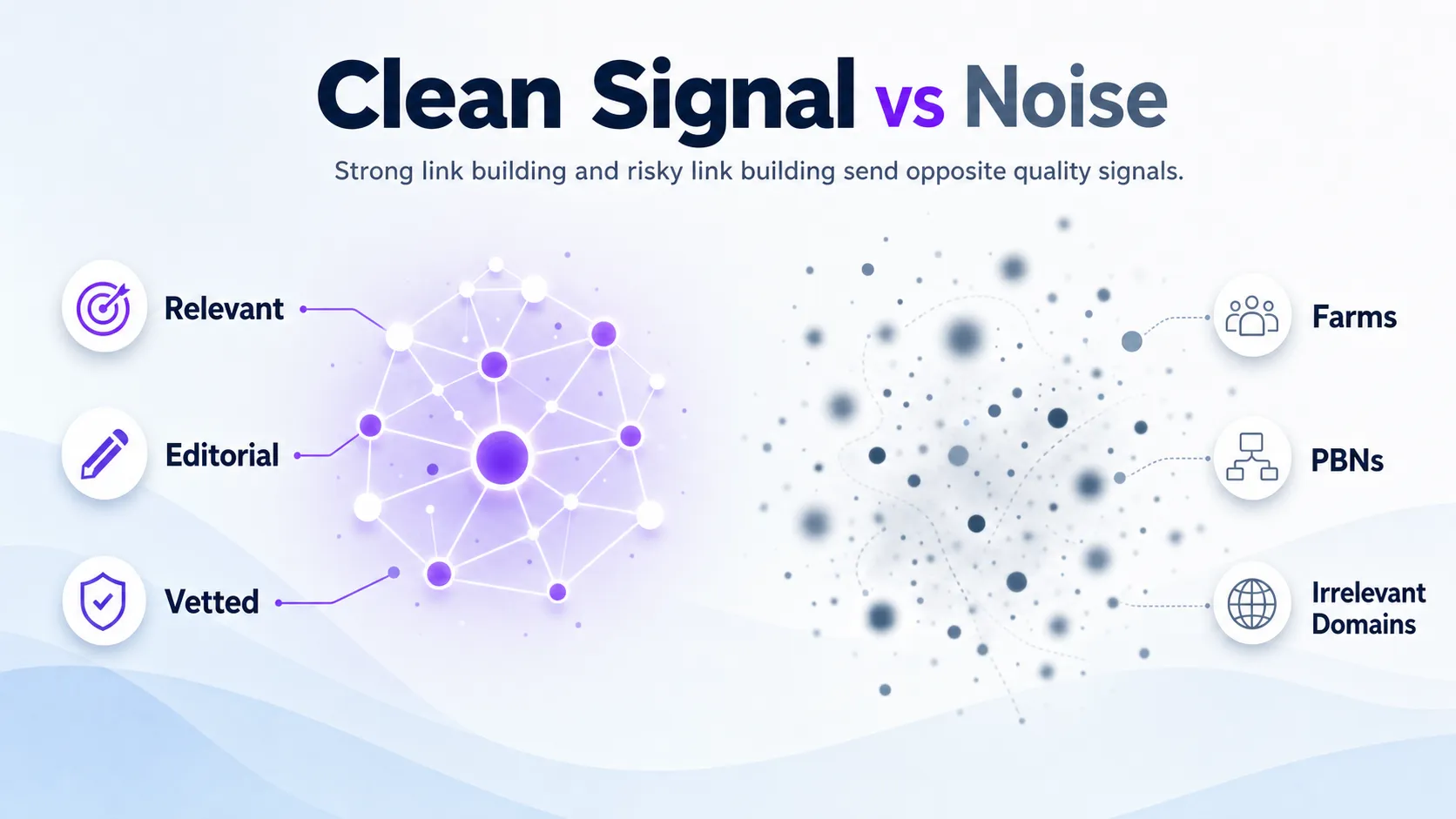
Link safety matters more than raw link volume. A campaign that adds twenty placements on spammy domains does more damage than a campaign that adds five on relevant, editorially controlled sites. The model you choose changes how consistently you get the second kind.
Agencies often run more quality assurance layers: a prospector finds sites, a separate reviewer vets relevance and metrics, and an account lead signs off before placement. A strong freelancer can match or beat a weak agency, because the work depends on the person, not the org chart. The question is whether the provider has a repeatable vetting process, not whether they call themselves an agency.
The Red Flags That Cost You Later
Weak link building shows the same warning signs across both models. Watch for recycled guest post farms, private blog network placements, irrelevant domains chosen for cheap metrics, inflated authority scores, and anchor text packed with exact-match keywords.
Each of those carries a business cost: wasted spend, rankings that stall instead of climb, and cleanup work later that often costs more than the original campaign. Understanding the difference between guest posts and niche edits helps you ask sharper questions about how a provider actually places links.
Scalability and Capacity
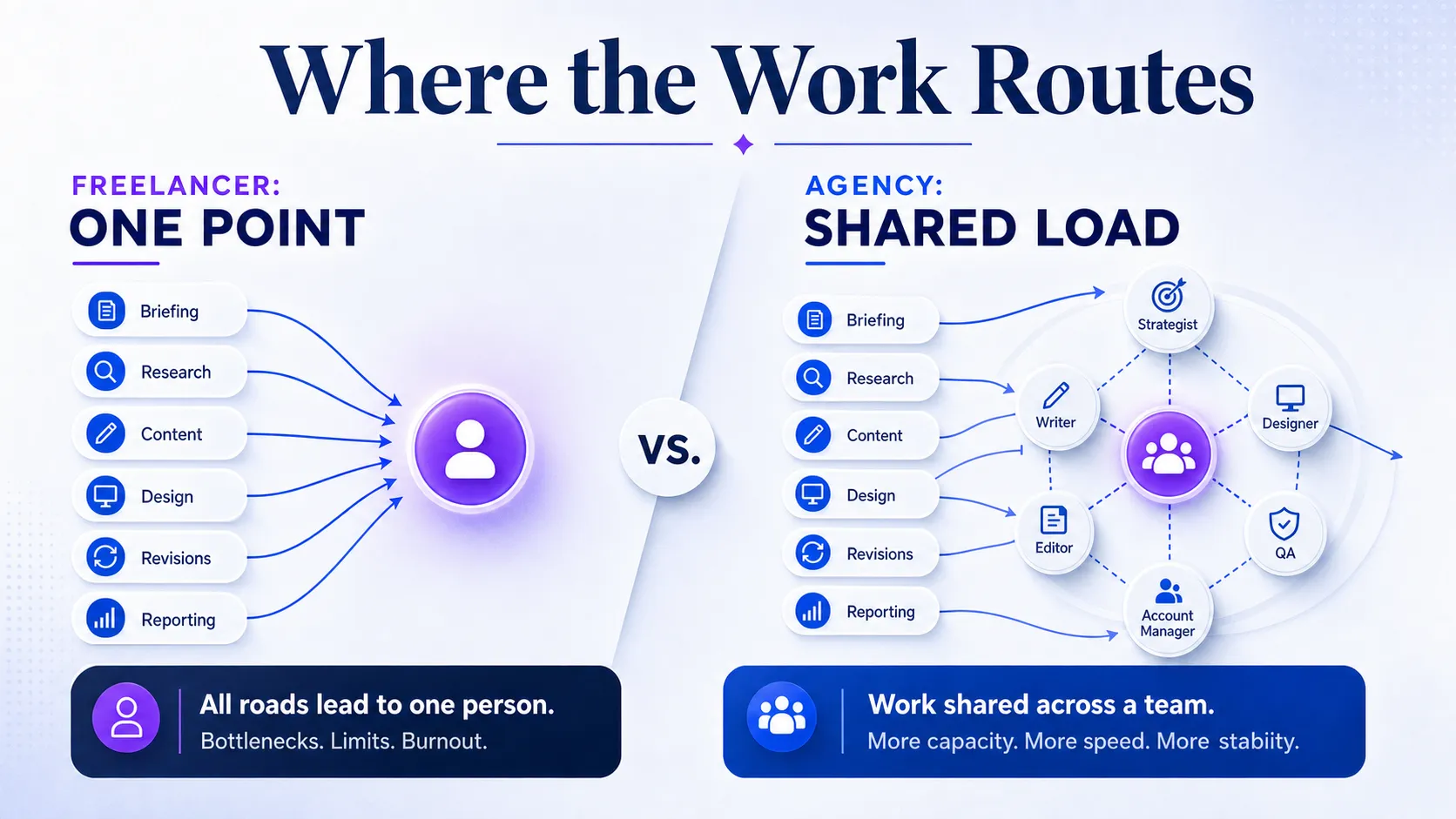
An agency usually handles volume and continuity better than a freelancer, because the work can be split across outreach, content, operations, and quality control. A freelancer often moves faster at the start, then hits a ceiling set by one person’s available hours.
This shows up the moment a campaign grows from a few links to an ongoing monthly program. Five placements a month is comfortable for a skilled freelancer. Thirty placements a month, every month, with consistent quality, is hard for any single person to sustain without the work slipping or the timeline stretching.
The structural difference is continuity. When a freelancer takes a holiday, gets sick, or signs a bigger client, your campaign pauses. That single point of failure is the quiet risk in solo arrangements. An agency absorbs the same disruption because another team member picks up the thread. For brands scaling fast, the link building services built for startups tend to be the ones that can grow with you rather than cap out.
Communication, Workflow, and Onboarding
Freelancers usually offer simpler, faster communication, while agencies usually offer more structured reporting with fewer single-person dependencies. Neither is automatically better. The right fit depends on how much coordination overhead you want to carry.
With a freelancer, you talk to the person doing the work, so feedback is direct and turnaround on small questions is quick. With an agency, you talk to an account manager who routes work and packages results into reporting, which adds a layer but removes the need to chase one busy individual.
Onboarding differs too. A freelancer can often start within days. An agency usually runs a more structured kickoff, which is slower to begin but tends to produce a clearer strategy and cleaner handoffs. Campaigns usually stall when one person must do strategy, outreach, reporting, and client communication at once, which is the failure mode solo arrangements share.
Expertise, Resources, and Accountability
The core question here is whether your campaign needs one sharp specialist or a broader team with more safeguards. Both have a clear home.
A freelancer’s niche expertise wins when the work hinges on deep industry relationships or mastery of a single link tactic. A specialist who has spent years building contacts in fintech publications will often place better links there than a generalist agency team. Agency breadth wins when the work needs content support, outreach volume, strategic planning, and quality control running together, which a solo operator cannot cover at once.
Whichever model you pick, the accountability tools should be the same. Look for a written contract, defined key performance indicators, milestone dates, and clear replacement terms for placements that do not meet spec. Transparency means seeing the prospect list, tracking live links, and knowing the delivery milestones before kickoff, not just after links go live. Strong providers make the work visible before kickoff, not only in the final report. If you want a single accountable expert rather than a team, a link building consultant who delivers can sit between the two models.
Which One Wins by Use Case
There is no single winner. The right choice maps to your business stage, your monthly link target, and how much internal oversight you can spare. Here is the practical verdict by scenario.
| Your situation | Better fit | Watch out for |
|---|---|---|
| Startup, narrow scope, tight budget | Freelancer | You need internal oversight to direct the work |
| Small local business, a few links | Freelancer or boutique agency | Relevance matters more than volume |
| SaaS or B2B, ongoing growth | Agency | Add freelancer support for niche placements |
| Ecommerce, recurring campaigns | Agency | Category coverage and scale at volume |
| Enterprise or regulated brand | Agency | Continuity, accountability, and reporting |
| Short-term or cleanup project | Freelancer | Set clear deliverables and exit terms |
| Long-term growth program | Agency | Operational reliability over months |
For SaaS teams especially, the answer usually tilts toward a team that can sustain output, which is why the link building services built for SaaS lean structured rather than solo. Ecommerce brands with broad category pages face the same volume pressure, and the agencies built for ecommerce link building are designed for that recurring scale.
The correct answer usually appears when you map your monthly link target against how much internal oversight you can actually spare. High target plus low oversight points to an agency. Low target plus high oversight points to a freelancer.
The Verdict, Stated Plainly
Choose a freelancer for lower-budget, tightly scoped, high-touch work where you can direct the campaign yourself. Choose an agency for scalable, lower-risk, ongoing link building where continuity and quality control matter more than the lowest fee. The deciding factors are budget, risk tolerance, and the monthly volume you need to sustain.
A hybrid model works for buyers who need both. Run an agency for steady monthly delivery and bring in a freelancer for a niche placement only that specialist can land. Whichever way you go, your next step is the same: shortlist two or three providers, compare deliverables rather than headline prices, and ask each one about replacement policies and reporting samples before you sign.
Frequently Asked Questions
Is it better to hire a link building agency or freelancer?
It depends on scope and oversight. Hire a freelancer for narrow, budget-conscious campaigns you can manage directly, and hire an agency for scalable, ongoing programs where you want quality control and continuity without close supervision. A founder needing five relevant links over two months should pick a freelancer. A growth team needing thirty links a month for a year should pick an agency.
How do I hire a link building freelancer?
Vet for a repeatable process, not just a low rate. Ask to see recent placements, the sites they typically secure, how they vet relevance, and what happens when a placement falls through. Request a written scope with a clear link target, anchor text guidance, and a replacement policy. Avoid anyone who promises a fixed number of links without explaining how they qualify the sites.
How much should I pay for link building?
Expect freelancers to charge roughly $500 to $2,500 per month on retainer and agencies to charge $3,000 to $15,000 or more. Project work ranges from $500 to $5,000 with freelancers and $2,500 to $30,000 or more with agencies. The right number depends on your link target and quality bar, not the headline rate alone, because cheap placements often cost more once you count rework.
Can a freelancer build safe, high-quality backlinks?
Yes, a skilled freelancer can build links as safe and durable as any agency. Quality tracks the person’s process, not the business model. The risk is capacity and continuity rather than skill: one person can only vet and place so many links, and the campaign pauses if they become unavailable. Confirm their vetting standards and ask how they handle volume spikes.
What should I ask before hiring a link builder?
Ask five things: how they find and vet target sites, what their typical placements look like, how they report progress, what their replacement policy covers, and how they handle a month when outreach underperforms. The answers reveal whether you are buying a repeatable process or a hopeful effort. Vague replies on vetting and reporting are the clearest signal to walk away.
The right partner keeps link quality high without consuming hours of your week chasing updates. If you want a lower-risk, scalable plan and a clear view of where your brand stands, book a short strategy call and see whether an agency is the better fit for your next campaign.