
If you need links but are stuck choosing between a managed agency and a self-serve marketplace, the better model comes down to budget, control, and risk. Here is the short call: an agency wins when you need strategy and hands-off execution, and a marketplace wins when you want control, transparency, and lower cost per link.
Both can produce good backlinks. The difference is who does the work, how much you see before you pay, and how much internal time the program eats. This guide compares the two models on the criteria that actually decide the purchase, then gives you a verdict by buyer type.
What a Link Building Agency vs Marketplace Actually Means
A link building agency is a managed service. You pay for outcome management: strategy, prospecting, outreach, content, placement negotiation, and reporting come bundled, and a team runs the campaign on your behalf. A link building marketplace is a self-serve or semi-managed platform where you browse publishers or placements directly, usually filtering by niche, traffic, domain rating, or price, and order what you want.
Most confusion starts when buyers compare a retainer to a catalog. Define the service model before comparing price, because the two charge for different things. An agency sells management of the result. A marketplace sells access and selection.
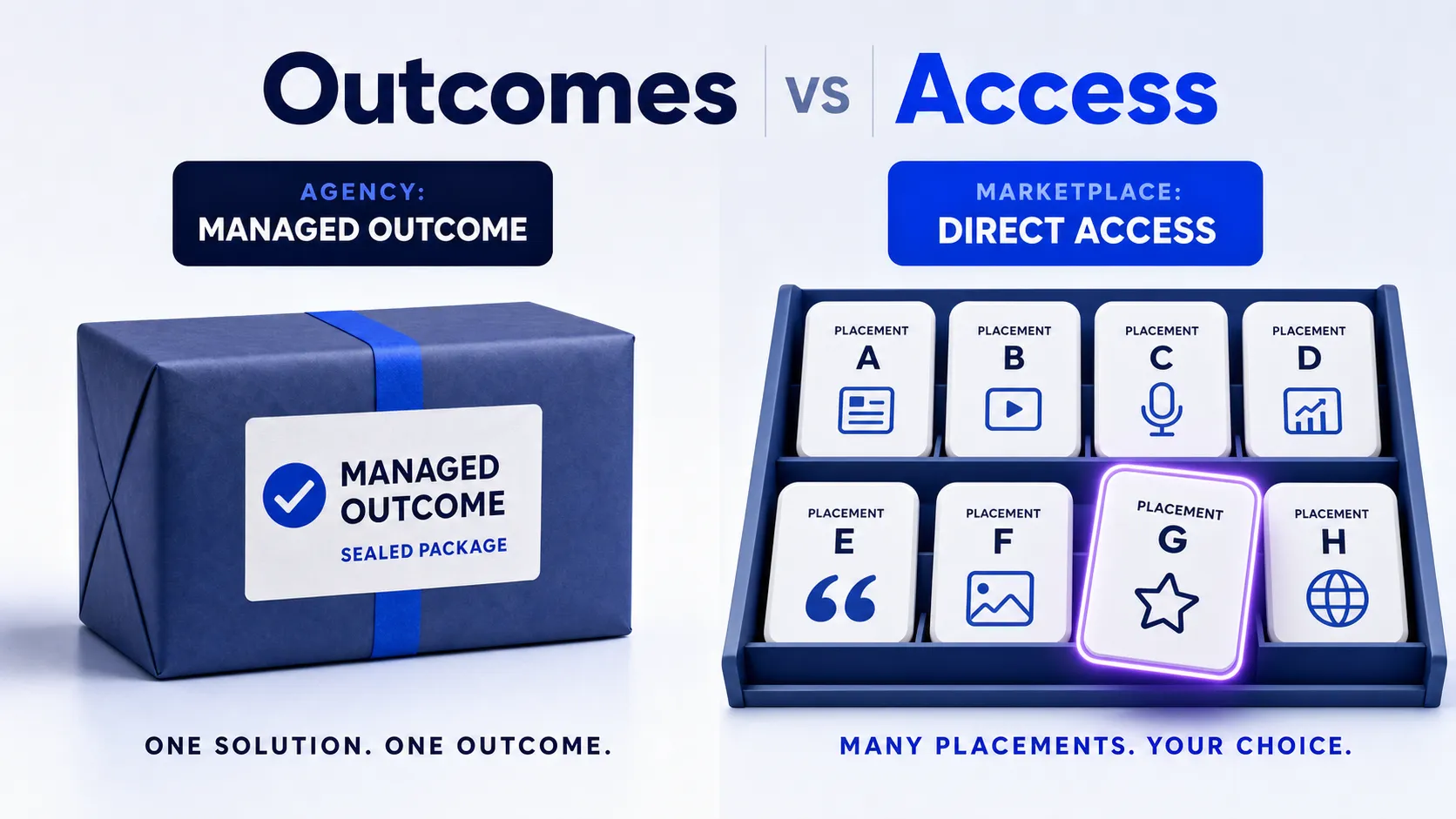
Some providers blur the line. A platform that sells direct placements but also offers a managed plan still behaves like one of the two models on any given order: you are either picking sites yourself or handing the picking to someone else. The same goes for an agency that gives you a publisher dashboard. Judge by who controls selection on the order in front of you, not by the label on the homepage.
| Dimension | Link building agency | Link building marketplace |
|---|---|---|
| What you buy | Managed outcomes | Access and selection |
| Who picks sites | The agency team | You, with filters |
| Typical billing | Monthly retainer or package | Per placement, pay as you go |
| Your time required | Low, mostly approvals | Higher, you drive selection |
The right choice depends on how much control, time, and quality assurance you want to own. If you want to own less, you lean agency. If you want to own more, you lean marketplace. Everything below sharpens that call.
The Decision Criteria That Matter Most
Seven criteria decide this purchase: pricing model, control over placements, quality vetting, turnaround speed, reporting and transparency, scalability, and support or management burden. Use a scoring lens, not a preference lens, because it’s easy to overvalue the headline link price and ignore the time cost behind it.
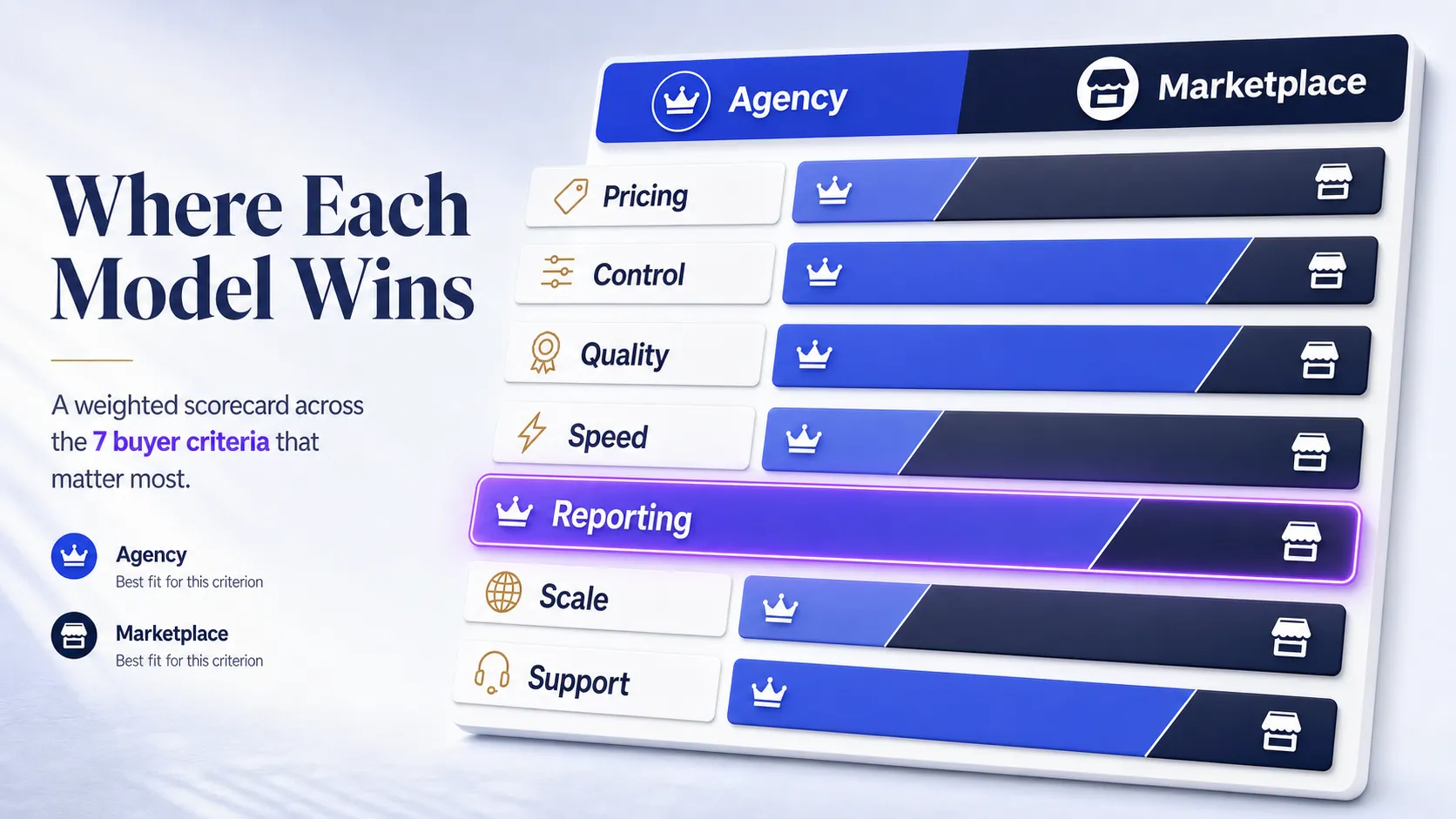
The criteria are weighted differently by buyer type. A small team usually cares most about support burden and budget, because it has no spare hours to manage placements. An enterprise team usually cares most about control and risk, because brand safety and stakeholder approvals raise the stakes on every link.
| Criterion | What to ask | Agency usually wins when | Marketplace usually wins when |
|---|---|---|---|
| Pricing model | Retainer or per link? | You want predictable monthly spend | You want flexible, low-entry buying |
| Control | Who picks the site? | You want to delegate selection | You want to choose every placement |
| Quality vetting | Who screens publishers? | You lack time to vet sites | You can judge inventory yourself |
| Speed | How fast can it launch? | The campaign needs strategy first | You need one-off or volume links fast |
| Reporting | What can you see, when? | You prefer curated updates | You want live placement visibility |
| Scalability | How does it grow? | Growth needs consistent relevance | You need high link velocity |
| Support burden | How much of your time? | You have no internal bandwidth | You have in-house SEO process |
The decision rule is simple. If two models tie on price, choose based on workflow maturity and risk tolerance. No single model wins every category, so weight the rows that match your situation and let the others go.
Cost and Pricing Structure
The two models price the same goal in opposite ways. Agencies charge a monthly retainer, a tiered package or a per-link rate, and that fee covers the strategy and execution too. Marketplaces charge per placement, so you pay for each link plus any platform commission and add-ons such as copywriting. The cheapest invoice is rarely the cheapest program, because the headline price hides what each model adds around it.
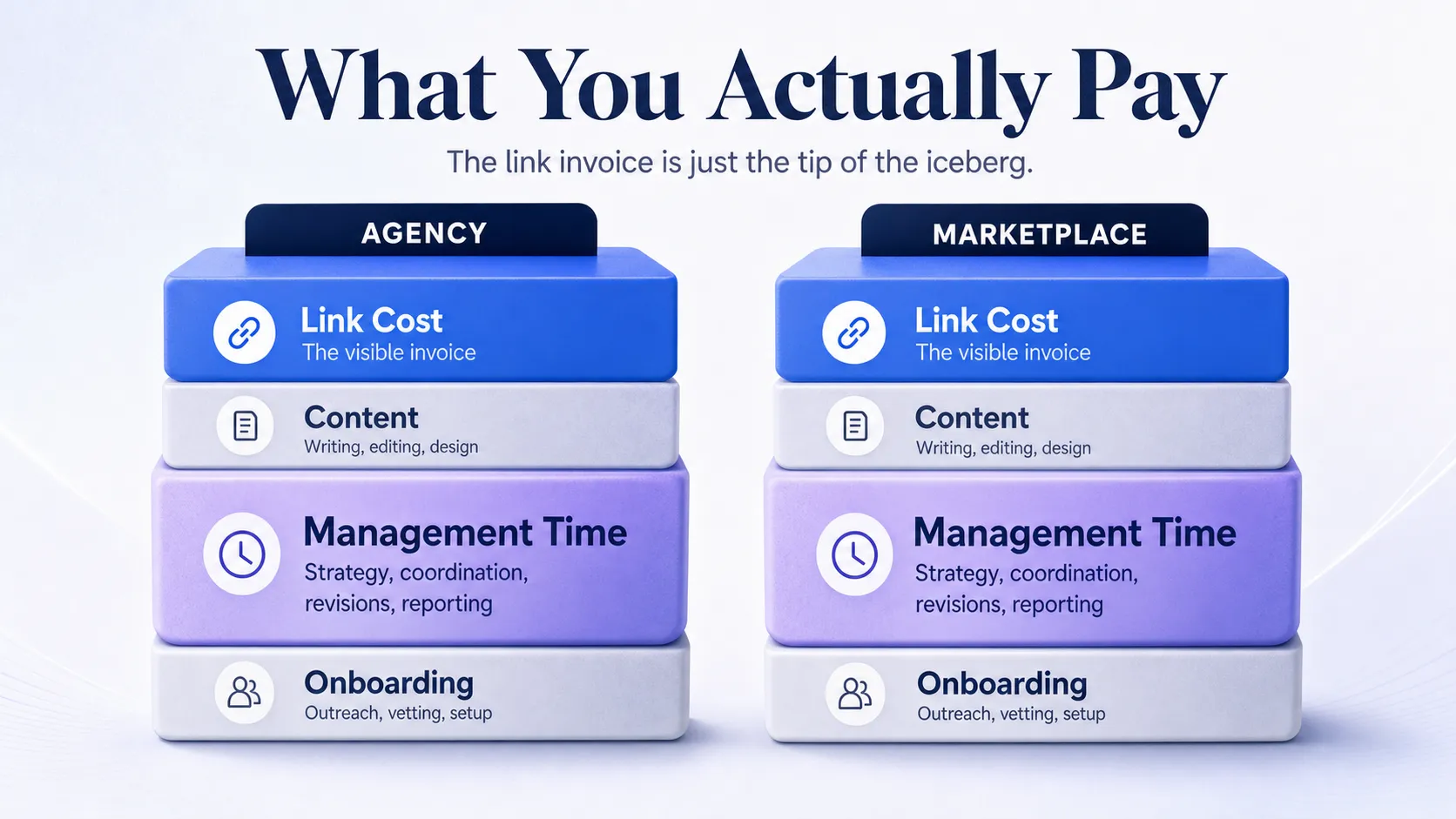
Hidden costs sit on both sides. Agencies fold in content fees, onboarding, account management, and the white-label markup if you resell. Marketplaces look leaner per link, but the labor moves to you: vetting sites, ordering, briefing content, and checking placements all become internal time. In our view, the bigger cost difference is often management time, not the link invoice.
| Cost factor | Agency | Marketplace |
|---|---|---|
| Core billing | Retainer or package | Per placement |
| Minimum spend | Often a monthly floor | Often none |
| Content fees | Usually bundled | Sometimes add-on |
| Internal labor | Low | Higher |
| Budget flexibility | Easier to forecast | Easier to scale up or down |
The budget rule: agencies win for predictable monthly spend and done-for-you execution, and marketplaces win for lower entry cost and flexible buying. Read total cost of ownership, not the sticker. A marketplace link at a low per-unit price can cost more once you add the hours your team spends running the order. If you are already weighing whether to handle this internally, the tradeoffs in how to vet and budget outsourced link building map closely to this same cost question.
Control, Workflow, and Reporting
Control is the clearest dividing line between the two models. An agency runs the workflow for you, so you trade hands-on control for saved hours. A marketplace hands you the controls, so you gain full say over selection but spend the time to use it.
The agency workflow runs through set stages: a discovery call, a campaign brief, prospecting, outreach, your approvals, content creation, placement, and reporting. You shape the brief and approve the targets, then the team executes. The marketplace workflow is shorter and self-driven: browse inventory, filter sites, choose placements, review content options, place the order, and receive a report.
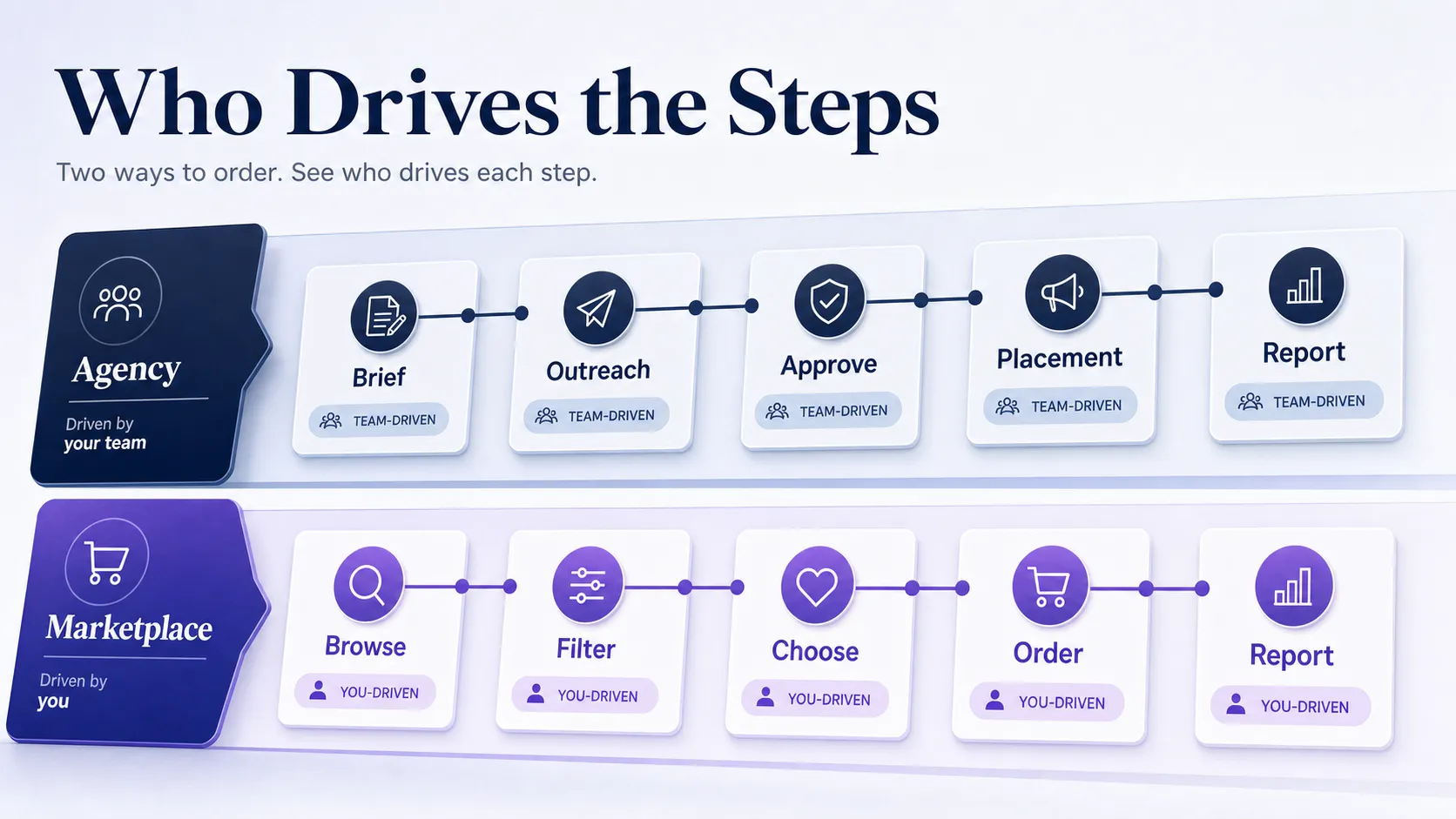
The two models reduce different workloads. An agency cuts execution burden, which matters when your team has no spare hours. A marketplace cuts back-and-forth, which matters when you already have SEO expertise in-house and just want to act without waiting on an account manager. The model that looks simpler on paper is not always simpler in practice, and workflow breaks when approvals live in too many hands.
Reporting styles split too. Agencies usually deliver curated status updates on a schedule, so you see a clean summary but not always the raw queue. Marketplaces usually give direct placement visibility and faster order tracking, so you watch each link move through the pipeline yourself. If transparency before purchase is a deciding factor for you, the marketplace model shows more by default. For teams running outreach themselves, the campaign mechanics in running a reply-worthy outreach campaign explain what that hands-on workflow actually involves.
Quality, Risk, Speed, and Scalability
Quality and speed are not the same thing, and treating them as one is where buyers misfire. An agency usually adds more vetting and editorial oversight, so quality control is built in. A marketplace gives you more direct choice, but quality varies by inventory, so the floor depends on how well you screen.
Risk follows the same pattern. The compliance exposure is real on both sides: sponsored-link disclosure, anchor-text balance, and low-quality inventory can all hurt you. An agency carries more of that judgment for you. A marketplace puts it in your hands, which is fine if you know what to reject and a problem if you do not.
Speed favors the marketplace for one-off placements and volume buying, because you can browse and order the same day. An agency is usually slower to start, since strategy and prospecting come first, but that head start pays off on complex campaigns that need a narrative and consistent relevance. Scalability splits the same way: marketplaces scale operationally for high link velocity, while agencies scale more safely when each link has to fit a tight subject and brand frame.
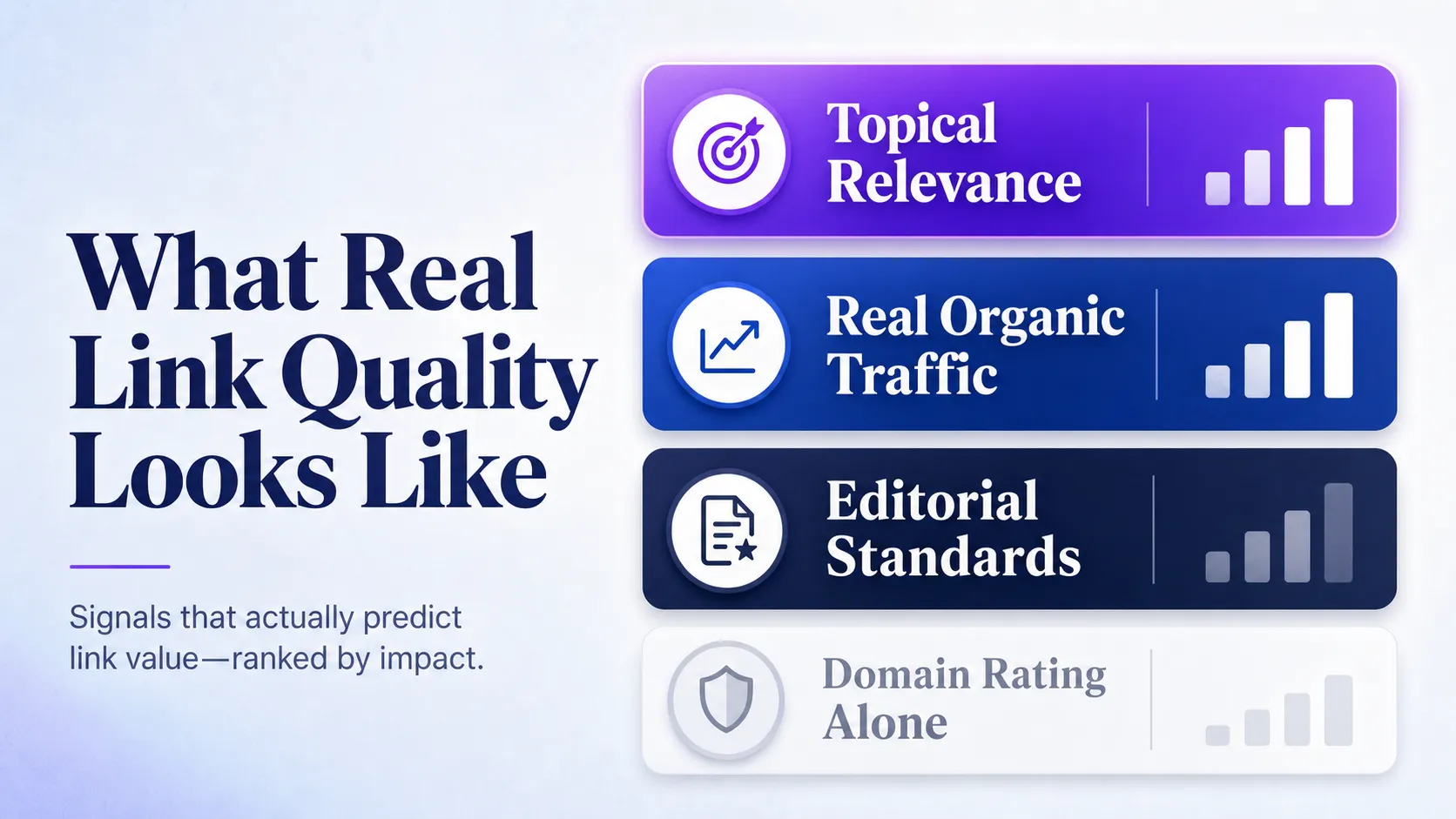
One quality rule cuts across both models: domain rating alone is not quality. Topical relevance, real organic traffic, and editorial fit matter more than any authority score. Watch the signals below before you accept a placement from either model.
- Topical relevance to your niche, not just a high authority score
- Verified organic traffic, not inflated or bot-driven visits
- Editorial standards on the publishing site
- Clear sponsored-link and disclosure handling
- A natural anchor-text mix across your link profile
The buyer mistake to avoid is chasing volume when your site profile needs relevance, or chasing relevance when your team actually needs velocity. Match the model to the gap. If your foundation is thin, the relevance-first logic in manual link building tactics shows why slower, hand-built placements often beat bulk buying early on.
See where AI answers put your brand
Twenty minutes with a senior strategist: where the major engines point buyers in your category, who gets named instead of you, and a straight read on what a programme would change.
Book a strategy callWhich Model Fits Your Team? Use Case Verdicts
The right model is usually the one that fits your internal maturity, not your ambition level. Here is the call by buyer profile, from smallest team to enterprise.
Small Businesses and Budget-Conscious Buyers
Choose a marketplace if you can vet sites yourself and want a lower entry cost. The pay-as-you-go model lets you start small and stop anytime, which suits a tight budget. The catch is that you own the quality check, so only go this route if you can tell a relevant publisher from a thin one. If you cannot, the savings disappear into a weak link profile.
In-House SEO Teams
Choose a marketplace when you already have process and want control over every placement. Your team can filter inventory and order without waiting on anyone. Choose an agency instead when you lack bandwidth or need strategy you do not have time to build, because the agency fills the gap your headcount cannot.
SEO Agencies and White-Label Resellers
Choose a marketplace for flexibility and margin, since per-placement buying lets you mark up and control client delivery. Choose an agency partner when client delivery needs genuinely hands-off execution that your team cannot staff. The in-house versus outsourced link building tradeoff applies directly here, since reseller margin depends on which work you keep and which you hand off.
Enterprise Brands
Choose an agency when approvals, brand safety, and stakeholder management are complex, because the managed model absorbs that coordination. Use a marketplace only if your internal governance is strong enough to police selection and disclosure at scale. Weak governance plus a self-serve marketplace is how brand-unsafe links slip through.
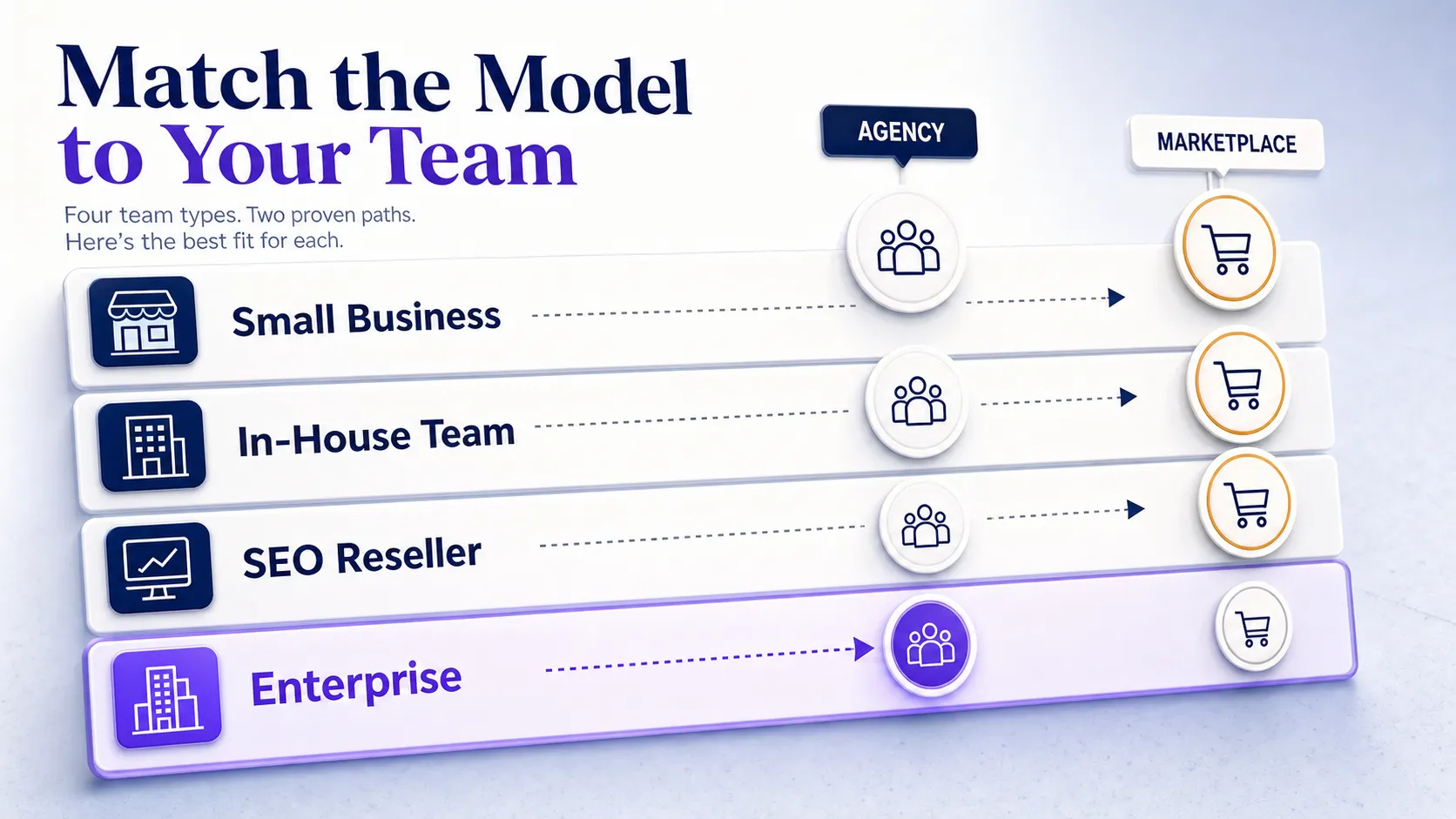
The decision rule pulls all of this into one line: if you need strategy and do not have time, choose an agency, and if you need control and transparency, choose a marketplace. When you are still building the basics, the foundational sequence in how to do link building in 2026 helps you decide what to run yourself before you buy either way.
Frequently Asked Questions
Is a link building marketplace the same as buying backlinks?
Yes, in most cases a marketplace is a structured way to buy backlinks. You pay for placements directly, which is paid link acquisition. The quality and safety depend on the inventory and how the placements are disclosed, not on the marketplace label itself. A vetted, relevance-focused marketplace placement is still a paid link, and Google’s systems can detect sites that buy links, so apply the same disclosure and quality checks you’d use anywhere.
Which is safer, a link building agency or a marketplace?
An agency is usually the safer default because vetting is built into the service, but Google says you’re still responsible for what any agency you hire does. A marketplace can be just as safe, but the safety moves to you, since you decide which publishers to accept. If you can judge topical relevance and real traffic, and every paid link carries a sponsored or nofollow attribute, a marketplace can be safe. If you can’t, an agency reduces the chance of a damaging placement. BrandMentions is itself a done-for-you agency.
Is a marketplace cheaper than a link building agency?
A marketplace usually has a lower cost per link and no monthly retainer, so the sticker price is lower. Whether it is cheaper overall depends on your time. Once you add the hours your team spends vetting sites, briefing content, and checking placements, a marketplace program can cost as much as an agency. Compare total cost of ownership, not the per-link price.
When should an in-house SEO team use a marketplace instead of an agency?
Use a marketplace when your team already has a working link process and wants direct control over every placement. If you can filter inventory, judge quality, and brief content without external help, the marketplace removes the account-manager delay and gives you faster ordering. Switch to an agency the moment your team runs out of bandwidth or hits a campaign that needs strategy you cannot staff internally.
Can a marketplace match the quality control of a managed agency?
A marketplace can match agency quality, but only when the buyer brings the vetting discipline the agency would otherwise supply. The platform gives you the inventory and the filters; the judgment is still human. A skilled in-house team using a strong marketplace can hit the same quality bar as an agency. A team without that skill will see quality drift, because the marketplace does not make the final call on relevance and editorial fit for you.
Decide which model fits your workflow first, then make the buyers do the talking: request one agency quote and one marketplace pricing sheet, and compare total cost of ownership before you commit a budget. Want to know where your brand already stands in AI search before you spend on links? Book a strategy call and see what the engines say about you and your competitors.