

Quick answer: Brand tracking software measures how your audience perceives your brand over time, awareness, sentiment, consideration, and competitive positioning. In 2026, the category has split into two distinct camps: survey-based platforms that collect structured perception data directly from consumers, and monitoring tools that track online mentions, social conversation, and now AI search citations in real time.
Choosing the wrong type wastes budget. Choosing the right one gives you a measurable feedback loop between brand investment and business outcomes. This article breaks down how each approach works, what has changed since 2024, and which scenarios call for which tool, so you can stop guessing and start measuring.
Key Takeaways
- Brand tracking software falls into three categories as of 2026: survey-based trackers, social/web monitoring tools, and a newer class of AI visibility monitors
- Survey platforms measure what people think when asked directly; monitoring tools measure what people say organically, you likely need elements of both
- AI search engines now influence brand discovery, and most legacy brand trackers don’t yet capture this signal
- The right tool depends on your stage, budget, and whether you need perception data, conversation data, or both
- Pricing ranges from $49/month for basic social monitoring to $50,000+/year for enterprise research platforms
- Integration with your existing marketing stack determines whether brand data drives action or collects dust
What Brand Tracking Software Actually Measures
Brand tracking software is marketing technology that systematically collects data about how a brand is perceived by its target audience and the broader market. It turns subjective brand perception into structured, measurable metrics you can track over time.
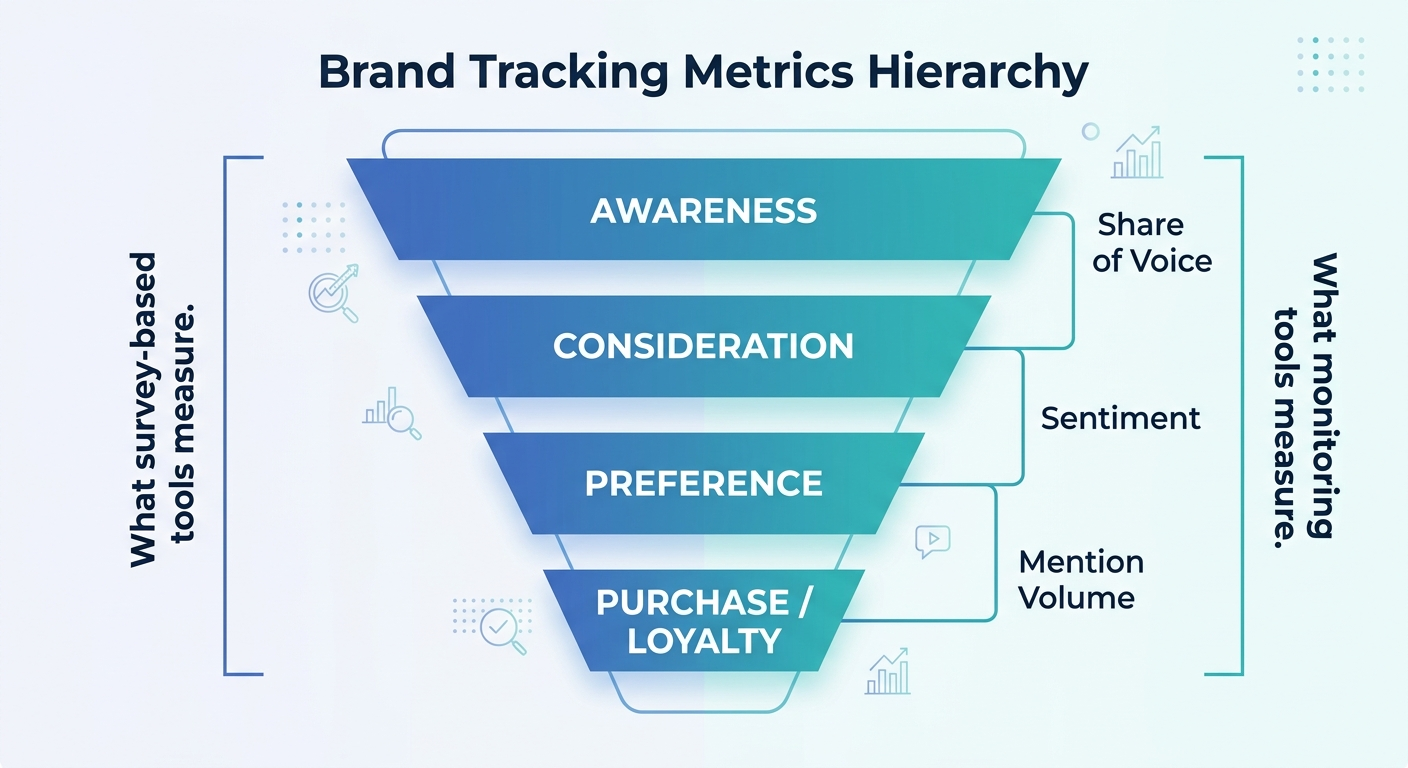
The core metrics fall into a few categories:
- Brand awareness, aided and unaided recall among your target audience
- Consideration and preference, where your brand sits in the purchase decision relative to competitors
- Sentiment, whether conversations about your brand skew positive, negative, or neutral
- Share of voice, how much of the category conversation your brand owns compared to competitors
- Brand associations, which attributes, values, and qualities people connect to your brand
These metrics matter because they sit upstream of revenue. A prospect who has never heard of your brand won’t convert from a paid ad. A buyer who associates your brand with “outdated” won’t shortlist you. Brand tracking quantifies these invisible forces so you can act on them.
Three Types of Brand Tracking Software in 2026
The brand tracking landscape has evolved significantly since 2024. What was once a two-category market, surveys vs. social listening, now includes a third approach focused on AI search visibility. Understanding the differences saves you from buying the wrong tool.
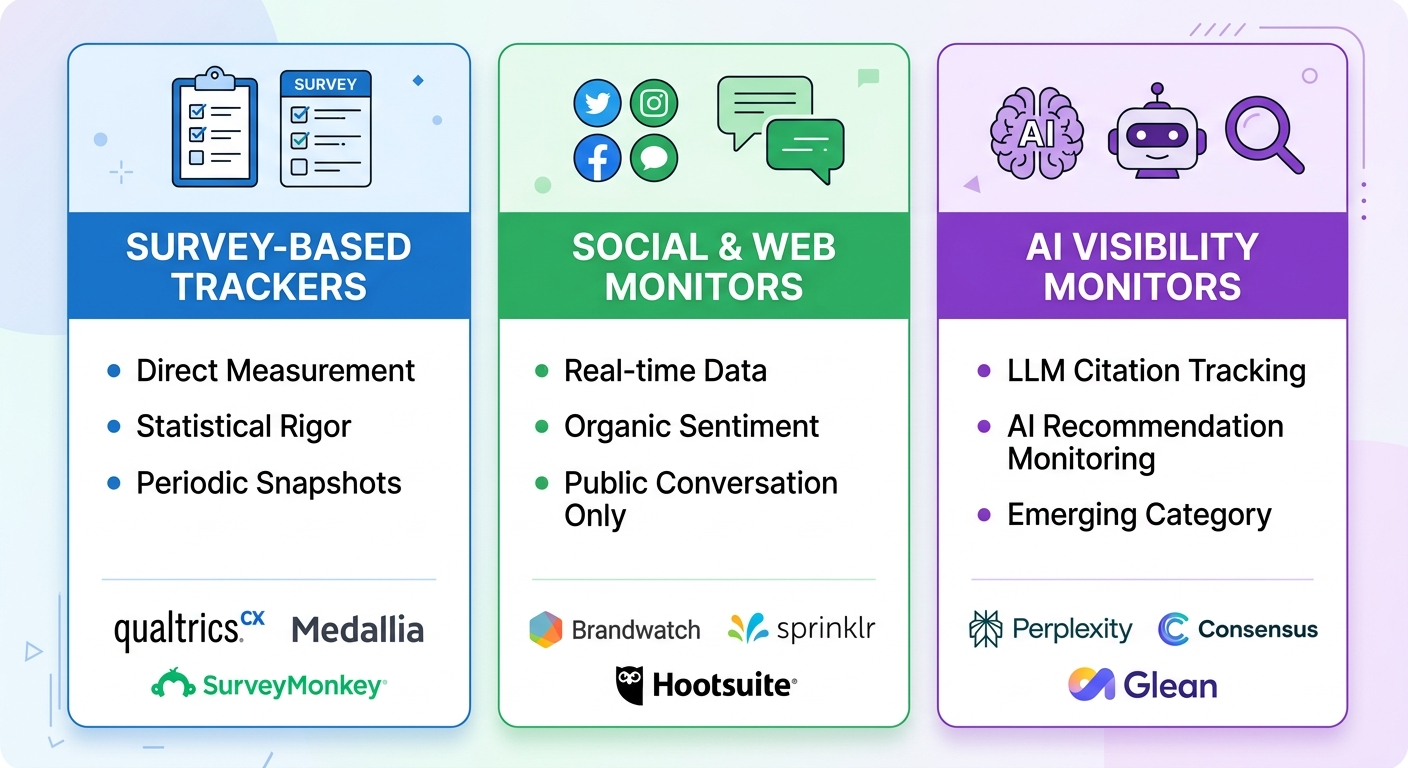
| Category | What it measures | Data type | Core limitation |
|---|---|---|---|
| Survey-based trackers | Awareness (aided/unaided recall), consideration, preference, and brand associations gathered by asking consumers directly | Structured perception data (what people think when asked) | Highest cost tier (enterprise research platforms run $50,000+/year); slower feedback loop |
| Social/web monitoring tools | Online mentions, social conversation, sentiment, and share of voice as they happen | Organic conversation data (what people say unprompted) | Captures only people who post publicly; misses the silent majority who never mention the brand |
| AI visibility monitors | Whether and how the brand is cited in AI search answers (ChatGPT, Perplexity, Gemini, Copilot, Google AI Mode) | AI citation / discovery signal | Newer class that most legacy brand trackers do not yet capture, leaving a blind spot in 2026 stacks |
Survey-Based Brand Trackers
Survey-based platforms collect structured perception data by asking real consumers questions at regular intervals. They measure awareness, consideration, preference, and brand associations directly.
How they work: You define a target audience, set up a recurring survey with standardized questions, and collect responses from consumer panels. Over time, you build a trend line showing how perception shifts in response to campaigns, market events, and competitive moves.
Strengths: Statistical rigor, audience segmentation, direct measurement of what people think (not just what they say publicly). You control the questions.
Limitations: You only see answers to questions you ask. Response quality depends on panel quality. Surveys capture a snapshot, they miss real-time shifts between collection waves.
Representative tools: Tracksuit, Latana, Attest, Qualtrics, Pollfish, Kantar Marketplace
Social and Web Monitoring Tools
Monitoring platforms track what people say about your brand organically, across social media, forums, news sites, review platforms, and blogs. They capture unstructured conversation in real time.
How they work: You set up keyword and brand name alerts. The platform continuously scans data sources and surfaces mentions, sentiment scores, category visibility share comparisons, and trending topics.
Strengths: Real-time data. Captures organic sentiment people share without being prompted. Useful for crisis detection, campaign monitoring, and competitive intelligence.
Limitations: Biased toward people who post publicly. can’t measure awareness among people who don’t talk about you. Social sentiment is noisy, sarcasm, bots, and spam pollute the signal.
Representative tools: Brandwatch, Meltwater, Brand24, YouScan, Awario
AI Visibility Monitors (New in 2026, 2026)
A newer category of brand tracking focuses on how brands appear in AI search results, ChatGPT, Perplexity, Google AI Overviews, Gemini, and other large language model (LLM) interfaces. This matters because AI-generated answers are increasingly where buyers discover and evaluate brands.
How they work: These tools query AI platforms with category-relevant prompts and track whether your brand appears in the responses, how it’s described, and how frequently it’s recommended relative to competitors.
Strengths: Measures a visibility channel that traditional brand trackers and social monitors completely miss. According to a 2025 Gartner forecast, traditional search traffic is expected to drop 25% by 2027 as AI-generated answers capture more queries. Tracking your brand’s presence in AI responses fills this growing blind spot.
Limitations: The category is young. Methodologies are still maturing. AI responses change frequently, so point-in-time snapshots may not reflect stable positioning.
Representative tools: Otterly.ai, Profound, custom monitoring solutions. Agencies like BrandMentions track brand mentions across AI platforms as part of broader AI visibility campaigns, combining monitoring with strategic placement on publications that LLMs learn from.
What Changed in Brand Tracking Between 2024 and 2026
The brand tracking category has shifted in three important ways. Understanding these shifts helps you evaluate whether your current approach is still adequate.
AI Search Created a New Tracking Blind Spot
in 2026, most brand tracking focused on traditional search, social media, and survey panels. By 2026, AI-generated answers from ChatGPT, Perplexity, and Google AI Overviews have become a primary discovery surface for B2B and B2C buyers alike.
The problem: legacy brand tracking tools don’t monitor this channel. A brand could score well on awareness surveys and own strong social share of voice, yet be completely absent from AI recommendations in its category. This is a meaningful gap, especially for B2B SaaS brands where buyers increasingly use AI assistants for vendor research.
If your brand tracking stack doesn’t include some form of AI mention monitoring, you’re missing a growing portion of the picture.
Mental Availability Frameworks Gained Traction
Several platforms, including Quantilope, Tracksuit, and Zappi, have adopted frameworks from the Ehrenberg-Bass Institute that measure mental availability: how readily a brand comes to mind in buying situations. Metrics like Mental Market Share, Mental Penetration, and Category Entry Points have moved from academic research into production dashboards.
This matters because it shifts brand tracking from “do people know us?” to “do people think of us when they’re ready to buy?”, a more actionable question for marketing teams.
Pricing Transparency Improved at the Mid-Market
in 2026, most brand tracking tools required a sales call for pricing. As of 2026, platforms targeting mid-market teams, Tracksuit ($600/month per market), Brand24 (from $49/month), Pollfish ($0.95/response), publish pricing openly. Enterprise platforms (Qualtrics, Brandwatch, Sprinklr) still require custom quotes, but mid-market buyers now have realistic budget benchmarks before engaging sales teams.
How to Match Brand Tracking Software to Your Situation
The right tool depends on what you need to measure, your team’s research capability, and your budget. Here is how to think through the decision.
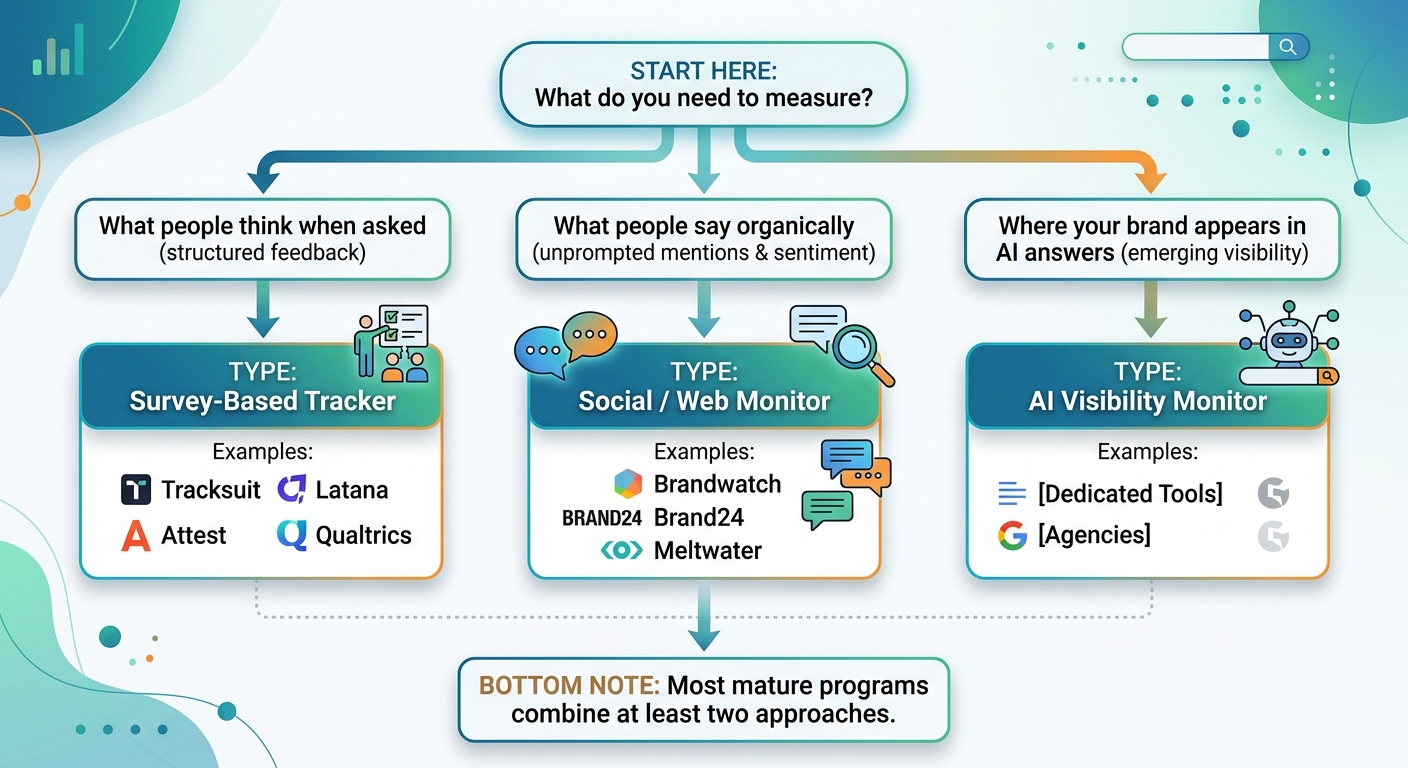
If You Need to Measure Awareness and Consideration Among Target Buyers
Use a survey-based brand tracker. This is the only reliable way to measure perception among people who may never mention your brand publicly. Platforms like Tracksuit, Latana, and Attest deliver awareness, consideration, and preference data segmented by demographics.
Action step: Start with a baseline study measuring unaided and aided awareness in your category. Run follow-up waves after major campaigns to quantify perception shifts. For a deeper guide on this process, see how to measure brand awareness effectively.
If You Need Real-Time Conversation Monitoring and Crisis Detection
Use a social and web monitoring tool. Brandwatch, Meltwater, Brand24, and Awario scan social platforms, forums, news outlets, and review sites continuously. Real-time alerts let you respond to negative sentiment or emerging PR issues before they escalate.
Action step: Set up brand name monitoring plus key product names and executive names. Configure sentiment alerts for negative spikes. Review your platforms that watch your brand 24/7 quarterly to ensure coverage across the platforms your audience actually uses.
If You Need to Track Competitive Positioning Across Multiple Markets
Survey-based trackers with multi-market support (Latana, Kantar Marketplace, Attest) let you run identical studies across geographies and compare results. Social monitoring tools add a real-time layer by tracking share of voice vs. share of market across regions.
Action step: Decide whether you need the same methodology applied consistently across markets (survey-based) or directional conversation volume data (monitoring). For most mid-market brands expanding internationally, a survey tracker with quarterly waves in each new market is the more reliable starting point.
If You Need to Understand How AI Search Engines Describe Your Brand
As of 2026, this requires either a dedicated AI visibility monitoring tool or an agency that tracks AI citations systematically. Standard brand trackers and social listening platforms don’t capture this data.
Action step: Run a manual audit first. Ask ChatGPT, Perplexity, and Gemini category-level questions (“What are the best [your category] tools?”) and document where your brand appears. If you’re absent or misrepresented, explore AI brand mention strategies to build the editorial footprint AI models learn from.
Key Evaluation Criteria for Brand Tracking Software
Once you’ve identified which type of tool fits your primary need, evaluate specific platforms against these criteria.
Data Source Quality
For survey tools: How large and diverse is the respondent panel? Are respondents incentivized or non-incentivized? How does the platform prevent fraud and low-quality responses? Pollfish, for example, uses a 14-day evaluation period before respondents enter the active pool. Latana uses non-incentivized, mobile-based sampling with MRP (multilevel regression with post-stratification) for statistically reliable results from smaller samples.
For monitoring tools: Which data sources are indexed? Social platforms, forums, review sites, and news outlets vary by tool. If Reddit matters for your category, confirm the tool covers it, many legacy platforms still focus on X (formerly Twitter) and mainstream news.
Speed to First Insight
Social monitoring tools deliver data within hours of setup. Survey-based trackers require one to four weeks for an initial baseline. Enterprise platforms like Qualtrics and Sprinklr may take months to implement fully.
Match the tool’s ramp time to your urgency. If you need brand data before a board meeting next month, a platform with an eight-week implementation cycle is the wrong choice.
Integration With Your Marketing Stack
Brand tracking data drives the most value when it flows into the dashboards your team already uses, your CRM, analytics platform, or reporting tools. Check whether the tool offers API access, direct integrations (Salesforce, HubSpot, Looker), or at minimum clean data exports.
Data that lives in a separate tab gets checked once and forgotten. Data that appears alongside pipeline and campaign metrics gets acted on.
Competitive Benchmarking Depth
Every brand tracker claims to offer competitive insights. The differences matter. Some platforms limit you to tracking five or ten competitors. Others (like BERA.ai) let you benchmark against 1,000+ brands. Determine how many competitors you realistically need to monitor and confirm the tool supports it within your pricing tier.
Pricing Model and Total Cost
Pricing models vary significantly:
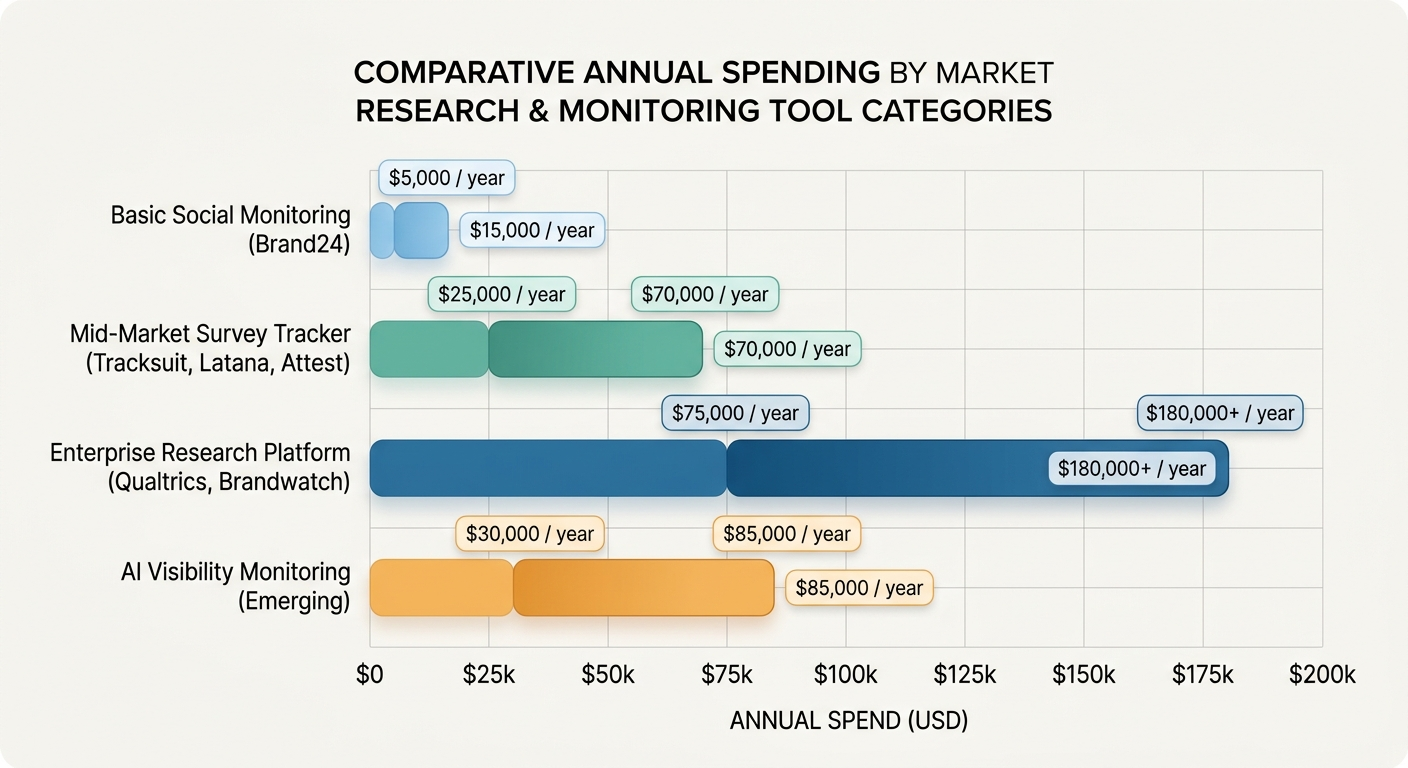
- Per-response pricing (Pollfish: $0.95/response), scales with sample size, predictable per-study
- Per-market pricing (Tracksuit: ~$600/month per market), adds up for multi-region brands
- Tiered subscriptions (Brand24: from $49/month), affordable entry, feature-gated
- Enterprise contracts (Qualtrics, Brandwatch, Sprinklr: $5,000, $50,000+/year), custom quotes, annual commitments
Calculate total annual cost based on your actual usage pattern: number of markets, survey waves per year, competitors tracked, and team seats. Some platforms charge per user seat; others (like Pollfish) include unlimited team members.
Where Most Brand Tracking Stacks Fall Short in 2026
Even well-built brand tracking programs have gaps. Recognizing them helps you decide whether to add tools or adjust expectations.
The AI Search Gap
This is the most significant blind spot as of 2026. Your brand might rank well on Google organic, score highly on awareness surveys, and dominate social share of voice, yet be completely absent when someone asks ChatGPT or Perplexity “What is the best [your category] tool?”
AI models form brand associations from their training data, which includes high-authority editorial content, Wikipedia, documentation, and trusted publications. If your brand lacks presence in these sources, brand mentions in AI search will be minimal regardless of your traditional brand tracking scores.
The pattern we see in stack audits is that brands with sustained editorial coverage on category-relevant publications appear in AI recommendations far more reliably than those leaning on traditional SEO alone. Tracking your brand in 2026 therefore requires measuring AI visibility alongside the traditional channels, not as an optional addendum.
The “Awareness Without Context” Problem
Survey-based trackers tell you that 42% of your target audience is aware of your brand. They rarely tell you what those people associate with your brand in the context of a specific buying moment. Mental availability frameworks (Ehrenberg-Bass methodology adopted by Quantilope and Tracksuit) address this partially, but most tools still report awareness as a blunt number.
What to do: Supplement awareness metrics with open-ended brand association questions. If your tracker doesn’t support this, run quarterly qualitative studies alongside your quantitative waves.
The Social Listening Bias
Social monitoring tools capture what people say publicly. This skews toward strong opinions, complaints, praise, controversy. The vast majority of your target audience forms brand perceptions silently, through ads, content, word of mouth, and now AI-generated answers. Treating social sentiment as a proxy for overall brand health overstates the influence of vocal minorities.
What to do: Use social monitoring for real-time signal detection and crisis management. Use survey-based tracking for representative perception measurement. They answer different questions.
Building a Brand Tracking Stack That Covers 2026 Realities
Most mature brand programs combine multiple tools. Here is a practical framework for assembling a stack that covers the channels where brand perception actually forms.
Layer 1: Structured Perception Data (Survey-Based)
Choose one survey-based tracker as your foundation. This delivers the statistically rigorous, audience-segmented data you need for strategic decisions and executive reporting.
For teams under 50 employees or single-market focus: Tracksuit or Attest offer the fastest path to usable data with transparent pricing.
For multi-market, enterprise teams: Latana, Kantar Marketplace, or Qualtrics provide the methodology depth and global panel access you need.
Layer 2: Real-Time Conversation Monitoring
Add a monitoring tool for organic social and web conversation. This gives you the real-time signal that survey waves miss, campaign reactions, competitor moves, emerging issues.
Budget-friendly: Brand24 ($49/month) covers social, news, forums, and blogs with sentiment scoring. For teams just getting started, free social listening tools can provide an initial signal before you commit to paid platforms.
Enterprise-grade: Brandwatch or Meltwater for deeper analytics, visual monitoring, and larger data sets.
Layer 3: AI Visibility Tracking
Add monitoring for how your brand appears in AI-generated answers. This is the layer most brand tracking stacks are still missing.
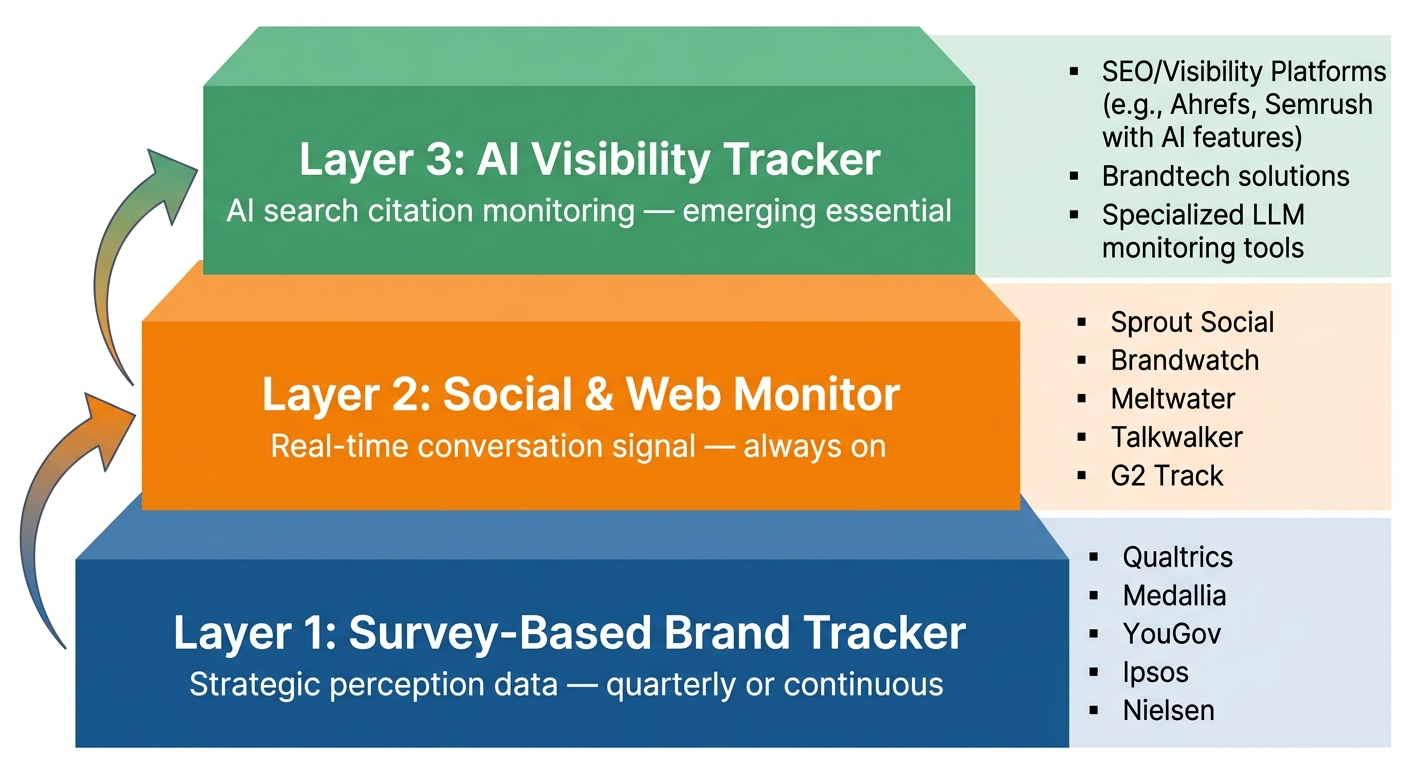
Manual approach: Run monthly audits querying ChatGPT, Perplexity, Gemini, and Google AI Overviews with category-relevant prompts. Document appearances, descriptions, and competitor presence. Tools for tracking brand mentions in AI search results can simplify this process.
Systematic approach: Use dedicated AI monitoring tools or work with an agency that combines AI citation tracking with strategic editorial placements across publications in LLM training data.
Common Mistakes When Selecting Brand Tracking Software
The selection mistake we see most often in stack audits is a team buying the tool with the most polished dashboard and then realizing, six weeks in, that it can’t answer the one question their CMO actually asks. Write that question down before any demo, and make the vendor produce the exact report against your own category. Dashboards that look great in a sales deck frequently fall apart the moment you ask them something specific.
These errors cost teams months of wasted implementation time and thousands in misallocated budget.
Buying an enterprise platform at a startup stage. If you’ve fewer than 1,000 customers and a marketing team under five people, Qualtrics or Sprinklr will be underused. Start with tools that match your current scale and upgrade when complexity demands it.
Confusing social listening with brand tracking. Social listening tells you what people say. Brand tracking tells you what people think. They overlap but aren’t interchangeable. A brand can have positive social sentiment among a vocal minority while awareness among the broader target audience remains low.
Ignoring the AI search channel entirely. As of 2026, pretending AI-generated recommendations don’t influence buyer behavior is a strategic blind spot. Even if dedicated AI tracking tools aren’t yet in your budget, running manual monthly audits takes minimal effort and prevents you from being blindsided.
Tracking too many competitors. Monitoring 30 competitors across every metric creates noise, not insight. Focus on your three to five most direct competitors for deep tracking. Use broader monitoring for directional awareness of the wider category.
Failing to act on the data. The most expensive brand tracker is the one nobody uses. Before purchasing, define who will review the data, how often, and what decisions it will inform. If you can’t answer those questions, delay the purchase until you can. For guidance on connecting brand data to competitor analysis, start there.
How Brand Tracking Connects to AI Visibility Strategy
For the per-platform walkthroughs that drive the AI side of this stack, see checking brand mentions in ChatGPT and sampling Perplexity for brand presence, and the LLM monitoring playbook covers the cross-platform cadence the software described below should support on day one.
Traditional brand tracking measures perception as it exists today. AI visibility strategy shapes how your brand is represented in the AI-generated answers that increasingly influence discovery.
These two disciplines reinforce each other:
- Brand tracking identifies gaps, low awareness in a key segment, weak associations on a critical attribute, or poor competitive positioning
- AI visibility strategy fills those gaps, strategic editorial placements on high-authority publications build the entity authority that AI models use to form brand associations
- Brand tracking measures the impact, subsequent survey waves and AI citation monitoring confirm whether the strategy shifted perception
This feedback loop turns brand tracking from a passive measurement exercise into an active growth driver. Instead of simply reporting that awareness increased by three points, you can trace that increase to specific editorial placements, AI citation improvements, and campaign activities.
Pro Insight: When evaluating brand tracking software, ask whether it can segment brand perception data by channel of discovery. Understanding whether buyers found your brand through Google search, social media, or an AI assistant answer changes how you allocate resources.
Frequently Asked Questions
What is the difference between brand tracking and brand monitoring?
Brand tracking uses surveys to measure perception metrics, awareness, consideration, preference, among representative samples of your target audience over time. Brand monitoring uses technology to scan social media, news, forums, and the web for real-time mentions and sentiment. Tracking tells you what people think. Monitoring tells you what people say.
How much does brand tracking software cost in 2026?
Costs range widely. Basic social monitoring starts at $49/month (Brand24). Mid-market survey-based trackers run $600, $1,500/month (Tracksuit, Latana, Attest). Enterprise research platforms cost $5,000, $50,000+/year (Qualtrics, Brandwatch, Kantar). Per-response models like Pollfish start at $0.95 per completed response, making costs proportional to sample size.
Can brand tracking software measure AI search visibility?
Most legacy brand tracking platforms, both survey-based and social monitoring, don’t yet measure how your brand appears in AI-generated answers from ChatGPT, Perplexity, or Google AI Overviews. Dedicated platforms for AI visibility tracking and specialized agencies address this gap, but the category is still maturing as of 2026.
How long does it take to get meaningful data from brand tracking software?
Social monitoring tools deliver data within hours. Survey-based trackers produce an initial baseline in one to four weeks. Meaningful trend data, enough to identify real perception shifts versus statistical noise, requires two to three months of tracking at minimum. Plan for at least one full quarter before making strategic decisions based on brand tracking data.
Do I need both a brand tracker and a social listening tool?
For most mid-market and enterprise brands, yes. They answer fundamentally different questions. Social listening captures real-time, organic conversation, useful for crisis detection, campaign monitoring, and competitive intelligence. Survey-based tracking captures representative perception data from your target audience, useful for awareness measurement, positioning strategy, and proving brand investment ROI. Teams that rely on only one approach have a partial picture.
How does brand tracking software relate to SEO tools like Ahrefs or Semrush?
SEO tools track branded search volume, backlinks, and organic keyword rankings. This provides a behavioral signal, how many people search for your brand name, but not a perception signal. Brand tracking software measures why people search (or don’t search) for your brand, what they associate with it, and how you compare to competitors in their minds. Tools like Ahrefs and Semrush complement brand tracking by adding a search behavior layer.
Closing the Biggest Gap in Your Tracking Stack First
Start by identifying your primary measurement gap. If you’ve strong social monitoring but no structured perception data, a survey-based tracker fills that gap. If you’ve regular survey data but can’t detect real-time sentiment shifts, add a monitoring tool. And if your brand tracking stack covers traditional channels but ignores AI search entirely, that’s the most urgent gap to close in 2026.
Before purchasing any tool, run a manual audit: query three AI assistants with your category’s most common buyer questions and document whether your brand appears. The result will tell you how much of the brand perception picture your current stack is missing.
If you want a baseline before committing to a tool or process, request a quick AI visibility audit. We’ll run 25 category-relevant prompts across ChatGPT, Perplexity, Gemini, and Google AI Overviews so you can see exactly which sources each platform trusts for your category, and which competitors are capturing citations you’re not.