
Brand mentions in AI are the new visibility layer in search, because an AI answer can shape a buyer’s decision before they ever click a result. A brand mention in AI is any time an AI system names, references, recommends, or cites your brand inside a generated answer, whether that happens in ChatGPT, Google AI Overviews, Perplexity, Gemini, Claude, or a Copilot-style assistant.
This is about visibility inside the answer itself, not classic social listening that scrapes posts and articles after the fact. A mention, a citation with a source link, and a recommendation are three different things, and the rest of this guide separates them so you can read your own AI presence accurately.
The short version: AI mentions are probabilistic, they vary by engine and by query, and they are shaped by your presence across the web more than by any single ranking lever. Once you understand the mechanism, monitoring and improvement become a deliberate exercise instead of a guess.
What Brand Mentions in AI Actually Mean
A brand mention in AI is any reference to your brand inside an AI-generated response, from a passing name-drop to a full recommendation with a linked source. The phrase covers every major surface: ChatGPT, Google AI Overviews, Gemini, Perplexity, Claude, and Copilot. What unites them is that the brand appears inside synthesized text the model wrote, not in a ranked list of blue links.
The trap is treating three distinct outcomes as one. A plain mention names you with no attribution. A citation names you and attaches a visible source link. A recommendation actively positions you as the answer to the user’s need. You can be mentioned without being linked, and linked without being recommended.
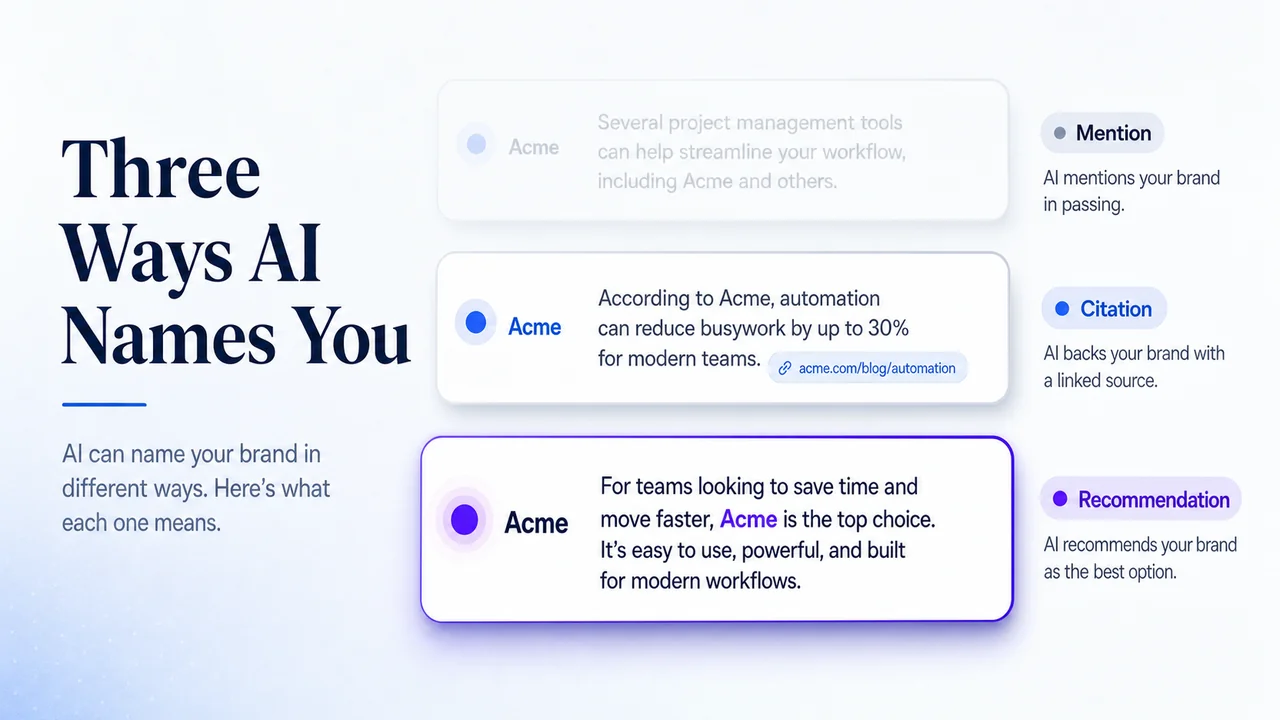
Here is a concrete example. Ask an engine “what tools track brand mentions in AI search,” and one answer might name your brand in a sentence with no link, another might name you and cite your own page as the source, and a third might list a competitor as its top pick while relegating you to an also-ran. Same brand, three very different business outcomes.
| Type | What appears | What it tells you |
|---|---|---|
| Mention | Brand name, no source link | The model knows you exist for this topic |
| Citation | Brand name plus attributed source | A specific page earned the reference |
| Recommendation | Brand positioned as the answer | The model treats you as a strong fit |
In audits, the same prompt often produces a brand mention with no source link at all, which is exactly why these terms must not be used interchangeably. If you count every name-drop as a citation, you will overstate your visibility and miss where the real gaps sit. For a fuller breakdown of the terminology, the AI visibility glossary terms spell out each distinction.
Why Brand Mentions in AI Matter
AI brand mentions matter because the answer now does the research a buyer used to do themselves. When someone asks an engine to recommend a category, the model compresses dozens of sources into a short response, and the brands it names enter consideration before any site visit happens. Being in that answer is a seat at the table. Being left out removes you from the shortlist before you knew the conversation started.
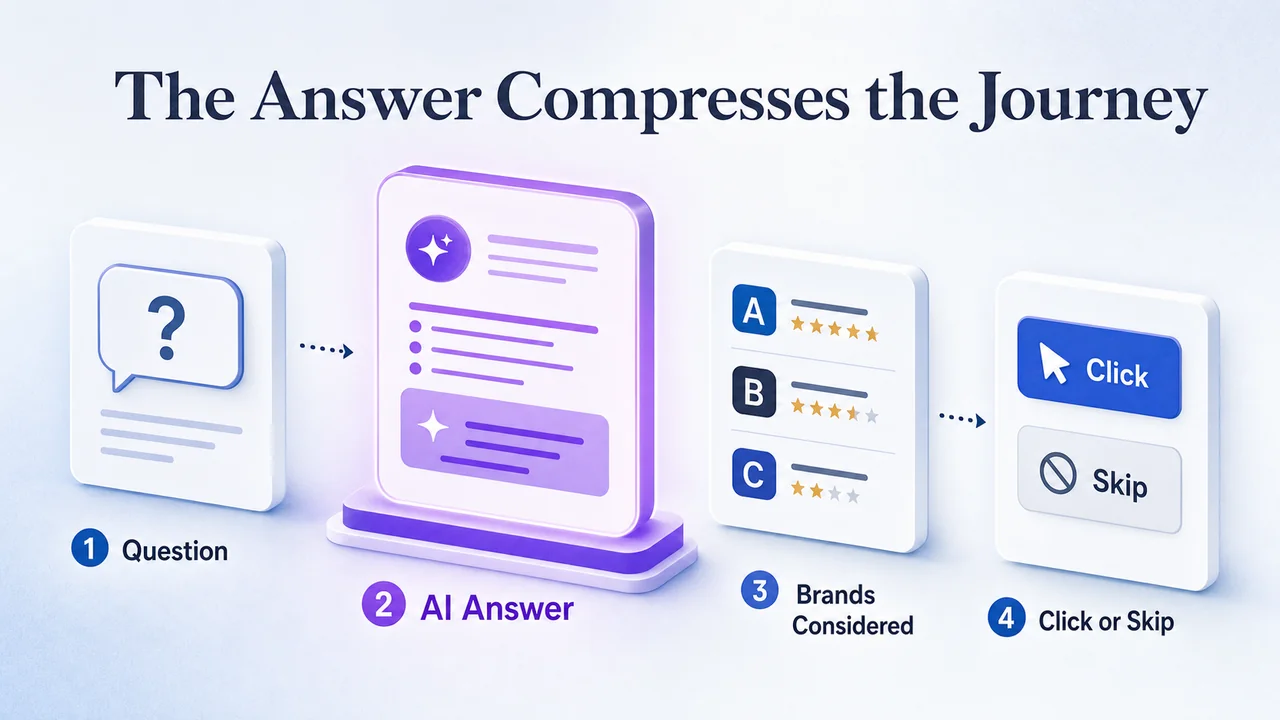
Trust rides on placement. A brand the model names with confidence borrows the assistant’s authority, while a brand the model never surfaces effectively does not exist for that query. Competitor mentions are not neutral either. Every rival named in the answer occupies space in the reader’s head that you wanted.
This connects directly to business outcomes: awareness at the top, evaluation in the middle, and pipeline influence further down. Competitive prompt tests often show two to four brands repeatedly appearing across the answer set, and that repetition can quietly define who the market treats as the leaders. AI visibility is its own layer, separate from classic SEO rankings, which is why teams that track only keyword positions miss it. If you want the distinction drawn out, see AI visibility versus SEO metrics.
How AI Systems Decide Which Brands to Mention
AI answers are synthesized from patterns across many sources, not pulled from one fixed ranking factor. That single fact explains most of the confusion teams feel. There is no scoreboard you climb. Instead, several signals combine differently for each query and each engine, and the brand that fits best surfaces. Here are the main inputs that decide whether you appear.
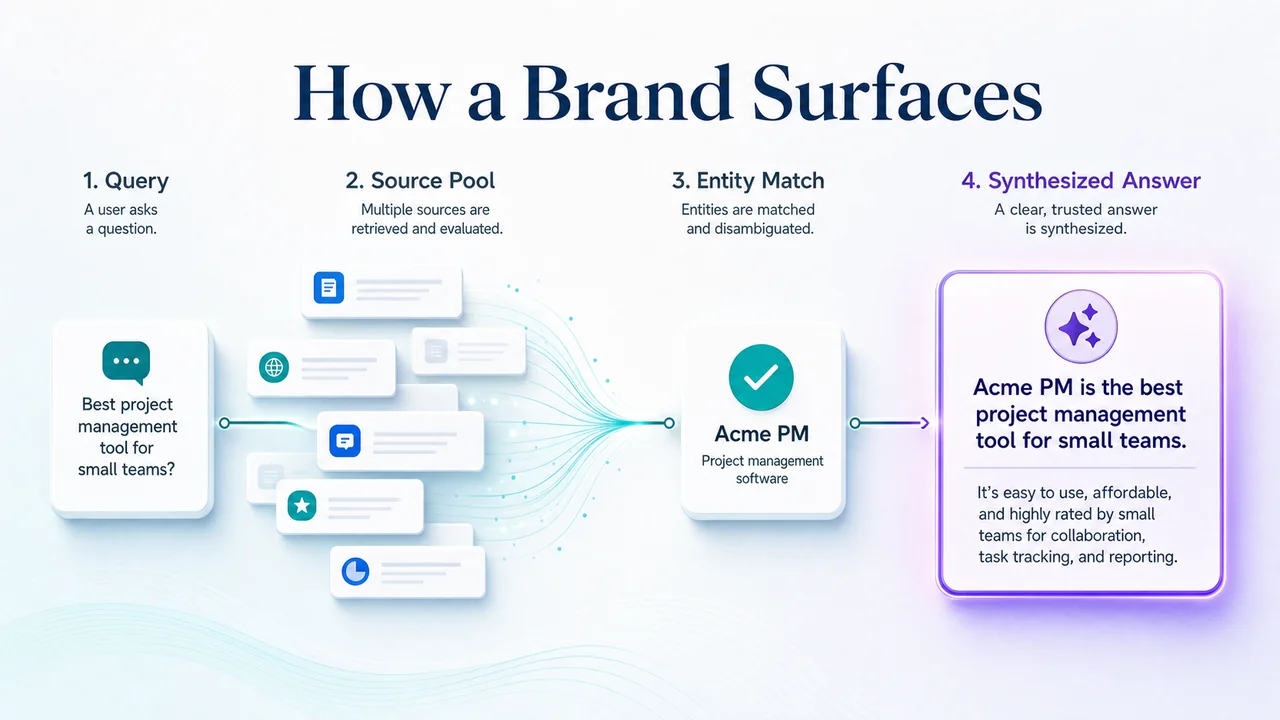
- Source selection: which pages, platforms, and domains the model treats as evidence for the query.
- Entity recognition: whether the system correctly matches your brand to the topic and tells it apart from similar names.
- Authority signals: brands with a stronger web presence and clearer topical ownership surface more often.
- Recency and prominence: in fast-moving categories, fresher and more visible coverage carries more weight.
- Query intent: comparison, informational, and recommendation prompts each trigger different brand sets.
Entity recognition deserves a flag of its own. If the model cannot reliably tell your brand apart from a similarly named company, it hedges or skips you, no matter how strong your content is. Clear, consistent naming across the web is what fixes that, and the mechanics sit in how AI crawlers pick sources.
The same brand can appear in one model and disappear in another, because each system blends its source set and interprets the query differently. That is not a bug you can patch. It is the nature of synthesized answers, and it is why measuring one engine tells you almost nothing about the others. For the deeper signal breakdown, AI citation ranking factors covers what actually moves the needle.
The Main Types of Brand Mentions in AI
Brand visibility in AI breaks into a few practical categories, and seeing the full spectrum stops you from judging your presence by linked citations alone. A name-drop with no link still counts. So does a competitor showing up where you wanted to. So does the sentiment wrapped around your name. Each category carries different business value.
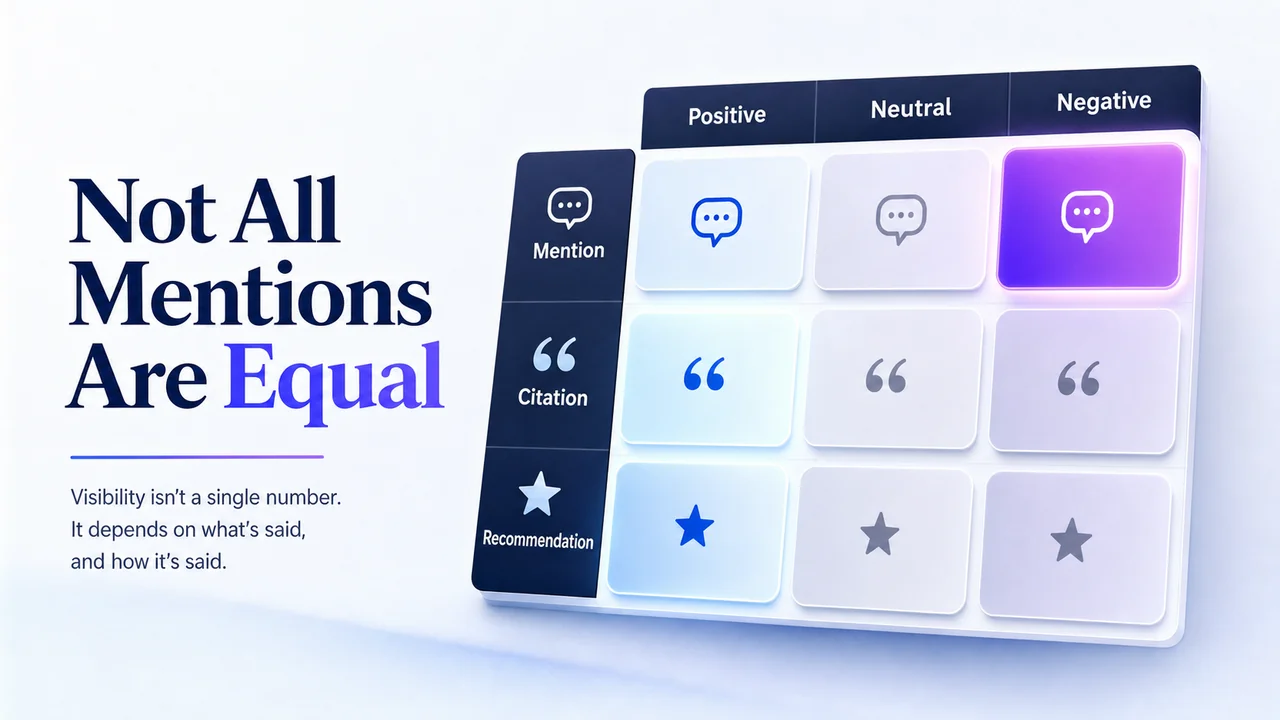
| Mention type | What it looks like | Why it matters |
|---|---|---|
| Mention without citation | Brand named, no visible source | Awareness signal, harder to trace |
| Mention with citation | Brand named, source attributed | A specific page earned trust |
| Competitor mention | Rival named instead of or ahead of you | Direct visibility loss |
| Sentiment-framed mention | Positive, neutral, or negative framing | Changes the value of the mention |
| Cross-surface mention | Present in one engine, absent in another | Coverage is uneven by design |
Sentiment is the part teams skip. A positive recommendation and a hedged, lukewarm mention both count as “you appeared,” but they pull a buyer in opposite directions. A negative or cautionary mention can do real damage while still registering as presence in a basic tracker.
Cross-surface variance is the other blind spot. Your brand can look strong in AI Overviews and weak in Perplexity, or the reverse, so a single screenshot never tells the whole story. To compare against the linked-citation question specifically, brand mentions versus backlinks is worth a read.
Common Mistakes and Misconceptions About AI Mentions
Most reporting errors come from a handful of wrong assumptions, and each one leads a team to misread its AI presence. The fixes are simple once you name the mistake.
Mistake 1: Assuming Backlinks Alone Guarantee Mentions
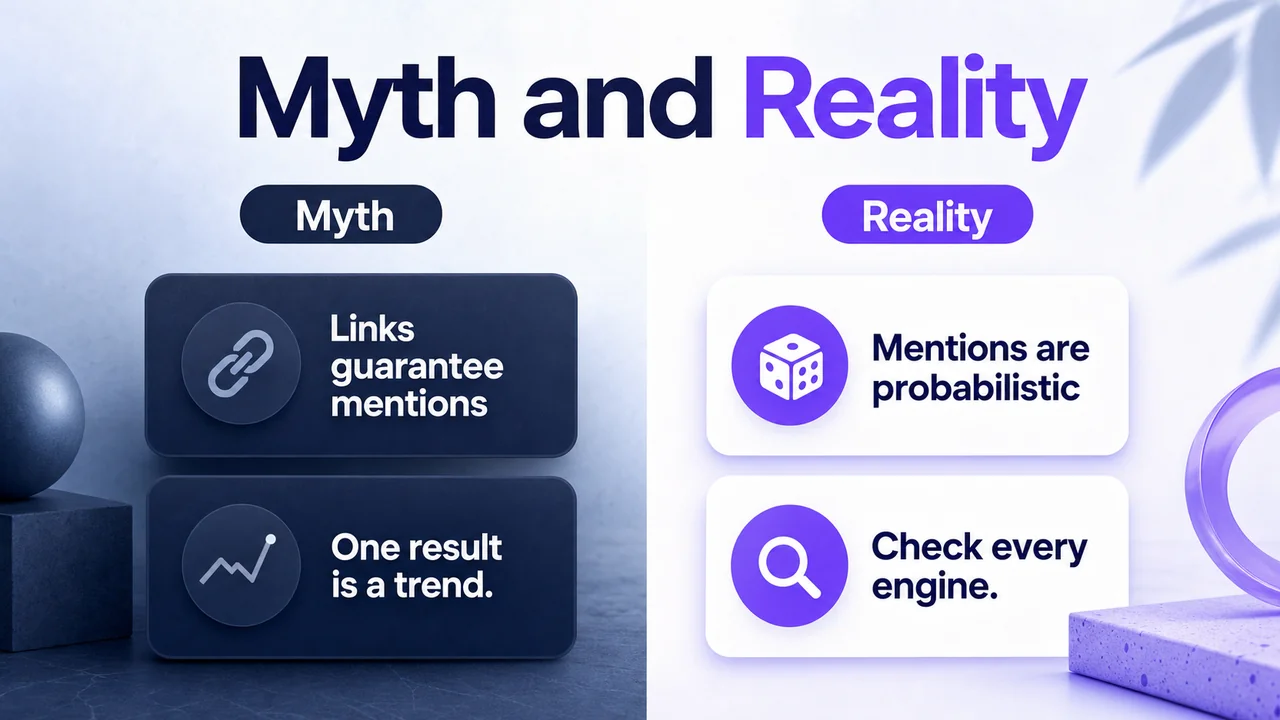
Backlinks help your overall authority, but they do not directly buy a spot in an AI answer. Models synthesize from source patterns and entity strength, so a brand with thousands of links can still be skipped if its topical ownership is unclear. Treat links as one input, not the switch.
Mistake 2: Treating AI Visibility as Fully Controllable
You influence AI mentions, you do not command them. The output is probabilistic, shaped by source ecosystems and query phrasing you do not own. Plan for ranges and trends, not guarantees.
Mistake 3: Confusing SEO Rankings With AI Answer Visibility
Ranking first in classic search does not promise a mention in the AI answer above it. The two layers overlap but run on different signals, so you measure them separately or you misjudge both.
Mistake 4: Assuming All AI Platforms Behave the Same
Each engine pulls from a different source mix and interprets prompts its own way. A strategy tuned for one surface can underperform on another, which is why coverage has to be checked engine by engine.
Mistake 5: Treating One Prompt Result as a Stable Trend
A single answer is a point-in-time snapshot, not a pattern. Re-run the same prompt across days and engines before you call anything a result. The biggest reporting error is turning one AI answer into a permanent insight.
Mistake 6: Ignoring Competitor Mentions
Reviewing only your own presence hides half the picture. If rivals appear in answers where you do not, that gap is the real finding, and it stays invisible until you track the full answer set.
If you want the foundational version of how this all fits together, how brand mentions work in AI search walks through the same mechanics from a different angle.
See where AI answers put your brand
Twenty minutes with a senior strategist: where the major engines point buyers in your category, who gets named instead of you, and a straight read on what a programme would change.
Book a strategy callWhat This Means for How You Read Your AI Presence
Brand mentions in AI are a visibility layer inside generated answers, not a social listening metric you check once a quarter. The pattern of where you appear is shaped by authority, relevance, source presence, and the exact query, and it shifts from engine to engine. Understand the mechanism first, then decide what to monitor and what to improve, because a tactic built on the wrong mental model wastes the months it takes to compound. Teams that learn the system before they chase the metric consistently make sharper calls about measurement and priority.
Frequently Asked Questions
What are brand mentions in AI?
Brand mentions in AI are any instance where an AI system names, references, recommends, or cites your brand inside a generated answer. They appear across ChatGPT, Google AI Overviews, Gemini, Perplexity, Claude, and Copilot. Unlike traditional social listening, they live inside the synthesized response a model writes, which makes them a visibility layer rather than a scraped record of past coverage.
What is the difference between an AI mention and an AI citation?
An AI mention names your brand with no source attached, while an AI citation names your brand and attaches a visible source link. A mention signals the model associates you with the topic. A citation means a specific page earned the reference. You can be mentioned without being cited, so counting every name-drop as a citation will overstate your real visibility.
Do backlinks help brand mentions in AI?
Backlinks support your overall authority, but they do not directly guarantee an AI mention. Models build answers from source patterns and entity strength rather than a raw link count, so a heavily linked brand can still be skipped if its topical ownership is unclear. Treat links as one contributing signal among several, not the deciding lever.
Why does my brand show up in Perplexity but not ChatGPT?
Each engine blends a different set of sources and interprets the same prompt its own way. Perplexity leans heavily on live retrieval and visible citations, while other assistants weight their training data and source mix differently. That divergence is normal, which is why a strong showing in one surface tells you little about the others and you should check each engine on its own.
How can I see if AI mentions your brand?
Start by asking each engine your top buying questions and reading the full answer for your name, your competitors, and the sentiment around each. Run the same prompt across several days and several engines, since one result is a snapshot, not a trend. Compare mentions, citations, and outright omissions side by side to find where the real gaps sit.
Brand mentions in AI are not magic and they are not fully controllable, so the honest move is to measure before you act. Ask ChatGPT, Perplexity, Gemini, and AI Overviews your most important buying question and read whether your brand, or only your competitors, gets named. Compare your mentions, citations, and omissions across every engine before you try to influence them. See where your brand stands in AI search, and let the gaps tell you where to start.