
Yes, brand mentions can influence visibility in AI search, but they usually do it indirectly by helping systems recognize, trust, and select your brand as a source. They are not a switch you flip.
Brand mentions raise the odds that an AI engine knows your brand exists, treats it as a credible entity, and pulls it into a generated answer, though they work alongside authority, relevance, and source trust rather than replacing them. The honest version of the answer matters here, because most coverage either overstates mentions as the single dominant factor or dismisses them as a vanity signal. Neither holds up against what the research actually shows.
You can measure this for your own brand in a few minutes with the free AI visibility checker.
This is an evidence-based read on how strong that influence appears to be relative to rankings, backlinks, and domain authority, so you can decide where mentions sit in your own priorities.
What Brand Mentions Mean in AI Search
A brand mention in AI search is any textual reference to your brand that an AI system can read, retrieve, or cite, whether or not it carries a link. That definition is broader than the SEO version most teams carry over from link building, and the breadth is the point.
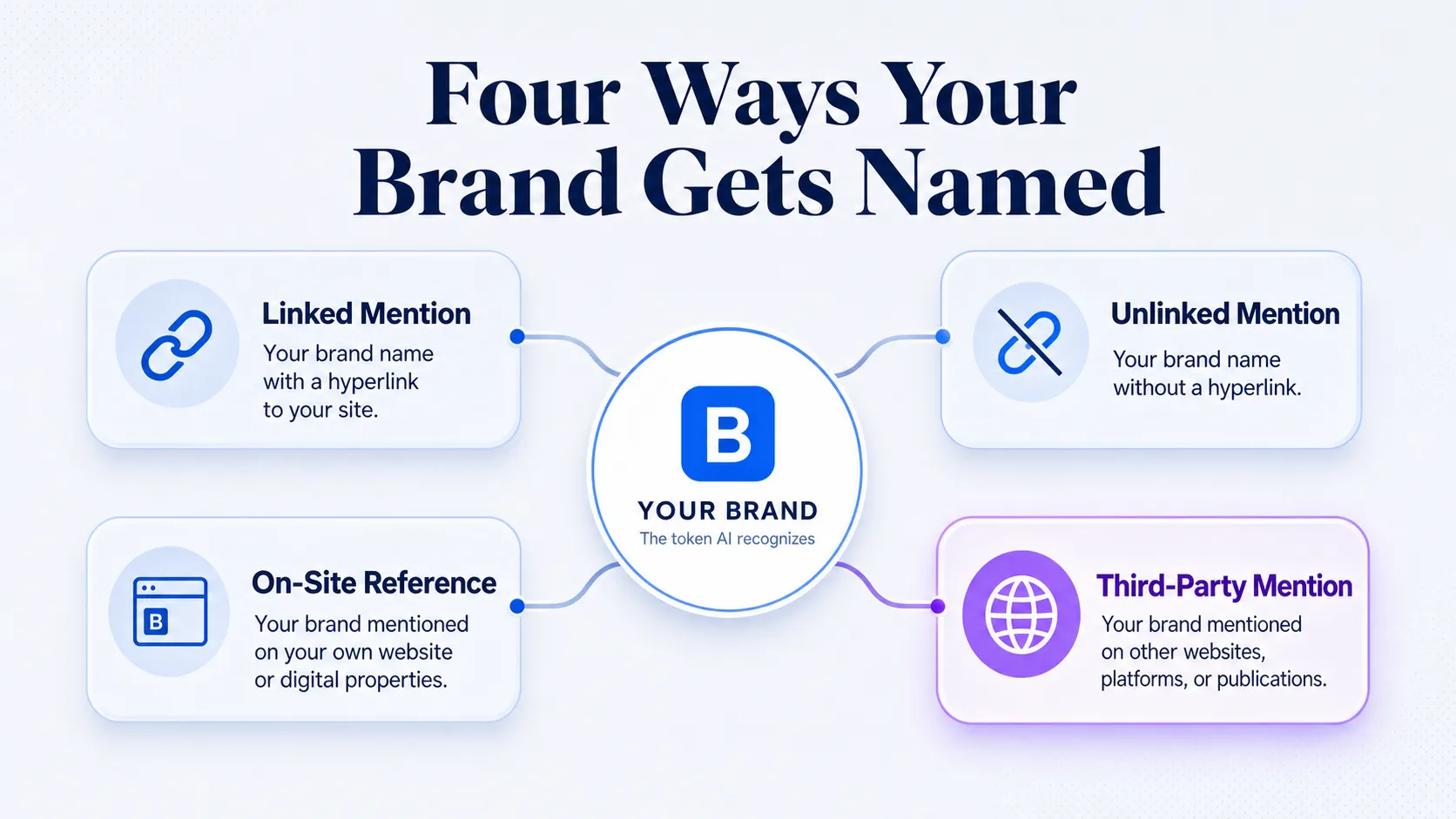
The split that matters most is linked versus unlinked. A linked mention names your brand and points to your site. An unlinked mention names your brand in plain text with no hyperlink at all. Traditional search leaned hard on the link, because the link was the vote. AI systems read language, so they can use the unlinked mention too: the words around your brand name tell the model what you do and who you serve, no link required.
The second split is where the mention lives. On-site references sit on your own pages and tell AI engines, in your own words, what your brand is. Third-party mentions appear in editorial articles, community threads, review sites, and social platforms that the model may treat as outside validation. A brand that describes itself well but is never named anywhere else looks thin to an engine weighing whether to trust it.
One thing to keep straight: a mention is not a citation, a backlink, or a ranking position. A citation is the engine choosing to credit a source in its answer. A backlink is a link earning ranking equity. A mention is the raw reference that sits upstream of both. The practical reality is that two mentions of the same brand can carry wildly different value depending on where they appear, which is why volume alone tells you almost nothing. To go deeper on the link question, see brand mentions for SEO.
What Visibility in AI Search Actually Means
Visibility in AI search is the degree to which your brand appears, gets cited, gets recommended, or gets summarized inside AI-generated answers across engines like ChatGPT, Google AI Overviews, Gemini, and Perplexity. It is not a blue-link ranking, and treating it like one leads you to track the wrong things.
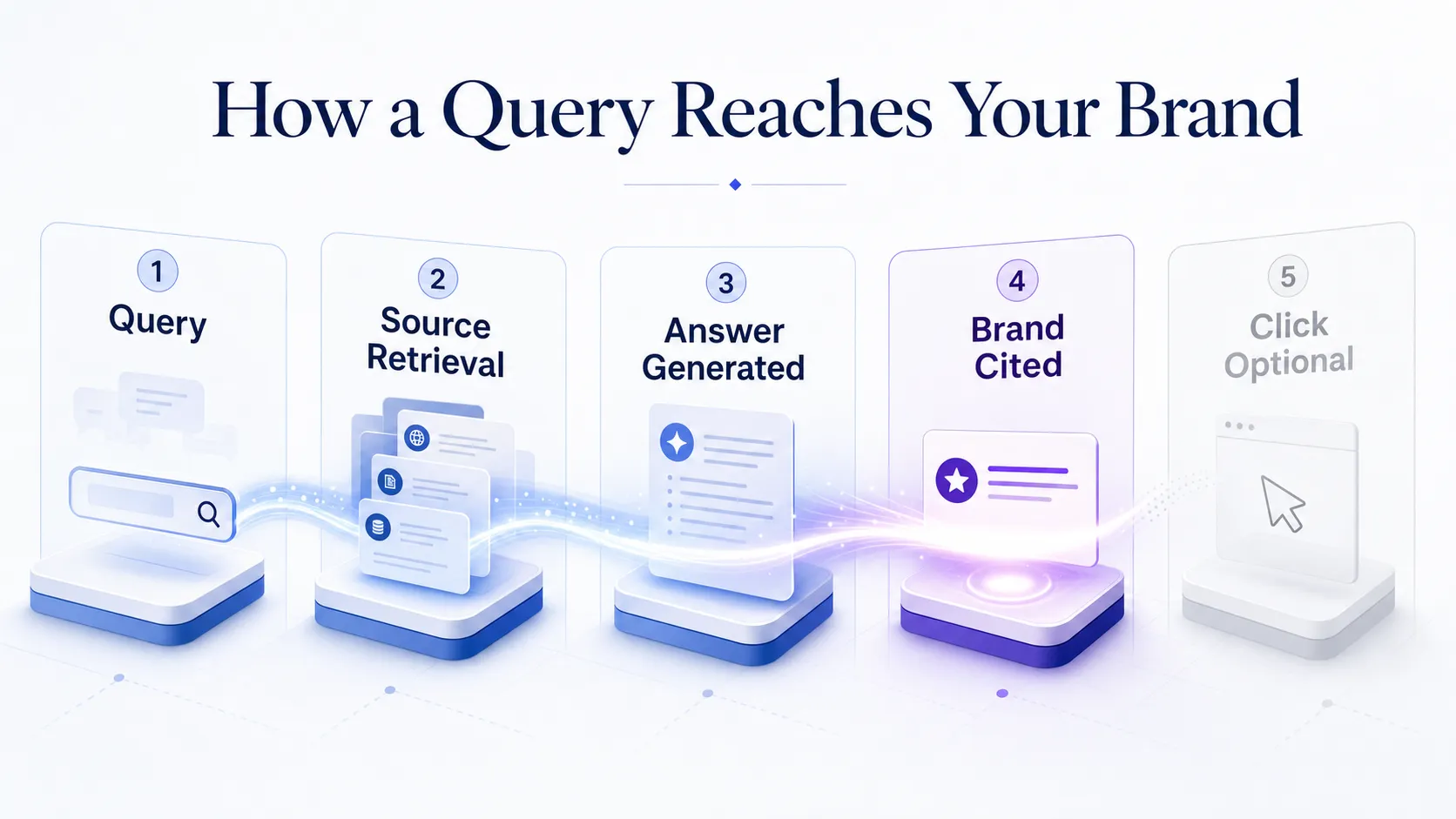
A brand can gain visibility without earning a single click. When an AI answer satisfies the question directly, the user reads your brand name, absorbs the framing, and never visits your site. That is the zero-click reality of AI search, and it reshapes what success looks like. You measure presence and framing, not just sessions.
Visibility also varies by engine, prompt type, and answer format. The same brand can be named in Perplexity and absent in Gemini for the same question, because each engine retrieves and ranks sources differently. Query type matters just as much. Informational prompts pull broad source sets, comparative prompts surface a shortlist of named options, and branded navigational prompts behave almost like a lookup.
A practical pattern shows up repeatedly: teams see citation growth before traffic growth, especially in zero-click environments, so judging early progress by clicks alone hides the wins. For a fuller breakdown of what to track, see AI visibility versus SEO metrics.
Why Brand Mentions Matter for Discovery and Trust
Brand mentions matter because they teach AI systems to recognize your brand as an entity, not just a keyword string. An entity is a thing the model understands as a distinct, real-world subject with attributes and relationships. The more your brand is named in clear, category-relevant contexts, the more confidently a model can place you in the right slot when a question fits.
Trusted third-party mentions do something a brand cannot do for itself: they reduce the model’s uncertainty. When a brand only describes itself, the engine has one self-interested source. When credible outside sources name the same brand the same way, the model gets corroboration, and corroboration is what lowers the risk of surfacing you in an answer.
Consistency across credible sources raises the chance of inclusion. This is where discovery, category association, and memorability connect. A brand named again and again as a strong option in its category becomes the easy answer for the model to reach for.
The strategic implication is blunt: brands that are consistently talked about in the right places are easier for AI systems to surface. We see the pattern often, where a brand with thin owned content but strong, repeated third-party coverage shows up in AI answers more than its own site would predict. The mentions did the recognition work the site could not.
Which Mention Types Matter Most and Why Source Quality Wins
Not every mention pulls the same weight. Source quality, topical relevance, and surrounding context decide a mention’s value far more than raw volume does. One high-quality editorial mention can outperform a cluster of low-quality, context-light mentions, and that single fact reshapes how you should spend effort.
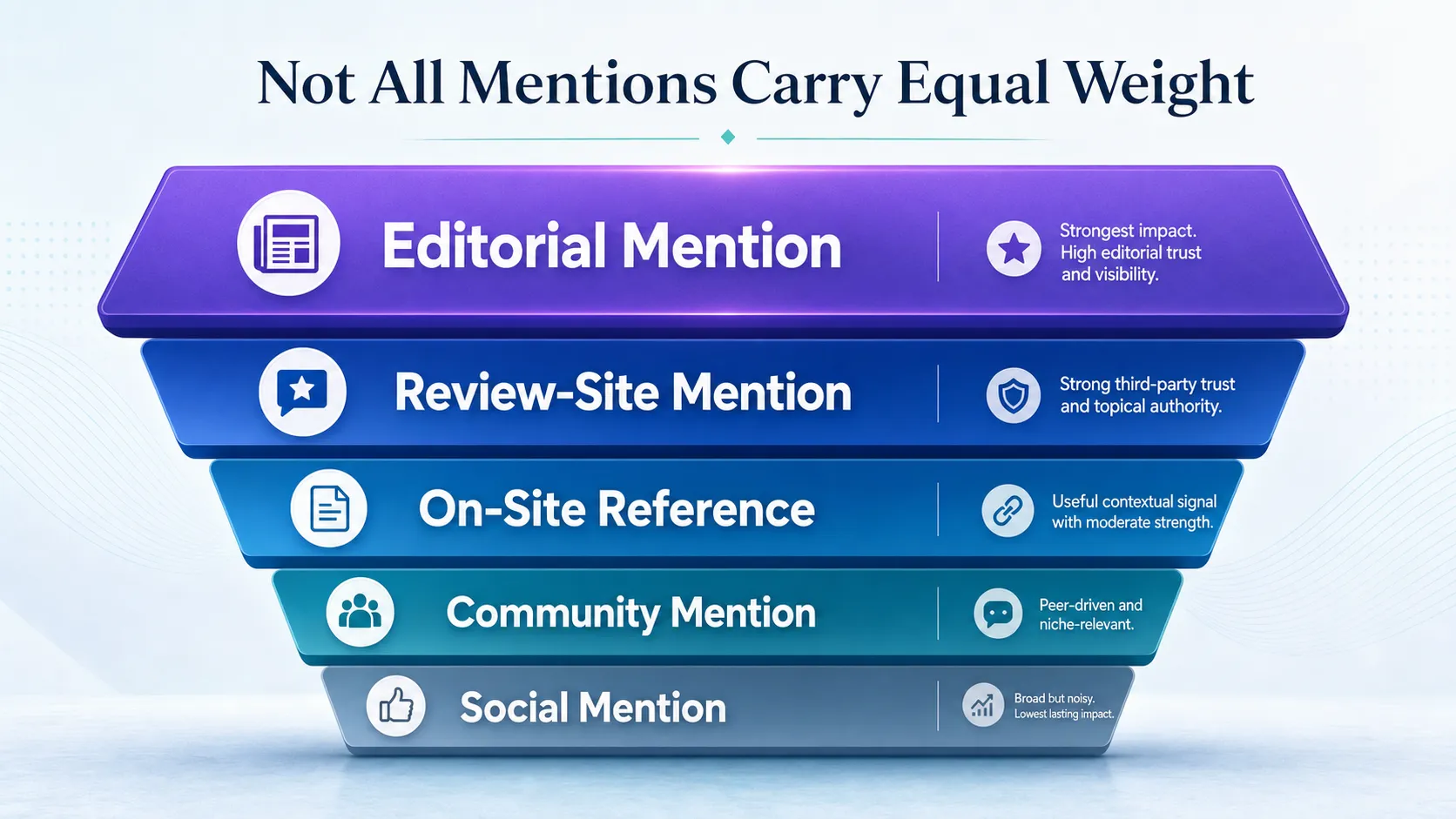
The table below ranks the main mention types by how much they typically move AI visibility, along with the trust and context each one carries. Treat it as a guide to where attention pays off, not a fixed law, since engines weigh sources differently.
| Mention type | Likely value for AI visibility | Why |
|---|---|---|
| Editorial mention | Strongest | Combines relevance, context, and outside trust in one place |
| Review-site mention | High for product categories | Carries comparative trust where buyers weigh options |
| On-site reference | Moderate | Clarifies your entity and gives crawlable context, but is self-reported |
| Community and forum mention | Variable | Strong for long-tail discovery and buyer language, inconsistent in quality |
| Social mention | Weaker as a direct signal | Reinforces awareness, but rarely cited unless widely indexed |
Editorial mentions usually win because a credible publication naming your brand in the right context bundles three things the model wants at once. Review-site mentions punch above their weight in categories where buyers compare options, because that comparative framing is exactly what comparative prompts surface. On-site references still earn their place: they give the engine your own clear account of who you are, which helps entity clarity even though the engine knows you wrote it.
Community and forum mentions are the wild card. They carry real buyer language and surface long-tail discovery, but quality swings hard from thread to thread. Social mentions reinforce awareness and can feed the broader picture, yet on their own they rarely act as a direct AI visibility signal unless they are widely cited or indexed. If you are chasing the unlinked ones specifically, here is how to find unlinked brand mentions quickly.
How AI Systems Likely Use Brand Mentions
AI systems appear to use brand mentions through a mix of retrieval, ranking, source selection, and entity understanding, not as a single ranking factor you can isolate. The honest framing is that mentions are one input into a system, and overstating the mechanism into a tidy cause-and-effect story misleads more than it helps.
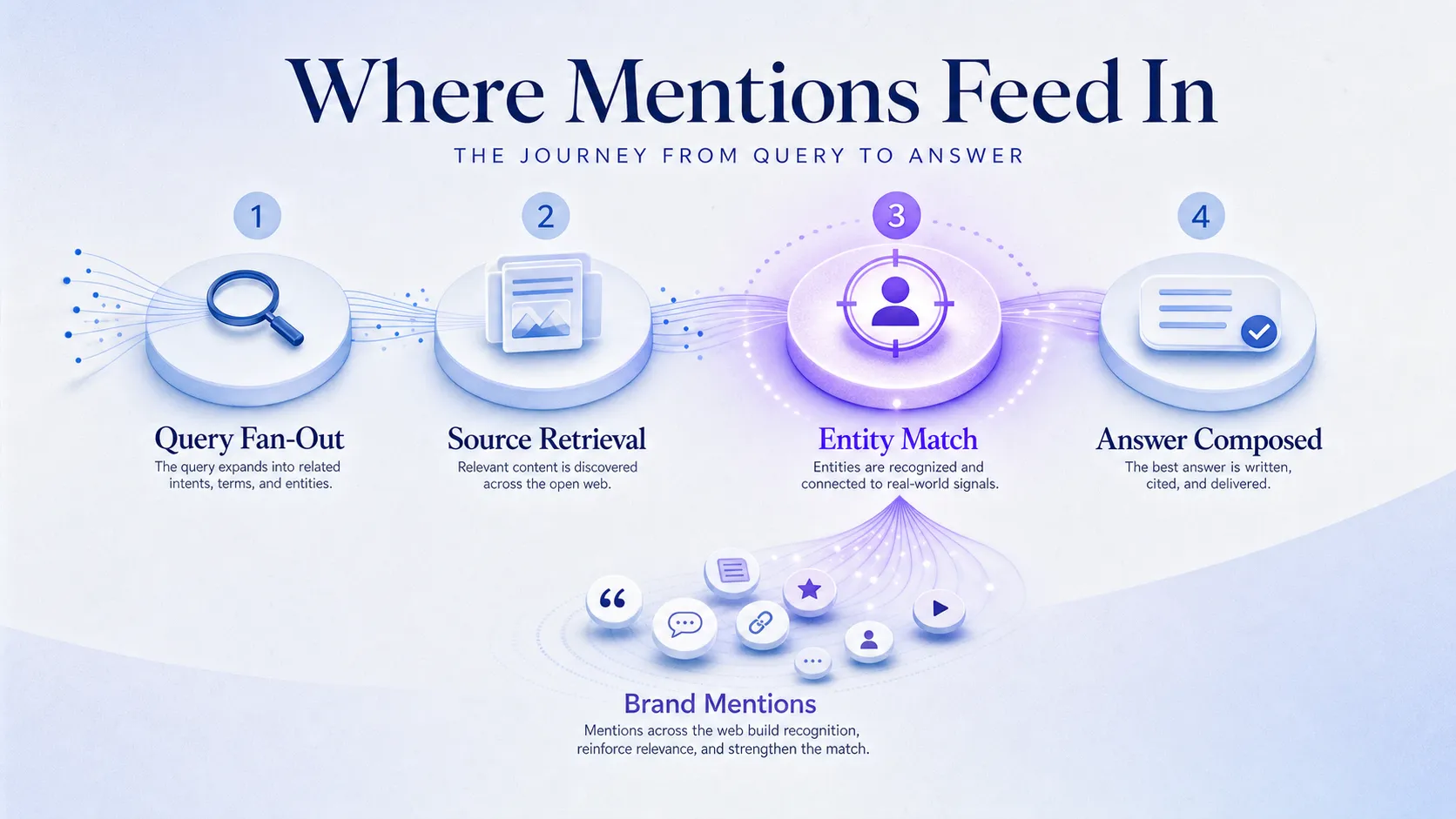
Walk it through stage by stage so the role of mentions is clear.
Step 1: The Query Fans Out
A single question often expands into several related sub-queries before the engine looks for sources. This query fan-out means your brand can be matched against more angles than the literal question, so the contexts you are mentioned in matter more than one exact phrase.
Step 2: Sources Get Retrieved and Ranked
The engine pulls a set of candidate sources and ranks them by relevance and trust. Mentions in retrievable, frequently indexed, credible places are the ones that can enter this pool. A mention in a page no engine reaches does nothing here.
Step 3: The Model Matches Your Brand as an Entity
This is where repeated mentions earn their keep. Consistent references across the right category contexts strengthen the model’s confidence that your brand belongs to a given topic, which makes you easier to connect to the question correctly.
Step 4: The Answer Gets Composed
The model writes the answer and may name or cite the brands it trusts most for that query. Topical alignment decides a lot here: a brand mentioned in the right category context is far easier to surface than one mentioned in unrelated places.
Because of query fan-out and source aggregation, the same brand can appear differently across engines and prompts, which is why a single absence is not a verdict. Brands with clear category language and consistent off-site mentions tend to get classified correctly, and correct classification is what gets you named. Building entity authority for 2026 search is the longer game underneath this step.
What the Evidence Suggests
The evidence points one direction: branded web mentions tend to correlate strongly with AI visibility, often more strongly than raw backlink volume or page count. That is a meaningful finding, and it is also a correlation, not proof that mentions cause citations. Holding both of those at once is the whole discipline of reading this research well.
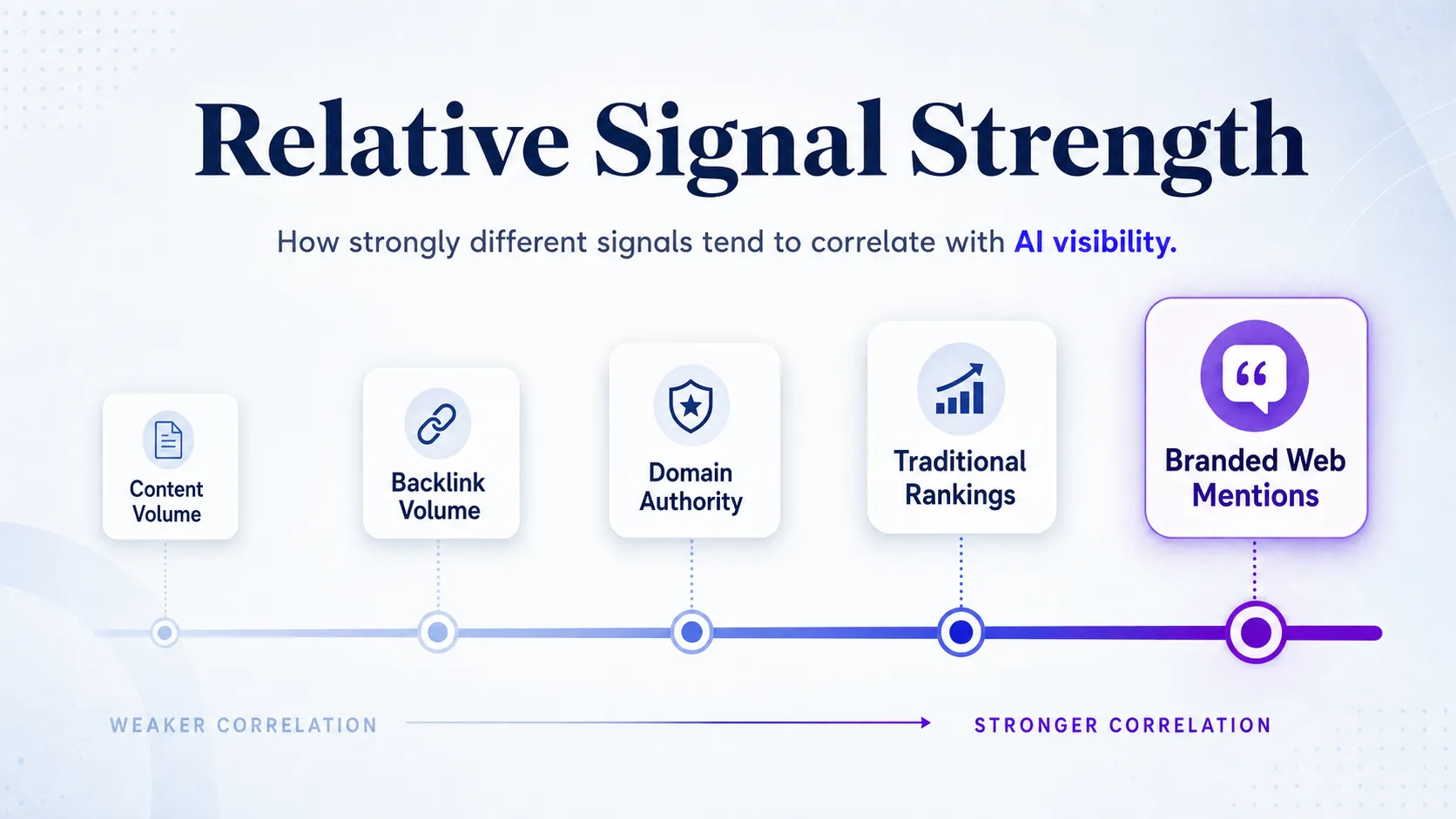
Set the signals side by side. Branded web mentions sit near the top of the correlation tables. Backlink volume and sheer page count sit lower and behave more inconsistently, which lines up with what practitioners see: piling on more links or more pages alone rarely moves AI visibility much. Traditional rankings and authority signals still matter, especially inside Google-related AI features that draw on core search systems, so this is not a story about rankings becoming irrelevant.
The limits deserve naming, because they shape how far you can trust any single study. Many studies filter to higher-authority sites, which leaves out smaller brands by design. Engines differ from one another. Industry concentration skews samples, and the models themselves keep changing, so a 2026 correlation may not hold next quarter. The recurring pattern across studies and hands-on audits is consistent though: brand mentions often outperform link volume alone, but they rarely beat the combination of strong authority and strong topical relevance. For the head-to-head, see brand mentions versus backlinks.
Common Mistakes, Strategic Implications, and the Direct Answer
The misreadings here cost teams real time, so address them head-on before translating any of this into action.
Mistake 1: Treating Backlinks as the Only Signal That Counts
Backlinks are not the only signal, and they are not irrelevant either. The truth sits in between. Links still feed ranking and authority, which still feed Google-related AI features, but link volume alone is a weak predictor of whether an engine names you.
Mistake 2: Assuming Every Mention Is Worth the Same
A mention’s value depends on its source, its context, and its topical fit. One editorial mention in a credible, category-relevant publication outweighs a pile of throwaway references. Counting mentions without weighing them produces a flattering number that predicts nothing.
Mistake 3: Believing More Mentions Automatically Mean More Visibility
Volume is not the lever you think it is. Engines weigh quality and relevance, so chasing raw mention counts can leave you busier and no more visible. Aim for credible, context-rich mentions in places engines actually retrieve.
Mistake 4: Expecting Mentions to Rescue Weak Content or Authority
Mentions cannot paper over thin content, muddy entity signals, or low authority. If a model recognizes your brand but your own pages give it nothing clear to work with, the recognition stalls. Mentions amplify a solid foundation; they do not build one.
The practical takeaway flows straight from those four. Earn credible, context-rich mentions in places AI engines retrieve. Keep your brand and entity naming consistent everywhere you appear, so the model never has to guess whether two references are the same company. Support those mentions with crawlable content that states clearly who you are and what you do. And measure visibility across multiple AI engines, because a single engine’s view is a partial one. For the mechanics of watching this across platforms, see how to track brand mentions across AI search platforms.
So, the direct answer one more time: yes, brand mentions impact AI search visibility, but as part of a broader trust-and-authority system rather than a standalone switch. AI visibility improves fastest when mentions, authority, and content quality all point in the same direction.
The Correlation Data: What 2026 Research Actually Shows
Ahrefs studied 75,000 brands across ChatGPT, Google AI Mode, and Google AI Overviews and published the strongest available correlation data on what predicts AI mention frequency. The findings are more specific than most SEO advice acknowledges:
- YouTube mentions: 0.737 correlation — the single strongest predictor of AI search visibility, outperforming every other signal studied across all three platforms.
- Branded web mentions: 0.66–0.71 correlation — consistently among the top signals across ChatGPT, AI Mode, and AI Overviews.
- Brands in the top 25% for web mentions get 10x more AI visibility than brands in the bottom 75%.
- The top 50 brands account for 28.9% of all AI Overview mentions — concentration is high, meaning modest mention-building activity moves you past the majority of competitors.
How the Platforms Handle Mentions Differently
The same brand mention has different effects depending on which AI system processes the query — and understanding the difference changes where you should focus:
- Gemini mentions brands in 83.7% of responses but generates a citation link only 21.4% of the time — it surfaces brands often but rarely credits the source page directly.
- ChatGPT cites sources 87% of the time but names specific brands in only 20.7% of answers — when it names you, it nearly always links, but the bar for naming you is higher.
- Perplexity combines aggressive citation behavior with deep real-time web retrieval, making it the platform most sensitive to content recency and freshness signals.
One finding that reframes content strategy: pages updated within the past two months earn 28% more AI citations than older content, and content with statistics, citations, and specific data achieves 30–40% higher AI visibility. AI retrieval systems weight fresh, evidence-backed content heavily when deciding what to surface — and passively-maintained pages lose that advantage over time.
Brands with both mentions AND citations in AI answers are 40% more likely to resurface across consecutive queries — the compounding advantage of dual presence as both a referenced entity and a cited source.
Five Ways to Increase Your AI Citation Probability
- Earn brand mentions on high-authority, topically relevant domains. Source domain authority and topical relevance both matter. A mention in a dedicated industry publication outweighs ten mentions on general-purpose blogs in AI retrieval ranking.
- Publish content with specific statistics and original data. Content with citations, statistics, and specific claims achieves 30–40% higher AI visibility. Vague generalities are rarely cited; specific, verifiable claims frequently are.
- Create YouTube presence covering your category. The 0.737 YouTube-to-AI-visibility correlation is the clearest single finding from the 75,000-brand study. Brands with YouTube content discussing their category appear disproportionately in AI answers, even when users never watch the video — YouTube mention signals alone improve AI citation rates.
- Refresh high-priority pages regularly. Given the 28% citation premium for content updated in the past two months, establish a refresh cadence for your most important pages — substantive content updates, not just timestamp changes.
- Pursue editorial mention-building alongside content publishing. The fastest path to AI visibility is being cited in sources that AI systems already trust and retrieve from — industry publications, comparison platforms, high-authority review sites. Done-for-you brand mention building focuses specifically on this — earning the editorial citations that move AI and organic visibility in parallel.
Frequently Asked Questions
Are unlinked brand mentions important for AI search?
Yes, unlinked brand mentions matter for AI search, because AI systems read language rather than counting links. When your brand is named in plain text inside credible, category-relevant content, the surrounding words tell the model what you do and reinforce its recognition of you as an entity. The link adds ranking equity, but the mention alone still feeds entity understanding.
Do brand mentions matter more than backlinks?
For AI visibility specifically, branded web mentions tend to correlate more strongly than raw backlink volume, though this is correlation, not a clean cause. Backlinks still carry weight for ranking and authority, which feed Google-related AI features. The sharper way to put it: mentions often beat link volume alone, but neither beats strong authority paired with strong topical relevance.
How do you track brand visibility in AI search?
You track it by querying the engines that matter to your category with the prompts your buyers actually use, then recording whether and how your brand appears across them. Say you sell project software to agencies. You would run your top buying questions through ChatGPT, Gemini, and Perplexity on a set cadence, note where you are named, cited, or recommended, and watch how that framing shifts over time rather than relying on click data alone.
What brand signals most strongly correlate with AI mentions?
Branded web mentions consistently sit near the top of the correlation tables, alongside established brand-strength signals. Backlink volume and sheer content volume correlate weakly and inconsistently. Traditional rankings and domain authority still register, especially in Google-related AI features, so the strongest position combines recognized mentions with real topical authority.
Do citations still matter in AI search?
Yes, citations still matter, but mostly as validation and discovery support rather than the primary driver of whether a brand surfaces. A citation is the engine choosing to credit a source in its answer, which lends credibility and can send a click. Mentions sit upstream of that, shaping recognition before any citation decision is made.
Brand mentions move AI visibility, but only when they land in trusted places, match your category, and sit on top of content and authority that hold up. Chase recognition in the right rooms, keep your naming consistent, and judge progress by where you appear across engines, not by clicks alone. Book a strategy call and compare your mentions against your rankings, backlinks, and citations to find what is actually driving the results.