
If your brand shows up less often than competitors in the places buyers look, share of voice tells you how far behind you are. Share of voice is the percentage of total category visibility your brand owns compared with rivals, measured as your brand’s metric divided by the category total. It started as a media-spend metric and now stretches across PR, social, organic search, and paid media. This guide explains what it means, how the formula works in each channel, where it misleads people, and why a clean baseline beats a flashy number.
What Share of Voice Means
Share of voice measures how much of a category’s total attention your brand captures against competitors, expressed as a percentage. The metric is always relative. A 20% share means nothing until you know whose 80% sits across from you.
The classic definition is narrow. Share of voice once meant your slice of category advertising spend in a given market and time period. Spend $100 million in a category that spends $1 billion total, and your share of voice is 10%. Media planners still use it this way to gauge competitive weight. The newest line in that spend calculation is advertising inside ChatGPT, billed per impression or click and matched to conversation context rather than keywords.
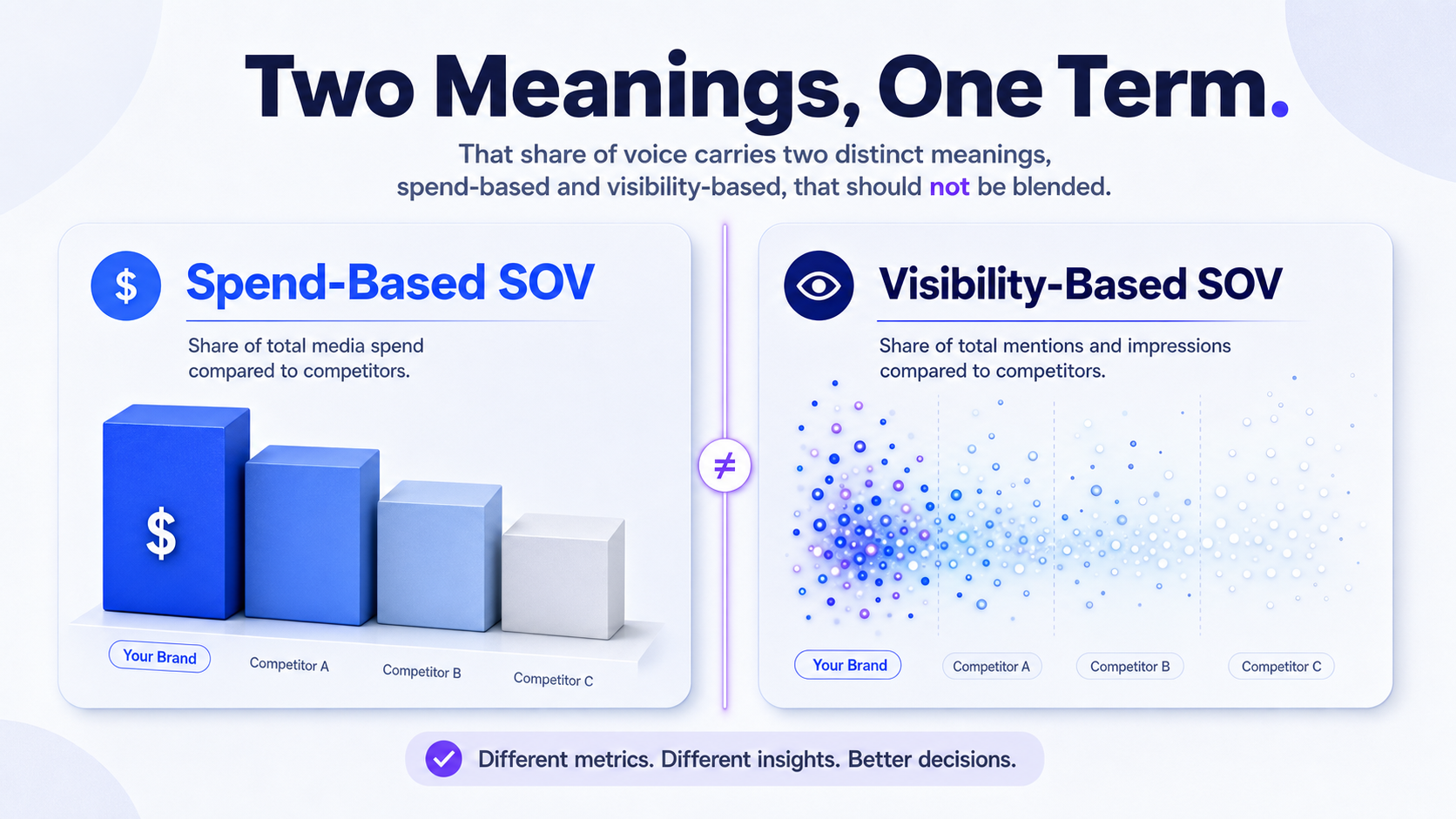
The modern definition is broader. Today share of voice usually means your share of mentions, impressions, search visibility, or conversation against rivals. The strategic idea holds steady across both versions: how loud are you relative to the people you compete with? What changes is the unit you count.
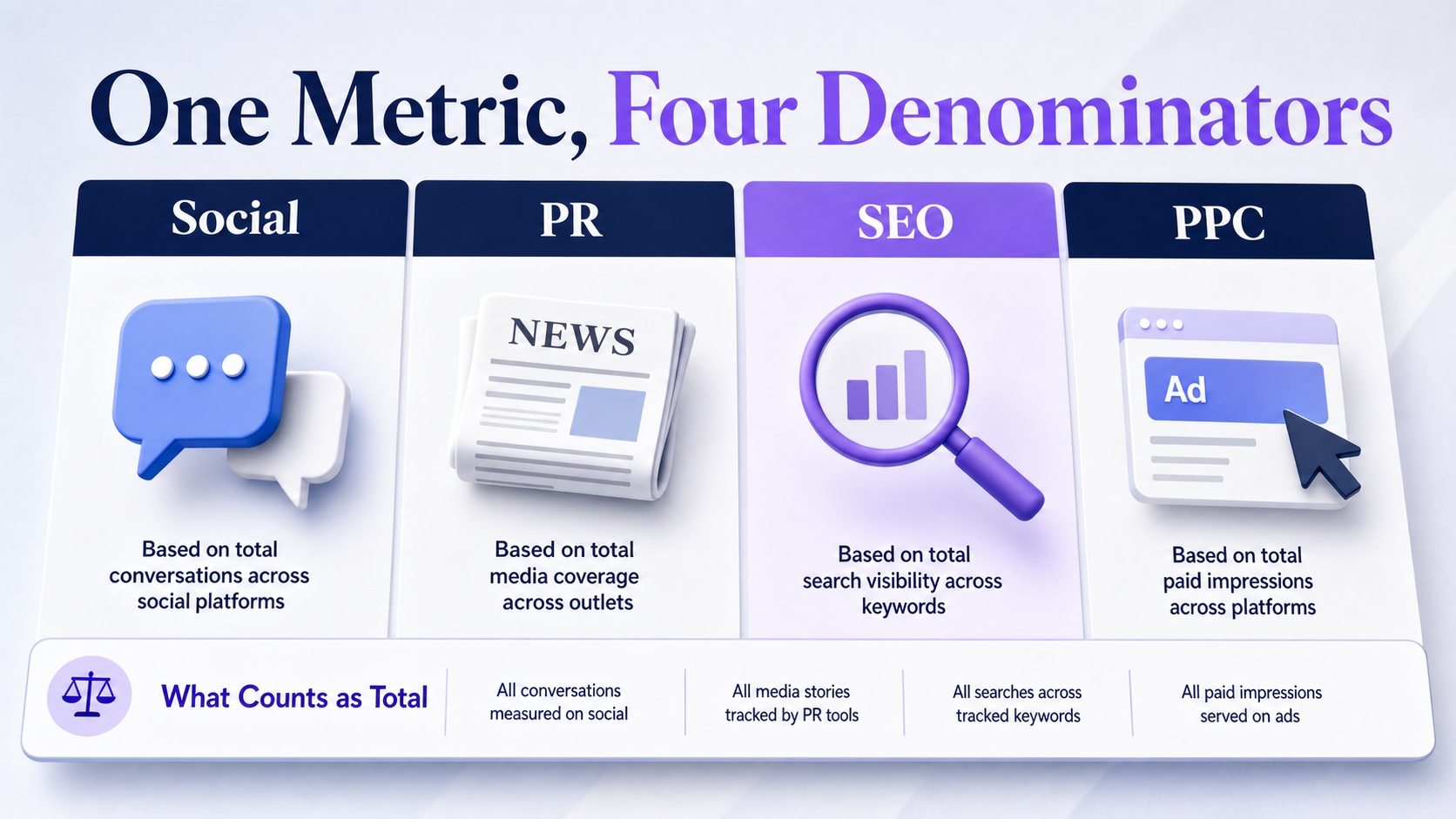
Here is where most teams get sloppy. They use one term, share of voice, to describe four different measurement methods, then compare numbers that were never built the same way. A social mention count and a paid impression share are both called share of voice, but they answer different questions and cannot be averaged into one figure.
Why Share of Voice Matters
Share of voice tells you whether your brand is winning or losing attention before slower metrics like traffic or pipeline catch up. That early-warning quality is the main reason marketers track it.

It earns its place in four ways:
- Competitive benchmarking: you see your visibility against a defined peer set, not against a vague sense of how things feel.
- Campaign evaluation: a launch, a PR push, or a paid burst either moved your share or it did not, and the number shows which.
- Reputation monitoring: a sudden spike or drop, yours or a competitor’s, surfaces fast enough to act on.
- Brand awareness signal: share of voice tends to move before branded search and pipeline shift, so it reads as a leading indicator.
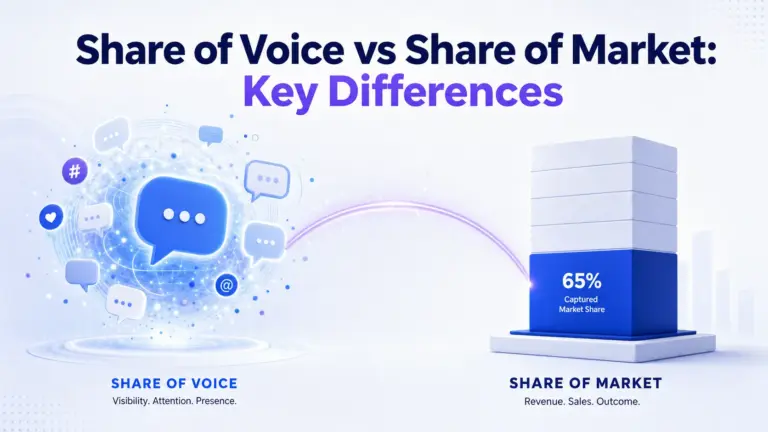
The relationship with share of market is real but not a fixed rule. Brands that hold a share of voice above their market share often grow, and brands sitting below it often slip. The link is directional, not a guarantee, and it varies by category, budget, and how crowded the space already is. Treat it as a pattern worth watching, not a formula that prints revenue. For the full breakdown of where the two metrics overlap and where they part, see our piece on how share of voice and market share differ.
One thing we see often: share of voice moves first. Visibility often shifts before branded search volume or pipeline data confirms it, which is exactly why it earns a spot on a tracking dashboard rather than a quarterly review.
How the Share of Voice Formula Works
The formula is your brand’s metric divided by the total category metric, multiplied by 100. If your brand earned 500 mentions in a month and the full competitive set earned 5,000, your share of voice is 10%. Simple math, but the inputs decide whether the answer means anything.
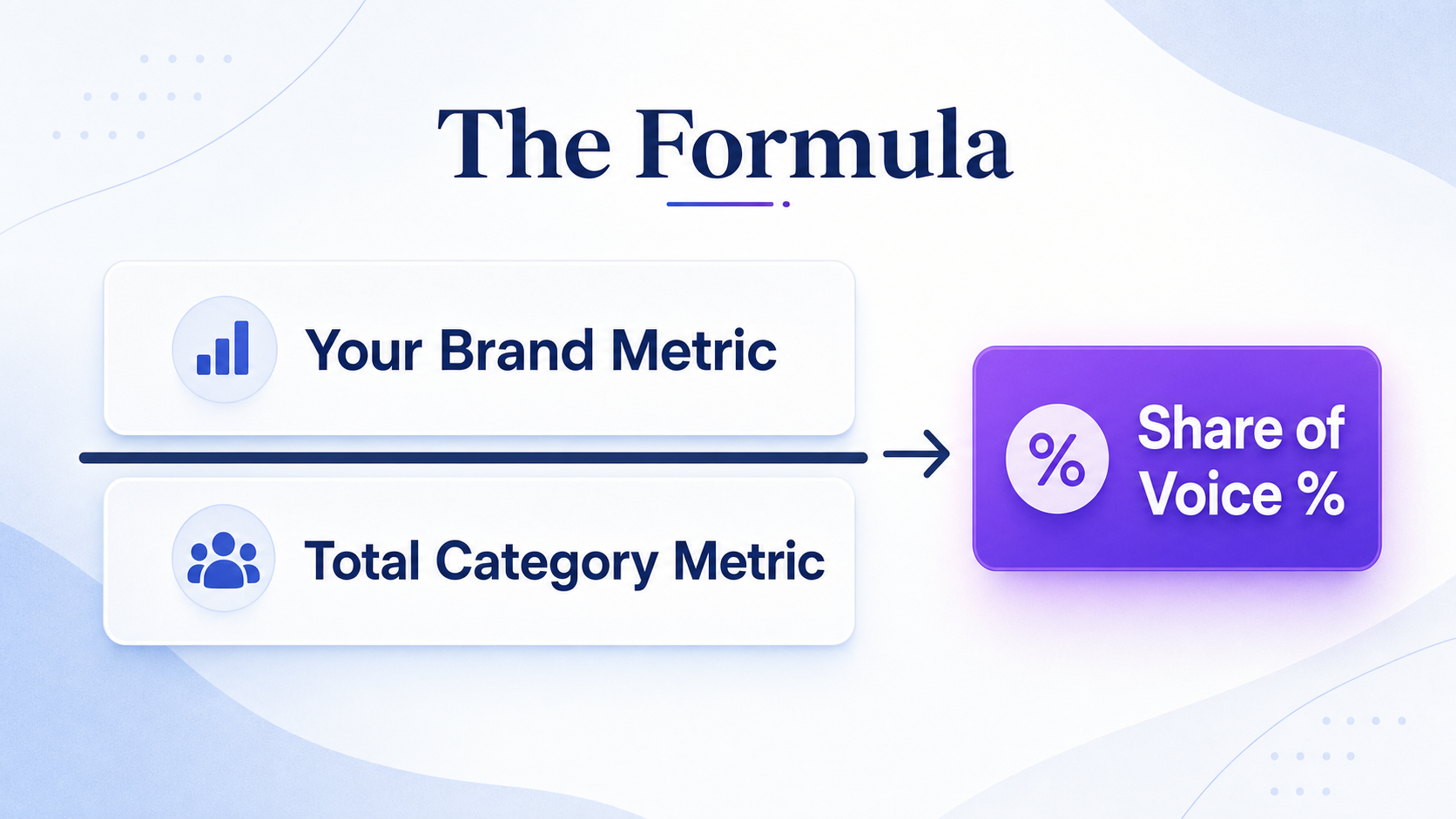
The numerator is your brand’s count of whatever you are measuring: mentions, impressions, ranking visibility, or coverage. The denominator is the total for the category, which means every brand you have chosen to count. Your competitor set defines that denominator, so a sloppy or shifting peer group corrupts every number that follows.
The time window must be identical for every brand in the comparison. Pull your mentions from a 30-day window and a competitor’s from a 90-day window, and the result is fiction. Same channel, same window, same competitor list, every time.
The formula stays constant. What you feed it changes by channel.
| Channel | Your brand metric | Total category metric |
|---|---|---|
| Social | Brand mentions or conversation volume | All mentions across your competitor set |
| PR / media | Coverage or citation count | Total coverage across a defined media set |
| SEO | Ranking share, clicks, or impressions | Total visibility for your keyword set |
| PPC / paid | Your impressions served | Eligible impressions in the auction |
The formula itself almost never fails. Bad inputs do. A clean 10% from a tight competitor set over a fixed window tells you more than a precise-looking 14% built from mismatched data.
Share of Voice by Channel
The word “total market” means something different in every channel, which is why share of voice numbers do not transfer between them. A 30% social share and a 30% paid share are not the same achievement, and you cannot blend them into a single brand score. Each channel keeps its own denominator and its own reporting logic.
| Channel | What gets measured | What “total market” means | Main blind spot |
|---|---|---|---|
| Social | Mentions, conversation share | All mentions in your peer set | Bots, spam, virality spikes |
| PR / media | Coverage, citations | Coverage across a defined media list | Outlet quality varies wildly |
| SEO | Ranking share, clicks, impressions | Visibility for your keyword set | Zero-click results and SERP features |
| PPC / paid | Impression share | Eligible auction impressions | Share does not equal performance |
Social Share of Voice
Social share of voice measures your brand’s conversation volume against direct competitors across social channels. You count brand mentions or topic mentions, divide by the total for your peer set, and read the percentage.
Raw mentions mislead on their own. A thousand mentions during a product complaint storm is not the same as a thousand mentions during a positive launch, so the count needs sentiment and relevance beside it. The usual data source is social listening, which scans platforms for your brand and competitor names. Watch for distortion from viral moments, paid campaigns, and bot activity, all of which inflate volume without reflecting real interest. For the channel-by-channel mechanics, our guide on measuring share of voice on social media walks through the calculation in detail.
PR / Media Share of Voice
PR share of voice measures your earned coverage across news, blogs, and media against a defined set of outlets and competitors. You count placements, citations, or mentions and compare them to the category total in that media set.
Raw placement counts hide a lot. Ten mentions in trade newsletters do not equal ten in national press, so weighted coverage that accounts for outlet reach and authority tells a truer story. Message pull-through, whether the coverage carried your actual point, matters as much as the count. Media monitoring tools supply the data. The interpretation depends on whether you treat a placement as a placement or weight it by where it ran.
SEO Share of Voice
SEO share of voice measures your organic search visibility within a defined keyword set against competitors ranking for the same terms. You can express it through ranking share, clicks, impressions, or total SERP coverage.
The denominator is the total search visibility available for your keyword set, not the whole internet. Pick the keywords that matter to your category, then measure your slice of the visibility they generate. Zero-click results, featured snippets, and other SERP features complicate the picture, since visibility no longer always means a click. Google Search Console and keyword visibility data are the common inputs. To extend this into a single cross-channel view, see our walkthrough on measuring share of voice across every channel.
PPC / Paid Media Share of Voice
In paid media, impression share is the direct equivalent of share of voice. It measures the impressions your ads received against the total impressions you were eligible to receive in the auction.
The denominator is eligible impressions, the auction opportunity you could have captured with enough budget and quality. Auction Insights and platform-level impression data report it. Keep three numbers distinct: impression share is how often you showed, top-of-page share is how often you showed prominently, and neither one tells you whether the click converted. Performance lives in a different report. For the spend-weighted history of this metric, our overview of share of voice in advertising covers the media-planning roots.
What to Measure Alongside Share of Voice
Share of voice on its own answers one question: how visible are you? It says nothing about whether that visibility is positive, large, or driving results. Pair it with three other readings and it stops being a vanity score.

| Pair with | What it adds |
|---|---|
| Sentiment | Separates positive visibility from a crisis spike that looks like growth |
| Reach or impressions | Shows audience size, so 200 mentions to millions beats 2,000 to nobody |
| Engagement quality | Reveals whether visibility produced interaction or just scrolled past |
| Clicks, branded search, conversions | Connects share of voice to downstream business impact |
A high share of voice during a product recall is still a high share of voice, and the number alone would read as a win. Sentiment corrects that. Reach corrects the opposite error, where a high percentage hides a tiny audience. Together these readings turn share of voice from a single figure into a dashboard.
Executives usually ask one question, “did we win?”, when they actually need three answers: did we get visible, was the attention good, and did it move the business. Share of voice handles the first. The companion metrics handle the rest. For the broader set of signals worth tracking together, our piece on brand tracking metrics that predict pipeline maps how visibility connects to growth.
See where AI answers put your brand
Twenty minutes with a senior strategist: where the major engines point buyers in your category, who gets named instead of you, and a straight read on what a programme would change.
Book a strategy callCommon Mistakes and Misconceptions
Most share of voice analysis goes wrong at the inputs, not the math. These are the errors that show up most in real reporting.
- Treating every mention as equal when relevance and authority differ. A passing mention in a low-traffic forum counts the same as a feature in a trade publication, and that flattens the picture.
- Ignoring sentiment and context. A spike of negative coverage reads as a visibility win until someone checks the tone.
- Using the wrong competitor set, or changing it midstream. Swap a competitor in or out between reports and your trend line becomes meaningless.
- Measuring over too short a window. A one-week jump from a news event gets mistaken for durable growth, when it fades the moment the cycle moves on.
- Confusing share of voice with share of market. They correlate, they are not the same number, and treating them interchangeably leads to bad forecasts.
- Letting noise into the count. Duplicate mentions, spam, and bot activity inflate volume without reflecting real attention.
- Assuming one channel speaks for the whole category. A dominant social share means little if buyers research on search and read trade press.
The most common version we see: a brand catches a one-week spike from a press hit, screenshots the chart, and declares the visibility war won. Three weeks later the line is back to baseline. A clean trend over a fixed window would have shown the spike for what it was.
Building a Share of Voice Baseline That Holds
Share of voice is a flexible competitive visibility metric, but the flexibility is also the trap. The number only means something when the channel, competitor set, and time window stay consistent from one measurement to the next.
Read it next to sentiment, reach, engagement, and market outcomes, and it tells a real story. Read it alone, and it tells a flattering one. The goal is a benchmark you can trust over time, not a verdict you can wave in a single meeting.
A clean baseline beats a flashy score every time. Start with one channel, one competitor set, and one time window, then expand once that first number holds steady enough to trust, and let the rest of your visibility tracking build from there.
What Actually Moves Your Share of Voice Number
Measuring share of voice tells you where you stand. The lever that moves the number is earning more mentions across the channels being measured: press coverage, social conversation, review sites, and increasingly AI-generated answers. In our experience, brands that pair SOV tracking with active mention-building tend to outgrow brands that only measure. If earning more of the conversation is the next step after measurement, done-for-you brand mention building is built for exactly that.
Related Share of Voice Resources
Depending on what you need next: the full measurement methodology, channel-specific breakdowns for social media, advertising, and search, a tool comparison, or how SOV differs from share of market.
Frequently Asked Questions
What is share of voice in marketing?
Share of voice is the percentage of total category visibility your brand owns against competitors. It started as a measure of your slice of category ad spend and now covers mentions, impressions, search visibility, and coverage across PR, social, SEO, and paid media. The core idea stays the same: how loud are you relative to your rivals.
How do you calculate share of voice?
Divide your brand’s metric by the total category metric and multiply by 100. If your brand earned 500 mentions and the full competitor set earned 5,000, your share of voice is 10%. The trick is keeping the competitor set and time window identical for every brand you compare, since mismatched inputs produce a misleading result.
What is the difference between share of voice and share of market?
Share of voice measures visibility, share of market measures actual sales or revenue. They correlate, since brands holding a share of voice above their market share often grow, but the link is directional rather than a fixed rule. It varies by category, budget, and competition, so treat the relationship as a pattern to watch, not a formula that prints revenue.
How do you measure share of voice on social media?
Count your brand’s mentions or conversation volume across social channels, then divide by the total mentions for your competitor set over the same window. Social listening tools supply the data. Read the count alongside sentiment and relevance, because raw mentions inflate during viral moments, paid campaigns, and bot activity without reflecting real interest.
What is a good share of voice?
A good share of voice is one that sits at or above your share of market and trends upward over a consistent window. There is no universal benchmark, since the right target depends on how many competitors share your category and how crowded the space is. The more useful question is whether your share is growing against a stable peer set, not whether it hits a fixed number.
Share of voice is only as honest as the inputs behind it. Lock your channel, your competitor set, and your window before you read a single percentage, and the metric becomes a benchmark you can act on instead of a number you argue about. Start with one channel and one peer set this week, get a baseline that holds, then widen the lens from there.