

Most SEOs check Trust Flow and Citation Flow before building a link, then misread what the numbers actually say. A domain with a Trust Flow of 42 and a Citation Flow of 58 isn’t “almost good enough.”
It’s telling you something specific about who links to that site and whether the link you’re about to chase will carry any weight. Trust Flow measures backlink quality on a 0-100 scale, Citation Flow measures volume on the same scale, and their ratio tells you whether the profile is clean or inflated.
That’s the part most guides skip, and it’s the part that actually changes link-building decisions.
This guide is for SEOs and link builders who already know what backlinks are and want to use Majestic’s Flow Metrics to make faster, sharper prospecting calls in 2026.
The Short Version
- Trust Flow (TF): 0-100 score estimating link quality based on proximity to a manually curated set of trusted seed sites.
- Citation Flow (CF): 0-100 score estimating link volume and influence based on how many URLs point at a page or domain.
- The ratio matters more than either score alone. TF ÷ CF gives you the Trust Ratio. Anything below 0.5 is a warning sign.
- Topical Trust Flow breaks TF down by subject category. It’s the metric that actually matters for relevance-weighted link building.
- Neither score is a Google ranking factor. They’re third-party estimates, useful for prospecting, not proof of ranking power.
What Trust Flow Actually Measures
Trust Flow is Majestic’s attempt to answer one question: how close is this site to the sites we know are trustworthy? Majestic built a manually curated seed set of trusted domains, think major news outlets, government sites, well-known educational institutions, and then measured how many hops a link-following crawler takes to reach any other URL from that seed set. Fewer hops, stronger trust connection, higher score.
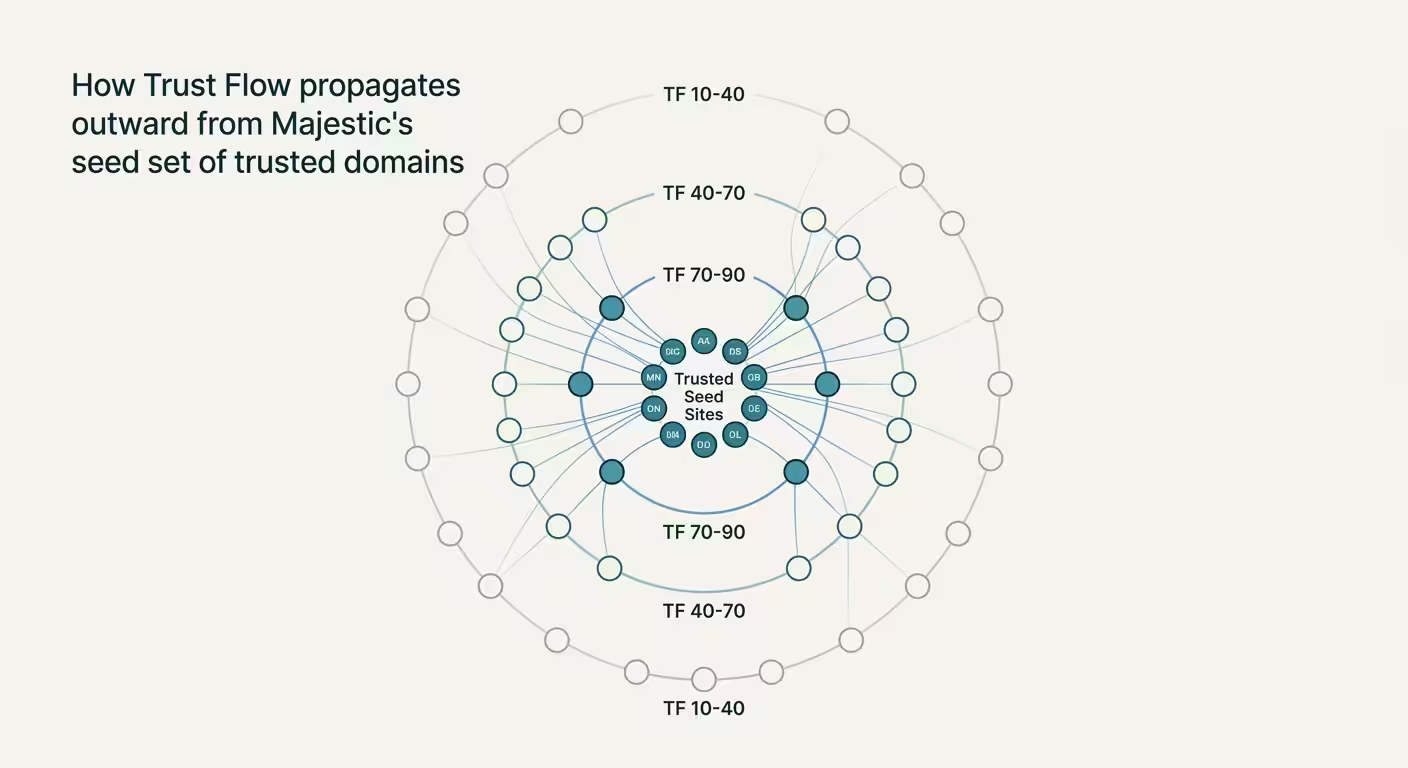
The result is a 0-100 score where a high number signals that the site sits in a neighborhood of other reputable sites. A local plumber with a single link from a regional newspaper will often outscore a spammy directory with 40,000 links from low-quality blogs. That’s the mechanism working as intended.
The manual seed set is also what makes Trust Flow harder to manipulate than raw link counts. You can’t just build 10,000 links to inflate it. You need links from sites that are themselves close to the trusted seeds, which is exactly the kind of link that’s hard to fake.
What Citation Flow Actually Measures
Citation Flow is the volume metric. It estimates how influential a URL is based on the quantity of links pointing at it and the Citation Flow of those linking pages.
It doesn’t care whether those links come from Harvard or a Hungarian link farm. It only counts.
That makes Citation Flow useful for one thing: understanding reach. A page with a Citation Flow of 75 has a lot of link signal flowing into it, regardless of where that signal came from.
On its own, that number is close to meaningless for link prospecting. Paired with Trust Flow, it becomes the denominator in the only Majestic calculation most SEOs should actually care about.
The Trust Ratio Is the Only Majestic Math That Matters
Divide Trust Flow by Citation Flow. That’s the Trust Ratio. It’s a single number that tells you whether a site earned its link volume or inflated it.
| Trust Ratio (TF ÷ CF) | What It Signals | Prospecting Call |
|---|---|---|
| 0.8-1.0+ | Clean profile. Links come from trustworthy neighborhoods. | Strong candidate. Pursue. |
| 0.6-0.8 | Healthy but not exceptional. Typical of legitimate sites. | Worth pursuing if topically relevant. |
| 0.4-0.6 | Mixed profile. Some quality links, plenty of filler. | Inspect manually before outreach. |
| Below 0.4 | Inflated CF, low TF. Often signals PBN, directory spam, or link manipulation. | Skip unless the topical match is extraordinary. |
A site with TF 50 / CF 55 (ratio 0.91) is in a better link neighborhood than a site with TF 45 / CF 90 (ratio 0.5), even though the second site looks more “impressive” on Citation Flow alone. The ratio strips away the illusion of volume.
One caveat: ratio doesn’t replace judgment. A tiny niche site with TF 8 / CF 8 has a perfect 1.0 ratio and is still a weak prospect in most cases. Use the ratio to filter, not to decide.
Topical Trust Flow Is Where Link Builders Should Actually Look
Majestic breaks Trust Flow down into over 800 topical categories. A domain might carry an overall Trust Flow of 55, but when you drill in, you find TF 68 in “Business/Financial Services” and TF 12 in “Sports.” For a fintech brands, only the first number matters.
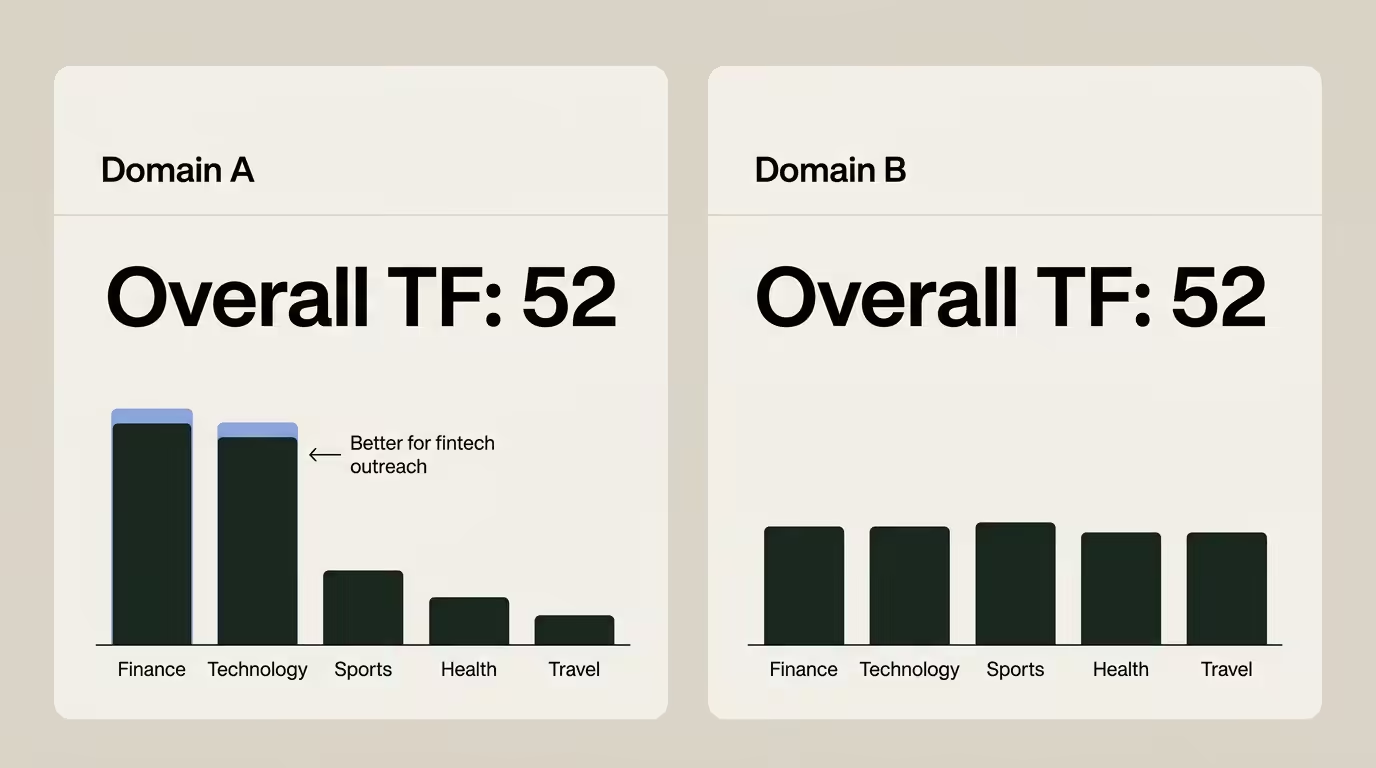
This is the layer most SEOs ignore. Overall Trust Flow averages across every topic the site has ever been linked within. Topical Trust Flow tells you whether the site carries weight in your category.
A finance blog with overall TF 40 but Topical TF 55 in “Personal Finance” is almost always a better link target than a general news site with overall TF 70 but no topical alignment to your industry.
In link campaigns across competitive SaaS verticals, the prospects that convert fastest, faster response rates, higher editorial acceptance, stronger downstream ranking lift, almost always show strong Topical Trust Flow alignment rather than impressive overall scores. The overall number gets you a reply. The topical match gets you a placement that actually moves rankings.
How to Read a Domain in Under 30 Seconds
Here’s the mental checklist to run when you pull up a prospect in Majestic:
1. Glance at the Trust Ratio
TF ÷ CF. Under 0.4 is usually a skip.
2. Check the Top 3 Topical Trust Flow Categories
Do they match your industry or the content you’d place there? If no, the raw TF doesn’t help you.
3. Scan the Linking Domains Count Vs. Total Backlinks
A domain with 50,000 backlinks from only 200 referring domains is getting hammered by sitewide links, usually a red flag.
4. Look at the Referring Domain TF Distribution
If most linking domains have TF below 10, the target’s own TF is borrowed, not earned.
5. Eyeball the Anchor Text Cloud
Heavy commercial anchor distribution plus high CF / low TF is the classic PBN fingerprint.
This whole pass takes less than a minute per domain once you’ve done it a few times. It’s faster than reading a content page and catches 90% of the obvious skips before you invest real outreach effort.
Where Trust Flow and Citation Flow Fall Short
The flow-metric mistake we see most often in link audits is a team treating a high Trust Flow score as a green light, without ever checking Topical Trust Flow for category alignment. A domain can carry a TF of 45 built entirely on unrelated finance and lifestyle coverage and add nothing to a SaaS buyer’s authority surface. Always pair the headline score with the topical breakdown before a prospect moves onto the outreach list.
These metrics are useful. They’re not gospel. A few things to keep in mind:
They’re Not Google Ranking Factors
Majestic built them. Google doesn’t use them, doesn’t see them, and doesn’t care about them. They’re estimates of what a clean backlink profile should look like, not proof that Google agrees.
The Seed Set Has Blind Spots
Trust Flow reflects the trusted seeds Majestic chose. Some legitimate niches, especially newer B2B categories, emerging technologies, and non-English markets, are underrepresented.
A site can be authoritative in a small vertical and still score low because the seed set doesn’t capture that vertical’s trusted anchors.
Scores Update on Crawl Cycles
The Fresh Index moves faster than the Historic Index. A new high-quality link might not move the needle on TF for weeks.
Cross-Tool Triangulation Matters
In 2026, most experienced link builders run prospects through Majestic plus at least one of Ahrefs (Domain Rating, Referring Domains) or Moz (Domain Authority, Spam Score). When three tools agree a domain is strong, it usually is.
When they disagree, the disagreement itself is the signal, so dig deeper before committing.
Practical Ways to Improve Your Own Trust Flow
For the AI-visibility complement to traditional authority signals, see verifying ChatGPT cites your brand and the Perplexity tracking guide, and the LLM monitoring playbook covers the cross-platform cadence that sits alongside Trust Flow work in a modern authority program.
There’s no shortcut. The mechanism is proximity to trusted seeds, so the only real lever is earning links from sites that already sit close to those seeds.
Earn Editorial Placements in Your Category
A single mention in a reputable trade publication will move your Topical Trust Flow more than dozens of guest posts on general marketing blogs. Topical relevance compounds.
Stop Chasing Volume
50 links from low-TF sites will raise your Citation Flow and drop your Trust Ratio, the opposite of what you want. A clean profile with 15 strong links beats a messy one with 500.
Audit and Disavow If Needed
If your Trust Ratio is below 0.4 and you can identify the spammy cluster dragging it down, Google’s disavow tool won’t change your Majestic score directly. But cleaning the underlying profile helps every link signal work harder over time.
Build Real Topical Authority
The sites with the healthiest Topical Trust Flow are the ones that consistently produce content the trusted seeds in their category want to reference. That’s the long game: it takes 6 to 12 months to show up meaningfully, and it compounds.
For a broader view on how link-building fits into modern search visibility, our SEO competitor analysis guide walks through how to benchmark your backlink profile against the sites winning in your category.
When to Use Flow Metrics and When to Skip Them
Use Flow Metrics when:
- Prospecting link opportunities at scale and need a fast filter
- Evaluating guest post offers or paid placements for obvious spam signals
- Auditing a competitor’s backlink strategy to spot their strongest relationships
- Investigating whether a negative SEO attack has dragged your profile
Skip them when:
- The site is in a niche Majestic’s seed set underrepresents (check with Ahrefs or a manual review instead)
- You’re evaluating a brand-new domain with no crawl history
- The decision is about editorial fit or topical alignment, not link weight
- You’re measuring anything Google-specific, use Google Search Console data instead
For tool-level comparisons in the broader SEO stack, our breakdown of the best competitor analysis SEO tools covers where Majestic fits relative to Ahrefs, Semrush, and Moz in 2026 workflows.
Both metrics ultimately feed into a bigger question: how brand authority is scored for AI citations, since link quality signals are one of the inputs models weigh when deciding who to cite.
Frequently Asked Questions
What’s a good Trust Flow score?
A Trust Flow above 40 is generally considered strong for most industries, and above 60 puts you in the top tier. But context matters, a niche B2B site with TF 35 and perfect topical alignment will outperform a general news site with TF 70 when it comes to link placements that actually move rankings.
Is Citation Flow or Trust Flow more important?
Trust Flow is more important for judging link quality. Citation Flow on its own tells you volume, which is close to meaningless without the quality context. The ratio between them, Trust Ratio, is what most experienced SEOs actually look at.
Does Google use Trust Flow and Citation Flow?
No. These are Majestic’s proprietary metrics, not Google’s. Google has its own internal trust signals that no third party can replicate exactly. Flow Metrics are estimates of what a healthy backlink profile looks like, useful for prospecting, not a substitute for Google’s own evaluation.
How often do Trust Flow and Citation Flow update?
Majestic’s Fresh Index updates continuously as new links are crawled, typically reflecting changes within days. The Historic Index updates on a longer cycle and captures the full long-term picture. New links usually show up in Fresh first, then roll into Historic over subsequent cycles.
Can you manipulate Trust Flow?
Not easily. Because Trust Flow is based on proximity to a manually curated seed set, you can’t inflate it by buying thousands of low-quality links, those raise Citation Flow and drop your Trust Ratio, which is the opposite of what you want. The only real way to raise Trust Flow is to earn links from sites that are themselves close to the trusted seeds.
What’s the difference between Trust Flow and Domain Authority?
Trust Flow (Majestic) measures link quality based on proximity to trusted seeds. Domain Authority (Moz) is a predictive score trained on correlations with Google rankings. Trust Flow tells you about the link neighborhood. Domain Authority tries to predict ranking potential. Most serious link builders check both plus Ahrefs’ Domain Rating before committing to a prospect.
A 15-Minute Prospect-Filtering Routine to Run This Week
Pull up your three highest-value link prospects right now and calculate the Trust Ratio on each one. Then check the Topical Trust Flow categories.
If any prospect has a ratio below 0.4 or zero topical alignment to your category, cut it from the list today. That single filter saves more wasted outreach hours than any other link-prospecting habit.
For a broader look at how backlinks stack up against other modern authority signals, read our take on brand mentions vs backlinks.
Trust Flow measures the quality of a site’s backlinks on a 0 to 100 scale, while Citation Flow measures the volume of those backlinks on the same scale. The ratio between them tells you whether a backlink profile is clean or inflated.
If you’d rather have this vetting done for you, talk to our link-building team about which prospects are actually worth pursuing in your category.