
If your SaaS competitors keep outranking better content, the missing edge is often not more posts but better links to the pages that drive revenue. SaaS link building is the practice of earning relevant backlinks for software companies to improve rankings, trust, and visibility, with the strongest campaigns pointing those links at product, comparison, feature, and pricing pages rather than blog posts alone. In a category where ten vendors publish near-identical guides, authority is what separates the page that ranks from the page that does not. This article explains what SaaS link building is, why it still matters in 2026, how it works, and the tactics and mistakes that decide whether it pays off.
What SaaS Link Building Is
SaaS link building is the work of earning backlinks from other websites to a software company’s pages, so search engines and AI engines treat the brand as a trusted, relevant source. The point is not the link count. The point is whether the linking site is topically relevant, carries real authority, and sends a credible signal to the pages that matter for revenue.
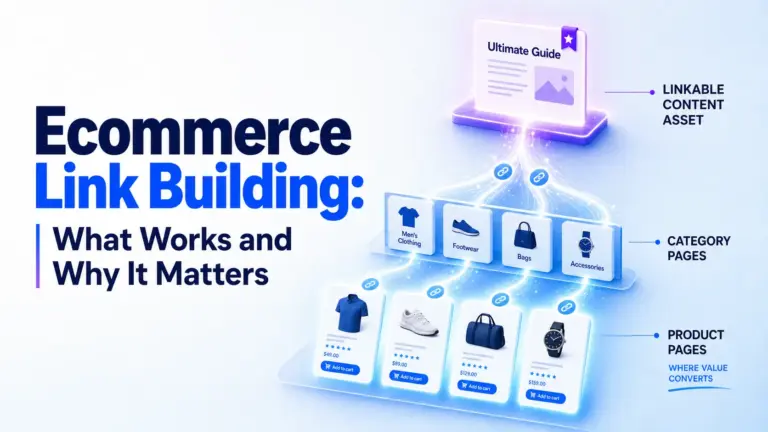
It differs from generic link building in where the links should land. A blog or a local business often builds links to articles and a homepage. A SaaS company needs links pointing at commercial pages too: the product page, the feature pages, the integration pages, the comparison and alternative pages, and the pricing page. Those are the pages a buyer reads before a demo or a trial, and they are usually the hardest to rank because they carry the most competition.
The goal across all of it is relevance and discoverability in crowded SaaS search results, not a bigger number in a backlink tool. A single contextual link from a respected industry publication does more than fifty links from sites no buyer ever reads. If you want the full grounding on how backlinks work before going SaaS-specific, the practitioner’s guide to link building covers the fundamentals.
SaaS link building also overlaps heavily with editorial outreach, digital PR, and brand mention reclamation. Many of the best SaaS links are earned through the same motions a PR team uses: pitching journalists, contributing expert commentary, and turning existing brand mentions into actual links. The campaigns that win usually support commercial pages tied to demos, trials, and pricing, not just a steady stream of informational articles.
Why SaaS Link Building Matters in 2026
SaaS link building matters because authority is the deciding factor when content quality is otherwise even. In most SaaS categories, the top results all have strong, well-structured content. What separates them is the trust signal behind the page, and backlinks remain one of the clearest signals search engines and AI engines read.
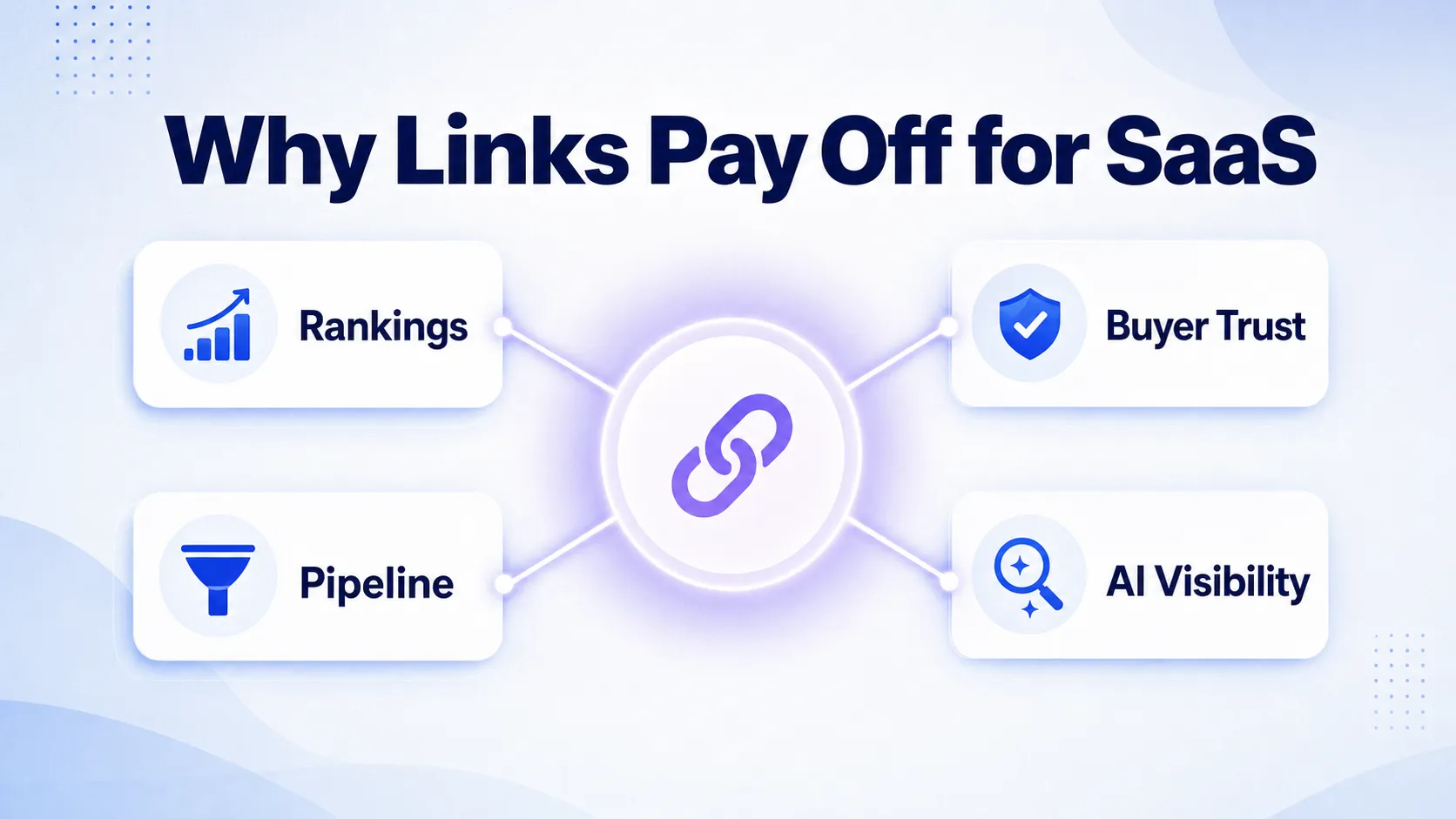
SaaS is unusually link-sensitive because the buying cycle is long and comparison-heavy. A prospect rarely converts on a first visit. They read your product page, then a comparison page, then a review platform, then an analyst’s roundup, building confidence over weeks. Links shape whether your pages even appear at each of those stops. Brands with comparable content quality usually separate on authority, not on article length or how often they publish.
The 2026 angle is real competition plus AI-influenced discovery. More vendors are publishing more content, and a growing share of buyer research now happens inside AI answers that summarize and cite sources. That raises the value of being one of the trusted sources an engine pulls from. Backlinks still work as a ranking and trust signal, and they work best when paired with a recognizable brand and assets worth citing.
AI search does not make backlinks irrelevant. It changes what they buy you. The better model is that a credible link now supports two things at once: your position in traditional rankings, and your odds of being treated as a trustworthy source by an answer engine. For a fuller view of what compounds, the growth case for link building breaks down the durable returns.
How SaaS Link Building Works
SaaS link building works as a repeating loop: identify the pages you want to strengthen, prospect relevant sites, create or choose a link-worthy asset, pitch the right editor or publisher, and monitor whether the placement holds and performs. Each link is a small project, and the program is the sum of those projects run consistently.
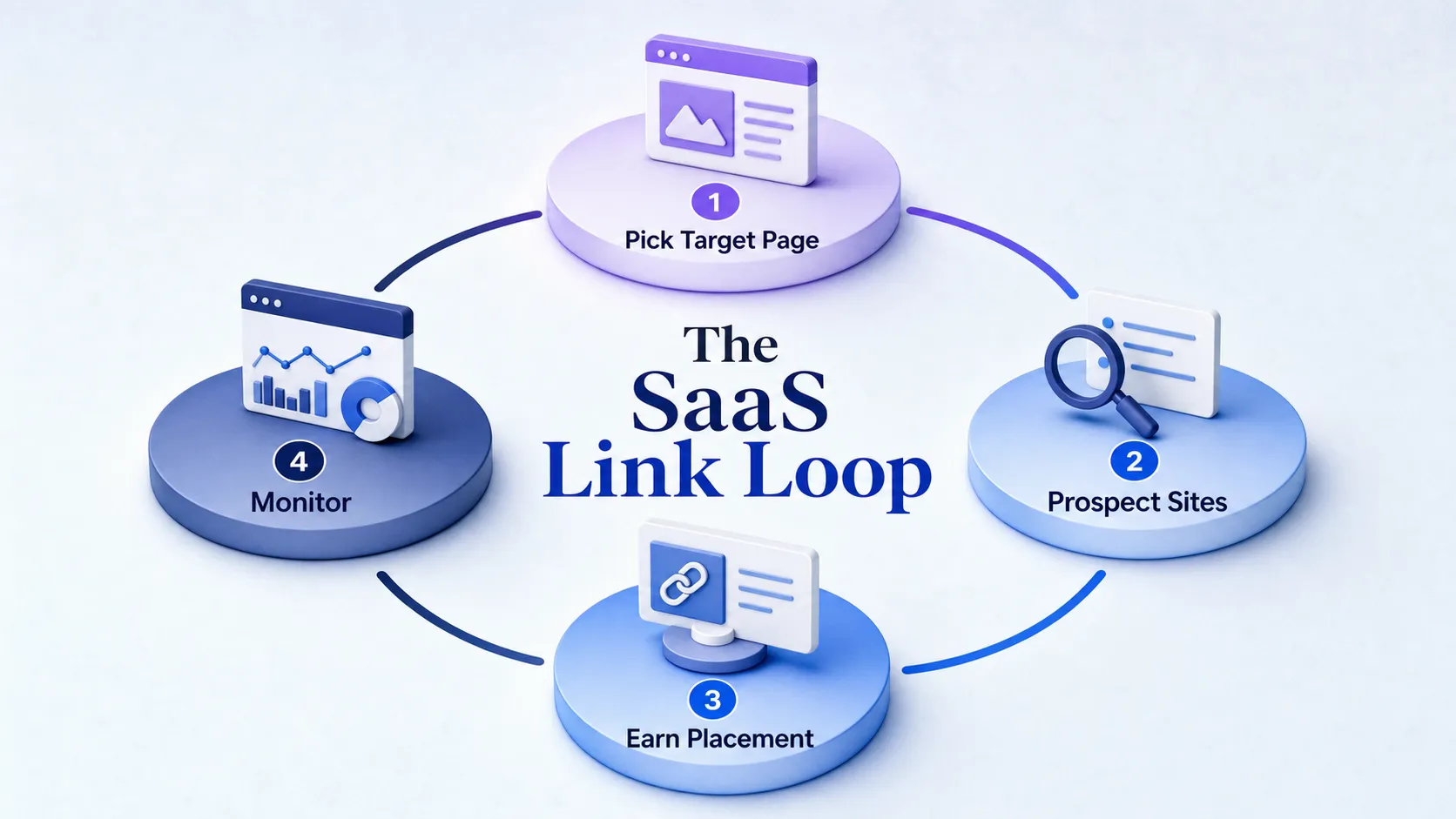
Strong campaigns start backward. You name the shortlist of money pages you want to rank, usually the product, comparison, and pricing pages, then work out what kind of links those pages actually need. A pricing page rarely earns links on its own, so you build authority to the cluster around it and route relevance inward. A blog asset, by contrast, can earn links directly because it gives publishers something to reference.
Results depend on fit across three layers: the site, the page, and the context of the link. A link from a relevant site, on a page with real traffic, inside a sentence that genuinely relates to your product carries weight. A link from an unrelated site, on an orphaned page no one reads, does little even if it is technically dofollow. Treating “dofollow” as the only quality bar is one of the faster ways to waste a budget.
Monitoring is part of the work, not an afterthought. Links disappear when pages get pruned, lose indexation, or get rebuilt. A placement on a page that never earns its own traffic also fades in value. Keeping a simple record of what went live, where, and whether it still resolves protects the program over time. If you want the deeper mechanics of running this end to end, the guide on how to do link building in 2026 covers execution in detail.
Key SaaS Link Building Tactics and Asset Types
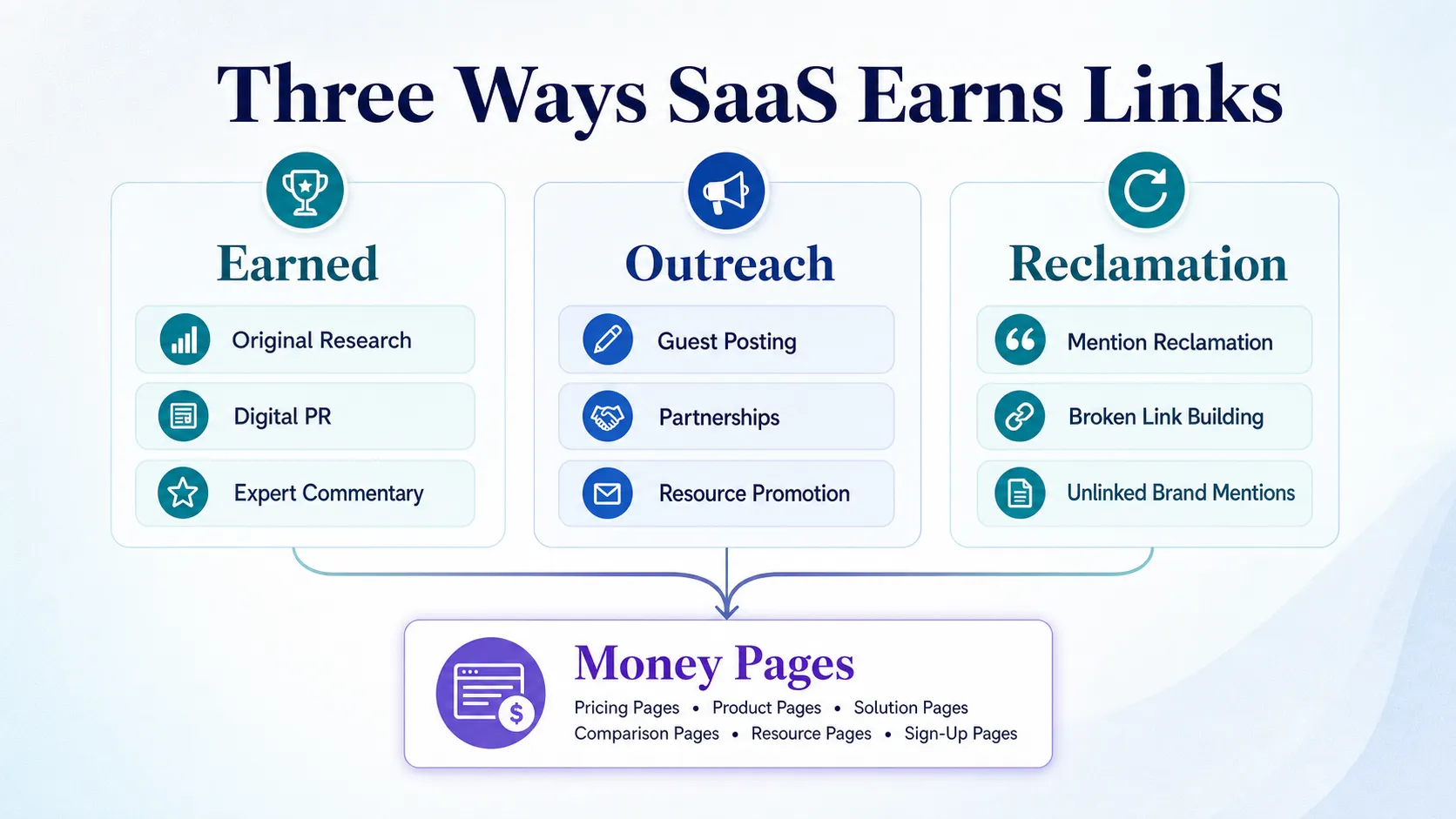
The SaaS toolkit splits into three motions: earned links, outreach-driven links, and reclamation or partnership links. The strongest programs combine one passive asset, one outreach motion, and one reclamation motion rather than leaning on any single tactic. Below is how the main methods map to use cases and the pages they support.
| Tactic | Best use case | Pages it supports |
|---|---|---|
| Editorial outreach | Earning contextual links inside relevant industry articles | Feature, comparison, and blog assets |
| Guest posting | Placing bylined articles on niche-relevant sites | Blog clusters and product pages |
| Unlinked brand mention reclamation | Converting existing mentions into links with low friction | Homepage, product, and pricing pages |
| Digital PR | Earning press and roundup links through data or commentary | Brand pages and linkable assets |
| Resource pages | Getting listed on curated reference pages in your category | Tools, guides, and feature pages |
| Integration co-marketing | Trading links and features with partner products | Integration and comparison pages |
| Linkable assets | Attracting passive links with research, calculators, and tools | Standalone asset pages |
Editorial outreach and guest posting are the main proactive methods. Both earn contextual placements on sites your buyers actually read, and both depend on giving the publisher something worth referencing rather than asking for a favor. The quality of the placement comes from editorial fit, which is why a strong editorial link building approach beats volume-first outreach.
Unlinked brand mentions are the lowest-friction win. When a publication names your product without linking it, you already have the hard part: someone chose to mention you. A short, polite request to add the link converts that visibility into a backlink, and the conversion rate on warm mentions is high. The workflow for finding and converting unlinked mentions is one of the first things any SaaS team should run.
Resource pages, digital PR, partnerships, and integration co-marketing round out the outreach side. Resource page link building targets curated lists where a relevant tool belongs, while digital PR earns links through original data and expert commentary. Linkable assets, the original research, data studies, calculators, and free tools, attract links passively over time once they exist. SaaS directories and review platforms like G2 and Capterra support credibility and decision-stage traffic, but treat them as supporting surfaces rather than primary authority drivers. SaaS teams rarely scale from one tactic alone, and the best results come from mixing asset-led and outreach-led acquisition.
What Makes SaaS Link Building Different From Other Niches
SaaS needs its own approach because the buying journey and the target pages differ from almost every other niche. In ecommerce or local business, links to a homepage and a few category pages go a long way. In SaaS, the pages that decide a sale are deeper: product, feature, integration, comparison, and pricing pages, and those are the pages link building has to strengthen.

The buying journey is comparison-heavy, which changes what queries you need to win. SaaS buyers search “X vs Y,” “X alternatives,” and “best [category] tool” constantly, so your link building has to support category and competitor queries, not just broad informational topics. Ranking a comparison page often matters more to pipeline than ranking a top-of-funnel guide.
SaaS also fights feature-level SEO battles. Buyers search for the specific capability they need, and a feature page that ranks for “[feature] software” can pull qualified demand a generic page never touches. Winning those requires building authority around both the brand and the category, so the brand is recognizable and the product pages carry enough trust to compete.
That difference also shapes the in-house versus outsourced decision. Building in-house works when your team already has content production, outreach capacity, and editorial relationships, because the work is continuous. Outsourcing helps when you lack the speed, the publisher relationships, or the scale to keep a pipeline full. The honest framing of that tradeoff is covered in the comparison of in-house versus outsourced link building. Whichever path you choose, prioritize the pages that influence demos and trials, because those are the pages most directly tied to revenue.
Common Mistakes and Misconceptions
Most failed SaaS link building comes down to a handful of repeated errors and a couple of stubborn myths. Weak campaigns obsess over metrics like domain rating and link volume. Strong campaigns optimize for relevance, placement quality, and page intent.
Chasing Domain Rating Over Relevance
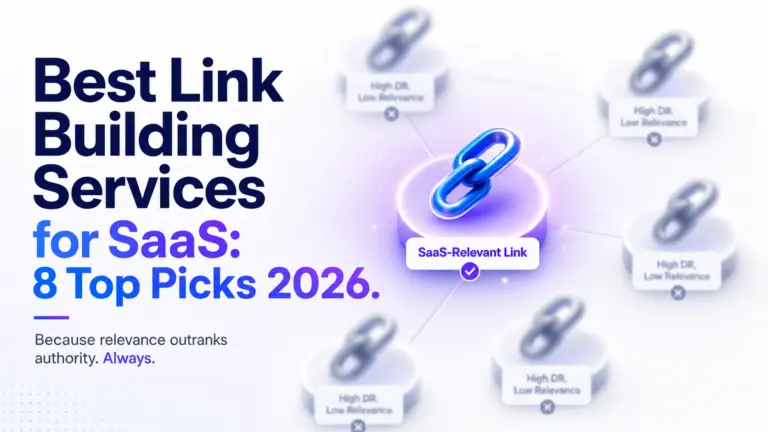
A high domain rating means nothing if the linking site is topically irrelevant or gets no real traffic. A link from a respected publication in your category carries more weight than a higher-DR link from a site no buyer reads. Relevance and real organic traffic on the linking page should rank above the headline authority number every time.
Building Links Only to Blog Posts
It is easier to earn links to a helpful article than to a pricing page, so teams default to building everything to the blog. The result is a strong content section and weak commercial pages that still cannot rank. The fix is routing relevance from blog assets toward the money pages through internal linking, and earning at least some links directly to product and comparison pages.
Relying on Spammy, Volume-First Outreach
Mass-blasted templates and automated link drops ignore editorial fit, and they produce links that age badly or get devalued. The placements that hold are the ones a real editor agreed to because the content fit their site. Quality of fit beats quantity of sends, and a smaller batch of well-matched pitches usually outperforms a flood of generic ones.
Treating Link Building as a One-Time Project
SaaS authority compounds, which means a single campaign that stops after a quarter rarely holds its gains. Competitors keep building, links decay, and rankings drift. Link building works in SaaS as an ongoing motion measured against business outcomes like signups and demos, not a one-off push measured only by links delivered.
Believing AI Search Killed Backlinks
The common misconception is that AI answers replaced the need for links. The better reading is that links now do double duty: they support traditional search ranking and they support source trust inside answer engines. Anchor text, page relevance, and link neighborhood still matter more than raw link count, and which methods earn citation lift is laid out in this breakdown of tested link building methods.
Where SaaS Authority Compounds
SaaS link building is a long-term authority and visibility system, not a shortcut to more backlinks. The work pays off when the links support the pages that drive signups, demos, and pricing decisions, and when the program runs consistently instead of in one-off bursts. Authority compounds when you tie link building to the right pages and repeat it. If AI answers are where you’re losing deals, our GEO programme for SaaS covers that side.
The practical next step is an audit. Map your product, comparison, and pricing pages, check which ones lack the authority to rank, and identify the linkable assets you could build or already own. Then decide whether you can earn the right links in-house or need outside help, using the buyer’s view in the roundup of link building services for SaaS.
Frequently Asked Questions
What is SaaS link building?
SaaS link building is the practice of earning backlinks from other websites to a software company’s pages to improve rankings, trust, and visibility. It differs from generic link building because the target pages often include product, feature, comparison, integration, and pricing pages, not just blog posts. The goal is relevance and authority for the pages that drive revenue, not raw link count.
How many backlinks does a SaaS company need?
There is no fixed number, because relevance and quality matter more than volume. A useful heuristic is to look at the pages currently ranking for your target query and match their authority on relevant, real-traffic sites rather than chasing a round count. A handful of strong, topically relevant links to a competitive page often outperforms dozens of weak ones, so size the program to the competition you face, not to a number in a tool.
Should SaaS backlinks point to blog posts or product pages?
Both, but most teams under-support their product and pricing pages. Blog posts earn links more easily, so they tend to accumulate authority that never reaches the commercial pages that actually convert. Earn links directly to product, comparison, and feature pages where you can, and route relevance from blog assets to those pages through internal linking.
Is link building still worth it with AI search?
Yes. AI search did not make backlinks irrelevant; it raised the value of being a trusted, cited source. A credible link now supports both your traditional search ranking and your odds of being treated as a reliable source by answer engines. The brands that earn relevant links from respected publications are the ones AI engines lean on when they summarize a category.
Is it better to build SaaS links in-house or hire an agency?
It depends on your team’s bandwidth and relationships. In-house works when you already have content production, outreach capacity, and editorial contacts, because the work is continuous and benefits from product knowledge. An agency helps when you need speed, established publisher relationships, or scale you cannot reach internally. Audit your own capacity against the volume you need before deciding.
Start with the pages that decide deals. Audit your product, comparison, and pricing pages first, see which ones lack the authority to rank, then decide whether you can earn the right links in-house or need a partner to do it. See where your brand stands in AI search and which pages need authority most.