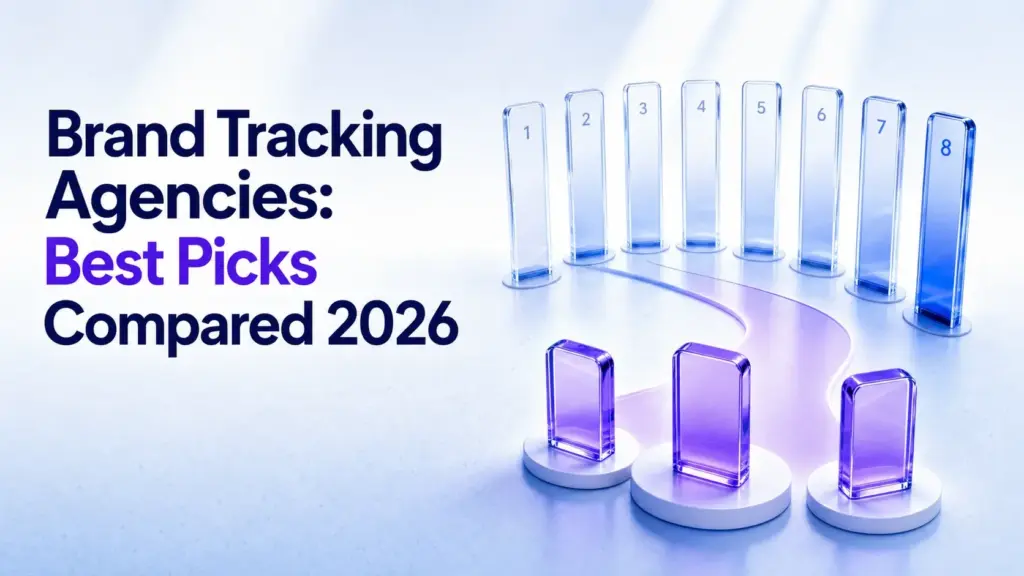

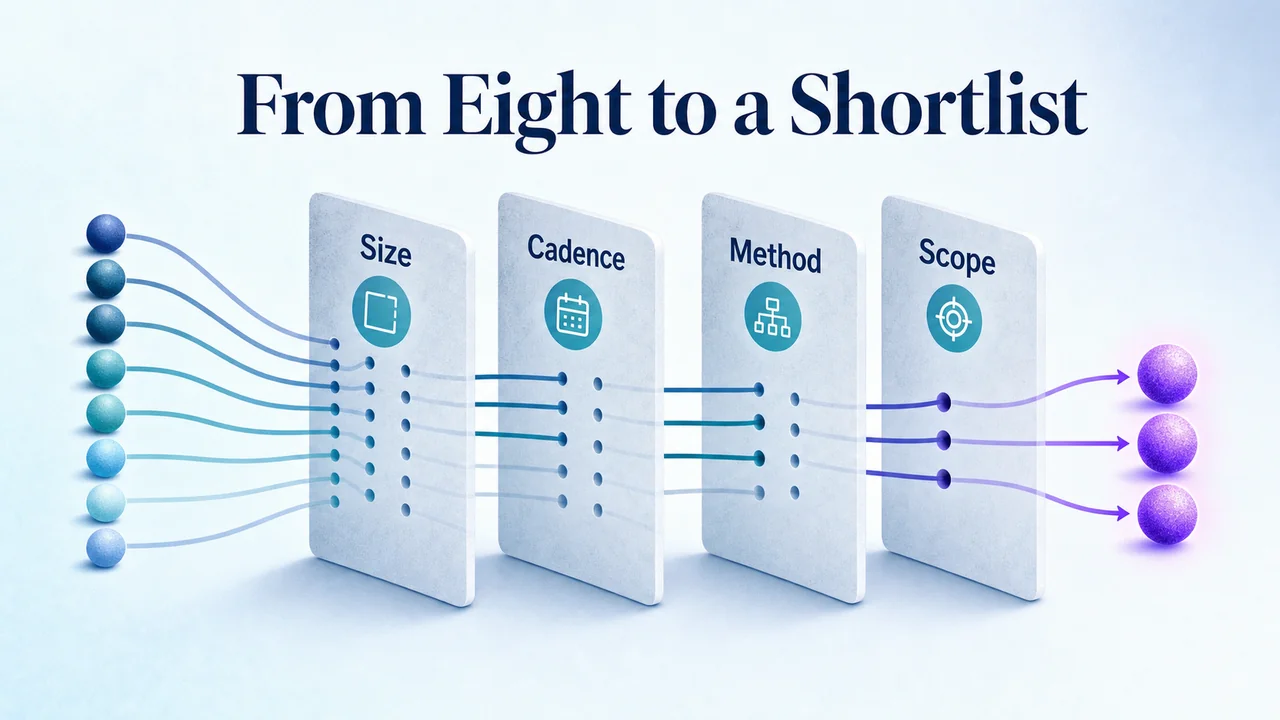
If you need a brand tracking agency, you probably don’t need a definition. You need a shortlist that can survive a budget review.
This guide compares eleven brand tracking agencies by methodology, cadence, reporting style and the buyer each one fits.
By the end you’ll know which providers suit global benchmarking, custom survey work, real-time monitoring or strategy-led interpretation. Each profile carries the decision data, not vague praise.
The comparison table at the end turns all of it into a two-minute shortlist.
Before briefing an agency, it helps to arrive with data. The free visibility scorecard gives you a baseline to hand over.
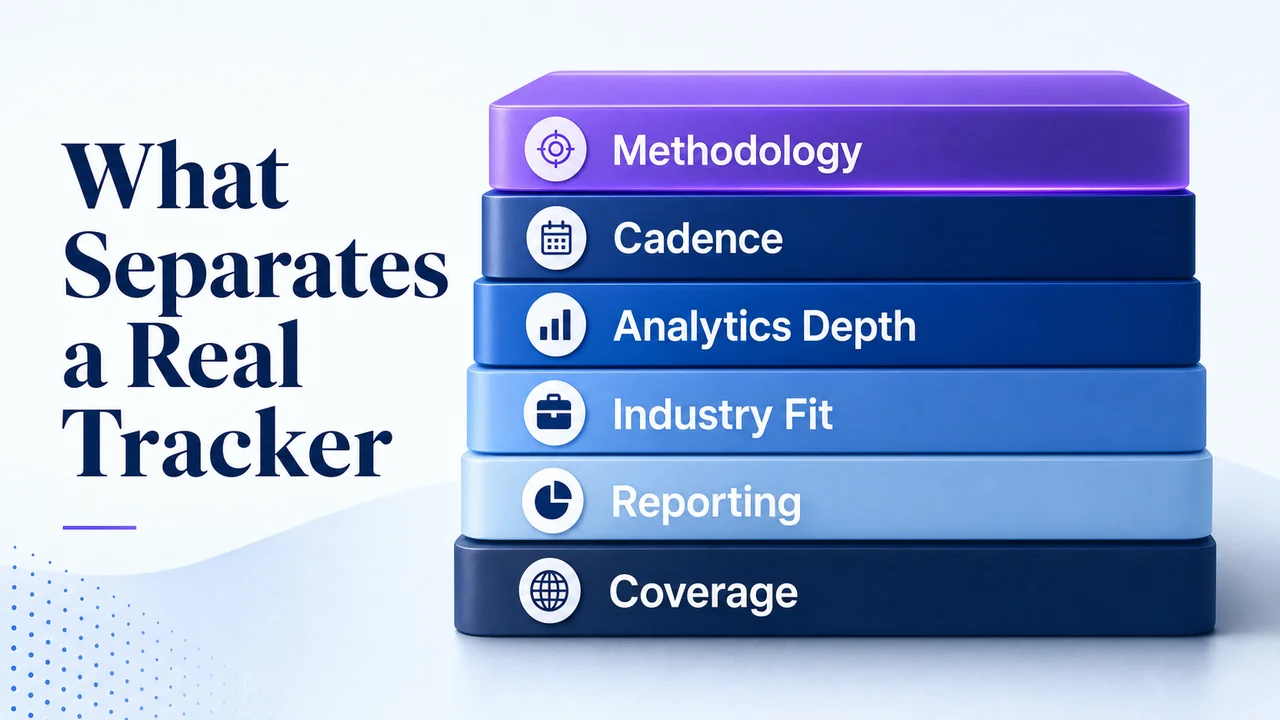
Criteria for Selecting Brand Tracking Agencies
This list is built on six factors: methodology transparency, tracking cadence, analytics depth, industry fit, reporting quality, and geographic coverage. Those are the things that actually separate a usable tracker from an expensive dashboard.
The strongest agencies do more than collect data. They turn findings into decisions, alerts, and executive-ready recommendations.
A tracker that tells you awareness dropped three points is half the job. A good partner tells you why, which competitor gained, and what to do about it next quarter.
The providers below run different operating models. Some are syndicated trackers that survey the same panel daily across markets.
Some build custom survey programs from scratch for one brand. Others are monitoring-led, reading conversation and behavior rather than asking questions.
Knowing which model you’re buying matters more than any feature list, because the model decides what kind of answer you get.
Before you sign anything, a strong provider explains how they sample, how they benchmark, and how often reporting refreshes. The ones that lead with speed and dashboard polish before they explain sample design are usually selling the wrapper, not the measurement. A clean interface tells you nothing about whether the numbers underneath it are sound.
11 Brand Tracking Agencies to Shortlist
Each profile below follows the same shape: what it is, why it matters, and the key benefit for the buyer. The decision-data block under each one carries the fields you need to compare apples to apples. Scan the labels, not the prose, if you’re in a hurry.
1. YouGov BrandIndex: Best for Daily Global Benchmarking
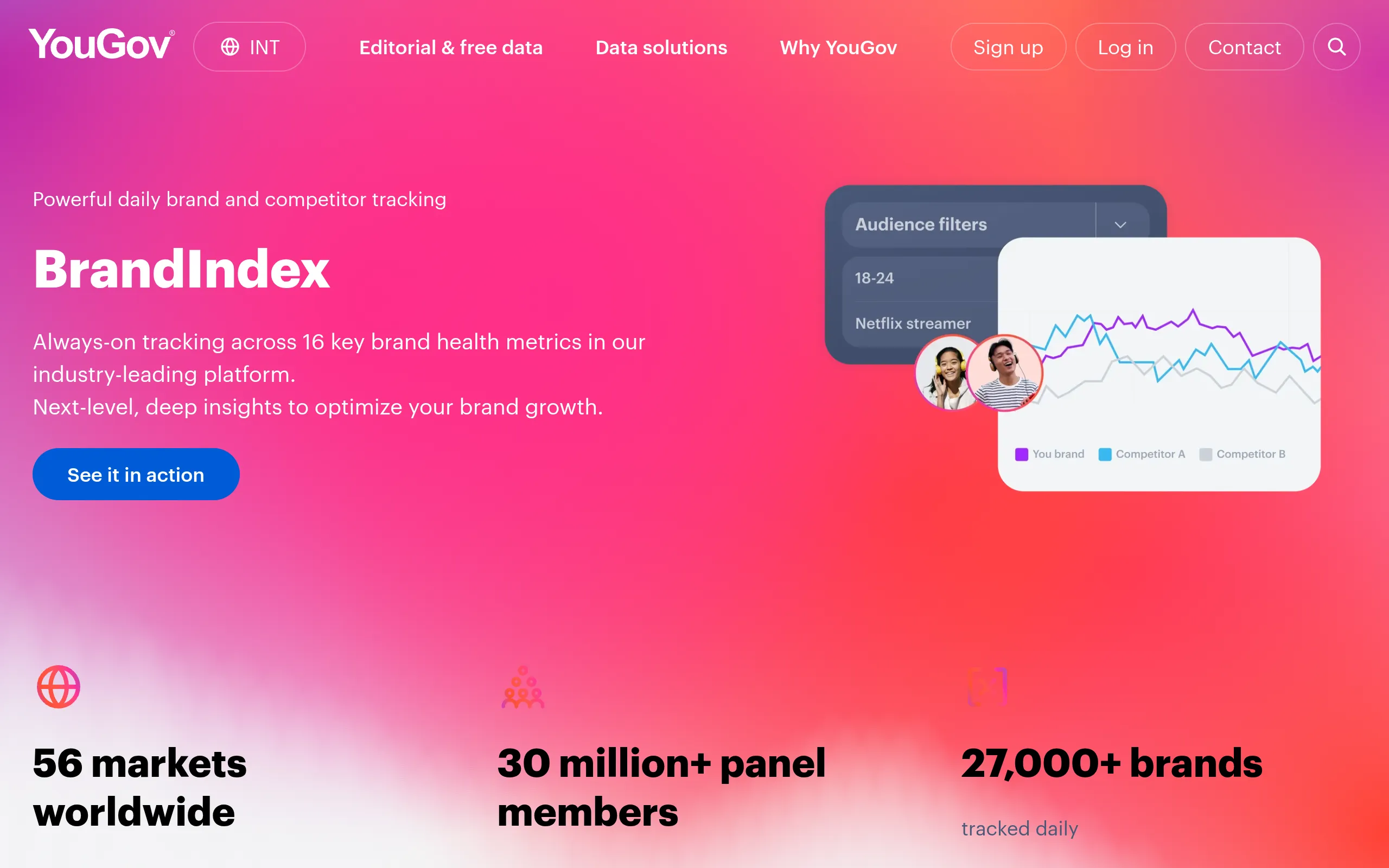
YouGov BrandIndex is a syndicated, always-on brand tracker built for teams that need consistent cross-market comparisons. It measures brand health daily across 16 metrics and carries years of historical trend lines, so you can see movement against category rivals without commissioning a new study each quarter.
It’s strongest when your core question is “how is my brand moving versus competitors over time” rather than “why did this specific campaign land.” The scale is real: broad market coverage and a large panel mean the benchmarks hold up.
The limitation is the flip side of syndication. You get standardized metrics, not a questionnaire tailored to your exact strategic question, so brands needing bespoke depth often pair it with a custom study.
- Methodology type: Syndicated daily tracker
- Best for: Enterprise marketing teams needing cross-market benchmarks
- Pricing: No public rate card, enterprise subscription quoted per market and category
- Tracking cadence: Daily, always-on
- Geographic scope: Broad multi-market global coverage
- Standout strength: Long historical trend lines for competitor benchmarking
2. The Research Agency (TRA): Best for Hybrid Consultancy Plus Tracking
The Research Agency pairs always-on tracking technology with human consultancy, including a genAI assistant called Arti and tiered offers from lighter-touch Tracking Essentials to full-service TRA Tracking. It suits buyers who want interpretation and strategic context, not just a data feed.
This model earns its place when the board needs direction rather than raw numbers. The self-service dashboards give your team fast access between reviews, while the analysts add cultural context and marketing theory when a decision is on the line.
It’s less ideal if you only want a cheap, hands-off tracker, because the consultancy layer is the point of the offer and shapes the cost.
- Methodology type: Hybrid consultancy plus survey tracking
- Best for: Brand teams wanting strategic interpretation alongside data
- Pricing: No public rate card, quoted per research programme
- Tracking cadence: Always-on with tiered touch levels
- Geographic scope: Global enterprise and specialist B2B
- Standout strength: Human analysts plus a self-service assistant
3. Material+: Best for Brand Health Analytics and Action
Material+ is a brand health tracking service built around analytics, data science, and proprietary tools including AI Muse, Implicit Identity Mapping, and Active Voice. It fits buyers who want to connect brand measurement directly to growth, positioning, and campaign decisions.
The differentiator is diagnosis. Rather than reporting that perception shifted, the analytics layer is positioned to explain what changed and why, which is what makes tracking actionable rather than descriptive.
The honest caveat from reading their own materials: the proof is thin on public case studies and benchmarks, so press hard for sample results before you commit. A strong analytics promise still needs evidence it delivers.
- Methodology type: Analytics-led survey tracking
- Best for: Teams linking brand measurement to growth decisions
- Pricing: No public rate card, quoted per research programme
- Tracking cadence: Ongoing, program-based
- Geographic scope: Multi-market
- Standout strength: Proprietary diagnosis tools for perception change
4. GWI: Best for Audience-Linked Brand Measurement
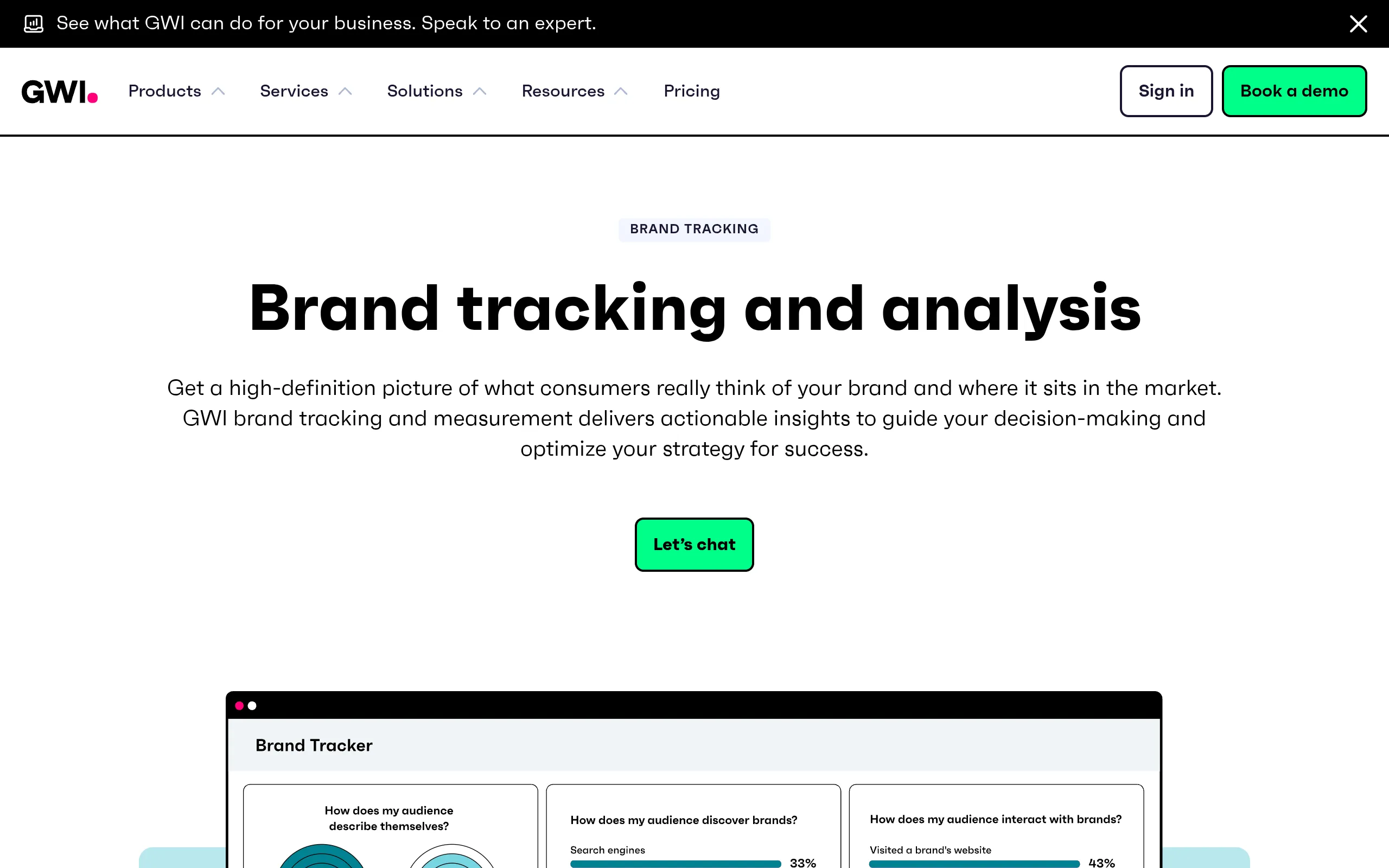
GWI ties brand tracking to its audience profiling data, so measurement comes with segmentation and consumer context built in. It’s useful when you need to connect brand health to specific consumer segments, behaviors, and audience opportunity, not just a single headline score.
The strength is context. A standard tracker tells you awareness moved; GWI links that movement to who the audience is and how they behave, which makes the result easier to act on in media and creative planning.
The trade-off is that the offer leans on its profiling ecosystem, so the deeper value shows up when audience insight matters as much as the brand score itself.
- Methodology type: Survey tracking plus audience profiling
- Best for: Teams needing segment-level audience context
- Pricing: No public rate card, enterprise subscription quoted per market
- Tracking cadence: Ongoing custom programs
- Geographic scope: Global
- Standout strength: Brand metrics linked to deep audience data
5. Hanover Research: Best for Custom Survey-Led Trackers
Hanover Research leans into custom brand tracking surveys, structured questionnaire design, and executive-friendly reporting. It’s the fit for teams that need a tailored study rather than a syndicated or off-the-shelf model.
You get more control here over the exact questions, the audience definition, and the reporting outputs. That suits organizations whose strategic questions don’t map cleanly onto a standardized panel.
The cost of that control is setup time and bespoke design work, so it’s a heavier lift than buying into a ready-made tracker. Pick it when the questions matter more than the speed.
- Methodology type: Custom survey program
- Best for: Teams needing a tailored, question-specific study
- Pricing: No public rate card, quoted per research programme
- Tracking cadence: Periodic, often quarterly or biannual
- Geographic scope: Multi-market on request
- Standout strength: Full control of questions, audience, and reporting
6. Caliber: Best for Real-Time Stakeholder Intelligence
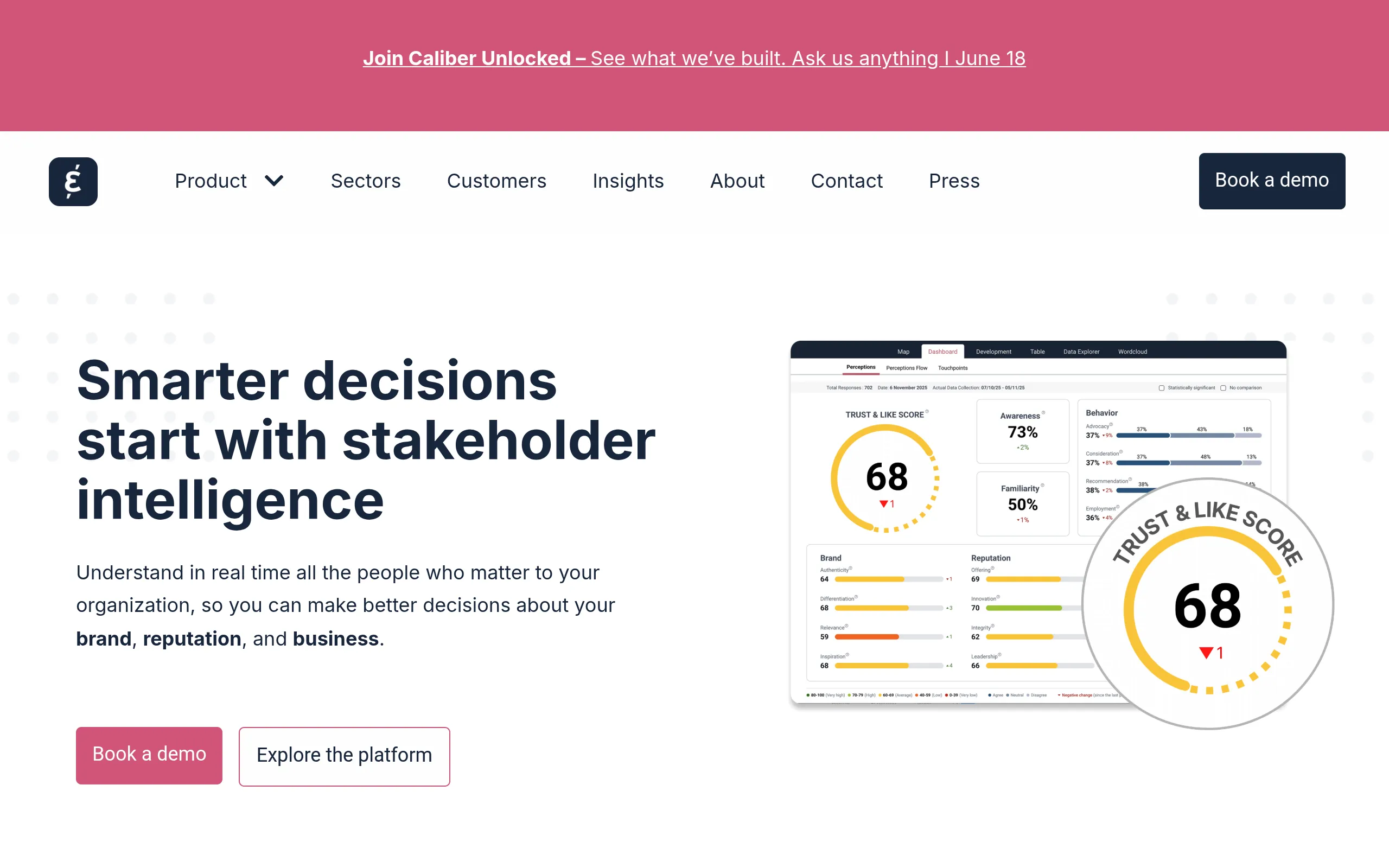
Caliber blends brand and reputation tracking, quick polls, and audience-specific measurement through its Caliber 360 and Caliber Focus platforms. It’s stronger in fast-moving reputation or comms environments where waiting for quarterly survey data is too slow.
The value is the warning system. Continuous monitoring plus the ability to drill into specific stakeholder groups means you catch a perception slide early and follow up on the audience that matters.
That speed is genuinely useful in a crisis. The candid limit: real-time monitoring carries the same data-quality and bias questions as any continuous method, so treat fast signals as an early read, not a final verdict.
- Methodology type: Monitoring-led with rapid polling
- Best for: Comms and reputation teams needing early warnings
- Pricing: No public rate card, quoted per brand tracking programme
- Tracking cadence: Real-time, continuous
- Geographic scope: Global stakeholder coverage
- Standout strength: Real-time alerts plus stakeholder-specific tracking
7. i-Genie.ai: Best for Behavioral Intelligence
i-Genie.ai emphasizes behavioral signals from search, social, reviews, and AI-era discovery paths rather than survey responses. It fits categories where surveys lag behind market shifts and behavior tells the story faster.
The argument is that what people do beats what they say, and signals like share of search can move days before a quarterly survey would catch them. That earlier read is the draw for fast categories.
The fair counter, which the approach tends to understate, is that behavioral data answers the “what” better than the “why.” It’s sharpest as a leading indicator paired with survey work for validation, not as a full replacement for it.
- Methodology type: Behavioral signal monitoring
- Best for: Fast-moving categories where surveys lag
- Pricing: No public rate card, quoted per engagement
- Tracking cadence: Continuous, real-time signals
- Geographic scope: Online, market-dependent
- Standout strength: Early signal detection from behavior
8. Brandwatch: Best for Social Listening-Led Tracking
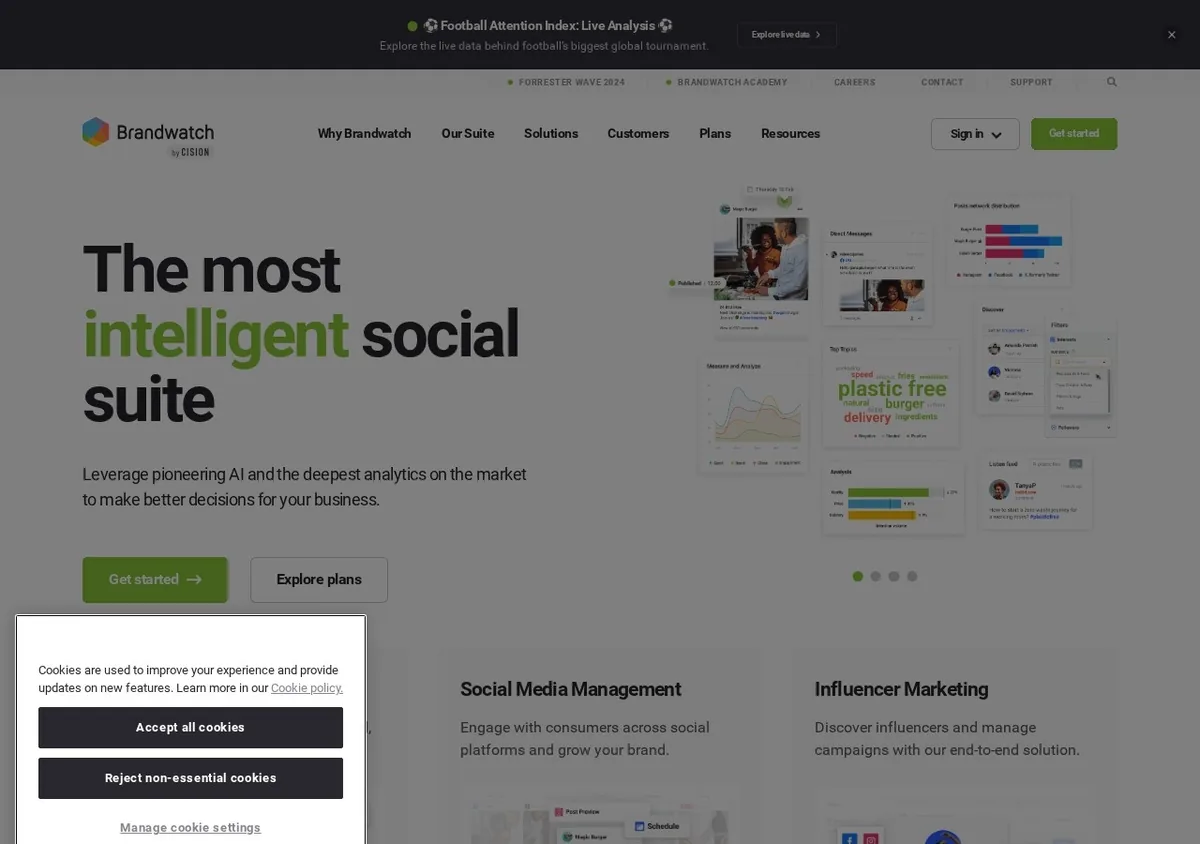
Brandwatch is a monitoring-first platform for mentions, sentiment, and share of voice across online conversation. It suits digital-first teams that want a fast read on how the brand shows up in public discussion.
You get quick visibility into conversation volume and sentiment, which is genuinely useful for spotting spikes and tracking campaign chatter. Frame it honestly, though: this is complementary to survey-based brand health work, not a substitute for it.
Social conversation skews toward the loud and the online, so it tells you what’s being said, not what your whole market believes. Pair it with a structured tracker for the full picture, the way our team treats brand monitoring tools as one input among several.
- Methodology type: Social listening and monitoring
- Best for: Digital-first teams tracking conversation
- Pricing: No public rate card, quotes typically land in the low four figures per month and climb for enterprise
- Tracking cadence: Real-time
- Geographic scope: Global online conversation
- Standout strength: Fast read on volume and sentiment
9. Hall & Partners: Best for Decision-Ready Tracking
Hall & Partners builds bespoke brand trackers for brands that need decisions, not only headline metrics. Each tracker sits on a tailored brand equity model rather than a standard questionnaire.
Its standout is simulators that test the impact of a strategic decision before you commit to it, backed by interactive workshops that get stakeholders acting on the findings. One published case study reports a 3% year-over-year sales lift for a fashion brand.
The catch is transparency. Pricing and tracking cadence aren’t published, so ask for a sample simulator output and a scoped quote before you sign.
- Methodology type: Bespoke tracker on a tailored brand equity model
- Best for: Brands that need workshop-ready, decision-focused outputs
- Pricing: Not published, quoted per program
- Tracking cadence: Set per program, not published
- Geographic scope: Scoped per program
- Standout strength: Simulators that test decisions before you act
10. Attest: Best for Self-Serve Survey Tracking
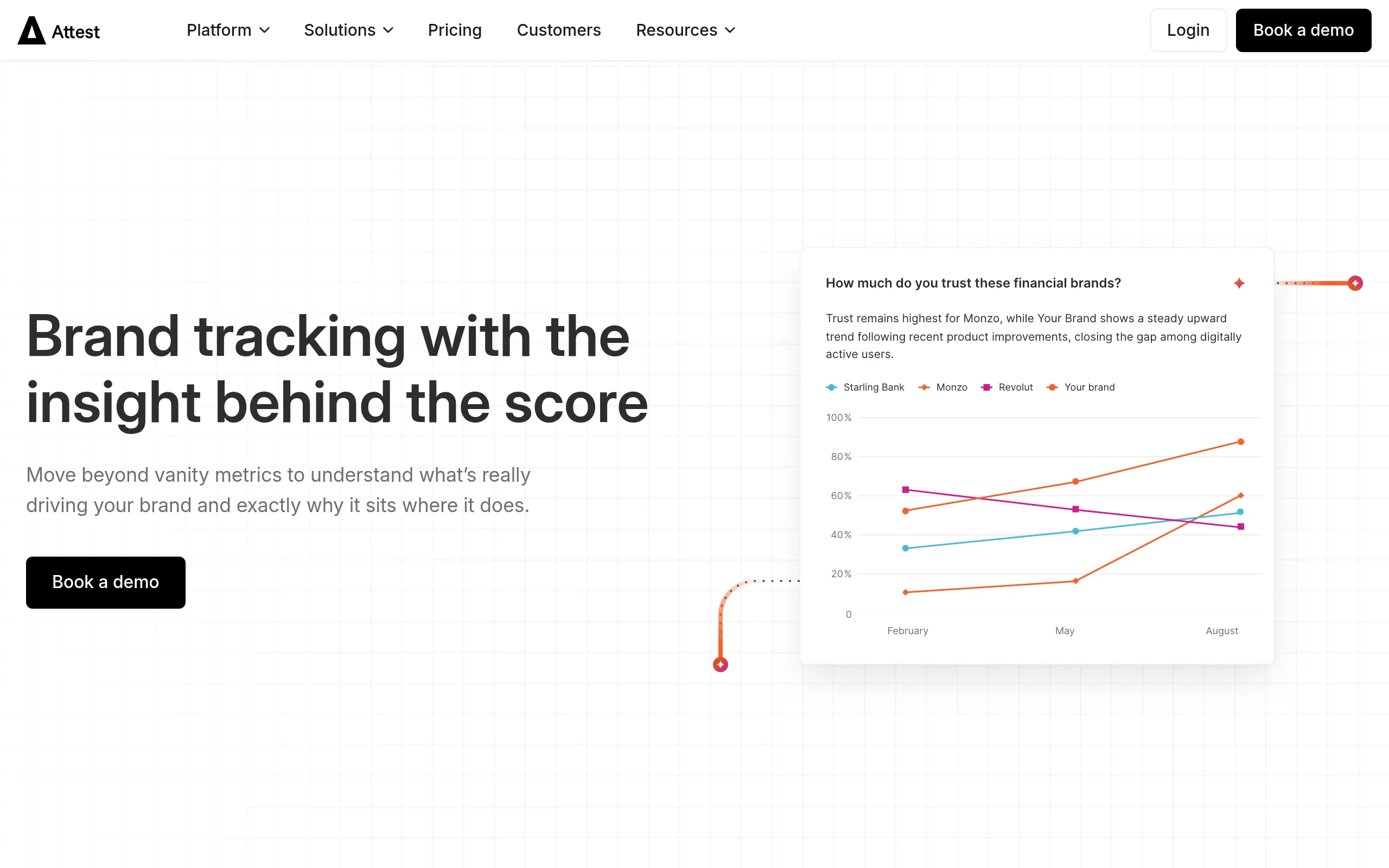
Attest is a self-serve consumer research platform that lean teams use to run their own brand tracking surveys. You design and field the tracker yourself instead of waiting on an agency cycle.
It sells subscription tiers in credits, where 1 credit is one answer to one question from one person, so a 10-question survey to 500 people uses 5,000 credits. Every survey passes three layers of quality checks before results reach you.
The trade-off is that self-serve asks more research skill of your team than a full-service agency does. It suits buyers who already know which questions to track.
- Methodology type: Self-serve survey platform
- Best for: Lean insight teams running their own tracker
- Pricing: Credit tiers from Basic (up to 50,000 credits) to Custom (over 400,000), prices not published
- Tracking cadence: Whenever you field a wave
- Geographic scope: Set by the audiences you buy
- Standout strength: Three layers of quality checks on every survey
11. Kantar BrandDynamics: Best for Daily Tracking With Forecasts
Kantar’s BrandDynamics is a daily brand performance tracker for teams that watch themselves and their competitors in close to real time.
Its standout is forecasting: Kantar says the platform shows how your brand metrics will evolve over the next three months, which turns tracking into an early warning system.
It’s sold as a self-serve subscription with optional consultancy, and pricing isn’t published, so you’ll need a quote before you can budget.
- Methodology type: Daily tracker with AI forecasting
- Best for: Brand teams that need daily readings and forecasts
- Pricing: Subscription, not published
- Tracking cadence: Daily
- Geographic scope: Multi-market
- Standout strength: Three-month forecasts of brand metrics
Brand Tracking Agencies Comparison Table
This table reduces the eleven options to a shortlist in under two minutes. Read down the methodology column first, since the operating model decides what kind of answer you get, then narrow by buyer type.
| Agency | Best Use Case | Methodology Type | Geographic Scope |
|---|---|---|---|
| YouGov BrandIndex | Daily competitor benchmarking | Syndicated daily tracker | Broad global |
| The Research Agency | Tracking plus strategic guidance | Hybrid consultancy | Global, B2B and enterprise |
| Material+ | Brand health diagnosis | Analytics-led survey | Multi-market |
| GWI | Audience-linked measurement | Survey plus profiling | Global |
| Hanover Research | Tailored custom studies | Custom survey program | Multi-market on request |
| Caliber | Reputation early warnings | Monitoring plus polling | Global stakeholders |
| i-Genie.ai | Early behavioral signals | Behavioral monitoring | Online, market-dependent |
| Brandwatch | Conversation and sentiment | Social listening | Global online |
| Hall & Partners | Decision-ready tracking | Bespoke tracker plus simulators | Scoped per program |
| Attest | Self-run tracking surveys | Self-serve survey platform | Set by your audiences |
| Kantar BrandDynamics | Daily readings with forecasts | Daily tracker with AI forecasts | Multi-market |
How we picked these eleven: each one represents a distinct operating model, from syndicated daily trackers to bespoke consultancies, self-serve survey platforms and monitoring-led tools.
We selected for methodology variety and clear buyer fit rather than padding to a round number, so the list maps to how teams actually buy. For a tools-first view rather than agencies, the deeper breakdown sits in our brand tracking software comparison.
How to Choose the Right Brand Tracking Agency
The best fit is the agency that matches your cadence and decision process, not the one with the flashiest dashboard. Work through these checks in order.
Match the Model to Your Company Size
Enterprise buyers usually need stronger methodology transparency, multi-market coverage, and repeatable reporting that holds up under board scrutiny. Smaller teams often need the opposite: simpler setup, lower overhead, and a single clear metric they can act on.
Buying enterprise-grade syndication when you operate in one market is overspend, and buying a lightweight tracker when you run twelve markets leaves gaps.
Decide Between Continuous and Periodic Tracking
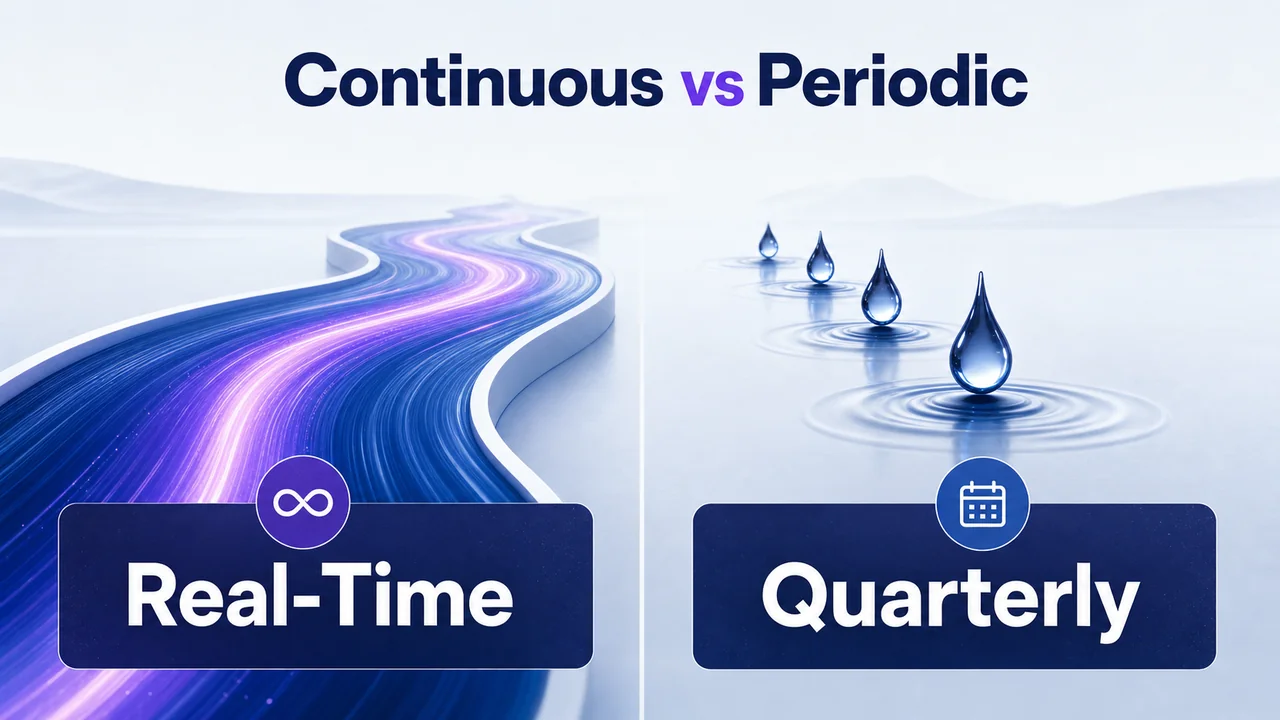
Continuous tracking is better for fast-moving categories where perception shifts in days, such as retail, fintech, or anything tied to news cycles. Periodic studies, run quarterly or biannually, are enough when brand movement is slower and a deep tailored read matters more than speed. Don’t pay for daily data you only review twice a year.
Set the Balance of Qualitative and Quantitative
Use qualitative add-ons when you need the why behind a number, such as why consideration dropped in one segment. But keep a quantitative backbone in the core tracker, because the numbers are what give the qualitative story weight. A tracker that’s all narrative and no measurement can’t survive a budget review.
Weigh Local Against Global Scope
Global brands need comparable methods across every market, or the cross-market numbers mean nothing. Regional brands often get more value from depth in one country than thin coverage across many.
Decide which matters before you read a single proposal, because scope quietly drives both price and methodology. This connects directly to how you measure share of voice across markets.
Ask for Proof Before You Sign
Request sample dashboards, sample questionnaires, the benchmark logic, and a relevant case study from every agency on your shortlist. A provider that can show how its tracking changed a real decision is worth more than one with a polished interface and no evidence behind it.
2026 Benchmark for Evaluating Tracking Agency Output
The benchmark worth holding a tracking agency to is what happens after the report.
In our experience, dashboards and monthly PDFs don’t change anything on their own. The decisions and outreach that follow the data do.
When comparing agencies, weight “what do you do with the data” above “how much data do you collect.”
FAQ
What does a brand tracking agency actually do?
A brand tracking agency measures your brand’s health over time and turns that measurement into decisions. The work covers metrics like awareness, consideration, perception, and purchase intent, tracked at a set cadence and benchmarked against competitors. The better agencies go past reporting numbers to explain what changed, why, and what you should do next.
How often should brand tracking be done?
It depends on how fast your category moves. Continuous or daily tracking suits fast-changing markets where perception can shift in days, while quarterly or biannual studies are enough for slower categories. A common pattern is twice-yearly deep studies for stable brands, with always-on monitoring layered on when news cycles or campaigns demand a faster read.
What’s the difference between brand tracking and brand monitoring?
Brand tracking measures long-term brand health through structured, repeatable research, usually surveys. Brand monitoring watches real-time mentions and conversation across media and social channels.
Tracking tells you what your market believes over time; monitoring tells you what’s being said right now. They answer different questions, and serious teams run both.
What metrics should a brand tracking study include?
A solid study covers the full journey, not just awareness. The core set is awareness, perception, prior usage, preference, future purchase consideration, and a loyalty measure like NPS. Awareness alone hides blind spots, so include consideration and intent to see where the brand actually leaks in the funnel.
How do you choose the best brand tracking company for your team?
Match the operating model to your cadence, scope, and decision process rather than chasing the slickest dashboard. A global enterprise needs comparable multi-market methods and transparent sampling; a single-market brand may get more from a focused custom study. Shortlist two or three, then ask each for sample dashboards, questionnaires, and a case study before deciding.
How much does brand tracking cost?
It ranges from free to custom enterprise pricing, because the models differ.
GWI has a free plan and charges $150 per user a month for its Plus plan, while Attest sells credit-based tiers without published prices.
Programs from Kantar and Hall & Partners are quoted per project, so a scoped quote is the only real number.
Budget matters less than fit: a cheap tool nobody opens costs more than a right-sized program you use every month.
Is an agency better than brand tracking software?
Neither wins everywhere, because they answer different questions.
An agency is the better choice when you need defensible perception data and someone to interpret it.
Software wins on speed, control and always-on coverage, and teams with the budget run both: software for the live signal, an agency for the quarterly deep read.
Your Shortlist Starts Here
The best brand tracking agency is the one that matches your business model, your tracking cadence, and your reporting needs, not the one with the biggest name. Narrow this list to two or three providers based on fit, then judge them on actionability rather than recognition.
Ask each finalist for sample dashboards, methodology notes, and a relevant case study before you sign anything. If you also want to know how your brand surfaces in AI answers, not just in surveys, book a short strategy call and see where you stand.