
Free social listening tools let you track what people say about your brand online, without spending a dollar. But in 2026, the landscape has shifted. Most tools that were genuinely free a few years ago now lock core features behind paywalls. Platform API restrictions have tightened. And the rise of AI search means the conversations that matter most are happening in places traditional listening tools don’t even monitor.
This article breaks down what free social listening actually gets you in 2026, which tools still offer meaningful free access, where the gaps are, and how to build a monitoring setup that covers both social platforms and the AI search engines increasingly shaping how people discover brands.
What You’ll Learn
- What free social listening can and can’t do in 2026, realistic expectations based on current tool capabilities
- The four tools that still offer genuinely free social listening features worth using
- How platform API changes since 2024 have reduced what free tools can access
- Why traditional social listening misses conversations happening in AI search, and what to do about it
- A practical setup for combining free tools to cover your most important monitoring needs
- When it makes sense to move from free tools to a paid or agency-supported approach
What Free Social Listening Actually Means in 2026
Social listening is the practice of monitoring online conversations, across social media platforms, forums, blogs, news sites, and review platforms, to understand what people say about your brand, competitors, or industry. It goes beyond tracking direct mentions to capture indirect references, sentiment shifts, and emerging trends.
| Monitoring capability | Free social listening tools | Requires paid or agency-supported setup |
|---|---|---|
| Keyword / brand tracking | Limited, typically one to three keywords or brand names | Unlimited keywords plus multi-brand competitor monitoring |
| Platform coverage | Usually one or two social networks plus basic web mentions | Broad coverage including newer platforms like Threads, Bluesky, and Mastodon |
| Historical data window | Short, most free tiers show seven days or fewer | Months or years of searchable historical data |
| Sentiment analysis | None or surface-level positive/negative classification | AI-powered sentiment analysis and trend forecasting |
| Reporting | Basic email alerts without advanced filtering | Shareable dashboards, data exports, and filtered reports |
| AI search monitoring | Not covered (ChatGPT, Perplexity, Gemini) | Dedicated AI search visibility monitoring |
Free social listening, specifically, refers to tools or tool tiers that provide this monitoring capability at no cost. In 2026, that definition comes with significant caveats.
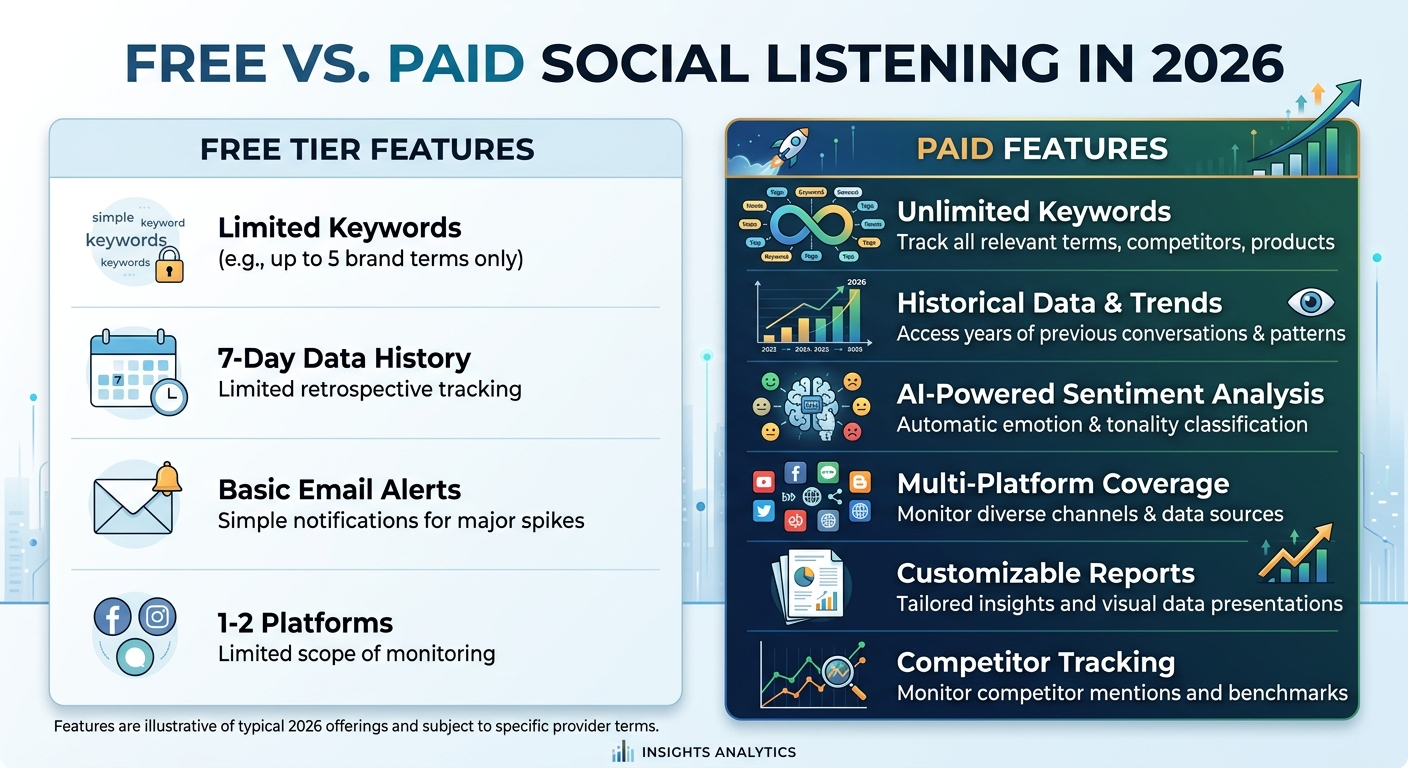
What Free Tools Typically Include
- Limited keyword tracking, usually one to three keywords or brand names
- Restricted platform coverage, often only one or two social networks, plus basic web mentions
- Short data windows, most free tiers show seven days or fewer of historical data
- Basic alerts, email notifications when your keyword appears, without advanced filtering
- No sentiment analysis, or only surface-level positive/negative classification
What Free Tools Typically Exclude
- Competitor monitoring across multiple brands
- AI-powered sentiment analysis or trend forecasting
- Data exports, dashboards, or shareable reports
- Coverage of newer platforms like Threads, Bluesky, or Mastodon
- Monitoring of AI search platforms (ChatGPT, Perplexity, Gemini) for brand mentions
Understanding these boundaries matters. Free social listening is a starting point, useful for solo founders, early-stage startups, and small teams testing whether systematic monitoring adds value. It isn’t a substitute for comprehensive brand monitoring at scale.
Why Most “Free” Social Listening Tools Aren’t Truly Free Anymore
If you searched for free social listening tools in 2022, you’d find a dozen viable options. As of 2026, that list has shrunk dramatically. The reason is structural, not just commercial.
API Access Has Become Expensive
X (formerly Twitter) introduced paid API tiers in 2023 and has continued raising prices. Meta restricts Instagram data access to approved business partners. Reddit’s API pricing changes in 2023 pushed many smaller tools to drop Reddit coverage or charge for it. TikTok’s data remains largely closed to third-party monitoring tools.
For tool providers, accessing social platform data now costs real money. Offering that access for free is increasingly unsustainable.
The Freemium Squeeze
Tools that once offered generous free tiers, including Talkwalker’s standalone free social search, BuzzSumo’s free content analysis, and Mention’s free plan, have either eliminated those tiers or reduced them to near-unusable levels. According to a 2025 analysis by G2, the number of social listening tools offering a functional free tier dropped by 40% compared to 2023.
This doesn’t mean free options are gone. It means you need to be more strategic about which free tools you combine and what gaps you accept.
Four Free Social Listening Tools That Still Deliver Value
After testing the current landscape, these four tools provide genuine free social listening capabilities in 2026. Each has clear limitations, but each also provides something useful without requiring a credit card.
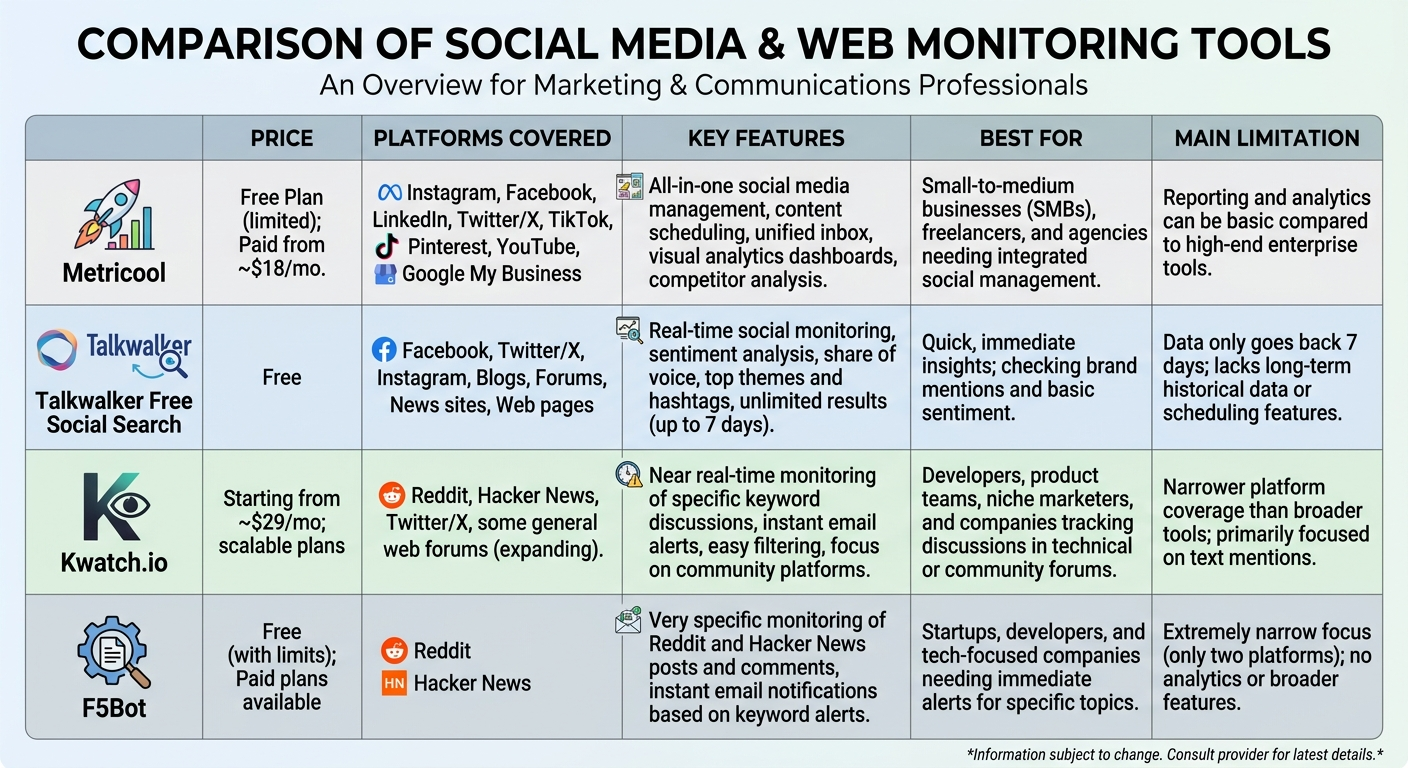
1. Metricool, Best Free All-in-One Option
Metricool stands out because its free plan combines scheduling, analytics, and listening in one dashboard. You won’t get deep sentiment analysis or large-scale keyword tracking, but for a single-brand operation, it covers the essentials.
- Best for: Creators, freelancers, and small businesses managing one brand who want monitoring alongside their content workflow
- Cost: Free plan for one brand, paid tiers from $22 a month
- Platforms covered: TikTok, Instagram, Facebook, X, LinkedIn
- Standout strength: Scheduling, analytics, and listening in one free dashboard
- Key limitation: Instagram data is capped by Meta’s API, even on paid tiers
2. Talkwalker Free Social Search, Best for Quick Research
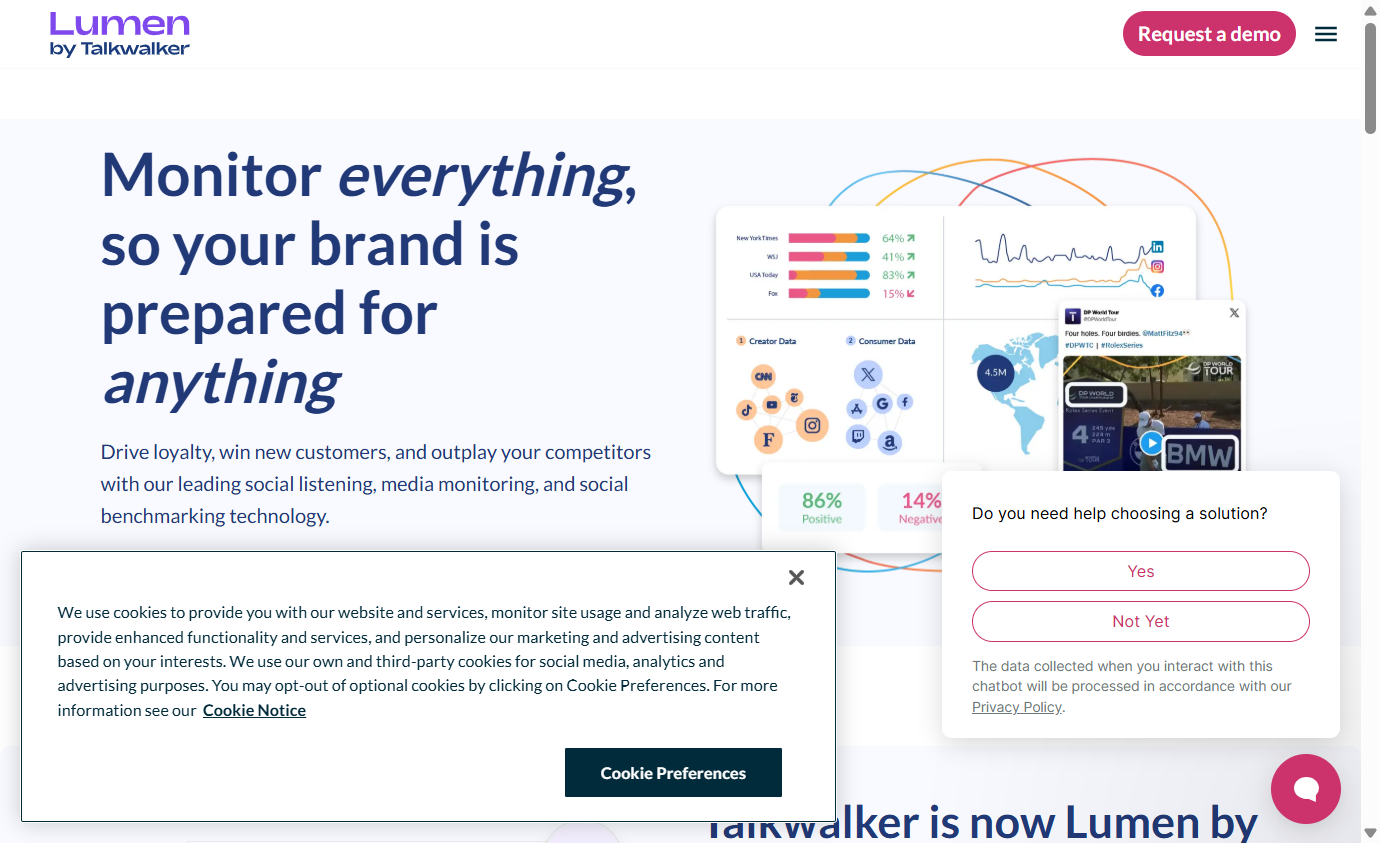
Talkwalker, now part of Hootsuite, maintains a free social search tool that remains one of the fastest ways to get a snapshot of any conversation happening online. You type a keyword, and it returns volume data, sentiment breakdowns, and source distribution in seconds.
- Best for: Quick competitive research, PR monitoring, or one-off brand checks
- Cost: Free, no account required
- Platforms covered: X, YouTube, news sites, forums, podcasts, seven days of history
- Standout strength: Volume, sentiment, and source breakdown in seconds with no signup
- Key limitation: Seven-day window, no saved searches, alerts, or export
3. Kwatch.io, Best Free Reddit Monitoring
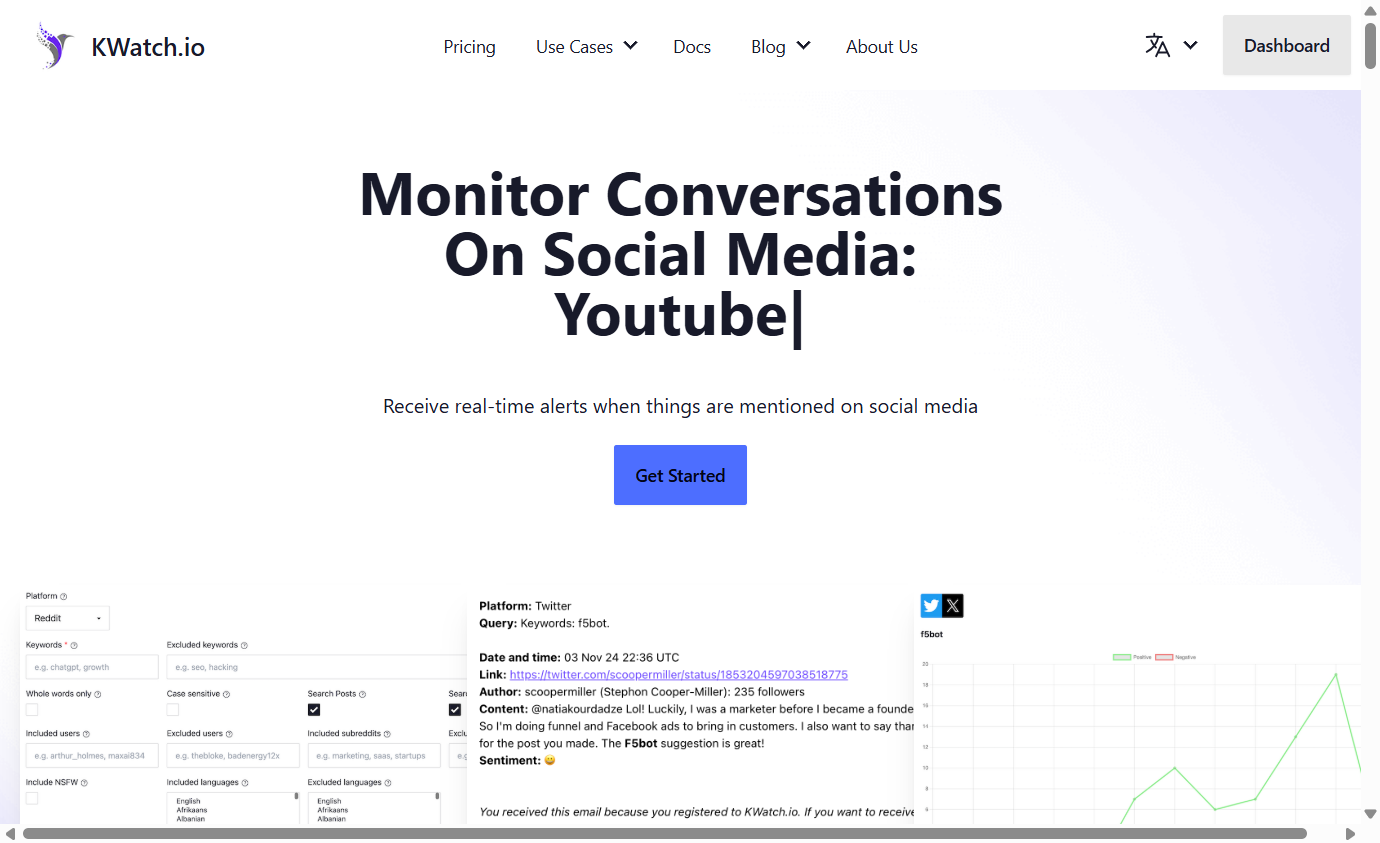
Reddit has become one of the most important platforms for authentic consumer conversation. Kwatch.io monitors Reddit mentions in real time and alerts you when your brand, product, or chosen keywords appear. The free tier covers Reddit and Hacker News, the two platforms where unfiltered opinion tends to surface first.
- Best for: B2B SaaS companies, tech brands, and startups whose audiences are active on Reddit
- Cost: Free for Reddit and Hacker News, paid from $19 a month
- Platforms covered: Reddit and Hacker News free, paid adds X, YouTube, Facebook, LinkedIn
- Standout strength: Real-time Reddit alerts where unfiltered buying opinion surfaces first
- Key limitation: Free tier stops at Reddit and Hacker News
4. F5Bot, Best for Simple, No-Frills Reddit Alerts
F5Bot has been running since 2017 and does exactly one thing well: it emails you when your keywords appear on Reddit. You can monitor specific subreddits or Reddit as a whole. There’s no dashboard, no analytics, and no sentiment scoring. It’s a notification tool, pure and simple.
- Best for: Anyone who needs reliable Reddit alerts without learning a new platform
- Cost: Free
- Platforms covered: Reddit only
- Standout strength: 200 keyword alerts, running dependably since 2017
- Key limitation: Reddit only, with a delay between post and email
How to Build a Free Social Listening Setup That Actually Works
No single free tool covers everything. The practical approach is to combine two or three tools so their strengths compensate for each other’s gaps.
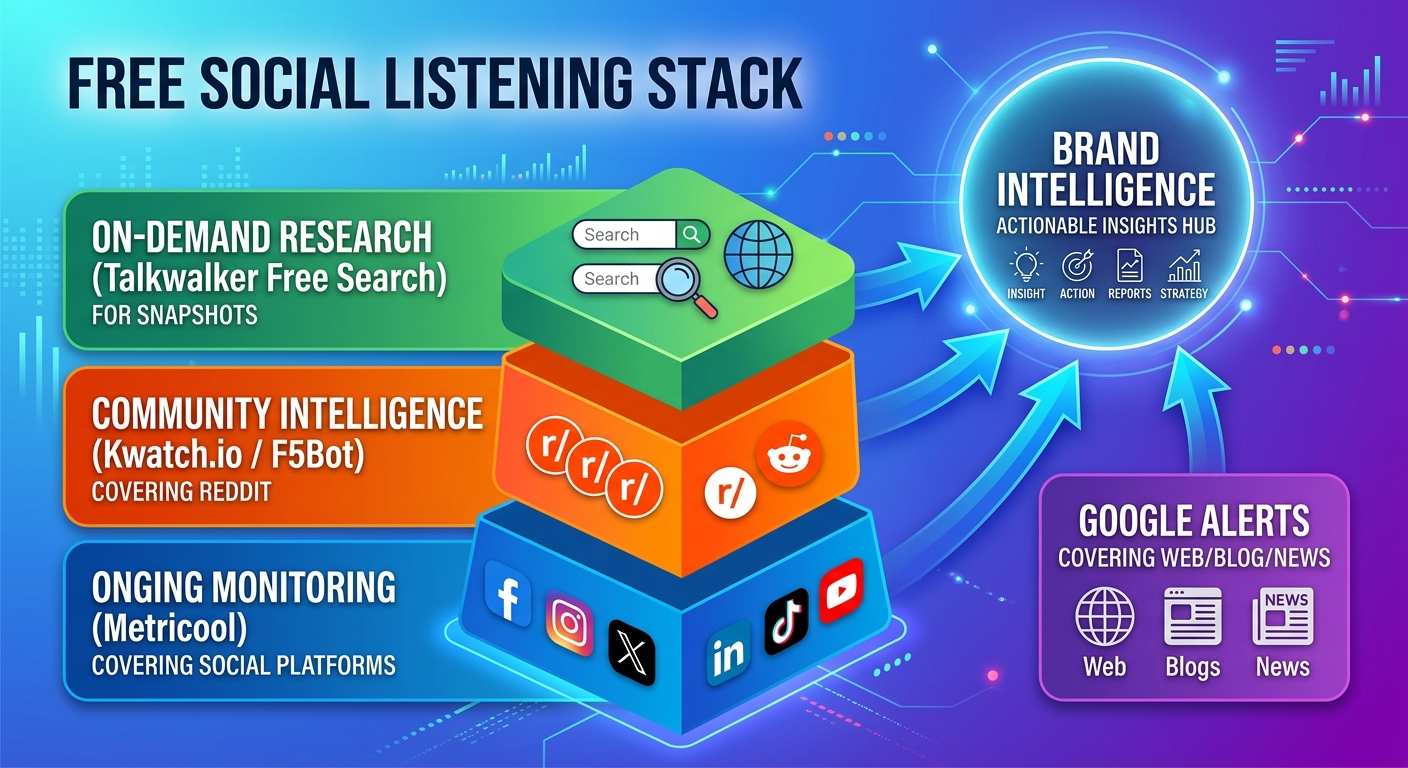
A Three-Tool Stack for Zero Budget
Layer 1, Ongoing monitoring: Use Metricool’s free plan to track mentions, hashtags, and competitor activity across your primary social platforms. Set this up once and check it weekly.
Layer 2, Reddit coverage: Add Kwatch.io or F5Bot to capture Reddit conversations where your brand, product category, or competitors get discussed. Reddit threads often surface pain points and comparison discussions that don’t appear on other platforms.
Layer 3, On-demand research: Use Talkwalker Free Social Search whenever you need a quick snapshot, before a product launch, after a campaign, or when you suspect sentiment has shifted.
This combination gives you persistent monitoring (Metricool), community-level intelligence (Kwatch.io/F5Bot), and research-grade snapshots (Talkwalker), all without spending anything.
Add Google Alerts for Web Mentions
Social listening tools focus on social platforms. But brand conversations also happen on blogs, news sites, and niche publications. Setting up Google Alerts for your brand name, CEO name, and product names fills this gap. Google Alerts is free, requires no special tools, and delivers results via email or RSS.
It won’t catch everything, Google Alerts has well-documented coverage gaps, but it adds a layer of web monitoring that social-focused tools miss entirely.
The Gap Free Tools Can’t Fill: AI Search Monitoring
Here’s what none of the tools above can do: tell you what AI search engines say about your brand.
As of 2026, a growing share of brand discovery happens through AI-powered interfaces. When a potential customer asks ChatGPT, Perplexity, or Google’s AI Overviews for a product recommendation, your brand either gets mentioned, or it doesn’t. According to a 2025 SparkToro study, nearly 60% of Google searches now result in zero clicks to external websites, driven partly by AI-generated answers that satisfy the query directly.
Traditional social listening monitors what humans say about your brand on social platforms. AI visibility monitoring tracks whether AI systems recommend, cite, or mention your brand when users ask relevant questions. These are fundamentally different data streams.
Why This Matters for Your Brand
If someone asks Perplexity “What’s the best project management tool for remote teams?” and your competitor gets cited but you don’t, that’s a visibility gap no amount of social listening will detect.
AI models form brand-category associations based on patterns in their training data, primarily high-authority editorial content, structured data, and consistent brand mentions across trusted sources. Brand mentions on high-authority publications influence AI recommendations because large language models learn which brands are associated with specific categories from the content they ingest.
Free social listening tools don’t monitor AI search outputs. To understand how AI platforms perceive your brand, you need a different approach, one focused on tracking what AI says about you and building the editorial presence that shapes those responses.
Pro Insight: Social listening tells you what people say about your brand. AI visibility monitoring tells you what machines say about your brand. In 2026, you need both. Start with free social listening to understand customer sentiment, then layer in AI monitoring as your brand matures.
When Free Social Listening Stops Being Enough
The free-to-paid tipping point we watch for most in audits is volume, not features. Once a brand is generating more than roughly 150 meaningful mentions a week, the time cost of manual triage inside free tools outgrows the savings versus a paid plan. If your team is losing 5+ hours a week chasing alerts that turn out to be noise, the tool has already paid for itself.
Free tools work well in specific situations. They stop working when your needs exceed their structural limits.
Signs You’ve Outgrown Free Tools
You’re Monitoring More Than One Brand or Product Line
Free tiers typically restrict you to a single brand.
You Need Sentiment Trends Over Time
Seven-day data windows don’t show whether perception is improving or declining.
You’re Missing Conversations on Key Platforms
If your audience is on TikTok, Instagram, or Threads, free tools offer limited or no coverage there.
You Can’t Export or Share Data
When stakeholders need reports, copying and pasting from a free dashboard becomes unsustainable.
You Need to Understand AI Search Visibility
No free social listening tool tracks how AI models reference your brand in their responses.
The Middle Ground: Affordable Paid Tools
If free tools aren’t enough but enterprise solutions (Brandwatch, Meltwater, Talkwalker’s full platform) are out of budget, several mid-range options exist in 2026:
Awario
Starts at $49/month, covers major social platforms plus blogs and forums
Brand24
Starts at $149/month, includes AI sentiment analysis across 25 million sources
Mentionlytics
Starts at $49/month, includes newer platforms like Bluesky and Threads
Social Champ
Starts at $8/month for basic social listening with sentiment tracking
For a more detailed comparison, see our breakdown of free social listening tools and how they compare to paid alternatives.
See where AI answers put your brand
Twenty minutes with a senior strategist: where the major engines point buyers in your category, who gets named instead of you, and a straight read on what a programme would change.
Book a strategy callHow to Use Free Social Listening Data to Strengthen Your Brand
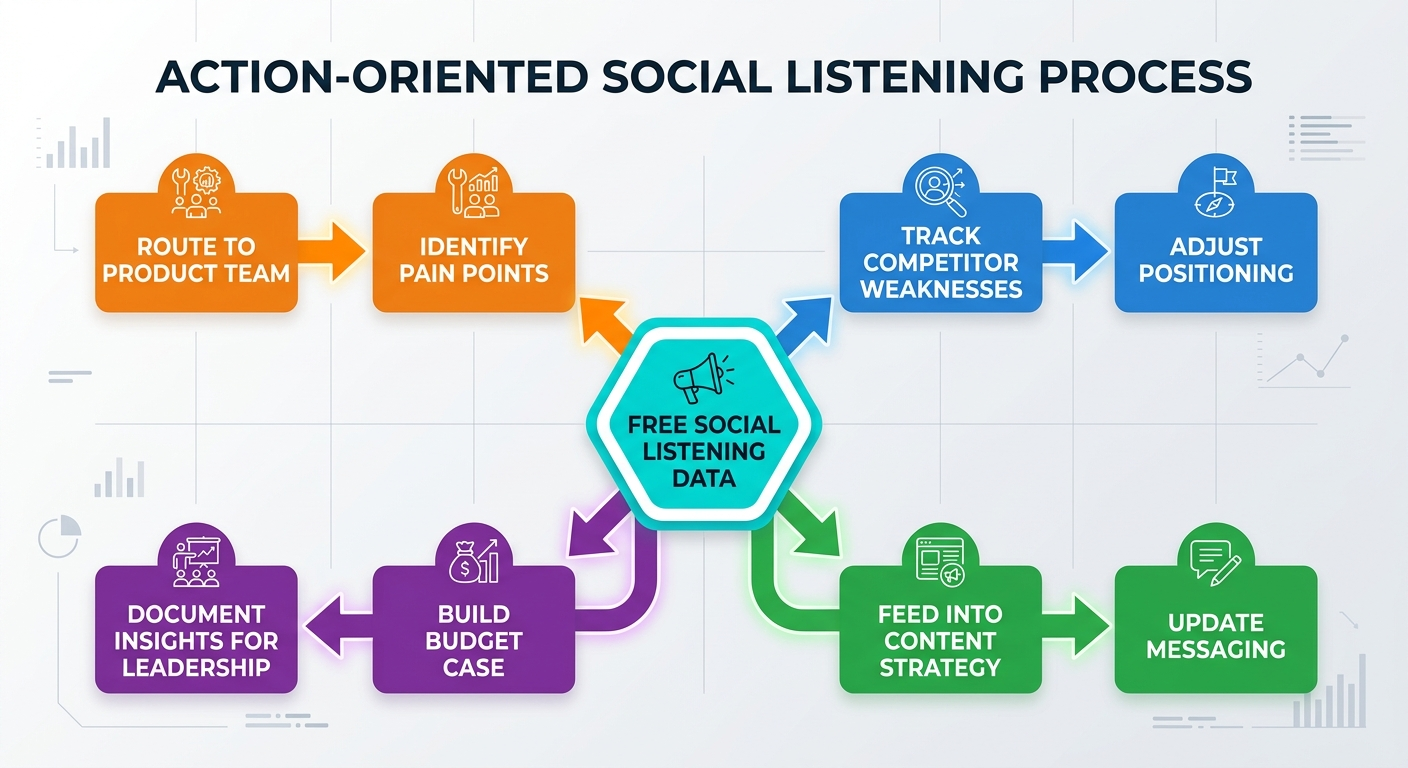
Collecting mentions is only useful if you act on what you find. Here’s how to turn free tool data into concrete outcomes.
Identify Recurring Customer Pain Points
When the same complaint appears across multiple Reddit threads or social posts, that’s a signal. Document these patterns and route them to your product or support team. Free tools won’t auto-categorize these for you, but a weekly manual review of alerts is enough to spot trends.
Track Competitor Weaknesses
Set up alerts for competitor brand names alongside terms like “frustrated,” “alternative,” “switching from,” or “looking for.” These conversations reveal exactly where competitors are losing customers, and where you can position your brand. This approach complements a broader competitor analysis strategy.
Feed Insights Into Content and Messaging
The language your audience uses in organic conversations is the language your marketing should use. If customers describe your product category differently than your website does, that’s a messaging gap. Social listening data, even from free tools, provides real phrasing you can incorporate into landing pages, ad copy, and brand monitoring reports.
Build a Case for Budget
If you’re using free tools to prove the value of social listening before requesting budget for a paid tool, document every actionable insight you find. Show your leadership team specific examples: a PR issue caught early, a customer complaint resolved quickly, a competitor gap identified. Data from free tools, presented well, justifies the investment in more capable monitoring.
Free Social Listening and AI Visibility: How They Connect
For the AI-search side of that connection, see checking brand mentions in ChatGPT and brand mention tracking inside language models, which walk through how editorial mentions surfaced by listening tools eventually feed AI citations.
Social listening and AI visibility monitoring serve different purposes, but they feed the same goal: understanding and strengthening how your brand shows up wherever your audience looks for information.
Social listening captures what real people say about you on social platforms. AI visibility monitoring captures what AI systems say about you when users ask questions. Together, they provide a complete picture of brand perception, human and machine.
The pattern we see repeatedly in audits is that brands with sustained editorial coverage on category-relevant publications appear in AI answers far more reliably than those leaning only on traditional SEO. Social listening tools sometimes surface the same editorial content when monitoring brand mentions across blogs and news sites, which is why free listening and AI-mention work are complementary.
If your free social listening setup reveals that your brand is rarely mentioned, or mentioned mostly in neutral, low-impact contexts, that’s also a signal about your AI visibility. Brands with low social mention volume typically have low AI citation rates, because neither humans nor machines have enough signals to associate that brand with its category.
Building entity authority through strategic editorial placements addresses both problems simultaneously. More high-authority mentions mean more social conversations to track and stronger signals for AI models to learn from.
Frequently Asked Questions
Is there a completely free social listening tool in 2026?
Yes, but with significant limitations. Metricool’s free plan, Talkwalker Free Social Search, Kwatch.io’s free tier, and F5Bot all provide genuine social listening capabilities at no cost. However, each restricts platform coverage, data history, or feature depth. Combining multiple free tools provides broader coverage than any single option.
Can ChatGPT or other AI assistants do social listening?
AI assistants like ChatGPT can’t monitor social platforms in real time. They don’t have live access to social media feeds or the ability to set up keyword alerts. However, you can paste listening data into an AI assistant and ask it to summarize trends, identify sentiment patterns, or draft responses, making it a useful analysis layer on top of your monitoring tools.
How much do paid social listening tools cost in 2026?
Affordable options range from $8/month (Social Champ) to $149/month (Brand24). Mid-market tools like Awario and Mentionlytics sit around $49/month. Enterprise platforms, Brandwatch, Meltwater, and Talkwalker’s full suite, typically cost $6,000 to $50,000+ per year depending on scope.
Does social listening help with AI search visibility?
Social listening helps you understand human perception of your brand, which is one input into AI visibility. But social listening tools don’t monitor what AI search engines say about your brand. For that, you need dedicated AI brand mention tracking that checks responses from ChatGPT, Perplexity, Gemini, and other AI platforms.
What’s the difference between social listening and social monitoring?
Social monitoring tracks direct mentions of your brand, tags, @mentions, and hashtags you own. Social listening goes broader, tracking conversations about your category, competitors, and industry even when your brand isn’t directly tagged. Listening provides strategic insight. Monitoring provides operational alerts. Most free tools lean toward monitoring, while paid tools offer deeper listening capabilities.
Building a Free Listening Stack in Under an Hour
Free social listening gives you a foundation. It won’t replace a comprehensive social media monitoring tool, and it won’t tell you what AI search engines say about your brand. But it will help you understand what your audience cares about, where competitors are vulnerable, and whether your messaging resonates.
Start with the three-tool stack outlined above. Spend 30 minutes setting it up. Review your alerts weekly. When you find insights that change how you communicate or position your brand, and you’ll, that’s the signal to invest further.
And if you’re wondering whether AI platforms mention your brand when it matters most, find out what AI says about you, it might be the most important listening you do this year.