
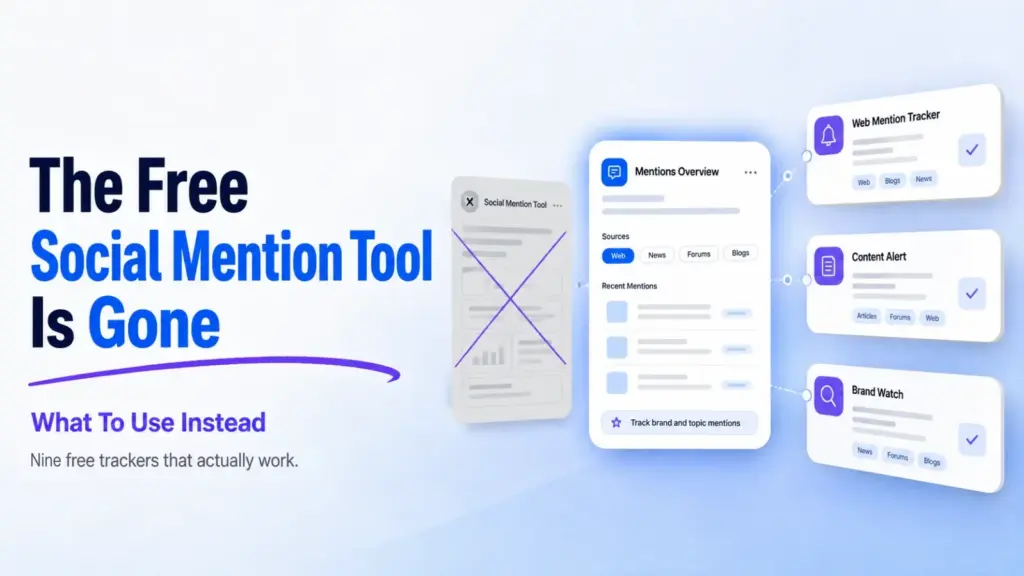

The original Social Mention tool (socialmention.com) is gone, so there’s no free version left to use.
On 21 September 2026, socialmention.com didn’t load at all, and the site using the name at socialmention.net only opens other networks’ searches.
The closest free replacement is Social Searcher for a one-off search, with Google Alerts and F5Bot running in the background to catch new social mentions. Eight more free options below cover advanced search, real-time alerts and the old sentiment scores.
Every tool below was checked in September 2026, and each free limit comes from the tool’s own site.
Quick Summary
- Social Mention left socialmention.com in 2022, and the domain stopped loading by September 2026.
- socialmention.net opens other sites’ searches but returns no results of its own.
- Social Searcher is free, unlimited and needs no account.
- F5Bot watches Reddit, Hacker News and Lobsters for free and emails you within minutes.
- Brand24 and Mention are trials, not free plans, and Brand24 starts at $249 a month.
What Happened to Social Mention
Social Mention shut down, and its old address no longer reaches a working tool.
It was a free real-time search engine that pulled mentions of a keyword from blogs, microblogs, bookmarks, images, videos and question sites into one results page.
It also scored every search for strength, sentiment, passion and reach, which is why people still look for it by name.

The socialmention.com Domain No Longer Loads
The domain doesn’t open anymore.
On 21 September 2026 it pointed to 127.0.0.1, the address of your own computer, so browsers found nothing there.
In early August 2026 it still loaded, showing a social media marketing panel that sold followers, likes and views.

Either way, the mention search people remember isn’t at that address.
The Site at socialmention.net Is a Link Launcher
socialmention.net uses the old name, but it doesn’t return results of its own.
Type a keyword and it gives you buttons that open the same search on more than 30 sites, from X and Reddit to YouTube, one at a time.
The site doesn’t say who runs it, and it carries ads.
It saves a few clicks, but it isn’t the original tool and it won’t collect anything for you.
What to Use Instead
Nine tools still do part of what Social Mention did for free, and none of them does all of it.
Some search on demand, and others send an alert when something new appears.
| Tool | Type | What it covers | Free limit |
|---|---|---|---|
| Social Searcher | Search | Public social posts and web mentions | Unlimited, no account |
| BrandMentions.com Social Mention search | Search | 7 social networks plus blogs, news and forums | Limited results, no account |
| Google Alerts | Alerts | News, blogs, the web, video and discussions | Free |
| Talkwalker Alerts | Alerts | News, Twitter, blogs and forums | Free |
| F5Bot | Alerts | Reddit, Hacker News and Lobsters | Free forever |
| KWatch.io | Alerts | Reddit and Hacker News | 2 alerts each |
| CommunityTracker | Alerts | 1 keyword, daily | |
| Alertmouse | Alerts | The web | Free, limits unpublished |
| ForumScout forum search | Search | Public forums Google has indexed | Free search |
Social Searcher
Social Searcher is the closest match to the old one-search experience.
Type a name or brand and it returns public posts and web mentions, which you can sort by relevance or by date.

Its results come from public posts that major search engines have indexed, so it works as a lookup rather than a live feed.
Best for: a quick check of what’s been said about a name.
Free limit: unlimited searches, no registration.
Catch: it only sees what search engines have already indexed.
BrandMentions.com Social Mention Search
BrandMentions.com’s free Social Mention page is the closest match to the old tool’s scores.
It shows sentiment, strength, passion and reach for each result, the same four measures Social Mention used.
It covers Instagram, Facebook, TikTok, YouTube, LinkedIn, Reddit and Pinterest, plus blogs, news, review sites and forums.
It’s run by BrandMentions.com, a separate company with no connection to us at BrandMentions.link.
Best for: the old strength, sentiment and reach view.
Free limit: no account, but a limited number of results per search.
Catch: ongoing tracking needs a paid subscription.
Google Alerts
Google Alerts is the lowest-effort free option, and it stays free.
You give it a query, and it emails you when Google finds new matching pages, either as they appear, once a day or once a week.
Its sources include news, blogs, the web, video and discussions, and our walkthrough shows how to create a Google alert in 5 steps.
Best for: web and news mentions at zero cost.
Free limit: completely free.
Catch: most social platforms limit what Google can index, so social posts rarely show up.
Talkwalker Alerts
Talkwalker Alerts works like Google Alerts, but you choose its sources and send results to any email address.
Pick News, Twitter, Blogs or Discussion forums, set a language, and it runs for free.
Running it next to Google Alerts gives you a second net built by a different company.
Best for: a second net beside Google Alerts.
Free limit: free.
Catch: it’s an alert feed, so it only reports what’s new.
F5Bot
F5Bot is the best free option when Reddit is where people talk about you.
It watches Reddit, Hacker News and Lobsters for your keywords and emails you within minutes of a new post or comment.

It’s run since 2017, and paid plans start at $9.99 a month for 20 keywords and advanced filtering.
Best for: catching Reddit mentions as they’re posted.
Free limit: free forever, with email alerts.
Catch: it covers those 3 sites and nothing else.
KWatch.io
KWatch.io gives you a small free allowance of Reddit and Hacker News alerts.
The free plan includes 2 Reddit keyword alerts and 2 Hacker News keyword alerts, and none for X, YouTube, Facebook or LinkedIn.
Best for: a backup Reddit alert beside F5Bot.
Free limit: 4 keyword alerts in total.
Catch: the other networks it lists aren’t in the free plan.
CommunityTracker
CommunityTracker’s free plan tracks 1 keyword on Reddit, with daily alerts and basic analytics.
Paid plans start at $39 a month and add more keywords and communities.
Best for: one brand name, checked once a day.
Free limit: 1 keyword, Reddit only.
Catch: alerts arrive daily, not within minutes.
Alertmouse
Alertmouse sends free, categorized email alerts when your name appears on the web.
It’s run by independent creators, who describe it as their take on a good version of Google Alerts.
Best for: a third net for web mentions.
Free limit: free, with no limits published on its site.
Catch: it covers the web, not social platforms.
ForumScout Forum Search
ForumScout’s forum search is a free search engine for discussion threads.
It covers public forums that Google has indexed, filters by time and country, and accepts Google search operators.
ForumScout’s alerts are a separate paid product, with a 7-day free trial and no card required.
Best for: finding forum threads about a name.
Free limit: free search, including filtering by a single domain, time or country.
Catch: it searches, it doesn’t alert you.
Which One to Start With
Start with the tool that matches where your mentions happen, then add a second one for coverage.

| If you want | Start with | Why |
|---|---|---|
| The old one-search experience | Social Searcher | Free, unlimited, no account |
| The old strength, sentiment and reach scores | BrandMentions.com Social Mention search | The only free tool we found showing all four |
| Web and news alerts that stay free | Google Alerts plus Talkwalker Alerts | Two nets built by different companies |
| Reddit mentions within minutes | F5Bot | Free, emails within minutes |
| Forum threads | ForumScout forum search | Searches indexed public forums |
| History, trends and reports | A paid tool, after a trial | Free tools don’t track totals over time |
Most teams end up running two free tools, because none of them covers both social platforms and the wider web.
If you need dashboards rather than alerts, our comparison of free social listening tools covers 9 of them.
Social Mention Features and Their Free Equivalents
Each of Social Mention’s main features, from advanced search to real-time results, has a free equivalent today, but they’re spread across different tools.
Advanced Search
Search operators replace Social Mention’s advanced search, and they cost nothing.
Google’s site: operator narrows results to one network, such as site:reddit.com with your brand in quotes, and it needs no account.
ForumScout’s forum search accepts the same operators.
X has its own advanced search too, but X now asks you to sign in before it shows any results.
Real-Time Search
F5Bot is the closest free real-time option, because it emails you within minutes of a new Reddit, Hacker News or Lobsters post.
Google Alerts set to “as-it-happens” and Social Searcher sorted by date cover the wider web, but both wait for search engines to index a page first.
Bluesky’s own search has a Latest tab, but it’s unavailable while you’re logged out.
Photo Search
Social Searcher’s image search is the nearest free match to Social Mention’s photo tab.
It finds images by keyword, so it catches pictures that carry your brand name in their text or captions.
For a logo with no words around it, a reverse image search in Google Images works better.
Sentiment, Strength, Passion and Reach
BrandMentions.com’s free search is the only tool we found that still shows all four of Social Mention’s scores.
Treat them as a starting point, since automated sentiment misreads sarcasm and industry slang.
Our guide to brand sentiment analysis covers how to read those scores without overtrusting them.
When a Free Trial Makes Sense
You should start a trial once you need history, trends or reports, because free alerts only report what’s new.
None of the free tools above tracks your totals from one month to the next.
Mention
Mention offers a free trial rather than a free plan.
Its pricing page lists real-time monitoring across 1 billion sources, but historical data is a paid add-on, not part of the plan.
If you’re weighing it, our guide to Mention social listening covers the filters worth setting up first.
Brand24
Brand24 has a 14-day free trial, and its cheapest plan costs $249 a month, or $199 a month billed yearly.
That plan tracks 3 keywords and up to 2,000 mentions a month, updated every 12 hours.
What Free Tools Cannot Do
Free mention tools answer one question well: is anyone talking about you right now?
They Don’t Keep History
Alerts tell you about today.
Asking whether mentions grew over 6 months needs a paid tool that stores what it finds.
They Don’t Cover AI Answers
None of these tools can see whether ChatGPT or Perplexity recommends you, because an AI answer isn’t a page a crawler indexes.
Checking that takes prompt-level testing, and our walkthrough shows how to see if AI mentions your brand.
They Don’t Tell You Which Mentions Matter
A mention on a site with real readers and one in a scraped directory look identical in an alert email.
Sorting them is manual work on a free plan.
Frequently Asked Questions
Is Social Mention still free?
No, because the original Social Mention no longer exists.
The tool left its old domain, socialmention.com, in 2022, and the domain stopped loading by September 2026.
Social Searcher is the closest free replacement for a one-off search.
Is socialmention.net the original Social Mention?
Nothing on the site says so.
It doesn’t name who runs it, and it doesn’t return results itself: it opens each network’s own search, one at a time.
What is the best free social mention tool?
The best free social mention tool is Social Searcher for one-off searches, Google Alerts for ongoing web alerts, and F5Bot for Reddit.
Most teams run two, because no single free tool covers both social platforms and the wider web.
Can Google Alerts track social media mentions?
Only partly.
Google Alerts watches pages that Google indexes, and most social platforms limit indexing.
Pair it with Social Searcher for social posts or F5Bot for Reddit.
Which free tool is best for Reddit mentions?
F5Bot.
It’s free, it emails you within minutes of a new post or comment, and it also covers Hacker News and Lobsters.
What are social mentions?
Social mentions are public posts, comments and threads that name your brand, product or people, whether or not they tag your account. They show up on networks like Reddit, X and LinkedIn, and in blogs and forums. Tracking them tells you what’s being said about you when you’re not in the conversation.
How do I exclude irrelevant social mentions?
Put your brand name in quotes and add a minus sign before words that pull in the wrong results. A query like “Acme” -cartoon works in Google Alerts and in Google site: searches. For a brand name that’s also a common word, add a product or category term so alerts only fire when both appear.
Set Up Two Alerts Today
Create a Google Alert and an F5Bot alert for your brand name today.
Between them, you’ll cover the indexed web and Reddit within the hour, at no cost.
If both stay quiet for a month, that’s your real finding, and it’s a different problem from not being able to measure.
When two alerts stop being enough, our roundup of tools for brand monitoring on social media covers the next layer.