Corporate reputation management is the strategic process of shaping, monitoring, and strengthening how stakeholders perceive your organization — across traditional media, digital platforms, and increasingly, AI-powered search engines. In 2026, this discipline has expanded far beyond crisis response and PR campaigns. It now determines whether AI assistants recommend your company, whether investors trust your leadership narrative, and whether top talent chooses you over a competitor.
What’s changed since 2024–2025? AI search engines like ChatGPT, Perplexity, and Google’s AI Overviews now synthesize corporate reputation signals from editorial content, news coverage, and structured data to form real-time brand assessments. A company’s reputation isn’t just shaped by what it says — it’s shaped by what AI models learn about it from third-party sources. This article breaks down how corporate reputation management works in 2026, what drives it, and how to build a system that compounds trust across every channel where decisions happen.
Key Takeaways
- Corporate reputation management in 2026 requires a dual strategy: managing human perception and AI-generated brand narratives.
- Stakeholder trust — from customers, investors, employees, and regulators — is the single most important reputation asset, according to research from Ipsos and Edelman.
- AI search engines extract reputation signals from editorial mentions, structured data, and sentiment patterns across high-authority publications.
- Proactive reputation building outperforms reactive crisis management by a significant margin in both cost and long-term brand value.
- Measurement requires more than sentiment scores — you need to track AI discoverability, share of voice, and entity authority alongside traditional KPIs.
- Reputation strategies must integrate corporate communications, digital PR, SEO, and AI visibility into a single, coordinated system.
What Corporate Reputation Management Actually Covers
Corporate reputation management is the ongoing process of influencing how key stakeholders — customers, investors, employees, regulators, media, and the public — perceive your organization. It spans every touchpoint where opinions form: news coverage, earnings calls, product reviews, social media, employee experiences, and now, AI-generated search results.
Unlike personal brand management or product-level review management, corporate reputation management operates at the organizational level. It addresses questions like:
- Does this company act ethically and deliver on its promises?
- Is the leadership team credible and forward-thinking?
- Would I recommend this company to a colleague, partner, or investor?
- What does this company stand for beyond profit?
The Harris Poll Reputation Quotient framework, widely cited in reputation research, measures corporate reputation across six dimensions: social responsibility, vision and leadership, financial performance, products and services, emotional appeal, and workplace environment. Each dimension influences stakeholder behavior differently depending on the audience.
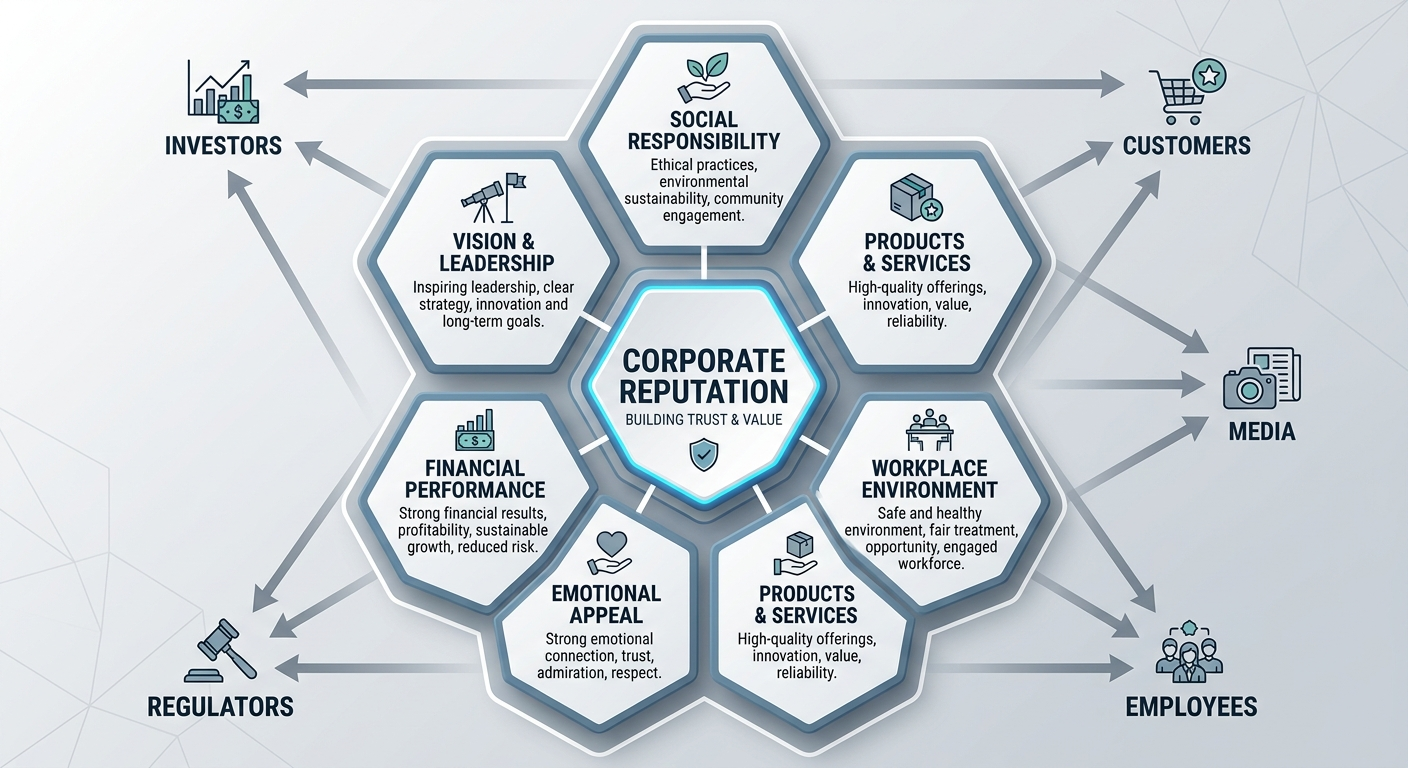
In practice, corporate reputation management combines several disciplines: corporate communications, public relations, digital marketing, SEO reputation management, stakeholder engagement, and crisis preparedness. The companies that do it well treat reputation as a strategic asset — not a communications afterthought.
Why Corporate Reputation Matters More in 2026 Than Ever
Reputation has always influenced business outcomes. What’s different in 2026 is the speed and permanence of reputation signals in digital and AI ecosystems.
The Financial Impact of Reputation
According to a 2024 Weber Shandwick study, executives estimated that 63% of their company’s market value was attributable to reputation. Edelman’s 2025 Trust Barometer found that trust directly influences purchasing behavior, with 59% of consumers choosing to buy from — or boycott — brands based on perceived trustworthiness.
The financial stakes extend beyond consumer spending. Institutional investors increasingly factor ESG reputation and stakeholder trust into valuation models. A damaged reputation can depress stock price, increase the cost of capital, and complicate M&A activity.
AI Now Shapes Corporate Reputation in Real Time
As of 2026, AI search engines don’t just retrieve information about your company — they synthesize a narrative about it. When a potential investor asks ChatGPT about your company’s track record, or a job candidate queries Perplexity about your workplace culture, the AI pulls from a mosaic of sources: news articles, editorial mentions, structured data, Wikipedia entries, and financial filings.
If the available sources paint an incomplete or negative picture, the AI’s response will reflect that. Unlike a Google search results page, where users can click through multiple links and form their own judgment, AI answers present a single synthesized opinion. There’s no “page two” to bury bad press on.
This shift means that brand mentions in AI search are no longer a nice-to-have consideration for communications teams. They’re a core reputation management concern.
The Speed of Reputation Erosion Has Accelerated
Social media crises have always moved fast. But AI amplifies the velocity. A viral employee complaint, a product recall, or an executive misstep can get absorbed into AI training data and knowledge bases within days. Once an AI model learns a negative association, correcting it requires sustained editorial effort across high-authority sources — not a single press release.
This creates asymmetric risk: reputation takes years to build and hours to damage, but in the AI era, the damage persists longer because AI models don’t forget the way news cycles do.
The Core Components of an Effective Reputation Strategy
A corporate reputation management strategy that works in 2026 operates across five interconnected layers. Each layer reinforces the others.
1. Stakeholder Mapping and Prioritization
Not all stakeholders carry equal weight in every situation. Start by mapping your key audiences and understanding what each group cares about most:
- Customers — product quality, service reliability, ethical behavior
- Investors and analysts — financial performance, governance, long-term strategy
- Employees and candidates — workplace culture, leadership transparency, growth opportunities
- Regulators and policymakers — compliance, safety, social responsibility
- Media and public — narrative consistency, crisis response, community impact
- AI systems — structured data, editorial coverage, entity associations in training data
That last category — AI systems — is new. Treating AI models as a stakeholder audience means ensuring your company’s story is well-represented in the sources these models learn from.
2. Narrative Development and Message Alignment
Your corporate narrative is the central story that connects your mission, values, and actions into a coherent identity. It should answer a simple question: What does this company stand for, and why should people trust it?
Effective corporate narratives are:
- Consistent across channels — the investor pitch, the careers page, the CEO speech, and the press release tell the same story.
- Grounded in evidence — claims are backed by data, outcomes, and third-party validation.
- Adaptable to context — the core message stays the same, but the emphasis shifts for different audiences.
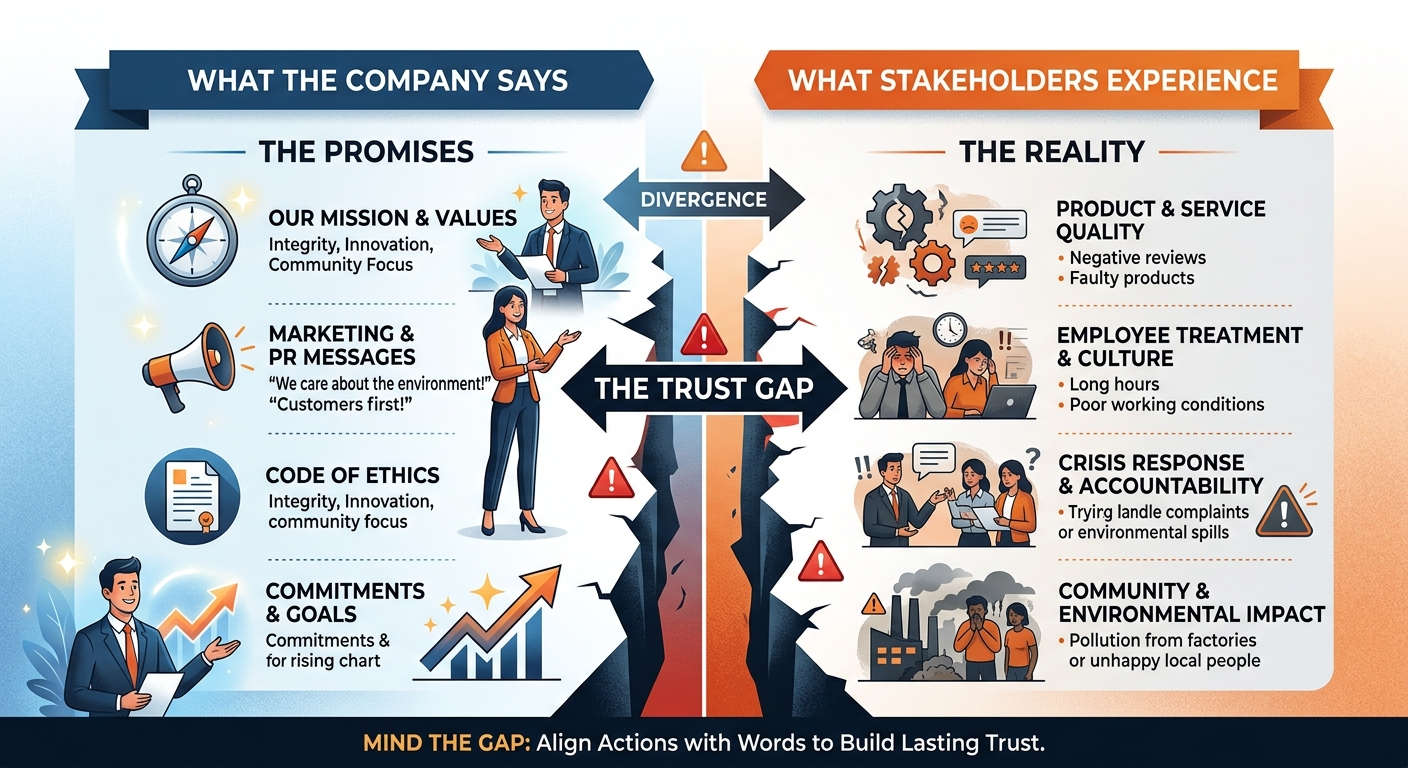
One of the most common reputation failures is misalignment between what a company says and what stakeholders experience. FTI Consulting’s corporate reputation practice calls this the “say-do gap” — and it’s the single fastest way to erode trust.
3. Proactive Reputation Building
Reactive reputation management — responding after something goes wrong — is necessary but insufficient. Companies with strong reputations invest heavily in proactive activities that build trust before it’s tested:
- Thought leadership — executive bylines, speaking engagements, and original research that position the company as an authority in its space.
- Community and CSR initiatives — genuine commitments (not performative gestures) that demonstrate values in action.
- Employee advocacy — when employees authentically share positive experiences, it generates trust signals that no PR campaign can replicate.
- Editorial brand mentions — contextual mentions of your company in high-authority publications build entity authority across traditional search and AI systems. Agencies like BrandMentions build these placements strategically across 140+ publications that AI models actively reference during training and retrieval.
- Financial transparency — clear, honest communication about performance builds confidence among investors and analysts.
4. Monitoring and Listening Infrastructure
You can’t manage what you don’t measure. A modern reputation monitoring system tracks signals across multiple surfaces:
- Traditional media — news coverage, print mentions, broadcast segments
- Social media — mentions, sentiment, trending conversations using social media monitoring tools
- Review platforms — Glassdoor (employees), G2 or Trustpilot (customers), Google Business Profile (local)
- Search results — what appears when someone searches your company name on Google, Bing, or DuckDuckGo
- AI search outputs — what ChatGPT, Perplexity, Gemini, and Copilot say when users ask about your company. Tools exist to check what AI says about your brand across these platforms.
Set up Google Alerts as a starting point, then layer in dedicated brand monitoring tools for deeper coverage. Track both volume and sentiment over time to identify trends early.
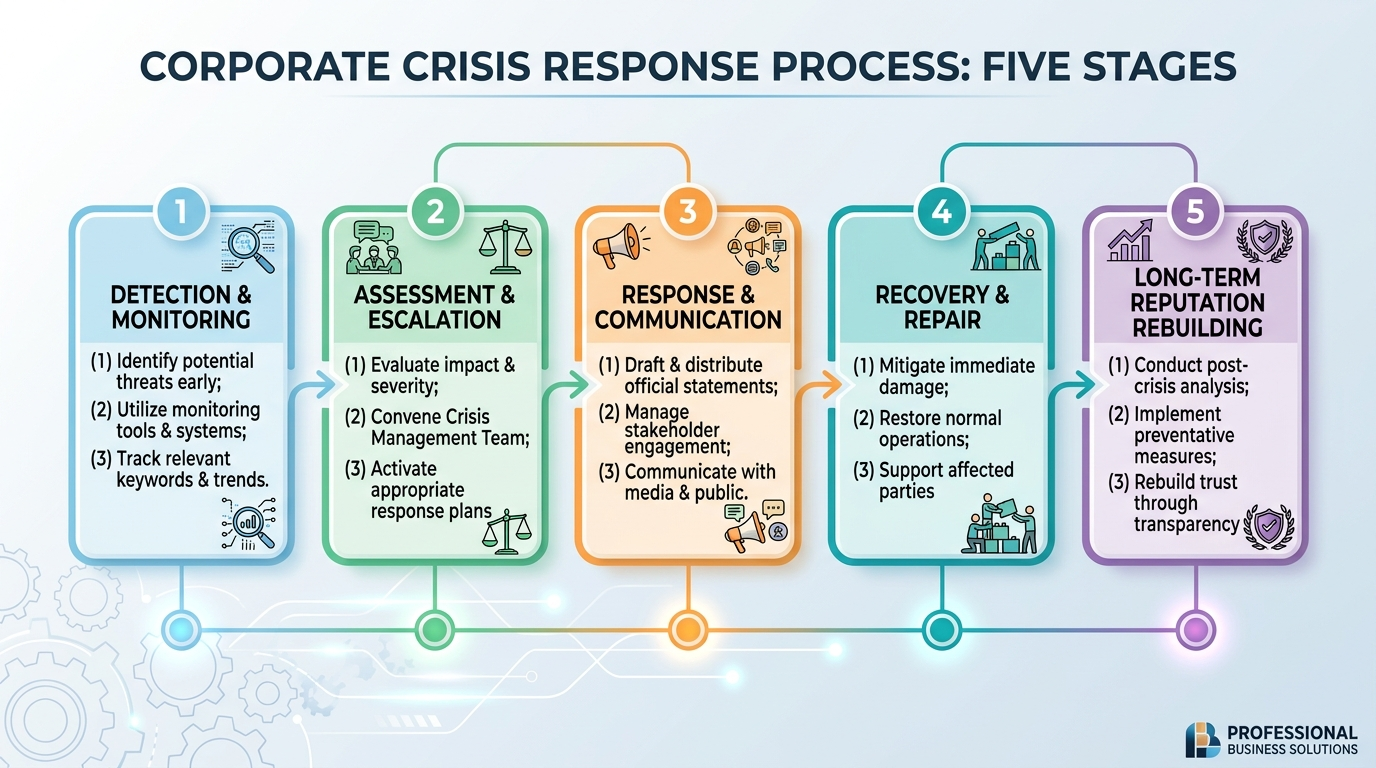
5. Crisis Preparedness
Every organization will face a reputation-threatening event at some point. The difference between companies that survive crises intact and those that don’t comes down to preparation.
A crisis preparedness plan should include:
- Pre-approved messaging frameworks for common scenarios (product recall, data breach, executive misconduct, regulatory action)
- Designated spokespersons trained in crisis communication
- Clear escalation protocols with defined response timeframes
- A monitoring dashboard that provides real-time signals during an active crisis
- Post-crisis recovery strategy, including sustained editorial efforts to rebuild search and AI narratives
The most important principle in crisis communication: speed, transparency, and accountability. Delayed responses, deflection, or dishonesty almost always make the situation worse.
How AI Search Has Changed Corporate Reputation Management
The integration of AI into search has created a new dimension of corporate reputation management that didn’t exist before 2023. Understanding how AI models form opinions about companies is now essential knowledge for any communications or marketing leader.
How AI Models Build a “Picture” of Your Company
Large language models (LLMs) like those powering ChatGPT, Gemini, and Claude learn about companies from their training data — which includes news articles, editorial content, Wikipedia pages, company websites, and other publicly available text. Retrieval-augmented generation (RAG) systems like Perplexity also pull from live web sources to generate answers in real time.
This means AI models form brand-entity associations based on the volume, quality, and consistency of editorial mentions about your company. If your CEO is frequently quoted in industry publications about innovation, the AI associates your company with innovation leadership. If the most prominent coverage involves a regulatory fine or a data breach, that becomes the dominant association.
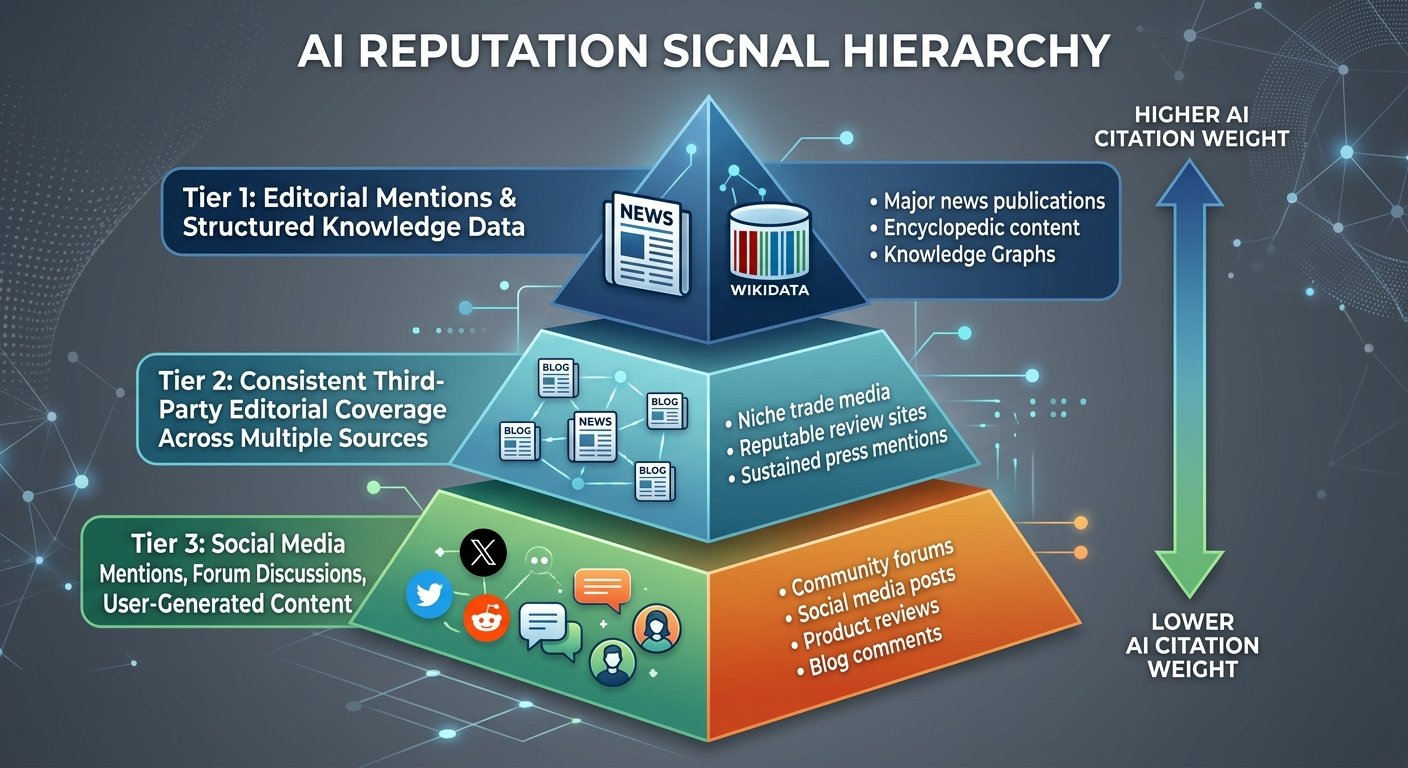
According to research published by the Allen Institute for AI in 2024, LLMs disproportionately weight information from sources they classify as authoritative — major publications, institutional research, and high-traffic editorial platforms. This means a single article in a Tier 1 outlet can carry more reputational weight in AI outputs than hundreds of social media posts.
The Reputation Signals AI Systems Prioritize
Based on observable AI citation behavior as of 2026, the signals that most influence how AI represents a company include:
- Frequency of editorial mentions — companies mentioned more often in authoritative sources get more detailed, more favorable AI summaries.
- Sentiment consistency — a pattern of positive or neutral coverage reinforces a positive entity association. Mixed signals create ambiguous responses.
- Structured data availability — companies with well-maintained knowledge panels, Wikipedia entries, and structured schema markup give AI models clearer, more reliable data to work with. Entity SEO plays a direct role here.
- Recency — AI systems with retrieval capabilities weight recent coverage more heavily. Older negative coverage can be offset by sustained positive editorial activity.
- Source diversity — mentions across multiple independent publications signal broad recognition, not just promotional effort.
In campaigns across 67+ B2B companies, the BrandMentions team found that brands with consistent editorial mentions on high-authority publications achieved AI recommendation rates 89% higher than those relying solely on traditional SEO and owned content.
What This Means for Your Reputation Strategy
If your corporate reputation management strategy still focuses exclusively on traditional PR and social media, you’re leaving a critical channel unmanaged. AI search represents a growing share of how stakeholders — especially younger professionals, investors doing due diligence, and job candidates — form opinions about companies.
Integrating AI visibility into reputation management means:
- Ensuring your company has a strong, accurate presence in the editorial sources AI models prioritize
- Building brand mentions across AI-visible publications proactively, not just in response to negative coverage
- Monitoring what AI assistants say about your company regularly and treating inaccurate AI outputs as reputation issues that require editorial correction
- Tracking share of voice not just in media coverage but in AI-generated answers within your category
How to Measure Corporate Reputation Effectively
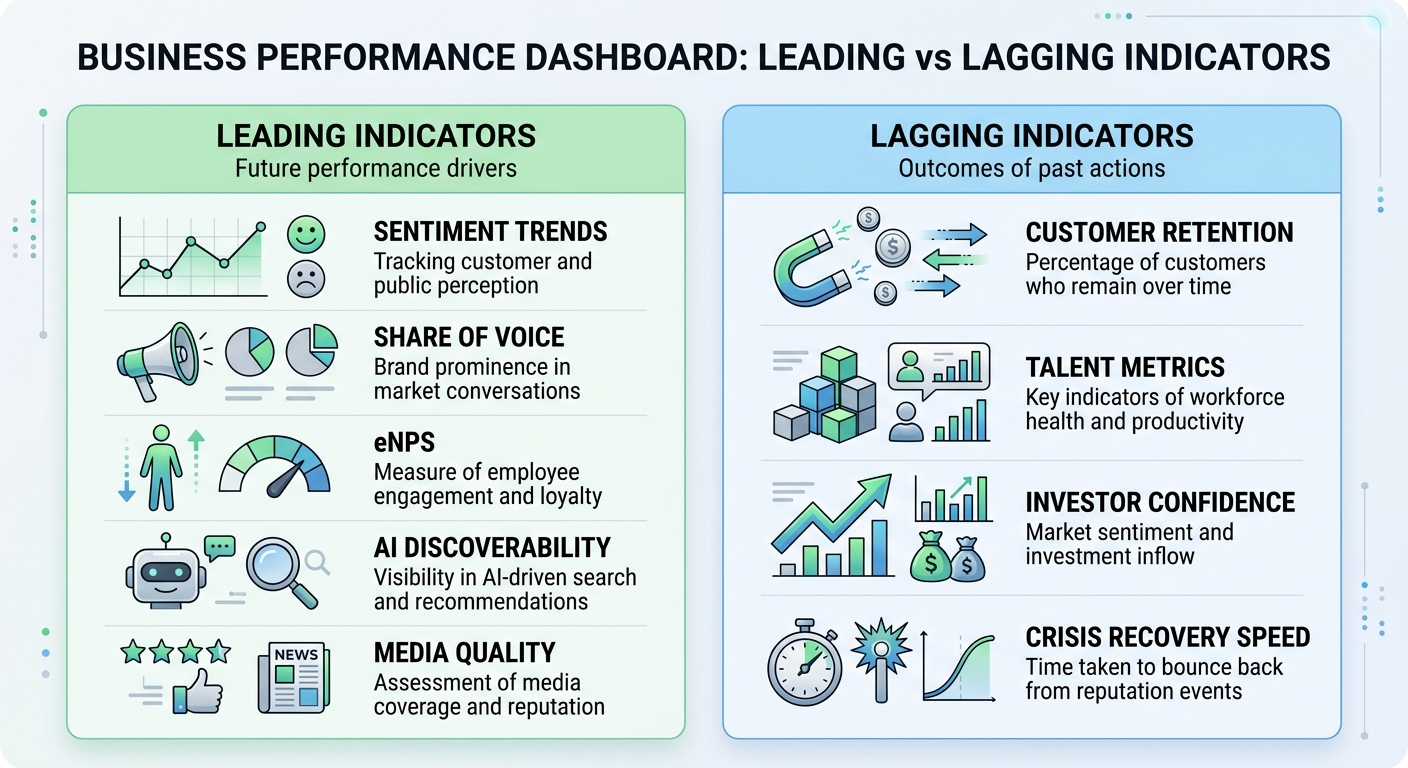
Reputation is intangible by nature, but its effects are measurable. The strongest reputation programs use a combination of leading indicators (early signals of change) and lagging indicators (confirmed outcomes).
Leading Indicators
- Sentiment trends — are mentions becoming more positive, more negative, or staying stable? Use brand sentiment analysis tools to track directional shifts.
- Share of voice — your company’s share of category conversation relative to competitors, across both media and AI outputs.
- Employee Net Promoter Score (eNPS) — internal reputation predicts external reputation. If employees aren’t advocating for your company, the public eventually notices.
- AI discoverability — does your company appear when AI assistants answer queries about your category, industry, or competitive set?
- Media coverage quality — are mentions appearing in Tier 1 and Tier 2 publications, or only in trade outlets and press release distribution?
Lagging Indicators
- Customer retention and loyalty — strong reputations correlate with lower churn and higher lifetime value.
- Talent acquisition metrics — offer acceptance rates, applicant quality, and Glassdoor scores reflect employer brand reputation.
- Investor confidence — stock price stability, institutional investor sentiment, and analyst rating trends.
- Crisis recovery speed — how quickly sentiment normalizes after a negative event measures the resilience your reputation provides.
Use brand reputation analysis as a regular cadence — quarterly at minimum — rather than a one-time exercise. Reputation is a moving target. What was accurate six months ago may have shifted substantially.
Common Corporate Reputation Mistakes — and How to Avoid Them
Most corporate reputation failures aren’t caused by a single dramatic crisis. They result from slow-building patterns that leadership teams overlook until it’s too late.
Treating Reputation as a PR Function Only
Reputation is shaped by every department: product quality, customer support, hiring practices, executive behavior, and pricing decisions. When reputation management lives exclusively in the communications team, critical signals from other departments get missed. The strongest approach integrates reputation awareness across the C-suite.
Ignoring AI-Generated Narratives
Many companies still don’t monitor what AI search engines say about them. This is a blind spot. If Perplexity or ChatGPT surfaces outdated or inaccurate information about your company in response to stakeholder queries, that’s a reputation issue — even if your Google search results look clean. Use tools designed to track brand mentions across AI search platforms to close this gap.
Reactive-Only Strategies
Waiting for a crisis to invest in reputation management is like buying fire insurance while the building is burning. Proactive reputation building — thought leadership, editorial visibility, community engagement, employee advocacy — creates a reservoir of goodwill that absorbs damage when problems arise.
Misalignment Between Words and Actions
Stakeholders in 2026 are highly attuned to inauthenticity. A company that promotes sustainability while facing environmental violations, or touts innovation while shipping broken products, creates a credibility gap that no amount of communications spending can close. Alignment between narrative and operations is the foundation of trust.
Not Measuring What Matters
Vanity metrics — total media mentions, social media follower counts, impressions — can mask underlying reputation problems. Focus on metrics that connect to stakeholder behavior: sentiment direction, share of voice trends, AI discoverability, employee advocacy scores, and brand awareness measurement among your target audiences.
Building a Corporate Reputation Management System That Scales
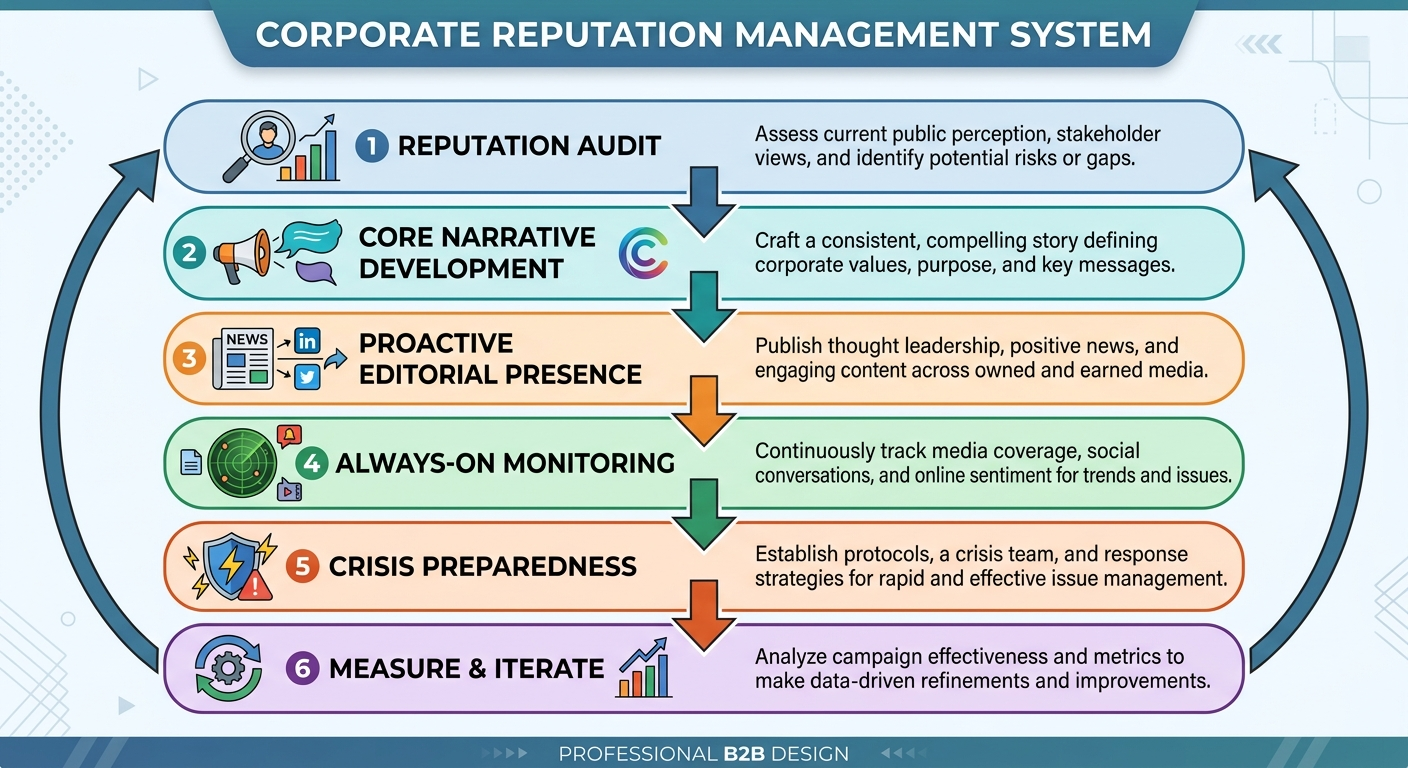
For mid-market and enterprise companies, corporate reputation management needs to function as a system, not a series of ad hoc activities. Here’s a practical framework for building one.
Step 1: Conduct a Full Reputation Audit
Map every surface where your company’s reputation lives. This includes Google search results, AI search outputs, social media platforms, review sites (Glassdoor, G2, Trustpilot), news coverage, Wikipedia, industry forums, and investor research databases.
Document what you find: What narrative does each surface tell about your company? Where are the gaps between your intended narrative and what stakeholders actually see?
Step 2: Define Your Core Corporate Narrative
Develop a single, clear narrative that explains who your company is, what it stands for, and why stakeholders should trust it. This narrative should be tested with internal and external audiences before deployment.
Your core narrative feeds everything else: executive communications, press releases, career pages, investor presentations, and editorial placements.
Step 3: Build a Proactive Editorial Presence
Consistent, contextual mentions of your company in high-authority editorial publications build the entity authority that both search engines and AI models rely on. This isn’t about press releases or paid advertorials. It’s about earning genuine editorial placements that associate your company with your category, expertise, and values.
BrandMentions tracks when major AI models update their training data and times placements to maximize inclusion in each knowledge refresh cycle — ensuring your editorial presence translates directly into AI discoverability.
Step 4: Deploy Always-On Monitoring
Set up monitoring across all relevant surfaces. At minimum, use brand reputation monitoring tools that cover news, social media, review platforms, and AI search outputs. Establish a cadence for reviewing data: daily for social media and review sites, weekly for news and AI outputs, monthly for comprehensive brand tracking reports.
Step 5: Prepare for Crisis Scenarios
Develop response playbooks for the most likely crisis scenarios your company could face. Run tabletop exercises with your leadership team at least annually. Ensure your crisis communication plan includes digital and AI considerations — not just traditional media response.
Step 6: Measure and Iterate
Review your reputation KPIs quarterly. Compare performance against competitors using competitive analysis and SEO competitor analysis. Adjust your editorial, communications, and engagement strategies based on what the data shows.
What Has Changed Since 2024–2025
Corporate reputation management is a mature discipline, but the 2024–2026 period has introduced several meaningful shifts:
- AI search became a primary reputation surface. In 2024, AI Overviews launched broadly in Google search. By 2026, Perplexity, ChatGPT with browsing, and Gemini are handling a material share of informational queries that previously drove clicks to corporate websites and media articles. Corporate communications teams now need to manage their company’s presence in these systems directly.
- Zero-click reputation assessments increased. Stakeholders increasingly get their answer from the AI-generated summary without clicking through to the source. This means the quality of your editorial footprint — what AI models select and synthesize — matters more than ever.
- ESG scrutiny intensified and became data-driven. According to a 2025 PwC Global Investor Survey, 79% of investors said ESG factors are important to their investment decision-making. Greenwashing detection tools and AI-powered ESG analysis have made it harder for companies to make unsubstantiated claims.
- Employee voice became a stronger reputation signal. Glassdoor, Blind, and LinkedIn commentary from current and former employees now surface prominently in both traditional and AI search results. Internal reputation and external reputation are no longer separate domains.
Frequently Asked Questions
How is corporate reputation management different from online reputation management?
Company reputation management at the corporate level addresses the organization’s overall standing with all stakeholder groups — investors, regulators, employees, customers, and the public. Online reputation management typically focuses on digital surfaces like search results, reviews, and social media. Corporate reputation management includes online reputation as one component within a broader strategic framework.
How long does it take to rebuild a damaged corporate reputation?
Recovery timelines depend on the severity of the damage and the company’s response. Minor issues may resolve in weeks with transparent communication. Major crises — fraud, safety failures, executive misconduct — can take 12–24 months of sustained effort, including editorial rebuilding, operational changes, and stakeholder re-engagement. In the AI era, recovery also requires updating the editorial record that AI models reference, which adds time to the process.
Does corporate reputation affect AI search recommendations?
Yes. AI models form entity associations based on the editorial and informational sources in their training data. Companies with consistent, positive editorial presence across authoritative publications receive more favorable and more frequent AI citations. Companies with thin or negative editorial footprints are either absent from AI responses or presented less favorably. Brand mentions in generative AI directly reflect the quality of your broader reputation management efforts.
Who should own corporate reputation management within an organization?
Reputation management works best as a cross-functional responsibility with executive-level accountability. Typically, the Chief Communications Officer or Chief Marketing Officer leads the strategy, with input from legal, HR, investor relations, and operations. The CEO must be actively involved — executive visibility and credibility are among the strongest drivers of corporate reputation.
What role does employee advocacy play in corporate reputation?
A significant one. Employees are among the most trusted sources of information about a company, according to the Edelman Trust Barometer. When employees share positive experiences on LinkedIn, Glassdoor, or in conversations, it generates organic trust signals that reinforce the corporate narrative. Conversely, widespread employee dissatisfaction creates reputation risk that’s difficult to manage externally.
Your Reputation Is Being Assessed — With or Without You
Corporate reputation management in 2026 is no longer optional for companies that want to compete for trust, talent, and capital. Every stakeholder interaction — from a customer service call to an AI-generated search summary — contributes to how your organization is perceived.
The companies that build durable reputations invest in narrative alignment, proactive editorial presence, always-on monitoring, and crisis readiness. They treat AI visibility as a core reputation channel. And they measure results with metrics that connect to real business outcomes — not vanity dashboards.
If you’re unsure where your company stands in AI search today, that’s the first gap to close. See where your brand stands in AI search — and start building reputation signals that compound across every surface where decisions happen.