Pricing
Request a Free Audit

How to Track Brand in Microsoft Copilot (2026 Guide)

three-copilot-surfaces-showing-where-public-brand-tracking-lives-versus-tenant-data

To track brand in Microsoft Copilot, you run a fixed prompt set against Copilot weekly, log which answers mention your brand, capture the cited URLs behind each answer, and compare share of voice against three named competitors. That’s the workable version. Most “Copilot tracking” advice skips the prompt design and the citation log, which is where the signal lives. This guide gives you the prompt structure, the logging schema, and the weekly review cadence we use across client accounts.

What Tracking Brand in Microsoft Copilot Actually Means

Copilot tracking is the practice of measuring how often your brand appears in Copilot answers, which prompts trigger those mentions, what sources Copilot cites, and how your share of voice shifts against competitors over time.

Copilot is not one surface. It’s at least three: Microsoft 365 Copilot inside Word, Outlook, and Teams, Copilot Chat on copilot.microsoft.com, and Copilot in Bing search. Each pulls from a different blend of training data, grounded web results, and your tenant’s internal data when applicable. For brand tracking, the public-facing surface that matters is Copilot Chat, because that’s where buyers, analysts, and journalists ask discovery questions about categories you compete in.

Track Brand In Microsoft Copilot, three-copilot-surfaces-showing-where-public-brand-tracking-lives-versus-tenant-data

The thing buyers and tools get wrong: they treat Copilot like a search engine and watch keyword rankings. Copilot doesn’t return ten blue links. It returns a synthesized answer with a small number of cited sources. Your job is to be one of those cited sources, or to be named in the answer text even when you’re not the citation.

Build the Prompt Set First

Your tracking only works if your prompts mirror how real buyers ask Copilot about your category. Generic prompts give generic answers, and generic answers rarely cite anyone specific.

Prompt layer What it asks Copilot Example prompt What it reveals
Category Recommend or compare options in your space without naming any brand “What are the best tools for tracking brand mentions in AI search?” Whether you surface unprompted when buyers ask Copilot about the category cold
Comparison Pit two or three named competitors against each other “Compare [Competitor A] and [Competitor B] for monitoring ChatGPT citations.” How Copilot frames you against rivals, and whether you get pulled into the answer at all
Problem Describe a buyer pain and ask for tools or approaches “How do I find out if AI tools recommend my SaaS product to buyers?” Whether Copilot connects your brand to the jobs-to-be-done your buyers actually search
Direct Name your brand and ask Copilot what it knows “What is [Your Brand] and who uses it?” What Copilot believes about you and which sources it cites to say it

A working prompt set has four layers. Category prompts ask Copilot to recommend or compare options in your space without naming any brand. Comparison prompts pit two or three named competitors against each other. Problem prompts describe a buyer pain and ask for tools or approaches. Direct prompts name your brand and ask Copilot what it knows.

For a mid-market AI visibility tool, the set looks like this:

  • Category: “What are the best tools for tracking brand mentions in AI search?”
  • Comparison: “Compare [Competitor A] and [Competitor B] for monitoring ChatGPT citations.”
  • Problem: “How do I find out if AI tools recommend my SaaS product to buyers?”
  • Direct: “What is [Your Brand] and who uses it?”

Aim for 25 to 40 prompts in the first set. Fewer and you’ll miss surface variance. More and the weekly review becomes a chore nobody does. Run each prompt twice per session, because Copilot’s answers vary even on identical inputs, and you need both variants in your log.

Where Buyers Actually Ask These Questions

Skim the Reddit authority playbook for AI citations and pull the exact phrasing buyers use in r/sales, r/marketing, and the subreddits closest to your category. Those phrasings become your prompts. The closer your prompt mirrors a real buyer question, the more representative your tracking data.

Capture Citations, Not Just Mentions

Most Copilot tracking tools count mentions. That’s half the picture. The other half is which URLs Copilot cited to produce the answer, because those are the sources earning real visibility, not the brands named in passing.

When you run a prompt in Copilot Chat, the response footer shows numbered citations. Open the side panel and you’ll see each source URL, the publication, and which sentence in the answer pulled from it. Log every citation, not just the ones that mention you. The pattern over time tells you which publications, review sites, and community threads Copilot trusts for your category.

copilot-tracking-log-schema-with-eight-fields-for-mentions-citations-and-competitor-data

Here’s the schema we use, eight fields per prompt run:

  1. Prompt ID (so you can rerun the exact prompt next week)
  2. Prompt text
  3. Date and time
  4. Brand mentioned in answer? yes/no
  5. Citation URLs (all of them, in order)
  6. Competitor mentions (which competitors, how prominently)
  7. Sentiment of the brand mention if present
  8. Answer snippet (the 1 to 2 sentences containing the mention or the closest equivalent)

A Google Sheet works for the first 90 days. After that, the volume gets unwieldy and you’ll want something purpose-built. The point is to start with the schema, not the tool.

Measure Share of Voice the Right Way

Share of voice in Copilot is the percentage of prompts in your tracking set where your brand appears in the answer, divided by the same percentage for each competitor. Run it weekly, plot the trend, and look at three things: directional change, prompt-level patterns, and citation-source overlap.

Directional change tells you whether Copilot is mentioning you more or less over time. Prompt-level patterns tell you which buyer questions you win and which you lose. Citation-source overlap tells you which publications are pulling competitors into Copilot answers when you should be there instead.

The mistake we see most often: teams measure share of voice on category prompts only. Category prompts are the hardest to win because Copilot defaults to broad market leaders. Problem prompts and comparison prompts are where mid-market brands actually move the needle, and they should weight heavier in your scoring.

For a deeper read on calibrating this across surfaces, see share of voice in AI search.

Set Up Weekly and Monthly Cadences

Weekly is for catching regressions. Monthly is for steering strategy. Don’t conflate them.

The weekly cadence runs the full prompt set, logs the results, and flags two things: prompts where you lost a mention you had last week, and new citation sources Copilot started pulling from. The weekly review takes 30 to 45 minutes if your prompt set is sane.

The monthly cadence does three deeper passes. First, audit which content of yours is and isn’t being cited, and why. Second, look at the cited sources Copilot trusts most in your category and identify which ones you have no presence on. Third, run a competitive teardown: pick the competitor closest to you in share of voice and reverse-engineer where they’re earning their citations.

weekly-versus-monthly-copilot-tracking-cadence-comparing-operational-and-strategic-reviews

Across roughly 40 client accounts running this cadence, the median time from a sudden share-of-voice drop to root cause identification is 9 days. Without a weekly review, it stretches past 30 days, and by then the cause is usually obscured by everything else that’s changed.

Tools That Help and Tools That Get in the Way

You can run this manually with a spreadsheet and a calendar reminder for the first quarter. After that, the volume forces a tool decision.

What helps: a tool that runs your prompt set on a schedule, captures the full Copilot answer with citations intact, stores historical responses so you can diff week over week, and lets you tag prompts by type and priority. The Microsoft Copilot brand mentions guide walks through how Copilot’s citation logic shifts across surfaces and what that means for which tool features actually matter.

What gets in the way: tools that score Copilot visibility with a single proprietary number and won’t show you the underlying responses. If you can’t see the actual answer Copilot returned, you can’t act on the data. The single-score dashboards make for good demos and bad operating decisions.

Compare options against the framework in AI visibility analytics tools tested for 2026 before committing to a contract.

Act on the Data: Three Moves That Move the Needle

Tracking without action is a sunk cost. Here are the three moves that consistently shift Copilot share of voice across our client base.

three-strategic-moves-to-shift-copilot-share-of-voice-from-observation-to-outcome

First, earn placements on the publications Copilot already cites in your category. Pull your top 20 most-cited URLs from the monthly review, find which ones are review sites or industry publications, and pitch original commentary or contributed pieces. Copilot’s grounded answers lean on a surprisingly small pool of trusted sources per topic, and getting into that pool moves your visibility faster than any on-site optimization.

Second, fix the answer hygiene on your own pages for queries you’re losing. If Copilot is citing a competitor for “how to track brand mentions in [category]” and your page on the same topic isn’t being cited, the issue is usually structural: the page buries the answer, doesn’t have a clear definitional sentence, or doesn’t reinforce the entities Copilot expects to see together.

Third, build community presence on the sources Copilot pulls from for problem prompts. Reddit, Stack Overflow, niche industry forums. The how to increase brand mentions in AI search playbook covers the mechanics. Community signals carry weight in Copilot’s grounded answers because Copilot’s web layer treats them as recency-rich, authentic discussion.

Common Mistakes That Waste a Quarter

The patterns we see most often, across roughly 60 audits in the last year:

Tracking only the brand-name prompt. If your CEO asks Copilot “what is [our brand]” and gets a clean answer, that’s not tracking. That’s vanity. You learn nothing about how Copilot represents your category.

Ignoring the answer text and only counting URL citations. Copilot mentions brands in answer prose without citing them as a numbered source. Those naked mentions still drive recall and still influence buyer perception. Log both.

Running the same prompt set forever. Buyer language shifts. The prompts that mattered in Q1 don’t match how buyers ask by Q4. Refresh 20 to 30 percent of your prompt set every quarter.

Treating Copilot tracking and ChatGPT tracking as one workflow. The two systems cite different sources, weight different signals, and update on different cycles. If you want a fuller view of how the major systems differ, the cross-platform tracking guide breaks it down.

Frequently Asked Questions

How often does Microsoft Copilot update its training data?

Copilot’s underlying models have a training cutoff, but its grounded web answers pull live results in real time. That means your tracking should run weekly at minimum, because the grounded layer can swing within days when a new article ranks or a competitor earns a big citation.

Can I track Copilot mentions without a paid tool?

Yes, for the first 90 days. A spreadsheet, a 30-prompt set, and a calendar reminder will produce real data. The constraint is time. Once you cross 40 prompts and you’re running them twice for variance, manual logging eats two hours a week and tool economics start to make sense.

Why does Copilot give different answers to the same prompt?

Copilot’s responses involve sampling and retrieval that introduce variance. The same prompt at 9 a.m. and 4 p.m. can return different cited sources and slightly different answer text. That’s why running each prompt twice per session and logging both variants is part of the protocol.

Does tracking brand in Microsoft Copilot help my SEO?

Indirectly, yes. Pages that earn Copilot citations tend to share traits with pages that perform well in classic search: clear definitional content, strong entity coverage, and inbound authority. Working on Copilot citations usually lifts traditional rankings as a side effect, not a goal.

The Honest Take

Most brands tracking Copilot are tracking the wrong layer. They watch a dashboard score and miss the point: Copilot is reshaping how buyers discover categories, and the brands that show up in its answers are the brands buyers consider. The score is downstream. The work is upstream, in your prompt set, your citation log, your weekly review, and the publications you earn placements on.

Start with the spreadsheet. Run it for four weeks. You’ll know more about how Copilot represents your brand than 95 percent of your competitors.

See where your brand stands in AI search with a free AI visibility audit. background reading

Microsoft Copilot Brand Mentions: 2026 Visibility Guide

copilot-brand-mention-pipeline-bing-retrieval-entity-match-citation-selector-diagram

Microsoft Copilot brand mentions happen when Copilot pulls your brand into a generated answer or footnote, grounded in the Bing index and a tenant’s connected data. If you want to show up there, you optimize for Bing’s retrieval surface, the entity record Copilot trusts, and the third-party sources Copilot cites alongside you. This guide walks through how those mentions get earned in 2026, what we see when we run citation audits across Copilot, and the workflow that moves a brand from invisible to cited.

What a Brand Mention in Microsoft Copilot Actually Is

A brand mention in Microsoft Copilot is any instance where Copilot names your company, product, or domain inside a generated answer, a follow-up suggestion, or a numbered citation. Three surfaces matter most in 2026: Copilot in Bing search, Copilot in Edge and Windows, and Microsoft 365 Copilot Chat with web grounding turned on.

Mentions split into two categories. Cited mentions carry a numbered footnote linking to your domain or a third-party source that names you. Uncited mentions sit in the prose with no link. Both shape buyer perception, but only cited mentions send a measurable referral signal and a confirmable trust marker back to your team.

Microsoft Copilot Brand Mentions, copilot-brand-mention-pipeline-bing-retrieval-entity-match-citation-selector-diagram

Copilot does not crawl the web the way a generic chatbot does. It runs retrieval against Bing’s index, applies a freshness and authority filter, then composes an answer over the retrieved set. That detail matters because it tells you exactly where the leverage is: Bing visibility, citation density on trusted sources, and a clean entity profile.

Why Copilot Mentions Earn a Different Workflow Than ChatGPT or Gemini

Copilot mentions sit on top of Bing, and that single fact changes the playbook. ChatGPT pulls from training data plus a browsing layer. Gemini pulls from Google’s index and knowledge graph. Copilot pulls from Bing’s index with a strong preference for recent, link-rich, structurally clean pages.

AI engine Where it retrieves answers from Page traits it favors Primary optimization leverage
Microsoft Copilot Bing’s index plus a tenant’s connected data, with a freshness and authority filter Recent, link-rich, structurally clean pages Bing visibility, citation density on trusted sources, and a clean entity record
ChatGPT Training data plus a browsing layer Established, frequently referenced sources Broad citation presence across the open web
Gemini Google’s index and knowledge graph Pages Google ranks and trusts Google SEO and knowledge graph entity signals

What we see in client audits: a brand can rank in Copilot citations while sitting on page two for the same query on Google. The reverse is also true. We have moved domains from zero Copilot mentions to consistent citations on category queries by fixing three things. IndexNow submission, Bing Webmaster Tools coverage gaps, and the entity record on Wikipedia and Wikidata.

For a wider view of how citation logic shifts across surfaces, our breakdown of brand mentions in AI covers the cross-engine model. For the Copilot-specific lift, the work is closer to a hybrid of Bing SEO and digital PR.

The Three Surfaces You’re Actually Optimizing For

Public, ungated, Bing-index grounded. This is where most measurable mentions happen.

Copilot in Edge and Windows

Same retrieval layer, different UI. Mentions here mirror Bing search Copilot but can also pull from the open browser tab.

Microsoft 365 Copilot Chat With Web Grounding

Enterprise users get an answer mixed from tenant data and Bing-grounded web results. You cannot observe tenant-specific responses, but the web layer follows the same rules.

The Signals That Drive Microsoft Copilot Brand Mentions

Five signals move the needle. Treat them as a stack, not a checklist.

five-signal-stack-driving-microsoft-copilot-brand-mentions-citation-leverage

1. Bing Index Visibility

If you are not indexed in Bing, you are not in Copilot. Run Bing Webmaster Tools coverage. Submit your XML sitemap. Use IndexNow for fast updates. Watch for crawl errors that Google never flagged.

One pattern we see often: domains with strong Google performance and weak Bing crawl logs. Bing tends to be stricter on duplicate content, canonical signals, and slow servers. Fix the crawl health first, then chase rankings.

2. Entity Clarity

Copilot resolves your brand against an entity record before it considers citing you. That record gets built from Wikipedia, Wikidata, your About page, your LinkedIn company profile, Crunchbase, and consistent third-party descriptions across the web.

If three different sources describe your company three different ways, Copilot picks the safest, most consistent description, and that description may not be yours. The fix is editorial, not technical. Our guide to entity SEO covers the practical steps for building a stable record.

3. Third-Party Citation Density

Copilot cites the source it trusts, not always the brand itself. When a Copilot answer about your category cites G2, TechCrunch, or a tier-1 trade publication, your goal is to be named inside those cited pages. This is where the work overlaps with digital PR.

A tiered approach helps. We map this in our piece on the tier-based publication hierarchy for AI citations. The same hierarchy applies in Copilot, with slight weighting toward Bing-indexed business publications and Microsoft-friendly sources like LinkedIn long-form.

4. Freshness

Copilot favors recent content for any query with a current-event or product-comparison tilt. A two-year-old comparison page can lose citation slots to a six-month-old equivalent, even if the older page has more backlinks.

This is the single most fixable signal for most B2B sites. Update your strongest pages on a 90 to 120 day cycle. Refresh dates only when you genuinely change content. Resubmit through IndexNow.

5. Structured, Skimmable Content

Copilot lifts sentences. It prefers content that answers a question in one line, supports the answer with two or three sentences, and ends a thought before moving to the next. Tables get pulled cleanly. Lists get pulled cleanly. Walls of prose do not.

How to Track Microsoft Copilot Brand Mentions

You track Copilot mentions by running a defined prompt set, capturing the answer and citation list on a schedule, and watching for changes in three variables: whether your brand appears, where it sits in the answer, and which competitors get cited beside you.

microsoft-copilot-brand-mention-tracking-dashboard-share-citations-competitor-co-mentions

Build Your Prompt Set

Start with 30 to 60 prompts. Mix four types:

  • Category prompts, “best [tool type] for [persona]”
  • Comparison prompts, “[your brand] vs [competitor]”
  • Problem-led prompts, “how to [solve the problem your product solves]”
  • Branded prompts, “what does [your brand] do” and variants

Run the set weekly. Save the raw answer text and the cited URLs. Log changes. The work is closer to share-of-voice tracking than rank tracking, and our piece on share of voice in AI search covers the underlying measurement model.

What to Watch For

Three patterns matter. First, mention velocity, are you appearing in more prompts month over month. Second, citation depth, how often Copilot links directly to your domain versus naming you inside a third-party source. Third, competitor stack, which two or three brands tend to appear in the same answer as you, and which ones never do.

The Practitioner Workflow for Earning Copilot Citations

Here is the sequence we run for clients targeting Copilot specifically. It assumes you already have a working SEO foundation.

four-phase-workflow-earning-microsoft-copilot-brand-mentions-audit-entity-citations-refresh

Phase 1: Baseline Audit

Run your prompt set. Capture every answer. Categorize each result: cited with link, mentioned without link, competitor-only, or generic answer with no brand. This becomes your starting line. In a recent SaaS audit we ran, the baseline showed the brand cited in 6 of 47 category prompts, mentioned without a link in 11, and absent from the remaining 30.

Phase 2: Entity Cleanup

Audit your Wikipedia presence, Wikidata record, LinkedIn About section, Crunchbase entry, and the top 10 third-party descriptions of your company. Standardize one short description, one long description, and one canonical category label. Push the standardized copy through every channel you control.

Phase 3: Citation Outreach

Identify the third-party sources Copilot already cites for your top 20 category queries. These are your citation targets. Pitch contributed content, expert commentary, or data partnerships to those publications. The goal is not a backlink. The goal is being named inside the page Copilot already trusts.

Phase 4: Refresh and Measure

Update your three strongest commercial pages every 90 days. Resubmit through Bing Webmaster Tools and IndexNow. Re-run your prompt set. Compare. Most of the lift we see arrives between weeks 6 and 14 after Phase 3 begins.

What Does Not Work

A few tactics get pitched as Copilot optimization that do not move the needle in our testing.

low-leverage-versus-high-leverage-tactics-microsoft-copilot-brand-mention-optimization

llms.txt Files

Copilot does not use them as a ranking input. Skip.

Keyword Stuffing for AI Parsing

Modern models read meaning. Stuffed phrases hurt readability without helping retrieval.

Mass Press Release Distribution

A wire blast across 200 syndication sites adds noise, not authority. One placement in a publication Copilot already cites beats 200 thin syndicated copies.

Schema as a Ranking Lever

Useful for rich results in Bing search. Not a Copilot citation factor.

How BrandMentions Handles Copilot Visibility

We run Copilot citation audits as part of our AI brand mentions work. The audit covers your prompt set baseline, entity record gaps, the third-party publications already cited in your category, and a 90-day plan to close the gap. Most clients see their first new citation slot within six weeks of starting Phase 3 outreach.

FAQ

How long does it take to get cited in Microsoft Copilot?

Most B2B clients see their first new Copilot citation between 6 and 14 weeks after starting structured outreach, assuming Bing indexation is healthy. Brand-new domains take longer because the entity record needs to stabilize first.

Does Copilot use the same sources as ChatGPT or Gemini?

No. Copilot is grounded in the Bing index, ChatGPT relies on training data plus a browsing layer, and Gemini pulls from Google’s index. The cited source list for the same prompt can look completely different across the three.

Can I track Microsoft 365 Copilot Chat mentions inside enterprise tenants?

No. Tenant-specific Copilot responses pull from internal data and are not externally observable. You can only measure the public, web-grounded Copilot surfaces in Bing, Edge, and Windows.

Does paid Bing Ads spend help with Copilot citations?

Ads spend does not directly influence organic Copilot citations. Bing organic visibility, entity clarity, and trusted third-party mentions are the inputs that matter.

What is the single highest-leverage fix for low Copilot visibility?

Get named inside the third-party sources Copilot already cites for your top category queries. Citation-by-association beats domain-level optimization in most cases we run.

The Honest Take

Copilot mentions are the closest thing to old-school PR in the AI search era. Bing rewards crawl health and freshness. Copilot rewards being named in the right places, with a stable entity record, on pages it already trusts. The brands winning this surface in 2026 are not the ones writing for the model. They are the ones earning real coverage in real publications, then keeping their own pages clean enough for Bing to lift cleanly.

See where your brand stands in AI search. Get your free AI visibility audit and we’ll map your Copilot citation gap against the publications already shaping your category.

Google AI Mode Optimization: 2026 Playbook for Brands

google-ai-mode-query-fan-out-diagram-source-pool-synthesis

Google AI Mode optimization is the practice of structuring your content, citations, and brand signals so Gemini-powered AI Mode selects your pages as source material when it generates conversational answers. It is not a new flavor of SEO. It is a measurement and content shift, because AI Mode rewards extractable answers, entity clarity, and off-site authority instead of just ranking position. If you lead marketing or growth at a B2B company, this is the work that decides whether AI Mode quotes you or quotes a competitor when buyers research your category.

This guide shows you what AI Mode actually does, the signals it reads, and the moves that compound visibility over the next two quarters.

What Google AI Mode Actually Does Differently

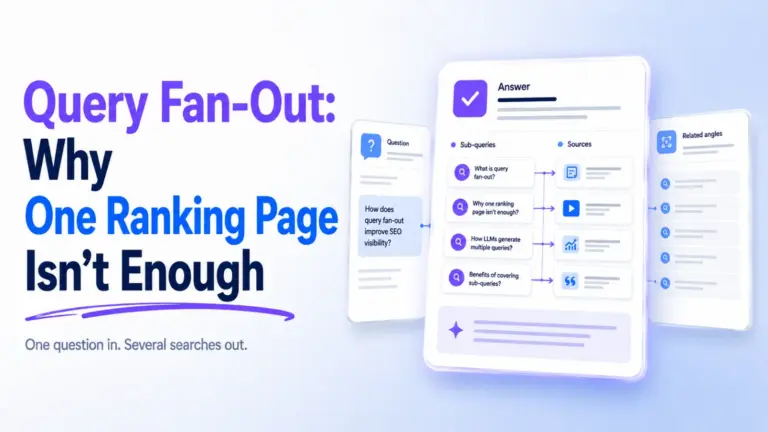
AI Mode runs a query fan-out: one question splits into multiple sub-queries, each retrieves its own pool of sources, and Gemini synthesizes a single answer. That changes the visibility math. A page no longer competes for a position. It competes for inclusion in the synthesis pool for each sub-query.

Google AI Mode Optimization, google-ai-mode-query-fan-out-diagram-source-pool-synthesis

Three behaviors matter most for your planning:

  • AI Mode pulls from indexed pages, so traditional ranking still gates eligibility.
  • It favors passages that answer a specific sub-question cleanly, not pages that bury the answer.
  • It cites sources the model already trusts as entities, which is why brand authority outweighs keyword density.

The practical implication: you optimize at the passage level for retrieval and at the brand level for trust. Both have to be true.

The Signals AI Mode Actually Reads

Most “AI Mode checklists” repeat generic SEO advice. The signals that move the needle are narrower than that.

Signal What AI Mode reads What to do about it
Passage-level extractability Gemini selects passages, not whole pages, favoring ones that answer a specific sub-question cleanly instead of burying the answer Write each H2/H3 to answer one sub-question in 40-90 words, lead with the answer, use concrete nouns, and avoid hedging
Entity authority The trust AI Mode places in entities it has seen described consistently across the web, so brand authority outweighs keyword density Use the same shape for your company name, product category, founders, and proprietary methods across your site, third-party publications, podcasts, and structured profiles
Citation profile The set of third-party pages referencing your brand by name (with or without a link), plus the surrounding context of each mention Earn mentions in comparison posts, review roundups, and trusted publications so the model reads your brand in authoritative context

Passage-Level Extractability

Gemini selects passages, not pages. A passage gets picked when it answers a clean sub-question in 40 to 90 words, uses concrete nouns, and avoids hedging. Write each H2 and H3 like it is the only thing the model will read from that page. Lead with the answer. Add the reasoning underneath.

Entity Authority

AI Mode trusts entities it has seen described consistently across the web. Your company name, your product category, your founders, and your proprietary methods all need to appear in the same shape across your site, third-party publications, podcasts, and structured profiles. Inconsistent naming is the most common reason a strong brand gets ignored by AI Mode.

Citation Profile

A citation profile is the set of third-party pages that reference your brand by name, with or without a link. AI Mode reads the surrounding context of those mentions. A mention inside a comparison post, a review roundup, or an expert quote carries more weight than a directory listing, because the model can infer the relationship between your brand and the surrounding entities.

Topical Coverage Depth

Single-page authority does not exist in AI Mode the way it did for blue-link SEO. The model checks whether your domain has covered the supporting sub-topics around the main query. If a competitor has 12 pages mapping a topic and you have 2, the fan-out will pull from them across more sub-queries even when your main page outranks theirs.

ai-mode-ranking-signals-four-panel-comparison-extractability-entity-citation-depth

How to Structure Pages for AI Mode Retrieval

Page structure is where most teams either gain or lose ground. The pattern below has produced the cleanest citation lift in BrandMentions client campaigns over the last two quarters.

Open With the Answer

The first 200 words must answer the primary query in plain language. AI Mode often pulls the opening passage when it matches the intent of a sub-query. Bury the answer and the model bypasses your page even when it ranks.

Use Sub-Question Headings

Convert your H2s and H3s into the questions a buyer would actually ask. Not keyword stuffed headings. Real questions. Then answer each one in its first sentence. This mirrors how query fan-out maps sub-queries to passages.

Keep Passages Self-Contained

Each passage should make sense without the section above or below it. If a sentence relies on a definition from three paragraphs back, the model will skip it. Re-anchor entities every two to three paragraphs by naming them again instead of leaning on pronouns.

Add Structured Data Where It Earns Its Keep

Schema does not give you a special AI Mode lane. It helps the model parse your content faster and confirm entity relationships. Use Article, Organization, and FAQPage where the content type matches. Skip the schema theater. Entity SEO and authority building does more for AI Mode visibility than any markup change.

The Off-Site Work That Moves AI Mode Citations

On-page work is necessary. It is not sufficient. AI Mode cross-references your brand against third-party context, and that context lives off your domain.

Earn Mentions in Comparison and Review Content

When a roundup post compares five tools in your category and names you alongside the recognized players, AI Mode picks up the implicit entity relationship. Pursue inclusion in category roundups, “best of” lists, and analyst-style comparisons. A single placement in a Tier-1 industry publication outperforms 20 directory submissions for AI Mode trust signals.

Build a Consistent Brand Footprint Across Communities

Reddit threads, Stack Overflow answers, niche Slack archives, and industry forums feed AI Mode source pools. Not because you spam them. Because the model treats community discussion as evidence of real-world adoption. Show up in the communities where your buyers already debate your category. The playbook for community-driven citations walks through how to do this without tripping spam signals.

Get Quoted in Original Reporting

Expert quotes inside news coverage, trend pieces, and trade publication articles carry unusual weight because the surrounding text describes you as an authority. A handful of strong quote placements changes how AI Mode frames your brand across dozens of related queries.

off-site-citation-weight-comparison-directories-communities-editorial-mentions

How to Measure AI Mode Visibility

Search Console will not tell you the full story. AI Mode citations show up as referral traffic spikes, branded search lifts, and direct visits from buyers who never clicked through. You need a separate measurement layer.

The dashboard most BrandMentions clients use tracks four things:

  1. Citation count across AI Mode and AI Overviews for a fixed prompt set, refreshed weekly.
  2. Share of voice against named competitors inside that same prompt set.
  3. Branded search volume month over month, as a proxy for AI-driven discovery.
  4. Assisted conversions tagged to sessions that started with branded queries or direct visits after a known AI Mode citation period.

The pattern we see across campaigns: citation count moves first, branded search lifts 4 to 8 weeks later, and pipeline impact shows up in the quarter after that. Teams that expect AI Mode work to produce same-week traffic gains will misread the data and pull the program too early. For dashboard setup details, see the metrics tracking framework.

What Most Teams Get Wrong

Three patterns show up in almost every audit we run before a client engages.

common-google-ai-mode-optimization-mistakes-three-card-comparison

Treating AI Mode like a separate channel. It is not. It is a layer on top of Search. The same indexability, quality, and authority work feeds both. Building a parallel “AI content” strategy creates two thin programs instead of one strong one.

Over-rotating on schema and llms.txt. These help at the margin. They do not produce citations. Time spent on markup that should have gone into editorial mentions and topical depth is the most common opportunity cost.

Ignoring entity consistency. Your brand appears as three different shapes across LinkedIn, G2, your own about page, and your founders’ bios. AI Mode resolves entities by triangulation. Inconsistency dilutes the signal.

A 90-Day Plan You Can Actually Run

If you are starting from zero, this is the sequence that has produced the cleanest results in our campaigns.

Weeks 1 to 3: Audit and instrument. Map your prompt set. Pull baseline citations across AI Mode for 30 to 50 buyer-relevant queries. Document where you appear, where competitors appear, and where nobody from your category shows up. Set up the four-metric dashboard above.

Weeks 4 to 8: On-page restructure. Rewrite the top 10 pages most likely to be retrieved for your priority sub-queries. Lead with the answer. Convert headings to questions. Tighten passages. Add Article and Organization schema where missing. Confirm entity consistency across every public surface.

Weeks 9 to 13: Off-site authority push. Earn three to six placements in category-relevant editorial content. Pursue inclusion in two or three high-trust comparison or review pages. Place one or two expert quotes in trade publications. Track citation count weekly and watch for inclusion in new sub-query pools.

The teams that hold this sequence for two full quarters see compounding gains. The teams that bounce between tactics see noise.

FAQ

Is Google AI Mode optimization different from SEO?

It overlaps heavily but is not identical. AI Mode optimization adds passage-level structure, entity consistency work, and off-site citation building on top of traditional SEO. The eligibility layer is the same. The selection layer is different.

Do I need llms.txt for AI Mode?

No. Google has stated AI Mode does not use llms.txt as a ranking or retrieval input. Spend the time on content structure and citations instead. The llms.txt explainer covers where it does and does not help.

How long until AI Mode work shows results?

Citation count typically moves within 4 to 8 weeks of on-page restructuring. Branded search and pipeline impact follow in the quarter after that. Same-week traffic spikes are rare and not the right metric.

Does ranking number one still matter?

Ranking matters as an eligibility gate. AI Mode pulls primarily from indexed pages with strong topical relevance. Pages that rank well are more likely to enter the source pool, but high rank alone does not guarantee selection.

Can small brands compete with larger ones in AI Mode?

Yes, in narrow sub-queries. Smaller brands win by owning deep topical coverage and earning concentrated editorial mentions in their specific category. Going broad against a market leader rarely works. Going deep in a defined sub-niche usually does.

The Honest Take

Google AI Mode rewards the same things great brands have always built: clear writing, consistent identity, and earned reputation in the places buyers actually research. The tactics shift. The fundamentals do not. The teams that win the next two years are the ones who stop chasing markup tricks and start investing in the slower work that makes their brand legible to both humans and models.

See where your brand stands in AI search. Get your free AI visibility audit and find out which AI Mode queries cite you, which cite your competitors, and where the gap is closing or widening. background reading

AI Visibility Agency vs In-House Team Cost 2026

ai-visibility-agency-versus-in-house-team-cost-comparison-ledger-2026

The honest answer most CFOs don’t get: an AI visibility agency runs $4,000 to $15,000 per month, while a credible in-house team lands between $280,000 and $520,000 in fully loaded year-one cost. That gap is not a marketing line. It’s salary plus tooling plus the six months your first hire spends learning how ChatGPT, Perplexity, and Google’s AI Overviews actually pick sources. This guide breaks down the AI visibility agency vs in-house team cost question with real numbers, the hidden line items both options hide, and a decision framework you can take to your finance partner this week.

The Short Version

  • Agencies cost $48K to $180K per year. In-house teams cost $280K to $520K fully loaded in year one.
  • In-house wins on product knowledge and long-term ownership. Agencies win on speed-to-citation and tooling depth.
  • Most funded startups should run a hybrid: one internal lead plus a specialist partner for off-page citation work.
  • The break-even point is roughly $18K to $22K monthly agency spend. Above that, in-house math starts working.
  • Ramp time matters more than salary. A new AEO hire takes 4 to 7 months to drive citations. An agency starts in week two.
AI Visibility Agency Vs In-house Team Cost, ai-visibility-agency-versus-in-house-team-cost-comparison-ledger-2026

What an AI Visibility Agency Actually Costs in 2026

The market has settled into three clear pricing tiers. You’ll see them when you request quotes from five different agencies in the same week.

Starter retainers run $3,500 to $6,000 per month. At this band, you get monitoring across two or three AI surfaces, a content cadence of four to six pieces per month, and basic citation outreach. Most agencies in this tier are former SEO shops that added AI tracking to their stack within the last 18 months.

Mid-market retainers run $7,000 to $12,000 per month. This is where most funded B2B SaaS companies land. You get cross-platform tracking, structured data audits, llms.txt implementation, and 8 to 15 placements in tier-2 and tier-3 publications. Strategy time is usually capped at four to six hours per month.

Enterprise retainers start at $15,000 and climb past $40,000 per month. At this level, you’re paying for dedicated strategists, custom citation network access, and integration with your demand-gen attribution model. Our own work at this band routinely involves a 20 to 30 publication footprint per quarter.

For deeper benchmarks on the mid-market band, the breakdown in our AI visibility retainer pricing 2026 guide walks through what each retainer tier actually includes.

What’s Hidden in Agency Pricing

The retainer is rarely the full number. Three line items quietly inflate the real cost:

  • Tooling pass-through. Some agencies bill their AI tracking stack separately at $400 to $1,200 per month.
  • Onboarding fees. $2,500 to $7,500 one-time, usually buried in the first invoice.
  • Content production add-ons. Long-form assets and original research often sit outside the retainer at $1,500 to $4,000 per piece.

Ask for an itemized year-one quote, not a monthly number. The two figures rarely match.

What an In-House AI Visibility Team Actually Costs

Building this internally is more expensive than most leadership decks assume. Here’s the unvarnished math for a U.S.-based team in 2026.

Role-by-Role Salary Reality

A functioning in-house AI visibility function needs three competencies: technical SEO and structured data, content production with AEO instincts, and off-page citation development. One person rarely covers all three at senior level.

Role Base Salary Fully Loaded (1.3x)
Senior AEO/GEO Specialist $125,000 to $165,000 $162,500 to $214,500
Content Lead with AEO focus $95,000 to $130,000 $123,500 to $169,000
Digital PR or Citation Manager $85,000 to $115,000 $110,500 to $149,500

The 1.3x multiplier covers payroll taxes, health benefits, equipment, and the share of HR and finance overhead each role consumes. It’s a conservative figure. Some finance teams use 1.4x.

Tooling Adds Another $30K to $80K

An in-house team without tools is blind. The minimum credible stack in 2026 includes a brand-mention tracker, an AI search visibility monitor, a structured data validator, a content optimization platform, and a rank tracker that surfaces AI Overview presence.

in-house-ai-visibility-team-roles-and-tooling-stack-annual-cost-breakdown

Expect $2,500 to $6,500 per month combined. Annual prepay knocks that down by 10 to 15 percent. Enterprise contracts climb higher.

The Ramp Cost Almost No One Calculates

A senior AEO hire takes 8 to 12 weeks to source through executive recruiters. Then 4 to 7 months to deliver measurable citation lift. During that ramp, you’re paying full salary for partial output.

If you value the gap conservatively at 50 percent productivity for the first six months, that’s $40,000 to $65,000 in soft cost per senior hire. Multiply by three roles. The number gets uncomfortable.

Side-by-Side: Year-One Total Cost

Here’s what the two paths actually look like over 12 months for a Series A or Series B B2B SaaS company.

Line Item Agency (Mid-Tier) In-House (3-Person Team)
Core fees / salaries $96,000 $396,500 to $533,000
Tooling Included $30,000 to $80,000
Recruiting $0 $25,000 to $60,000
Ramp lost productivity $0 $60,000 to $120,000
Onboarding / setup $2,500 to $7,500 Included in ramp
Year-One Total $98,500 to $103,500 $511,500 to $793,000

The agency path costs roughly 18 to 20 percent of a fully built in-house function in year one. The gap narrows in year two and three, but it rarely closes for teams under 200 employees.

Where In-House Actually Wins

Cost is one axis. The honest comparison runs across five.

Product knowledge. An internal hire learns your roadmap, your pricing logic, and your customer language in ways no agency can match. For deeply technical categories like devtools, security, and fintech, this matters more than tooling depth.

Long-term IP ownership. The frameworks, processes, and citation relationships your in-house team builds belong to you. Agencies build their version, and you rent it.

Cross-functional integration. An internal AEO lead sits in roadmap meetings, briefs PMM directly, and influences product positioning. Agencies operate one layer removed.

Compliance posture. In regulated categories, internal teams handle review cycles inside the same Slack channel. Agencies add a handoff that slows everything down.

Multi-year compounding. If you’ll spend on this function for five years, the in-house TCO eventually becomes competitive. The crossover usually lands in year three.

Where Agencies Actually Win

Speed, tooling, and citation network density. Those are the three real advantages, and they matter most in the first 18 months.

agency-vs-in-house-ai-visibility-team-decision-matrix-five-criteria

A specialized partner has already invested in the tracking infrastructure, the publication relationships, and the pattern recognition across dozens of similar campaigns. You inherit that on day one. Our own campaign data shows clients reaching first measurable citation lift within 6 to 9 weeks, which is roughly half the timeline a brand-new internal hire can deliver from a cold start.

Agencies also absorb the personnel risk. If your senior AEO hire leaves in month nine, you start over. If an agency strategist leaves, the account continues with continuity.

The Hybrid Model Most Funded Startups Should Run

For companies between Series A and Series C, the cleanest setup is one internal lead plus a specialist agency partner. The internal hire owns strategy, product alignment, and editorial direction. The agency owns off-page citation work, technical implementation, and cross-platform monitoring.

This costs roughly $180,000 to $260,000 per year fully loaded. That’s one senior salary plus a mid-tier retainer. You get internal context and external velocity without paying for either at full scale.

Our pattern observation across 40-plus B2B SaaS engagements: hybrid setups reach citation parity with full in-house teams in roughly 60 percent of the time, at roughly 45 percent of the cost. The internal lead becomes more valuable in year two as agency dependency drops.

For a clearer picture of how this maps to scale, the AI visibility agency for B2B SaaS buyer guide walks through engagement structures by company stage.

When to Choose Each Path

Use this as a decision shortcut.

Choose an agency when: you need first results within 90 days, your team is under 50 people, you don’t have an AEO-fluent leader internally, or your category is moving fast enough that one in-house hire can’t keep up with surface changes across ChatGPT, Perplexity, Gemini, and Google AI Overviews.

Choose in-house when: your company has more than 250 employees, AI visibility is core to your category positioning, you’ll spend more than $20,000 per month on this function for at least three years, and you can offer a senior hire interesting enough scope to retain them.

Choose hybrid when: you fall between those two profiles, which is most funded B2B startups in 2026.

The Real ROI Question

Cost is the wrong starting point. Citation lift per dollar is the right one.

A mid-tier agency that delivers measurable mention share growth across two AI surfaces inside six months has an effective cost per attributable citation that’s hard for a building in-house team to match in year one. By year two, an internal team that’s hit stride can pull ahead, especially if the agency was generalist rather than specialist.

The framing that wins board conversations: what does it cost to be invisible to ChatGPT for another six months while you recruit? That number is usually larger than the agency retainer you were trying to avoid.

Frequently Asked Questions

How much does an AI visibility agency cost per month?

Most B2B AI visibility agencies charge $4,000 to $15,000 per month depending on scope, with enterprise engagements running $20,000 to $40,000. Starter retainers begin around $3,500. Onboarding fees and tooling pass-throughs can add $2,500 to $7,500 in year one.

Is it cheaper to hire an in-house AEO specialist than use an agency?

No, not in year one. A single senior AEO specialist costs $160,000 to $215,000 fully loaded, plus tooling and ramp time. That exceeds most mid-tier agency retainers. In-house only becomes cost-competitive when you’d otherwise spend more than $20,000 per month on agency fees for three or more years.

How long does an in-house AI visibility team take to deliver results?

A new senior hire takes 8 to 12 weeks to source, then 4 to 7 months to drive measurable citation lift across AI surfaces. Total time from job opening to first results lands around 7 to 10 months. Agencies typically reach first measurable lift in 6 to 12 weeks.

Can one in-house hire replace an AI visibility agency?

Rarely. AI visibility work spans technical SEO, content production, and off-page citation development. One person can lead the function and own strategy, but execution at credible quality requires either additional hires or external specialist support.

What’s the break-even point between agency and in-house cost?

Around $216,000 in annual agency spend, or roughly $18,000 per month. Above that figure, building a small in-house function starts to compete on year-one cost. Below it, the agency path is almost always cheaper when ramp and tooling are included.

The Honest Take

Most founders ask which path costs less. The better question is which path gets you cited in ChatGPT and Perplexity inside two quarters, because that’s the window where your category positioning is being decided by models that read whatever they read this year. Year-one cost matters. Time-to-citation matters more. Pick the path that gets you visible first, then optimize the cost structure once the citations are landing.

See where your brand stands in AI search. Get your free AI visibility audit and find out what ChatGPT, Perplexity, and Gemini say about you and your competitors today. background reading

GEO Audit Pricing Per Page: 2026 Cost Breakdown

geo-audit-pricing-per-page-tier-comparison-chart

GEO audit pricing per page runs from about $15 on the low end to $250 for deep, prompt-tested audits in 2026. The spread is wide because a “page audit” means different things at different vendors. Some run an automated crawl and hand you a score. Others test your URL against 50+ live prompts across ChatGPT, Gemini, Claude, and Perplexity, then map which competitors win those citations. This guide breaks down what you actually get at each price point, when per-page pricing beats a flat retainer, and how to read a quote so you stop comparing apples to spreadsheets.

What “Per Page” Actually Means in a GEO Audit Quote

Per-page pricing is a unit, not a methodology. Two vendors can both quote you $75 per page and deliver completely different work. One ships a generative engine optimization scorecard built from on-page signals. The other tests the URL against real AI search prompts and reports which models cite you, which cite competitors, and why.

GEO Audit Pricing Per Page, geo-audit-pricing-per-page-tier-comparison-chart

The distinction matters because the cheaper option often skips the part that actually moves AI visibility: prompt-level testing against the models your buyers use.

Three definitions show up in vendor quotes:

  • Technical page audit: schema, structured data, llms.txt readiness, crawlability for AI bots
  • Content audit: answer alignment, entity coverage, citation-worthiness, chunk readability
  • Prompt-tested audit: live queries run against ChatGPT, Gemini, Claude, and Perplexity to see if the page surfaces

A quote that bundles all three lands higher than $100. A quote under $30 almost always means option one alone.

The 2026 Price Bands, Tier by Tier

Per-page GEO audits cluster into three bands. The shape of each band has stayed consistent across the quotes we have seen this year, but what vendors include keeps expanding as AI search adds new surfaces.

$15 to $30 Per Page: Automated Scan

At this price you get a tool-driven scan. The vendor runs your URL through a crawler, checks schema markup, evaluates structured data, flags missing llms.txt directives, and outputs a numerical score with generic fix suggestions.

What you do not get: prompt testing, competitive context, or a human reviewing whether the recommendations make sense for your business.

This tier works if you have 100+ pages and want a triage map. It does not work if you are trying to figure out why your top three product pages are losing AI citations to a competitor.

$50 to $120 Per Page: Content and Entity Audit

The mid-tier adds a human pass. A consultant or analyst reviews your page for entity coverage, answer alignment, chunk readability, and citation worthiness. They check whether the page answers the questions buyers actually ask AI models, and whether your brand entity is connected to the right semantic neighbors.

You usually get a written report, 8 to 15 prioritized recommendations, and a short rewrite brief or content gap list. Some vendors include a single round of prompt testing at this tier, but it tends to be shallow, maybe 10 prompts against one or two models.

This is the band most B2B SaaS teams land in when they audit 5 to 20 high-priority URLs.

$150 to $250 Per Page: Prompt-Tested Audit

The top tier runs your page against 50+ live prompts across multiple AI search platforms. ChatGPT, Gemini, Claude, Perplexity, and increasingly Google AI Overviews each get tested. The vendor records which prompts surface your page, which surface competitors, and which surface neither.

You get a competitor citation map, an entity gap analysis tied to specific prompts, a content rewrite brief, and a technical fix list. Some vendors include a 60-minute review call.

This is the audit you buy when one URL is responsible for meaningful revenue and you need to know exactly why it is or is not winning in AI search.

What Drives GEO Audit Pricing Per Page Up or Down

The price you see on a quote is shaped by six variables. Vendors rarely list them, but they sit underneath every number.

geo-audit-pricing-drivers-stacked-cost-breakdown

Driver Effect on Price
Number of AI platforms tested Each additional platform adds roughly $20 to $40 per page
Prompt volume per page Going from 10 to 50 prompts roughly doubles the audit cost
Competitor citation mapping Adds $30 to $75 per page depending on competitor count
Industry complexity Regulated industries (fintech, healthtech, legal) carry a 20% to 40% premium
Technical depth Schema, llms.txt, and structured data review adds $25 to $50
Deliverable format Live review call vs PDF report can swing pricing by $40 to $80

A page audit for a fintech product page tested against four AI models with 50 prompts and competitor mapping will sit at the top of the $250 band. A blog post audit against ChatGPT alone with 10 prompts sits closer to $60.

When Per-Page Pricing Beats a Flat Retainer

Per-page makes sense in three scenarios. Retainer pricing wins in the others.

Buy per-page when:

  • You have 3 to 15 pages driving most of your AI search visibility and you want a focused diagnosis
  • You are scoping a larger engagement and need a sample audit before committing
  • You inherited a content estate and need to triage which URLs deserve investment

Buy a retainer when:

  • You are publishing or updating 10+ pages per month and need ongoing optimization
  • Your AI visibility work spans content, citations, schema, and PR together
  • You want continuous prompt monitoring, not a one-time snapshot

The math usually breaks like this: if you need more than 12 pages audited at the mid-tier, a monthly retainer often delivers the same depth for less total spend. We see this pattern most often with Series A and Series B SaaS teams that start with a 5-page diagnostic audit, then move to a retainer once they understand where the gaps live. For context on what those retainers look like, see our breakdown of AI visibility retainer pricing for 2026.

How to Read a GEO Audit Quote Without Getting Burned

Most quotes hide more than they reveal. Five questions surface what the per-page number actually buys you.

1. Which AI Models Get Tested?

If the answer is “we use a proprietary tool that scores AI readiness,” the audit is not testing live AI models. It is scoring on-page signals against a checklist. That can be useful, but it is not the same as knowing whether ChatGPT actually cites your page.

2. How Many Prompts Per Page?

Ten prompts gives you signal. Fifty gives you confidence. Anything under five is theater. Ask for the prompt list, or at least the prompt generation methodology.

3. Is Competitor Citation Mapping Included?

Knowing your page does not get cited is useful. Knowing exactly which three competitors are getting cited instead, and what their pages do differently, is actionable.

4. What Is the Deliverable Format?

A PDF with 40 recommendations and no prioritization is harder to use than a 1-page summary with the three fixes that matter most. Ask to see a sample deliverable before signing.

5. Who Does the Work?

A senior analyst with five years of GEO experience produces a different audit than a tool output reviewed by a junior. Both can be valuable. The pricing should reflect which one you are getting.

five-questions-to-ask-before-buying-geo-audit-per-page

The Hidden Costs Most Per-Page Quotes Skip

Three line items usually live outside the per-page price. Knowing them in advance keeps the project from doubling in cost mid-engagement.

Implementation. An audit tells you what to fix. Fixing it costs more. A 10-page audit might surface 80 recommendations. Executing those recommendations either consumes your team’s time or becomes a separate scope of work, typically billed hourly at $100 to $250.

geo-audit-budget-allocation-audit-implementation-retesting

Re-testing. The first audit tells you where you stand. To know if your fixes worked, you re-test. Some vendors include a follow-up audit at 50% of the original price. Most do not include it at all.

Ongoing monitoring. AI search results shift weekly. A single audit is a snapshot. Continuous monitoring across the AI models that matter to you usually runs $200 to $1,500 per month as a separate retainer, depending on prompt volume and platform coverage.

What a Good Per-Page Audit Should Output

A useful deliverable does three things. It tells you where you stand, what to fix first, and what success looks like.

Specifically, look for:

  • A prompt-by-prompt visibility map showing which queries surface your page and which do not
  • A competitor citation analysis naming the brands winning the prompts you are losing
  • An entity coverage gap list identifying which semantic concepts your page should connect to
  • A prioritized fix list with effort estimates, not just a flat checklist
  • A re-test plan with a specific timeline and success metric

If the deliverable does not name competitors or list specific prompts, the audit is not prompt-tested. It is a content review wearing a GEO label.

We have seen audits where the “prompt testing” section was a paragraph of generalizations. We have also seen audits where every recommendation was tied to a specific prompt the page lost and the specific competitor that won it. The price was similar. The value was not.

Related: AI visibility retainer pricing · GEO tools · enterprise GEO agency

Frequently Asked Questions

Is per-page pricing more cost-effective than retainer pricing for GEO audits?

Per-page pricing is more cost-effective when you need fewer than 10 to 12 pages audited and you want a one-time diagnosis. Above that volume, monthly retainers usually deliver more depth per dollar because the vendor amortizes setup costs across more work.

What is a fair price for a single page GEO audit in 2026?

A fair price depends on what is included. A meaningful audit with prompt testing across three or more AI models, competitor citation mapping, and a written fix brief lands between $80 and $180 per page for most B2B contexts. Regulated industries pay a premium.

Can I do a per-page GEO audit myself?

You can run the basics yourself. Test your page against 10 to 20 prompts in ChatGPT, Gemini, Claude, and Perplexity. Note when your page surfaces and when competitors do. Check your schema and llms.txt. The DIY version takes 2 to 4 hours per page and works well for small content estates. For 20+ pages or competitive categories, a paid audit usually returns the time.

How often should I re-audit a page?

Most B2B pages benefit from a re-audit every 4 to 6 months. Pages tied to fast-moving topics (AI tooling, regulatory shifts, product comparisons) often need it every 60 to 90 days. Pages in stable categories can stretch to twice a year.

Does GEO audit pricing per page differ by industry?

Yes. Fintech, healthtech, legal, and other regulated sectors typically carry a 20% to 40% premium because compliance review and citation accuracy demand more careful work. Ecommerce and SaaS pricing tends to sit at the median.

The Honest Take

Per-page GEO audit pricing is a useful frame when you have a small, high-value set of URLs and you want to know exactly why they are or are not getting cited. It stops being useful when you scale past a dozen pages or when your real need is continuous optimization, not a snapshot.

The vendors worth paying are the ones who test against live AI models, name your competitors, and tie every recommendation to a specific prompt your page is losing. The vendors to skip are the ones selling tool output dressed up as analysis.

Start with a sample. One page, top tier, full prompt testing. If the deliverable changes how you think about your AI search position, scale up. If it does not, you have learned something cheap.

See where your brand stands in AI search. Get your free AI visibility audit and find out which AI models cite you, which cite your competitors, and what it would take to flip the result. background reading

Article delivered as a single HTML block, ready for the Gumloop to WordPress pipeline.

Monthly Cost of AI Citation Building Agency Retainers

ai-citation-building-agency-pricing-tiers-by-monthly-scope

The monthly cost of AI citation building agency support is not one flat market rate. Most serious B2B programs fall between $3,500 and $12,000 per month, while enterprise authority programs often reach $20,000 or more. The right number depends on citation gap size, content production, publication access, technical cleanup, and measurement depth. If a proposal costs less than the work required to build durable citations, you’re buying activity instead of visibility.

Monthly Cost Of AI Citation Building Agency Work By Scope

AI citation building pricing changes most when the agency moves from tracking mentions to actively building the sources that large language models, or LLMs, can cite.

Monthly Cost Of AI Citation Building Agency, ai-citation-building-agency-pricing-tiers-by-monthly-scope

A small program tracks prompts, fixes weak entity signals, and earns a limited number of third-party mentions. A larger program builds a citation profile across editorial sources, comparison pages, industry pages, founder expertise, and source-ready owned content.

Monthly Budget Best Fit Typical Work Included What You Should Expect
$2,500 to $4,000 Early startup or narrow category Prompt tracking, citation audit, owned content fixes, light outreach Cleaner signals and early visibility movement
$4,000 to $8,000 Funded startup or B2B service brand Authority mapping, source creation, targeted publication work, competitor monitoring Measurable citation growth across priority prompts
$8,000 to $12,000 Growth-stage SaaS or multi-product company Content refreshes, digital PR support, expert pages, comparison assets, recurring reporting Stronger category presence and more stable AI visibility
$12,000 to $25,000+ Enterprise or regulated market Multi-market citation building, governance, executive thought leadership, technical entity work Compounding authority across several buying journeys

Those ranges apply to ongoing retainers, not one-time audits. A one-time audit helps you see the gap, but it doesn’t build enough third-party proof to change how AI systems describe your brand.

What You’re Paying For In A Citation Building Retainer

You’re paying for source development, not just mention tracking.

A strong AI citation retainer combines research, content, outreach, technical cleanup, and measurement. The work matters because AI answers pull from sources that look clear, current, consistent, and useful for the question being asked.

In campaign reviews, we see the same pattern: brands with scattered messaging get mentioned less consistently than brands with clear category pages, named experts, comparison assets, and outside citations. That gap shows up even when both brands have similar SEO traffic.

Citation Gap Analysis

A citation gap analysis shows where competitors appear in AI answers and where your brand is missing.

The useful version goes beyond counting mentions. It groups prompts by buyer intent, maps cited sources, labels sentiment, and identifies which assets AI systems appear to trust for each topic.

Entity Authority Work

Entity authority is the confidence search and AI systems build around who your brand is, what category you belong to, and what you’re known for.

This work includes clearer company descriptions, consistent product naming, expert profiles, structured pages, and better internal links. It also includes source alignment across third-party mentions so your brand isn’t described five different ways.

Owned Source Creation

Owned sources give AI systems a clear place to verify your positioning.

These assets include category pages, comparison pages, research posts, answer-first explainers, and expert-authored content. If your owned content is vague, third-party citations carry less weight because the model has no stable source to reconcile against.

Third-Party Citation Building

Third-party citation building earns mentions on sources your buyers and AI systems already consult.

That can include editorial articles, industry roundups, partner pages, niche directories, community references, and review profiles. The best work prioritizes relevance over raw volume.

Measurement And Reporting

Reporting proves whether citations are changing the answers buyers see.

five-workstreams-inside-an-ai-citation-building-retainer

Your report should track prompt coverage, competitor share, source overlap, answer sentiment, and visibility changes by platform. For a deeper measurement setup, use the framework in AI Visibility vs SEO Metrics.

Why Cheap Citation Building Usually Costs More Later

Low-cost citation building fails when it treats AI visibility as a list of placements instead of a source quality problem.

cheap-citation-volume-versus-quality-ai-citation-building

A cheap program often produces scattered mentions with weak context. That creates noise. It doesn’t strengthen the sources AI systems use to answer buyer questions.

The hidden cost is cleanup. We’ve seen teams inherit old citation work that mentioned outdated products, dead taglines, wrong locations, or categories they had already left. Fixing those signals takes longer than building the right ones the first time.

If The Proposal Emphasizes Ask This Question Likely Risk
Number of mentions only Which prompts and sources will those mentions influence? Volume without buyer relevance
Guaranteed AI recommendations What exactly is guaranteed? Overpromising in a channel no agency controls
One-time citation blast How will the source profile stay current? Fast decay after the first month
No source review process Who approves where our brand appears? Brand safety and relevance problems
No competitor benchmark What are we trying to outrank or replace? No clear path to share growth

The better question isn’t ā€œHow many citations do I get?ā€ Ask what those citations make easier for AI systems to understand, verify, and repeat.

How To Match Budget To Your Current AI Visibility Gap

Your budget should follow the gap between how buyers ask questions and how often your brand appears in credible answers.

Start with three inputs: priority prompts, competitor visibility, and source strength. If your competitors appear across buying questions and you appear only for branded prompts, a small monitoring retainer won’t close the gap.

BrandMentions usually starts this kind of work with an AI visibility audit because the same monthly spend can be wasted or powerful depending on the gap. See the deeper process in our audit methodology.

Use A Smaller Retainer When The Category Is Narrow

A smaller retainer works when you sell into a focused niche and your competitors don’t have a deep source profile.

This budget should improve owned pages, build a short list of relevant citations, and track prompt movement. It should not pretend to build category leadership in a crowded market.

Use A Mid-Range Retainer When Competitors Already Own The Answers

A mid-range retainer fits when competitors show up in comparison prompts, shortlist prompts, and problem-solution prompts.

This level requires more source creation and more third-party coverage. It also requires tighter messaging because weak positioning gets repeated poorly by AI systems.

Use An Enterprise Retainer When The Risk Of Being Misdescribed Is High

An enterprise retainer fits when accuracy, compliance, or category framing affects revenue.

ai-visibility-gap-matrix-for-citation-building-budget

Regulated and complex markets require more review cycles, expert input, and governance. The cost rises because the work must protect the brand while it grows visibility.

What A Good Monthly Proposal Should Include

A good proposal should make the work, the sources, the cadence, and the measurement clear before you sign.

You should see how the agency defines a citation, which prompts it tracks, which competitors it benchmarks, and which sources it plans to build or improve. If those pieces are vague, the price is impossible to evaluate.

Use this proposal checklist before comparing retainers:

  • Priority prompt set grouped by buyer intent
  • Baseline AI visibility and competitor share
  • Owned content fixes tied to citation gaps
  • Third-party source plan with approval steps
  • Entity authority cleanup plan
  • Monthly reporting format and decision cadence
  • Clear definition of what counts as a successful citation

Ask for source tiers, not just placement counts. The hierarchy in our publication-tier guide explains why one relevant industry citation can matter more than a bundle of weak mentions.

The Agency Should Separate Setup From Ongoing Work

Setup work finds the gap and builds the operating system.

Ongoing work compounds source strength. A clean proposal separates audit, strategy, content production, outreach, reporting, and technical support so you can see what the monthly fee actually funds.

The Agency Should Show How Citations Become Assets

A citation becomes an asset when it keeps strengthening your brand after the month ends.

ai-citation-building-proposal-checklist-for-monthly-retainers

Examples include durable editorial references, partner ecosystem pages, expert profiles, category explainers, and comparison content that keeps earning attention. Temporary activity belongs in a lower budget tier.

What Results Should You Expect By Month

AI citation building usually shows progress in signal quality before it shows up as broad answer dominance.

six-month-ai-citation-building-progress-roadmap

Month one should establish the baseline, fix obvious entity issues, and identify the source gaps. Month two and three should add better sources, improve owned content, and show early movement across priority prompts.

By months four to six, a healthy program should show clearer brand descriptions, more consistent inclusion in relevant answers, stronger competitor comparisons, and fewer wrong or incomplete summaries. If nothing changes by then, the strategy deserves a hard review.

Timeframe Healthy Signal Unhealthy Signal
Month 1 Clear baseline, prompt map, source map, entity cleanup plan Only a generic audit report
Months 2 to 3 New source assets and early answer changes Placements with no prompt-level tracking
Months 4 to 6 More stable mentions across high-intent prompts No movement in competitor comparisons
Months 6+ Compounding source strength and cleaner category association Reports still focus only on activity

The strongest programs treat measurement as a decision system. If a source starts appearing in AI answers, build around it. If a source never appears, stop funding it.

For brands that already invest in AI visibility retainers, compare this against AI Visibility Retainer Pricing 2026 to see how citation building fits inside the broader budget.

Where AI Citation Building Fits In Your Marketing Budget

AI citation building should sit between content, digital PR, SEO, and brand measurement.

It doesn’t replace those functions. It redirects part of their work toward sources that influence AI answers. That is why many teams fund citation building by reallocating budget from low-performing content volume, generic outreach, or brand tracking that doesn’t lead to decisions.

A practical split for a funded B2B company looks like this:

  • Use content budget for owned sources that answer buying questions.
  • Use PR budget for credible third-party mentions and expert visibility.
  • Use SEO budget for technical access, internal linking, and source clarity.
  • Use analytics budget for AI answer tracking and competitor monitoring.

If you treat citation building as a disconnected add-on, it gets expensive fast. If you tie it to content and authority work you already fund, the retainer becomes easier to defend.

The pillar for this topic is How an AI Citation Service Closes Your Visibility Gap. Use it to evaluate the service model before you compare quotes.

FAQ

How much do agencies charge for AI search optimization?

Agencies commonly charge $3,500 to $12,000 per month for serious AI search optimization, with enterprise programs often priced higher when they include publication work, governance, and multi-market reporting.

Is AI citation building a separate service from SEO?

AI citation building is separate from SEO when the work focuses on AI answer visibility, third-party source authority, prompt tracking, and brand representation inside LLM responses.

How long does AI citation building take to show results?

AI citation building usually needs three to six months to show meaningful movement because sources must be created, discovered, trusted, and reflected in answer patterns.

What should I ask before hiring an AI citation building agency?

Ask which prompts the agency tracks, which sources it builds, how it defines a citation, how it benchmarks competitors, and how monthly reporting connects activity to visibility gains.

The Honest Take On Monthly Retainers

The right monthly cost is the number that funds the sources your category actually requires.

A $3,500 retainer can work in a narrow market with weak competitors. A $10,000 retainer can fail if it funds random mentions with no prompt strategy. Price only means something after you understand the gap.

If you want that gap mapped before you commit budget, Get your free AI visibility audit. background reading

AI Visibility Retainer Pricing 2026: Real Numbers

ai-visibility-retainer-pricing-tiers-ladder-2026

AI visibility retainer pricing in 2026 sits between $2,000 and $25,000 per month, with most mid-market brands paying $5,000 to $12,000 for ongoing work that combines prompt tracking, citation building, and entity reinforcement. The wide gap reflects scope, not market confusion. A $3,000 retainer rarely buys the same work as a $9,000 one, and a $20,000 enterprise contract covers things most growth-stage brands do not need. This guide breaks down what sits inside each band, where the pricing logic comes from, and how to read a proposal before you sign it.

The Short Version

  • Audits run $1,500 to $7,500 as a one-time engagement.
  • Mid-market retainers cluster at $5,000 to $12,000 per month.
  • Enterprise contracts start near $20,000 and scale with brand surface area.
  • Pricing under $2,500 usually buys monitoring, not optimization.
  • Results stabilize between months four and nine, not in 30 days.
AI Visibility Retainer Pricing 2026, ai-visibility-retainer-pricing-tiers-ladder-2026

What an AI Visibility Retainer Actually Buys in 2026

A real retainer in 2026 funds five categories of work, not a dashboard subscription. Strip any of these out and the price stops matching the deliverable.

  • Prompt tracking across ChatGPT, Perplexity, Gemini, and Claude
  • Citation baseline and gap analysis against named competitors
  • Entity and schema work on owned properties
  • Third-party citation building on Reddit, LinkedIn, YouTube, and tier-one publications
  • Content updates tied to the prompts that drive pipeline

If a proposal lists “AI visibility monitoring” as the primary line item, you are buying software with a service wrapper. That is fine at $1,500 a month. It is not fine at $7,000. We see the gap most often in proposals from traditional SEO agencies that added a GEO line in late 2025 without rebuilding the delivery model. The clue is always the citation work. Real retainers name the publications and communities they will target. Repackaged ones describe “authority signals” in the abstract.

The Four Pricing Bands and What Sits Inside Each

Pricing splits cleanly into four bands once you read enough proposals. The labels vary. The scope behind them does not.

Pricing band Monthly cost What’s included Best fit
Monitoring $1,500–$2,500 Prompt tracking, monthly report, light strategist check-in; no citation building or content production Brands with an existing SEO team that just need visibility data to act on
Growth $3,000–$5,000 Adds limited citation work (roughly two to four community placements per month) plus light schema or entity cleanup and content updates Growth-stage brands starting active citation building
Mid-market $5,000–$12,000 Full scope: prompt tracking, citation baseline and gap analysis, entity and schema work, third-party citation building, and content updates tied to pipeline prompts Most mid-market brands wanting ongoing optimization, not just monitoring
Enterprise $20,000+ Scales with brand surface area; covers work most growth-stage brands do not need Large brands with broad surface area across many prompts and competitors

Monitoring Tier: $1,500 to $2,500 per Month

This band buys prompt tracking, a monthly report, and a light strategist check-in. No citation building. No content production. A reasonable starting point if you already have an SEO team and want visibility data they can act on. A bad fit if you expect citation growth from the retainer itself.

Growth Tier: $3,000 to $5,000 per Month

The growth band adds limited citation work, usually two to four community placements per month and light schema or entity cleanup. Content updates show up here, but the volume is small. This tier works for seed and Series A brands that need motion without enterprise overhead. Our guide on AI visibility for seed and Series A startups covers the scope tradeoffs at this stage.

Mid-Market Tier: $5,000 to $12,000 per Month

This is where most B2B SaaS brands land. The scope includes full prompt tracking, eight to fifteen citation placements per month across communities and publications, ongoing schema and entity work, content refreshes tied to priority prompts, and a senior strategist on the account. The price gap inside this band almost always reflects strategist seniority and publication tier access, not deliverable count.

Enterprise Tier: $15,000 to $25,000+ per Month

Enterprise contracts cover multi-brand portfolios, regulated industries, or programs that need legal and compliance review on every external placement. The scope expands to include analyst relations work, executive thought leadership pipelines, and dedicated reporting infrastructure. Most growth-stage brands do not need this. Fortune 1000 brands often do.

growth-tier-vs-mid-market-tier-retainer-scope-comparison

Why the Same Scope Costs Different Numbers

Two agencies can quote the same deliverable list and arrive at prices that differ by 40%. The difference comes from four inputs.

Strategist seniority sits at the top. A retainer led by someone with five years of AI visibility work runs higher than one led by a junior who inherited the account. Ask who runs your weekly. If the answer is vague, the seniority is junior.

Publication access is the second input. Agencies with editorial relationships at tier-one outlets price higher because those placements take real relationship capital to land. Our breakdown of the how we rank publications explains why a single tier-one mention often outweighs ten community placements.

Tool stack cost is the third. Most agencies pass through $400 to $1,200 per month in monitoring tools per client. Some bundle it. Some bill it separately. Read the contract.

Industry premium is the fourth. Fintech, healthtech, and legal carry a 20% to 35% premium because the content review cycle is longer and the citation surface is smaller. The AEO consultant guide for fintech compliance covers why regulated industries cost more to serve.

Where Buyers Routinely Overpay

Three patterns show up across proposals we review for clients evaluating other agencies.

ai-visibility-retainer-proposal-overpayment-pattern-flags

Dashboard inflation is the first. A proposal lists six monitoring platforms and prices the retainer accordingly. The reality is that most platforms pull from the same handful of model APIs. Coverage of four engines is the practical ceiling. Anything beyond that is sales theater.

Content volume padding is the second. A $9,000 retainer that promises twelve blog posts a month is almost always producing thin content. AI visibility moves on citation depth and entity reinforcement, not blog volume. If the scope reads like a content marketing contract with AI labels added, the pricing is wrong for the outcome.

Generic outreach is the third. Some retainers include “PR distribution” or “brand mention outreach” as a high-priced line. Press release blasts to syndication networks rarely produce citations the models trust. Our press release strategy for AI citations walks through what actually earns model attention.

What a Real Mid-Market Retainer Looks Like Line by Line

Here is the scope behind an $8,000 mid-market retainer that produces results. Use it as a benchmark when you compare proposals.

  • Prompt tracking across four engines, refreshed weekly, with 80 to 120 monitored prompts
  • Monthly citation gap analysis against three named competitors
  • Ten to fifteen external citation placements per month across Reddit, LinkedIn, niche publications, and one tier-one outlet quarterly
  • Schema and entity work on 8 to 12 priority pages per quarter
  • Content refreshes on four to six existing pages per month
  • Senior strategist runs the weekly, with junior support on execution
  • Monthly report tied to pipeline-relevant prompts, not vanity metrics

If a proposal at this price is missing more than two of these lines, the scope is light. If a proposal at $5,500 includes all of them, ask how. Usually the answer involves junior staffing or a tool stack the agency does not actually pay for.

How Long Before the Retainer Pays Back

Payback windows are tighter than they were in classic SEO, but slower than paid media. Most accounts we run show measurable citation lift between months three and four, with pipeline attribution stabilizing between months six and nine. The first 60 days are entity cleanup, prompt baselining, and the first wave of placements. The second 60 days produce the citation growth that actually shows up in AI responses. Brands that pull the plug at month three almost always do so before the work compounds.

ai-visibility-retainer-six-month-citation-lift-timeline

A reasonable internal benchmark: expect a 30% to 60% lift in branded citation frequency across major models by month four if the retainer is sized correctly. If a vendor promises faster, ask which prompts they will move and how they will prove it. Our AI visibility diagnostic framework covers the baseline measurements that make this question answerable.

Retainer vs. Project vs. Pay-Per-Placement

Three pricing models compete for the same budget. Each has a real use case.

Retainers fit brands that need ongoing prompt movement and citation maintenance. The model rewards compounding work and consistent strategist attention. It is the dominant model for mid-market and enterprise programs.

Project pricing fits brands that need a defined output, like a 90-day citation sprint or a one-time entity overhaul. Projects run $8,000 to $40,000 depending on scope. They are not a substitute for ongoing work, but they are a useful pilot before a full retainer.

Pay-per-placement fits brands with strong existing content that just need external citations landed. Pricing runs $800 to $4,000 per placement depending on publication tier. The model only works if the agency has real editorial relationships. Without them, it collapses into pitching.

Red Flags in Retainer Proposals

A few patterns reliably predict a bad fit before the contract is signed.

  • Guaranteed rankings or guaranteed citations in named models
  • Scope written entirely around dashboard counts and platform coverage
  • No named publications or communities in the citation plan
  • 12-month minimum with no break clause at month three
  • Reporting that measures activity, not citation or pipeline movement
  • Senior strategist time under four hours per month at any tier above $5,000

The break clause matters most. A retainer that compounds after month four should be confident enough to let you exit at month three if the baseline work is not visible.

How to Read a Proposal in 15 Minutes

You do not need a procurement team to evaluate an AI visibility proposal. You need four questions answered in writing.

First, which prompts will you move and what is the baseline today. If the answer is generic, the strategist has not done discovery.

Second, which publications and communities will you target by name. If the list is a category instead of a list, the relationships do not exist yet.

Third, how many senior strategist hours sit on the account each month. If the answer is below four hours at a mid-market price, the account is junior-led.

Fourth, what is the exit clause at month three. If there is no early exit, the agency does not trust their own compounding curve.

Frequently Asked Questions

Is there a minimum viable AI visibility budget in 2026?

Yes. Below $2,500 per month you are buying monitoring or junior-led content. Real citation work starts around $3,500 and the mid-market scope opens at $5,000. Anything cheaper that promises full retainer outcomes is misrepresenting the scope.

Why do monitoring platforms cost so much less than agencies?

Platforms pull data. Agencies move citations. The pricing gap reflects labor, editorial relationships, and strategist time. A platform tells you where you stand. An agency changes where you stand. Both have value. They are not substitutes.

Should I hire an AI visibility specialist or my existing SEO agency?

If your SEO agency added GEO as a line item in the last 12 months and cannot name the communities and publications they will target, hire a specialist. If they have a dedicated AI visibility practice with named strategists and published case work, the integration is worth the continuity.

Can I test AI visibility on a 90-day pilot?

Yes, and most credible agencies offer one. Expect a baseline audit, prompt tracking setup, and a first wave of citation work in that window. Do not expect stabilized pipeline attribution. The pilot proves process, not full ROI.

How does AI visibility pricing compare to SEO pricing?

AI visibility retainers run 20% to 40% higher than comparable SEO retainers because the citation surface is smaller and the entity work is denser. Our comparison of AI visibility versus SEO metrics covers why the measurement model also costs more to operate.

The Honest Take

Most brands overpay for AI visibility retainers by 20% to 30% because they buy on dashboard breadth instead of citation depth. The fix is not finding a cheaper agency. The fix is reading the scope line by line and asking which lines actually move prompts. A $6,000 retainer with real editorial work outperforms a $10,000 retainer with a wider tool stack every time. Price the outcome, not the platform count.

See where your brand stands in AI search. Get your free AI visibility audit and find out what the models say about you before you sign your next retainer. background reading

Enterprise GEO Agency: How to Pick One in 2026

four-operating-layers-of-enterprise-geo-program-stack

An enterprise GEO agency is a specialized partner that earns your brand citations inside ChatGPT, Perplexity, Claude, and Google AI Overviews at the scale Fortune 1000 marketing demands. The work is not SEO with a new label. It blends entity authority engineering, citation tracking infrastructure, and content operations across hundreds of product pages and regions. If you are weighing a six-figure retainer, the wrong choice costs you two quarters of pipeline. This guide shows you how to separate true GEO operators from rebranded SEO shops, what to demand in a pitch, and where the category is still bluffing.

What an Enterprise GEO Agency Actually Does

An enterprise GEO agency builds the systems that get your brand cited by generative engines when buyers ask category-defining questions. That includes prompt-level visibility audits, entity authority work across Wikidata and knowledge graphs, structured content engineering, and weekly citation tracking against a fixed query corpus. The output is not a ranking report. It is a measurable share of voice inside AI answers, mapped to your ICP’s research path.

Enterprise GEO Agency, four-operating-layers-of-enterprise-geo-program-stack
Working Layer What It Covers Concrete Deliverable
Citation Tracking Infrastructure Measurement first: a query corpus of buyer prompts sampled weekly across ChatGPT, Perplexity, Claude, and AI Overviews A weekly citation rate reported as a percentage (share of voice in AI answers), not traffic charts
Entity Authority Engineering Structured entity data the engines pull from when deciding who to cite Wikidata entries, knowledge panel optimization, and schema markup systematized across owned and earned properties
Content Engineering for Machine Readability Making content models can parse cleanly Answer-first formatting, defined entity blocks, citation-friendly statistics, a working llms.txt, and rewrites of top commercial pages
Governance and Cross-Functional Integration Coordination across legal, brand, product marketing, and engineering A governance model that ships CMS changes, secures sign-off on entity statements, and maintains one source of truth for product naming and claims

The discipline splits into four working layers. Most rebranded SEO agencies handle one. A real enterprise operator handles all four.

Citation Tracking Infrastructure

Real GEO starts with measurement. The agency builds a query corpus of 800 to 2,000 prompts your buyers actually type, samples them weekly across ChatGPT, Perplexity, Claude, and AI Overviews, and reports your citation rate as a percentage. If the pitch deck shows traffic charts instead of citation rates, walk.

Entity Authority Engineering

Generative engines pull from structured entity data when they decide who to cite. That means Wikidata entries, knowledge panel optimization, schema markup at scale, and consistent brand-to-product entity mapping across every owned and earned property. Enterprise sites with 10,000-plus URLs need this work systematized, not freelanced.

Content Engineering for Machine Readability

Models cite content they can parse cleanly. That requires answer-first formatting, defined entity blocks, citation-friendly statistics, and a working llms.txt for AI search. The agency should be rewriting your top 200 commercial pages, not just publishing new blog posts.

Governance and Cross-Functional Integration

Enterprise GEO touches legal, brand, product marketing, and engineering. The agency needs a governance model that ships changes through your CMS, gets sign-off on entity statements, and maintains a single source of truth for product naming, claims, and category positioning.

Why Enterprise GEO Is Different From SMB GEO

Scale changes the work. An SMB GEO retainer optimizes 30 pages, monitors 200 prompts, and reports monthly. An enterprise engagement covers hundreds of product SKUs, multiple regions, six buyer personas, and 1,500-plus prompts running weekly. The blockers are organizational, not technical.

Three friction points show up on every enterprise engagement:

Approval Chains

Every content edit passes through brand, legal, and sometimes compliance. Agencies that cannot operate inside a six-week review cycle stall by month three.

System Fragmentation

Enterprise CMSes, PIMs, and DAMs rarely share clean data. Entity work requires schema injection that survives platform migrations.

Attribution Gaps

AI search self-attributes at 2 to 9 percent of inbound for most B2B accounts. Your finance team wants a clean revenue line. The agency has to build a measurement model that survives the audit.

smb-vs-enterprise-geo-scale-comparison-diagram

Signals That Separate Real GEO From Rebranded SEO

Most agencies pitching GEO in 2026 added the service line last year. You can spot the difference in the first 20 minutes of a pitch. Look for these five signals before the contract.

They Show Citation Data, Not Traffic Charts

A real GEO agency opens the pitch with a citation rate dashboard. You see prompt-level data: “Brand X cited in 14 percent of queries about category Y last week, up from 7 percent in week one.” If the first slide is organic traffic, the team is still selling SEO.

They Have a Named Methodology With Versions

Real operators ship frameworks they update quarterly because model behavior changes. Ask which version of their methodology you would be on, and what changed from the previous version. Blank stares mean the methodology is marketing copy.

Backlinks still matter for authority, but entity grounding sits upstream. An agency that opens with link building is solving the wrong layer first. A real GEO operator audits your Wikidata entries, knowledge panel coverage, and entity disambiguation before any link work begins.

They Refuse to Guarantee Citations

Anyone promising guaranteed AI citations is either naive or lying. Model outputs shift weekly. The honest pitch shows you a 90-day citation trajectory based on similar accounts, with confidence bands, not a fixed promise.

They Have Run a Migration Through an Enterprise CMS

Ask for a specific story about implementing schema changes inside Adobe Experience Manager, Sitecore, or Contentful at scale. If the answer is theoretical, your engagement will stall the first time the engineering team gets involved.

How Citation Tracking Actually Works at Enterprise Scale

Citation tracking is the foundation of any defensible enterprise GEO program. Without it, you are buying activity, not outcomes. The mechanics are straightforward once you see them.

weekly-citation-tracking-workflow-four-step-diagram

Building the Query Corpus

The corpus is the agency’s first deliverable. It pulls from your existing SEO keyword list, sales call transcripts, support tickets, and competitive query gaps. Enterprise corpuses sit between 1,200 and 2,500 prompts. Anything smaller misses the long-tail buyer questions where AI search wins.

Sampling and Classification

The agency runs the corpus weekly through each major generative engine. For every prompt, they record whether your brand appears, whether it is cited as a source, whether it is recommended, and what position it holds in the answer. This data feeds a citation rate, a recommendation rate, and a competitive share of voice.

Reading the Numbers

Enterprise citation rates land between 4 and 19 percent for accounts running 9 to 12 months of consistent GEO work. Anything above 20 percent in a competitive B2B category usually signals a narrow prompt set. Anything under 4 percent after a year means the entity layer is broken. Track the trend line, not the absolute number.

What an Enterprise GEO Retainer Should Include

The pitch deck will list 40 deliverables. Most are filler. Here is the short list that actually moves citation rate.

  • Quarterly entity audit covering Wikidata, knowledge graph coverage, and schema implementation across owned properties
  • Weekly citation tracking with prompt-level reporting and competitor benchmarks
  • Content engineering sprints rewriting your top 100 to 300 commercial URLs for machine readability
  • Earned mention strategy targeting the publications and communities AI engines actually cite
  • llms.txt and AI crawler configuration with monthly review
  • Executive reporting tied to pipeline-influenced revenue, not vanity metrics
  • Governance documentation covering entity definitions, claims library, and approved positioning

Pricing for this scope sits between $15,000 and $60,000 per month depending on team size, region count, and content production volume. Anything under $12,000 monthly for an enterprise account is either junior-staffed or short on tracking infrastructure.

How AI Engines Decide Who to Cite

Understanding source selection logic changes how you brief an agency. The mechanics are not identical across engines, but the overlap is large enough to plan around.

five-inputs-ai-engines-use-to-decide-citations

For a deeper breakdown of crawler behavior, see how AI crawlers actually pick sources. The short version: entity grounding, structured content, citation network strength, and topical depth do most of the work. A GEO agency that ignores any of these is leaving citations on the table.

Red Flags in Enterprise GEO Pitches

You will sit through 6 to 10 pitches before signing. These red flags appear in roughly half of them.

The “We Use AI to Do GEO” Pitch

Every agency uses AI tools. That is not a methodology. If the differentiation is “our AI writes content faster,” you are looking at a content mill with a new front door.

The Case Study Without a Citation Rate

A case study showing 200 percent organic traffic growth is an SEO win, not a GEO win. Ask for the citation rate before and after. If the answer is “we don’t track that,” the work was not GEO.

The Black-Box Methodology

Some agencies refuse to explain their process under NDA logic. Real GEO operators publish their frameworks. The work is not magic. The execution is what’s hard.

The Single-Point-of-Failure Strategist

Ask who runs your account day-to-day. If it is the founder who closes every deal, you will get six weeks of attention before they vanish onto the next pitch. Enterprise accounts need a named director plus a delivery team with depth.

How to Run a Six-Week GEO Agency Evaluation

A clean evaluation process saves you from a bad 12-month commitment. Run it on a fixed timeline so internal stakeholders stay aligned.

Week 1. Build a shortlist of 8 to 10 agencies. Filter on enterprise client count, named methodology, and citation tracking capability.

Week 2. Send a short brief: your category, three competitors, and the question “What would you measure in the first 90 days?” Cut anyone who responds with a generic deck.

Week 3. First-round calls. Ask each finalist to walk through one citation tracking dashboard from a current account, with names redacted.

Week 4. Paid audit. Spend $5,000 to $10,000 per finalist on a real audit deliverable. Compare the depth of analysis, not the slide design.

Week 5. Reference calls with two current enterprise clients each. Ask specifically about governance friction, approval cycles, and how the agency handles a missed citation target.

Week 6. Final pitch with the proposed account team in the room. The director who will own your account must be on camera.

Measuring GEO ROI Without Lying to Your CFO

AI search attribution is messy. Self-attributed inbound from “ChatGPT recommended you” sits between 2 and 9 percent for B2B SaaS accounts in 2026. That number grows quarterly, but it is still small relative to paid and organic channels. Build the business case honestly.

Three measurement layers hold up under finance scrutiny:

1. Citation Share of Voice

Your percentage of category citations versus named competitors. This is the leading indicator.

2. Branded Prompt Volume

The number of AI search queries that include your brand name, measured against pre-engagement baselines.

3. Pipeline-Influenced Revenue

Opportunities where AI search appears in the multi-touch attribution path, even if it is not the last touch.

For a fuller framework on the metric stack, see AI visibility vs SEO metrics. The same logic applies whether you run GEO in-house or with an agency.

When to Hire an Agency vs Build In-House

Not every enterprise should hire a GEO agency. The decision turns on three variables: internal SEO maturity, content production capacity, and how quickly you need citation rate movement.

Hire an agency when:

  • You need citation rate movement in under two quarters
  • Your internal team has SEO but no AI visibility playbook
  • You need an outside party to push governance changes through legal and brand
  • You lack tracking infrastructure and do not want to build it

Build in-house when:

  • You have a senior SEO lead who can absorb GEO as a discipline
  • Your content production is already a strength
  • You want long-term cost control and the methodology to live with you
  • You can hire a citation tracking tool and a dedicated analyst

Most enterprise accounts run a hybrid. The agency owns measurement, entity work, and earned mentions. The internal team owns content and CMS implementation. That split survives the longest.

Where the Category Is Still Bluffing

Enterprise GEO in 2026 is real work with real outcomes. It is also a category where half the pitches you see are SEO retainers with a new label. The honest read: the discipline matters, the measurement is finally credible, and the gap between operators and pretenders is widening every quarter.

If you remember one thing from this guide, make it the citation rate test. Any agency that cannot show you a live citation rate dashboard from a current account is not running GEO. They are running content marketing with a price increase.

Enterprise GEO engagements are a specific tier of the broader brand mentions agency category. The brand mentions service buyer guide covers what enterprise-tier service models include.

Frequently Asked Questions

How much does an enterprise GEO agency cost in 2026?

Enterprise GEO retainers run from $15,000 to $60,000 per month in the US market. The range depends on content production volume, number of regions, and whether the agency builds custom tracking infrastructure for your account. Anything under $12,000 monthly for a true enterprise scope is usually understaffed or missing measurement.

How long before an enterprise GEO program shows results?

First citations typically appear 6 to 14 weeks after launch, with measurable citation rate movement by month four. Pipeline impact takes longer, usually 9 to 12 months, because AI search self-attribution lags actual influence. The first 90 days should focus on entity work and tracking setup, not traffic.

What is the difference between GEO and AEO?

GEO, generative engine optimization, focuses on earning citations and recommendations inside AI engines like ChatGPT and Perplexity. AEO, answer engine optimization, targets featured snippets, voice search, and AI Overviews where the engine returns a single answer. Most enterprise programs need both, but the workflows and measurement diverge.

Can an SEO agency also do enterprise GEO?

Some can, most cannot. The technical SEO foundation transfers cleanly, but citation tracking, entity engineering, and AI crawler configuration require new tooling and methodology. Ask any SEO agency claiming GEO capability to show a citation rate dashboard from a live account. If they cannot, the service line is theoretical.

Do I need a separate GEO agency or can my current SEO partner add it?

Test your current partner first. Send them a brief asking for a 90-day GEO measurement plan with named tools and a sample query corpus. If the response is substantive, they may be the right partner. If it is a recycled SEO proposal with “AI” sprinkled in, run the full evaluation process with specialist agencies.

The Forward Look

Enterprise GEO will not stay a separate service line forever. Inside two years, it folds into integrated visibility programs alongside SEO, AEO, digital PR, and brand measurement. The agencies that survive the consolidation are the ones building measurement infrastructure now, not the ones writing 2,000-word think pieces about the future of search.

If you are evaluating an enterprise GEO agency this quarter, run the citation rate test, run the paid audit, and run the reference calls. The work is real, the budgets are real, and the wrong choice is expensive.

See where your brand stands in AI search. Get your free AI visibility audit and find out what AI says about your brand and your competitors.

Article published, ready for the Gumloop pipeline. background reading

AI Visibility Agency for B2B SaaS: 2026 Buyer Guide

ai-visibility-agency-citation-system-for-b2b-saas-diagram

An AI visibility agency for B2B SaaS engineers your brand into the answers ChatGPT, Perplexity, Gemini, and Claude give buyers researching your category. The work sits next to SEO, but the deliverable is different. You’re earning citations inside generative answers, not blue links on page one. This guide breaks down what these agencies do, how to vet one, what to pay, and the metrics that prove pipeline impact in 2026.

What an AI Visibility Agency for B2B SaaS Actually Does

An AI visibility agency builds the conditions that make large language models cite your product when a buyer asks a category question. That work has three layers: entity authority, citation assets, and trust signals.

AI Visibility Agency For B2B SaaS, ai-visibility-agency-citation-system-for-b2b-saas-diagram

Entity authority is how clearly an LLM understands what your product is, who it serves, and how it differs from alternatives. Citation assets are the pages, comparisons, integrations, and data resources that AI systems pull from. Trust signals are the third-party mentions, reviews, and editorial coverage that confirm you exist as a legitimate option in the category.

The agency runs all three in parallel. A specialist firm will audit your current citation share across the major models, map the prompts your buyers actually use, find where competitors are getting cited and you are not, then build content and earn placements to close those gaps.

How This Differs From a Traditional SEO Agency

SEO agencies optimize for rankings against a search index. AI visibility agencies optimize for retrieval and synthesis inside language models. The mechanics overlap, but the deliverables don’t.

A traditional SEO program might celebrate a top-three ranking for “best CRM for startups.” An AI visibility program asks a different question: when a founder types that prompt into ChatGPT, does your name appear in the response, and is the description accurate? For a deeper breakdown of the metric differences, see our work on AI visibility vs SEO metrics.

The Core Deliverables You Should Expect

A real engagement produces six things, every month:

  • Citation share baseline and trend across ChatGPT, Perplexity, Gemini, and Claude
  • Prompt set tied to your category, competitors, and buying stages
  • Content built or refactored for citation, not just ranking
  • Third-party placements on publications that LLMs index heavily
  • Schema, entity, and llms.txt work on your domain
  • A monthly readout connecting citation movement to pipeline signals

If a pitch deck mentions “AI-powered SEO” but cannot define citation share, you’re looking at an SEO agency with a new homepage, not an AI visibility specialist.

Why B2B SaaS Needs This Now

B2B software buyers research differently than they did two years ago. A serious portion of the shortlist forms before a prospect ever lands on your homepage. That shortlist gets built inside an AI assistant.

b2b-saas-buyer-shortlist-shift-from-google-to-ai-assistants

The competitive dynamic matters more than the channel. AI answers typically surface three to five vendors. If you’re not in that set, you don’t get evaluated. You don’t even get the chance to lose the deal, because the deal never enters your pipeline.

This is where the early-mover dynamic gets real. Models build associations over time. The brands that earn citation density in 2026 are the ones LLMs default to in 2027, the same way early SEO winners compounded authority for a decade.

The Citation Density Compound Effect

Citation density behaves like backlink equity used to behave, but faster. Once a model associates your brand with a category, that association reinforces every time you appear in new training data and every time the model retrieves you in a live answer.

The compounding goes the other way too. Competitors who invest first widen the gap on every refresh cycle. You can read more on this pattern in our B2B SaaS AI visibility playbook.

How to Vet an AI Visibility Agency

The category is full of repositioned SEO shops. Use these filters to separate signal from positioning.

Ask for Their Measurement Methodology

A real agency can walk you through exactly how they track citations across models, how often they sample, how they handle prompt variability, and how they normalize results. If the answer is vague, the program will be vague.

Specific questions to ask:

  • What prompt set do you run, and how do you build it for my category?
  • How often do you sample each model, and how do you handle model updates?
  • How do you separate brand mentions from competitor mentions in long responses?
  • How do you tie citation movement to pipeline signals?

Look at Their Own AI Visibility

An agency selling AI visibility should be cited when you ask AI assistants about AI visibility agencies. Run the test before the first call. If they cannot get themselves cited in their own category, they cannot do it for you.

Check Their Citation Network

The publications a firm can place you on determine the ceiling of your citation share. Ask for the named list of outlets they’ve earned placements on in the last six months, not a logo wall. A useful benchmark is our framework for the way we tier outlets.

Demand Practitioner Patterns, Not Frameworks

Frameworks are easy to draw. Patterns are earned. A strong agency will tell you what they’ve seen go wrong: which content formats underperform in Perplexity, which schema changes moved the needle for a client, where Claude diverges from ChatGPT on the same prompt. If the team can only speak in frameworks, they haven’t done the reps.

ai-visibility-agency-vetting-checklist-for-b2b-saas-buyers

Pricing Benchmarks for 2026

Pricing in this category ranges wide because the work ranges wide. Here’s what the market looks like for B2B SaaS engagements.

Engagement Type Monthly Range Best Fit
Audit and strategy only $8K to $20K one-time Seed to Series A testing the channel
Managed program, mid-market $10K to $25K $2M to $20M ARR SaaS
Managed program, growth stage $25K to $60K $20M to $100M ARR, competitive category
Enterprise program $60K+ Public companies or category leaders

If you’re paying under $8K monthly for a managed program, you’re getting either a productized SEO retainer or a citation monitoring tool with a slide deck. Real campaigns require content production, outreach, technical work, and ongoing measurement.

What Skews the Number

Three variables move pricing more than anything else: category competitiveness, content velocity, and citation network access. A founder in a low-competition vertical with strong existing content can run a smaller program. A challenger brand fighting category leaders needs more aggressive volume.

The Metrics That Prove Pipeline Impact

Stop asking for traffic reports. Citation work doesn’t always produce traffic graphs that look like SEO graphs. The right scorecard tracks four metrics.

Citation Share of Voice

How often your brand appears versus the named competitor set across a defined prompt library. This is the leading indicator. Track it weekly across at least three models.

Citation Quality

Not all citations are equal. A citation that positions you as a category leader differs from one that lists you as an “also consider.” Quality scoring assesses position, sentiment, and accuracy of the description.

AI-Referred Traffic and Conversions

Track the sessions arriving from AI assistant referrers and the conversion behavior of that segment. AI-referred users typically convert at higher rates than organic search, because they’ve already pre-qualified through the assistant.

Self-Reported Attribution

Add “How did you hear about us?” to your demo form with an AI assistant option. Self-reported attribution is the cleanest signal you’ll get for AI-influenced pipeline, and it gets reported far more often than most teams expect.

ai-visibility-pipeline-metrics-dashboard-for-b2b-saas

When to Hire and When to Build In-House

Hire an agency when you need speed, citation network access, or specialized measurement infrastructure you don’t have. Build in-house when AI visibility is a permanent strategic function and you have the budget for a senior hire plus a content engine.

Most B2B SaaS companies in the $5M to $50M ARR band benefit from a hybrid model. The agency runs the program for the first nine to twelve months while an internal content lead absorbs the methodology. After that, you can move execution in-house and keep the agency on a smaller retainer for measurement and network access.

Red Flags in Agency Pitches

Walk away when you hear any of these:

  • Guaranteed citation positions in any model
  • “AI-powered” content production with no human strategist
  • Refusal to name the publications they place clients on
  • One single proprietary score with no underlying methodology
  • Pricing that depends on locking in a 12-month minimum

The best agencies will tell you what they cannot do. The worst will promise things no one can deliver.

Frequently Asked Questions

How long until an AI visibility agency moves the needle?

Most B2B SaaS programs see early citation lift in 8 to 12 weeks and meaningful share-of-voice movement by month four. Pipeline signal usually follows by month six. Faster results come when the brand already has strong existing content; slower when the citation foundation has to be built from scratch.

Can we just use AI tools instead of hiring an agency?

Tools tell you where you stand. Agencies move the number. If you have a strong content team and a clear strategy, a monitoring tool plus internal execution can work. Most growth-stage SaaS teams find that the citation network access and production capacity an agency provides moves faster than tool-plus-internal.

Does AI visibility work cannibalize SEO traffic?

No. The two compound. Most of the technical foundation that makes content citation-ready also strengthens traditional rankings. The work creates downside risk only if you let it crowd out demand-gen content that still drives bottom-of-funnel conversions.

What size SaaS company is this worth for?

The math gets attractive around $2M to $3M ARR for most B2B categories, earlier in highly competitive verticals where shortlisting decisions are already happening in AI assistants. Below that, founders can often do meaningful work themselves with a tight prompt set and a focused content sprint.

The Honest Take

AI visibility is not a separate channel anymore. It’s the new first impression for B2B software. The agencies worth hiring treat it that way: as the front edge of your demand engine, measured against pipeline, not against vanity metrics.

The brands that build citation density in 2026 will compound that advantage for years. The ones that wait will spend the next budget cycle paying more to catch up. Pick a partner that can prove the work, not one that can sell the deck.

See where your brand stands in AI search. Get your free AI visibility audit and find out exactly which competitors AI assistants are recommending in your category. background reading

Article ready for the Gumloop pipeline.

How Do AI Detectors Work? The Mechanics, Honestly

perplexity-comparison-human-vs-ai-writing-visualization

How do ai detectors work, AI detectors work by scoring how predictable your writing is. They run text through a language model, measure how closely each word matches what a machine would have picked, and flag passages that look too statistically clean to be human. That’s the whole trick. No hidden watermark, no secret signature, just probability math wearing a confidence score. Which is why they’re useful, fallible, and frequently wrong about the same paragraph twice.

If you’re a content lead deciding whether to trust a 87% AI score on a freelancer’s draft, you need to know what that number actually measures before you act on it.

The Short Version

  • AI detectors score text on predictability (perplexity) and rhythm variation (burstiness), then run it through a classifier trained on human and machine samples.
  • Their accuracy claims (often “99%”) come from controlled benchmarks. Real-world false positive rates run higher, especially on edited AI text and non-native English writing.
  • Modern models like GPT-5 and Claude 4 produce text with more variation, which collapses the perplexity signal detectors built their reputation on.
  • Detectors are a signal, not a verdict. Treat the score like a smoke alarm: useful, occasionally hysterical, never the only evidence you need.

[FEATURED_IMAGE: This image teaches that AI detectors score predictability rather than identify hidden markers.
CONCEPT: A reader sees a paragraph of text passing through a scoring meter that measures predictability and rhythm, with a probability percentage on the right.
PROMPT: Horizontal 16:9 editorial infographic on a soft light-gray background. On the left, a clean document card shows a paragraph of placeholder text with blue accent lines. In the center, a horizontal scoring meter labeled “Predictability Score” runs from low to high with a small needle pointing toward the middle. On the right, a deep dark navy result card shows a large percentage with the label “AI Probability” below it. A subtle blue-to-purple gradient appears only on the result card. Thin connector arrows between elements. Rounded cards, soft shadows, large mobile-readable type, strong visual hierarchy, minimal clutter. No people, no faces, no neon.
Alt text: “ai-detector-predictability-scoring-flow-diagram”
Placement: featured
Caption: “Detection is a probability score, not a verdict on authorship.”]

What an AI Detector Actually Measures

An AI detector is a classifier. You feed it text, it returns a probability that the text came from a language model. That probability is built on a small set of signals, and once you understand them, the whole category stops feeling magical.

Signal What it measures Why it can be wrong
Perplexity How predictable each word is to a language model; low perplexity (statistically clean text) reads as machine-written Modern models like GPT-5 and Claude 4 produce more varied text, collapsing the signal; non-native English writing can also score as low-perplexity
Burstiness Variation in sentence rhythm and length; humans tend to mix short and long sentences, machines stay uniform Edited or paraphrased AI text gains human-like rhythm, while tightly edited human writing can look uniform
Classifier output A model trained on human and machine samples returns a probability that the text is AI-generated It is only as good as its training data; it produces a confidence score, not proof, and can flag the same paragraph differently

The two signals doing most of the work are perplexity and burstiness. Everything else (embeddings, stylometry, ensemble scoring) is a refinement layered on top.

Perplexity: How Surprised the Model Is

Perplexity measures how unexpected each word is, given the words before it. A reference language model reads your text and predicts the next word at every position. If the actual next word matches its top guesses, perplexity is low. If the word is one the model didn’t see coming, perplexity is high.

Human writing tends to be high-perplexity. We pick odd phrasings, double back, abandon a sentence halfway and start again. Machine-generated text tends to be low-perplexity, because the model writing it is the same kind of model doing the predicting. They agree on what should come next. That agreement is the fingerprint.

So when a detector says your text is “likely AI,” what it often means is: a reference model wasn’t surprised by any of your word choices.

Burstiness: The Rhythm of How You Write

Burstiness measures variation in sentence length and complexity. Humans write in bursts. A long sentence packed with clauses, then a short one. Then a fragment. Then back to a 25-word build. Machines, especially older ones, smooth that out. Their sentences cluster around a similar length and a similar grammatical shape.

How Do Ai Detectors Work, perplexity-comparison-human-vs-ai-writing-visualization
Detectors flag word streams that contain no surprises.

A detector that sees twelve consecutive sentences all between 18 and 22 words, all subject-verb-object, all hedged in the same way, raises a flag. Not because that’s proof, but because it’s a pattern humans rarely produce when writing naturally.

The Machine Learning Underneath

Perplexity and burstiness give a detector raw signal. The classifier turns that signal into a verdict.

Most production detectors are supervised classifiers trained on labeled corpora: human-written samples on one side, machine-generated samples on the other. The model learns the features that separate the two and outputs a probability score for new text. That’s the architecture behind GPTZero, Originality.ai, Copyleaks, Turnitin’s AI indicator, and most of the field.

The training data is where the real differences live. A detector trained mostly on GPT-3.5 output from 2023 will struggle on Claude 4 or GPT-5 output from 2026, because the newer models write differently. A detector trained on academic essays will misfire on marketing copy. The classifier is only as current as the samples it learned from.

This is why the same paragraph can score 12% AI on one tool and 91% on another. They’re not measuring the same thing against the same baseline. They’re each running their own classifier against their own training distribution.

Embeddings and Stylometric Layers

The better detectors add embedding analysis on top of perplexity. Embeddings turn text into a vector (a long list of numbers) that captures meaning, structure, and style. The detector compares your text’s vector to clusters of known human and AI vectors. If your text sits inside the AI cluster, that adds to the score.

Stylometric analysis goes further. It looks at function-word frequency, punctuation patterns, sentence-opener variety, and clause structure. Forensic linguists used these techniques on disputed authorship cases long before AI detection existed. They’ve been quietly absorbed into the modern detector stack.

Why Detectors Get It Wrong So Often

Every AI visibility client I work with has been burned by a false positive at least once. Usually it’s a senior writer’s draft flagged at 78% AI when the writer can’t even spell ChatGPT. The reason is structural, not a bug.

ai-detector-false-positive-failure-modes-grid
The four contexts where detector scores stop being trustworthy.

Polished Writing Looks Like AI

If you write tight, edited prose with consistent sentence rhythm and clean grammar, you produce low-perplexity text. The detector can’t tell whether you’re a careful writer or a careful machine. Both look the same on the meter.

This is why journalism graduates, technical writers, and people who edit their own work obsessively get flagged more than chaotic first-draft writers. Polish is a fingerprint detectors mistake for synthesis.

Non-Native English Triggers False Positives

A 2023 Stanford study found that detectors flagged non-native English essays as AI-generated at rates above 60%, while flagging native essays at single-digit rates. The mechanism is the same: non-native writers tend to use a smaller vocabulary and more predictable sentence structures, which the detector reads as machine-like.

Three years later, the bias has been documented but not fixed. If your editorial team includes ESL writers, a raw detector score is not just unreliable, it’s actively unfair.

Edited AI Text Slips Through

Take a ChatGPT draft, rewrite 30% of the sentences, swap in some idioms, vary the lengths, and most detectors drop their score below 20%. The signal they rely on (uniform predictability) gets disrupted by light human editing.

This is the open secret of the AI content economy in 2026. The companies producing AI content at scale aren’t trying to fool the detectors. They’re hiring editors to do a pass. The pass breaks the signal.

Short Text Has Nothing to Measure

Perplexity and burstiness need volume. Under 200 words, the statistical signal is too thin to be reliable. Most detectors will still produce a score, but it’s closer to a coin flip than a measurement. Treat any score on a short passage as advisory at best.

What “99% Accuracy” Really Means

Every major detector claims 98 to 99% accuracy. The numbers are real, and they’re also misleading.

Those accuracy claims come from controlled benchmarks: a set of clearly labeled human texts and clearly labeled AI texts, run through the detector, scored on whether each verdict was right. Under those conditions, the top tools do hit 95%+ accuracy.

The benchmark RAID (Robust AI Detection), maintained by researchers at the University of Pennsylvania, evaluates detectors against 11 domains, 12 language models, and 12 adversarial attack types. Top performers cluster around 95% on clean text and drop to 60 to 80% under adversarial conditions like paraphrasing, character substitution, or light editing.

ai-detector-accuracy-comparison-by-content-type-chart
The same detector can be 95% accurate in one scenario and 40% in another.

In production, “accuracy” splits into two numbers that matter more than the headline:

  • False positive rate: how often human writing gets flagged as AI. A 1% false positive rate sounds small until you realize you’d flag 50 innocent drafts out of 5,000.
  • False negative rate: how often AI writing gets through. Higher on recent models, higher on edited text.

A detector that’s 99% accurate overall can still be 30% accurate on the specific kind of text you’re checking. Ask vendors for the breakdown by content type, not the marquee number.

Watermarking: The Approach That Might Actually Work

The most promising long-term answer isn’t smarter detection. It’s text that comes labeled.

Watermarking embeds a statistical pattern into AI-generated text at the moment of generation. The model is steered toward a specific subset of words at certain positions, in a way humans can’t see but a detector with the watermark key can verify with high confidence.

Google’s DeepMind released SynthID for text in 2024, and OpenAI has been sitting on a watermarking system for ChatGPT output for over two years. The reason watermarks haven’t taken over: they’re trivially defeated by paraphrasing tools, and the labs are cautious about deploying systems that can be reverse-engineered to evade.

If watermarking becomes standard across major model providers, detection becomes a key-verification problem instead of a probability-guessing problem. We’re not there yet.

How to Actually Use a Detector Without Embarrassing Yourself

Detectors are tools, not judges. Use them inside a process that accounts for their failure modes.

For Editorial Teams

Run the detector as one signal in a review, not a gate. If a draft scores high, that’s a prompt to look closer, not a verdict. Check for the things detectors can’t see: does the writer have version history? Can they explain their sources? Does the voice match their previous work?

I’ve worked with content programs where a single 80%+ score automatically rejected a draft. Every one of those programs eventually lost a good writer to a false positive and had to walk back the policy. Make the score a flag, not a kill switch.

For Academic and Compliance Use

Don’t act on a detector score alone. Pair it with process artifacts: drafts, revision history, source notes, an oral conversation about the work. Detectors should support a judgment, not make it.

OpenAI shut down its own AI text classifier in 2023, citing low accuracy. That was an unusually honest move from a company that had every commercial incentive to keep the tool alive. The signal was loud: even the people building these models don’t trust detection as a standalone verdict.

For Your Own Content

If you’re publishing under your name and want to check whether your work would trip a detector, run it through two or three different tools. If they disagree wildly, the result is noise. If they agree, the issue is usually rhythm: your sentences are too uniform. Vary the lengths, break a pattern, add a fragment. The score drops.

ai-detector-responsible-use-workflow-three-steps
A detector score is the start of the review, not the end.

That’s also a sign your writing might benefit from the variation regardless of what any detector says.

Where This Connects to AI Visibility

The detection conversation matters for one more reason most marketing teams miss: the same signals detectors look for (predictability, low burstiness, generic phrasing) are the signals AI search models use when deciding which content to ignore.

Content that reads as machine-generated doesn’t get cited by ChatGPT, Perplexity, or Google’s AI Mode. The models can recognize their own house style and they actively avoid grounding their answers in it. If you want your brand to surface in AI search results, the same writing discipline that beats detectors also earns citations: real opinions, specific numbers, varied rhythm, and points of view a generic model wouldn’t produce.

That’s the deeper bet behind every AI search optimization strategy worth running. Detection isn’t just about catching AI content. It’s about understanding what authentic writing actually looks like to a machine, and producing more of it.

Related: how AI crawlers pick sources · AI search optimization · how to write llms.txt

Frequently Asked Questions

Can AI detectors tell which model generated the text?

Some claim to, but the accuracy drops sharply compared to the basic human-or-AI verdict. Detectors trained to identify GPT-4 specifically might confuse it with Claude or Gemini, especially as the models converge stylistically. Treat model-attribution claims with more skepticism than the base score.

Why does the same text score differently on different detectors?

Each detector uses its own training data, its own reference model for perplexity, and its own classifier weights. They’re measuring related but distinct things. A 20-point gap between two tools on the same passage is normal, not a sign that one is broken.

Do AI detectors work on languages other than English?

Most are English-trained and degrade significantly on other languages. Some support a handful of major languages, but performance drops 10 to 30 points compared to English. For Spanish, French, German, and Mandarin, results are usable but noisy. For lower-resource languages, the score is closer to a guess.

Can I make AI writing undetectable?

Yes, with enough editing. Vary sentence length, swap predictable word choices for unexpected ones, add a personal anecdote, break a grammatical convention occasionally. The signal collapses. Whether you should is a different question, especially in academic or compliance contexts where the rule is about disclosure, not detection.

How accurate is Turnitin’s AI detector?

Turnitin reports around 98% accuracy on clean GPT-generated text with a 1% false positive rate, based on its internal benchmarks. Independent testing has found higher false positive rates on student writing, especially edited drafts and non-native English. Use it as a signal, not a finding.

Will AI detection get better or worse over time?

Both. Detectors will improve their classifiers and add new signals. The underlying language models will also keep getting better at producing varied, human-like text. The gap stays open. Watermarking might close it, but only if major model providers all agree to deploy it, which they currently haven’t.

The Honest Take

AI detectors are useful when you treat them as probability scores from an imperfect classifier. They’re dangerous when you treat them as verdicts. The teams getting value from them have built workflows that use the score as one input among several. The teams getting burned by them gave the score the final word.

If you’re trying to figure out whether AI content is hurting your brand’s visibility in ChatGPT, Perplexity, or Google AI Mode, that’s a different question with a different answer. Get your free AI visibility audit and we’ll show you what AI search actually says about your brand. background reading

Here is the publication-ready HTML for “How Do AI Detectors Work? The Mechanics, Honestly.”