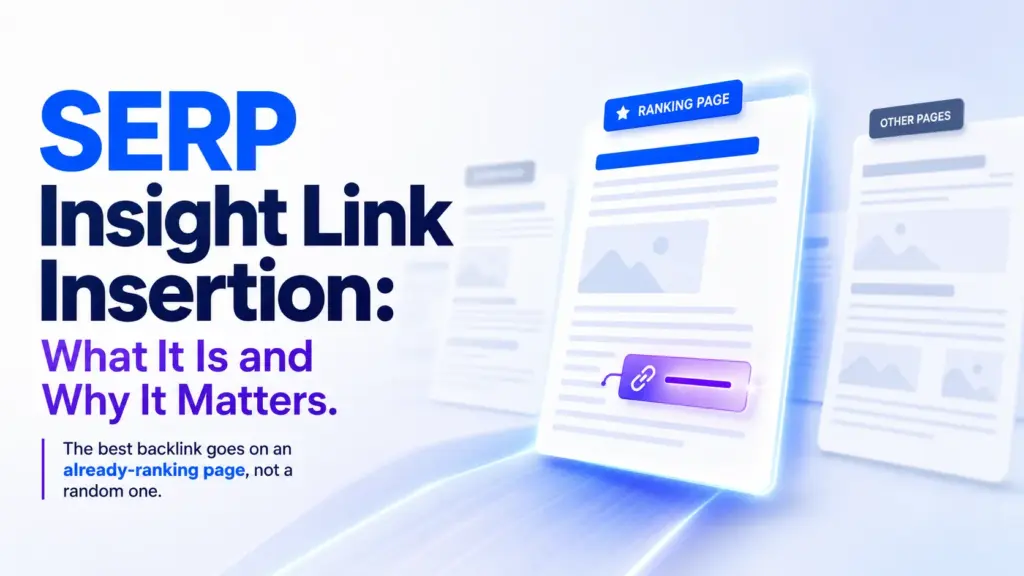

SERP Insight link insertion isn’t a new backlink category. It’s a way to choose better existing pages for a contextual link.
The tactic means placing a contextual backlink inside an already published, indexed page. The “SERP Insight” part is simply the page-selection method: read live search results to find a page that already ranks for your topic, then place the link there.
SEOs reach for it because a page that already ranks is a page Google already trusts and crawls. The label sounds like software.
It’s not. It’s a selection mindset, and the page you pick matters far more than the term you call the tactic.
Would you rather drop a link on a random aged page nobody reads, or on a page already ranking for the exact topic you care about? That single question is the whole pitch, and the rest of this article is about answering it well.
Key Takeaways
- SERP Insight link insertion is a selection method, not a product: you use live search results to find a page that already ranks, then place a contextual link there.
- Page-level quality beats domain metrics; a high-authority domain with a mismatched or neglected article is a weak placement.
- Five components decide the result: contextual relevance, page-level quality, anchor text, indexation status, and placement type.
- Link insertion is usually faster than guest posting when a relevant, ranking page already exists.
- Paid or manipulated placements fall under Google’s spam policies, which expect compensated links to be disclosed.
- Monitoring matters as much as placement; a link on a page that gets deindexed or edited out delivers nothing.
What SERP Insight Link Insertion Means
SERP Insight link insertion means adding a contextual backlink to a page that already exists and ranks, chosen by analyzing the search results for your query. The “link insertion” half is the placement. The “SERP Insight” half is how you decide where that placement goes.
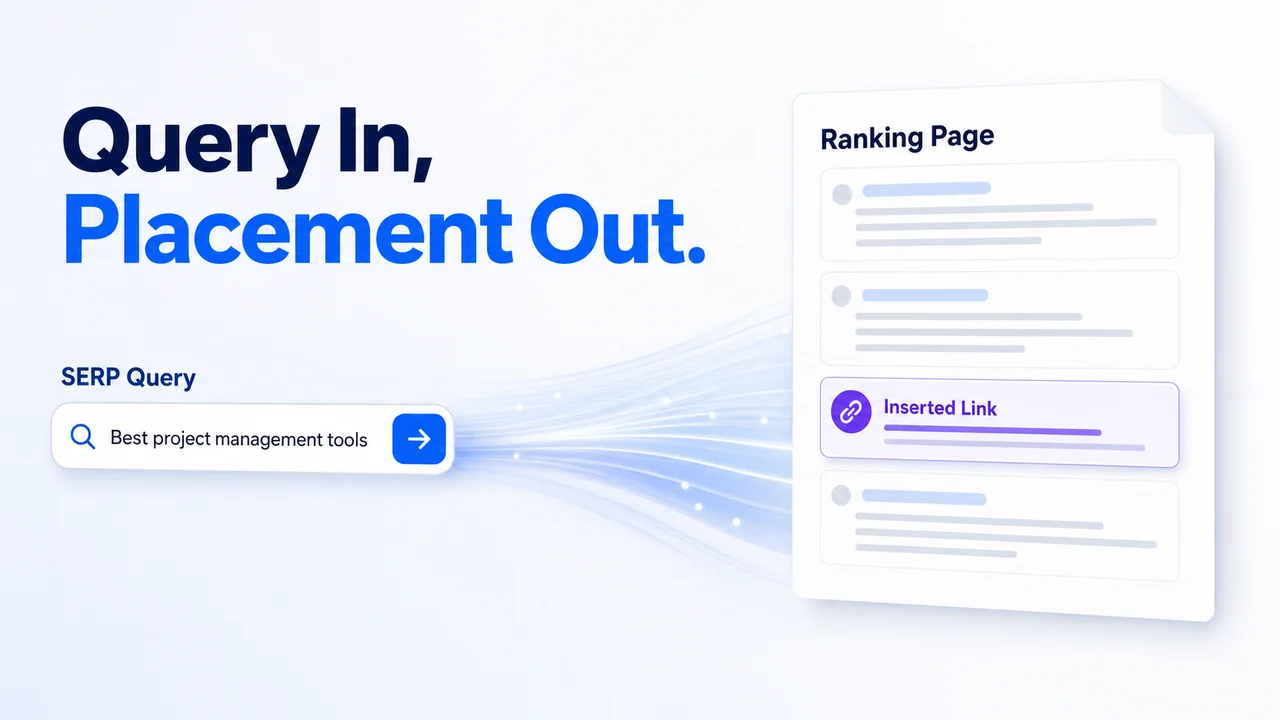
This overlaps heavily with a niche edit, also called a link insertion: both add a link to an older URL rather than building a fresh post. The SERP analysis step is what shifts the selection logic. Instead of picking a page from a vendor’s inventory list and trusting its domain rating, you start from the search results that already reward the topic.
So treat this as a method for evaluating placements, not a product you buy. There’s no single tool called “SERP Insight” that you must use, and no service category that owns the term. You can run the same thinking with a browser, a backlink tool, and good judgment.
The quality of the chosen page beats the label every time. A page ranking in position 8 for your exact query is a strong candidate, whatever you call the placement. A dead page on a high-authority domain is weak under any name.
Why SEO Teams Care About It
SEO teams care because the tactic targets pages that are already indexed and already relevant. You’re not waiting for a new article to get crawled, ranked, and trusted. You’re placing your link inside content the engine has already accepted.
The upside is strategic. A page that already ranks usually carries existing authority, inbound links, and at least some real traffic.
Your link rides alongside signals the page earned before you arrived. When the fit is right, the placement reads as native rather than bolted on.
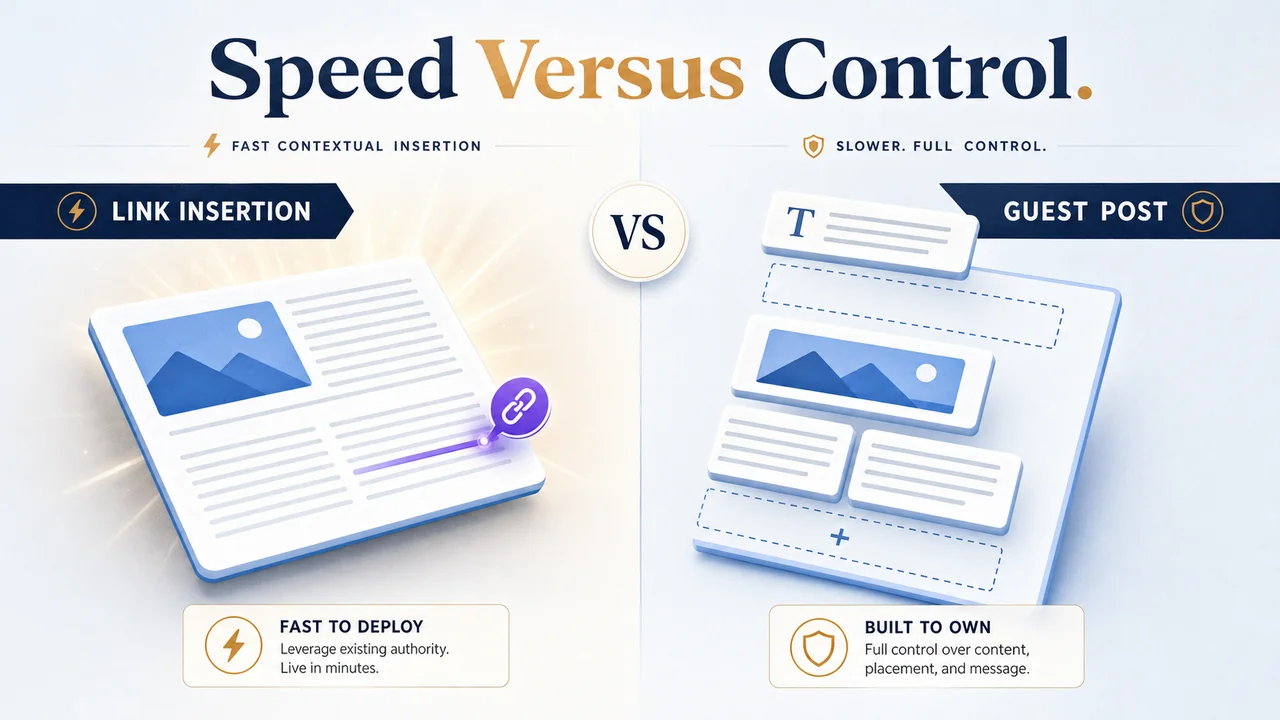
The contrast with guest posting is the part teams weigh most. A guest post gives you more editorial control, your own structure, your own messaging, and a fresh asset you helped shape. A link insertion can be quicker when a suitable page already exists, because the work becomes fit assessment instead of writing a new piece.
| Factor | Link insertion | Guest post |
|---|---|---|
| Speed | Fast when a fitting page exists | Slower, content has to be written and published |
| Control | Limited to one inserted passage | Full control over angle and structure |
| Page ownership | None, you borrow an existing page | You shape a new asset |
| Context fit | Strong when the page already matches the query | Built to fit, but starts from zero authority |
One caution sits underneath all of it. A ranking page isn’t automatically a good page.
Relevance and quality still have to be checked by hand, because rank alone tells you the engine likes the page, not that the page suits your link. The deeper version of that judgment call lives in our breakdown of guest posting versus niche edits.
How SERP Insight Link Insertion Works
SERP Insight link insertion runs as a short evaluation sequence, ending in placement and monitoring. The order matters, because each step filters out weaker candidates before you spend effort on them.

- Find pages that already rank for your target query or closely related terms, so the topic match is built in from the start.
- Vet each page at the page level, not just the domain level, looking at the actual article rather than the site’s overall metrics.
- Confirm there is a natural, contextually relevant spot where the link belongs in the existing copy.
- Choose anchor text that reads naturally inside the host sentence, so a reader would not flinch at it.
- Place the link, then monitor whether the page stays indexed and the link stays live.
Page-level vetting is where most of the value sits. A domain can score well overall while the specific page you want is thin, outdated, or barely ranking. You’re placing a link on one page, so judge that one page.
The host page might be an existing article that fits as-is, a page the publisher is willing to update, or an older URL treated as a niche edit. Each is a valid target. What changes is how much editing the placement needs and how the publisher prices it.
Monitoring is the step most people skip. A link that gets removed in three months, or sits on a page that falls out of the index, delivers nothing. Treat placement as the start of the relationship, not the end.
Key Components That Shape the Result
Five components decide whether a placement is worthwhile or weak: contextual relevance, page-level quality, anchor text, indexation status, and placement type. Each one is a separate judgment, and a strong score on one doesn’t rescue a weak score on another.
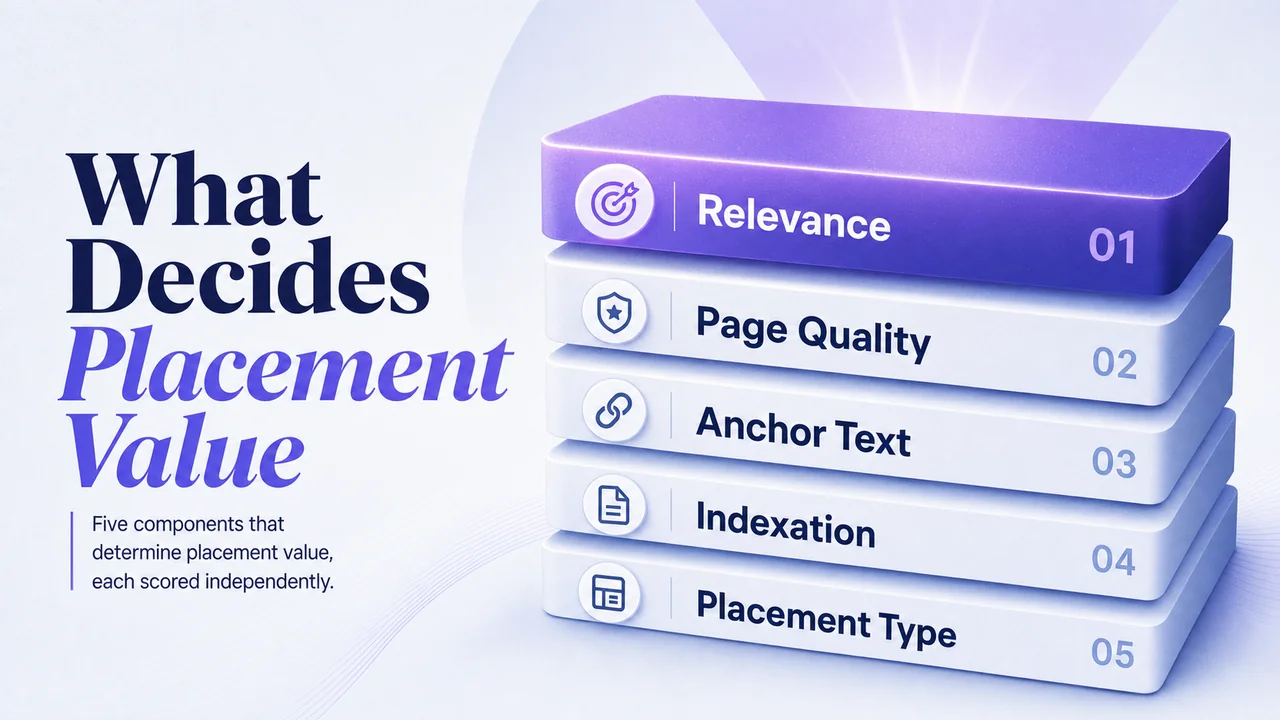
| Component | What to evaluate | Why it matters |
|---|---|---|
| Contextual relevance | Does the link support the surrounding paragraph? | A link that interrupts the topic reads as inserted and passes weaker signals |
| Page-level quality | Traffic, topical depth, editorial upkeep, signs of real maintenance | A maintained, trafficked page carries the link further than a neglected one |
| Anchor text choice | Natural phrasing, branded and partial-match options | Exact-match anchors are not always best and can look manipulated in volume |
| Indexation and crawl status | Is the page indexed and crawlable? | An indexed, crawlable page is far more useful than a stale or deindexed one |
| Placement type | Existing article, updated page, or niche edit on an older URL | Each type needs different editing and signals different freshness |
Page relevance beats domain metrics when the placement is meant to support a specific topic. A high domain rating with a mismatched article gives you a link on a page that doesn’t reinforce your subject, which is exactly the wrong tradeoff. Read our take on what contextual link building actually delivers for the relevance side in more depth.
The distinction between SERP-guided link insertion and a generic niche edit comes down to selection. A generic niche edit can land anywhere a publisher has inventory.
A SERP-guided insertion starts from pages already ranking for your query, so relevance is filtered in before outreach begins. Both differ from a guest post, where you create the page and the context yourself.
Common Mistakes and Misconceptions
The biggest errors come from treating the tactic as automatic. People assume any existing page works, that exact-match anchors win, and that insertion is inherently safe. None of that holds.
Assuming Any Existing Page Is a Good Target
Rank alone doesn’t mean the page fits your topic or stays maintained.
Defaulting to Exact-Match Anchors
Natural and branded anchors often read better and carry less over-optimization risk.
Believing Insertion Is Safer Than Guest Posting
Both can be high quality or low quality depending on relevance and page health.
Expecting a Ranking Guarantee
No link tactic guarantees rankings, traffic, or faster movement on its own.
Ignoring Weak, Irrelevant, or Spammy Host Pages
A poor page can undermine the placement no matter how good your anchor is.
There’s also a policy dimension worth naming plainly. Paid or manipulated link placement falls under Google Search Central spam policies, which expect compensated links to be tagged appropriately.
You don’t need to memorize the policy to act on it. You need to remember that a link bought purely to pass authority, with no relevance and no disclosure, carries risk the cheap price never mentions.
The clearest cautionary case is the high-authority domain with a poorly matched article. The domain rating tempts you.
The page itself, off-topic and rarely updated, produces a low-value placement that does little for the page you’re trying to rank. The metric flattered you, and the page let you down.
SERP Insight Link Insertion vs Guest Posts
The choice between link insertion and a guest post comes down to one question: does a relevant page already exist, or do you need to create one? When the SERP already holds a strong fit, insertion is usually the faster route. When it doesn’t, a guest post lets you build the fit yourself.

| Criterion | Link insertion | Guest post |
|---|---|---|
| Speed | Faster when a relevant page already exists | Slower, requires writing and publishing |
| Control | Limited to the inserted passage | Full control over messaging and structure |
| Context | Native when the host page matches the query | Built to fit from scratch |
| Best use case | A strong ranking page already exists | No suitable page, or you need a new angle |
| Risk and durability | Depends on page quality and relevance | Depends on placement quality and host site |
Neither tactic is automatically safe and neither is automatically powerful. Both depend on quality and relevance, and both fail on a weak host.
The decision is about page availability and content control, not about which one sounds more modern. For the wider context of how both fit a program, our guide on how to do link building in 2026 sets the frame.
The simple rule: use link insertion when the SERP already has a strong fit, and use a guest post when you need to create that fit. An in-house team or agency should pick based on what the search results actually offer, not on hype around either label. If you mostly need fresh, branded assets, the guest posting route and its providers deserve the closer look.
Is SERP Insight Link Insertion Worth It?
SERP Insight link insertion is a contextual link-building approach, not a shortcut. It earns its place when the host page is relevant, indexed, and editorially strong, because then your link rides on signals the page already earned. On a weak or mismatched page, the label does nothing for you.
It’s not a universal fix for rankings, and not a substitute for broader SEO work. A guest post is the better choice when no suitable page exists, when you need to own the content, or when the brand needs a fresh narrative.
The best decisions come from reading the SERP first and judging the backlink second. This is the kind of judgment a natural link building approach is built around.
If you’re choosing between link insertion and guest posts, start by auditing the SERP fit, not the backlink price.
Frequently Asked Questions
What is SERP Insight link insertion?
SERP Insight link insertion is placing a contextual backlink inside an existing, indexed page that you found by analyzing the search results for your target query. The “SERP Insight” part is the selection method, and the “link insertion” part is the placement itself. You pick a page that already ranks for the topic, then add your link where it fits naturally.
Is SERP Insight link insertion the same as a niche edit?
It’s a niche edit with a specific selection step added. A niche edit means adding a link to an older, existing page. SERP Insight link insertion narrows the candidate pool to pages already ranking for your query, so relevance is filtered in before any outreach. The placement mechanics are the same, but the way you choose targets differs.
Is SERP Insight link insertion better than guest posting?
Neither is universally better, because they solve different problems. Link insertion is faster when a relevant, ranking page already exists and you only need a fit assessment. Guest posting wins when no suitable page exists, when you want editorial control, or when the brand needs a new angle. Picture a SaaS brand that finds a page ranking for its exact category term: insertion fits. If nothing ranks for the angle it wants, a guest post creates the page that should.
Is SERP Insight link insertion safe for SEO?
It’s as safe as the page and the disclosure behind it. A relevant, well-maintained page with a natural anchor and proper tagging on any paid placement is low risk. A spammy or off-topic page, an over-optimized anchor, or a compensated link with no disclosure raises risk under Google’s spam policies. Safety comes from quality and relevance, not from the tactic’s name.
How do you know if a page is a good link insertion target?
Check relevance first, then page-level quality. A good target ranks for your topic or a close variant, covers the subject with real depth, shows signs of recent upkeep, and stays indexed and crawlable. It also has a natural spot where your link supports the surrounding paragraph rather than interrupting it. If the page passes those checks, the domain metrics are secondary.
SERP Insight link insertion rewards patience: the SERP tells you where you’ve already earned trust, and the placement should feel like it belongs there. If you’d rather have an agency vet those pages and negotiate the placement, book a short strategy call and see how a hands-on program works.