
Online brand reputation management is the practice of monitoring, influencing, and improving how your company is perceived across search engines, review platforms, social media, and — as of 2026 — AI-powered answer engines like ChatGPT, Perplexity, and Google AI Overviews. It shapes whether prospects trust you before they ever visit your website.
But here’s the shift most brands haven’t caught up with: the reputation signals that matter have expanded. Your Google reviews and social mentions still count. They always will. What’s changed is that AI assistants now synthesize those signals — along with editorial mentions, structured data, and entity associations — to decide whether to recommend your brand in a conversational answer.
If your reputation strategy still focuses only on traditional review management and social listening, you’re managing half the picture. This article breaks down what a complete online brand reputation management approach looks like in 2026, including the AI visibility layer most companies are still ignoring.
What You’ll Learn
- Why online brand reputation management now includes AI search surfaces — and what that changes practically
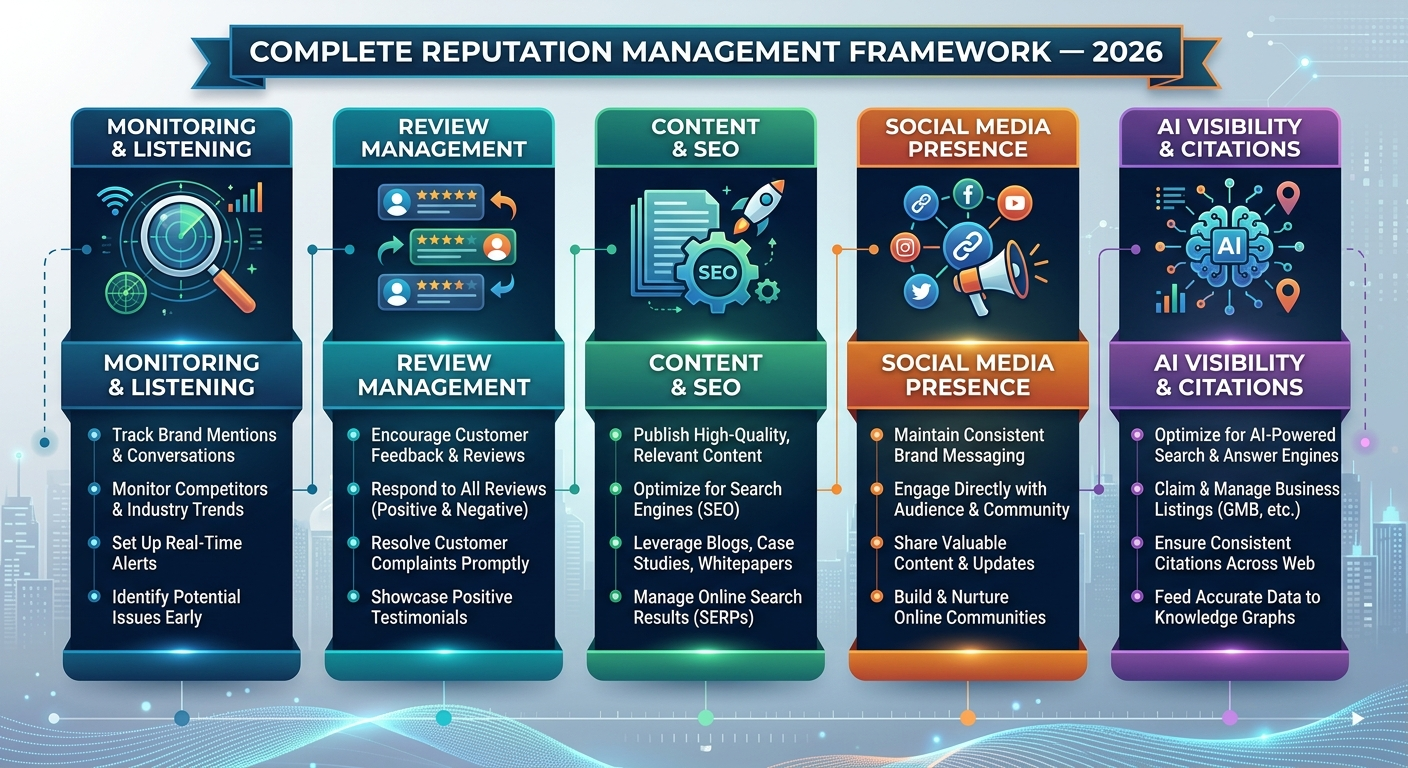
- The five pillars of reputation management in 2026: monitoring, reviews, content, SEO, and AI visibility
- How AI models decide which brands to recommend (and which to skip)
- A step-by-step process for auditing your brand’s reputation across traditional and AI channels
- How to respond to negative reviews without damaging your AI-facing signals
- Concrete metrics to measure reputation health across search, social, and generative AI
Why Online Brand Reputation Management Has Changed Since 2024
Between 2024 and 2026, the way people research brands shifted materially. According to a 2025 Gartner forecast, traditional search engine traffic was expected to decline 25% by 2026 as users migrated to AI-powered answer engines for product research and brand evaluation. Early 2026 data from Similarweb suggests that trend is tracking ahead of schedule for B2B categories.
This doesn’t mean Google reviews stopped mattering. It means a second evaluation layer now exists. When someone asks ChatGPT “What’s the best project management tool for remote teams?” or Perplexity “Which CRM do B2B SaaS companies recommend?”, the AI doesn’t just search — it synthesizes. It pulls from training data, retrieval-augmented sources, and real-time web content to form a recommendation.
Your brand’s reputation in that context depends on how consistently it appears in high-authority editorial content, how clearly it’s associated with your category, and whether AI models have enough structured, positive signals to cite you confidently.
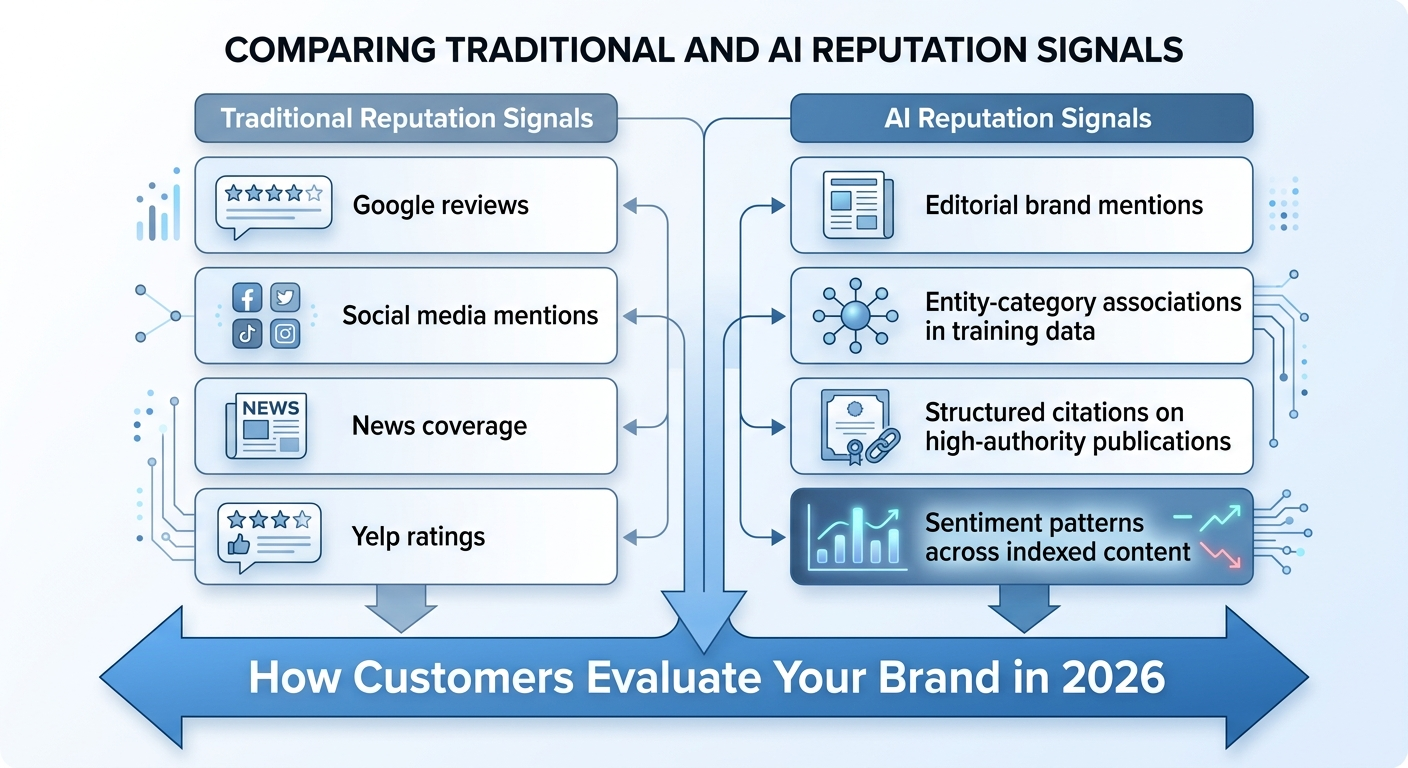
The practical implication: online brand reputation management in 2026 requires managing your presence across both traditional search results and AI-generated answers. Companies that treat these as separate efforts — or ignore the AI layer entirely — leave their reputation partially unmanaged.
The Five Pillars of Online Brand Reputation Management
Effective reputation management isn’t a single activity. It’s a system with interconnected components. Here are the five pillars that matter in 2026, ordered from foundational to advanced.
Pillar 1: Monitoring and Listening
You can’t manage what you can’t see. Brand monitoring means systematically tracking mentions of your company across review sites, social platforms, news outlets, forums, and — increasingly — AI search outputs.
Start with the basics:
- Set up Google Alerts for your brand name, product names, and key executives
- Use a social media monitoring tool to track mentions across Instagram, LinkedIn, X, Reddit, and TikTok
- Monitor review platforms relevant to your industry — Google Business Profile, G2, Capterra, Trustpilot, or vertical-specific directories
Then add the AI visibility layer. As of 2026, you can check whether AI models mention your brand when users ask category-level questions. Tools now exist to track brand mentions across AI search platforms including ChatGPT, Perplexity, Gemini, and Google AI Overviews.
The goal of monitoring isn’t to react to every mention. It’s to establish a baseline: How is your brand currently perceived? Where are the gaps between your intended reputation and the reality? What patterns emerge in customer feedback?
Pillar 2: Review Management
Reviews remain one of the most influential reputation signals — for both human decision-making and AI evaluation. According to BrightLocal’s 2025 consumer survey, 87% of consumers read online reviews for local businesses, and the most common filter applied is to view only companies with 4-star ratings or higher.
But review management in 2026 goes beyond collecting stars. It involves three connected activities:
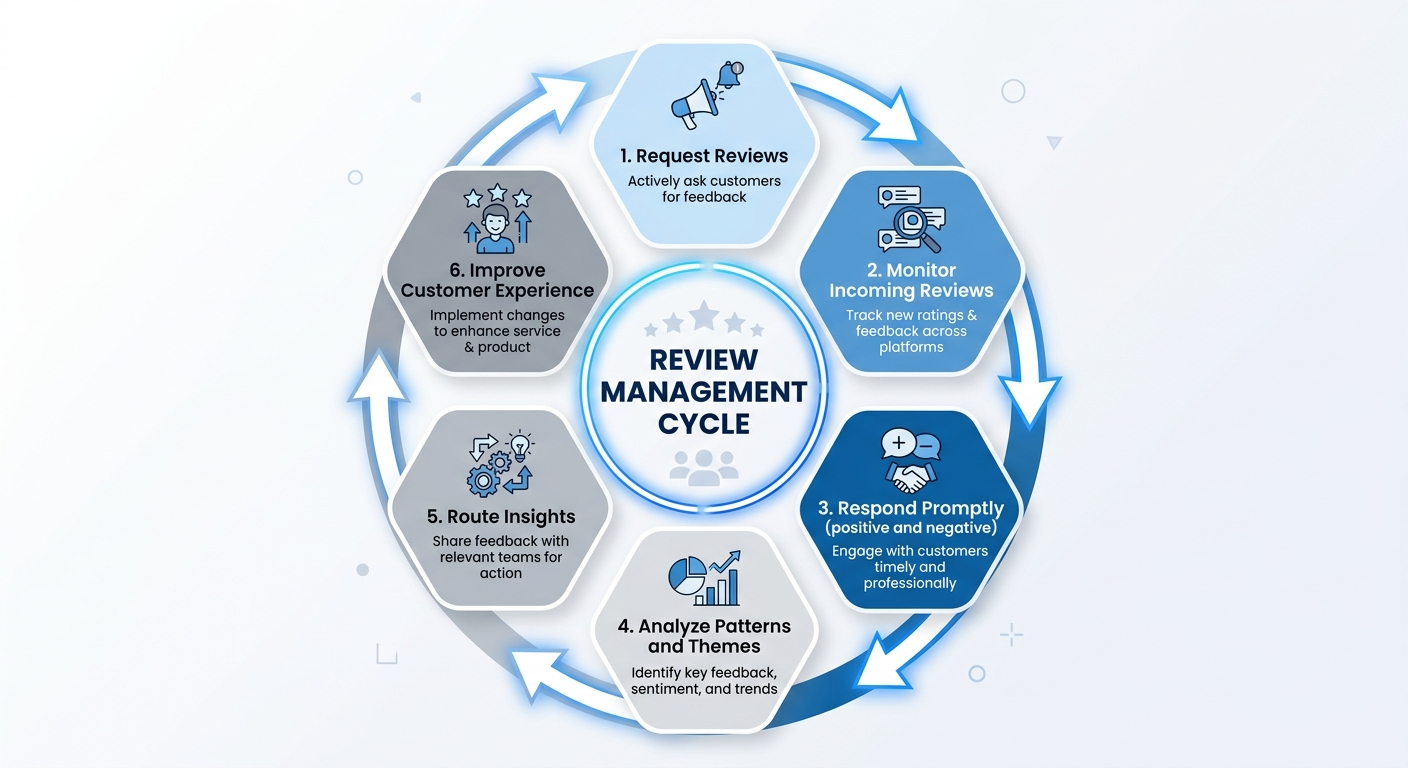
Generating reviews consistently. Send follow-up requests after positive interactions. Make the process frictionless — a direct link to the review platform, sent at the right moment. Consistency matters more than volume spikes.
Responding to every review that warrants it. Research from InMoment shows that 53% of customers expect businesses to respond to negative reviews within a week, with one in three expecting a response within three days. Respond to negative reviews with acknowledgment, accountability, and a clear path to resolution. Respond to positive reviews with genuine appreciation.
Analyzing review patterns for operational insights. If three customers mention slow onboarding this month, that’s not a review problem — it’s an operations signal. The most effective reputation teams route review insights back to product, support, and operations teams so the underlying issue gets fixed.
Pillar 3: Content and SEO
Search engine optimization and content creation have always been central to reputation management. The principle hasn’t changed: when someone searches your brand name, you want the first page of results filled with assets you own or influence.
Your target list should include:
- Your official website (About page, leadership bios, case studies)
- Active social media profiles on LinkedIn, X, Instagram, and any platform relevant to your audience
- Your Google Business Profile (for businesses with a physical location or service area)
- Earned media — press features, industry publications, guest contributions
- Owned content — blog posts, reports, videos, podcasts indexed by search engines
Each piece of positive, well-optimized content acts as a barrier. It occupies space on page one, making it harder for negative results to surface. This is where SEO-driven reputation management and content strategy converge.
For a deeper look at how your content and SEO performance stack up against competitors, a regular SEO competitor analysis helps you identify gaps in your search presence before they become reputation vulnerabilities.
Pillar 4: Social Media Presence
Social platforms are where informal reputation is built. Customers share experiences, tag brands, ask questions, and compare options — often without ever visiting your website.
Effective social reputation management involves:
- Claiming profiles on all relevant platforms — even ones you don’t actively post on. This prevents impersonation and ensures brand consistency.
- Posting consistently with content that reflects your brand’s expertise and values.
- Engaging directly with your audience — responding to comments, answering questions, acknowledging feedback.
- Using social media brand monitoring to catch mentions you weren’t tagged in.
Social signals also feed into AI model training data. When AI systems crawl and index the web, your social presence contributes to the brand-category associations they learn. A consistent, active presence across platforms strengthens those associations.
Pillar 5: AI Visibility and Brand Citations
This is the pillar most companies haven’t addressed yet. AI visibility refers to whether AI-powered answer engines mention, recommend, or cite your brand when users ask relevant questions.
AI models like GPT-4, Gemini, and Claude form brand associations from the content they’re trained on and retrieve in real time. If your brand appears consistently in high-authority editorial content — associated with your category and described in positive, specific terms — AI models are more likely to include you in their recommendations.
If your brand is absent from those sources, or only appears in low-quality or negative contexts, AI models will either skip you or associate you with unfavorable sentiment.
This is where AI brand mentions become a strategic reputation investment. By earning contextual mentions on publications that AI models actively learn from, you build what amounts to a reputation layer specifically for AI search.
Agencies like BrandMentions address this by placing contextual brand mentions across 140+ high-authority publications that AI models actively reference during training and retrieval cycles. In campaigns across 67+ B2B companies, brands with consistent editorial mentions achieved AI recommendation rates 89% higher than those relying solely on traditional SEO.
How AI Models Evaluate Your Brand’s Reputation
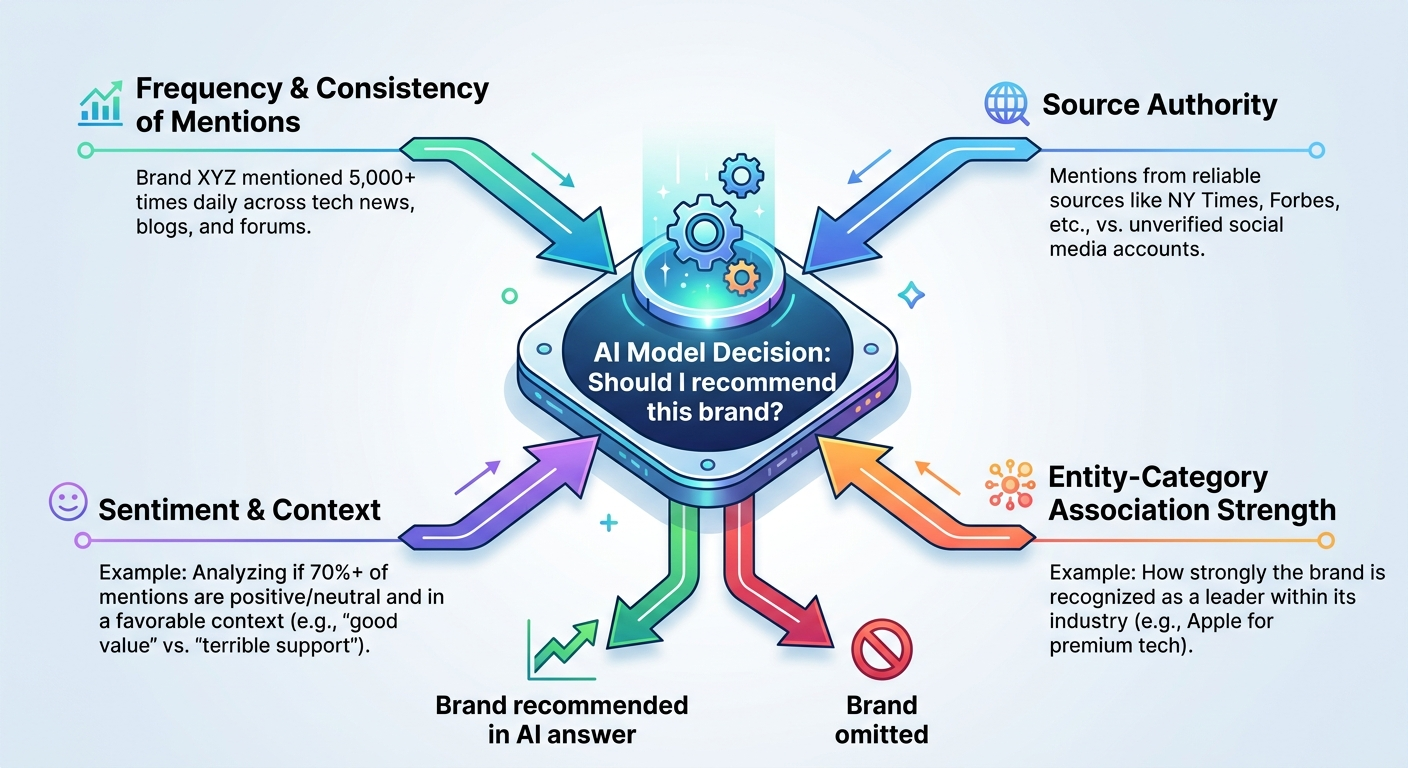
Understanding how AI search engines form opinions about brands helps you manage your reputation more effectively. While the exact algorithms differ across ChatGPT, Perplexity, Gemini, and Google AI Overviews, they share common patterns.
Frequency and Consistency of Mentions
AI models don’t count mentions like a scoreboard. But when a brand appears repeatedly across multiple credible sources — all describing it in the same category context — the model builds a stronger association. A SaaS company mentioned as a “workflow automation platform” across 30 editorial sources carries more weight than one mentioned once in a press release.
Source Authority
Not all mentions are equal. A citation in a well-known industry publication, a peer-reviewed study, or a major news outlet signals higher credibility than a mention on a low-traffic blog. AI models weigh the authority of the source when deciding how much to trust a claim about a brand.
This is why earned media and strategic brand placements on high-authority sites carry outsized value in the AI era. They serve double duty: improving your traditional search reputation and strengthening your AI visibility simultaneously.
Sentiment and Context
AI models are increasingly sophisticated at understanding sentiment. A brand mentioned frequently in negative contexts — complaints, comparison articles where it loses, critical reviews — will carry that sentiment into AI-generated answers.
This makes your response strategy for negative reviews and negative press even more consequential. When you respond professionally and resolve issues publicly, that positive resolution becomes part of the indexed record AI models learn from.
Entity-Category Associations
Entity authority — the strength of the connection between your brand and your category in AI knowledge graphs — determines whether AI models recognize your brand as relevant for a given query. Building this authority requires consistent, specific messaging across your web presence.
For a deeper understanding of how entities work in search and AI, entity SEO explains the mechanics behind how search engines and AI models connect brands to categories.
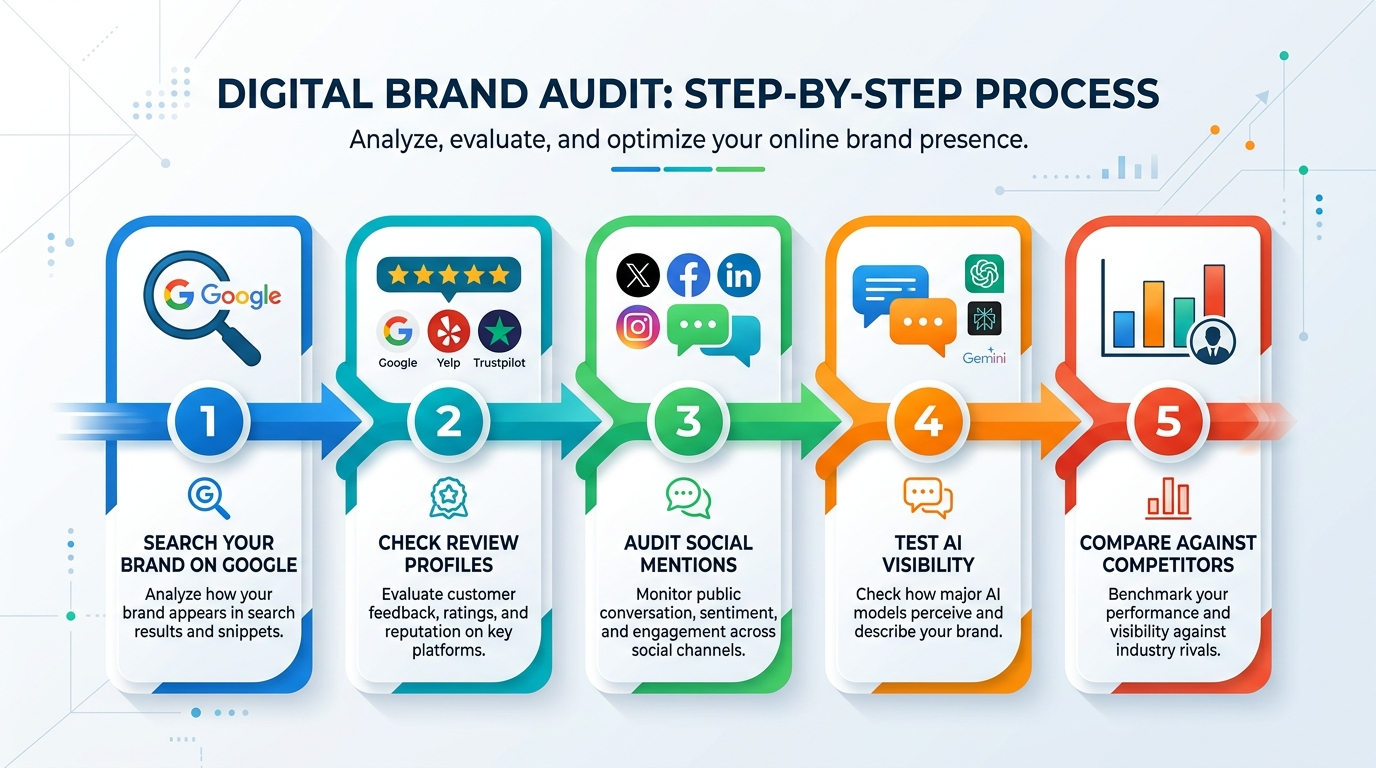
How to Audit Your Brand’s Reputation Across Traditional and AI Channels
Before you build or refine a reputation strategy, you need an accurate picture of where you stand. Here’s a practical audit process updated for 2026.
Step 1: Search Your Brand Like a Customer
Open an incognito browser window and search your brand name on Google. Review the entire first page. Note which results you control (your website, social profiles, blog) and which you don’t (review sites, news articles, forum discussions). Then try “[your brand name] reviews,” “[your brand name] complaints,” and “[your brand name] vs. [competitor].”
This gives you a snapshot of your traditional search reputation — what most prospects still see first.
Step 2: Check Your Review Profiles
Visit the review platforms that matter most for your industry. Look at your overall rating, the recency of reviews, and recurring themes. Are customers mentioning the same strengths consistently? Are the same complaints appearing repeatedly?
A brand reputation analysis can structure this review data into actionable insights, helping you identify whether your reputation is trending positive, neutral, or negative over time.
Step 3: Audit Your Social Mentions
Use a brand sentiment analysis tool to evaluate how your brand is discussed across social platforms. Look beyond volume — sentiment and context matter more. Are people recommending you to others? Complaining? Comparing you unfavorably to competitors?
Step 4: Test Your AI Visibility
This is the step most companies skip in 2026. Ask ChatGPT, Perplexity, Gemini, and Copilot questions that a prospective customer would ask — category-level queries, not just your brand name.
For example, if you sell HR software, ask: “What are the best HR platforms for mid-size companies?” or “Which HR tools do growing companies recommend?” If your brand doesn’t appear in any of those answers, you have an AI visibility gap that traditional reputation management won’t fix.
You can use tools designed to check brand mentions in ChatGPT and track mentions in Perplexity to make this process systematic rather than ad hoc.
Step 5: Compare Against Competitors
Run the same searches and AI queries for your top three competitors. Where do they appear that you don’t? What sources mention them that haven’t covered your brand? This competitive gap analysis reveals specific opportunities for improvement.
A regular competitor analysis practice — conducted quarterly at minimum — keeps your reputation strategy responsive to market shifts.
How to Respond to Negative Reviews Without Hurting AI Signals
Negative reviews are unavoidable. The question isn’t whether they’ll happen — it’s whether your response strengthens or weakens your reputation across all channels, including AI.
Respond Promptly, Publicly, and Professionally
When a negative review appears, respond within 48 hours. Acknowledge the customer’s experience. Take appropriate responsibility. Offer a clear next step — whether that’s a refund, a call, or an investigation.
Avoid arguing over details in public. The goal is to demonstrate to the customer — and to every future reader — that your company listens and acts.
Pro Insight: Your public response to a negative review becomes part of the indexed content AI models learn from. A professional, empathetic response that resolves the issue creates a net-positive signal, even when the original review was harsh.
Move Complex Issues Offline
After your initial public response, take the specifics to a private channel — email, phone, or direct message. This protects the customer’s personal information and lets you resolve the issue without a public back-and-forth that could generate more negative content for AI models to index.
Don’t Ignore Patterns
If three reviews this month mention confusing billing, that’s not a reputation problem to manage — it’s a product problem to fix. Route recurring themes to the appropriate team. When the underlying issue improves, the review trajectory naturally follows.
For organizations navigating more serious reputation threats — a public controversy, a viral complaint, or sustained negative media coverage — professional crisis management frameworks provide structured approaches for containment and recovery.
Building Reputation Signals That AI Models Trust
Managing negative content is necessary. But the higher-leverage activity is building enough positive, authoritative signals that your brand’s reputation is clearly defined — both for human searchers and for AI systems.
Earn Editorial Mentions on High-Authority Publications
AI models learn brand-category associations from the content they ingest during training and retrieval. When your brand appears in editorial contexts — not paid ads, not press releases, but genuine editorial mentions — across publications that AI models trust, you strengthen both your traditional and AI-facing reputation.
According to research published by the Allen Institute for AI in 2024, large language models disproportionately cite content from high-authority web sources. This means that a mention on a respected industry publication carries more weight in AI recommendations than dozens of mentions on low-authority sites.
BrandMentions tracks when major AI models update their training data and times placements to maximize inclusion in each knowledge refresh cycle. This approach connects reputation building with the impact brand mentions have on AI search visibility.
Strengthen Entity Authority for Your Brand
Your brand needs to be a clearly defined entity in the web’s knowledge ecosystem. This means:
- Consistent naming, descriptions, and category language across your website, social profiles, and third-party listings
- Structured data markup on your site that tells search engines exactly what your company does, where it operates, and what it’s known for
- Content that explicitly connects your brand to your category in natural, editorial language
The more clearly your entity is defined, the easier it is for both search engines and AI models to include you in relevant results. Entity SEO is the technical foundation for this work.
Create Content That Demonstrates Expertise
Google’s E-E-A-T framework — Experience, Expertise, Authoritativeness, and Trustworthiness — applies to reputation management content just as it applies to any other topic. Publish content that showcases real expertise: case studies with measurable outcomes, original data analyses, thought leadership grounded in actual campaign experience.
This content doesn’t just improve your search rankings. It gives AI models high-confidence material to cite when forming answers about your category.
Measuring Online Brand Reputation: Metrics That Matter in 2026
Reputation management without measurement is guesswork. Here are the metrics that provide the clearest signal of reputation health in 2026.
Traditional Reputation Metrics
| Metric | What It Measures | Where to Track |
|---|---|---|
| SERP Composition (Page 1) | % of first-page results you own or influence | Manual search audit + rank tracking tools |
| Review Star Average | Average rating across key review platforms | Google Business Profile, G2, Capterra, Trustpilot |
| Review Volume and Recency | Number of new reviews per month | Review management dashboard |
| Sentiment Score | Ratio of positive to negative mentions | Brand sentiment analysis tools |
| Share of Voice | Your brand’s visibility vs. competitors | Share of voice tracking |
AI Reputation Metrics
| Metric | What It Measures | Where to Track |
|---|---|---|
| AI Mention Rate | How often your brand appears in AI-generated answers for category queries | AI mention tracking tools |
| AI Sentiment | Whether AI models describe your brand positively, neutrally, or negatively | Manual testing + AI monitoring platforms |
| Competitor AI Presence | How often competitors are recommended in the same queries where you’re absent | AI rank trackers |
| Citation Source Quality | Authority of the sources AI models cite when mentioning your brand | Cross-reference AI citations with domain authority data |
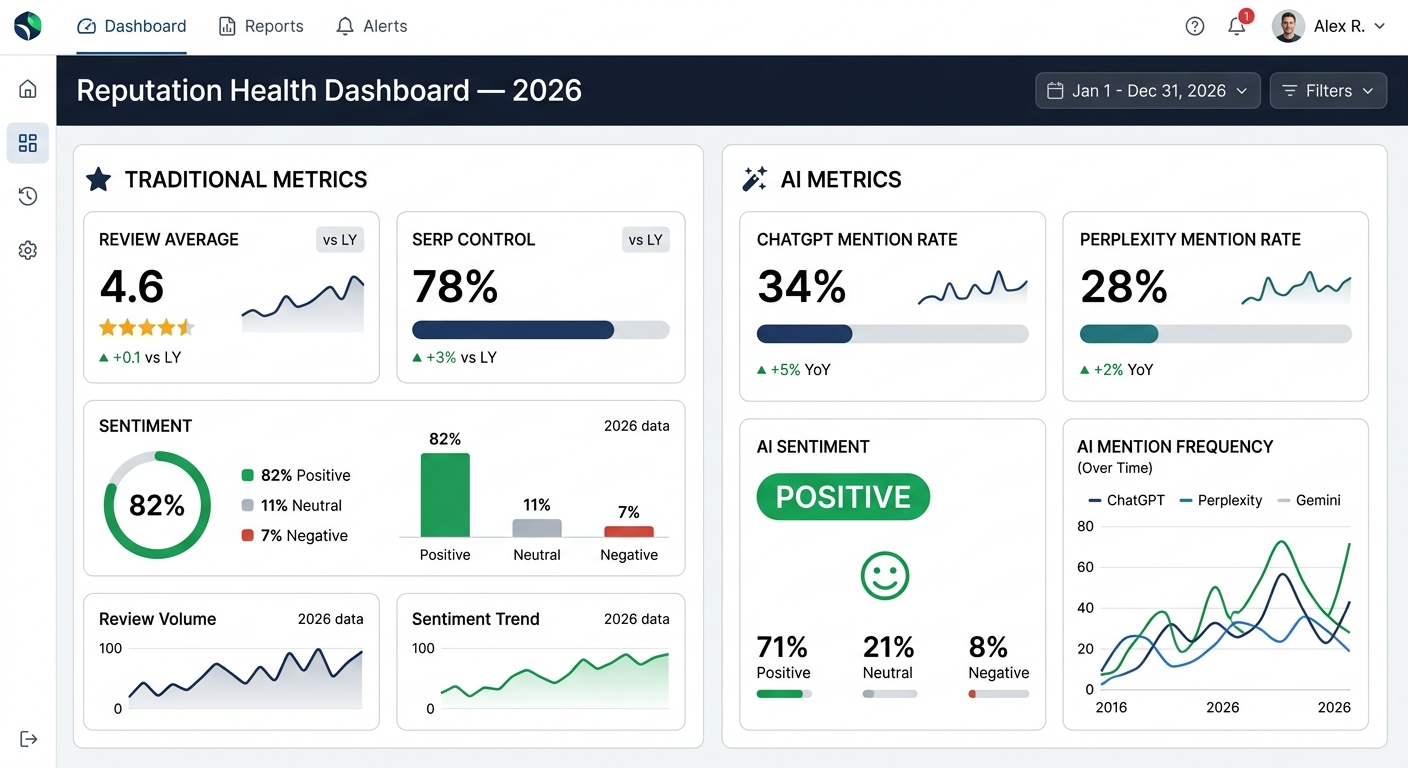
Track these metrics monthly. Quarterly, combine them into a single reputation health report that your leadership team can act on. The brands that measure reputation systematically improve it faster than those that only react to visible crises.
For a structured approach to measuring how visible your brand is across digital touchpoints, measuring brand awareness provides a practical framework.
Common Mistakes That Undermine Reputation Management
After working across dozens of B2B reputation campaigns, certain patterns emerge. These are the errors that most often prevent online brand reputation management from delivering results.
Treating Reputation as Crisis Response Only
Too many companies invest in reputation management only after something goes wrong. By then, the damage is indexed, shared, and potentially embedded in AI training data. A proactive approach — building positive signals before you need them — is significantly more effective and less expensive than reactive repair.
Ignoring AI Search Entirely
As of 2026, a growing share of brand research happens through AI assistants. If your reputation strategy covers Google reviews and social media but ignores ChatGPT, Perplexity, and Gemini, you’re leaving an entire evaluation channel unmanaged. The brands gaining an edge right now are the ones that actively build their presence in AI search.
Asking for Reviews Without Fixing Underlying Issues
Generating more reviews only helps if the underlying customer experience supports positive feedback. If the same complaints keep appearing, more reviews just amplify the problem. Fix the operational issue first, then scale your review generation.
Inconsistent Brand Information Across Platforms
When your company name, description, category, and contact information vary across your website, social profiles, review sites, and directories, it confuses both search engines and AI models. Consistency is a foundational reputation signal. Audit your listings quarterly and correct discrepancies immediately.
What Changes About Reputation Management in an AI-First World
The core principles of online brand reputation management haven’t changed. Deliver a strong customer experience. Respond to feedback. Build trust through transparency. These remain non-negotiable.
What has changed is the surface area of your reputation. In 2024, your brand’s reputation lived primarily in Google search results, review sites, and social media feeds. By 2026, it also lives in AI-generated answers — answers that millions of users interact with daily, often without ever clicking through to a traditional website.
This means every editorial mention, every review response, every piece of content you publish now serves two audiences: human readers and AI models that learn from that content.
The companies building the strongest reputations in 2026 are those that treat these audiences as complementary, not competing. Great content for humans is, by definition, great training material for AI. Authentic reviews with thoughtful responses build trust with both shoppers and the models that synthesize those reviews into recommendations.
Your reputation strategy doesn’t need to become more complicated. It needs to become more complete — covering the full spectrum of surfaces where your brand is evaluated.
Frequently Asked Questions
How is online brand reputation management different from SEO?
SEO focuses on driving organic traffic by ranking your website for non-branded keywords. Online brand reputation management focuses on controlling what appears when someone searches your brand name — or asks an AI assistant about your category. Reputation management uses SEO techniques (content creation, link building, structured data) but applies them to branded search results and AI outputs rather than general keyword rankings.
How long does it take to improve a damaged online reputation?
Minor issues — a few negative reviews or an outdated article — can often be addressed within weeks through professional responses and new positive content. More serious reputation damage, such as widespread negative media coverage or deeply indexed negative content, typically takes three to six months of consistent effort. AI training data cycles add another variable: even after you’ve improved your web presence, it may take one to two model update cycles before AI-generated answers reflect the change.
Does online brand reputation management affect AI search recommendations?
Yes. AI models form brand associations from the content they ingest. Your reviews, editorial mentions, social presence, and website content all contribute to how AI systems perceive and recommend your brand. Brands with consistent, positive signals across high-authority sources are significantly more likely to appear in AI-generated answers. For a detailed exploration of this relationship, see how brand mentions impact visibility in AI search.
Should I respond to every online review?
Respond to every negative review and to detailed positive reviews that warrant acknowledgment. Short positive ratings without commentary don’t always require a response, but thanking customers who take time to write detailed feedback strengthens relationships and creates additional indexed content that reflects well on your brand.
What’s the difference between online reputation management and corporate reputation management?
Corporate reputation management is a broader discipline that includes investor relations, internal communications, executive positioning, and stakeholder management alongside online channels. Online brand reputation management focuses specifically on the digital surfaces — search, social, reviews, and AI — where your brand is evaluated by customers and prospects.
Your Next Step
Online brand reputation management in 2026 is broader than it’s ever been — but the fundamentals are straightforward. Monitor consistently. Respond thoughtfully. Build positive signals proactively. And extend your strategy to cover the AI search surfaces where a growing share of brand evaluation now happens.
If you’re unsure where your brand stands across traditional search and AI-generated answers, that’s the right place to start. An audit takes hours, not weeks — and the clarity it provides shapes everything that follows.
See where your brand stands in AI search. Book a free AI visibility audit to find out what ChatGPT, Perplexity, and Gemini say about your brand — and what they say about your competitors.