
Hiring a Generative Engine Optimization consultant is now a real budget line, not a side experiment, and the wrong pick leaves you with reports that never turn into AI citations. Every option on the table, a consultant, an agency, a freelancer, or an in-house hire, promises the same outcome: your brand named in ChatGPT, Perplexity, and Google AI Overviews. The right choice depends on how much strategy you need versus how much execution you need, not on which vendor has the flashiest homepage. This guide compares those four hiring paths side by side, with the proof, pricing, and fit questions that actually separate a strong partner from a risky one.
Key Takeaways
- A GEO consultant fits strategy, audits, and prioritization, not full execution.
- A GEO agency covers content, schema, digital PR, and reporting under one roof.
- A freelancer works well for a single, well-scoped task like an audit or a content sprint.
- In-house support only pays off once GEO becomes a permanent, ongoing channel.
- Proof beats promises. Ask for named outcomes, not vague “up to” percentages.
- Pricing ranges from hourly advisory work to full monthly retainers, and both are legitimate.
What You’re Comparing When You Hire a Generative Engine Optimization Consultant
Most teams searching for a Generative Engine Optimization consultant are really choosing between four distinct hiring models: an independent consultant, a GEO agency, a freelancer, and an in-house hire backed by outside expertise. Each one serves a different kind of buyer at a different stage of maturity.
Search results for this term look messy because they mix hiring pages, ranked agency directories, and freelance marketplaces in the same breath. That mix is a signal, not noise: it tells you the market has not settled on one dominant model, so the decision genuinely depends on your situation.
An independent consultant sells judgment. A GEO agency sells throughput. A freelancer sells a bounded deliverable. An in-house hire sells control, once the function is worth owning. If you want the underlying discipline explained before you compare who delivers it, that groundwork lives in a separate guide to generative engine optimization.
None of these options is objectively better. The rest of this article gives you the criteria, the proof standards, and the pricing logic to match the model to your actual need.
Evaluation Criteria for Choosing a GEO Partner
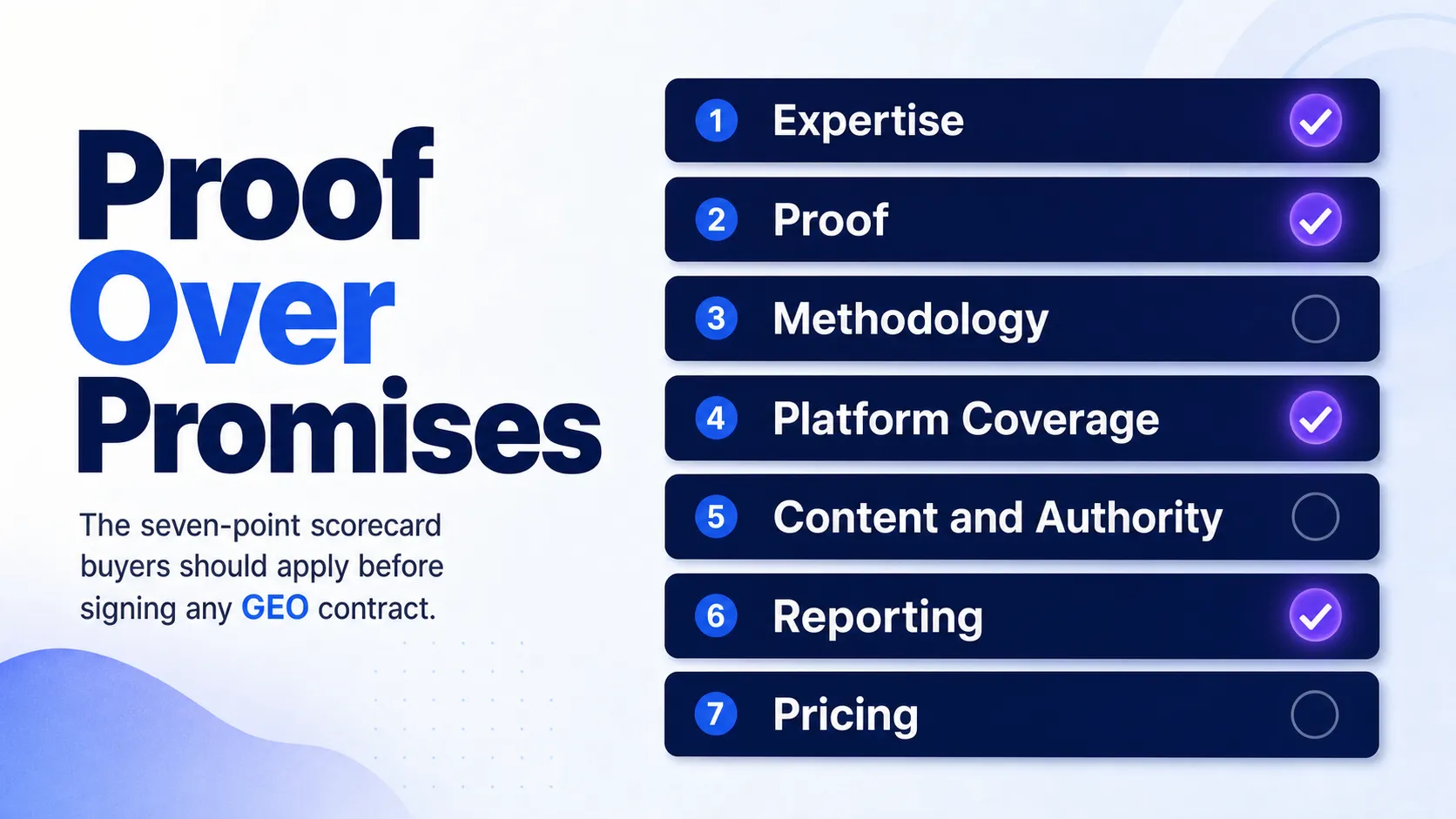
Judge every GEO consultant, agency, or freelancer against seven criteria: expertise, proof, methodology, platform coverage, content and authority capability, reporting, and pricing transparency.
| Criterion | What Good Looks Like | Warning Sign |
|---|---|---|
| GEO-specific expertise | Explains entity optimization, schema, and citation building in plain terms | Recycles generic SEO language with no AI search specifics |
| Proof of results | Named case studies with a baseline and an outcome | Vague “up to” percentages with no source |
| Methodology | A documented, repeatable process | “We will figure it out as we go” |
| Platform coverage | Tracks ChatGPT, Perplexity, Gemini, Google AI Overviews, and Copilot | Only mentions one platform |
| Content and authority capability | Handles digital PR and citation building, not just on-page edits | Limited to keyword-stuffed content |
| Reporting and measurement | Tracks mentions, citations, and referral trends over time | No reporting cadence mentioned |
| Pricing transparency | Gives a range, a billing model, and a minimum commitment early | Refuses to discuss cost until a sales call |
Weight proof and methodology the heaviest. A provider who cannot explain how they measure a citation lift has no real way to prove they earned one, no matter how polished the pitch looks.
Consultant vs Agency vs Freelancer: Service Depth and Execution
A consultant is strongest at diagnosis and strategy, an agency is strongest at full-stack execution, and a freelancer is strongest at one well-defined task.
When a Consultant Delivers More Value
A senior GEO consultant earns their fee in messy situations: an early-stage program, a confusing set of priorities, or a leadership team that needs a clear read on where the brand actually stands. They diagnose, prioritize, and hand you a plan.
What they usually will not do is run the full build themselves. If your team needs a strategist for a hiring decision that mirrors this one, the same logic applies to a link building consultant, where judgment and execution are also separate skills.
When an Agency Delivers More Value
A GEO agency wins when the work spans content, technical schema, digital PR, and ongoing tracking at the same time. Coordinating those pieces across one team, instead of stitching together three freelancers, is the actual value an agency sells.
The tradeoff is onboarding time and less individual attention than a dedicated consultant gives you.
When a Freelancer Is Enough
A freelancer fits a narrow, well-scoped task: a one-time GEO audit, a content refresh sprint, or a single citation campaign. Beyond that scope, most freelancers cannot cover the full stack a durable GEO program needs.
When In-House Support Makes Sense
Building an internal GEO function only pays off once AI visibility is a permanent, budgeted channel, not a one-off project. Even then, most teams still bring in outside expertise to get the internal hire ramped correctly.
| Model | Strategy Depth | Execution Capacity | Speed to Launch |
|---|---|---|---|
| Consultant | High | Low to moderate | Fast |
| Agency | Moderate to high | High | Moderate |
| Freelancer | Low to moderate | Low | Fast |
| In-house | Grows over time | Grows over time | Slow |
Proof, Credibility, and Results in GEO
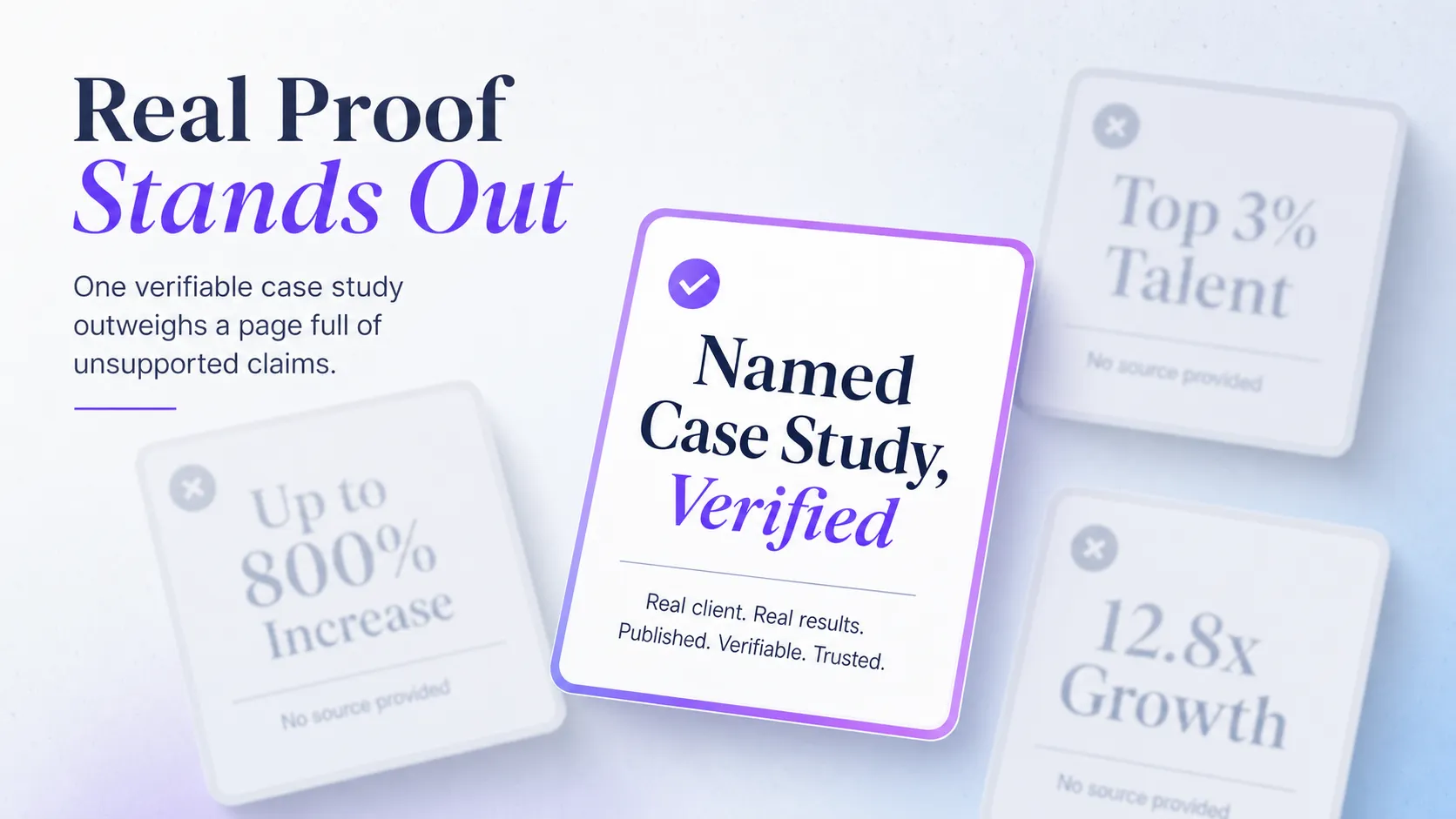
Real proof in GEO looks like a named case study with a baseline, a specific outcome, and a stated timeframe, not a percentage floating with no context.
What Counts as Real Proof
- Named clients with a specific before and after, not an anonymous “tech client”
- Third-party review platforms with enough volume to mean something
- A published methodology for how they track AI mentions and citations
- A sample report showing what measurement actually looks like
Red Flags That Signal Hype Over Substance
- Growth percentages with no baseline, no timeframe, and no named source
- “Top 3%” or “elite” talent claims with no explanation of how that was measured
- No answer when you ask how they track a citation change over time
- Future predictions stated as fact, with no study attached
If you want to see what credible evidence looks like in this category before you evaluate a provider’s claims, BrandMentions publishes its own AI citation case studies and results as a reference point.
Methodology and Deliverables You Should Expect
A serious GEO engagement includes six deliverables in sequence: an audit, an entity map, content restructuring, schema support, citation building, and ongoing AI visibility tracking.
Step 1: The GEO Audit
The audit maps your current AI visibility: which queries mention your brand, which competitors get cited instead, and where your content fails to answer the question clearly enough to be quoted.
Step 2: Entity and Topic Mapping
Entity optimization clarifies who your brand is and what it is known for inside the sources AI models pull from. This step decides whether a model has a clean, unambiguous reason to name you.
Step 3: Content Restructuring
Pages get rebuilt around direct answers, tighter headings, and source-worthy structure. This is where a page moves from readable to quotable.
Step 4: Schema and Technical Support
Structured data, crawlability, and internal linking give AI crawlers a clean, machine-readable path through your site’s context.
Step 5: Citation Building and Digital PR
Earning mentions in relevant publications, industry databases, and community sources builds the third-party consensus that AI models weigh heavily.
Step 6: AI Visibility Tracking
Ongoing reporting tracks mentions, citations, and platform coverage over time, so you can see whether the work is compounding or stalling.
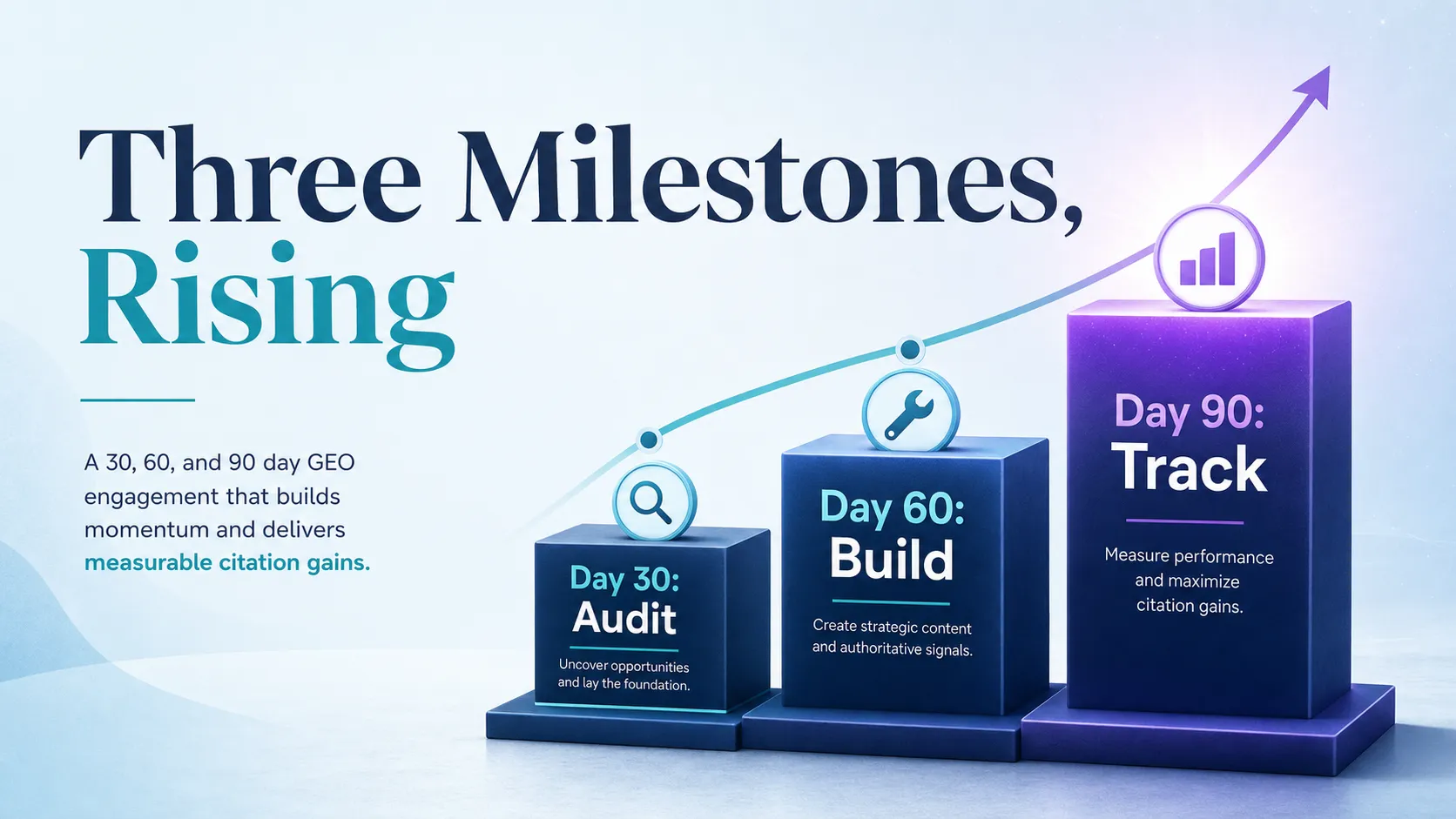
| Timeframe | What You Should See |
|---|---|
| First 30 days | Completed audit, entity map, and prioritized content list |
| Days 31 to 60 | Restructured pages live, schema implemented, first citation outreach sent |
| Days 61 to 90 | First visibility report showing mention and citation trends |
Pricing, Engagement Model, and Flexibility
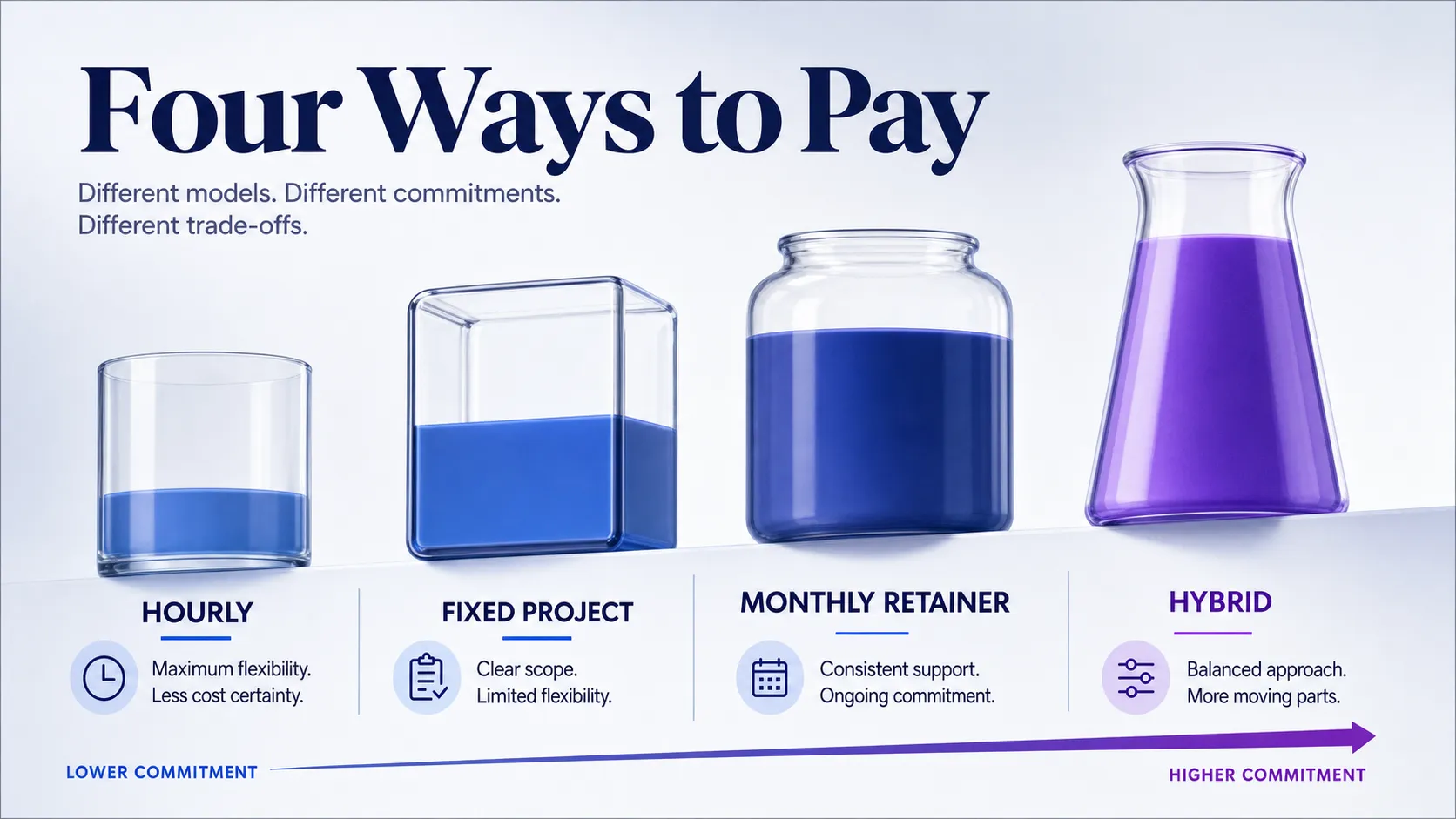
GEO providers price their work four ways: hourly consulting, fixed-scope projects, monthly retainers, and hybrid engagements that blend the two.
Hourly Consulting
Hourly pricing fits discovery work, an audit, or executive advisory sessions where you need judgment, not a build. It is the fastest way to get a second opinion before committing to more.
Fixed-Scope Projects
A fixed price makes sense for a one-time cleanup: a site restructure, a defined citation campaign, or a schema rollout with a clear end point.
Monthly Retainers
Retainers fit ongoing AI visibility work: iterative content updates, continuous citation building, and cross-platform monitoring that never really finishes. For a full breakdown of what these programs typically cost, see GEO audit pricing per page.
Hybrid Engagements
Many teams start with an hourly or fixed-scope engagement to test fit, then move to a retainer once the provider proves the methodology works.
| Model | Best For | Main Tradeoff |
|---|---|---|
| Hourly | Discovery, audits, advisory | Limited execution capacity |
| Fixed project | One-time cleanup or campaign | No ongoing monitoring included |
| Retainer | Ongoing visibility and content work | Higher monthly commitment |
| Hybrid | Testing fit before scaling up | Requires a second negotiation later |
Many providers still will not publish pricing upfront. If a candidate does not disclose a range, a billing model, and a minimum commitment in the first conversation, that opacity is itself useful information. It also helps to weigh the cost of an outside partner against building the function internally, which is covered in AI visibility agency versus in-house team cost.
Best Fit by Business Stage and Verdict by Use Case
The right hire depends less on company size and more on how much of the GEO stack you already own.
Startups and Seed-Stage Teams
Start with a consultant or a freelancer for a focused audit and a short implementation sprint. A full agency retainer is usually more than an early-stage budget needs.
B2B SaaS Companies
A consultant plus an agency is often the strongest combination once you need strategy, content, authority building, and tracking running at the same time. See the best GEO agencies for SaaS for provider-level comparison once you reach this stage.
Ecommerce Brands
An agency usually wins here because the work spans product content, category pages, and technical schema at a scale one consultant cannot cover alone.
Enterprise Organizations
Choose an agency or an in-house model backed by a senior consultant when governance, cross-team coordination, and formal reporting matter as much as the work itself. Review the options in how to pick an enterprise GEO agency before shortlisting.
Regulated Industries
Fintech, healthcare, and legal brands need a provider who can prove cross-platform coverage and careful, compliance-aware language, not just general GEO experience.
When to Avoid a Narrow Specialist
Walk away from any provider who cannot show measurable proof, cannot explain their methodology, or only talks about one AI platform. GEO that ignores Perplexity or Google AI Overviews in favor of ChatGPT alone is incomplete work. For a broader look at agency versus software tradeoffs, see AI visibility agency versus tool.
The clean verdict: hire a consultant for diagnosis and strategy, an agency for full execution, a freelancer for one defined task, and build in-house only once GEO is a durable, budgeted function.
How do I hire a Generative Engine Optimization consultant?
Start by requesting proof of measurable AI citation outcomes, not general SEO results, then confirm the consultant can explain entity optimization and platform coverage in plain terms before you discuss scope or price.
Should I hire a GEO consultant, agency, or freelancer?
Hire a consultant for strategy and diagnosis, an agency when you need content, schema, digital PR, and reporting delivered together, and a freelancer only for one narrow, well-defined task like a single audit.
What should a GEO proposal include before I sign?
A serious proposal names the audit scope, the platforms covered, the deliverables by timeframe, the reporting cadence, and the billing model, with no vague language about “figuring it out as we go.”
How much does GEO consulting cost?
Costs vary by engagement model: hourly consulting suits discovery and advisory work, fixed-scope projects suit a one-time build, and monthly retainers suit ongoing visibility work, with the range depending on scope and platform coverage.
How do I know if a GEO provider has real results?
Ask for a named case study with a stated baseline, a specific outcome, and a timeframe, and ask exactly how they measured the change, since a provider without a clear answer likely has no real tracking in place.
The honest reality is that GEO is still young enough that most providers are learning in public, so the buyer who asks for proof and a documented methodology will consistently outperform the one who hires on confidence alone. Match the hiring model to what you actually need this quarter, not to the biggest promise in the pitch. Book a strategy call to see where your brand stands before you sign anything.