
The Short Version
- Entity disambiguation links an ambiguous mention to one correct entity, which is the step AI systems take before they cite or summarize anything.
- Ambiguity costs you visibility through misattribution, generic answers, or full omission from AI responses.
- Schema markup, consistent naming,
sameAslinks, and contextual co-occurrence are signals, not switches, and they work best together. - The fastest wins usually come from fixing your homepage, About page, and external profile consistency before adding more markup.
What Entity Disambiguation Means for AEO
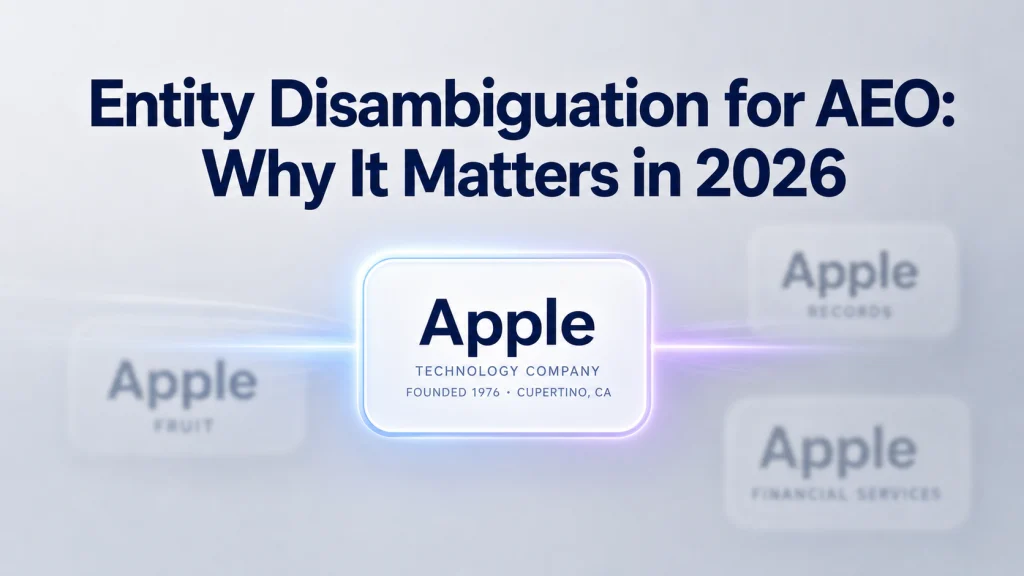
Entity disambiguation is the process of linking a mention in text to the correct unique entity in a knowledge base. Three terms sit at the center of this, and they are easy to blur together. A mention is the word or phrase that appears on the page. An entity is the real-world thing that mention points to: a person, a brand, a place, or a concept. Ambiguity is what happens when one mention could map to more than one entity.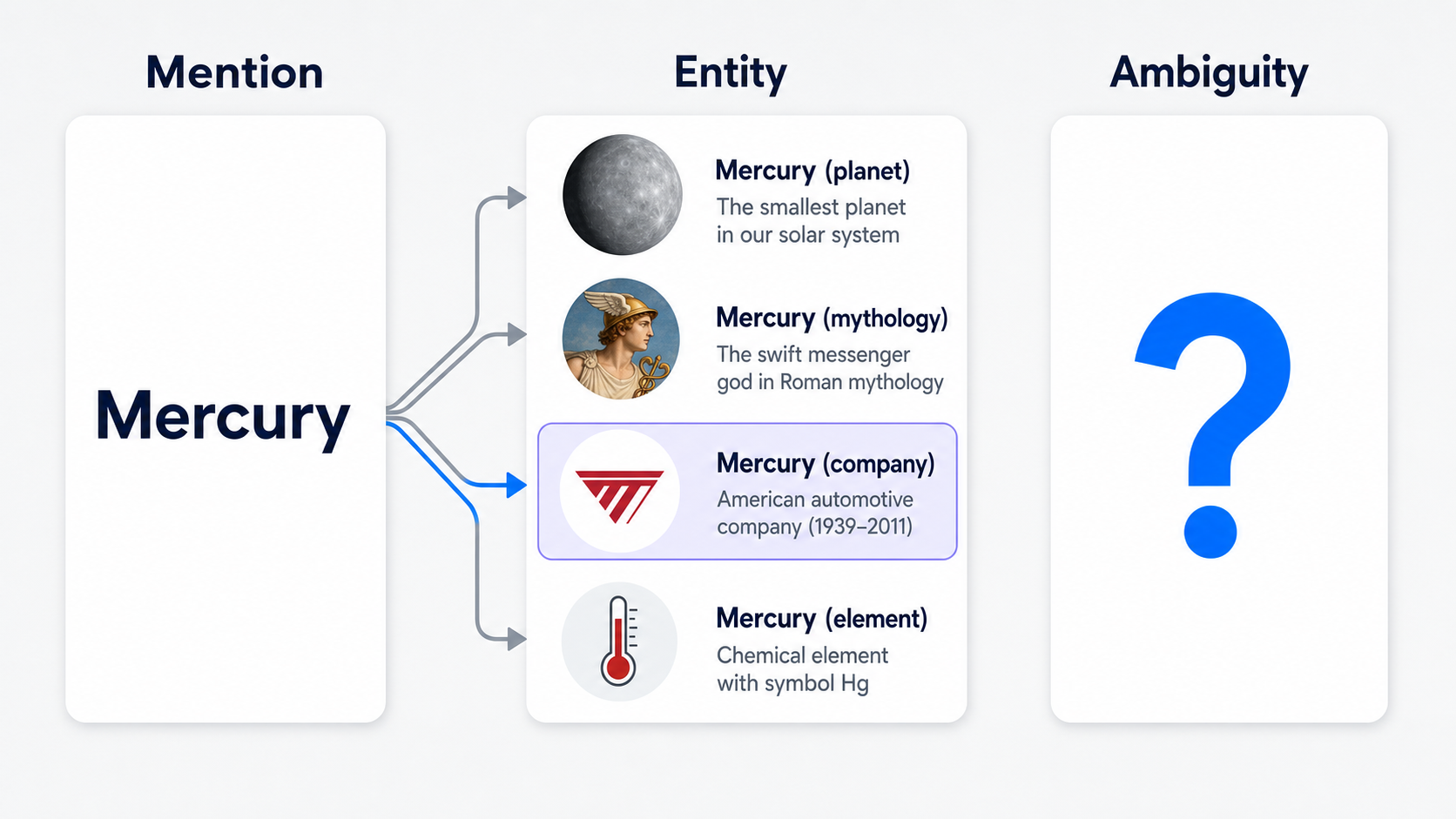 Take the word “Mercury.” It can mean the planet, the Roman god, the chemical element, or a fintech brand that helps startups manage banking. The mention is identical in every case. The entity is different in every case. An answer engine has to resolve which one you mean before it can use your page as a source.
This is where AEO depends on disambiguation. Answer engines need to know what your content is about before they can cite or summarize it accurately. If the model cannot confidently attach your page to a single entity, it has nothing stable to attribute facts to.
This is identity resolution, not keyword stuffing. Repeating “Mercury fintech” forty times does not help. Giving the model clear, corroborated signals about which Mercury you are does.
Consider a real pattern: a startup named “Atlas” launches an analytics tool. “Atlas” is also a publishing platform, a mapping reference, a Greek mythological figure, and a Marvel character. Without surrounding context that ties the name to analytics, dashboards, and its founders, an AI model has no reason to choose the startup over four better-known entities. It defaults to the famous one or describes the generic concept.
Take the word “Mercury.” It can mean the planet, the Roman god, the chemical element, or a fintech brand that helps startups manage banking. The mention is identical in every case. The entity is different in every case. An answer engine has to resolve which one you mean before it can use your page as a source.
This is where AEO depends on disambiguation. Answer engines need to know what your content is about before they can cite or summarize it accurately. If the model cannot confidently attach your page to a single entity, it has nothing stable to attribute facts to.
This is identity resolution, not keyword stuffing. Repeating “Mercury fintech” forty times does not help. Giving the model clear, corroborated signals about which Mercury you are does.
Consider a real pattern: a startup named “Atlas” launches an analytics tool. “Atlas” is also a publishing platform, a mapping reference, a Greek mythological figure, and a Marvel character. Without surrounding context that ties the name to analytics, dashboards, and its founders, an AI model has no reason to choose the startup over four better-known entities. It defaults to the famous one or describes the generic concept.
Why It Matters for AI Search Visibility
Clearer entity signals improve citation accuracy because AI systems can attribute facts to the right source with more confidence. When the entity is unmistakable, the model can pull a claim from your page and credit your brand. When the entity is fuzzy, three things tend to happen, and none of them help you.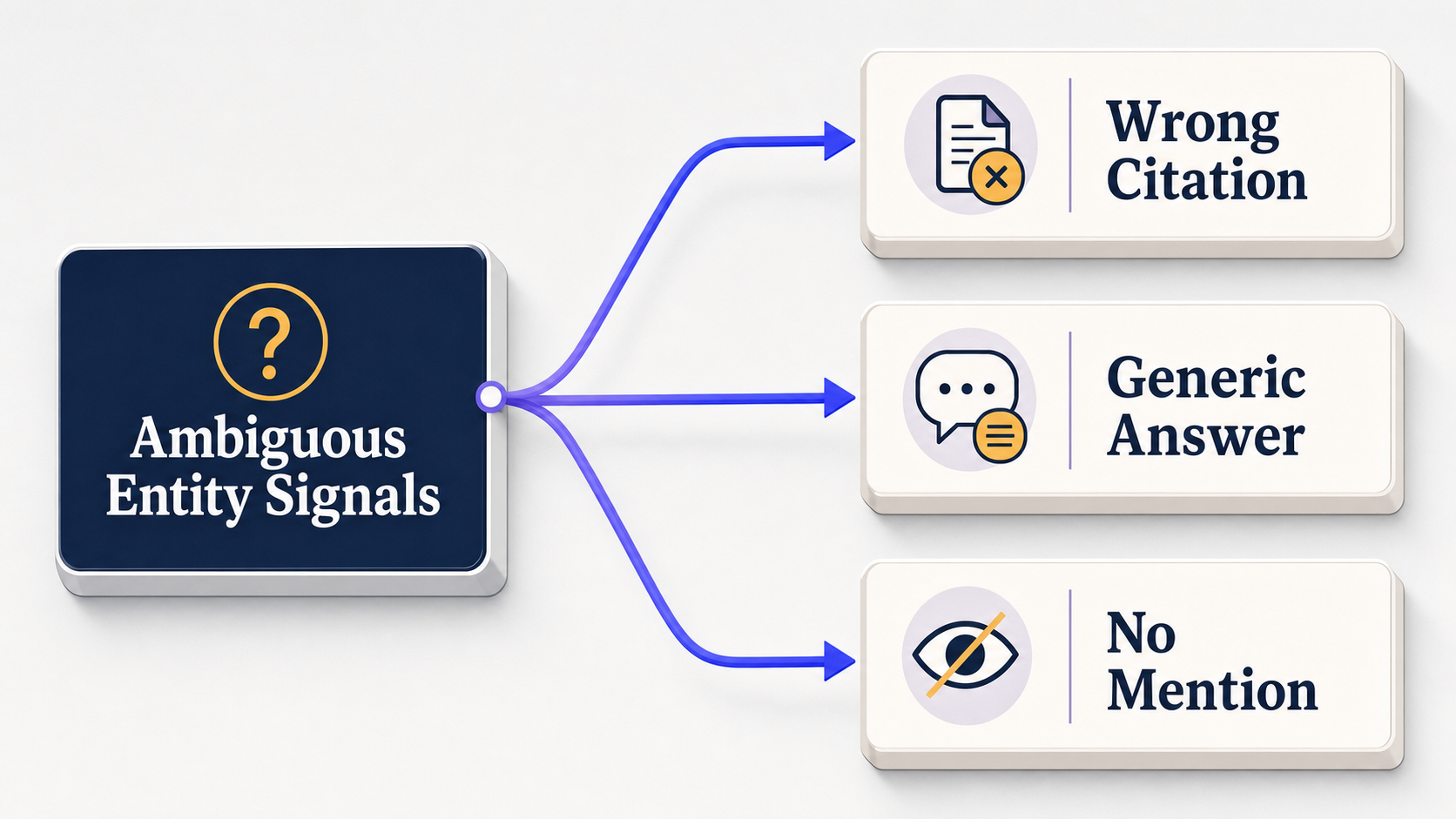 The model misattributes your fact to a better-known entity with a similar name.
The model retreats to a generic, definition-style answer that names no brand at all.
The model omits you from the answer because it cannot justify choosing you over a competing entity.
Brands that share a name with a city, a common noun, or a larger company feel this most. Trust erodes fast when an AI answer describes a different “Atlas” than yours, or blends two companies into one confused summary.
Entity disambiguation affects visibility before it affects anything that looks like ranking. The model has to understand who your content is about first. Only then does the question of whether you are the best source even apply. Skip the identity layer and you are competing for citations the system has already decided you are not eligible for.
The business case is straightforward. Sharper entity clarity supports brand consistency across AI surfaces, protects your authority from being absorbed by a namesake, and lowers the confusion that keeps you out of answers your buyers are reading.
The model misattributes your fact to a better-known entity with a similar name.
The model retreats to a generic, definition-style answer that names no brand at all.
The model omits you from the answer because it cannot justify choosing you over a competing entity.
Brands that share a name with a city, a common noun, or a larger company feel this most. Trust erodes fast when an AI answer describes a different “Atlas” than yours, or blends two companies into one confused summary.
Entity disambiguation affects visibility before it affects anything that looks like ranking. The model has to understand who your content is about first. Only then does the question of whether you are the best source even apply. Skip the identity layer and you are competing for citations the system has already decided you are not eligible for.
The business case is straightforward. Sharper entity clarity supports brand consistency across AI surfaces, protects your authority from being absorbed by a namesake, and lowers the confusion that keeps you out of answers your buyers are reading.
How AI Systems Resolve Ambiguous Entities
AI systems resolve ambiguity through a four-step process that moves from spotting a mention to locking it onto one entity.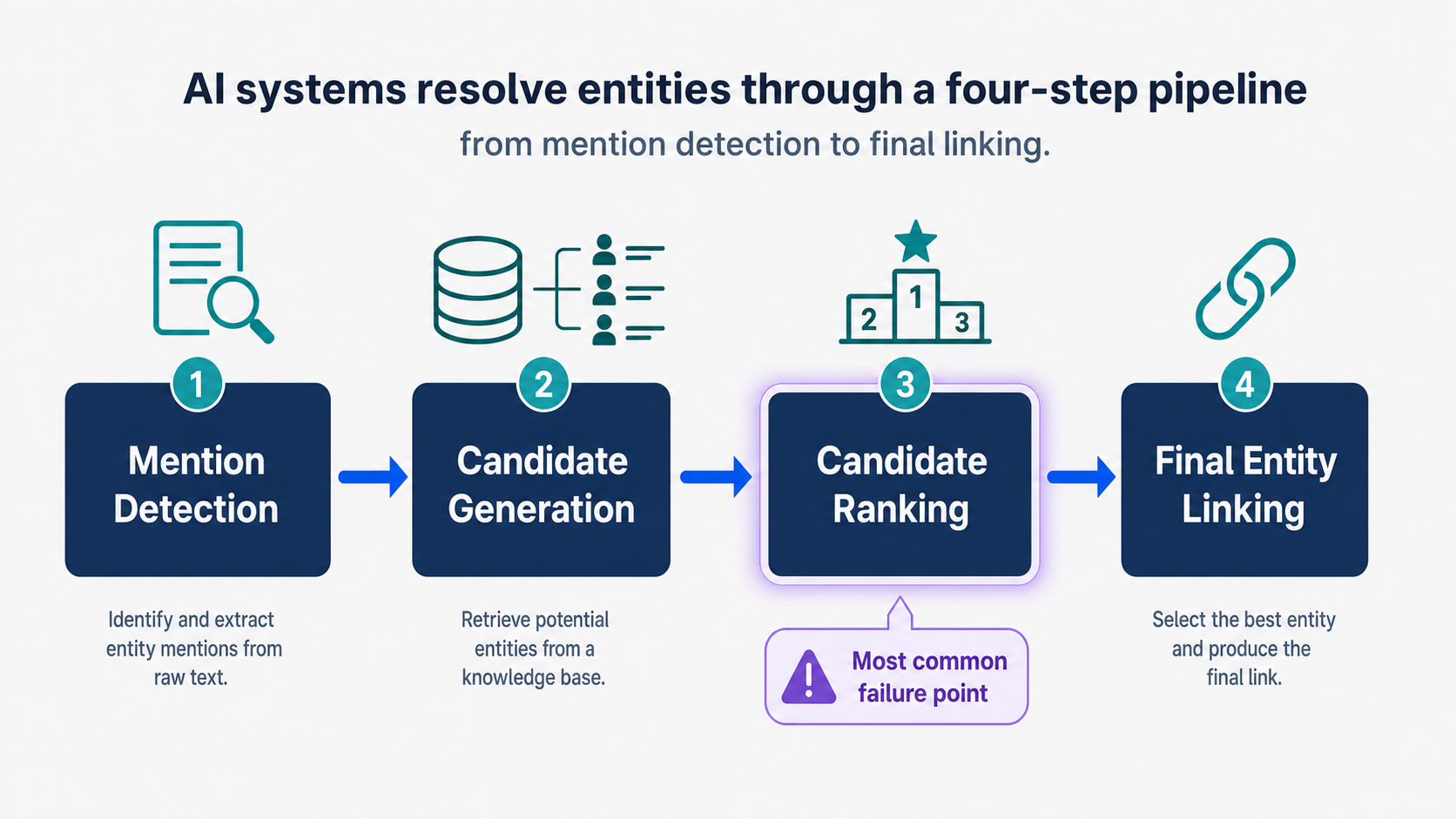
Signals That Improve Disambiguation
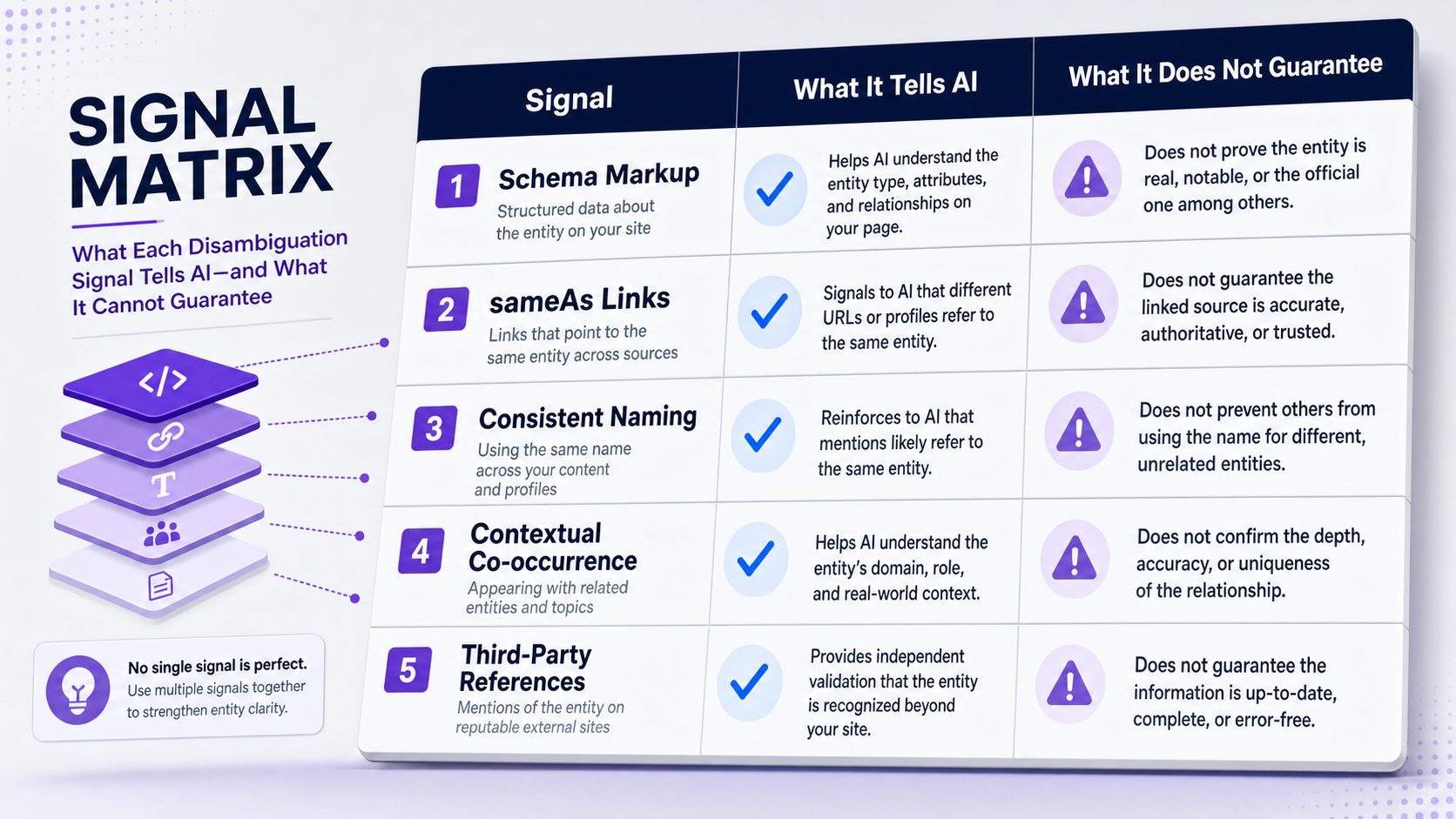
AI systems lean on a handful of signals to decide which entity a page belongs to, and the strongest results come from those signals agreeing with each other. The table below maps each signal to what it tells an AI system and what it does not guarantee on its own.| Signal | What it tells AI | What it does not guarantee |
|---|---|---|
| Schema markup (Organization, Person, Product, Article) | Machine-readable identity, type, and attributes for the entity | That the model trusts it without matching on-page and external context |
sameAs links |
That your site is the same entity as named external profiles | Authority on its own if those profiles are thin or inconsistent |
| Consistent naming | One stable name across homepage, About, bios, and listings | Recognition if the name still collides with a bigger entity |
| Contextual co-occurrence | Which category, location, founders, and products your brand sits with | A fix for missing structured data or external corroboration |
| Third-party references (Wikipedia, Wikidata) | Independent corroboration of who you are | Inclusion or accuracy, and they are not magic switches |
sameAs property connects your site to authoritative external profiles, which gives the model independent confirmation. Consistent naming matters because every variant of your name splits the signal: “Atlas,” “Atlas Analytics,” and “AtlasHQ” can read as three loosely related things instead of one.
Contextual co-occurrence is the quiet workhorse. Repeatedly pairing your brand with its category, location, founders, products, and industry terms builds the surrounding context that candidate ranking depends on. Wikipedia and Wikidata are corroboration signals worth earning, but they confirm an identity you have already made clear elsewhere. They do not create one from nothing.
The practitioner pattern that holds up: schema works best when it matches your visible on-page context and your external profiles. Markup that claims one thing while your copy and listings say another weakens the signal instead of strengthening it.
Common Mistakes That Weaken Entity Clarity
Most entity confusion traces back to a few predictable errors, and naming them makes the work feel far less mysterious. Avoid these patterns.Treating Keywords as Identity
Keywords alone do not resolve which entity you are. A page can rank for “atlas analytics” and still leave the model unsure whether you are a company or a feature.
Expecting Schema to Do Everything
Schema is a strong signal, not a magic fix. It does not force an AI citation or buy you a Knowledge Graph entry by itself.
Blurring Disambiguation With Broad Entity SEO
Entity disambiguation is the narrow act of resolving identity. Entity SEO, generative engine optimization, and generic structured-data advice are wider programs that include it but are not the same thing.
Expecting Instant Change
AI systems and knowledge graphs update on their own schedules. New or corrected signals take time to propagate, so do not read a flat first week as failure.
Betting on One Signal
Disambiguation is a signal system. Several aligned signals beat one isolated tactic every time.
The recurring audit mistake worth calling out: teams add detailed schema, then ignore inconsistent brand naming and thin contextual copy. The markup says one thing while the homepage, the About page, and the external listings say something looser. The signals disagree, and the model trusts the weakest link. For more on how models choose what to trust, see How AI Crawlers Actually Pick Sources.See where AI answers put your brand
Twenty minutes with a senior strategist: where the major engines point buyers in your category, who gets named instead of you, and a straight read on what a programme would change.
Book a strategy callHow to Audit and Improve Entity Disambiguation
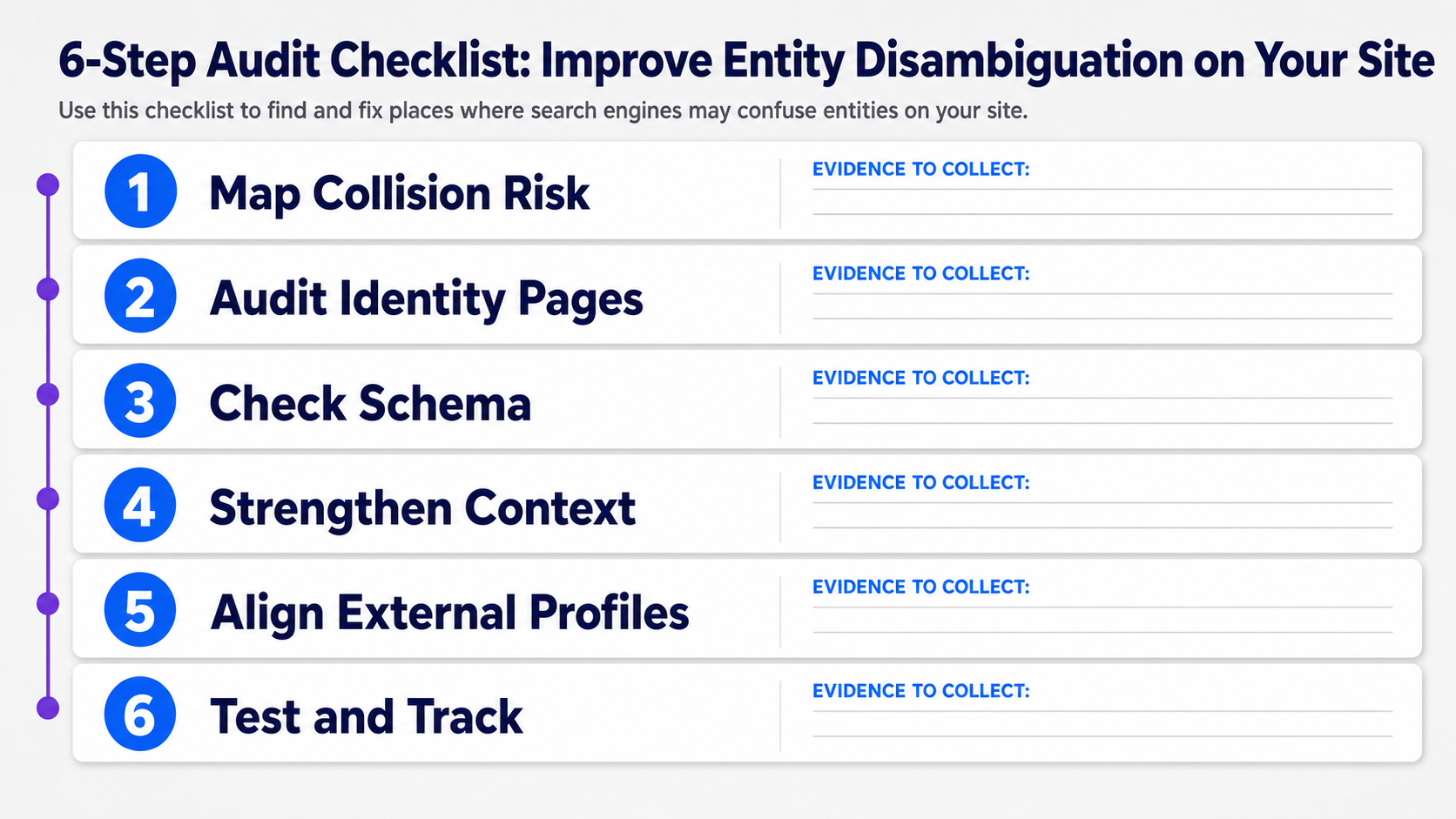
You can run a disambiguation audit on your own site in six steps, no agency required. Step 1: Map your collision risk. Identify where your brand name could be confused with another entity or a generic term. Search your name in a few AI tools and note whether the answer describes you or something else entirely. Step 2: Audit your core identity pages. Review your homepage, About page, product pages, and key author or founder pages for consistent naming and clear category language. Every page should make the same claim about who you are. Step 3: Check your schema. Confirm your structured data matches the real entity, uses the right type, and appliessameAs correctly to your authoritative profiles. Markup that contradicts your visible copy hurts more than it helps.
Step 4: Strengthen contextual anchors. Reinforce your identity in headers, intros, FAQs, and internal links so the page repeatedly signals what the entity is. Pair the brand name with its category, founders, and products without forcing it.
Step 5: Align external corroboration. Check your profiles, directories, review sites, and earned media for consistency. A LinkedIn page, a Crunchbase entry, and a G2 listing that disagree on your name or category fragment your identity.
Step 6: Test and track. Query AI tools with your brand name and category over time, and watch whether the answers become more precise, more specific to you, and more consistently attributed.
Here is the sequence applied to a generic-named brand. “Atlas” runs the test in Step 1 and finds AI describing the mythological figure. The team fixes the homepage and About page to consistently say “Atlas, the product analytics platform for SaaS teams,” adds Organization schema with sameAs links to its LinkedIn and Crunchbase profiles, then aligns those external profiles to match. Within a few update cycles, AI answers start naming the company and its category instead of the myth.
The practical lesson from doing this repeatedly: the fastest improvements come from fixing your homepage and About page plus your external identity consistency, before you add more technical markup. Identity clarity beats markup volume.