
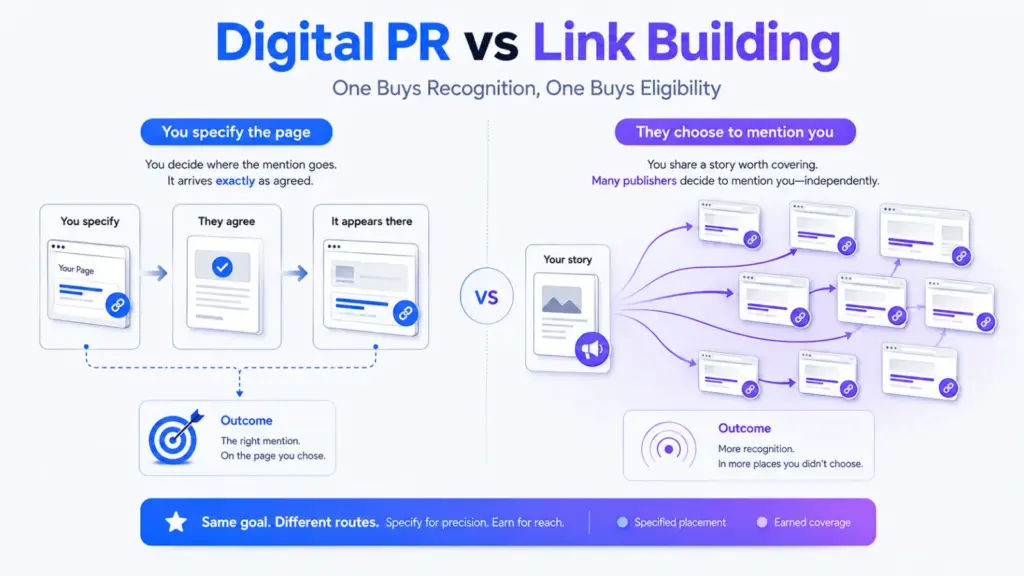

Most teams are sold these as the same service with different pricing. They aren’t.
Link building buys you ranking eligibility. Digital PR buys you recognition.
One moves a page up a results list. The other decides whether anything recommends you at all.
They overlap enough that agencies blur them, and differ enough that funding the wrong one wastes a quarter.
What Each One Buys
The clearest way to separate them is by what you receive at the end.
| Link building | Digital PR | |
|---|---|---|
| Deliverable | A link on a chosen page | Coverage you didn’t fully control |
| You pick the target | Yes, by URL and anchor | No, the journalist decides |
| Volume | Predictable per month | Lumpy, occasionally nothing |
| Primary effect | Rankings for the linked page | How widely the brand is known |
| Fails when | The page can’t rank anyway | The story isn’t newsworthy |
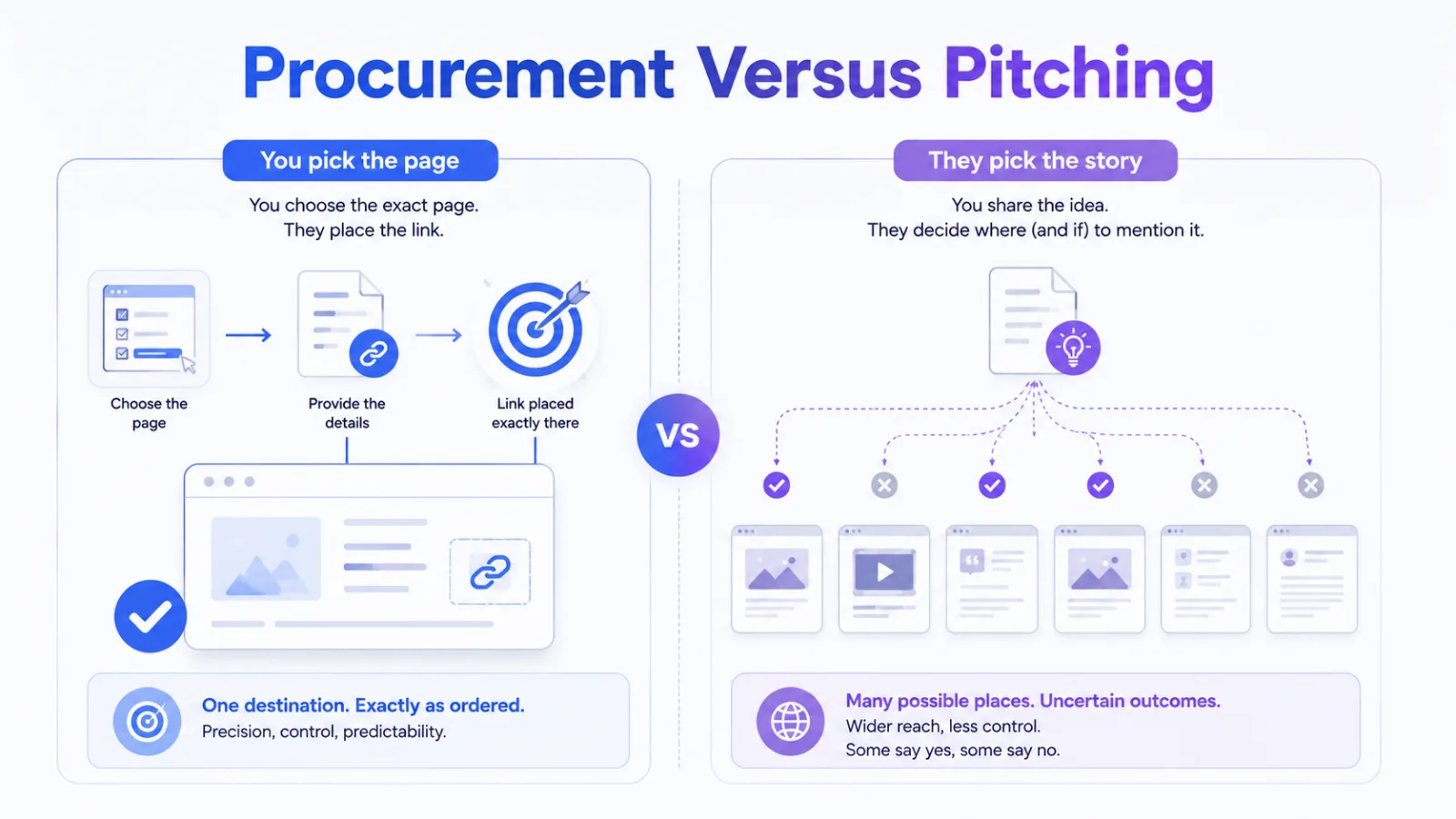
Link building is procurement. You decide the page, the anchor and the volume, and the work is finding sites that will carry it.
Digital PR is closer to sales. You pitch an angle, and someone with no obligation to you decides whether it runs.
Why the control difference matters
It matters because control and credibility trade against each other.
The link you fully control sits on a page chosen for its metrics. The mention you don’t control sits somewhere people were already reading, which is exactly why it carries more weight and why you can’t order it to spec.
The Genuine Overlap
Both end in someone else’s site referencing yours, which is why the categories blur in sales calls.
Good digital PR produces links as a side effect. Good link building, done editorially rather than by placement, looks a lot like small-scale PR.
The dishonest version of the overlap is an agency selling placements at PR prices because a press release technically appeared somewhere. What separates the tiers is set out in white hat vs grey hat links.
What AI Search Changed
Until recently the honest case for digital PR was brand-building you couldn’t fully measure. That changed when answer engines started deciding what to recommend.
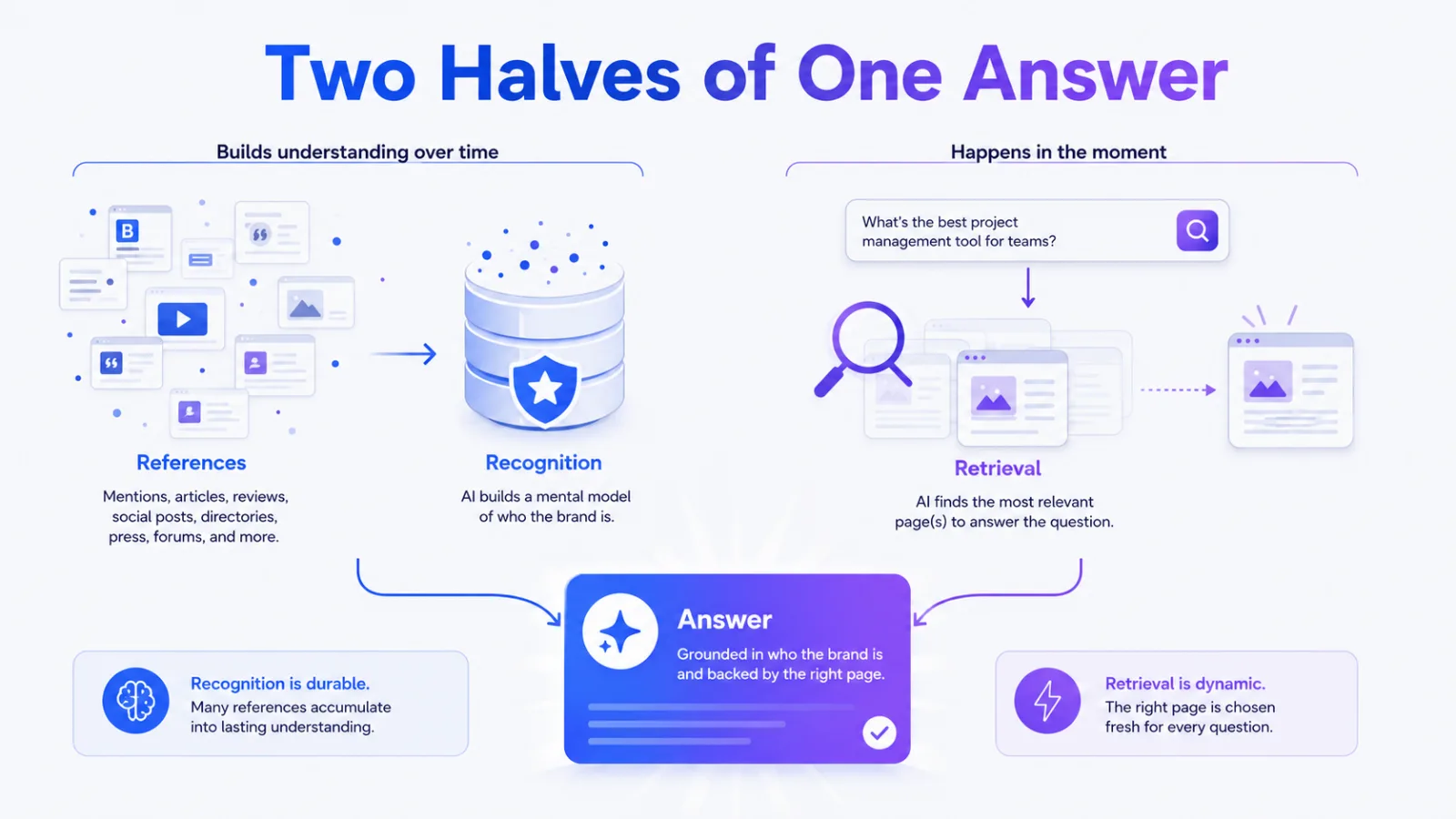
AI systems build a picture of who you are from text across the open web, then retrieve pages when someone asks a question. Those are two different jobs, and our own crawler logs show both happening at roughly equal scale.
Over 74 days this site logged 13,977 AI agent requests: 3,914 from crawlers collecting text for model training, 3,252 from agents fetching pages mid-answer. The full breakdown is in server logs for AI search.
Why that splits the two disciplines
It splits them because each discipline feeds a different half.
Training crawlers reward being written about in site after site, whether or not those references link. Retrieval rewards a page that ranks and answers cleanly, which is the half links still gate.
The two are no longer alternatives on one axis. Digital PR compounds into what models believe about you; link building keeps you eligible for the moment a question gets asked.
Which One to Fund First
Fund the one that fixes your bottleneck, which is usually obvious once you name it.
| If this is true | Fund |
|---|---|
| Pages rank on page two and stall | Link building, they need authority to clear the gap |
| Nobody in the category has heard of you | Digital PR, no link fixes an unknown name |
| You rank but AI answers name competitors | Digital PR, that’s a recognition problem |
| You need predictable monthly output | Link building, PR can’t promise volume |
| You have a genuinely novel data set | Digital PR, that’s the rare case with real advantage |
The last row is the one most teams skip. Digital PR without a story is an expensive way to be ignored, and most campaigns that fail were doomed at the angle rather than the outreach.
The Cost Difference Nobody Quotes
Link building prices per unit. Digital PR prices per attempt, and attempts fail.
A link programme quotes a rate per placement, so you can model a quarter before spending. A PR retainer buys pitching time, and a quarter can end with three excellent pieces or one. Both are legitimate; only one is forecastable.
What actual campaigns cost is broken down in digital PR agency pricing, and the agencies worth shortlisting are in best digital PR agencies.
Frequently Asked Questions
Is digital PR link building with a better name
No, though some agencies sell it that way. Link building starts with a target page and finds sites to link to it. Digital PR starts with a story and accepts whatever coverage it earns.
If a proposal names guaranteed placements and anchor text, that’s link building regardless of the label on the invoice.
Which one is better for AI visibility
Digital PR, for the recognition half. Being written about across dozens of sites is what shapes the model’s picture of your brand, and those references count whether or not they link.
Link building still matters for the retrieval half, because a page that can’t rank can’t be fetched when the question gets asked.
Can a small team do both
Rarely, and trying usually produces two half-programmes. Pick the bottleneck, run it for two quarters, then add the second.
The exception is a team sitting on original data, where one piece of research can feed a PR angle and earn links at the same time.
How long before either one shows results
Link building shows ranking movement in roughly three to four months, because the pages have to be recrawled and reassessed.
Digital PR shows coverage immediately and recognition slowly. The coverage is visible the week it runs; the effect on what buyers and models believe takes far longer.
What about guest posts and niche edits
Both sit inside link building, not PR, because you choose the page and the anchor.
Which suits you is covered in guest posting vs niche edits, and what you’re buying with the second is in niche edit services.
Name Your Bottleneck Before the Next Invoice
Write down one sentence: whether your problem is that people can’t find you, or that they’ve never heard of you.
Almost every wasted quarter comes from buying the service that fixes the other one. If both are true, fix findability first, because recognition is slower and needs somewhere to send the people it reaches.
If the answer is that AI answers keep naming someone else, that’s the recognition problem, and it’s what our citation network programme is built for. B2B tech teams can see how we run it as a done-for-you digital PR programme.