

Brand mentions are not backlinks, but they are one of the clearest ways search engines and AI systems learn who your brand is. A brand mention is any online reference to your company, product, or brand name, whether or not it carries a link. They show up in articles, reviews, forums, social posts, podcasts, news coverage, and now AI-generated answers. They matter for SEO because they help search engines connect your brand to trust, topical relevance, and entity signals, the same connections that decide whether you get surfaced at all. This article explains what they are, why they carry weight, and how Google and AI engines actually read them.
What Brand Mentions Are
A brand mention is any online reference to a company, product, service, or brand name. The reference can be a single sentence in a review, a roundup that names your tool, a Reddit thread where a customer recommends you, or a line inside a ChatGPT answer. None of those need a clickable link to count as a mention.
Mentions split into two basic forms. A linked mention includes a hyperlink back to your site. An unlinked mention names you in plain text with no link attached. Both register as references to your brand, but they pass value through different routes, which is the distinction the rest of this article builds on.
Where mentions appear shapes how much they help:
- Editorial articles and industry roundups
- Customer reviews on sites like G2 and Trustpilot
- Community threads on Reddit and Quora
- Social posts, podcasts, and video descriptions
- AI-generated answers from ChatGPT, Perplexity, and Google’s AI Overviews
A mention still matters even when it passes no link equity. Link equity is the ranking value a hyperlink passes from one page to another. An unlinked mention skips that route entirely, yet it still tells a search engine that an independent source referenced your brand in a specific context. That context is the part that does the work.
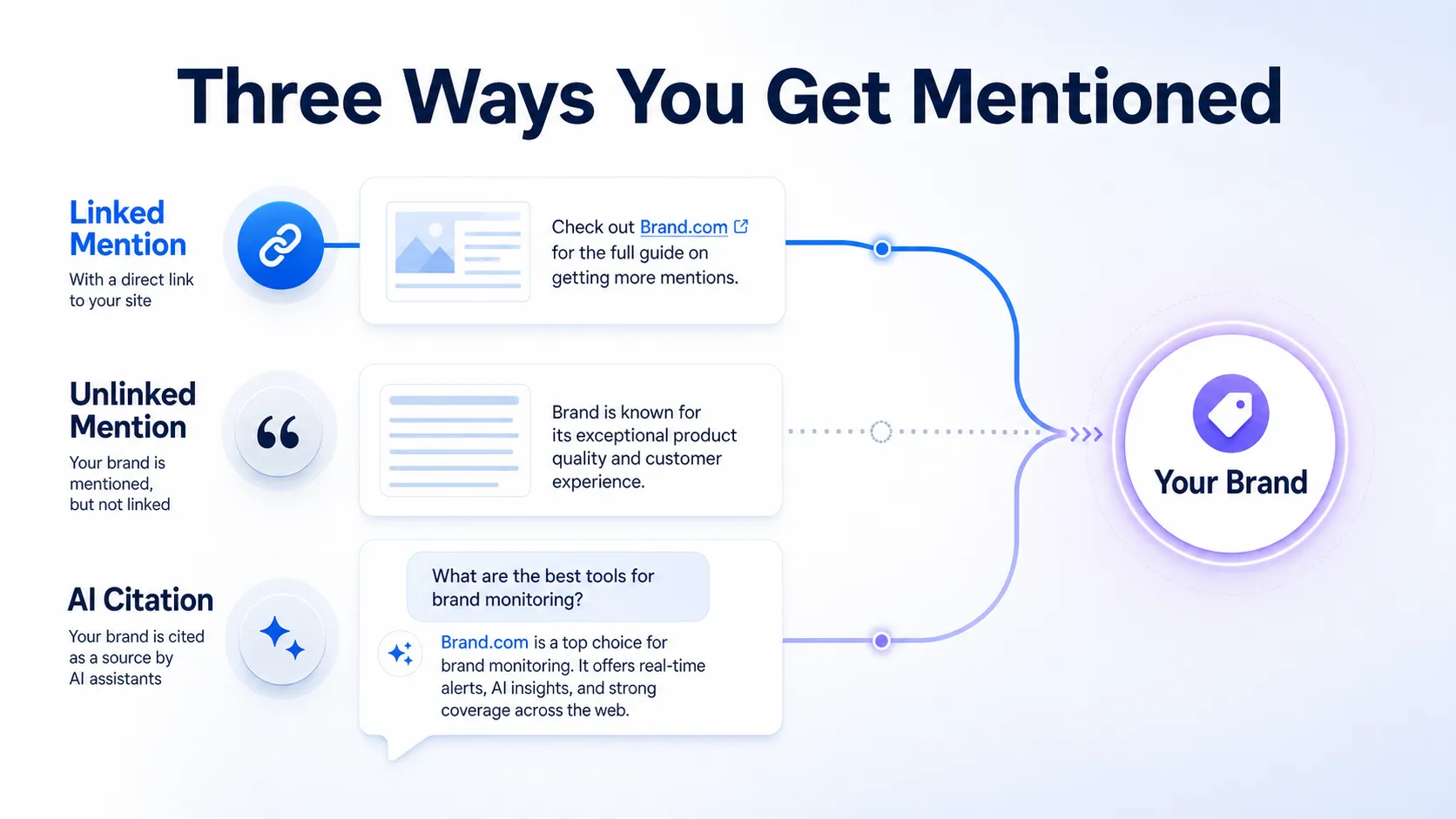
In real audits, the same brand often shows up in all three forms at once. But only the mentions with enough surrounding context let a search engine confidently connect the reference to the right brand rather than to a similarly named company.
Why Brand Mentions Matter for SEO
Brand mentions matter for SEO because they reinforce three signals search engines already use to rank pages: authority, relevance, and trust. A mention is one independent source vouching that your brand exists and belongs in a conversation.
Authority builds when credible sources reference you. Each reference from a respected publication or community adds to the picture that your brand is worth naming, the same way word of mouth builds a reputation offline. Relevance builds when the mention ties your brand to a topic, category, or use case. If five articles about AI visibility name your tool, search engines start associating your brand with that subject. Trust builds when the discussion is independent, like reviews, recommendations, and unprompted recognition that you did not write yourself.
Mentions deliver value in a few concrete ways:
- They strengthen your brand as a recognized entity in your category
- They tie your name to the topics you want to be known for
- They lift branded search demand as more people encounter your name
- They feed the same trust signals that influence AI citations
One thing needs to stay clear: brand mentions complement backlinks, they do not replace them. A page with strong links and no mentions still ranks. A page with mentions and no links works harder to compete. The honest pattern is rarely a direct ranking jump from mentions alone. It is a gradual lift in branded demand, perceived credibility, and topical association that compounds over time.
If you want the full breakdown of how the two signals divide the work, our brand mentions vs backlinks comparison walks through where each one wins.
How Search Engines Interpret Brand Mentions
Search engines interpret brand mentions through entity recognition, the process of reading text to identify which real-world thing a name refers to. When an article names your brand, the engine has to decide whether “Apple” means the company, the fruit, or the record label. The words around the mention resolve that.
Context determines topic association. A mention of your brand inside a paragraph about AI search tools tells the engine your brand belongs to that category. The same name dropped in an unrelated post carries far less signal. This is why placement and surrounding text matter more than the raw count of mentions.
Sentiment matters too. Positive, neutral, and negative mentions are not treated the same, because a search engine reading reputation signals weighs how people talk about you, not just whether they do. To understand why a single sentiment score can mislead, our piece on how sentiment analysis misses the real brand story digs into the nuance.
The clearest way to see the mechanism is to separate the two routes a mention can travel.
| Signal route | How it works | What it relies on |
|---|---|---|
| Link equity | A hyperlink passes ranking value directly from the source page to your page | The link itself plus the linking page’s authority |
| Mention signal | A named reference associates your brand with a topic and a level of trust, with no value passed through a link | Entity recognition, surrounding context, sentiment, and source authority |
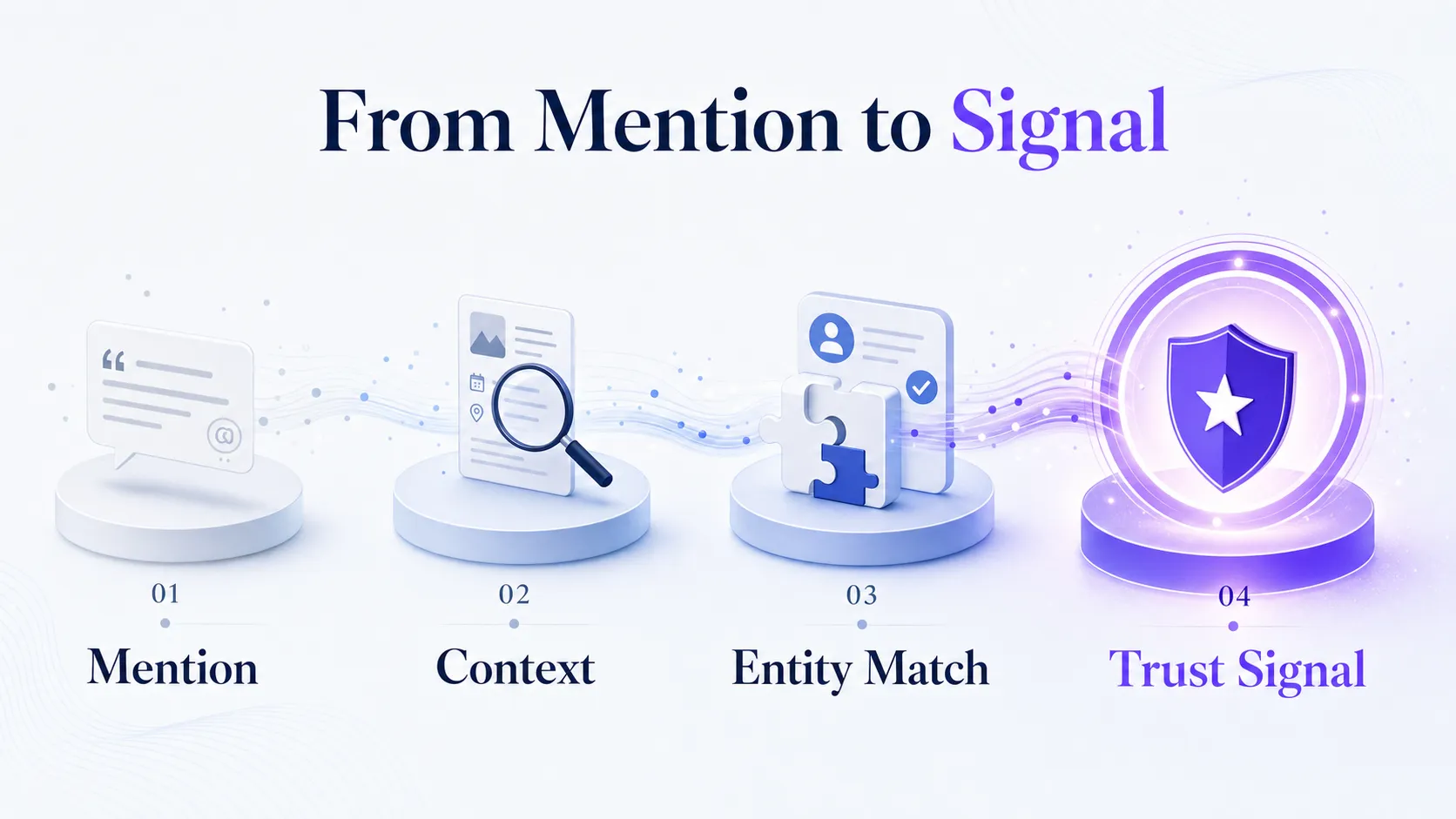
Source authority decides how much weight a mention carries. A reference on a respected industry publication tells the engine more than the same words on a low-quality directory. In practice the strongest mentions come from pages that already sit inside your topic cluster and carry credible authorship or publication authority. A passing mention on an unrelated site does little. For the deeper machinery behind this, entity SEO and building brand authority covers how engines map brands to a knowledge graph, the connected database Google uses to understand real-world things and how they relate.
Key Types and Components of Brand Mentions
Brand mentions come in four types, and each one helps search engines and AI systems differently. Knowing the type tells you what kind of value a mention is built to deliver.
Linked Mentions
A linked mention names your brand and includes a hyperlink to your site. These are the easiest for crawlers to process because the link gives the engine a direct path from the reference to your pages. They carry both the trust of a mention and the ranking value of a backlink, which is why they remain the most complete form.
Unlinked Mentions
An unlinked mention names you in plain text with no link. It still matters as an entity and trust signal, because the engine reads the reference and the context even without a clickable path. A wave of unlinked mentions across credible sources tells search engines your brand is being discussed, which is exactly the kind of independent recognition that builds authority.
Implied Mentions
An implied mention signals association without repeating your brand name. A review that describes your product’s signature feature, or a thread discussing your founder’s known framework, can connect to your brand through related entities rather than the literal name. These are harder for engines to attribute, but they widen the web of associations that point back to you.
AI Mentions and Citations
An AI mention is when a model like ChatGPT or Perplexity names or paraphrases your brand inside a generated answer. AI systems may quote, summarize, or recommend brands differently from how search engines rank them, and a citation in one engine does not guarantee one in another. To see how that machinery works under the hood, read how brand mentions work in AI search.
The type sets the ceiling, but the components below decide where a mention lands inside that ceiling.
| Mention type | Example | SEO and AI value | What increases its value |
|---|---|---|---|
| Linked | A roundup lists your tool with a link | Highest, passes trust and link equity | Authority of the linking page |
| Unlinked | A review names you with no link | Strong entity and trust signal | Source credibility and clear naming |
| Implied | A post describes your feature, not your name | Indirect association signal | Tight topical context |
| AI citation | Perplexity names you in an answer | Direct AI visibility | Repeated, consistent mentions across sources |
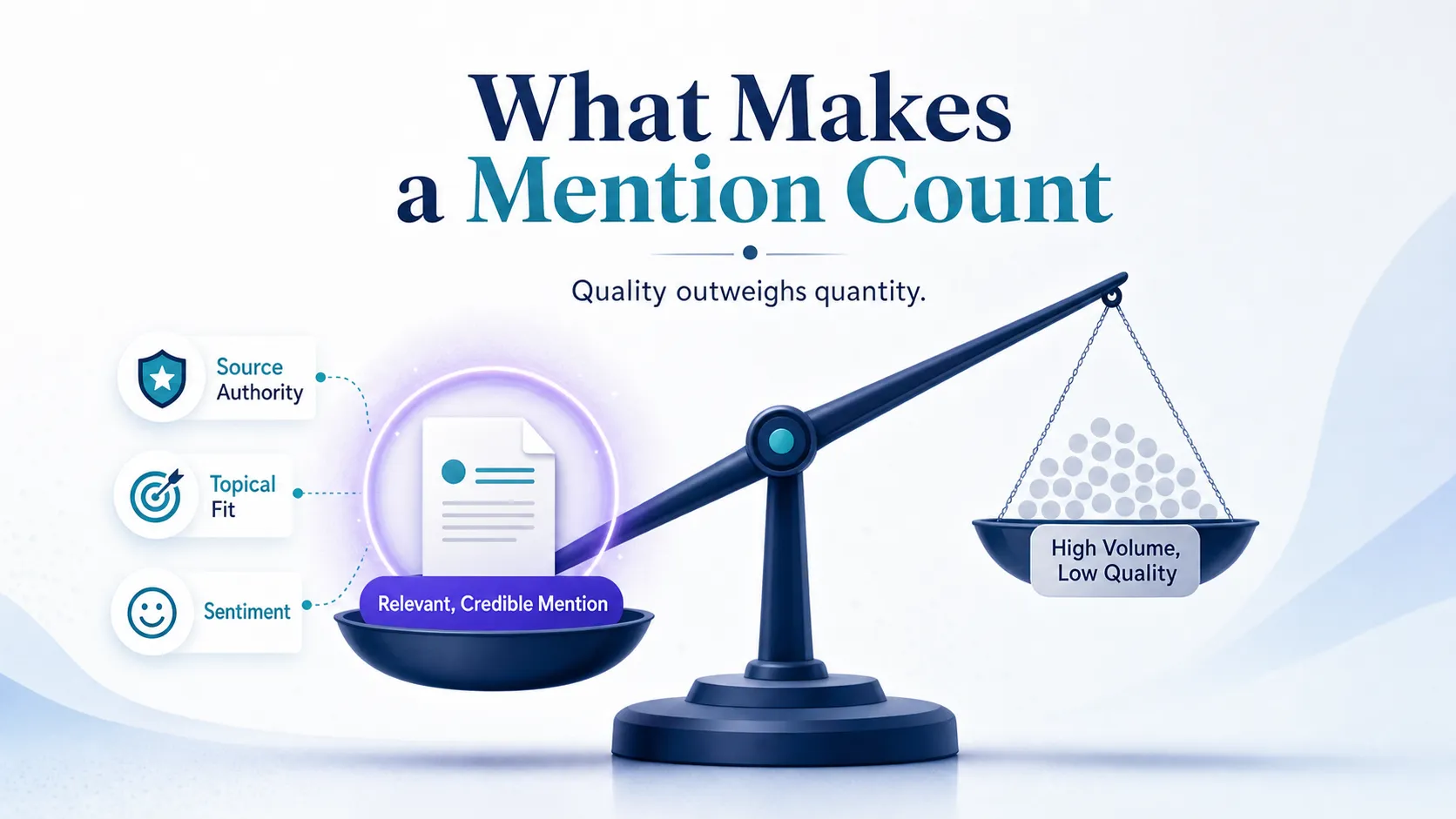
The components that change a mention’s value are source quality, topical relevance, sentiment, placement prominence, and surrounding context. A mention high on the page of a respected, on-topic article beats a buried line on a thin site. The highest-value mentions are rarely the most numerous. They are the ones that combine relevant context, credible sources, and clear brand naming.
Common Misconceptions About Brand Mentions SEO
Brand mentions get oversold, and the overclaims do real damage when teams chase the wrong thing. Here are the myths worth correcting, with what actually holds up.
Myth: Every Mention Automatically Helps SEO
It does not. A mention on a spammy, off-topic, or low-authority page adds little, and a cluster of them can look like manufactured noise. Value depends on source credibility and context, not on the fact that your name appeared somewhere.
Myth: Brand Mentions Replace Backlinks
They do not. Mentions and links do different jobs. Links pass ranking value through a direct path, mentions build entity and trust signals around your name. The strongest brands run both, which is why dismissing either one leaves results on the table.
Myth: AI Mentions Work the Same Everywhere
They do not. ChatGPT, Perplexity, Gemini, and Google’s AI Overviews each pull from different sources and weigh them differently. A brand cited often in one engine can be invisible in another, so treating AI visibility as a single number hides where you actually stand. Our take on why AI search optimization is not SEO with a new label explains why these surfaces behave on their own terms.
Myth: Volume Matters More Than Quality
It does not. A hundred thin mentions move the needle less than a handful from credible, on-topic sources. Worse, low-quality or negative mentions at scale can muddy your entity profile or signal reputation problems. The most common mistake we see is treating all mentions as equal, when source credibility and contextual fit matter far more than raw count.
What Brand Mentions Mean for Your Strategy
Brand mentions help search engines and AI systems understand who your brand is and why it belongs in a given conversation. That is the core of it. They work best when the mentions are relevant, credible, and consistent across sources, not when they spike in one burst and fade.
Treat mentions as one part of a broader effort that includes content, digital PR, and entity-building, not a standalone tactic. Backlinks still matter and should sit alongside your mention work, not behind it. The pattern across strong brands is a consistent story told by authoritative sources over time, the kind of compounding presence that how citations actually work in AI shows feeds straight into AI answers. Mention quality beats mention volume, every time.
Frequently Asked Questions
What are brand mentions in SEO?
Brand mentions in SEO are online references to your company, product, or brand name, whether or not they include a link. They appear in articles, reviews, forums, social posts, and AI answers, and they help search engines recognize your brand as an entity and tie it to relevant topics.
Do brand mentions help SEO without backlinks?
Yes. Unlinked mentions still help SEO by acting as entity and trust signals. When a credible source names your brand in a relevant context, search engines register that reference even without a clickable link, which strengthens how confidently they associate your brand with a topic and a level of trust.
Are brand mentions better than backlinks?
No, they are not better, they are different. Backlinks pass ranking value directly through a hyperlink, while mentions build recognition and trust around your brand name. The strongest results come from both working together rather than choosing one over the other.
How do search engines identify brand mentions?
Search engines identify brand mentions through entity recognition, reading the words around a name to determine which real-world brand it refers to. They then weigh the mention by its surrounding context, sentiment, and the authority of the source, which decides how much the mention contributes.
Do brand mentions affect AI search results?
Yes. AI engines like ChatGPT, Perplexity, and Google’s AI Overviews draw on how often and how credibly brands are referenced across their sources when generating answers. Consistent, relevant mentions across authoritative sites raise the odds of being named, though each engine pulls from different sources and weighs them differently. The AI visibility and brand mention glossary defines the related terms if you want the full vocabulary.
Brand mentions are not magic, and they are not a backlink substitute. They are how search engines and AI systems quietly learn who you are and what you are known for, one credible reference at a time. The brands that win do not chase volume, they earn consistent, relevant mentions from sources that actually carry weight. Want to know what AI says about your brand right now? Get a free AI visibility audit and see where you stand against your competitors.