SEO tools built for backlinks and keyword rankings do not tell you how AI models talk about your brand. As of 2026, the gap between traditional SEO content analysis and AI visibility tracking is wider than most marketing teams realize. Brands that monitor only search engine results pages miss the conversations happening inside ChatGPT, Perplexity, Gemini, and Google AI Overviews — conversations that directly influence purchase decisions.
This article breaks down how to combine SEO tools, brand mention tracking, and content analysis into a single workflow that covers both traditional search and AI-generated recommendations. You will learn which tools handle which surfaces, where the blind spots are, and how to build a monitoring system that reflects how buyers actually discover brands in 2026.
What You’ll Learn
- Why traditional SEO tools miss AI brand mentions — and what fills the gap
- How to analyze content for both search engine rankings and LLM citation potential
- The specific tool categories you need across SEO, social listening, and AI visibility
- A practical stacking approach to cover Google organic, AI Overviews, ChatGPT, Perplexity, and Gemini
- How content analysis signals differ between traditional crawlers and generative AI models
- What changed between 2024 and 2026 in how AI platforms reference brands
Why Traditional SEO Tools Only Show Half the Picture in 2026
Platforms like Ahrefs, Semrush, and Moz were built to track backlinks, keyword positions, and organic traffic. They do this well. But they were not designed to monitor how large language models reference your brand inside conversational responses.
The distinction matters because AI search behavior has shifted significantly since 2024. According to a 2025 Gartner forecast, traditional search engine traffic was projected to decline 25% by 2026 as users migrate toward AI-assisted discovery. BrightEdge data published in mid-2025 showed Google AI Overviews appearing on more than 13% of search results pages — a 22% increase since launch.
When someone asks ChatGPT “What’s the best project management tool for remote teams?” your brand either appears in that response or it doesn’t. No keyword ranking tool captures that interaction. No backlink profile explains why one competitor gets cited and you don’t.
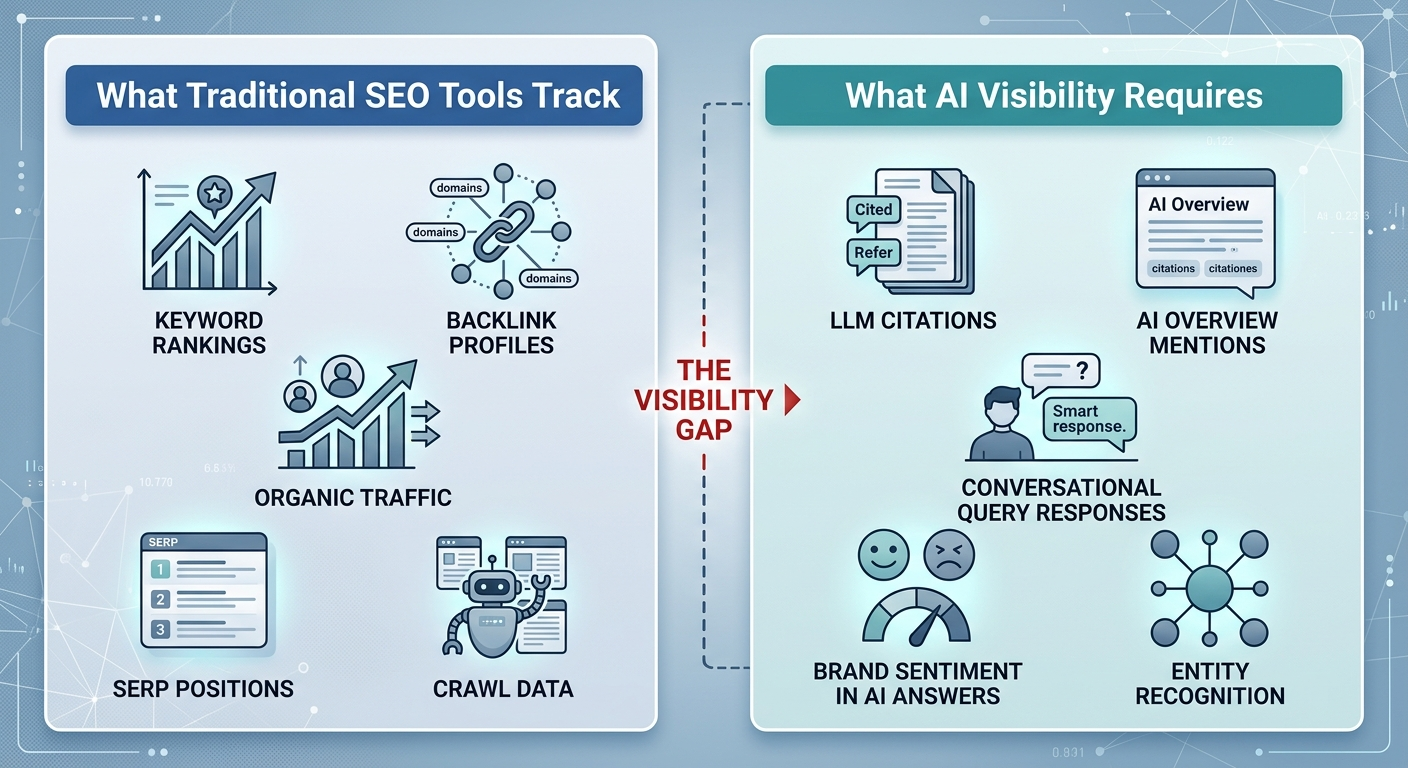
This is not an argument against SEO tools. You still need them. But content analysis for brand mentions now requires a layered approach that combines traditional SEO platforms with AI-specific monitoring — and connects the data between them.
How Content Analysis Differs for Search Engines vs. AI Models
Search engines and AI models evaluate content through fundamentally different mechanisms. Understanding both is necessary to build content that performs across every discovery surface.
What Google’s crawlers look for
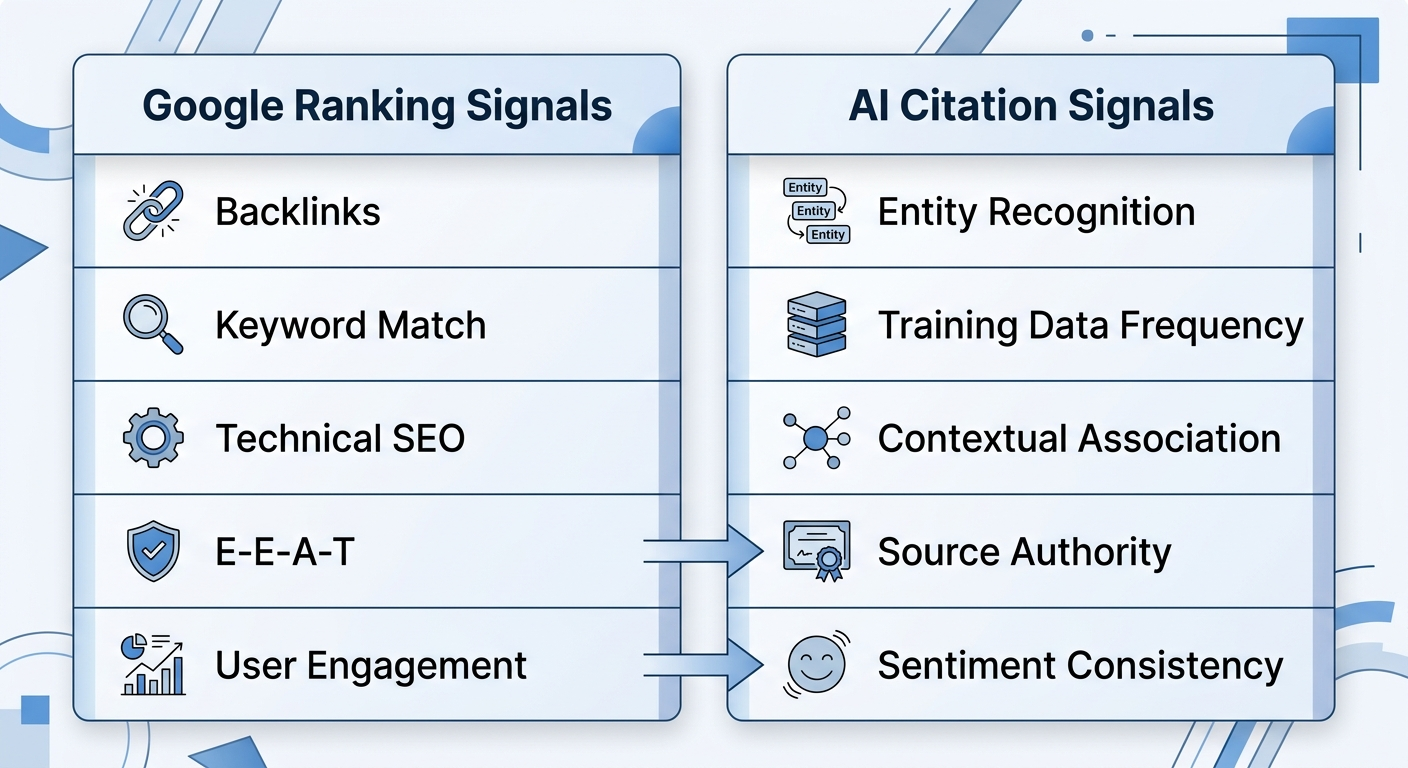
Google’s ranking systems assess content through crawling, indexing, and algorithmic scoring. Key signals include:
- Backlink authority — the quantity and quality of external sites linking to your pages
- Keyword relevance — how well your content matches the query’s intent and topical scope
- Technical health — page speed, mobile usability, structured data, and crawlability
- E-E-A-T signals — demonstrated experience, expertise, authoritativeness, and trustworthiness
- User engagement patterns — click-through rates, dwell time, and return-to-SERP behavior
Traditional SEO tools like Semrush, Ahrefs, and Screaming Frog provide visibility into these signals. They tell you where you rank, who links to you, and which technical issues need fixing.
What AI models look for when citing brands
Large language models process content differently. An LLM citation — any instance where an AI model references a brand by name in a generated response — depends on a separate set of factors:
- Entity recognition — whether the AI model identifies your brand as a distinct entity associated with specific categories, products, or expertise
- Training data frequency — how often your brand appears across the high-authority sources the model was trained on
- Contextual association — the topics, use cases, and comparisons consistently linked to your brand across editorial content
- Source authority — whether the publications mentioning your brand are ones AI models weight heavily during training and retrieval
- Sentiment consistency — whether mentions are predominantly positive, neutral, or negative across sources
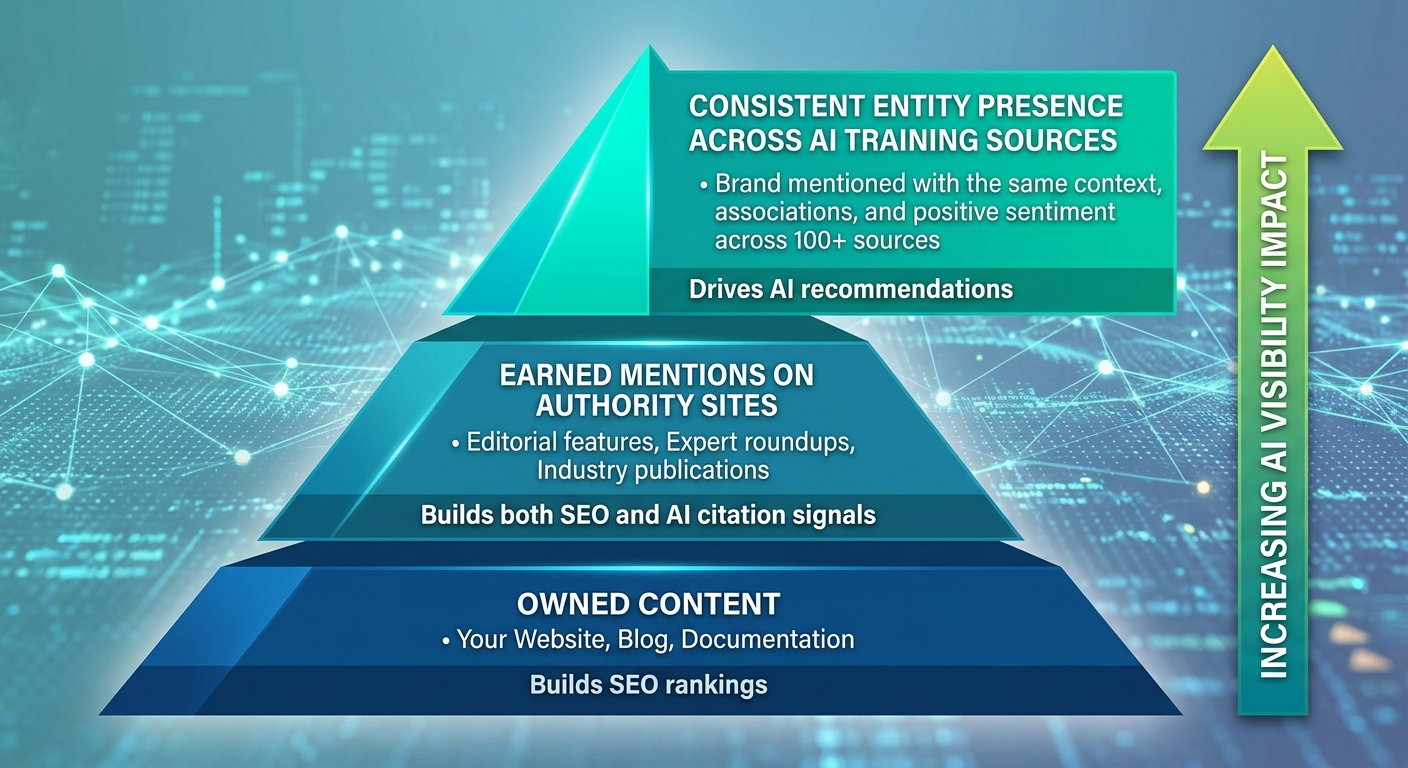
An Ahrefs study of 75,000 brands, published in 2025, found that brands with the highest number of editorial mentions appeared in AI-generated answers up to 10 times more often than less frequently mentioned brands. This aligns with how probabilistic models work: they surface what they’ve encountered most frequently in trustworthy contexts.
Where the two systems overlap
The overlap is E-E-A-T. Both Google’s quality raters and AI models reward brands that demonstrate real expertise through high-authority, editorially earned mentions. A brand mention placed on a respected publication strengthens your backlink profile for Google and increases the probability of AI citation.
This is why content analysis in 2026 requires examining not just how content performs in SERPs, but whether it creates the entity signals and contextual associations that AI models use to recommend brands.
Three Tool Categories You Need — and What Each One Covers
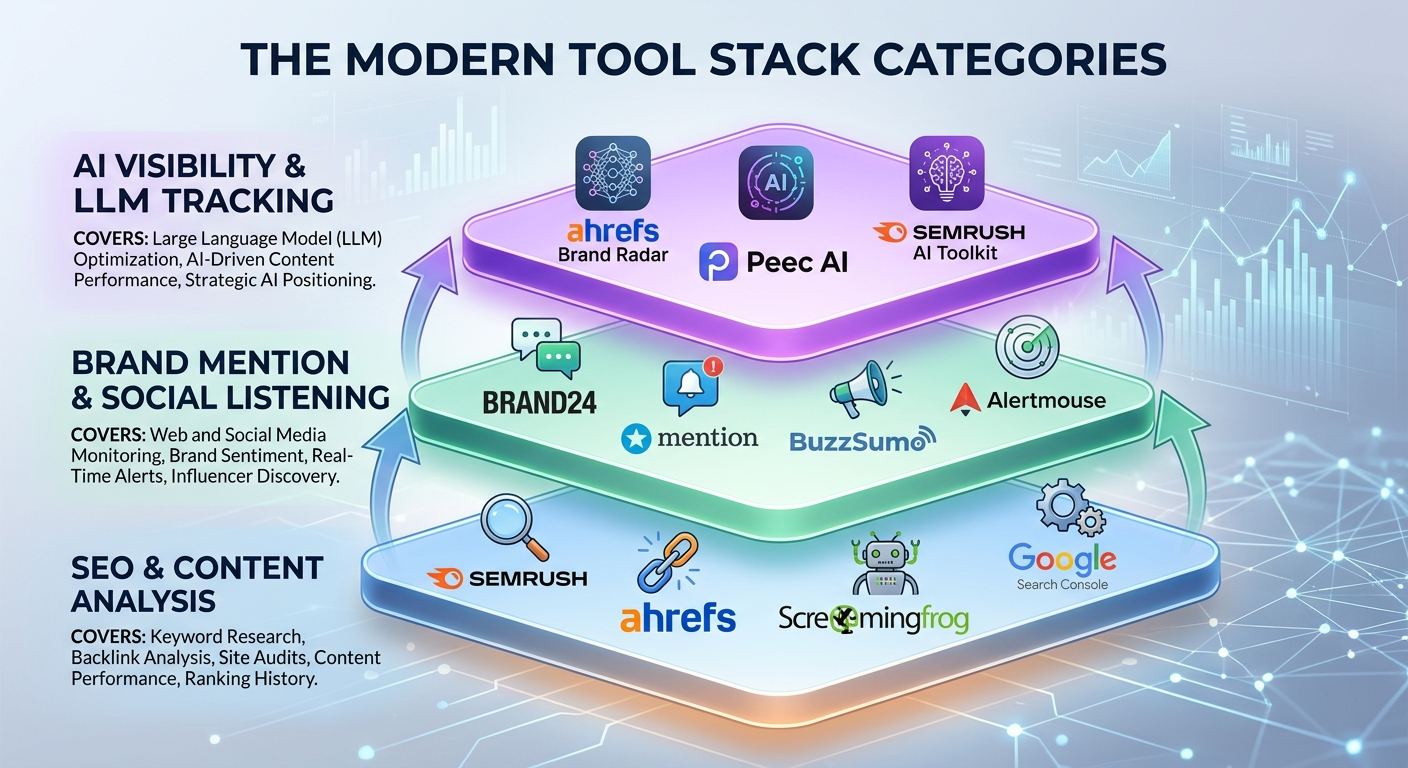
No single platform covers traditional SEO, brand mention tracking, and AI visibility monitoring. You need tools from three distinct categories working together.
Category 1: SEO and content analysis platforms
These platforms handle keyword research, backlink analysis, content audits, rank tracking, and technical SEO. They are the foundation of any search strategy.
- Semrush — keyword tracking, site audits, backlink analysis, and content gap identification. Starting at $139/month as of 2026.
- Ahrefs — backlink research, keyword exploration, content analysis, and competitive benchmarking. Plans from $129/month. Also offers the Brand Radar add-on for AI visibility (covered below).
- Screaming Frog — technical SEO crawling and on-page content analysis. Free for up to 500 URLs; paid at $259/year.
- Google Search Console — direct performance data from Google including impressions, clicks, and indexing status. Free.
What they do well: show you where you rank, who links to you, and which content gaps exist relative to competitors.
What they miss: how AI models discuss your brand, whether you appear in ChatGPT or Perplexity responses, and which editorial mentions influence LLM training data.
Category 2: Brand mention and social listening tools
These platforms monitor where your brand name appears across the web — social media, forums, news sites, blogs, and review platforms. They track volume, sentiment, and source authority.
- Brand24 — monitors 25+ million sources with real-time alerts and multilingual sentiment analysis. From $149/month.
- Mention — Boolean search operators, historical mention data, and team collaboration features. From $41/month.
- BuzzSumo — content-focused monitoring with influencer identification and backlink tracking. From $199/month.
- Alertmouse — built by Rand Fishkin as a more reliable alternative to Google Alerts. From $10/month.
What they do well: catch mentions across social media, blogs, forums, and news sites. Help you understand sentiment and share of voice.
What they miss: mentions inside AI-generated responses. When ChatGPT recommends a competitor during a product research conversation, these tools have no visibility into it.
Category 3: AI visibility and LLM mention trackers
This category emerged between 2024 and 2025 and has matured rapidly. These tools specifically track how brands appear across AI search platforms including ChatGPT, Perplexity, Gemini, and Google AI Overviews.
- Ahrefs Brand Radar — tracks mentions across ChatGPT, Perplexity, Gemini, and AI Overviews. Database of 150M+ monitored queries. Add-on starting at $199/month on top of base Ahrefs plans.
- Peec AI — affordable AI search monitoring with a conversational chat interface. From approximately $95/month.
- Semrush AI Visibility Toolkit — connects traditional SEO metrics with AI visibility data for ChatGPT and AI Overviews. Available as part of higher-tier Semrush plans.
What they do well: reveal which prompts trigger brand mentions in AI responses, track sentiment within AI-generated answers, and benchmark your AI share of voice against competitors.
What they miss: the full picture of traditional SEO performance. They are specialized tools, not replacements for your existing SEO stack.
How to Stack These Tools Into a Single Monitoring Workflow
Running three separate tool categories without connecting their insights creates more noise than clarity. The goal is a unified workflow where each tool feeds into a coherent brand visibility picture.
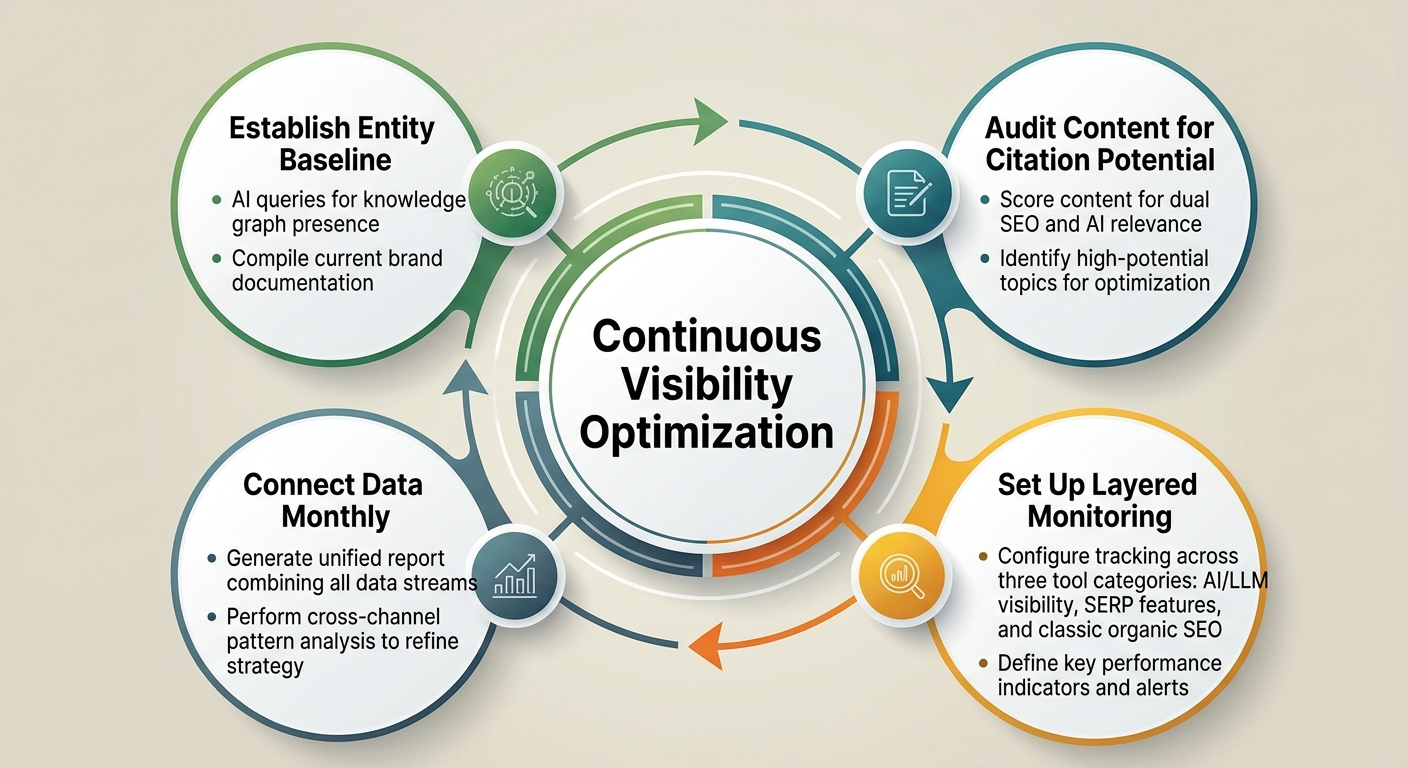
Step 1: Establish your entity baseline
Before monitoring mentions, you need to understand how well AI models currently recognize your brand as a distinct entity.
- Query ChatGPT, Perplexity, and Gemini directly: “What do you know about [your brand]?” and “What are the best [your category] solutions?”
- Document whether your brand appears, in what position, with what sentiment, and alongside which competitors.
- Use your AI visibility analytics tools to automate this baseline across hundreds of relevant prompts.
This baseline tells you where you stand before any optimization work begins.
Step 2: Map your content’s citation potential
Run a content audit using your SEO platform (Ahrefs or Semrush), but evaluate each piece through an AI citation lens:
- Does the content clearly define your brand as an entity? Pages like “About Us,” product descriptions, and category explainers help AI models understand what your company does.
- Does the content include specific, extractable claims? AI models favor statements that follow the pattern: [Entity] + [is/does] + [specific claim] + [evidence]. Vague content gets skipped.
- Is the content published on or referenced by high-authority sources? Content that only lives on your own domain has limited influence on LLM training data.
Score each content piece on both its traditional SEO performance (rankings, traffic, backlinks) and its AI citation potential (entity clarity, extractability, external mention frequency). This dual scoring reveals which content needs optimization for one surface, the other, or both.
Step 3: Set up layered monitoring
Configure each tool category to track specific signals:
- SEO tools: track keyword rankings for your brand name plus category terms (e.g., “[your brand] + project management software”), monitor backlink growth from editorial sources, and alert on ranking changes for high-value pages.
- Brand mention tools: track your brand name (including common misspellings and abbreviations), product names, key competitor names, and category keywords across social, news, and forum channels.
- AI visibility tools: track brand mentions in large language models using the conversational queries your buyers actually use. Monitor weekly for shifts in mention frequency, position, and sentiment.
Step 4: Connect the data monthly
Each month, review all three data streams together in a single report. Look for patterns:
- Did a new editorial mention (caught by your brand monitoring tool) lead to improved AI visibility (caught by your LLM tracker)?
- Did a ranking improvement for a key term (caught by your SEO tool) correlate with increased brand mentions in social and AI channels?
- Are competitors gaining AI mention share? If so, which new publications are mentioning them that aren’t mentioning you?
This connected analysis is where the real strategic value emerges. Individual tool dashboards show isolated metrics. The combined view shows causation.
What Changed Between 2024 and 2026 in AI Brand Mentions
The AI visibility landscape has shifted substantially over the past two years. If your monitoring approach was set up in 2024, it likely has blind spots.
AI Overviews now include explicit brand citations
Google’s June 2025 Core Update introduced direct brand citations within AI Overviews, according to analysis published by GetStuffDigital. Before this update, AI Overviews referenced sources through linked domains. After the update, brands are explicitly named within the AI-generated summary text itself — effectively creating a new “top position” that exists outside traditional rankings.
This means your AI Overviews monitoring needs to track not just whether your domain appears as a source link, but whether your brand name is cited by name within the overview text.
ChatGPT’s citation behavior became more selective
Research from BrightEdge in 2025 showed that only 2 in 10 ChatGPT mentions include citation links, while Perplexity averages over 5 citations per answer but mentions brands less frequently — only 1 in 5 responses include brand references. This means different AI platforms require different monitoring strategies.
For ChatGPT, the priority is brand name mentions within the response text. For Perplexity, the priority is source domain citations. Monitoring ChatGPT mentions and tracking Perplexity citations require different queries and different success metrics.
Entity recognition became a competitive differentiator
As AI models improved through 2025 and into 2026, their ability to distinguish between similar brands sharpened. Brands with consistent entity signals — the same name, description, and category associations across multiple high-authority sources — receive more accurate and frequent citations than brands with fragmented or inconsistent online presence.
This is where strategic brand mentions in generative AI become essential. Each mention on a trusted publication reinforces your brand’s entity profile in the data these models learn from.
Content Analysis Signals That Drive AI Citations
Traditional content analysis evaluates readability, keyword density, heading structure, and internal linking. AI-focused content analysis adds a layer of signals that determine whether your content is citation-worthy for language models.
Extractable definitions and claims
AI models prioritize content that contains clear, self-contained statements. A brand mention is any instance where a company name appears in editorial content — with or without a hyperlink — on a website that AI models are likely to include in their training data.
When analyzing your content, check whether key claims follow the extractable sentence pattern: [Entity] + [is/does] + [specific claim] + [evidence or source]. Content with vague generalizations gets skipped by AI extraction systems.
Structured information architecture
AI models favor content organized with clear headings, numbered processes, comparison tables, and question-answer formats. This is not just an SEO best practice — it directly affects whether an AI model can parse and cite specific sections of your content.
When auditing content for AI citation potential, ask:
- Does each section answer one clear question?
- Are key definitions placed at the top of their sections, not buried in paragraphs?
- Are comparison points structured in tables rather than narrative paragraphs?
- Are processes numbered sequentially with clear step labels?
Source authority and editorial context
Content published on your own website contributes to your traditional SEO performance. But for AI citation purposes, what matters more is how often other authoritative sites reference your brand in relevant contexts.
In campaigns across 67+ B2B companies, the BrandMentions team found that brands with consistent editorial mentions achieved AI recommendation rates 89% higher than those relying solely on traditional SEO. The publications where these mentions appeared — industry-specific media, high-domain-authority blogs, and recognized news outlets — were the determining factor.
Common Mistakes in Brand Mention Content Analysis
Monitoring and analysis workflows break down when teams make predictable errors. Avoid these:
Tracking only exact-match brand names
Customers misspell brand names, use abbreviations, or reference products without mentioning the parent company. Your monitoring must include variations, product names, founder names, and common misspellings. Boolean operators in tools like Mention and Awario help filter for these variations without generating excessive noise.
Treating all mentions as equal
A mention on a high-authority industry publication carries far more weight — for both SEO and AI visibility — than a mention in a low-quality blog comment. Your content analysis should score mentions by source authority, not just count them.
Ignoring competitor mention patterns
If a competitor appears in AI responses for queries where you don’t, the issue is usually that they have more editorial mentions on the sources AI models trust. Your monitoring workflow should track competitor AI brand mentions alongside your own to identify the gap.
Separating SEO and AI visibility into different teams
When SEO analysis and AI visibility tracking live in separate silos, strategic connections get missed. A single editorial placement can improve backlink authority, generate social mentions, and influence AI training data simultaneously. The teams or individuals analyzing each channel need access to the others’ data.
Pro Insight: The most effective brand visibility programs in 2026 treat every editorial mention as a multi-surface asset. Before pursuing any placement, evaluate its impact on three fronts: search rankings (backlink value), brand awareness (social reach and sentiment), and AI citation potential (source authority for LLM training data).
Building a Content Strategy That Feeds Both Search and AI
Knowing which tools to use and what to monitor is necessary but insufficient. The real advantage comes from creating content that is designed, from the start, to perform across Google organic search and AI-generated responses.
Prioritize topics where AI currently cites competitors
Use your AI visibility tools to identify the prompts and topics where competitors get mentioned and you don’t. These are your highest-priority content gaps. Create content — on your own site and through strategic brand mention placements on external publications — that directly addresses these gaps.
Publish on sources AI models trust
AI models weight their training data by source authority. Placing brand mentions on high-authority publications within AI training datasets creates compounding returns: each placement reinforces your entity profile across future model updates.
BrandMentions tracks when major AI models update their training data and times placements to maximize inclusion in each knowledge refresh cycle. This timing-aware approach accelerates the feedback loop between editorial publication and AI citation.
Create content with extractable value
Every piece of content you publish should contain at least one element that AI models can directly reference: a statistic with a source, a named framework, a comparison table, or a clear process. Content that exists only as narrative prose — without structured, citable elements — underperforms in AI extraction regardless of how well it ranks in traditional search.
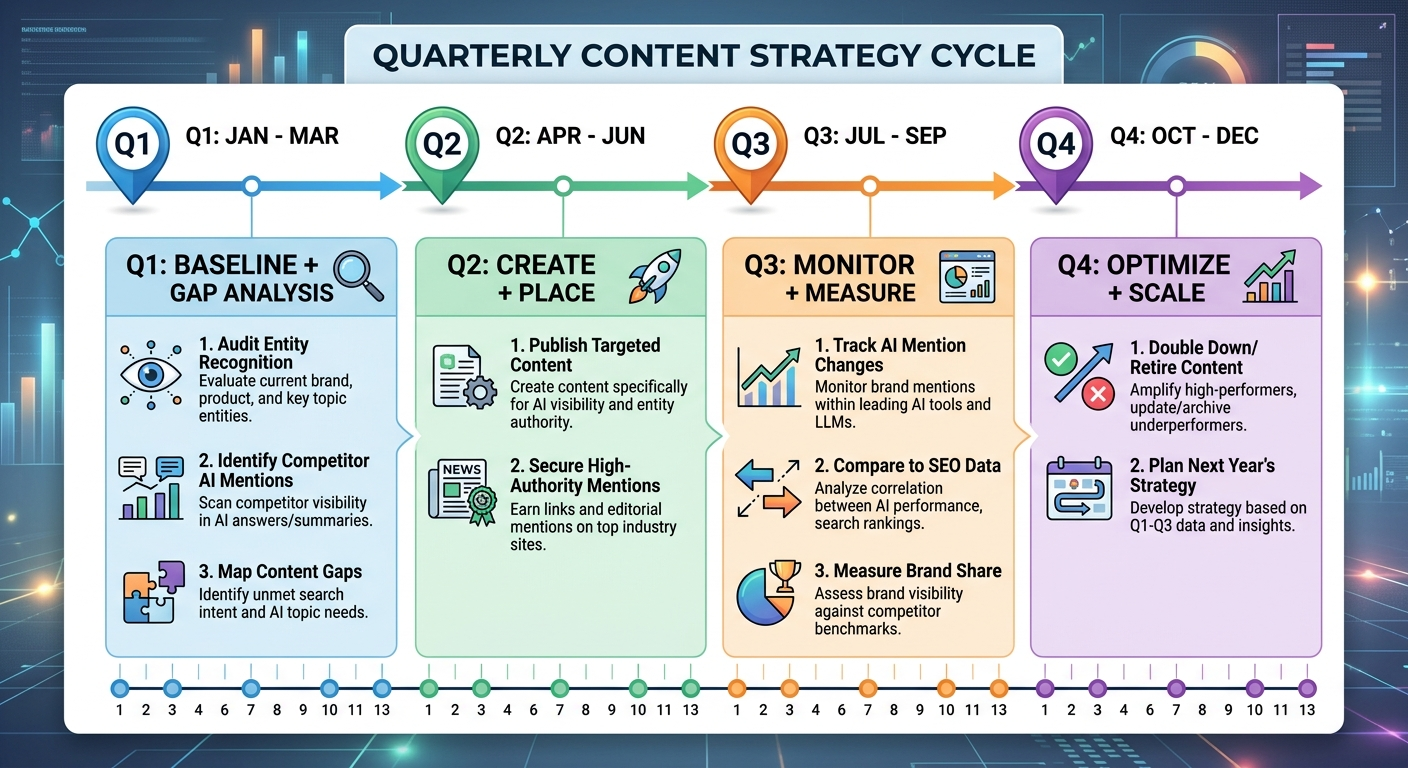
Monitor, analyze, adjust quarterly
AI model behavior changes with each training update. What works for AI visibility in Q1 2026 may shift by Q3. Build your content strategy on a quarterly review cycle that integrates data from all three tool categories and adjusts based on what the numbers show.
Frequently Asked Questions
Can one tool handle SEO analysis, brand mention tracking, and AI visibility?
No single tool covers all three as of 2026. Semrush and Ahrefs come closest by combining SEO analysis with emerging AI visibility features, but neither replaces dedicated brand monitoring tools like Brand24 or specialized LLM trackers. A layered approach using tools from each category provides the most complete picture.
How often should I check brand mentions across AI platforms?
Weekly monitoring is the minimum for AI visibility tracking. AI models update their responses based on retrieval-augmented generation (RAG) systems and periodic training refreshes. A brand that appears in Perplexity responses one week may disappear the next if competitors secure stronger mentions. Automated alert systems reduce the manual effort.
Do unlinked brand mentions actually affect SEO?
Yes. Google has acknowledged that brand mentions without hyperlinks serve as authority signals. Duane Forrester from Bing confirmed in 2016 that unlinked mentions function as trust indicators, and Gary Illyes from Google reinforced this at BrightonSEO in 2017. In the context of AI, unlinked brand mentions carry even more weight because LLMs process text — not HTML links — when building brand-entity associations.
How do I know which publications influence AI training data?
AI companies do not publish complete lists of their training sources. However, research from the Allen Institute for AI and public disclosures from model developers indicate that high-domain-authority news outlets, established industry publications, Wikipedia, Reddit, and academic repositories are consistently included. Publications with strong editorial standards and consistent indexing are the safest bets for AI-influencing mentions.
Is tracking brand mentions in AI worth the investment for smaller companies?
For B2B companies where a single closed deal represents significant revenue, AI visibility tracking pays for itself quickly. BrightEdge data from 2025 showed that AI search visitors convert at 4.4 times higher rates than traditional organic traffic. Even a few additional AI-sourced leads per month can justify the cost of dedicated AI rank tracking tools.
Your Next Move
The brands gaining ground in 2026 are the ones treating SEO tools, brand mention monitoring, and AI visibility tracking as interconnected systems — not separate line items. Start by auditing where your brand currently appears (and doesn’t) across all three surfaces. Identify the gaps between your traditional search performance and your AI citation presence. Then build a content and placement strategy that closes those gaps systematically.
If you want to see exactly where your brand stands across AI search platforms — and where your competitors show up instead — request a free AI visibility audit to get a clear picture of your current position.