
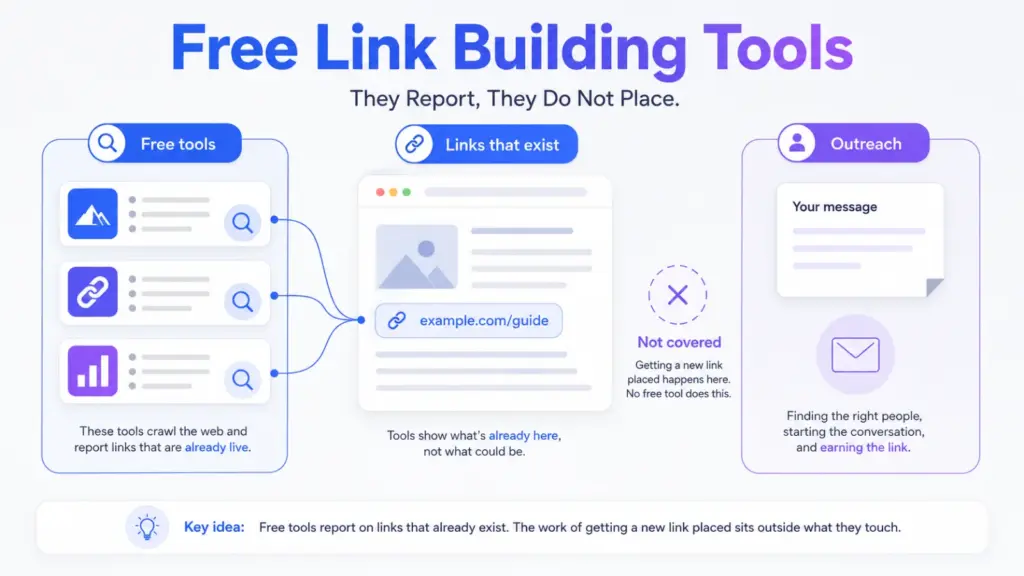

No free tool builds a link. Every one of them reports on links that already exist, and that’s a different job from getting new ones placed.
That distinction is worth holding onto, because the free tier of a backlink tool is a sales channel. It’s built to show you enough to want the paid one.
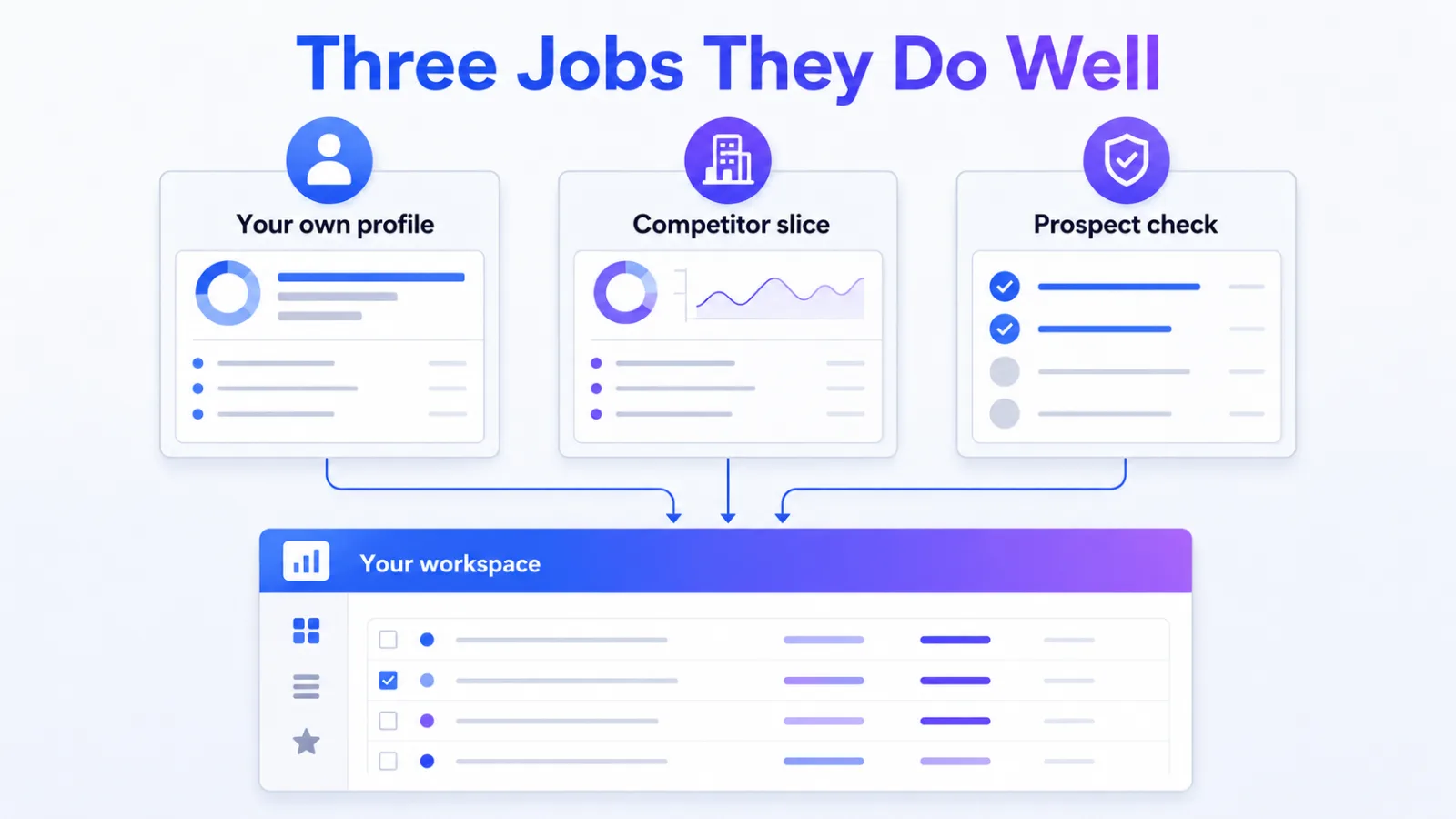
Used for what they’re good at, free link building tools do three jobs well. They show you your own profile, and they show you a slice of a competitor’s.
The third is the one that pays: they help you qualify a prospect before you spend time on it.
What Free Tools Can and Cannot Do
The split is sharper than most roundups admit.
| Free tools handle this | Free tools do not touch this |
|---|---|
| Auditing the links you already have | Persuading a publisher to add one |
| Spotting a competitor’s obvious sources | Reaching the sources worth reaching |
| Checking whether a prospect site is alive | Judging whether it will say yes |
| Flagging a link that has disappeared | Getting it restored |
Everything in the right column is outreach, and outreach is people work. That’s the part no tier of any tool automates, free or otherwise.
The Two Kinds of Free, and Why It Matters
Free backlink data comes in two shapes, and they fail in opposite directions.
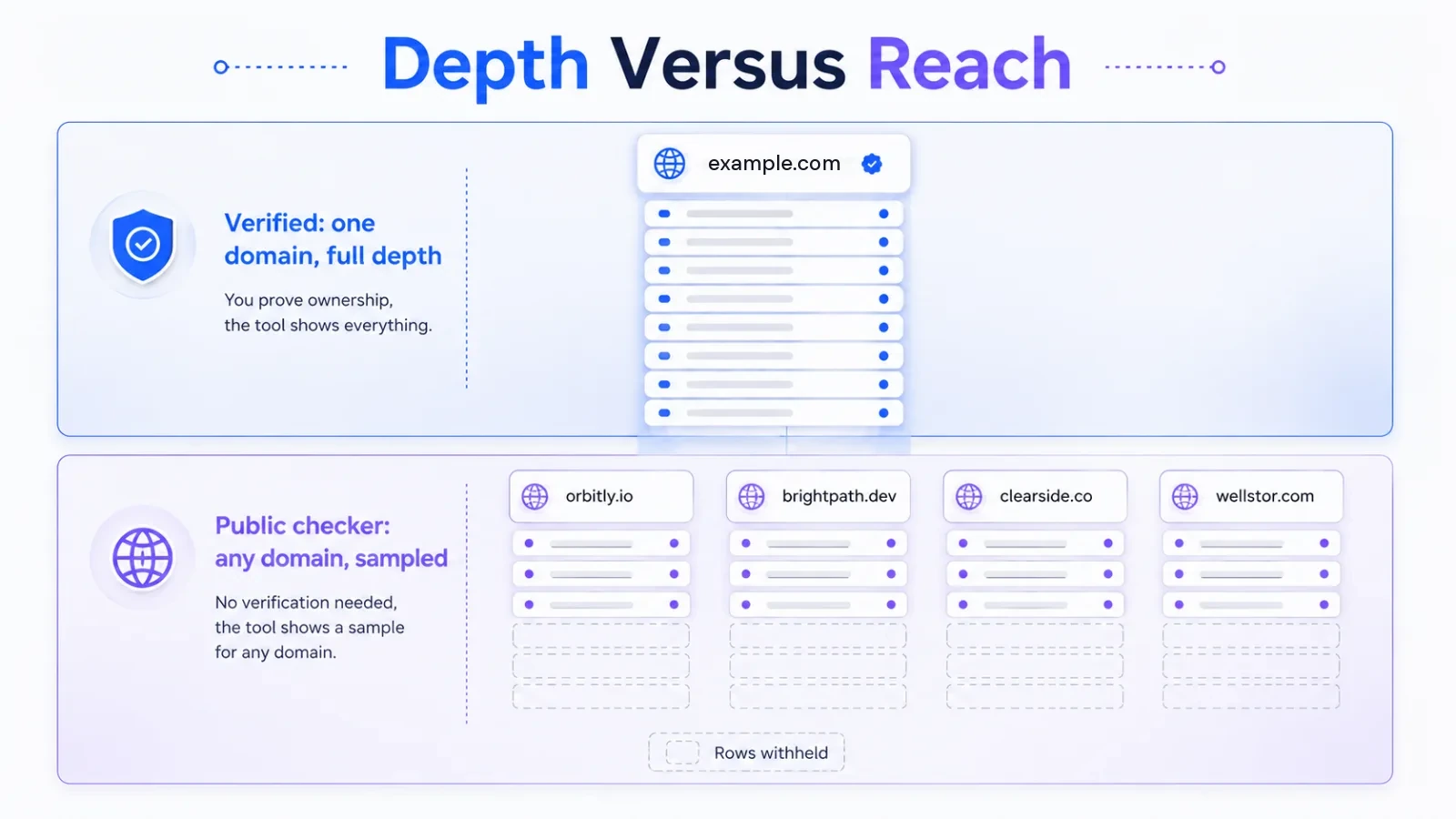
Ownership-verified tools
Google Search Console, Bing Webmaster Tools and Ahrefs Webmaster Tools are free without a meaningful cap. The catch is that they only ever show you a site you’ve proven you control.
These give you depth on your own domain and nothing at all on anyone else’s. For auditing what you have, they beat most paid lookups.
Public checkers on a free tier
The free lookup tools point at any domain, which is the appeal. They pay for it by returning a truncated list from a sampled index.
You’re seeing a slice, chosen by the vendor, of a crawl that was never complete. That’s fine for a rough read and misleading if you treat the count as a total.
Where Free Stops Being Free
You hit the limits in a predictable order, and knowing the order saves you an afternoon.
- Row caps. The report loads, then stops well before the end of the list, usually without saying so.
- Lookup quotas. Checks per day rather than per session, which turns a prospecting sprint into a queue.
- Filter controls. The data is present and the controls that make it usable are held back.
- Export blocks. The most common wall, because anything you cannot export cannot be worked.
That last one decides most upgrade moments. A list you can read on screen and can’t put into a sheet isn’t a prospect list, it’s a demo.
Reading a Free Report Without Being Misled
The number at the top of a free backlink report is the most quoted figure in this whole category, and it’s the least reliable thing on the page.
It’s a count of what that vendor’s crawler happened to store, capped by what the free tier will display. Two tools will hand you two different totals for the same domain, and both are describing themselves.
Treat free backlink counts as a shape, never as a quantity. The useful reading is which kinds of sites appear and how recent they are, not how far the number climbs.
The same caution applies in reverse. A link missing from a free report has not necessarily gone, because a sampled index and a truncated list both hide rows without warning you.
How to Get Real Work Out of a Free Tier
You get the most out of free tools by narrowing what you ask them, because the caps bite on breadth rather than depth.
Ask about one domain at a time
A single competitor examined properly beats ten skimmed. Pull one profile, sort by whatever authority measure the tool offers, and read the top of the list rather than counting the whole thing.
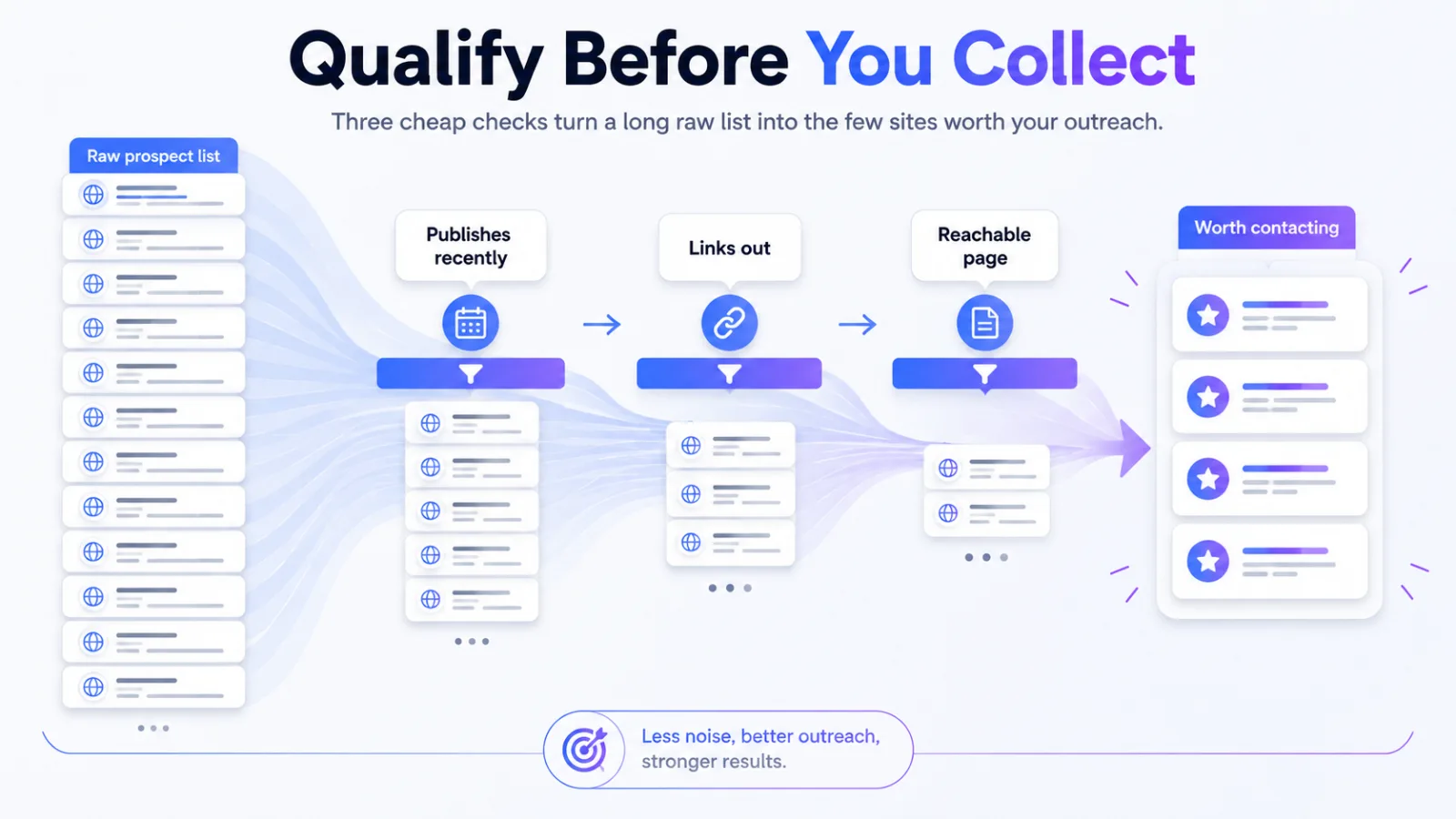
Qualify before you collect
Check that the prospect site publishes recently, links out at all, and isn’t running a page nobody can reach. Those three checks are free everywhere and they remove most of a raw list.
A page that no internal link points at will struggle to get indexed at all, so a placement there does little. That mechanism is set out in backlink not showing in Ahrefs.
Use your own verified data as the benchmark
Your Search Console link report is complete for your domain, which no free public checker will be. Use it to sanity-check anything a free tool tells you about your own profile.
When the two disagree, the verified one is right about your site. The public checker is describing its own index, not the web.
When Paying Starts to Make Sense
You should pay at the point where the tool stops being the bottleneck and your time starts being it.
That threshold is usually export plus filtering. Once you’re working prospects in volume, an afternoon of copying rows by hand costs more than the subscription it replaces.
The other threshold is competitive depth. If a decision rests on how a competitor earned a link, a sampled free list can’t answer it and a guess is worse than not asking.
What paying does not buy is the outreach itself. The tactics that convert a prospect into a placement are the same at every price, and they’re set out in link building methods. A managed contextual link building programme replaces the work rather than the tooling.
Frequently Asked Questions
Can I do link building with only free tools
Yes, at low volume. The tools are not the constraint on a handful of placements a month, because the work is research and outreach rather than reporting. Volume is where free stops holding up.
Why do two free checkers report different backlink counts
It happens because each one runs its own crawler and its own index, so they’re reporting different collections. Neither number is the web’s total, and the gap between them tells you about the tools rather than your profile.
Is Google Search Console enough on its own
For your own site, close to it. Its link report is complete for the domain you’ve verified, which no free public checker matches. It tells you nothing about a competitor.
Do free tools miss links that exist
Routinely. A sampled index and a truncated report both hide rows, so absence in a free tool is weak evidence. Check the page in Google before concluding a link is gone.
Are free backlink checkers worth using at all
For qualifying a prospect and reading the shape of a competitor’s profile, yes. For counting anything, no.
Start With the Tools You Already Own
The free tier with the best data on your site is the one attached to a property you’ve verified, and it costs nothing but a DNS record. Exhaust that before you evaluate a single roundup.