A competitor analysis SEO tool reveals the keywords, backlinks, and content strategies your rivals use to outrank you — so you can close gaps and capture traffic they’re already winning. As of 2026, these tools have evolved far beyond basic keyword tracking. The best options now integrate AI-powered insights, real-time SERP monitoring, and even visibility data across AI search platforms like ChatGPT and Perplexity.
Choosing the right tool matters more than most marketers realize. The wrong one wastes budget on vanity metrics. The right one surfaces specific, actionable opportunities — keyword gaps your competitors exploit, backlink sources you’ve missed, and content angles that drive organic traffic.
This article breaks down how to evaluate competitor analysis SEO tools based on what actually moves rankings in 2026 — and where the category is headed as AI search reshapes competitive intelligence.
What You’ll Learn
- How to evaluate a competitor analysis SEO tool based on data accuracy, coverage, and AI search integration
- Which tool categories exist and what each one does best — from backlink intelligence to audience research
- Why AI search visibility data is now a critical factor in competitive analysis
- How to run a competitor analysis workflow that produces results, not just reports
- What’s changed in this category since 2024–2025, including the rise of generative engine optimization (GEO) tracking
- Where free tools fall short — and when upgrading pays for itself
Why Your Competitor Analysis SEO Tool Needs to Cover More Than Keywords
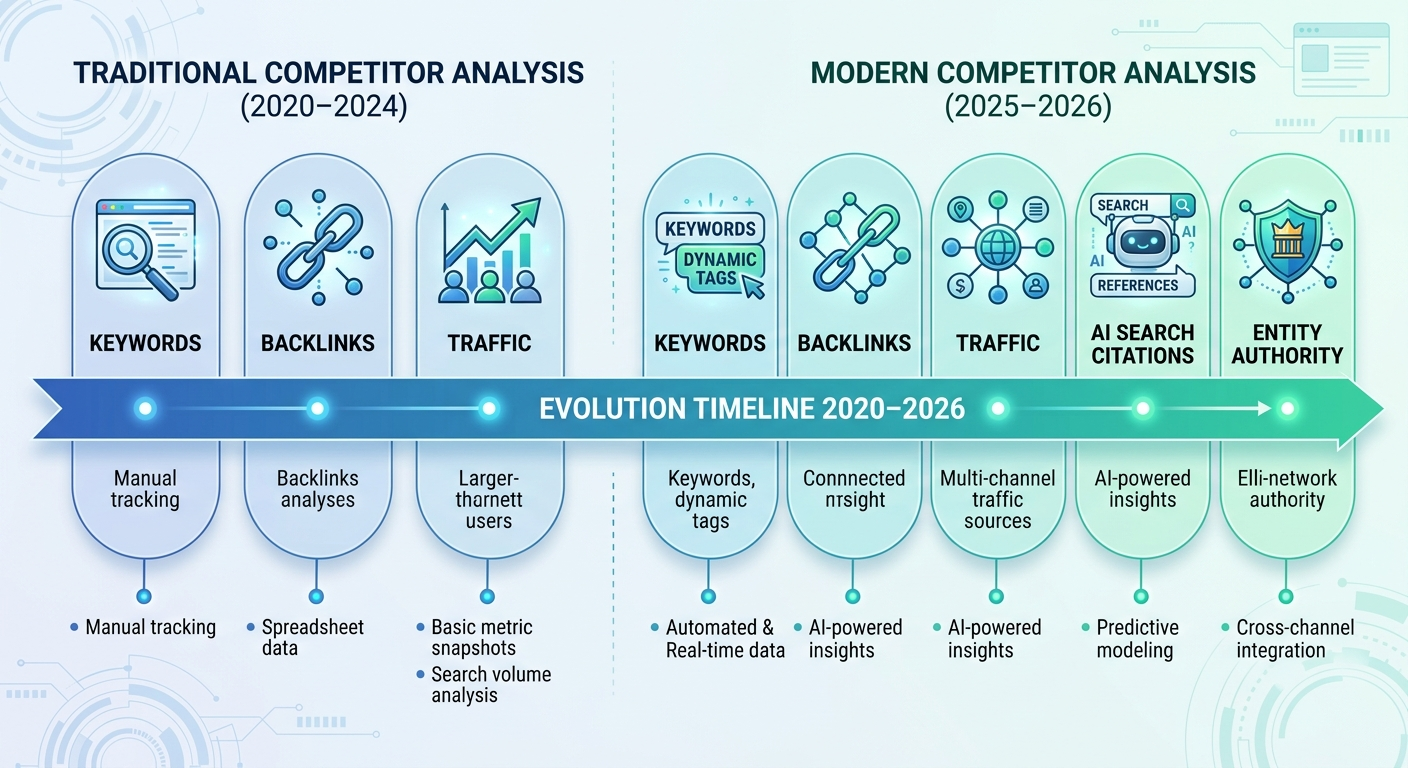
Traditional competitor analysis focused on three data points: ranking keywords, backlink profiles, and estimated traffic. In 2026, that’s necessary but insufficient.
AI search engines now drive a meaningful share of discovery and referral traffic. According to a 2025 Gartner forecast, traditional search engine volume was projected to decline 25% by 2026 as users shift toward AI-assisted answers. That shift means your competitors aren’t just competing in Google’s organic results — they’re competing for citations in ChatGPT, Perplexity, Gemini, and AI Overviews.
A competitor analysis SEO tool that only tracks traditional SERP positions misses half the picture. You need visibility into:
- Keyword gaps — queries your competitors rank for that you don’t
- Backlink sources — referring domains pointing to competitors but not to you
- Content performance — which competitor pages generate the most organic traffic and engagement
- AI search citations — whether competitors appear in AI-generated answers and recommendations
- Entity authority signals — how well competitors are recognized as category leaders by AI models
The tools that cover all five dimensions give you a strategic advantage. The ones stuck on dimensions one through three leave you flying blind in the fastest-growing search channel.
How to Evaluate a Competitor Analysis SEO Tool in 2026
Not all competitor analysis tools deliver equal value. Before committing to a monthly subscription, assess each option against these criteria.
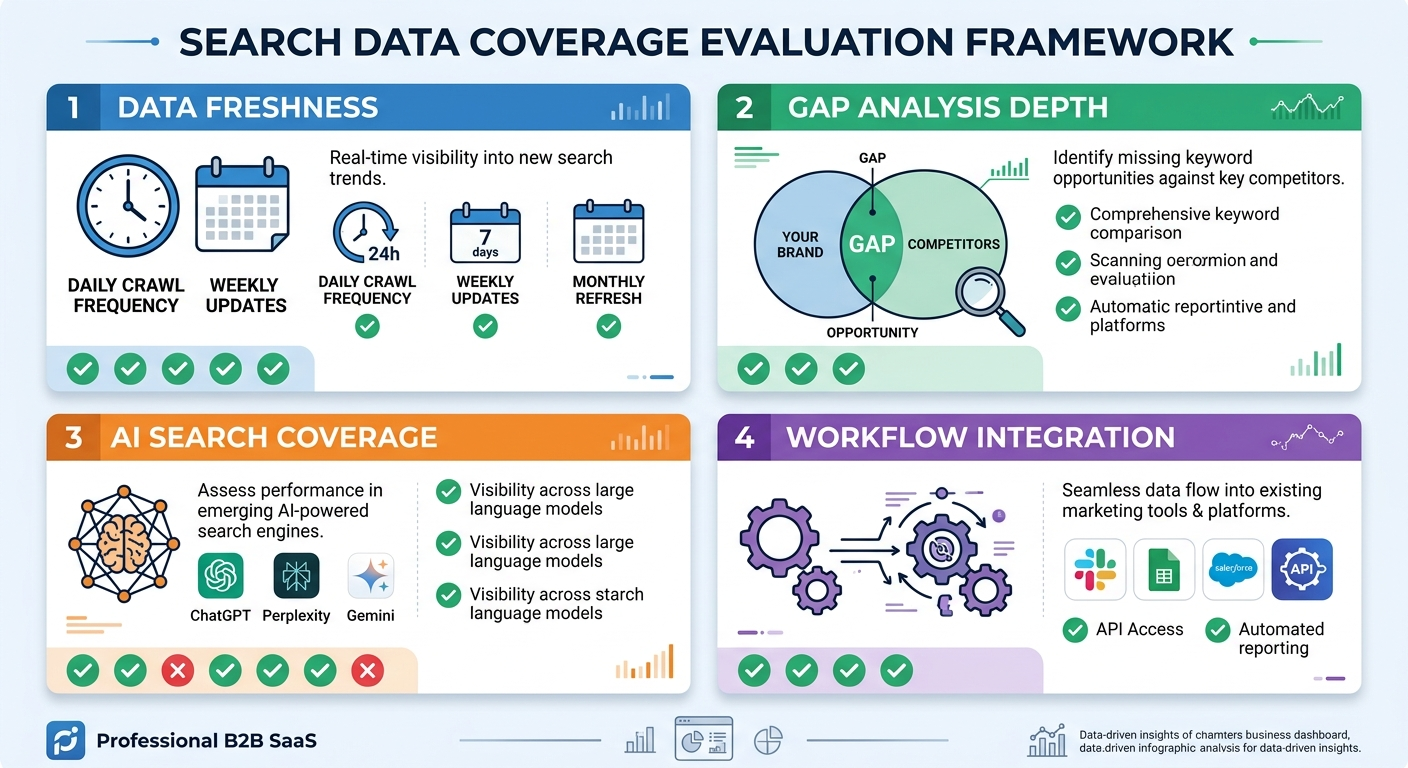
Data Freshness and Crawl Frequency
Stale data produces stale strategies. The best tools update their keyword and backlink databases weekly or daily. Ahrefs, for instance, operates one of the most active web crawlers globally — Cloudflare’s Radar data consistently places AhrefsBot among the top crawlers by volume. Semrush refreshes its keyword database of over 26 billion keywords on a rolling basis.
Ask two questions before subscribing:
- How often does the tool update its backlink index?
- How current is the keyword ranking data — real-time, daily, or weekly?
Depth of Competitive Comparison Features
A tool that shows your competitor’s keyword list is useful. A tool that shows the gap between your keyword portfolio and theirs — filtered by difficulty, search volume, and SERP feature eligibility — is actionable.
Look for dedicated gap analysis features: keyword gap, backlink gap, and content gap tools. These surface specific opportunities instead of drowning you in raw data.
AI Search and Entity Visibility
This is the differentiator in 2026. Tools like Semrush’s AI Visibility Toolkit and SEO Review Tools’ AI Visibility Checker now track whether domains appear in AI-generated results. Competitors appearing in ChatGPT recommendations or Perplexity citations hold an advantage that traditional rank tracking doesn’t capture.
If your competitor analysis SEO tool doesn’t account for entity SEO signals and AI discoverability, you’re analyzing a shrinking portion of the competitive landscape.
Integration and Workflow Fit
The best data is useless if it sits in a dashboard nobody opens. Evaluate how each tool fits into your existing workflow. Does it export to Google Sheets or Looker Studio? Does it integrate with your project management tools? Can you set automated alerts for competitor ranking changes?
A tool that fits your workflow gets used. A tool that doesn’t becomes shelfware.
The Core Categories of Competitor Analysis SEO Tools
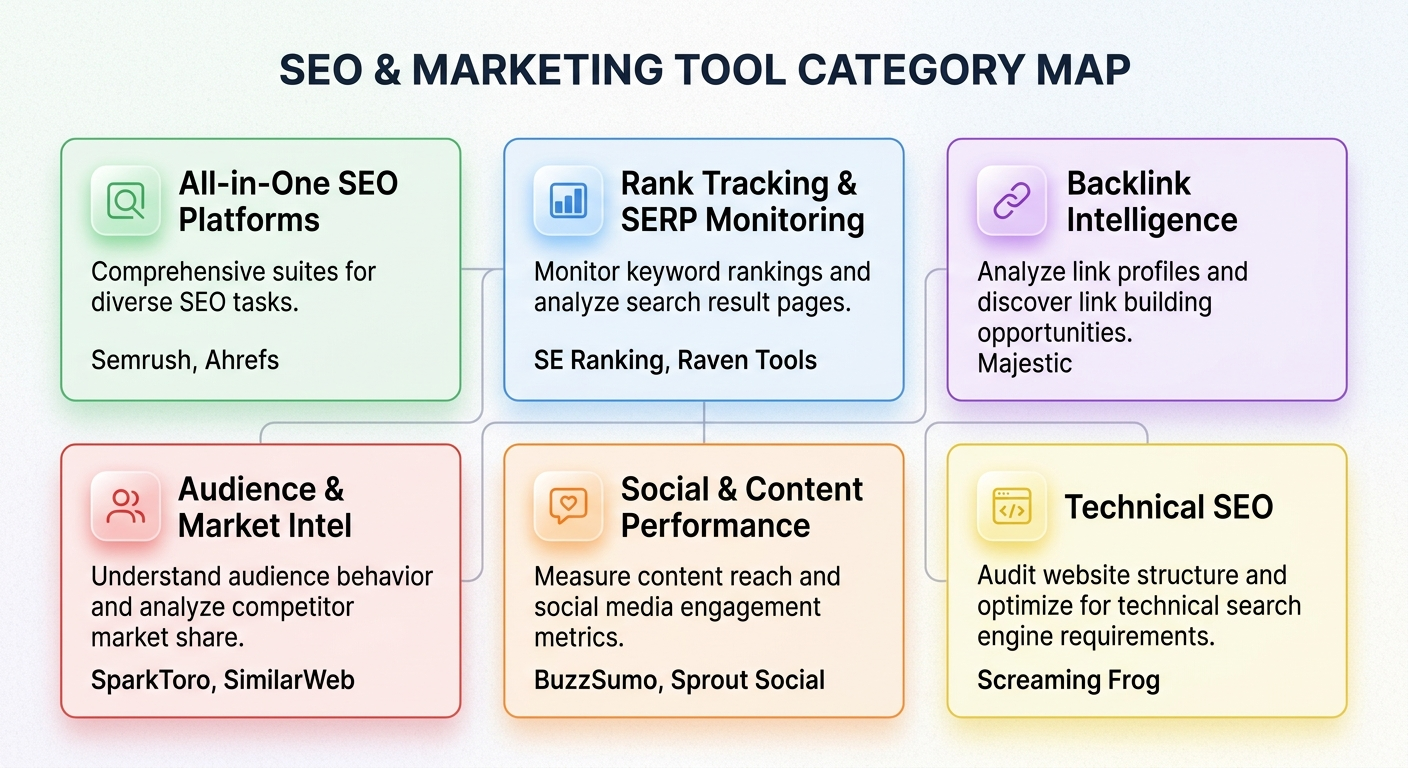
Competitor analysis tools aren’t interchangeable. They cluster into distinct categories, each solving a different problem. Understanding these categories prevents you from buying a social listening tool when what you actually need is backlink intelligence.
All-in-One SEO Platforms
These tools combine keyword research, backlink analysis, rank tracking, site auditing, and competitive intelligence into a single platform. Semrush and Ahrefs dominate this category.
Semrush stands out for its breadth. Its Keyword Gap tool compares up to five domains simultaneously, showing shared keywords, missing keywords, and unique keyword opportunities. The Traffic & Market Toolkit adds audience demographics, traffic source breakdowns, and market share estimates. As of 2026, Semrush also offers an AI Visibility Toolkit that tracks brand presence across AI search results — a significant competitive advantage for the platform.
Ahrefs leads on backlink intelligence. Its backlink index is one of the largest and most frequently updated. The Competitive Analysis feature identifies content gaps and backlink gaps in a single workflow. Ahrefs is often preferred by SEO specialists who prioritize link-building strategy and content-driven organic growth.
Both tools start at approximately $129–$140/month for entry-level plans. For most B2B marketing teams, one of these two platforms forms the foundation of competitive analysis.
Rank Tracking and SERP Monitoring
Dedicated rank trackers like SE Ranking and Raven Tools focus on monitoring position changes over time. SE Ranking’s SERP Competitors feature shows exactly which domains gained or lost positions on a given day — useful for spotting emerging threats or validating that your SEO efforts are working.
If you already use an all-in-one platform, a dedicated rank tracker may be redundant. But for agencies managing dozens of client campaigns, a purpose-built tool with granular tracking and white-label reporting can be worth the additional investment.
Backlink-Focused Intelligence
Majestic specializes exclusively in link intelligence. Its proprietary Trust Flow and Citation Flow metrics measure backlink quality and quantity independently — a distinction most all-in-one tools don’t make as cleanly. Majestic’s Topical Trust Flow goes further by measuring how many backlinks come from topically relevant domains, which may influence how search engines interpret your site’s category authority.
For teams whose competitive disadvantage is primarily a backlink gap, Majestic provides depth that general-purpose tools don’t match.
Audience and Market Intelligence
SparkToro approaches competitor analysis from the audience side. Instead of asking “what keywords does my competitor rank for?” it asks “where does my competitor’s audience spend time online?” Enter a competitor’s domain, and SparkToro reveals which publications, podcasts, social accounts, and communities their audience engages with.
This data is especially valuable for content distribution strategy and share of voice analysis. If your competitor’s audience reads specific industry publications, those publications become strategic targets for brand mentions and thought leadership placements.
SimilarWeb provides a broader market intelligence layer — traffic source breakdowns, audience demographics, and competitive benchmarking across paid and organic channels. It’s more suited for senior marketing leaders evaluating overall competitive positioning than for SEO specialists optimizing individual pages.
Social and Content Performance Analysis
BuzzSumo analyzes which competitor content earns the most social shares, backlinks, and engagement. It’s a content strategy tool disguised as a competitor analysis tool — by showing you what formats, topics, and angles resonate with your shared audience, it directly informs your editorial calendar.
Sprout Social focuses on social media competitor tracking, including sentiment analysis, engagement benchmarking, and share-of-voice measurement across Facebook, Instagram, X, and Pinterest.
Technical SEO Competitor Analysis
Screaming Frog crawls competitor websites to reveal their technical SEO architecture — internal linking patterns, meta tag optimization, heading structures, page speed metrics, and crawl depth. For teams competing in technically complex verticals (e-commerce, publishing, SaaS), understanding how top-ranking competitors structure their sites can surface high-impact optimization opportunities.
What’s Changed Since 2024–2025: AI Search Reshapes Competitive Intelligence
The competitor analysis SEO tool category has shifted significantly since 2024. Three changes stand out.
AI Visibility Tracking Is No Longer Optional
In 2024, AI search visibility was a novelty metric. By 2026, it’s a strategic priority. Google’s AI Overviews now appear in a majority of informational queries in the United States. ChatGPT’s integration with web search, Perplexity’s citation-heavy answer format, and Gemini’s expanding role in the Google ecosystem all mean that brand visibility in AI-generated results directly impacts traffic and pipeline.
Semrush responded by launching its AI Visibility Toolkit. SEO Review Tools added an AI Visibility Checker and platform-specific analyzers for ChatGPT, Perplexity, and Gemini. These features let you compare whether your brand or your competitor’s brand appears when users ask AI assistants category-relevant questions.
For B2B brands, this matters because purchase research increasingly starts with AI assistants. A 2025 study by the Allen Institute for AI found that large language models disproportionately cite sources they’ve encountered multiple times across high-authority domains during training. If your competitors have more brand mentions across authoritative publications, they’re more likely to appear in AI recommendations — regardless of your traditional search rankings.
Entity Recognition Drives Competitive Advantage
Entity authority refers to how well AI models recognize and associate a brand with its category. A brand with strong entity authority is more likely to be cited when an AI assistant answers questions about that industry.
This concept barely existed in competitor analysis tools before 2025. Now, understanding whether AI models recognize your brand as a credible entity — and whether they recognize your competitors more strongly — is a measurable competitive dimension.
Tools that track brand mentions in AI responses provide this insight. You can query AI platforms with category-relevant prompts and track which brands appear consistently. Agencies like BrandMentions specialize in building the kind of editorial citation footprint that strengthens entity authority across AI models.
Competitor Analysis Now Spans Both Traditional and AI Search
The most effective SEO competitor analysis workflows in 2026 run parallel tracks: one for traditional SERP competition and one for AI search competition. A competitor might rank #1 on Google for a target keyword but be completely absent from ChatGPT’s recommendations for the same topic — or vice versa.
Running both tracks simultaneously reveals opportunities that single-channel analysis misses.
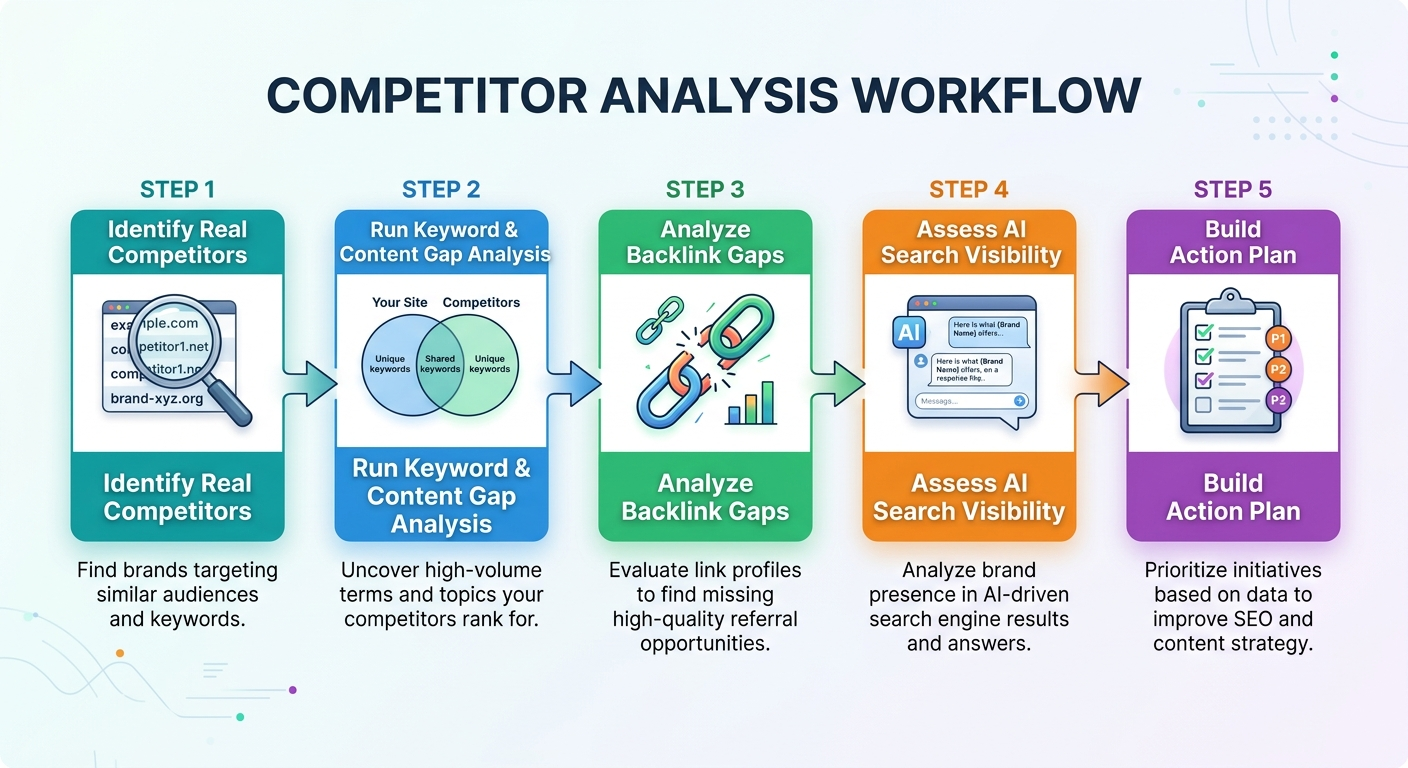
A Practical Competitor Analysis Workflow That Produces Results
Tools are only useful if they feed into a structured workflow. Here’s a process that translates competitive data into action.
Step 1: Identify Your Real Competitors
Your business competitors and your search competitors aren’t always the same companies. A SaaS startup might consider another startup its primary business rival, while its actual SERP competitors are enterprise incumbents and media publications ranking for the same keywords.
Use your all-in-one SEO platform’s competitor discovery feature. In Semrush, the Organic Research → Competitors report shows domains with the highest keyword overlap. In Ahrefs, Competing Domains surfaces the same data. Start with the top five organic competitors by shared keyword volume.
Then run the same exercise in AI search. Query ChatGPT, Perplexity, and Gemini with your most important category questions. Note which brands appear in the responses. These are your AI search competitors — and they may differ from your Google competitors.
Step 2: Run Keyword and Content Gap Analysis
Use the Keyword Gap tool to compare your domain against your top competitors. Filter results to show keywords where competitors rank in the top 10 and you don’t rank at all. Sort by search volume and business relevance.
This produces a prioritized list of content opportunities. Each missing keyword represents a topic your target audience searches for — and finds your competitor instead of you.
For content gap analysis, examine your competitors’ top-performing pages by estimated organic traffic. Identify topics you haven’t covered, angles you haven’t taken, and content formats you haven’t used (comparison pages, calculators, templates).
Step 3: Analyze Backlink Gaps
Use the Backlink Gap feature to find domains that link to your competitors but not to you. Filter by domain authority and topical relevance. These represent your highest-probability link-building targets — if a publication linked to your competitor on a similar topic, they may link to your content too.
Pay special attention to publications that AI models are likely to include in training data. High-authority editorial sites, industry publications, and established news outlets carry weight in both traditional SEO and AI visibility. If competitors have brand mentions and backlinks from these sources, prioritize earning similar coverage.
Step 4: Assess AI Search Visibility
Track which competitors appear in AI-generated results for your target queries. Use tools that monitor AI citations, or run manual queries across ChatGPT, Perplexity, and Gemini on a weekly cadence.
Document the patterns. Which competitors appear most frequently? Which sources do AI platforms cite? What language do AI responses use when recommending brands?
This data informs your AI brand mention strategy. If competitors consistently appear in AI answers because they have editorial mentions on authoritative publications, that’s a signal to invest in strategic brand placement.
Step 5: Build Your Action Plan
Translate findings into a prioritized action plan with three lanes:
- Content creation — fill keyword and topic gaps with content that’s more helpful and complete than what competitors offer
- Link and mention building — target the publications and sources where competitors have coverage and you don’t
- AI visibility — build entity authority through consistent editorial mentions on publications that AI models reference during training
Revisit your competitive analysis quarterly. Search landscapes shift. New competitors emerge. Algorithm updates change the playing field. Ongoing monitoring — not one-time analysis — is what produces compound results.
Where Free Competitor Analysis Tools Fall Short
Free tools exist across most competitor analysis categories. Google Search Console shows your own keyword performance. Google Alerts tracks competitor mentions. Free tiers of Semrush, Ahrefs, and Ubersuggest provide limited keyword and backlink data.
For early-stage businesses or individual SEO practitioners, free tools provide a starting point. But they have consistent limitations:
- Data caps — free plans restrict the number of queries, tracked keywords, or exported results per day
- Limited competitor comparison — most free tiers let you analyze one domain at a time, not compare multiple competitors side by side
- No historical data — free tools rarely provide trend data or historical ranking positions, making it hard to identify patterns
- No AI visibility tracking — as of 2026, AI search visibility features are exclusively available on paid plans or specialized tools
The inflection point comes when your business depends on search-driven revenue. At that stage, the cost of a paid tool — $130–$300/month for most platforms — is far less than the cost of missed opportunities that a free tool can’t surface.
Pro Insight: If budget is tight, start with one all-in-one platform (Semrush or Ahrefs) and supplement with free tools for specific tasks. This covers 80% of competitor analysis needs at a single subscription cost.
How AI Visibility Data Changes the Competitive Equation
The most significant shift in competitor analysis as of 2026 isn’t a new tool feature — it’s a new dimension of competition entirely.
When a prospect asks ChatGPT “What’s the best project management tool for remote teams?” and your competitor appears in the response but you don’t, that’s a competitive loss no traditional rank tracker captures. The same applies to Perplexity citations, Gemini recommendations, and Google AI Overview mentions.
In campaigns across 67+ B2B companies, the BrandMentions team found that brands with consistent editorial mentions on high-authority publications achieved AI recommendation rates 89% higher than those relying solely on traditional SEO. This gap is widening as AI search adoption accelerates.
Understanding this dimension changes how you interpret competitive data:
- A competitor with lower Domain Authority but frequent AI citations may capture more qualified traffic than you expect
- A competitor with strong backlinks but no editorial brand mentions may be vulnerable in AI search — even if they outrank you in Google
- Brand tracking now requires monitoring both traditional search positions and AI platform responses
The tools that integrate both dimensions — traditional SERP competition and AI search competition — provide the most complete competitive picture. Those that don’t leave a growing blind spot in your strategy.
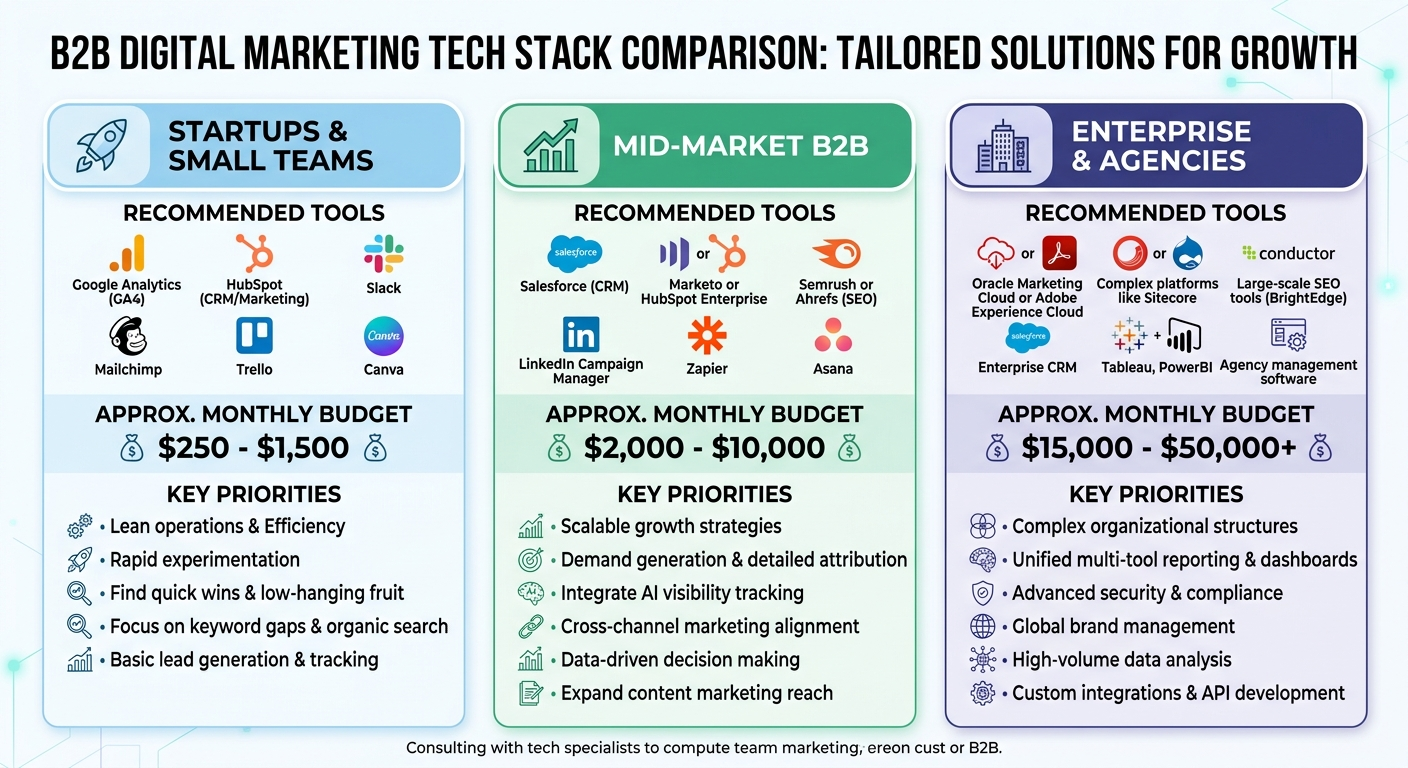
Matching the Right Tool to Your Situation
Your optimal tool stack depends on your team size, budget, competitive intensity, and which search channels drive your revenue.
For Startups and Small Marketing Teams
Start with one all-in-one platform. Ahrefs Lite ($129/month) or Semrush Pro ($139.95/month) covers keyword research, backlink analysis, rank tracking, and basic competitor comparison. Supplement with SparkToro’s free tier for audience insights and manual AI search monitoring.
For Mid-Market B2B Companies
Use an all-in-one platform at a mid-tier plan for expanded data limits and competitor comparison features. Add Semrush’s AI Visibility Toolkit or an equivalent AI monitoring tool. Consider Majestic for deep backlink intelligence if link-building is a primary growth lever.
Invest in brand monitoring tools to track competitor mentions across editorial publications, social media, and AI platforms.
For Enterprise Marketing Teams and Agencies
Enterprise teams typically run multiple tools simultaneously: an all-in-one SEO platform, dedicated social listening (Sprout Social or Talkwalker), market intelligence (SimilarWeb), and AI visibility monitoring. The key at this level is integration — ensuring data from multiple tools feeds into unified reporting and decision-making.
Agencies managing client campaigns benefit from platforms with white-label reporting, like SE Ranking or Raven Tools, alongside Semrush or Ahrefs for primary research.
The Role of Brand Mentions in Competitive SEO Strategy
One dimension of competitor analysis that traditional tools underreport is brand mention frequency and quality. Brand mentions — instances where a company name appears in editorial content on authoritative websites — influence both traditional search rankings and AI visibility.
Google has long acknowledged that unlinked brand mentions serve as implicit endorsement signals. AI models take this further: LLMs learn brand-category associations from their training data, which consists largely of web content from high-authority publications. A brand mentioned frequently in editorial contexts related to its category builds stronger entity associations than a brand mentioned only on its own website.
When analyzing competitors, track where they earn mentions:
- Which industry publications feature them?
- Are they cited in comparison articles, expert roundups, or product reviews?
- Do their mentions appear on sites that AI models are likely to include in training data?
Tools like brand mention trackers and brand awareness measurement tools surface this data. Agencies like BrandMentions build citation footprints across 140+ high-authority publications specifically to strengthen the kind of entity authority that drives AI recommendations.
If your competitors have a more robust editorial citation footprint than you do, that’s a competitive gap worth closing — and it won’t show up in a standard keyword gap report.
Frequently Asked Questions
What is the best competitor analysis SEO tool for beginners?
Semrush and Ahrefs both offer structured competitor analysis workflows accessible to beginners. Semrush’s Domain Overview provides a single-dashboard comparison of up to five competitors with metrics like authority score, organic traffic, and keyword overlap. Ahrefs’ Competitive Analysis tool walks users through keyword and backlink gap identification step by step. Either platform works well as a first tool.
Can free competitor analysis tools provide useful data?
Free tools like Google Search Console, Ubersuggest’s free tier, and Google Alerts provide basic competitive intelligence. They work for initial research and narrow-scope analysis. However, they lack the depth, comparison features, and AI visibility tracking that paid tools offer. For businesses where organic search drives revenue, paid tools typically pay for themselves through the opportunities they surface.
How often should you run a competitor analysis?
Run a comprehensive competitor analysis quarterly to catch strategic shifts, new entrants, and ranking changes. Set up ongoing monitoring — automated rank tracking, backlink alerts, and AI visibility checks — on a weekly or bi-weekly cadence. Markets move faster in 2026 than they did two years ago, especially as AI search results update more frequently than traditional indexes.
Do competitor analysis SEO tools track AI search results?
Some do. Semrush’s AI Visibility Toolkit, SEO Review Tools’ AI Visibility Checker, and dedicated brand monitoring platforms now track whether domains appear in AI-generated answers across ChatGPT, Perplexity, Gemini, and Google AI Overviews. As of 2026, this capability is still emerging — not every platform offers it, and methodologies vary. Prioritize tools that provide this data if AI search is a meaningful traffic channel for your industry.
How do brand mentions affect competitive SEO performance?
Brand mentions on authoritative publications influence both traditional search signals and AI citation behavior. Search engines treat editorial mentions as implicit trust indicators. AI models learn brand-category associations from training data — brands mentioned frequently alongside relevant topics build stronger entity authority. Tracking competitor brand mentions reveals a dimension of competitive advantage that keyword and backlink data alone don’t capture. Learn more about how brand mentions impact AI search visibility.
Competitive Analysis Is Now a Two-Front Strategy
The competitor analysis SEO tool you choose in 2026 needs to serve two fronts: traditional search competition and AI search competition. Tools that only address the first front leave you exposed to a channel that’s growing faster than any other in digital marketing.
Start with a strong all-in-one platform for keyword, backlink, and content gap analysis. Layer in AI visibility monitoring to track which competitors appear in AI-generated recommendations. And don’t overlook the editorial brand mention dimension — it’s the connective tissue between traditional authority signals and AI citation behavior.
The brands that gain ground in 2026 won’t just track competitors — they’ll act on what they find across both traditional and AI search channels. That’s the difference between competitive analysis as a report and competitive analysis as a growth engine.
Want to see where your brand stands in AI search compared to competitors? Get a free AI visibility audit and find out what AI platforms say about your brand — and your rivals.