
If you need Wikipedia edits or citations handled without creating policy problems, the best service is the one that can prove it works inside Wikipedia’s rules.
The strongest options are the providers that show real policy knowledge, source vetting, a transparent process, and ongoing monitoring, not the ones promising guaranteed publication. This roundup ranks seven providers by fit, not hype, so you can shortlist the right one for your risk level and page complexity.
No legitimate service can promise approval, because final calls rest with Wikipedia’s volunteer editors and the quality of your sources.
How We Ranked These Wikipedia Editing Services
The ranking rewards process over performance claims. A vendor that explains its workflow, disclosure approach, and revision rules is worth more than one waving a “95% acceptance rate” with no methodology behind it.
We weighed each provider on five factors:
- Wikipedia policy knowledge, including conflict-of-interest and notability handling
- Source quality and how references are vetted before submission
- Transparency of the editing and disclosure process
- Monitoring and post-edit support
- Fit for different buyer types, from one-off fixes to reputation management

Citation work isn’t one job. A one-off fix needs accurate references and a clean edit request.
Ongoing page maintenance needs watchlist coverage and someone who responds when an article gets flagged. Reputation management needs all of that plus dispute handling on the talk page.
Judge a service by how clearly it explains disclosure, how it manages revisions, and what happens after the edit goes live.
The red flags are consistent across the weakest providers: vague approval promises, no explanation of how edits are made, and no mention of monitoring once a page is published. Wikipedia’s own conflict of interest guideline tells you why disclosure matters, and any vendor that skips that conversation is cutting a corner you’ll pay for later.
For the bigger picture on how these pages feed answer engines, see our Wikipedia AI citation strategy.
The 7 Best Wikipedia Editing Citation Services
Each provider below uses the same structure: what it is, why it earns a place, and a decision-data block so you can compare on the fields that matter. Item count follows genuine merit, not a round number.
1. Reputation X: Best for High-Stakes, Disputed Pages
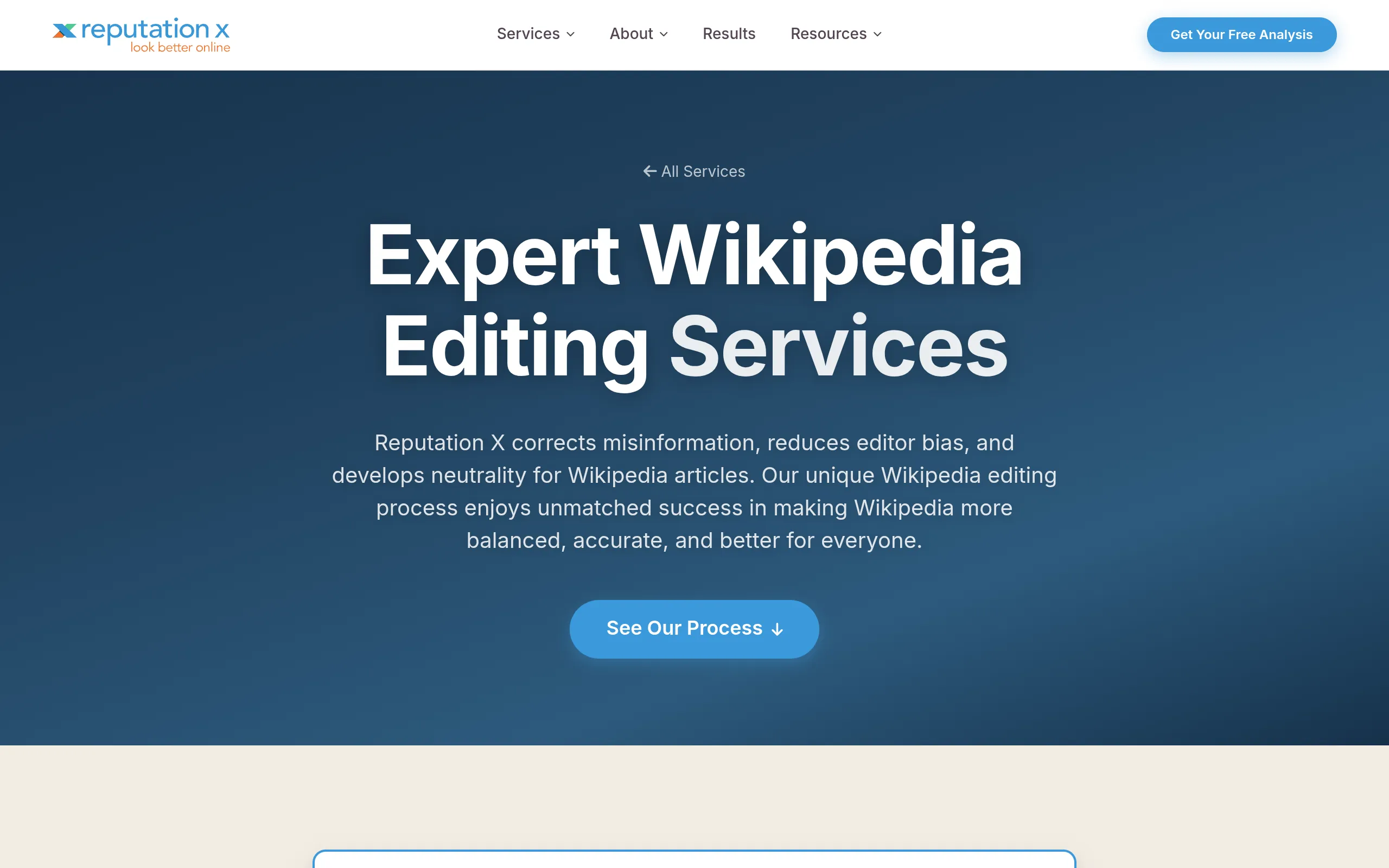
Reputation X is a compliance-forward Wikipedia editing service built around a peer-review workflow and trusted third-party editors. It fits brands and executives with high-visibility pages where a bad edit carries reputational risk. The standout is structural: it uses third-party editors rather than house accounts, which keeps disclosure cleaner and edits more durable.
It publishes a 95%-plus edit acceptance figure and a 45-day improvement-or-refund guarantee. Treat the acceptance number as a marketing claim, not verified data, since no methodology is shared. What’s genuinely useful here’s the tiered service model that matches effort to page risk.
- Best for: High-stakes or disputed pages needing peer review and protection
- Pricing model: Tiered service levels, with a 45-day guarantee
- Standout feature: Third-party editors plus ongoing monitoring and vandalism protection
2. Reputn: Best for Long-Term Page Stability
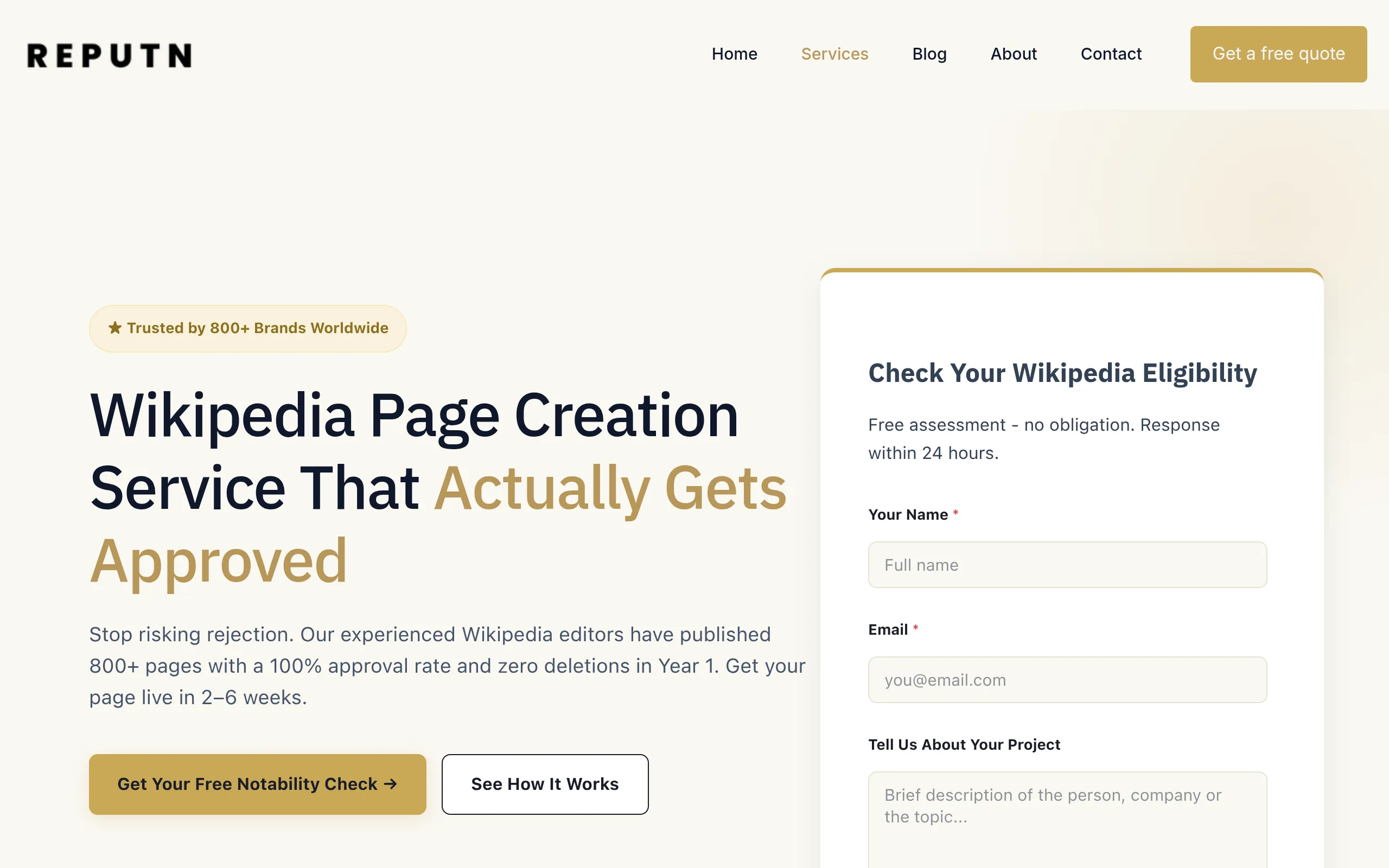
Reputn positions itself as a compliance-first provider with notability review, source research, and a protection-focused approach. It suits notable clients who care less about speed and more about keeping a page live and accurate over time. The differentiator is its post-publication protection: a one-year protection plan and a strict non-disclosure policy.
Reputn also offers a notability and source review before any work begins, which is the honest first step every serious provider should run. If your subject doesn’t clear notability, no amount of editing keeps the page alive.
- Best for: Notable clients who want long-term survival and confidentiality
- Pricing: No public rate card, quoted after a free audit
- Standout feature: One-year protection plan plus strict non-disclosure policy
- Free audit or trial: Yes, a notability and source review
3. WikiWriters.co.uk: Best for Fast, Straightforward Cleanup

WikiWriters.co.uk is a UK-based editing service built around speed, with a free eligibility check and no-charge revisions. It works best for brands and individuals who need practical cleanup on a page that’s already stable, not a contested rewrite.
The free eligibility check up front is a sensible filter that spares you from paying for an edit that can’t pass review.
One caution: it advertises a 100% success rate and a five-day approval promise. No service controls Wikipedia’s volunteer reviewers, so read those numbers as aspirations and ask exactly what happens if a page is rejected.
- Best for: Straightforward edits and citation cleanup on stable pages
- Pricing model: Budget-friendly, with free revisions
- Standout feature: Free eligibility check before any work starts
4. Lumino Digital: Best for Complex, Sensitive Cases

Lumino Digital is a consulting-heavy Wikipedia firm aimed at large companies and public figures with complex or reputation-sensitive situations. It fits buyers who want hands-off expertise on difficult engagements rather than a quick page edit.
The differentiator is its disclosure-first stance: it warns openly against undisclosed editing and routes conflict-of-interest changes through talk pages and Articles for Creation.
That ethics posture is the reason to consider it. The trade-off is a lack of public pricing, process steps, or timelines, so you’ll need to scope the engagement directly.
- Best for: Complex, sensitive, or reputation-driven Wikipedia work
- Pricing: No public rate card, quoted per engagement
- Standout feature: Disclosure-first consulting with talk page and AfC routing
5. Beutler Ink: Best for an Ethics-First Process
Beutler Ink offers notability and source review, drafting and editing, plus its WikiWatch-style monitoring, consulting, and team training. It serves corporations and public figures with established notability who want a process they can defend.
The standout is the combination of an ethics-first approach with structured monitoring, which is what separates durable work from edits that quietly get reverted.
Training is the underrated piece here. A team that understands disclosure and sourcing keeps a page healthy long after the engagement ends, which is the opposite of dependency on any single vendor.
- Best for: Established brands and figures wanting monitoring plus training
- Pricing: No public rate card, scoped per Wikipedia engagement
- Standout feature: Ethics-first review with WikiWatch-style page monitoring
6. Elite Wiki Publishers: Best for Personal Branding
Elite Wiki Publishers handles page creation, cleanup, and ongoing management across multiple industries, with a broad positioning around personal branding. It fits entrepreneurs, authors, and professionals who want help establishing a presence rather than defending a contested page. The benefit is breadth: it covers the full lifecycle from drafting to maintenance under one roof.
The weakness is evidence. Its claims lean on awards and counts without verifiable third-party proof, so press hard on sourcing standards and what happens when Wikipedia rejects a draft.
- Best for: Entrepreneurs, authors, and professionals building a first page
- Pricing: No public rate card, Wikipedia projects commonly quoted in the low five figures
- Standout feature: Full lifecycle service from drafting to maintenance
7. WikiCreation.co.uk: Best for Budget-Conscious Edits

WikiCreation.co.uk is a cost-efficient option for simpler edits and basic maintenance where price is the deciding factor. It suits small businesses and creators who need a light-touch page improvement and have realistic expectations. The appeal is straightforward affordability for low-complexity work.
It claims a page can go live in under ten days, which is plausible for uncontested edits but unreliable for anything contested. Confirm whether the quote covers source research and revisions, because budget providers often scope those out.
- Best for: Simple edits and basic maintenance on a tight budget
- Pricing model: Cost-efficient, low-complexity work
- Standout strength: Low-cost, light-touch edits with a fast turnaround on uncontested pages
Wikipedia Editing Service Comparison
Use this table to narrow the shortlist before you contact anyone. Where a provider doesn’t publish verifiable detail, the field reflects that rather than inventing a value.
| Service | Best For | Standout Strength |
|---|---|---|
| Reputation X | High-stakes, disputed pages | Peer review plus third-party editors |
| Reputn | Long-term page stability | One-year protection plan |
| WikiWriters.co.uk | Fast, straightforward cleanup | Free eligibility check |
| Lumino Digital | Complex, sensitive cases | Disclosure-first consulting |
| Beutler Ink | Ethics-first process | Monitoring plus team training |
| Elite Wiki Publishers | Personal branding | Full lifecycle service |
| WikiCreation.co.uk | Budget-conscious edits | Affordable, low-complexity work |
We picked these seven on policy knowledge, source vetting, process transparency, monitoring, and buyer fit, drawn from each provider’s published positioning. Confirm scope, revision rules, and disclosure practice with any provider before you sign, since published claims and delivered work don’t always match.
Which Wikipedia Service Fits Your Needs
Match the provider to your risk level first, then your page complexity, then your budget. That order keeps you from buying a cheap edit for a page that needs defense, or paying for consulting on a page that needs a single citation fix.
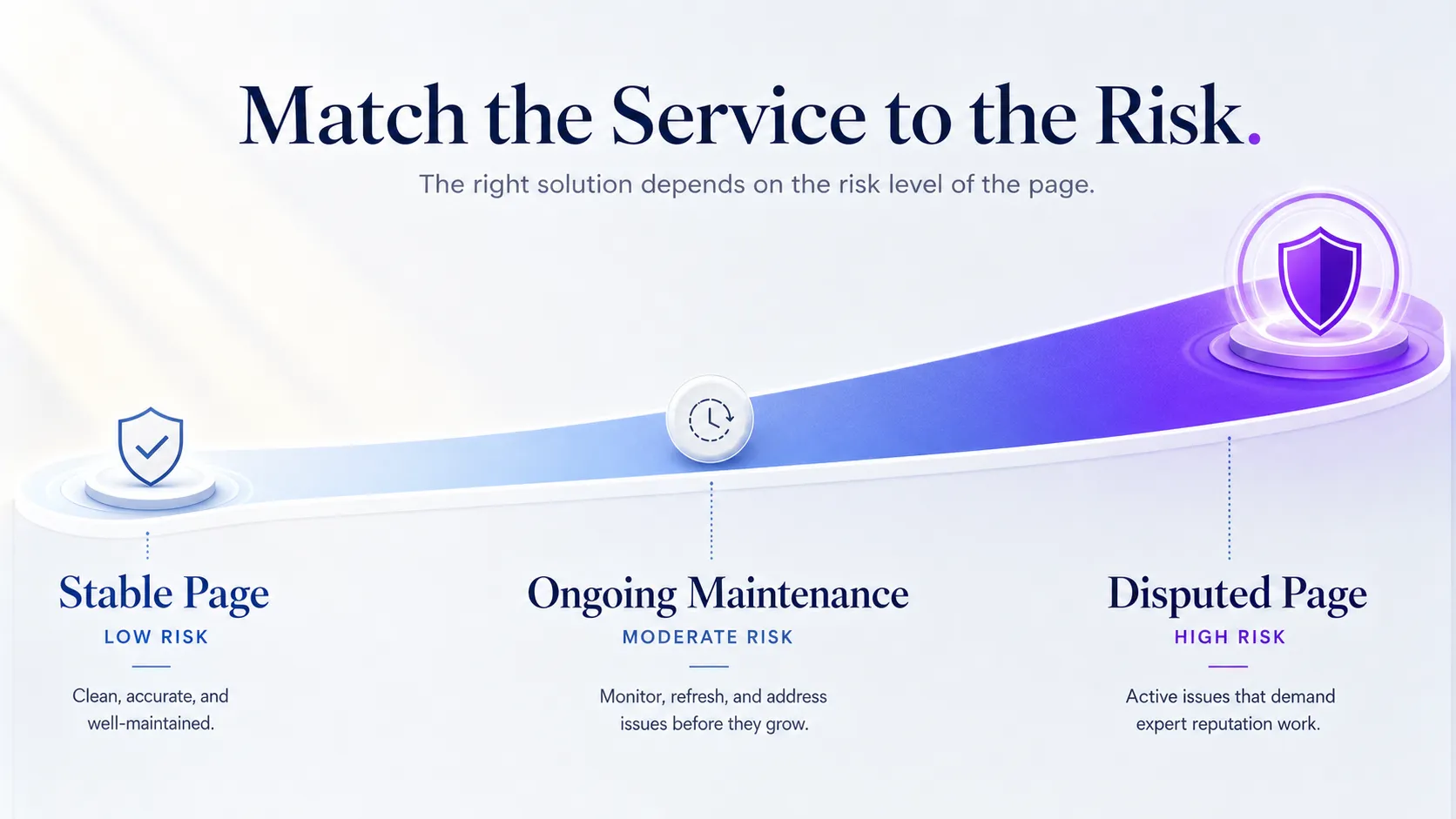
For high-risk, high-profile, or disputed pages, choose the compliance-forward options like Reputation X, Reputn, or Lumino Digital. These carry peer review, protection plans, and dispute handling, which is what a contested article actually needs.
For straightforward edits or citation cleanup on a stable page, a lighter-touch option like WikiWriters.co.uk or WikiCreation.co.uk does the job at lower cost. There’s no reason to pay for consulting when the page is healthy and the fix is a few references.
For reputation management and long-term protection, prioritize the monitoring-heavy providers. Beutler Ink and Reputn both build post-edit coverage into their model, and that watchlist work is what catches a quiet revert before it spreads.
Before you hire anyone, run a short checklist:
- How do you disclose paid or conflict-of-interest editing?
- What source standards must references meet?
- What’s the revision policy if Wikipedia rejects the change?
- How long does monitoring run after publication?
- Who actually performs the edits, in-house accounts or third-party editors?
The one red flag worth repeating: any service promising guaranteed publication or a fixed approval rate without evidence is selling certainty it can’t deliver. Choose by use case, not by the loudest marketing line. If you want to see how Wikipedia citations connect to broader AI visibility, our brand mention programme shows where it fits.
Frequently Asked Questions
Are Wikipedia editing services allowed?
Yes, Wikipedia editing services are allowed when they follow disclosure rules. Anyone can edit Wikipedia, but paid editors and those with a conflict of interest must disclose the relationship and, in most cases, propose changes through talk pages or Articles for Creation rather than editing the article directly.
Can I pay someone to edit my Wikipedia page?
You can pay someone to edit your Wikipedia page, but the editor must disclose that they’re being paid. Undisclosed paid editing violates Wikipedia policy and can get edits reverted, the page flagged, or the account banned. A compliant service handles disclosure for you and routes conflict-of-interest changes through the proper channels.
How do I know if a Wikipedia editing service is compliant?
A compliant service explains its disclosure process before you ask. Look for clear answers on how it handles conflict-of-interest editing, whether it uses third-party editors or house accounts, and how it sources references. If a provider dodges the disclosure conversation or relies on anonymous direct edits, treat that as a warning sign.
Do any Wikipedia services guarantee approval or publication?
No legitimate Wikipedia service can guarantee approval. Final decisions rest with volunteer editors and depend on whether your subject meets notability standards and has reliable, independent sources. Any provider advertising a 100% success rate or guaranteed publication is overpromising, and that claim alone should make you cautious.
What should I ask before hiring a Wikipedia editor?
Ask about disclosure, sourcing, revisions, monitoring, and who does the work. A practical example: if a provider says it can fix your declined draft, ask what specific notability and source gaps caused the rejection and how it will close them. A vendor that answers in detail understands Wikipedia; one that promises a quick approval doesn’t.
The honest reality is that no service controls Wikipedia, so the best one is whichever proves it can work within the rules for your specific page. A disputed corporate article needs a different provider than a stable founder bio that needs two new citations.
Shortlist the provider that fits your risk level, then request a source and compliance audit before you sign so you know exactly what you’re buying. See where your brand stands in AI search if Wikipedia is one piece of a wider visibility push.