
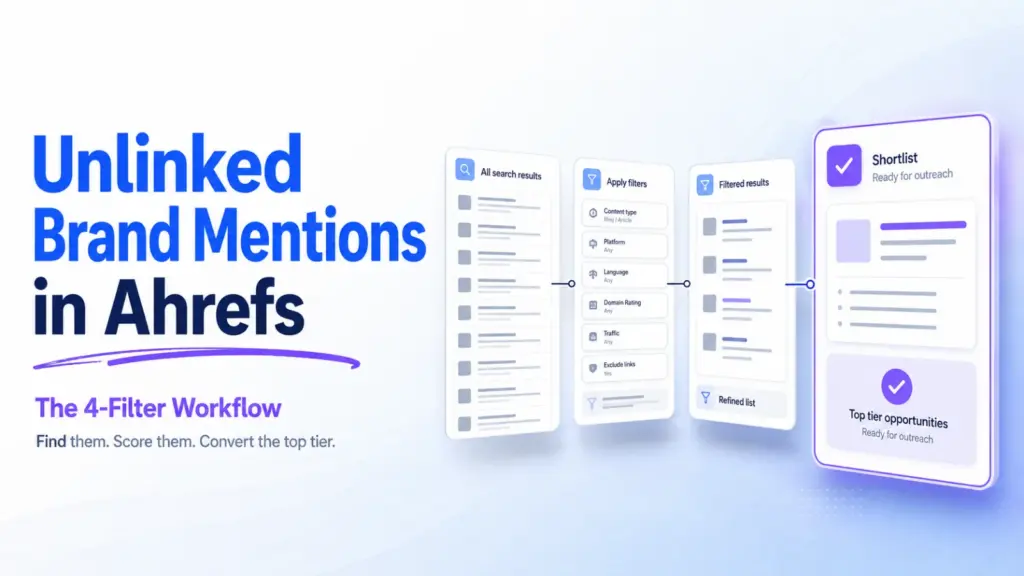

Ahrefs Content Explorer will hand you thousands of pages that mention your brand. Most of them aren’t worth your time.
The filtering is the job, not the search. A raw brand search on a known company returns tens of thousands of results. The useful ones sit buried under comment threads, author bios, navigation templates and autogenerated related-post blocks.
Here’s the four-filter workflow that cuts that list to something you can run outreach against, plus the page-level check Ahrefs can’t do for you.
The Short Version
- Content Explorer finds mentions at scale, but the filter order decides whether the list is usable.
- Ahrefs’ “highlight unlinked domains” works at domain level, not page level. You need a second check.
- Filter on DR 30+, 50+ monthly organic visits, your target language, and the last 6 to 12 months.
- Score every mention before you write a single email. Usually only a small top tier is worth an email.
- Reach out within 24 to 48 hours of a mention going live. Recency beats persuasion.
What Is an Unlinked Brand Mention?
An unlinked brand mention is a reference to your company, product, executive or branded term in online content that carries no hyperlink back to your site.
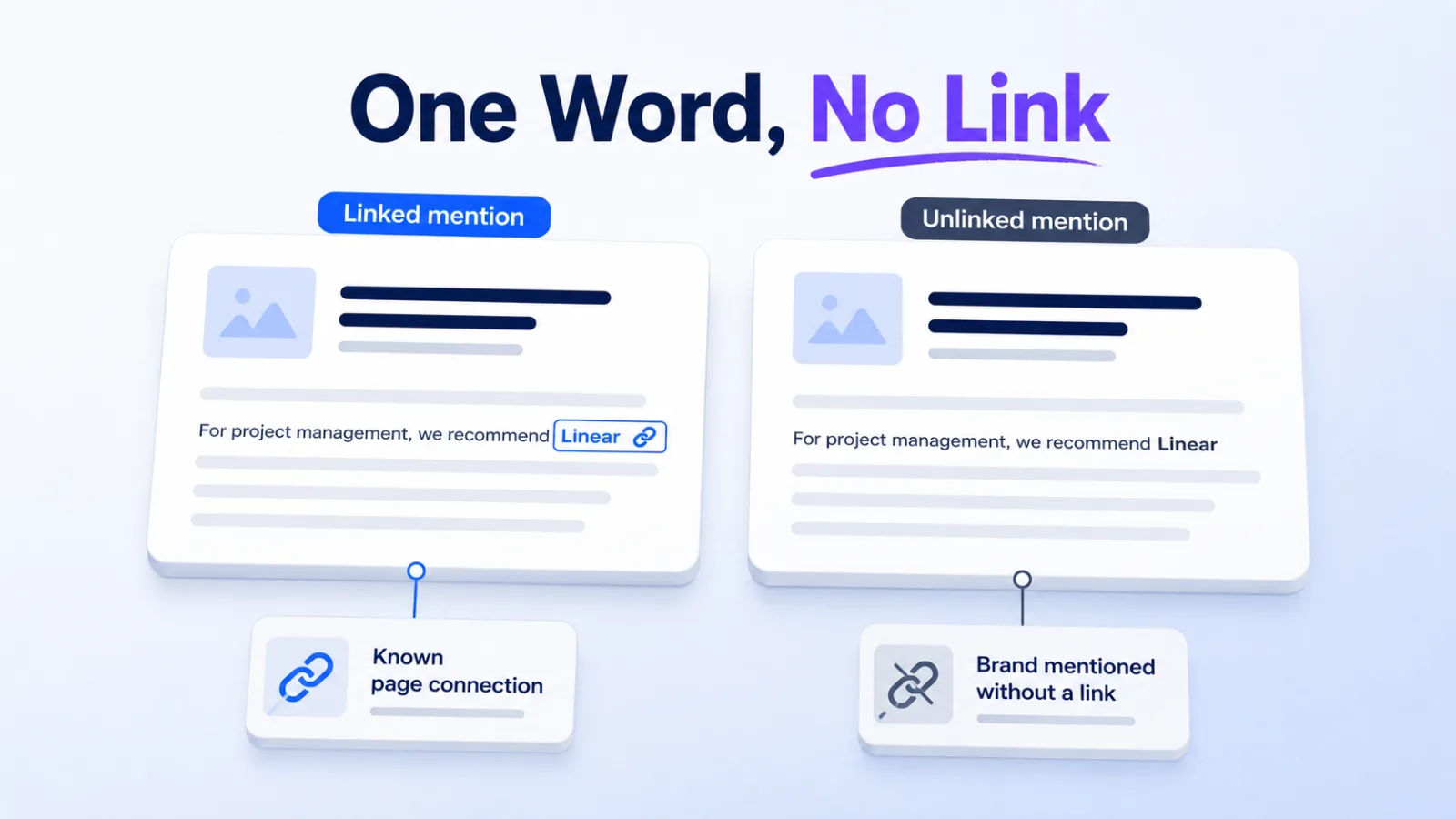
The name is in the text. There’s nothing for a reader or a crawler to follow.
A review blog writing “tools like Acme Analytics help teams track conversion rates” without linking to acmeanalytics.com is the whole pattern. Positive context, real placement, no link equity.
Why Unlinked Mentions Are Worth Chasing
They’re worth chasing because each one is a link you’ve already earned and haven’t collected.
The author chose to reference you. They researched the category, picked your brand, and wrote it into their copy. That’s the hard part of link building, already done.
Converting it takes one email rather than a pitch, a relationship, or a paid placement. That’s why reclamation outreach usually converts better than cold guest-post pitches.
Reclamation sits inside link building, or linkbuilding as it’s often written. It’s the one tactic in that category where the prospect already knows who you are.
There’s a second reason that matters more since 2026. Models retrieve from pages that reference a brand consistently.
An unlinked mention on a source an engine already reads still does entity work, even if nobody clicks it. We covered what Ahrefs’ own mention data shows in Ahrefs brand mentions.
Google’s John Mueller has said plainly that unlinked mentions aren’t treated as links. That’s still true. It isn’t the same as saying they do nothing.
How to Find Unlinked Brand Mentions in Ahrefs Content Explorer
To find unlinked brand mentions in Ahrefs, run the base brand query first, then layer filters one at a time so you can see what each one removes.
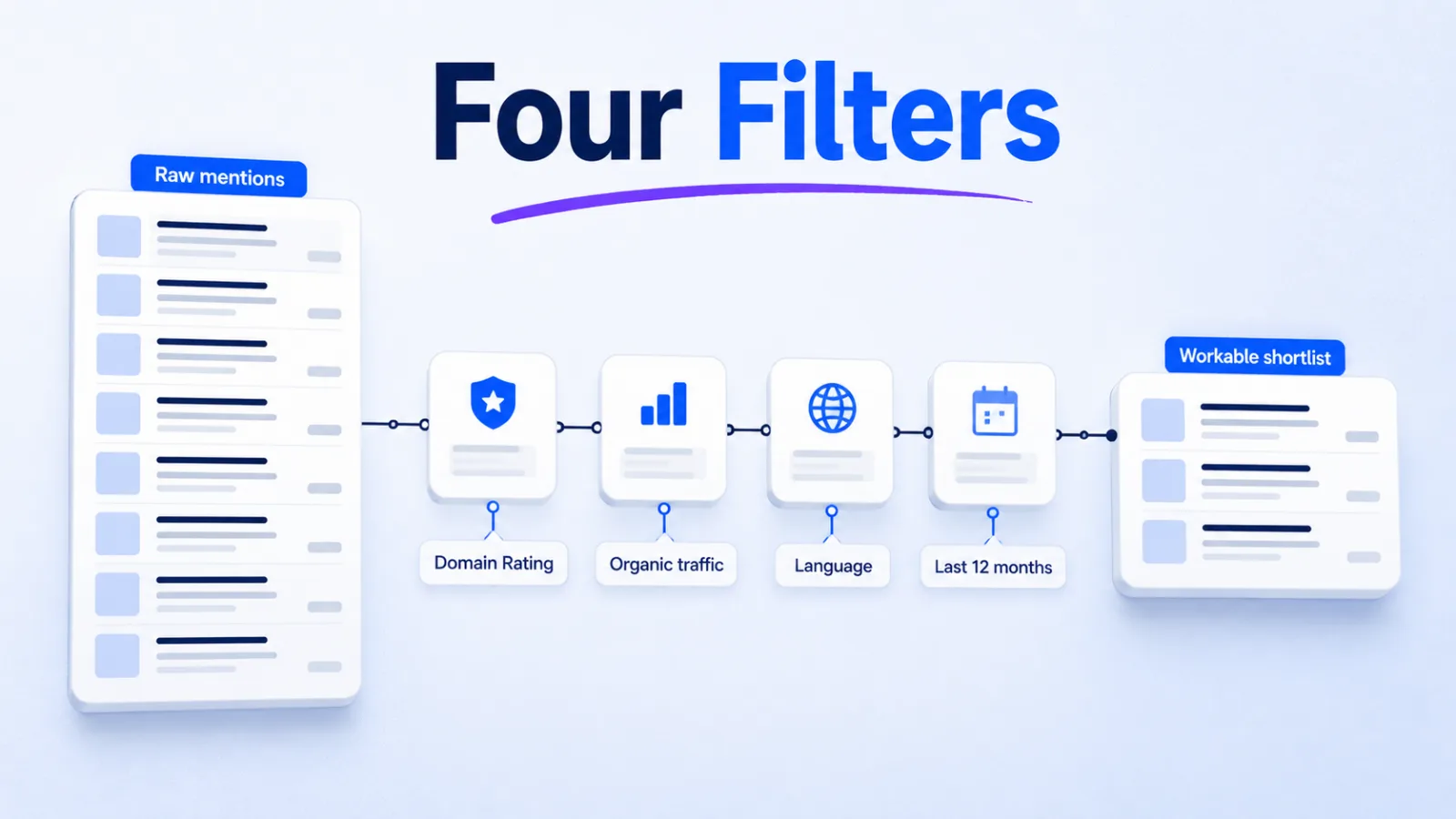
Applying all four at once hides which filter is doing the damage when your list comes back empty.
Step 1: Search your brand name, excluding your own domain
Open Content Explorer, enter your brand name, and set the search mode to “In content” so you capture full page text rather than titles alone.
Append your own domain as an exclusion:
"Acme Analytics" -site:acmeanalytics.com
That returns every page in Ahrefs’ index mentioning your brand that doesn’t live on your own site.
Step 2: Highlight unlinked domains
Click “Highlight unlinked domains” and enter your root domain.
Ahrefs highlights every result where the mentioning domain has never linked to you. Those are your strongest opportunities: sites that already know your brand and have no link relationship with you.
Don’t discard the non-highlighted results. Those domains link to you somewhere, but the specific page mentioning you may not.
Step 3: Apply the four filters
Raw mention counts mislead. These four filters do the actual narrowing.
Domain Rating 30 or above
Higher-DR domains pass more equity if you convert the mention, and they’re the sources models retrieve from more often.
Page organic traffic of 50+ monthly visits
This one quietly does the most work. It confirms the page is live, indexed and read, rather than abandoned or dropped from the index.
Language
Filter to your target language. On a brand with any international footprint this removes more noise than the DR filter does.
Published in the last 6 to 12 months
Authors update recent posts. They rarely reopen something from three years ago.
Export the list once the four are applied. Tick “Only pages with highlighted domains” if you want to work exclusively on domains that have never linked to you.
Step 4: Verify at page level with Screaming Frog
To confirm a specific page doesn’t link to you, crawl it. Ahrefs’ highlight feature answers a domain-level question, and you need a page-level answer.
Import your exported URLs into Screaming Frog and use Custom Search with a “does not contain” filter:
<a [^>]*\bhref\s*=\s*"([^"]*yourdomain\.com[^"]*)
Pages that pass are your confirmed unlinked mentions.
Import the list in list mode, which crawls only the URLs you upload. A 400-URL list stays a 400-URL crawl instead of spreading across every site on it.
Mention Types Most Teams Never Search For
Searching only your company name misses a large share of your mentions.
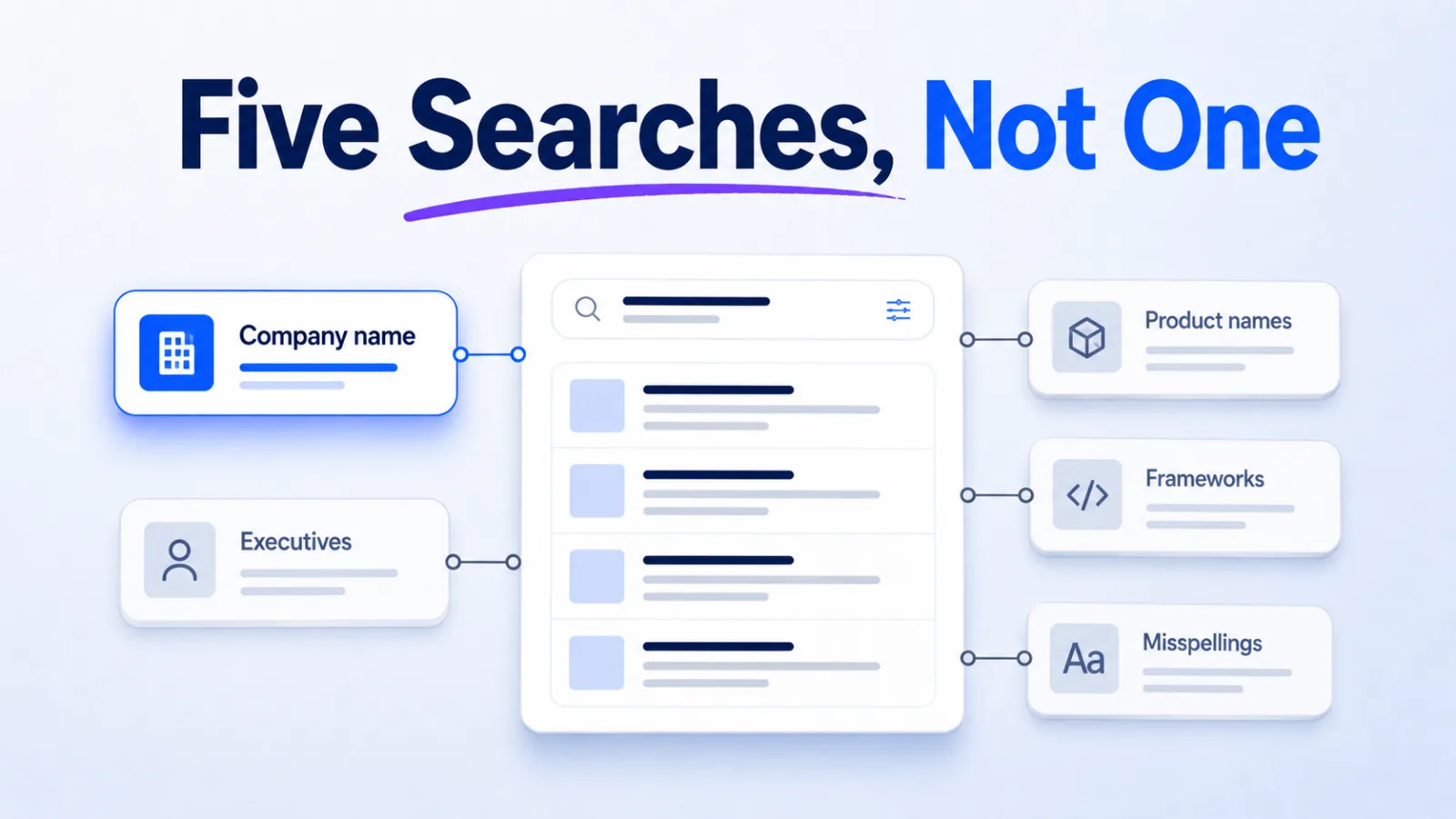
Run these as separate Content Explorer searches, apply the same four filters, then merge the exports into one list.
Product and feature names
Individual tools, service lines, or named features. Reviewers often name the product without naming the company.
Executive names
Founders, your marketing lead, anyone who gets quoted. Press coverage names people far more often than it names companies.
Framework and report names
Branded methodologies, signature research, recurring series. These get cited without attribution more than anything else you publish.
Common misspellings
Run your brand through a typo generator. Misspellings often produce broken links pointing at domains that don’t exist, which are easier conversions than unlinked mentions.
That same list of variants does a second job, too: excluding it is how you see your non-branded keywords in Ahrefs.
Slogans and taglines
Any phrase uniquely yours. Worth one search per quarter rather than per month.
Reverse Image Search Finds Mentions Text Search Can’t
Your original images get reused without attribution far more often than your brand name gets typed.
Right-click any original graphic on your site, choose “Search with Google Lens“, and read the results. Charts, product shots and custom diagrams are the ones that travel.
A publication using your chart has already decided your work is worth showing. That’s a stronger starting position for outreach than a passing name-drop, and almost nobody asks.
How to Prioritise Which Mentions to Act On
To prioritise, score every confirmed mention before writing any outreach.
Not every mention deserves an email. Some sit on dead pages, some are negative, and some are on sites with a standing policy against linking out.
Check whether the site links out at all
Open the page and look for any external link.
News databases, product directories and most enterprise blogs never link externally. Outreach there fails regardless of how good your email is, and it’s the single fastest disqualifier to check.
Read the mention
A detailed reference inside a category discussion converts. A passing name-drop in a listicle rarely does.
Negative mentions need a different move entirely. Correct the substance rather than asking for a link, because a wrong claim about you propagates into AI answers and outlives the page it started on.
Score it
| Criteria | High (3 pts) | Medium (2 pts) | Low (1 pt) |
|---|---|---|---|
| Domain Rating | DR 60+ | DR 30 to 59 | Under DR 30 |
| Page organic traffic | 500+ monthly | 50 to 499 monthly | Under 50 monthly |
| Editorial context | Detailed, positive, on topic | Neutral or brief | Passing or negative |
| Links out to others | Multiple external links | 1 to 2 external links | None |
Nine to twelve points is your top tier and where outreach goes first. Four to eight is secondary. Below four, the mention still does entity work, and chasing it for a link isn’t worth the email.
Outreach That Converts a Mention Into a Link
The reclamation email is the simplest in link building, which is exactly why most teams overwrite it.
Lead with the thank you
They wrote about you without being asked. Say so first, and mean it.
Frame the link as reader value
A link gives their readers a direct path to the thing the author already chose to reference. That’s an improvement to their page, not a favour to your SEO.
Hand over the exact URL and anchor
Include the specific page and suggest anchor text that fits the sentence they already wrote. Make saying yes a two-second job.
Stop at five sentences
Nobody needs your founding story. Three to five sentences, one ask, done.
What kills the reply rate
- Sending identical templates to every mention on the list
- Bundling a link exchange, guest post or “collaboration” into the same email
- Following up more than twice
- Chasing mentions that are years old with no timely reason
Timing beats all of it. Reach out within 24 to 48 hours of a mention going live, because an author will happily edit last week’s post and won’t reopen last year’s.
Mistakes That Waste the Whole Audit
Chasing every mention regardless of quality
A 400-row export feels like progress. Working it top to bottom is how teams spend a week for three links.
Score first. Email the top tier only.
Ignoring negative mentions
A critical mention is not a link opportunity, and it’s usually the more urgent one.
Wrong claims about your product propagate into AI answers and outlive the page that started them. Correct the substance, and skip the link ask entirely.
Treating it as a one-time campaign
Mentions accumulate continuously. A single audit captures a snapshot and then decays.
Emailing sites that never link out
Check for a single external link before writing anything. It takes five seconds and disqualifies more rows than any other check.
Measuring only the links you won
Reclamation outreach that fails still leaves the mention in place, doing entity work. Judging the audit purely on converted links undercounts it.
Setting Up Ahrefs Alerts for Ongoing Monitoring
To catch mentions as they publish, set a Mentions alert in Ahrefs for your brand name and your main product terms.
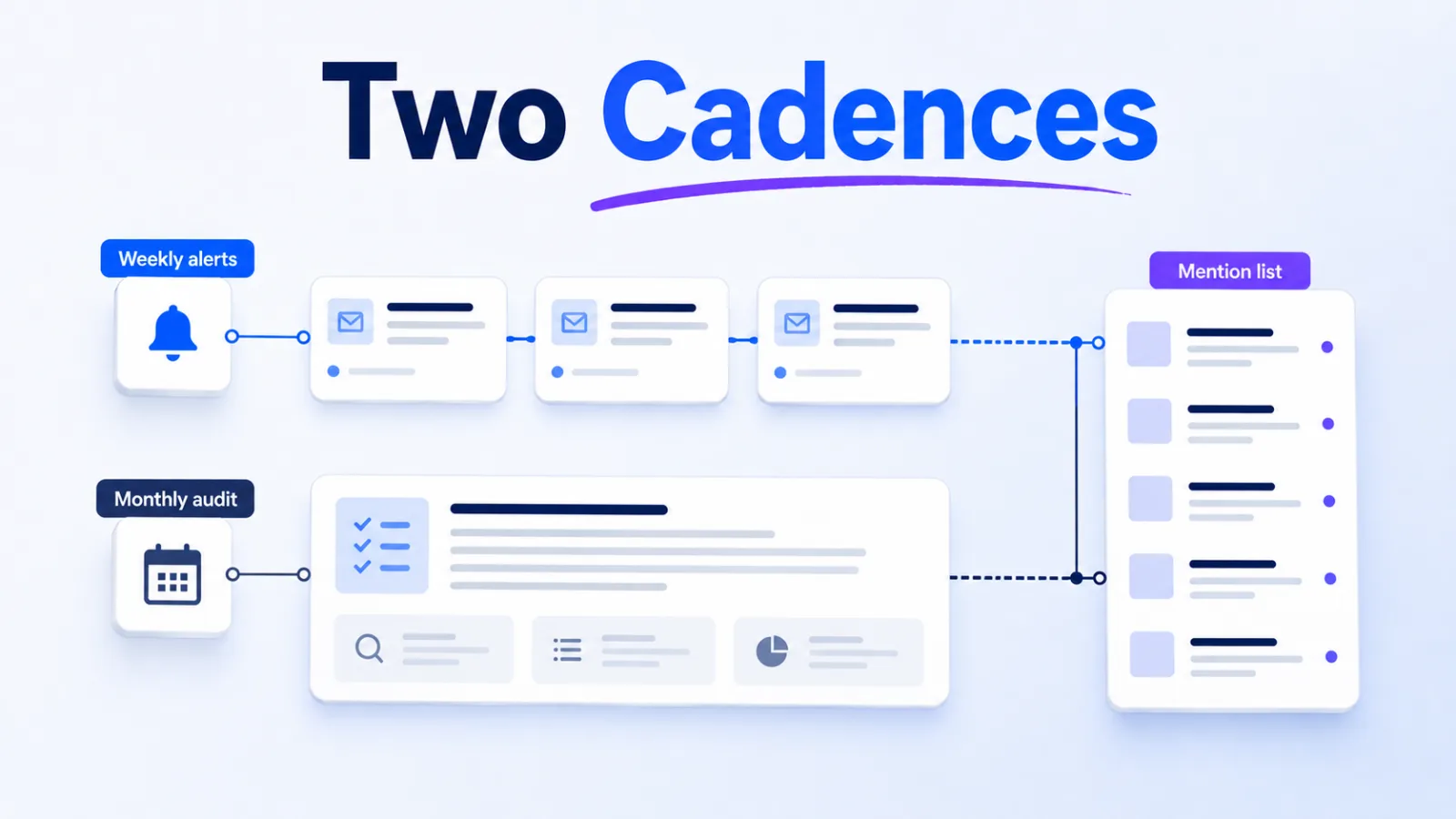
Review the results weekly rather than daily. Daily turns into noise you stop opening.
Alerts have one blind spot worth knowing. Ahrefs doesn’t document whether an edit to an older page triggers them. Don’t count on alerts to catch a page quietly changed months later to link to somebody else instead of you.
A monthly re-run of the full Content Explorer audit is the only thing that catches those.
Make It a Monthly Habit
Unlinked mention work compounds badly when it’s a one-off campaign and well when it’s a standing hour in the calendar.
Run the four-filter audit monthly. Verify the new list in Screaming Frog. Score it, email the top tier within two days, and let the rest sit as entity signal.
If you’d rather have that run for you, that’s what our unlinked mention reclamation work does.
The Limits of Ahrefs for Mention Tracking
Ahrefs indexes published web pages, which is most of where mentions live and not all of it.
Content Explorer misses most social and forum mentions
Reddit threads, X posts and community discussion sit largely outside Content Explorer. Ahrefs has started covering Reddit, YouTube and TikTok in Brand Radar as a beta, and a dedicated social listening tool still covers more of that ground.
AI answers need Brand Radar, not Content Explorer
Content Explorer can’t tell you whether ChatGPT recommends you. Ahrefs measures that separately in Brand Radar, which tracks mentions and citations across ChatGPT, Perplexity, Gemini, Copilot, AI Overviews and AI Mode.
It lags on recent mentions
Index freshness varies. Alerts narrow the gap, and for genuinely time-sensitive coverage a news monitoring tool still beats it.
Ahrefs handles the reclamation workflow well. It was never built to be a full brand monitoring stack, and using it as one is how teams conclude their mentions have dried up.
Frequently Asked Questions
Does Ahrefs show which mentions are unlinked automatically
Partly. The “highlight unlinked domains” toggle in Content Explorer flags domains that have never linked to you, which is a domain-level answer.
A page-level check needs a crawler. That’s what the Screaming Frog step above is for.
How often should I check for new unlinked mentions
Weekly for alerts, monthly for the full audit.
Alerts catch new publications while the author still cares about the post. The monthly audit catches everything alerts miss, including pages edited after publication.
Are unlinked mentions worth anything without the backlink
Yes, though not in the way a link is.
They don’t pass equity. They do put your brand in front of a real audience. On sources AI engines retrieve from, they add to the corroboration that decides which brands get cited.
What conversion rate should I expect from reclamation outreach
Higher than cold outreach, and it depends almost entirely on your filtering.
A scored list worked in the first 48 hours converts far better than the same list emailed in bulk a month later. Publish your own numbers rather than trusting anyone’s benchmark, including ours.
Can I find unlinked mentions of my competitors
Yes, and it’s the more useful search.
Run the same Content Explorer query against a competitor’s brand, then filter to pages that mention them and not you. That’s a list of publications already writing about your category who have never heard from you.
Run One Search This Week
Open Content Explorer and search your brand name with your own domain excluded. Don’t filter anything yet.
Look at the raw count, then apply the traffic filter alone and look again.
The gap between those two numbers is the amount of work you’d have wasted without it, and it’s usually the moment this stops feeling like a chore.