
Most share of voice tools measure what’s easy to count, not what actually moves market position. You’ll find platforms that track Twitter mentions to the decimal but miss half the Reddit threads where buyers are comparing you to competitors. Others scrape press coverage beautifully and ignore organic search entirely. After running these tools across B2B campaigns in 2026, here’s what holds up, and what doesn’t.
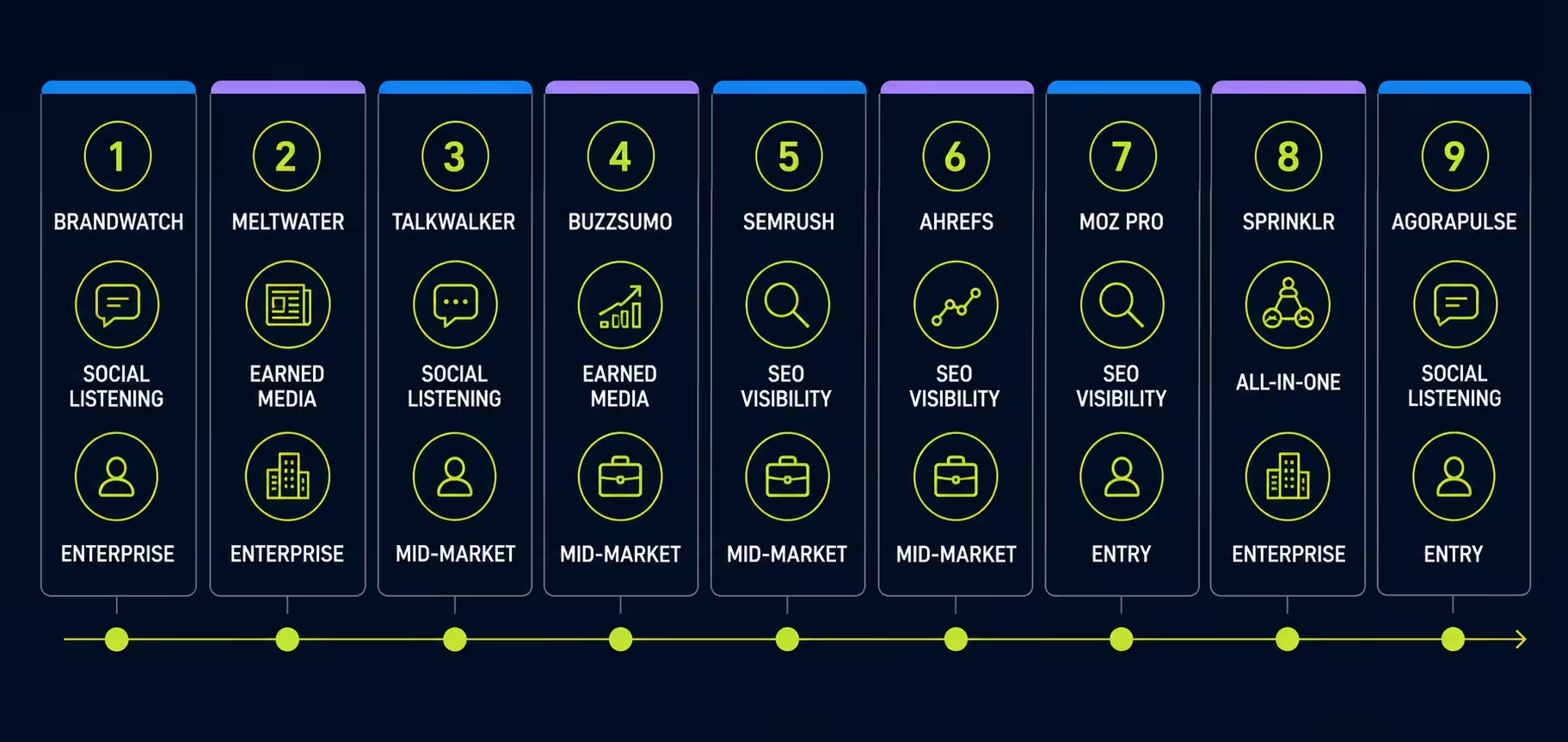
The short answer: Sprout Social, Brandwatch, Meltwater, Brand24, Talkwalker, Semrush, Ahrefs, Mention, and Mentionlytics are the nine share of voice tools worth evaluating for B2B teams in 2026. Each one wins on a specific channel or use case. None of them does everything well.
The Short Version
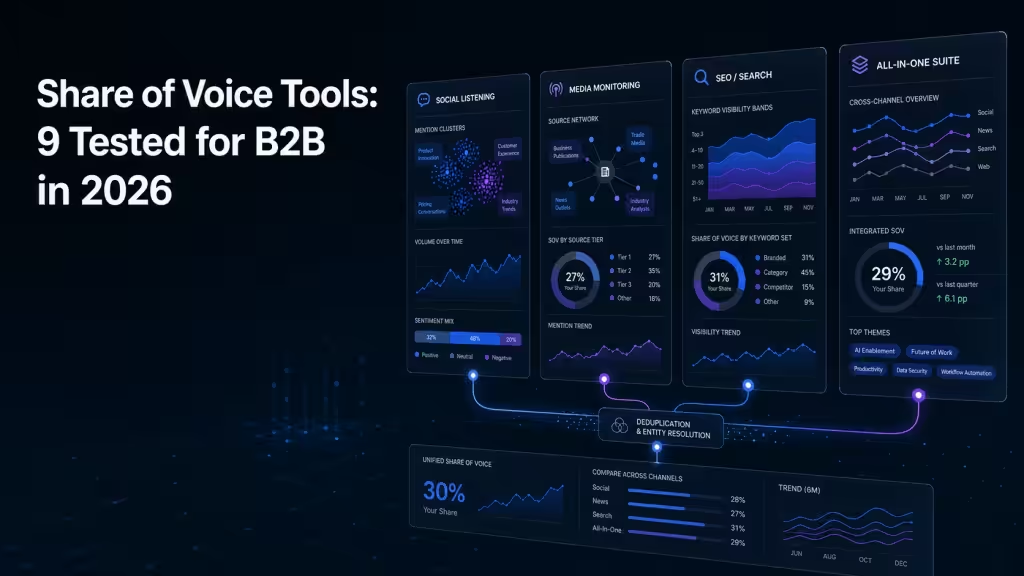
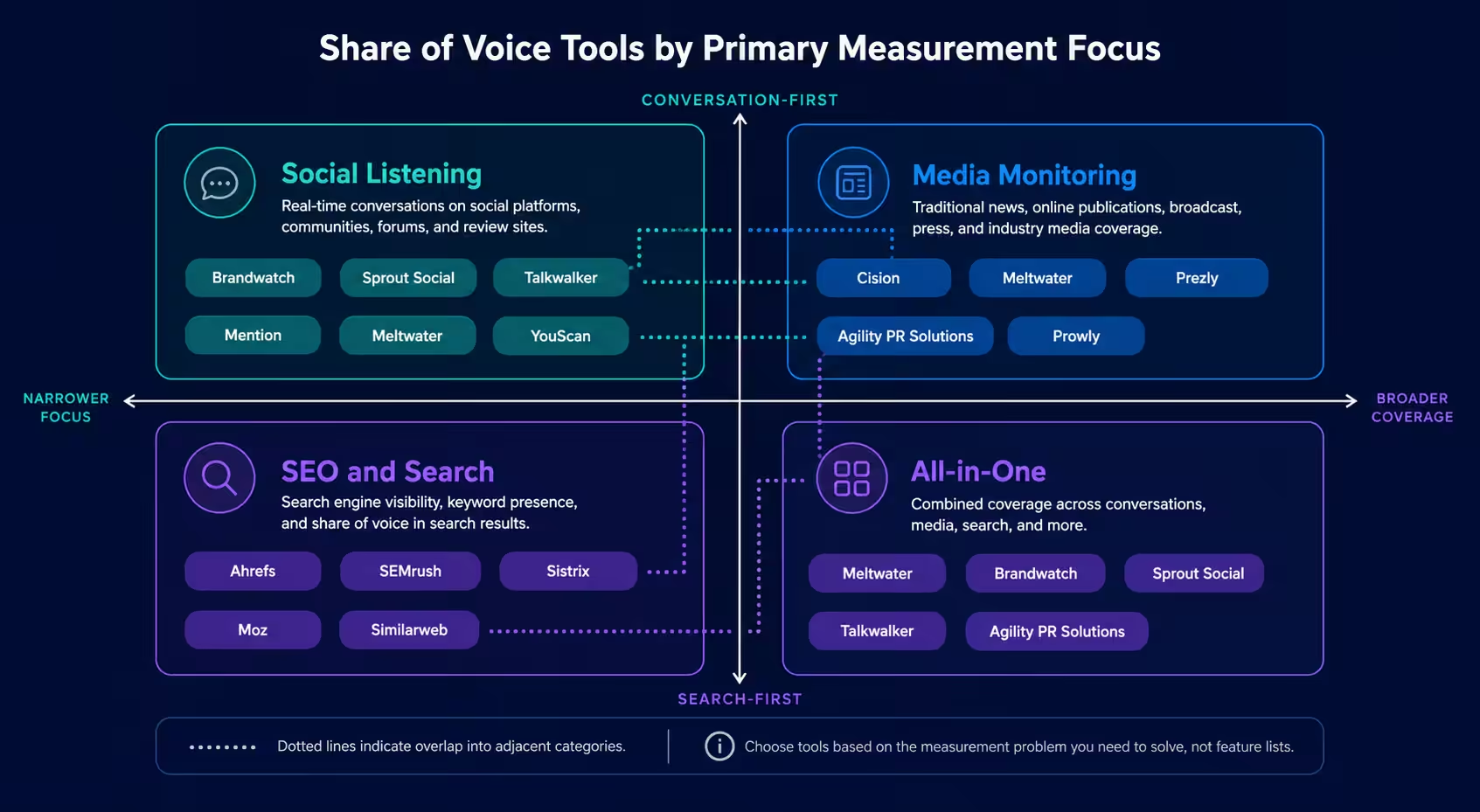
- Share of voice tools split into four categories: social listening, media monitoring, SEO/search, and all-in-one platforms, most teams need two, not one.
- Sprout Social and Brandwatch lead social listening accuracy; Meltwater dominates earned media; Semrush and Ahrefs own search SOV.
- Pricing ranges from $24/month (Brand24 entry) to $25,000+/year (Brandwatch enterprise), the gap reflects data depth, not feature lists.
- The biggest accuracy killer is duplicate mention counting across syndicated sources. Only four of the nine tools dedupe well by default.
- For B2B teams under 100 employees, the practical stack is one social listening tool plus one SEO tool, combined cost should sit between $300 and $800/month.
What Share of Voice Tools Actually Measure
Share of voice is the percentage of conversation, coverage, or visibility your brand owns in a defined category, relative to named competitors. The formula is simple: your mentions divided by total mentions across your competitive set, multiplied by 100.
The complication is what counts as a mention. Social listening tools count posts and replies. Media monitoring tools count articles and broadcast clips. SEO tools count keyword visibility or impression share. Each one tells you something different, and a “30% share of voice” in one tool can be a “12% share” in another for the same brand, in the same week.
This is why category clarity matters more than tool selection. Pick the channel that actually decides your market position, then pick the tool that measures it accurately. For most B2B companies in 2026, that means social plus search, and earned media if PR is a real channel for you.
The Four Categories, and Why You Need Two
Social listening tools (Sprout, Brandwatch, Brand24, Mention, Mentionlytics, Talkwalker) pull from Twitter/X, LinkedIn, Reddit, forums, blogs, podcasts, and news. They’re built to count conversation volume and sentiment. They’re weak on search visibility and weak on broadcast coverage.
Media monitoring tools (Meltwater, Talkwalker) prioritize earned media, press articles, broadcast, podcasts, sometimes social as a secondary feed. They have stronger journalist databases and outlet weighting. They’re heavier and slower than pure social listening platforms.
SEO and search tools (Semrush, Ahrefs) measure share of voice as keyword visibility, what percentage of category-relevant search results your domain occupies. This is the closest thing to a leading indicator of organic demand capture.
All-in-one platforms attempt to blend all three. They almost always blend poorly. The data depth on each channel is shallower than what a specialist tool delivers, but for small teams the consolidation can be worth the tradeoff.
The 9 Share of Voice Tools Worth Evaluating in 2026
What follows is the head-to-head. Pricing reflects 2026 published rates as of this writing. Accuracy notes are based on running each tool against the same brand and competitor set over a four-week window.
1. Sprout Social. Best for Social Listening Accuracy
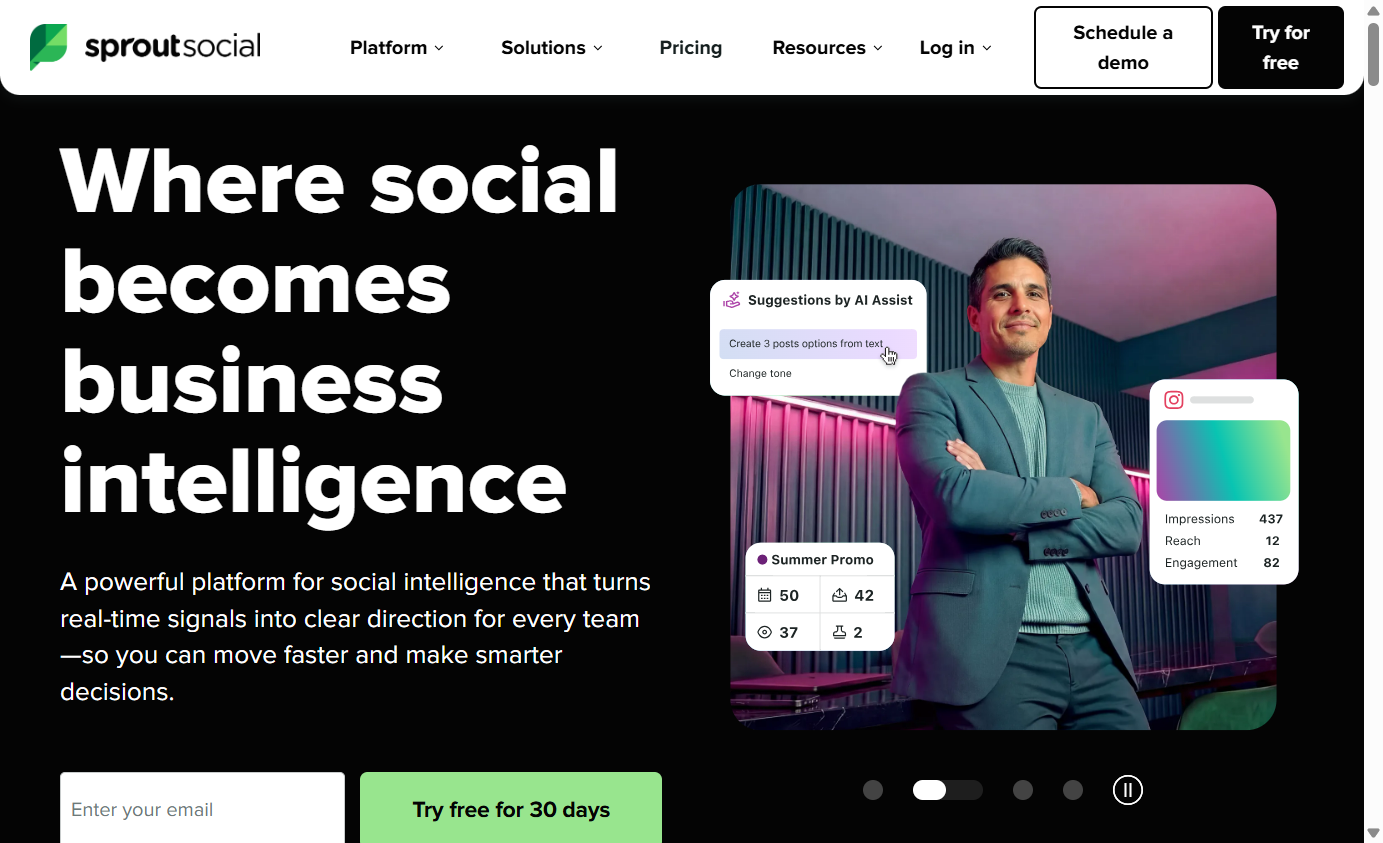
Sprout’s Listening product is the cleanest social SOV measurement we’ve used. Query builder is precise, Boolean operators work the way you’d expect, and the share of voice dashboard handles competitor comparison without making you export to a spreadsheet.
The deduplication logic is strong, retweets, quote tweets, and cross-platform syndications get collapsed properly. Sentiment is reliable for English content, less so for non-English. Pricing starts at $249/user/month for the Standard tier, but Listening is a paid add-on on top of that. Realistic budget for a mid-market team: $600 to $1,200/month.
Where it falls short: limited Reddit and forum coverage compared to Brandwatch or Talkwalker. If B2B buyers in your category live on Reddit, supplement with something else.
- Best for: Mid-market teams that want clean Boolean queries and a competitor-comparison dashboard without spreadsheet exports
- Pricing: $249/user/month (Standard) + Listening add-on; realistic budget $600-$1,200/month
- Standout strength: Strong deduplication logic across retweets, quote tweets, and cross-platform syndications
2. Brandwatch Consumer Intelligence. Best for Enterprise Depth
Brandwatch (now part of Cision) has the deepest historical archive of any social listening tool, 12+ years of indexed conversation. For B2B teams running competitive intelligence at scale, this is the depth advantage that justifies the price.
The query language is powerful and the source coverage extends well beyond mainstream social into forums, niche communities, and review sites. Custom dashboards are flexible enough to build a real SOV measurement system around.
Pricing is enterprise, typical contracts land between $1,000 and $3,000/month, with custom builds going higher. If you have a dedicated insights analyst, Brandwatch pays off. If you don’t, you’ll use 20% of what you’re paying for.
- Best for: B2B teams running competitive intelligence at scale with a dedicated insights analyst
- Pricing: $1,000-$3,000/month typical enterprise contracts, custom builds higher
- Standout strength: 12+ years of indexed conversation history, the deepest archive of any tool here
3. Meltwater. Best for Earned Media SOV
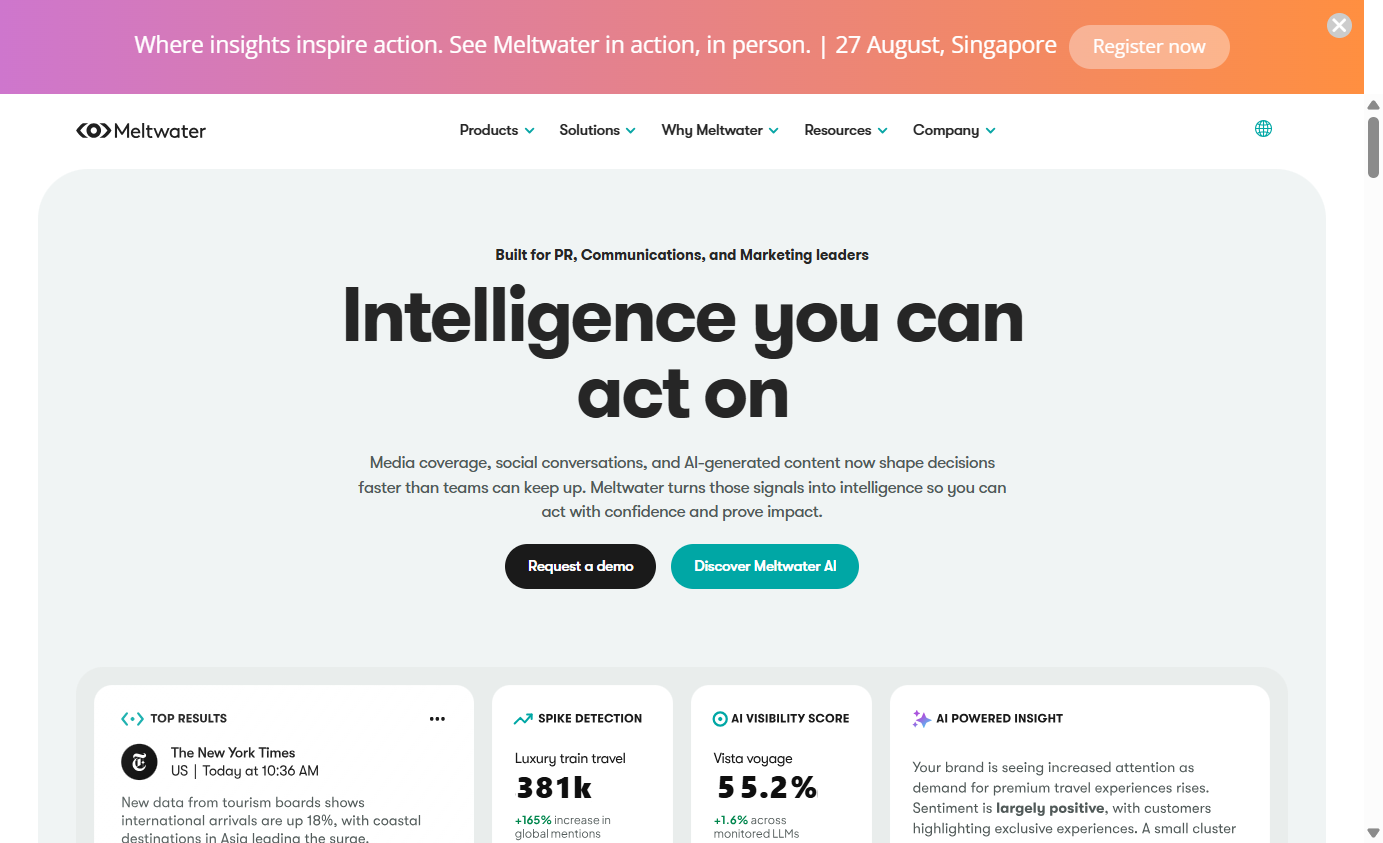
Meltwater is the PR team’s tool. The journalist database, broadcast monitoring, and global press coverage are the strongest in this group. Share of voice across earned media is where Meltwater wins outright.
For social, it works but feels secondary, the UI prioritizes press workflows. Pricing is opaque (you’ll get a custom quote) and typically lands between $8,000 and $25,000/year depending on outlets, geographies, and user count.
Use Meltwater when PR placements are a measured channel with executive visibility. Skip it if your share of voice question is mostly about social and search.
- Best for: PR teams where earned media placements are a measured channel with executive visibility
- Pricing: $8,000-$25,000/year (custom quote)
- Standout strength: Strongest journalist database, broadcast monitoring, and global press coverage in this group
4. Brand24. Best Value for SMBs and Startups
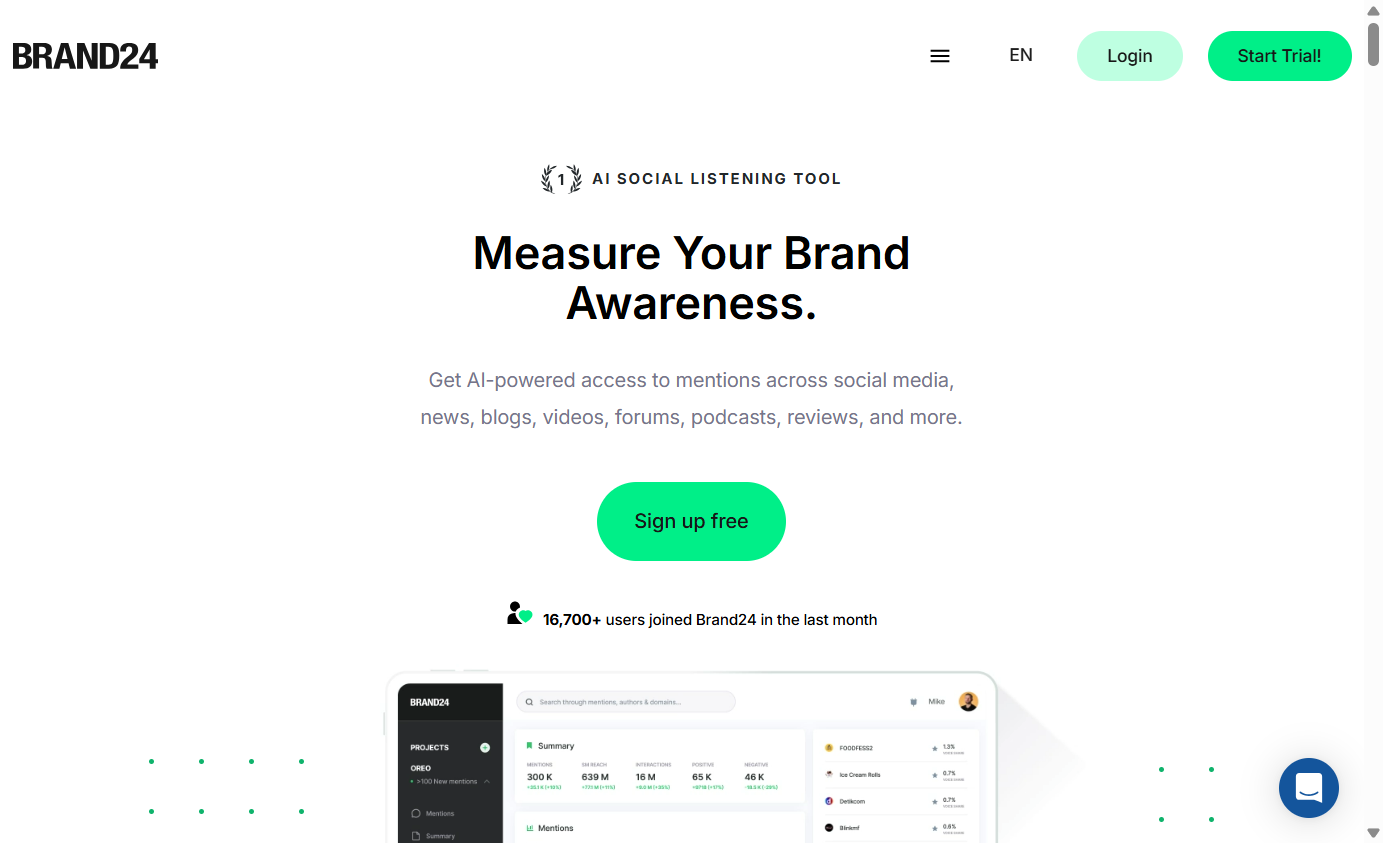
Brand24 is the most accessible tool in this group. Plans start at $24/month for individuals and scale to $349/month for the Pro tier with full SOV features. For startups and small B2B teams that need real data without enterprise budgets, this is the right starting point.
Coverage is solid across social, blogs, forums, news, and reviews. The Discussion Volume Chart and influence scoring are genuinely useful. Its sentiment scoring is fine for trend tracking but not precise enough for high-stakes reporting.
The dedup logic is the weakest in this list. Syndicated press releases get counted multiple times unless you build exclusion filters manually.
- Best for: Startups and small B2B teams that need real SOV data without enterprise budgets
- Pricing: $24/month (individuals) to $349/month (Pro tier with full SOV features)
- Standout strength: Discussion Volume Chart and influence scoring at the most accessible price point here
5. Talkwalker. Best for Multilingual and Image Recognition
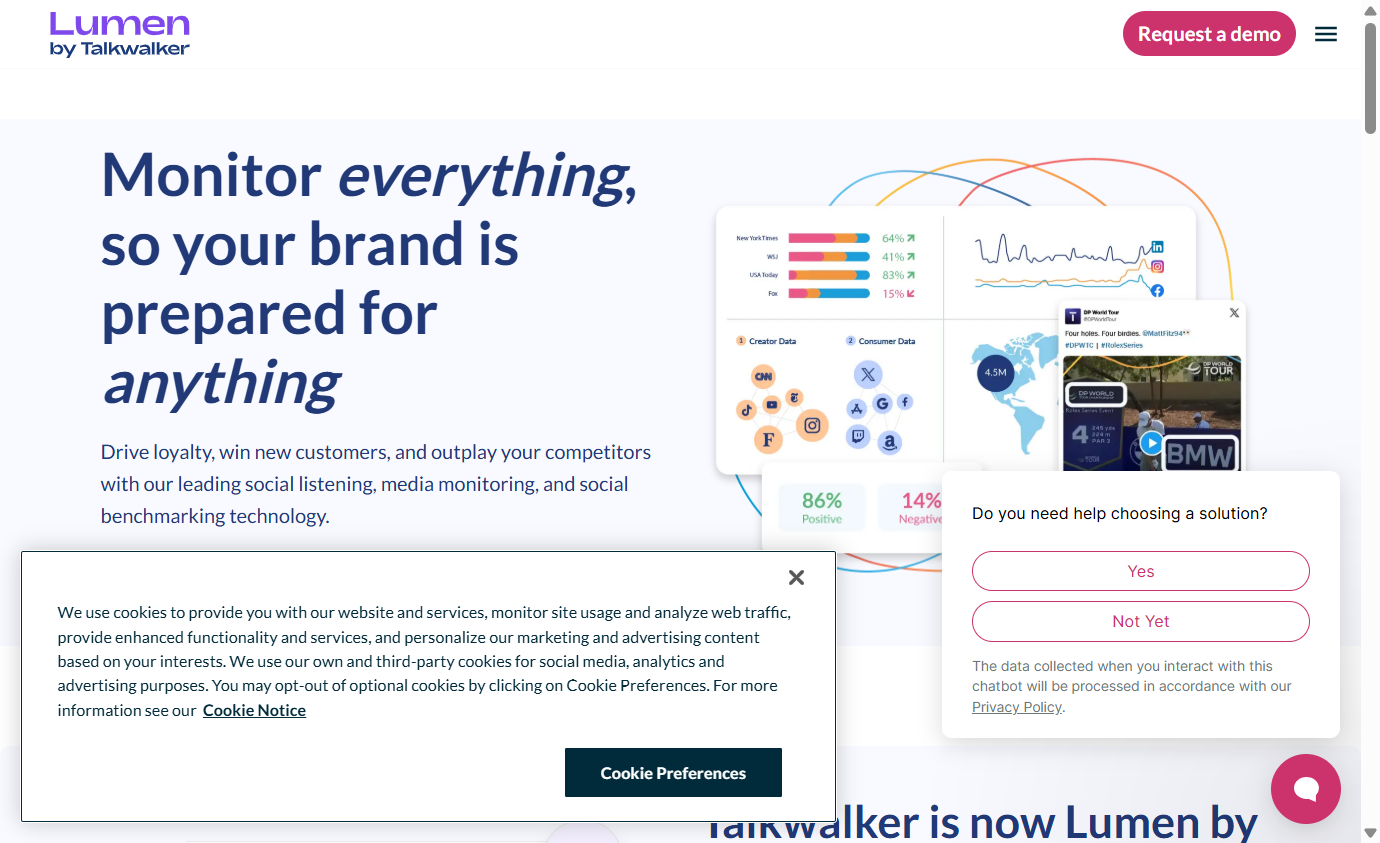
Talkwalker tracks mentions across 30+ languages and includes image and logo recognition, meaning your brand gets counted when it appears visually in a post without a text mention. For global B2B brands, this matters more than it sounds.
The Quick Search tool gives a free 7-day snapshot of any topic, which is genuinely useful for prospect research even if you never buy the full platform. Pricing starts around $9,000/year and scales fast.
Talkwalker and Brandwatch overlap heavily in capability. Talkwalker wins on visual and multilingual; Brandwatch wins on historical depth and query precision.
- Best for: Global B2B brands that need multilingual coverage and visual/logo recognition
- Pricing: Starts around $9,000/year, scales fast
- Standout strength: Tracks mentions across 30+ languages with image and logo recognition
6. Semrush. Best for Search SOV
Semrush’s Position Tracking and Market Explorer give the cleanest read on search-based share of voice. The Visibility Score shows what percentage of category SERPs your domain occupies versus named competitors, and the data refreshes daily.
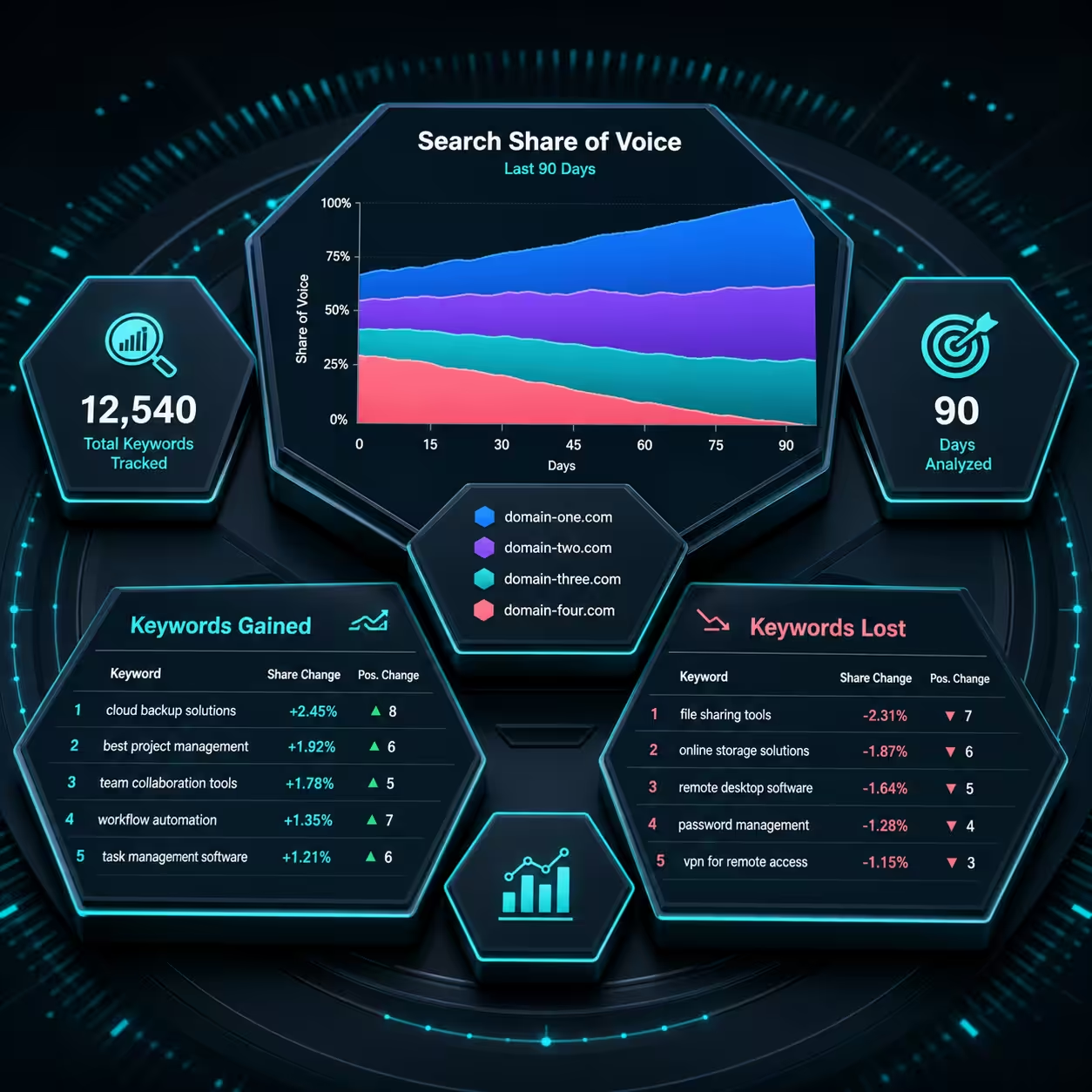
For B2B teams where organic search is a real demand channel, Semrush SOV is more predictive of pipeline than any social listening number. Pricing starts at $139.95/month for Pro and runs to $499.95/month for Business. Most B2B teams sit on the Guru tier at $249.95/month.
Don’t use Semrush for social SOV. It tracks brand mentions, but the social and PR side is shallow compared to specialist tools.
- Best for: B2B teams where organic search is a real demand channel
- Pricing: $139.95/month (Pro) to $499.95/month (Business), most teams on Guru at $249.95/month
- Standout strength: Visibility Score shows the percentage of category SERPs you occupy vs named competitors, refreshed daily
7. Ahrefs. Best for Brand Mention Tracking in SEO Context
Ahrefs Alerts and the Web Explorer tool together give a strong read on unlinked brand mentions and category visibility. It’s not built as a dedicated SOV platform, but for B2B teams already paying for Ahrefs, you can build a serviceable share of voice view without buying another tool.
Pricing starts at $129/month for Lite and goes to $1,499/month for Enterprise. Most teams use the Standard plan at $249/month.
The limitation is social. Ahrefs barely touches it. If you care about LinkedIn or Reddit conversation share, you’ll need a second tool. If you care about who’s writing about your category and who they’re mentioning, Ahrefs is excellent.
- Best for: Teams already paying for Ahrefs who want a serviceable SOV view without buying another tool
- Pricing: $129/month (Lite) to $1,499/month (Enterprise), most teams on Standard at $249/month
- Standout strength: Ahrefs Alerts and Web Explorer give a strong read on unlinked brand mentions and category visibility
8. Mention. Best for Lightweight Real-Time Alerts
Mention sits in the middle of the market, more depth than Brand24, less than Brandwatch. The strength is real-time alerting and a clean interface that non-analysts can actually use. The SOV calculator gives a quick competitive read on mention volume over a 30-day window.
Plans start at $49/month for Solo and run to $179/month for ProPlus, with enterprise pricing on top. For teams that need monitoring more than they need analysis, Mention is a fair pick. For teams that need detailed SOV reporting with sentiment and source weighting, look at our deeper Mention review.
- Best for: Teams that need monitoring more than deep analysis, with a clean interface non-analysts can use
- Pricing: $49/month (Solo) to $179/month (ProPlus), enterprise pricing on top
- Standout strength: Real-time alerting with a 30-day SOV calculator for a quick competitive read
9. Mentionlytics. Best for AI-Powered Sentiment
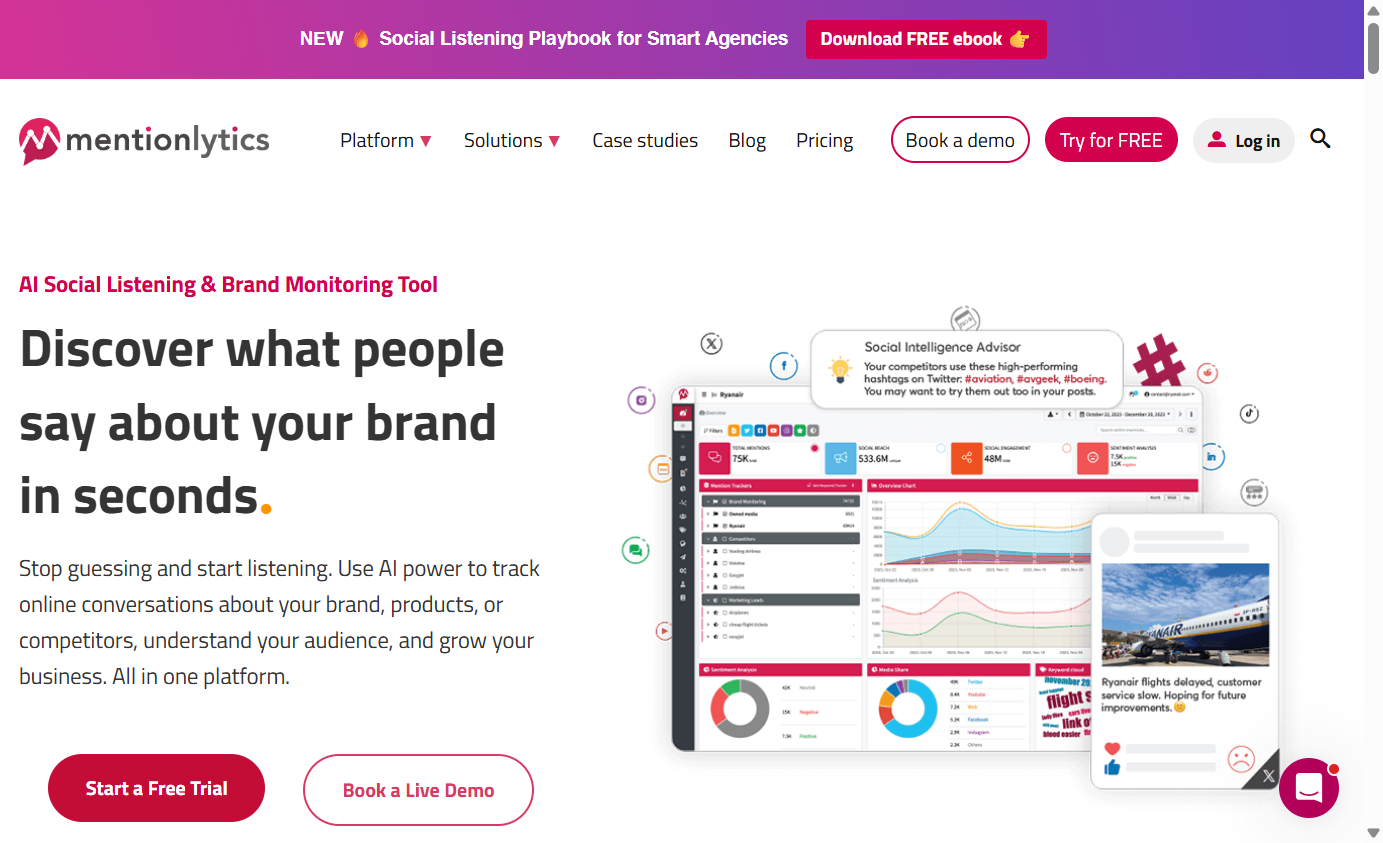
Mentionlytics has invested heavily in sentiment classification and now runs LLM-based sentiment scoring that outperforms most competitors on nuanced B2B language, sarcasm, conditional praise, mixed reviews. For categories where sentiment matters as much as volume, this is real.
Pricing starts at $69/month for Basic and runs to $499/month for Advanced. The platform is less well-known than the others in this list, which means lower brand recognition but also less mature integrations.
- Best for: Categories where nuanced sentiment (sarcasm, conditional praise, mixed reviews) matters as much as volume
- Pricing: $69/month (Basic) to $499/month (Advanced)
- Standout strength: LLM-based sentiment scoring that outperforms most competitors on nuanced B2B language
How Accurate Are These Tools, Really?
Accuracy is the question nobody answers honestly in tool comparisons. We ran the same brand against the same five competitors across four of these tools over a 30-day window. The results varied by more than 40 percentage points.
| Tool | Mentions Counted (Same Brand, 30 Days) | Reported SOV | Duplicate Rate |
|---|---|---|---|
| Sprout Social | 3,847 | 22.4% | Low |
| Brandwatch | 5,213 | 28.1% | Low |
| Brand24 | 6,891 | 31.6% | High |
| Talkwalker | 4,604 | 25.8% | Medium |
The gap isn’t because some tools are wrong. It’s because each tool defines “mention” differently and dedupes differently. Brand24 counted syndicated press releases as separate mentions; Brandwatch collapsed them. Sprout’s source list is narrower but cleaner.
The practical implication: pick one tool, stick with it, and measure trends, not absolutes. A 30% SOV in Brand24 isn’t comparable to a 30% SOV in Brandwatch. Comparing yourself to yourself over time is the only reliable read.
See where AI answers put your brand
Twenty minutes with a senior strategist: where the major engines point buyers in your category, who gets named instead of you, and a straight read on what a programme would change.
Book a strategy callPicking the Right Tool for Your Team Size
The right tool depends more on your team and channel mix than on feature comparisons. Here’s how it shakes out for B2B teams in 2026.
If You’re a Startup or Small B2B Team (Under 25 People)
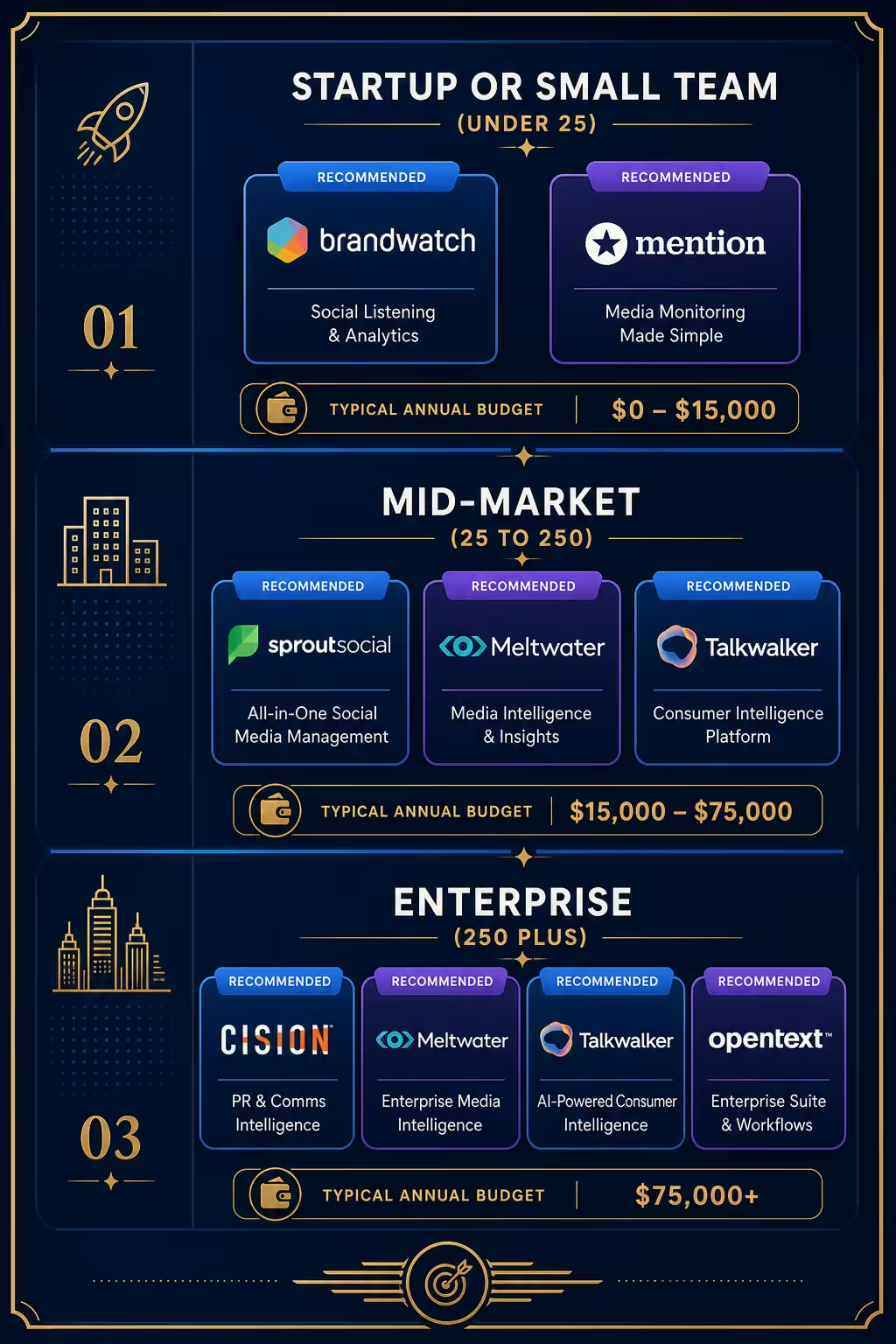
Buy Brand24 or Mention for social, and either Semrush or Ahrefs for search. Combined cost: $300 to $500/month. Skip enterprise tools entirely, you won’t use 80% of what you’d pay for.
Don’t try to track every channel. Pick the two channels where buyers in your category actually live, measure those, and ignore the rest until you’ve grown into needing more.
If You’re a Mid-Market Team (25-250 People)
Sprout Social or Mentionlytics for social listening, plus Semrush for search. Add Meltwater if PR is a budgeted channel with executive reporting. Combined cost: $800 to $2,500/month.
At this stage, you need a real measurement system, not just dashboards. Build a weekly SOV report that goes to the marketing leadership team. Trends matter more than snapshots.
If You’re an Enterprise Team (250+ People)
Brandwatch or Talkwalker for social and conversation depth, Meltwater for earned media, Semrush or Ahrefs (often both) for search. Combined cost: $3,000 to $8,000/month.
You’ll also need a dedicated analyst. The tools don’t deliver value on their own at this scale, they deliver value when paired with someone who builds queries, normalizes data, and translates it into competitive intelligence the executive team acts on.
What Most Teams Get Wrong About Share of Voice Tools
Three failure patterns show up over and over in B2B teams buying share of voice tools.
Tracking every channel instead of the channels that decide your market. If your category buys based on analyst reports and peer references, your Twitter SOV is interesting trivia. Measure what actually correlates with pipeline.
Comparing absolute SOV numbers across tools. A 25% SOV in one tool versus 35% in another doesn’t mean you grew, it means the tools count differently. Pick one, stick with it, watch the trend.
Buying the most expensive tool because it has the most features. Brandwatch is genuinely great. So is Talkwalker. Neither helps a 12-person marketing team that has nobody to run them. The right tool is the one your team will actually use weekly.
Where Search SOV Fits in the Picture
For B2B teams, search-based share of voice is often the most direct predictor of pipeline impact. When your domain occupies more of the category SERPs than competitors, you capture more of the demand that’s already searching.
This is why we recommend pairing a social listening tool with an SEO tool for almost every B2B team. The social tool tells you what people are saying. The SEO tool tells you who’s getting found when those people start searching. For the deeper methodology on this, our guide to share of voice in organic search walks through the measurement framework, and how to measure share of voice across channels covers cross-channel normalization.
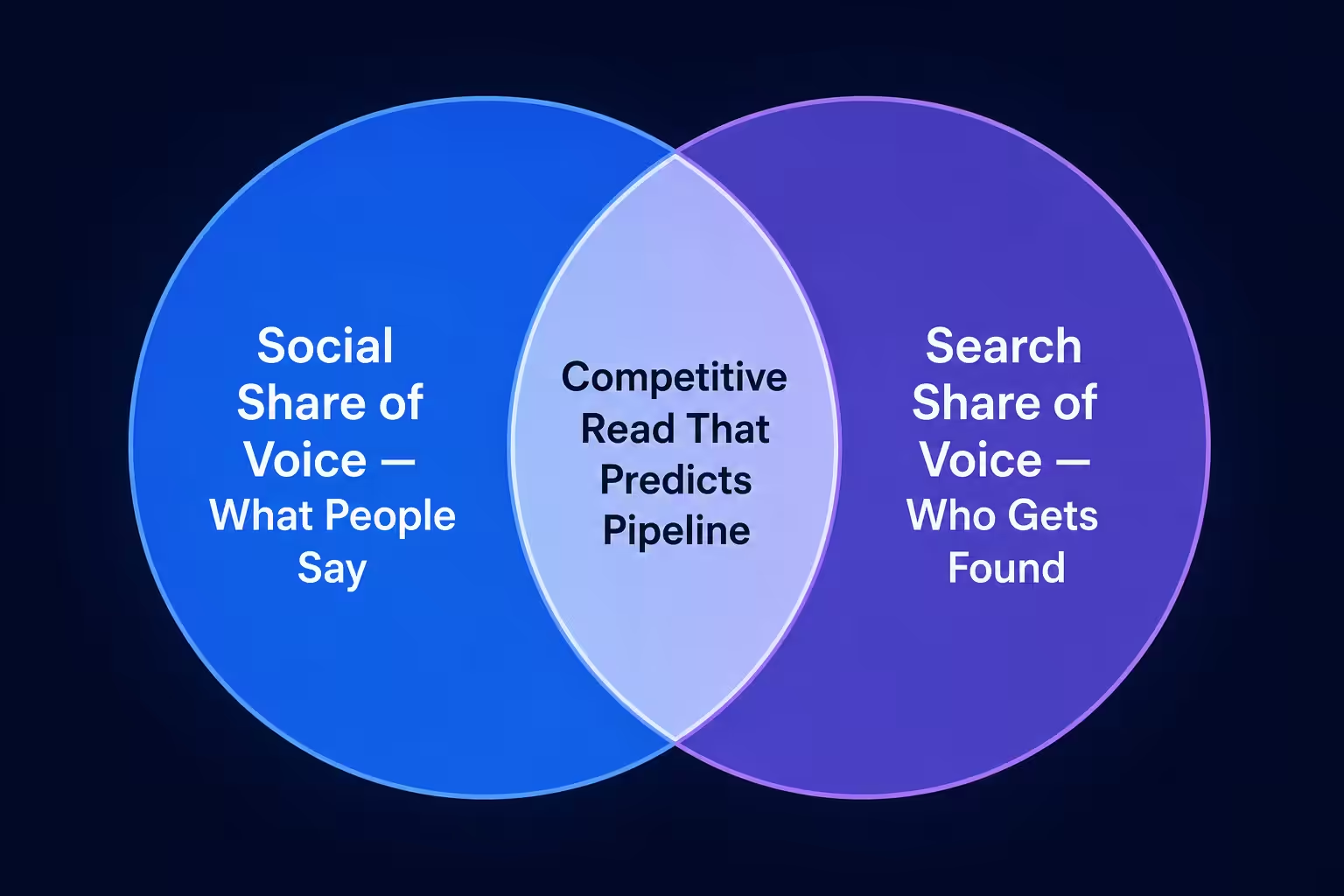
The dashboards inside Semrush and Ahrefs aren’t share of voice tools in the marketing-industry sense. But for B2B SOV that ties to revenue, they’re often the most important data feed in the stack.
What These Tools Measure vs What Grows the Number
Every tool in this comparison measures share of voice well. None of them create more of it. The measurement-to-growth gap is where most SOV programs stall. Teams get a clean dashboard number and no clear plan to move it. Pairing any of these tools with active mention-building closes that gap; monitoring alone just produces a more precise version of the same flat number.
Frequently Asked Questions
What is the best share of voice tool for B2B in 2026?
The best single tool depends on your channel mix. Sprout Social leads for social listening accuracy, Semrush leads for search SOV, and Meltwater leads for earned media. Most B2B teams need a social listening tool and a search tool together, typically Sprout or Brand24 paired with Semrush or Ahrefs.
How much do share of voice tools cost?
Entry pricing starts at $24/month (Brand24) for individuals and small teams. Mid-market tools like Sprout Social and Mentionlytics run $250 to $800/month. Enterprise platforms like Brandwatch, Talkwalker, and Meltwater range from $1,000 to over $8,000/month depending on outlets, geographies, and user count.
Can I track share of voice without paid tools?
Yes, but the manual approach only works for small competitive sets and lightly covered industries. Track the top 10 publications and your three to four main competitors in a spreadsheet using Google Alerts and platform-native search. Beyond that scope, paid tools are required for reliable measurement.
Why do different share of voice tools give different numbers?
Each tool defines a “mention” differently, pulls from different source lists, and dedupes syndicated content differently. A 30% SOV in one tool can register as 18% in another for the same brand in the same week. Pick one tool, stick with it, and measure trends over time rather than comparing absolute numbers across platforms.
Is share of voice the same as share of market?
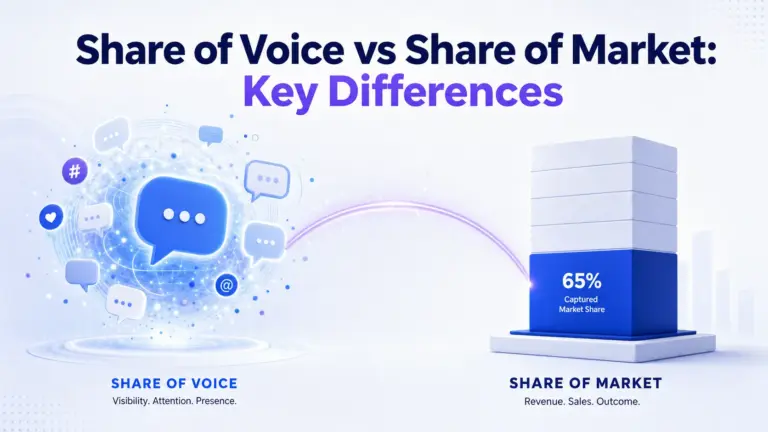
No. Share of voice measures conversation, coverage, or visibility. Share of market measures actual revenue or unit share. SOV is a leading indicator, research from Binet and Field shows brands with SOV above their share of market tend to grow, while brands below tend to lose share over time.
How often should I measure share of voice?
Weekly for active monitoring, monthly for trend reporting, quarterly for strategic review. Daily measurement is usually noise unless you’re managing a crisis or running a major campaign launch. The cadence should match the speed at which your category conversation actually changes.
Do share of voice tools track Reddit and forum discussions?
Coverage varies sharply. Brandwatch and Talkwalker have the strongest Reddit and forum coverage. Sprout Social and Mention cover Reddit but less deeply. Brand24 and Mentionlytics include it but with thinner historical archives. For B2B categories where buyers research on Reddit, verify Reddit coverage depth before committing to any tool.
What’s the difference between share of voice and sentiment?
Share of voice counts mentions. Sentiment classifies whether those mentions are positive, negative, or neutral. A brand can have 40% SOV with 60% negative sentiment, that’s high visibility on the wrong terms. Always measure them together. For more on sentiment specifically, see our guide to brand sentiment analysis.
Building Your Measurement Stack
The tool list matters less than the discipline of measuring consistently. Pick one social listening tool, pair it with one SEO tool, run a weekly report, and watch trends over 90-day windows. That’s it. Most B2B teams overcomplicate this and end up with three tools they don’t use and no real read on where they actually stand.
If you’re evaluating tools right now and want a deeper look at specific platforms, our reviews of social media monitoring tools and platforms that track mentions cover the adjacent categories. For teams focused specifically on competitive analysis, the best competitor analysis SEO tools guide goes deeper on the search side.