You can check whether AI mentions your brand by querying major AI platforms directly, monitoring referral traffic from AI sources in your analytics, and using dedicated AI visibility tracking tools. The process has changed significantly since 2024 — AI search platforms now drive measurable discovery, and the brands that track their presence across ChatGPT, Perplexity, Gemini, and Google AI Overviews gain a real competitive edge.
This article walks you through practical methods — from free, manual approaches to scalable monitoring systems — so you can see exactly where AI talks about your brand, how it describes you, and what to do when it doesn’t mention you at all.
What You’ll Learn
- How to manually query AI platforms to find your brand mentions in under 10 minutes
- Which referral traffic signals in Google Analytics 4 reveal AI-driven visits
- Dedicated tools that automate AI mention tracking at scale
- How to benchmark your AI citation share against competitors
- What to do when AI platforms ignore your brand entirely
- How brand mentions on high-authority publications influence what AI recommends
Why Checking Your AI Mentions Matters in 2026
AI-powered search platforms now process billions of queries monthly. According to a 2025 Gartner forecast, traditional search engine traffic is projected to decline 25% by 2027 as users shift toward AI-generated answers. That shift is already underway.
When someone asks ChatGPT “What’s the best project management tool for remote teams?” or prompts Perplexity with “Which CRM should a B2B startup use?”, the AI’s response shapes perception directly. There’s no list of ten blue links. There’s often one answer — and your brand is either in it or invisible.
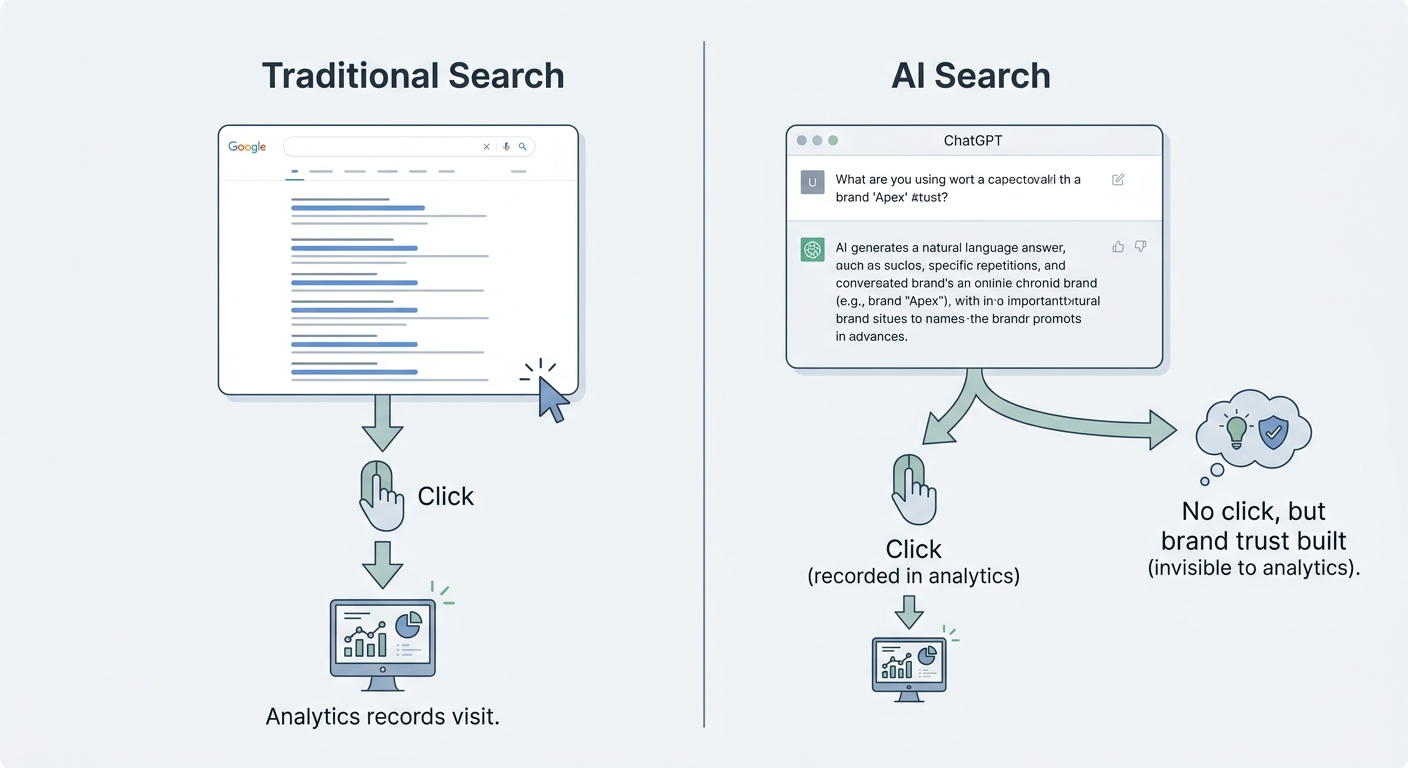
The challenge: these mentions don’t appear in traditional analytics unless someone clicks through. A user might see your brand recommended in a ChatGPT response, build trust in your product, and never visit your website that day. That’s still valuable visibility — but it’s invisible if you’re only watching click-based metrics.
Start Here: Query AI Platforms Directly
The fastest way to see if AI mentions your brand is to ask. This takes less than 10 minutes and costs nothing.
Which platforms to check
As of 2026, five AI platforms drive the most discovery-related traffic:
- ChatGPT (OpenAI) — the largest conversational AI platform by user base
- Perplexity — an AI search engine that includes inline citations with every answer
- Google AI Overviews — AI-generated summaries appearing at the top of Google results
- Google AI Mode — Google’s conversational AI search interface
- Microsoft Copilot — embedded in Windows, Edge, and Microsoft 365
- Gemini (Google) — Google’s standalone AI assistant
- Claude (Anthropic) — increasingly used for research and professional queries
What prompts to use
Don’t just search your brand name. AI platforms respond to natural-language questions — the same questions your potential customers ask. Build a prompt list around your product category and use cases:
- “What’s the best [product category] for [specific use case]?”
- “Compare [your brand] vs. [competitor]”
- “What are the pros and cons of [your product]?”
- “Which companies provide [service] for [industry]?”
- “Is [your brand] worth it for [audience segment]?”
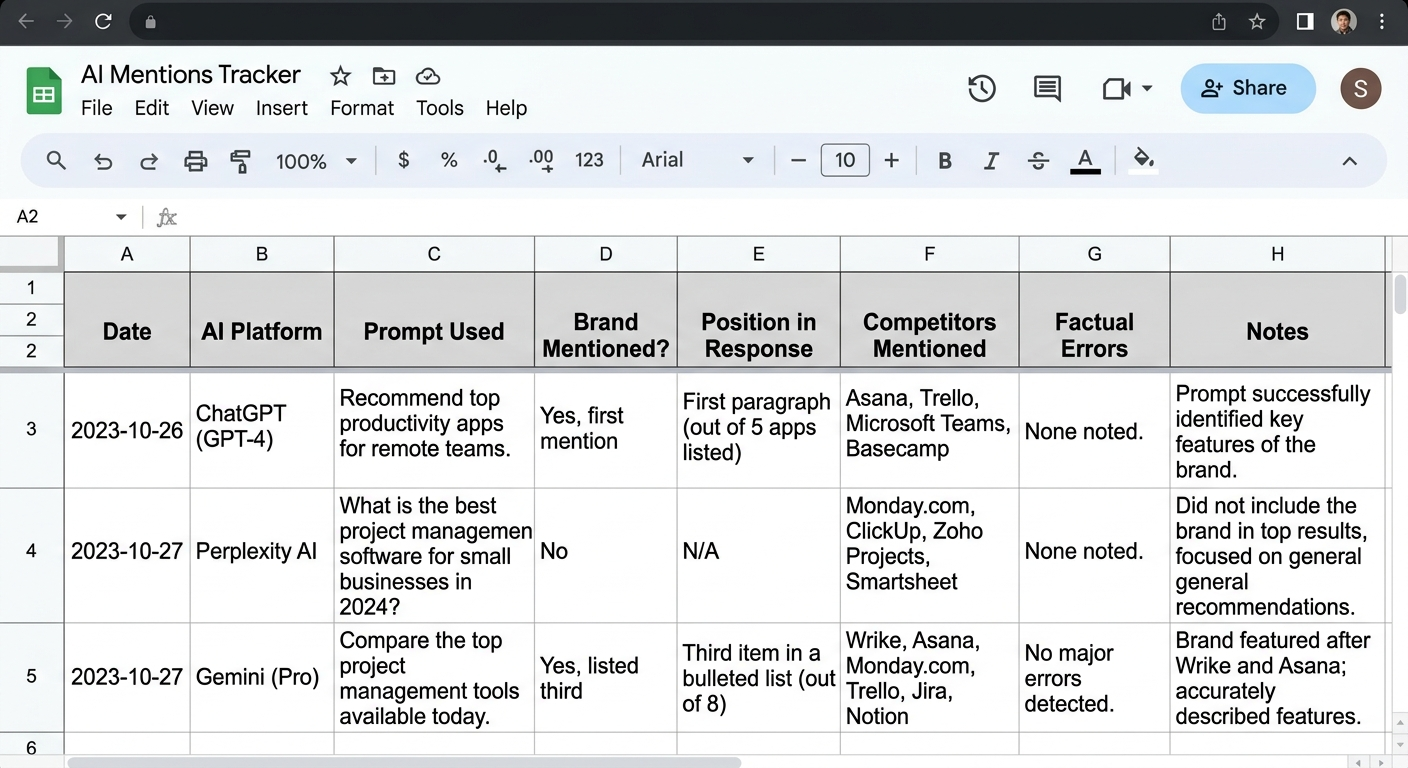
Run 10–15 of these queries across each platform. Document whether your brand appears, where it appears in the response (first mention, middle, end), how the AI describes you, and which competitors show up alongside you.
Tip: Use a simple spreadsheet with columns for date, platform, prompt, brand mentioned (yes/no), position, competitors cited, and any factual errors. This becomes your AI visibility baseline.
What to look for beyond yes or no
Whether your brand is mentioned matters — but how it’s mentioned matters more. Pay attention to these signals:
- Attribution framing: Does the AI say “According to [your brand]…” (definitive authority) or simply list you among several options (supporting mention)?
- Accuracy: Is the AI citing correct product features, pricing, and company details? Inaccurate information in AI answers spreads faster than traditional media errors.
- Sentiment: Is your brand described positively, neutrally, or with caveats?
- Co-citations: Which competitors consistently appear alongside you? These are your AI search competitors — they may differ from your Google search competitors.
Check Your Analytics for AI Referral Traffic
Manual prompting reveals whether AI mentions you. Your analytics reveal whether those mentions drive action.
Where AI traffic appears in Google Analytics 4
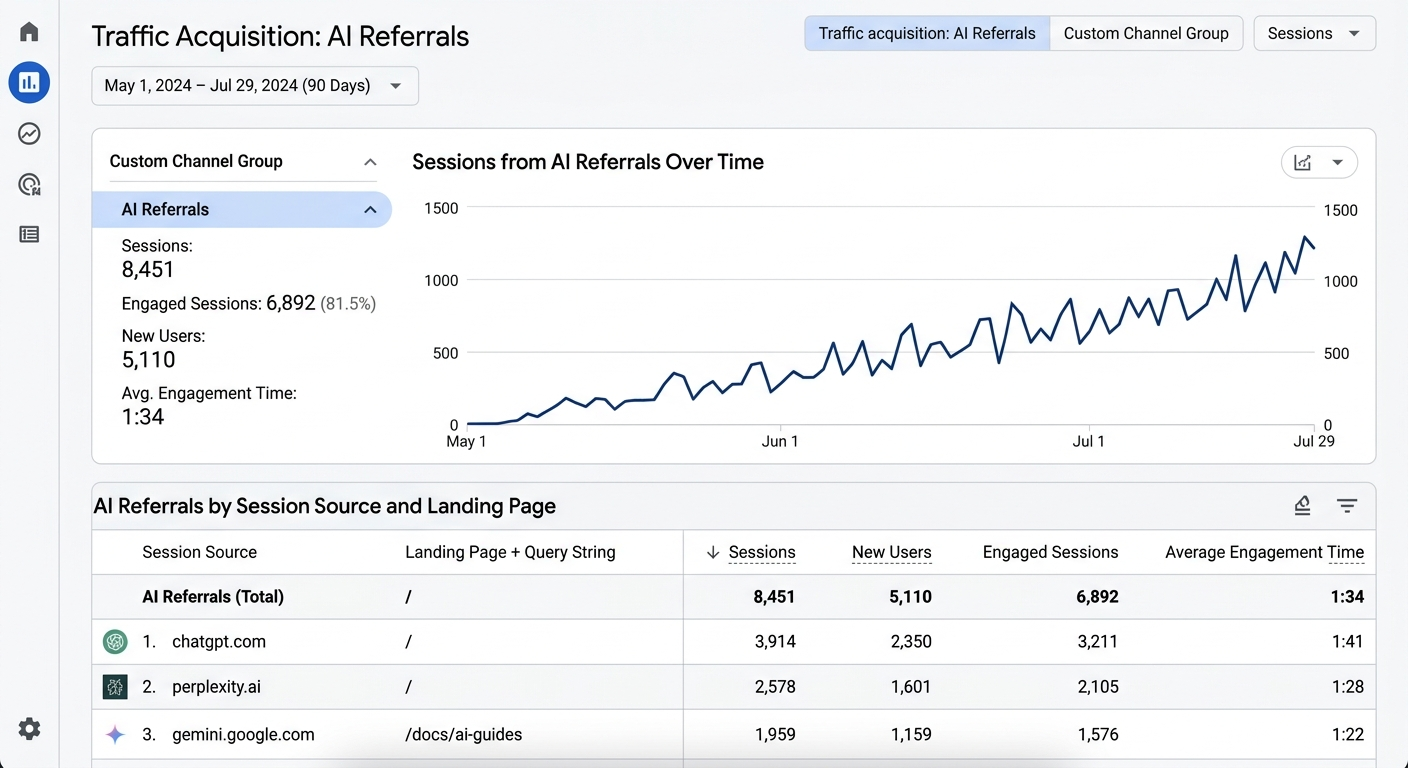
Most AI platforms — including Perplexity, Copilot, Gemini, and paid ChatGPT accounts — send referrer data that appears in your GA4 Traffic Acquisition reports. Look for sources like:
chatgpt.com / referralperplexity.ai / referralgemini.google.com / referralcopilot.microsoft.com / referralclaude.ai / referral
To isolate AI traffic in one view, create a custom channel group in GA4 using a regex filter that captures all major AI referral sources. This separates AI-driven visits from generic referral traffic and makes trends visible over time.
The hidden traffic problem
Free-tier ChatGPT users don’t send referrer data. Their visits appear as “Direct” in your analytics — indistinguishable from bookmarks, typed URLs, or other referrer-less sources. This means your actual AI-driven traffic is likely higher than what GA4 reports.
Watch for unexplained spikes in direct traffic to specific pages that AI commonly cites. If a blog post about “how to choose a CRM” suddenly gets a surge of direct visits without any corresponding email campaign or social push, AI referrals from free-tier users are a likely explanation.
Which landing pages AI platforms cite
Add “Landing page + query string” as a dimension in your AI traffic exploration. This reveals which specific pages on your site AI assistants reference most. These pages represent your strongest AI-visible content — and they deserve priority when you update, expand, or interlink your content library.
For deeper insight into setting up a comprehensive brand mentions report, you can build on this GA4 data with dedicated monitoring tools.
Use Dedicated AI Visibility Tracking Tools
Manual checks and GA4 data give you a starting point. Dedicated tools let you monitor brand mentions at scale — tracking dozens or hundreds of prompts across multiple AI platforms automatically.
What AI visibility tools actually track
An AI visibility tool is software that systematically queries AI platforms with relevant prompts and records whether your brand appears, how it’s described, and how your citation frequency compares to competitors. The best tools track:
- Mention frequency — how often your brand appears across platforms
- Citation share — your share of mentions compared to competitors
- Sentiment — whether mentions are positive, neutral, or negative
- Cited pages — which URLs on your site get referenced
- Competitor benchmarking — who appears for prompts where you don’t
Tool categories worth evaluating
The AI visibility tool market has matured significantly since 2024. As of 2026, tools generally fall into three categories:
- Full-suite SEO platforms with AI tracking: Semrush’s AI SEO toolkit and Advanced Web Ranking (AWR) both offer AI brand mention tracking alongside traditional rank tracking. These work well if you already use these platforms for SEO.
- Dedicated AI visibility platforms: Tools like Otterly AI and Peec AI focus exclusively on AI mention tracking. They tend to offer deeper prompt-level analysis but lack traditional SEO features.
- Manual + automation hybrids: Browser automation tools like Puppeteer or Selenium can capture AI responses programmatically. These require technical setup but offer full customization.
For a detailed comparison of options for monitoring ChatGPT mentions and tracking across other platforms, the BrandMentions resource library covers specific platform-by-platform tools.
Warning: AI responses can vary between API outputs and what users see in the live interface. A tool querying ChatGPT’s API may get different results than a user typing the same prompt in the chat window. Keep this limitation in mind when interpreting automated data.
How to Check Specific AI Platforms
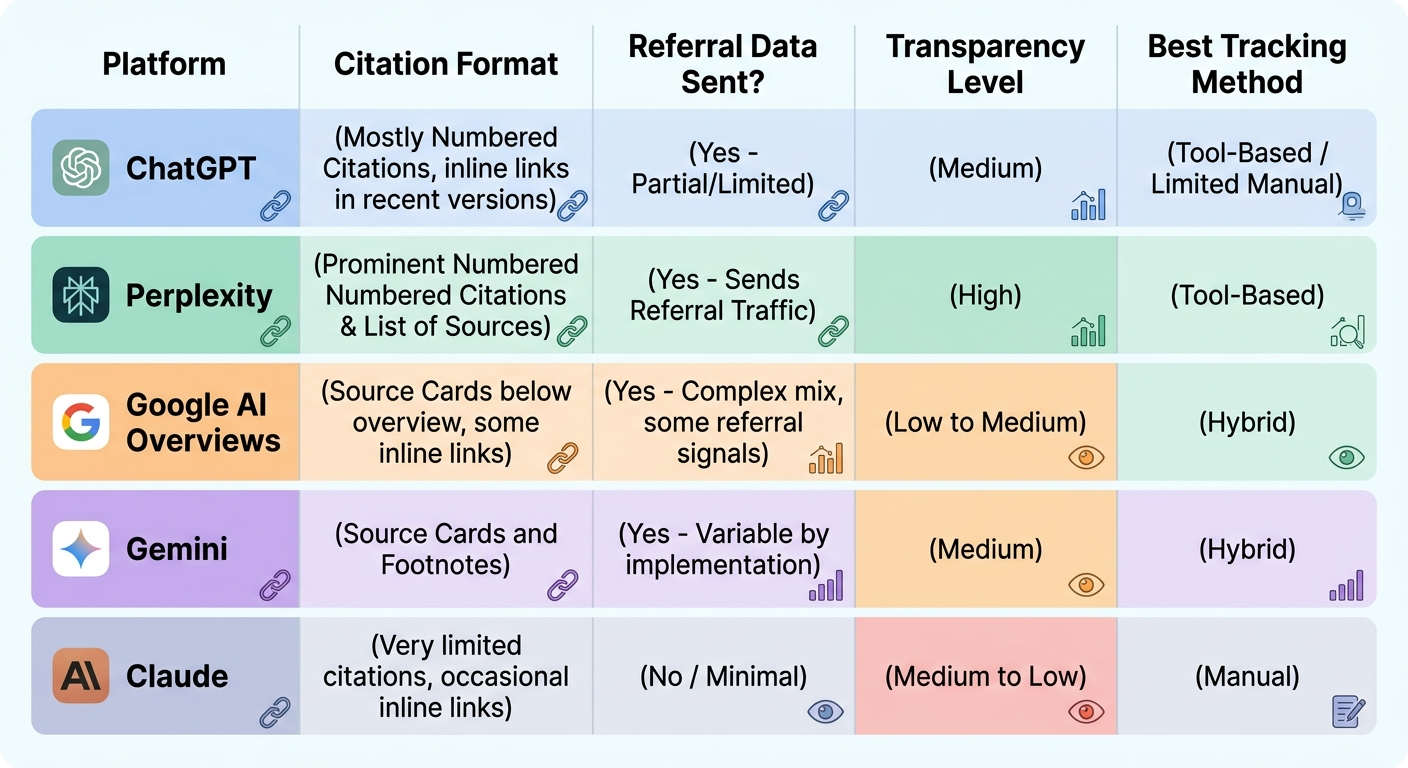
Each AI platform handles citations differently. Knowing what to look for on each one helps you interpret your results accurately.
ChatGPT
ChatGPT with search enabled includes source links in its responses. When your brand or website appears, it’s typically cited with an inline link or referenced by name in the answer text. Checking your brand mentions in ChatGPT requires either manual prompting or a tool that simulates user-facing queries — not just API calls.
Perplexity
Perplexity includes numbered citations linking to original sources with every answer. This makes it the most transparent AI platform for tracking brand visibility. You can see exactly which domains Perplexity trusts for each topic. Tools that track brand mentions in Perplexity can automate this across hundreds of queries.
Google AI Overviews and AI Mode
Google’s AI Overviews display citations as expandable source cards below the generated summary. Google AI Mode — a conversational search interface — includes inline citations similar to Perplexity. Both surfaces pull heavily from pages that already rank well in traditional Google search, which means your existing SEO foundation directly influences your AI visibility here. An AI Overviews mentions tool can help you track this systematically.
Gemini and Claude
Gemini and Claude handle citations less consistently than Perplexity or Google AI Overviews. They may reference your brand by name without linking to your site, or they may provide information clearly sourced from your content without explicit attribution. Monitoring these platforms requires comparing AI outputs against your published content. You can learn more about tracking brand mentions in Gemini specifically.
Benchmark Your AI Visibility Against Competitors
Knowing you’re mentioned is useful. Knowing how your mention frequency compares to competitors is strategic.
Calculate your share of AI citations
Share of AI citations measures what portion of all brand mentions in AI-generated answers belongs to you compared to your competitors. It’s the AI equivalent of share of voice in traditional SEO.
To calculate it:
- Run your priority prompt list across AI platforms
- Count how many times your brand is mentioned versus each competitor
- Use the formula: Your Share = (Your Citations ÷ Total Citations) × 100
For example, if your brand appears in 15 out of 40 total brand mentions across a prompt set, your AI citation share is 37.5%.
Track this monthly. Trends matter more than any single snapshot. AI models update frequently, and citation patterns can shift within weeks.
Identify your AI blind spots
The most actionable insight from competitive benchmarking is discovering which prompts your competitors get cited for — but you don’t. These are your AI blind spots.
Common causes of blind spots:
- You don’t have content that directly answers the query
- Your content exists but lacks clear structure, data, or attribution that AI can extract
- Competitor content has stronger authority signals — more backlinks, more brand mentions on trusted publications, clearer schema markup
- Aggregator sites (Reddit, Wikipedia, Quora) dominate the citations for that topic
Each blind spot is an optimization opportunity. Treat it the same way you’d treat a ranking gap in traditional SEO — identify the cause, strengthen the content, and monitor for improvement.
Building a cross-platform tracking system for AI brand mentions makes these benchmarks easier to maintain over time.
What to Do When AI Doesn’t Mention Your Brand
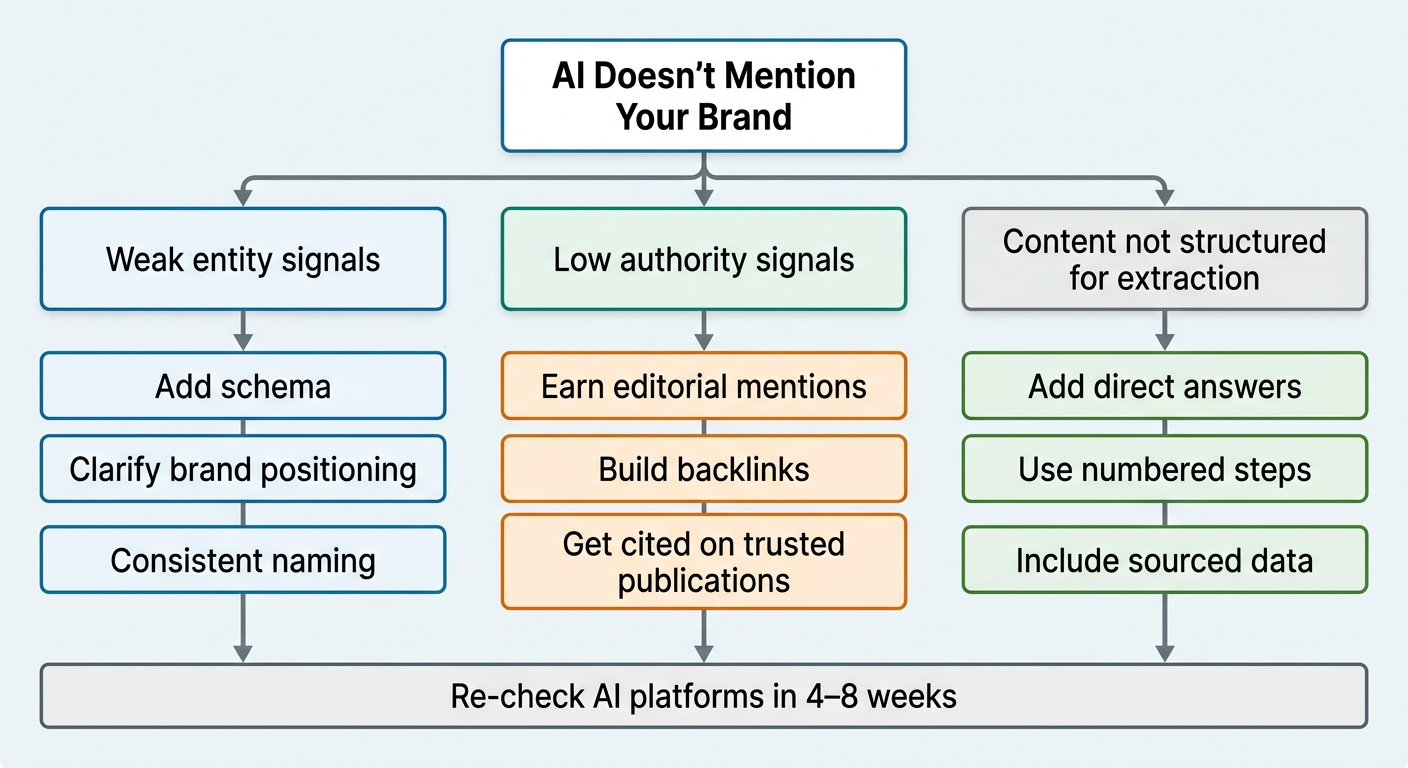
If you’ve queried every major platform and your brand doesn’t appear, that’s a clear signal — not a dead end. AI platforms select sources based on recognizable patterns, and you can influence those patterns.
Strengthen your entity signals
An entity, in the context of AI and search, is a clearly defined concept that AI models can identify and associate with specific attributes — your brand name, products, leadership, and category. AI models build associations between entities from the content they process during training and retrieval.
To strengthen your brand’s entity signals:
- Ensure your website has consistent, clear information about what your company does, who it serves, and what makes it distinct
- Add organizational schema markup so AI systems can easily parse your brand details
- Publish content that explicitly connects your brand name to your category (e.g., “BrandName is a [category] platform that helps [audience] achieve [outcome]”)
Build brand mentions on high-authority publications
AI models learn brand-category associations from the content they encounter during training data collection and real-time retrieval. When your brand appears contextually on publications that AI models trust — industry outlets, respected media, high-authority editorial sites — those mentions directly influence whether AI recommends you.
This is where brand mentions as an SEO strategy and AI visibility converge. A mention on a trusted publication serves both traditional search authority (through link equity and brand signals) and AI discoverability (through training data exposure).
Agencies like BrandMentions approach this by placing contextual brand mentions on 140+ high-authority publications that AI models actively learn from. In campaigns across 67+ B2B companies, brands with consistent editorial mentions achieved AI recommendation rates significantly higher than those relying solely on traditional SEO.
Create content structured for AI extraction
AI platforms extract definitions, frameworks, step-by-step processes, and data-backed claims more readily than narrative-style content. Structure your key pages to make extraction easy:
- Lead sections with direct answers to questions — no preamble
- Use numbered steps for processes
- Include specific data points with clear source attribution
- Define terms explicitly on first use
- Keep key claims self-contained — each important sentence should be understandable without the surrounding context
For a broader look at how brand mentions influence generative AI responses, the BrandMentions resource library covers the underlying mechanics in detail.
Track Changes Over Time — AI Visibility Is Not Static
AI citation behavior is volatile. Content cited today for a specific query may not appear tomorrow for the same query. Model updates, competing content entering the index, and weighting adjustments all cause shifts.
Set a monitoring cadence
For most B2B brands, a monthly monitoring cycle balances thoroughness with resource efficiency:
- Weekly: Check 5–10 high-priority prompts manually across ChatGPT and Perplexity
- Monthly: Run your full prompt list, update your benchmark spreadsheet, calculate citation share changes
- Quarterly: Review trends, identify new blind spots, and adjust your content and mention-building strategy
Watch for citation cliffs
A citation cliff is a sudden drop where your brand vanishes from AI answers for prompts where it previously appeared — even when your content hasn’t changed. Citation cliffs happen when:
- AI models update their training data or retrieval index
- A competitor publishes stronger content on the same topic
- An aggregator site (Reddit, Wikipedia) gains citation dominance
Catching these drops early — through regular monitoring — gives you time to respond before the visibility loss compounds. Compare your latest AI responses against previous snapshots to identify what changed.
Setting up predictive AI alerts for brand mentions can automate early detection of these shifts.
Frequently Asked Questions
Can I see exactly which prompts trigger my brand in ChatGPT?
Not directly from OpenAI — ChatGPT doesn’t share query logs or keyword data with website owners. You can discover mentions through manual testing, automated prompt monitoring tools, or by analyzing referral traffic from chatgpt.com in your analytics. Dedicated ChatGPT brand mention monitoring tools systematically test prompts and record where your brand appears.
Does showing up in Google search results mean AI will mention me too?
Strong Google rankings improve your chances, especially for Google AI Overviews and AI Mode, which pull heavily from pages that already rank well. However, other AI platforms like ChatGPT and Perplexity use different retrieval methods and data sources. A page ranking #1 on Google might not appear in ChatGPT’s response for the same topic if it lacks clear structure, authoritative brand signals, or editorial mentions on trusted publications.
How long does it take to start appearing in AI answers?
Timelines vary by platform. Perplexity and ChatGPT with web search can pick up new content within days to weeks. Google AI Overviews typically reflect changes on a similar timeline to Google’s regular index updates. For AI models that rely on training data rather than real-time retrieval, the lag can be months. Consistent publishing and building brand mentions alongside backlinks accelerates this process across all platforms.
Is there a free way to check my AI visibility right now?
Yes. Open ChatGPT, Perplexity, and Gemini in separate tabs. Enter 10 prompts your target customers would ask about your product category. Record whether your brand appears and how it’s described. This free, manual approach takes about 15 minutes and gives you an immediate baseline. For ongoing monitoring, free options include Google Alerts for web-wide brand mentions and GA4 for tracking AI referral traffic.
What’s the difference between a brand mention and a citation in AI?
A brand mention is any reference to your company name in an AI response — with or without a link. A citation specifically means the AI listed your page as a source it used to generate its answer. Citations carry stronger authority signals because they indicate the AI trusted your content enough to build its response from it. Both matter for visibility, but citations indicate deeper trust from the AI system.
Move From Monitoring to Strategy
Checking whether AI mentions your brand is the first step. The real value comes from turning that data into a repeatable system: monitoring your mentions, benchmarking against competitors, identifying gaps, and strengthening the signals that make AI platforms trust your brand.
The brands gaining ground in AI search right now aren’t the ones with the most content — they’re the ones with the clearest authority signals, the most consistent editorial presence, and content structured for AI extraction.
Start with a manual audit this week. Build your baseline. Then expand into automated tracking as the data starts informing your strategy.
If you want to see where your brand currently stands across AI search platforms — and where the gaps are — get a free AI visibility audit to understand your starting point.