

In 14 days, ChatGPT-User made 317 visits to our site, and pages in Google’s top 10 weren’t visited more often than pages ranked 11 to 40. Page demand predicted visits better than rank did.
ChatGPT-User is the name OpenAI’s fetcher gives itself when a person’s chat sends it to read a page. We matched its visits against Search Console, page by page.
Here’s how we counted, what it asked for, where rank stopped mattering, and what the numbers can’t tell you.
Updated 12 October 2026: we re-ran this study on Cloudflare’s request data, which sees fetches answered from its cache and labels verified senders. The conclusion held and the counts changed, as our server log and Cloudflare comparison explains.
What We Measured
Fourteen full days, 22 September to 5 October 2026, from Cloudflare’s request data, joined to 90 days of Search Console data.
- Visit: page fetches grouped, with a new visit after a 10-minute gap.
- Counted: successful page fetches from senders Cloudflare verified as OpenAI’s.
- Rank: a page’s average Google position, weighted by impressions.
- Demand: a page’s Google impressions over the 90 days.
The user agent is the name a visitor’s software gives itself, and a name can be copied. Every count here is a fetch Cloudflare verified, including the ones its cache answered.

What ChatGPT-User Asked For
The 361 page fetches grouped into 317 visits. Of those, 242 touched the homepage, on every one of the 14 days, and 217 asked for nothing else.
Visits reached 53 other pages out of 293 published, 114 page visits in all. One page, our guide to Ahrefs brand mentions, took 22 of them across 10 days.
Three visits went to addresses that aren’t published pages, so we left them out. Dropping the most-visited page doesn’t change any result below.
Rank Didn’t Predict Visits
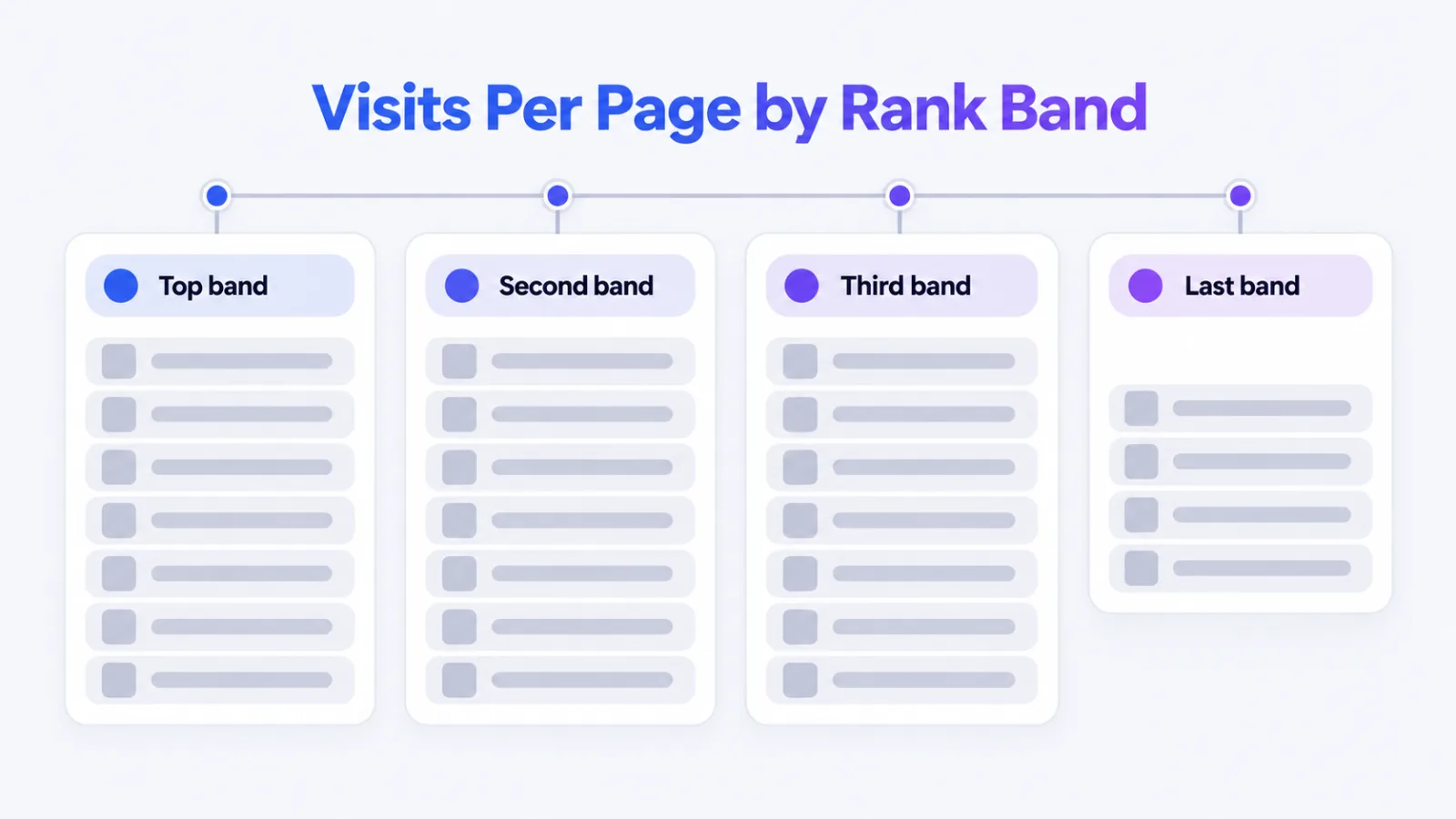
Pages in Google’s top 10 got about the same visits per page as pages ranked 11 to 40. The table divides each band’s visits by the number of pages in it.
| Google position | Pages | Visited | Visits per page |
|---|---|---|---|
| Top 10 | 38 | 13 | 0.58 |
| 11 to 20 | 48 | 12 | 0.77 |
| 21 to 40 | 68 | 16 | 0.49 |
| Beyond 40 | 64 | 7 | 0.20 |
| No impressions | 75 | 5 | 0.12 |
The gap between the top 10 and ranks 11 to 40 is two hundredths of a visit per page. Resampling the pages 5,000 times puts the difference between minus 0.47 and plus 0.57, so zero sits well inside it.
Visits only fall away past position 40, and for pages Google never showed at all.
Page Demand Predicted Them Better
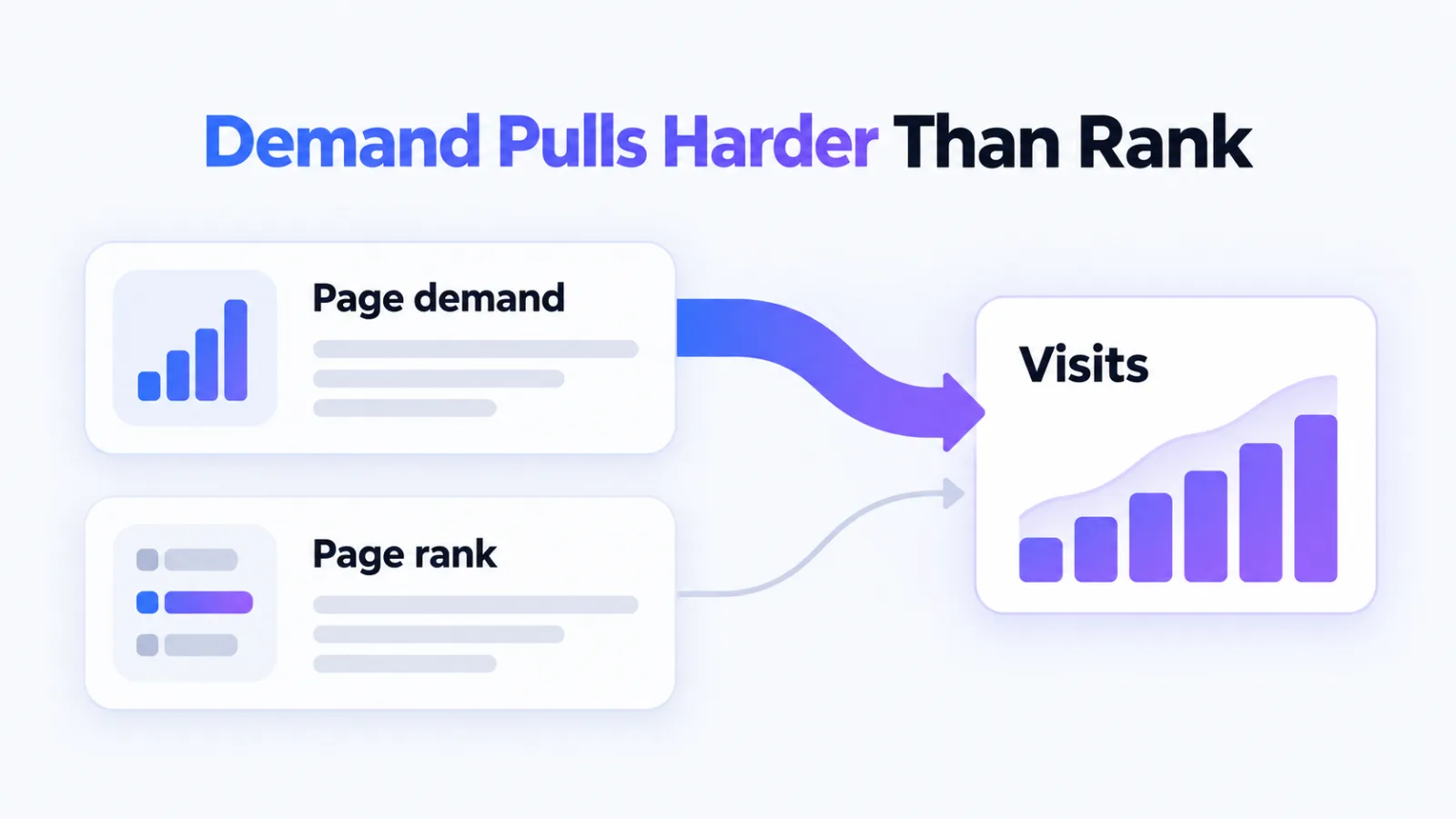
We split the pages that had impressions into three equal groups by the impressions they earned. Visits per page climbed with each group.
- Lowest third: 0.18 visits per page.
- Middle third: 0.44 visits per page.
- Highest third: 0.82 visits per page.
Inside the highest third, rank still didn’t sort the pages. Top-10 pages averaged 0.71 visits, ranks 11 to 20 averaged 1.65 and ranks 21 to 40 averaged 1.00. Pages beyond position 40 fell to 0.19.
A page earns Google impressions when people search for its topic. They may also be the topics people ask ChatGPT about, which would explain why the two move together.
Older pages were visited more
Pages under 90 days old drew 6 visits across 47 pages. Older pages drew 108 across 244.
We can’t separate age from demand here, because new pages also have fewer Google impressions. The data shows the pattern, not the cause.
Visits didn’t need a fresh crawl
OpenAI’s search crawler, OAI-SearchBot, fetched 18 of the 53 visited pages in the same 14 days. The other 35 were visited without a crawl from it in this window.
Claude-User and Perplexity-User
Claude-User made 23 verified page fetches on 15 pages, and 6 of those pages were also visited by ChatGPT-User.
Requests using Perplexity-User’s name numbered 153 in the window, and none came from Perplexity’s published addresses. The name told us nothing about real visits.
What the Numbers Don’t Prove
Four limits, and the first two matter most.
- Verification has limits: we rely on Cloudflare’s label and OpenAI’s published addresses.
- A visit isn’t a citation: nothing here shows which pages ChatGPT quoted.
- Demand may not cause visits: a topic’s popularity can drive both.
- One site, 14 days: that’s a case study, not a survey.
The first limit matters because requests wearing AI-crawler names have included fake AI crawlers hunting for secrets. Of 590 requests using ChatGPT-User’s name in the window, Cloudflare verified 366.
What to Do With It
Don’t read a top-10 ranking as a promise that ChatGPT will fetch the page. On this site it didn’t raise the odds.
Check demand first. Pages on topics people search for were visited more, wherever they ranked.
For a wider view of which crawlers reach you, see server logs for AI search. To see who asks for your llms.txt file, read who reads llms.txt.
How to Check Your Own Log
You need request data for a stretch of complete days and a Search Console export. If a CDN caches your pages, take it from the CDN, because a server log misses cached fetches.
- Filter by name: keep ChatGPT-User, successful responses only.
- Verify the sender: keep requests your CDN labels as verified.
- Group into visits: start a new visit after a 10-minute gap.
- Join to Search Console: match each URL to its impressions and position.
- Divide by pages: compare visits per page in each band, not total visits.
The last step is the one that matters. Our first count suggested mid-ranked pages were visited twice as often, until we divided by the number of pages in each band. To find which AI bots reach you at all, follow which AI bots reach your site.
Frequently Asked Questions
What is ChatGPT-User
ChatGPT-User is the user agent OpenAI’s fetcher sends when a person’s chat asks it to read a web page. It’s separate from the crawlers that build a search index.
Does ranking higher in Google get more ChatGPT-User visits
Not on our site. Top-10 pages averaged 0.58 visits per page and pages ranked 11 to 20 averaged 0.77, over 14 days.
What predicted ChatGPT-User visits
Page demand did better than rank. The third of pages with the most Google impressions averaged 0.82 visits per page, against 0.18 for the lowest third.
Is a ChatGPT-User visit the same as a citation
No. A visit shows a page was fetched, not that ChatGPT quoted it or linked to it in an answer.
How do I count ChatGPT-User visits in my log
You count them by filtering request data for the ChatGPT-User name and successful responses, keeping verified senders, and grouping requests into visits with a 10-minute gap. Divide by pages before you compare groups.
Divide by Pages Before You Trust the Pattern
On this site 317 ChatGPT-User visits tracked page demand and ignored the difference between a top-10 and a rank-30 page.
Run the count on your own last 14 days, divided by the number of pages in each band, before you decide what a ranking is worth.