Brand monitoring services track how your company is mentioned, perceived, and discussed across digital channels — from social media and review sites to AI search engines like ChatGPT, Perplexity, and Google AI Overviews. As of 2026, “monitoring” has expanded far beyond counting logo appearances and hashtag mentions. It now includes tracking whether AI assistants recommend your brand, how your entity appears in large language model outputs, and whether your reputation holds across surfaces you don’t own or control.
This article breaks down what brand monitoring services actually do in 2026, how the landscape has shifted since traditional social listening dominated the category, and how to evaluate which type of monitoring your business needs based on your growth stage and competitive reality.
Key Takeaways
- Brand monitoring services in 2026 span traditional web tracking, social listening, reputation management, cybersecurity surveillance, and AI search visibility monitoring.
- AI-powered search has created an entirely new monitoring surface — your brand’s presence in LLM-generated answers now directly impacts pipeline and trust.
- The right service depends on your primary risk: reputation damage, competitive intelligence gaps, or invisibility in AI recommendations.
- Monitoring without an action framework wastes budget. Every alert needs an owner, a severity level, and a response path.
- Brand monitoring data becomes most valuable when it feeds back into content strategy, product development, and entity-building for AI discoverability.
What Brand Monitoring Services Actually Cover in 2026
A brand monitoring service is any platform, tool, or managed offering that continuously tracks references to your brand across digital channels and provides alerts, analysis, or recommended actions based on what it finds.
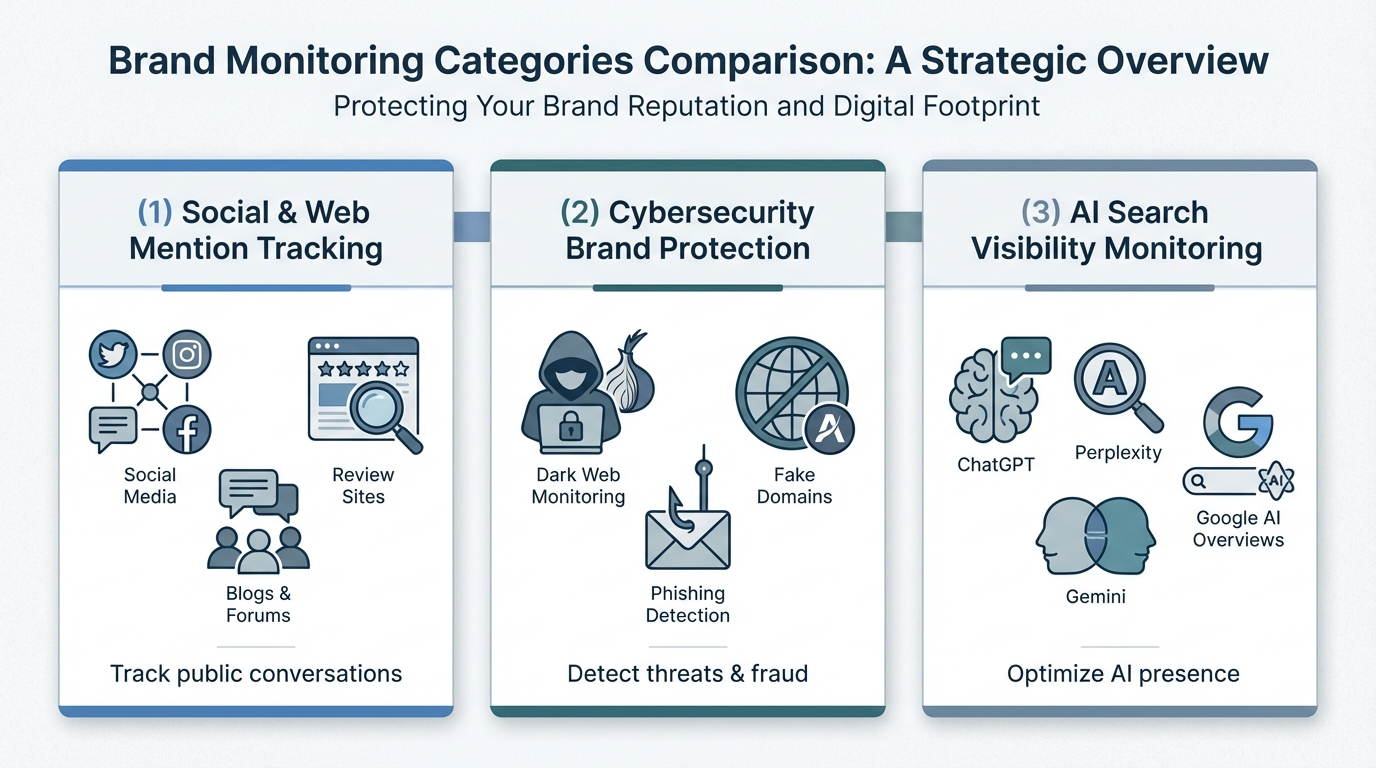
The category has splintered into several distinct disciplines. Understanding these distinctions matters because the service you need depends on the problem you’re solving.
Social and Web Mention Tracking
This is the original form of brand monitoring. Platforms like Brandwatch, Mention, and Brand24 scan social media platforms, blogs, forums, news sites, and review aggregators for references to your brand name, product names, executives, and competitors.
Social monitoring answers: What are people saying about us right now, and how do they feel about it?
Most platforms apply sentiment analysis to classify mentions as positive, negative, or neutral. More advanced tools use natural language processing to detect sarcasm, context, and emerging narrative shifts — not just keyword matches.
Cybersecurity Brand Protection
A growing segment of brand monitoring focuses on digital threat detection. Services from providers like Recorded Future, ZeroFox, and CloudSEK monitor for phishing campaigns, fake domains, counterfeit product listings, impersonation accounts, dark web data leaks, and unauthorized logo usage.
Cybersecurity-focused brand monitoring answers: Is someone exploiting our brand identity to commit fraud or steal customer data?
This category is especially relevant for financial services, healthcare, e-commerce, and any brand where customer trust directly ties to transaction security.
AI Search Visibility Monitoring
This is the newest — and fastest-growing — category. As of 2026, AI assistants like ChatGPT, Google Gemini, Perplexity, and Claude generate answers that include brand recommendations, product comparisons, and service suggestions. Whether your brand appears in these AI-generated responses has become a critical visibility metric.
AI search visibility monitoring tracks whether AI platforms mention your brand when users ask category-relevant questions — and how those mentions compare to competitors. According to a 2025 Gartner forecast, traditional search engine traffic was projected to drop 25% by 2026 as AI-powered answers capture more user attention. That shift has made tracking brand mentions across AI search platforms a strategic priority for B2B marketing teams.
Why Traditional Monitoring Alone Falls Short
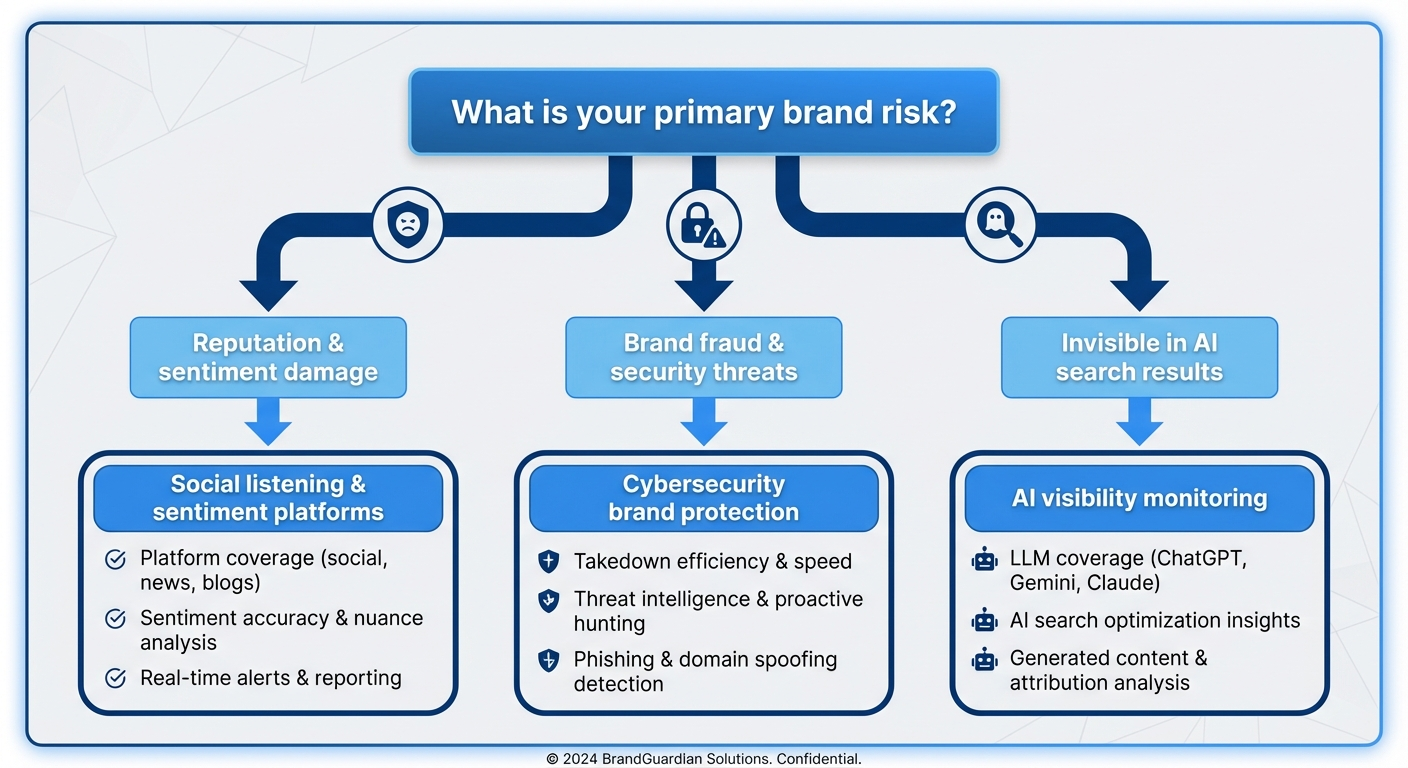
If your brand monitoring strategy was built before 2024, it likely focuses on social media mentions, review site alerts, and maybe some news monitoring. That foundation still matters. But it misses an entire layer of brand perception that now influences buying decisions.
AI Assistants Shape Purchase Decisions
When a VP of Engineering asks ChatGPT to recommend CRM platforms for mid-market SaaS companies, the response becomes a shortlist. If your brand isn’t mentioned, you’re not on that shortlist — regardless of your Google rankings or social media following.
Research from SparkToro in 2025 found that a growing share of B2B research begins with AI-assisted queries rather than traditional search. This means your brand’s discoverability in AI responses directly impacts early-stage pipeline.
Traditional brand monitoring tools don’t track this. They can tell you that someone mentioned your brand on X (formerly Twitter). They can’t tell you whether ChatGPT, Gemini, or Perplexity mention your brand when prompted with your most important category queries.
The Gap Between Sentiment and Visibility
Sentiment analysis tells you how people feel about your brand. AI visibility monitoring tells you whether your brand exists in the places where decisions are increasingly made.
A brand can have overwhelmingly positive sentiment across social media and still be completely invisible to AI assistants. These are separate problems that require separate monitoring strategies — and often separate services.
How to Evaluate Brand Monitoring Services by Business Need
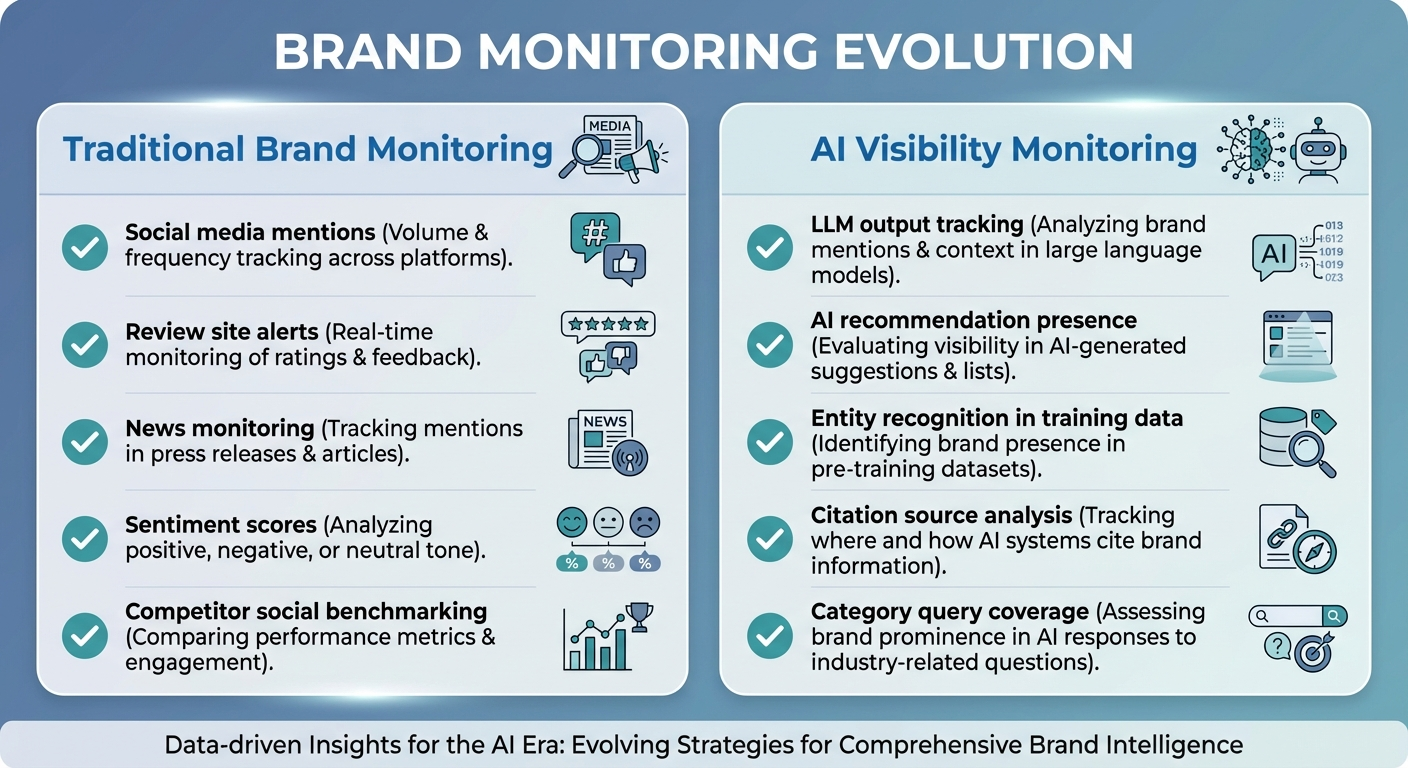
The brand monitoring market in 2026 is crowded. Choosing the right service starts with identifying your primary risk and growth objective — not with comparing feature lists.
If Your Primary Concern Is Reputation and Sentiment
Services like Brandwatch, Sprinklr Insights, and Mention provide enterprise-grade social listening, sentiment tracking, and crisis detection across social platforms, forums, news, and review sites.
These tools work best for brands that already have significant online conversation volume and need to detect narrative shifts, manage PR risks, or respond to customer complaints in near-real time.
Key evaluation criteria:
- Breadth of source coverage (does it monitor Reddit, Discord, and niche forums — not just major social platforms?)
- Sentiment accuracy (does it handle sarcasm, context, and multilingual content?)
- Alerting speed and escalation workflows
- Integration with your existing CRM, SIEM, or support stack
If Your Primary Concern Is Brand Security
Cybersecurity-focused services like ZeroFox, Recorded Future Brand Intelligence, and CloudSEK XVigil monitor for phishing domains, fake apps, impersonation accounts, dark web mentions, and executive identity theft.
These are critical for financial services, healthcare, and e-commerce companies where brand abuse directly translates to customer fraud and regulatory risk.
Key evaluation criteria:
- Dark web monitoring depth
- Takedown support (do they help remove fraudulent content or just alert you?)
- Domain and logo impersonation detection
- Integration with your security operations center
If Your Primary Concern Is AI Discoverability
This is where the market is evolving fastest. Brands that need to track and improve their visibility in AI-generated answers require a different type of monitoring — one that tracks LLM outputs across ChatGPT, Perplexity, Gemini, Google AI Overviews, and Claude.
Several brand monitoring tools now include AI visibility tracking alongside traditional mention monitoring. More specialized solutions focus exclusively on AI visibility analytics, tracking which brands appear in AI responses, how frequently, and in what context.
Key evaluation criteria:
- Coverage of major AI platforms (ChatGPT, Perplexity, Gemini, Claude, Copilot)
- Ability to track specific category queries relevant to your business
- Competitive benchmarking — where you stand relative to alternatives
- Historical tracking to measure improvement over time
What Makes AI Brand Monitoring Different From Social Listening
Monitoring brand mentions in LLMs is fundamentally different from tracking social media mentions. Understanding the distinction helps you allocate monitoring budget effectively.
Social Listening Tracks Conversations
Social listening tools scan for instances where real people mention your brand in content they’ve published — tweets, posts, reviews, blog articles, forum threads. The data source is human-generated content on indexed and sometimes unindexed platforms.
AI Visibility Monitoring Tracks Model Outputs
AI visibility monitoring checks what large language models say about your brand when prompted. The data source is the AI model’s response itself — which is influenced by the model’s training data, retrieval-augmented generation (RAG) sources, and the way your brand’s entity is represented across the web.
Retrieval-augmented generation (RAG) is a method where AI models pull real-time information from external sources to supplement their training data when generating answers.
This distinction matters because you can’t improve AI visibility using the same tactics that improve social sentiment. AI models learn brand-category associations from the quality and distribution of content that mentions your brand across high-authority publications — not from the volume of social media chatter.
Agencies like BrandMentions address this by placing contextual brand mentions on 140+ high-authority publications that AI models actively learn from during training and RAG retrieval cycles.
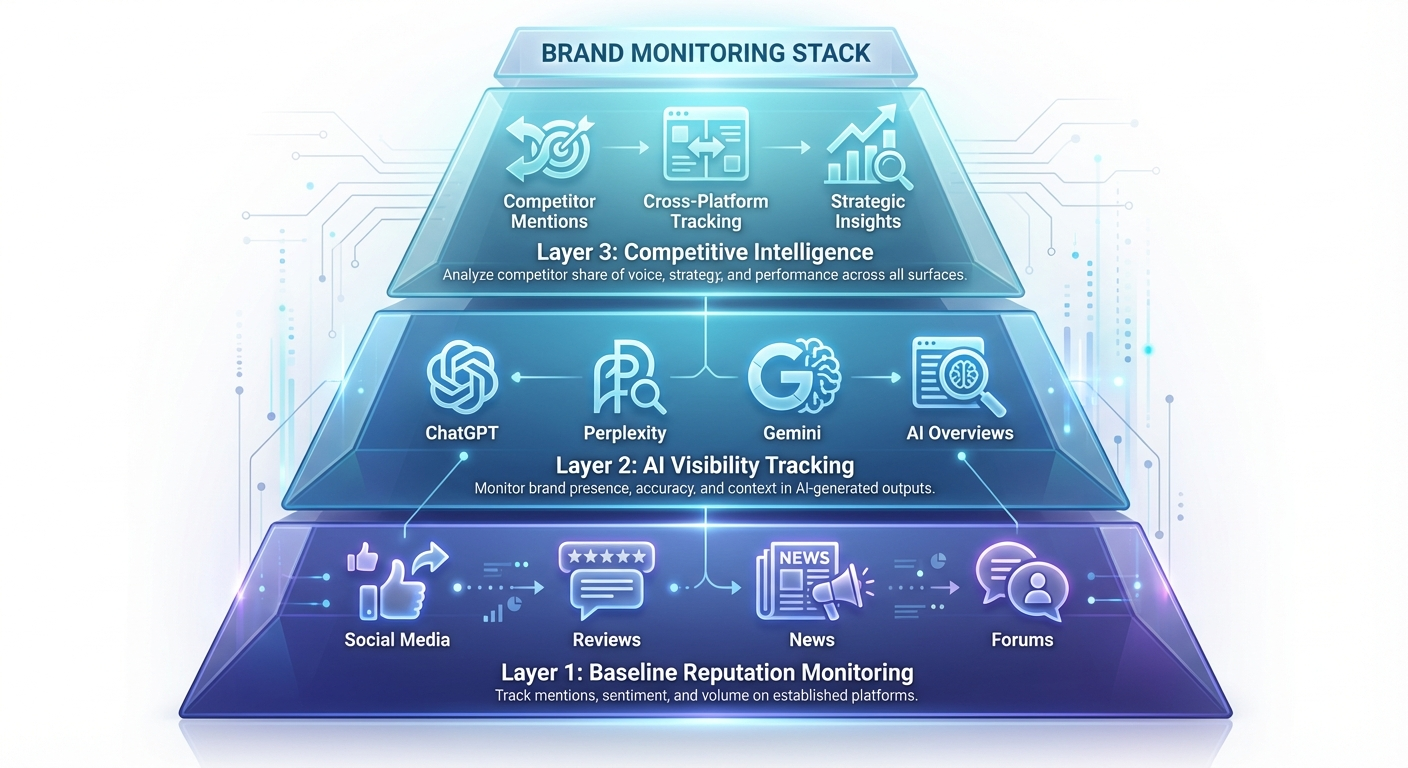
Building a Monitoring Stack That Covers All Surfaces
Most B2B companies in 2026 need monitoring coverage across at least two of the three categories described above. The question is how to structure that stack without creating alert fatigue or data silos.
Layer 1: Baseline Reputation Monitoring
Set up automated tracking for your brand name, product names, key executives, and common misspellings across social platforms, review sites, news outlets, and forums. Tools like Google Alerts (free) and Mention or Brand24 (paid) handle this layer.
Configure alerts by severity. Not every mention needs a response. Define clear escalation paths:
- Low severity: Neutral mentions, general industry discussion — log and review weekly.
- Medium severity: Negative sentiment, competitor comparisons, feature complaints — review within 24 hours.
- High severity: Crisis indicators, viral negative content, executive impersonation — immediate escalation to designated owner.
Layer 2: AI Visibility Tracking
Track your brand’s presence across the major AI search surfaces. At minimum, monitor ChatGPT, Perplexity, Google AI Overviews, and Gemini for your top 10–20 category-defining queries.
Several approaches work here:
- Manually query each AI platform weekly with your key category questions and log results (time-intensive but free).
- Use specialized AI rank trackers that automate this process and provide historical trend data.
- Engage a brand mentions service that combines monitoring with active placement to improve your AI discoverability.
The critical metric here is category query coverage — the percentage of relevant AI queries where your brand appears in the response. In campaigns across 67+ B2B companies, the BrandMentions team found that brands with consistent editorial mentions achieved AI recommendation rates 89% higher than those relying solely on traditional SEO.
Layer 3: Competitive Intelligence
Monitor not just your own brand but your top 3–5 competitors across all the same surfaces. Understanding when competitors appear in AI responses you’re absent from reveals your biggest opportunity gaps.
For traditional web monitoring, tools like Semrush and Ahrefs provide competitive mention tracking alongside SEO data. For AI-specific competitive intelligence, tracking competitor mentions in Perplexity and ChatGPT shows exactly where you’re losing ground.
Turning Monitoring Data Into Action
The most common failure in brand monitoring isn’t a lack of data. It’s a lack of action frameworks. Dashboards that nobody acts on are expensive screensavers.
Connect Monitoring Signals to Response Workflows
Every monitoring alert should map to an owner, a response timeframe, and a defined action. Build this mapping before you turn on monitoring, not after.
Example escalation framework:
| Signal Type | Owner | Response Window | Action |
|---|---|---|---|
| Negative review spike on G2 | Customer Success | 24 hours | Direct outreach to reviewers, root cause analysis |
| Competitor mentioned in AI response you’re absent from | Content/SEO team | Weekly review | Content gap analysis, entity-building prioritization |
| Brand impersonation detected | Legal/Security | 4 hours | Takedown request, customer notification if needed |
| Sudden sentiment drop on social | PR/Communications | 2 hours | Assess cause, prepare holding statement, monitor escalation |
| New AI platform begins citing your brand | Marketing | 48 hours | Document context, amplify through owned channels |
Feed Monitoring Insights Into Content Strategy
Monitoring data reveals exactly what your audience — and AI models — associate with your brand. This should directly inform your content calendar and strategy for increasing brand mentions in AI search.
If monitoring shows that Perplexity consistently mentions a competitor when users ask about your product category, the response isn’t to monitor harder. It’s to create authoritative content — placed on high-authority editorial sites — that builds the brand-category association AI models need to include you.
This is where monitoring transitions from a defensive function into a growth engine. The data tells you where to invest in brand mentions for SEO and AI discoverability.
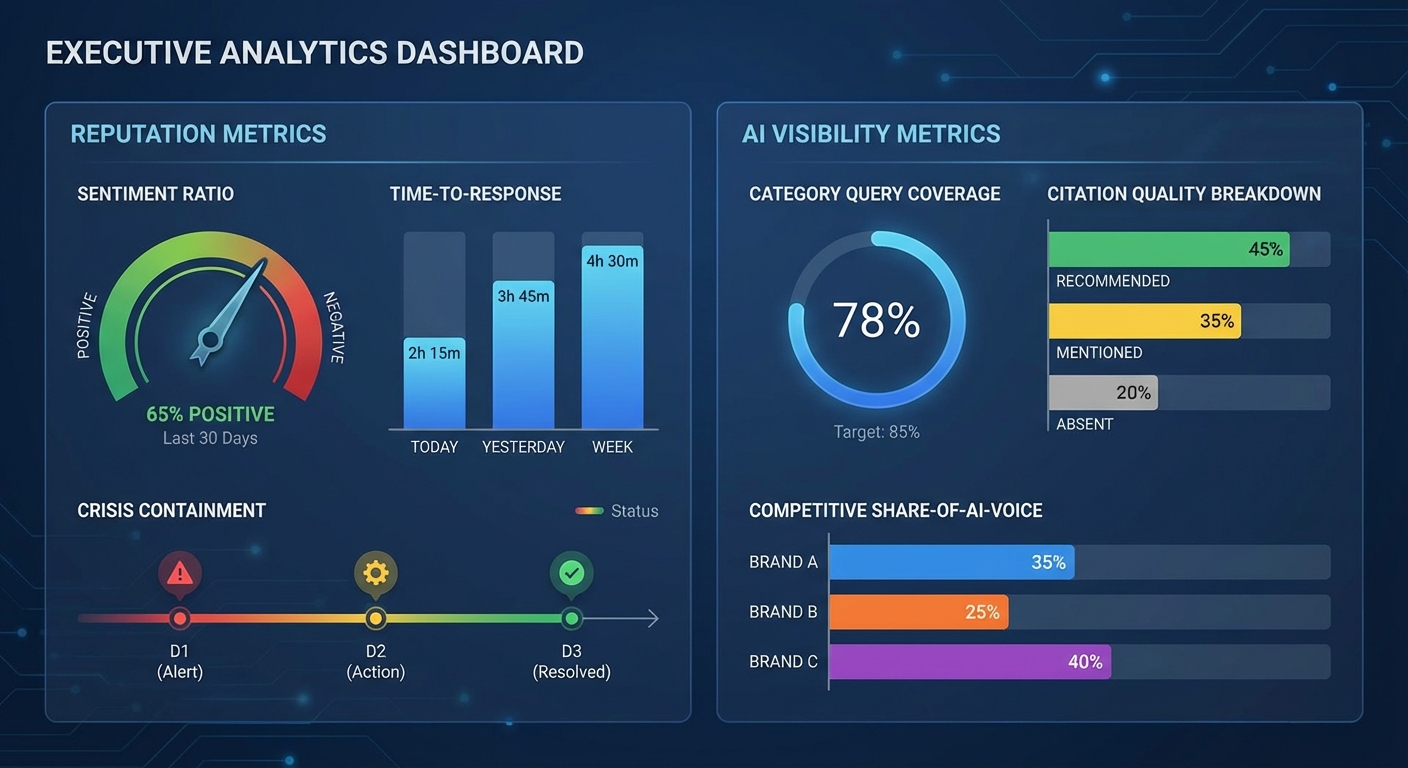
Metrics That Matter for Brand Monitoring in 2026
Vanity metrics — total mention count, raw impression numbers — don’t tell you whether monitoring is protecting your brand or driving growth. Focus on metrics tied to outcomes.
For Reputation Monitoring
- Sentiment ratio: Positive-to-negative mention ratio, tracked weekly. A sustained shift below your baseline (even if total mentions are up) signals trouble.
- Time to response: How fast your team acknowledges and addresses negative mentions or customer complaints. According to a 2025 Sprinklr analysis, roughly 32% of consumers expect a brand response within one hour on social channels.
- Crisis containment time: Measured from first detection of a negative spike to stabilization of sentiment. Shorter is better.
For AI Visibility Monitoring
- Category query coverage: The percentage of your tracked AI queries where your brand appears in the generated response. This is the single most important AI visibility metric.
- Citation quality: Is your brand mentioned as a recommendation, a comparison option, or just a passing reference? Context matters.
- Competitive share of AI voice: How often your brand appears relative to competitors for the same category queries across ChatGPT, Perplexity, Gemini, and Google AI Overviews.
A useful brand mentions report combines both dimensions — reputation signals alongside AI visibility data — to give marketing leaders a complete picture.
Common Mistakes With Brand Monitoring Services
After reviewing how dozens of B2B companies approach brand monitoring, several patterns consistently undermine results.
Monitoring Everything, Acting on Nothing
Alert fatigue is real. If every mention — positive, neutral, or irrelevant — triggers a notification, your team will learn to ignore them all. Configure monitoring with severity tiers and ownership assignments from day one.
Ignoring AI Search Surfaces
Many companies still treat brand monitoring as purely a social listening and PR function. If you’re not tracking brand mentions in AI, you’re missing the fastest-growing influence surface for B2B purchase decisions. AI search monitoring has shifted from “nice to have” to essential since 2024.
Treating Monitoring as a One-Time Project
Brand monitoring produces value through consistency. A one-time audit tells you where you stand today but gives no visibility into trends, emerging risks, or the impact of your actions over time. Build monitoring into your ongoing marketing operations, not your quarterly review checklist.
Not Connecting Monitoring to Entity Building
Monitoring tells you where gaps exist. Closing those gaps requires active entity building — creating the citations, editorial mentions, and authoritative content that strengthen your brand’s representation in AI training data and RAG sources.
BrandMentions tracks when major AI models update their training data and times placements to maximize inclusion in each knowledge refresh cycle. Monitoring without a corresponding action plan for improving discoverability leaves the most valuable insights on the table.
Choosing Between Self-Service Tools and Managed Services
The brand monitoring market offers both self-service platforms and fully managed services. The right choice depends on your team’s capacity and the complexity of your monitoring needs.
Self-Service Tools Work When:
- Your team has dedicated staff to configure, monitor, and act on alerts.
- Your monitoring needs are primarily social listening and review tracking.
- Your budget prioritizes tooling over analyst time.
Popular self-service options include Google Alerts (free, limited), dedicated brand tracking tools, Brandwatch, Mention, Brand24, and Hootsuite for social monitoring. For AI-specific tracking, tools focused on ChatGPT mention monitoring and Perplexity mentions tools serve this niche.
Managed Services Work When:
- You need both monitoring and action — not just dashboards, but takedowns, content placement, or entity-building support.
- AI visibility monitoring and improvement are a priority alongside traditional mention tracking.
- Your marketing team is lean and can’t dedicate a person to daily monitoring operations.
- You need cross-platform expertise covering both traditional search and AI surfaces.
The strongest brand mention agencies combine monitoring with strategic placement — identifying where you’re invisible and building the citations that close those gaps.
What Has Changed Since 2024–2025
The brand monitoring landscape has shifted significantly over the past two years. Understanding what’s changed helps you avoid building a 2024 strategy for a 2026 reality.
AI Search Went From Experimental to Mainstream
In 2024, Google AI Overviews were still rolling out. ChatGPT’s browsing features were new. Perplexity was a niche tool. As of 2026, these platforms collectively handle a substantial share of informational and commercial queries. Monitoring your brand’s presence in their outputs is no longer optional for competitive B2B companies.
Monitoring Fragmentation Increased
Brand conversations now happen in more places — Discord servers, private Slack communities, AI-generated content, short-form video comments, and podcast transcripts. Monitoring tools have responded with broader source coverage, but gaps remain. No single tool covers everything. A layered approach is required.
Deepfakes and AI-Generated Misinformation Escalated
AI-generated fake reviews, fabricated executive statements, and synthetic brand content have become more sophisticated. According to research from Stanford HAI published in 2025, the volume of AI-generated misinformation increased significantly year over year, making brand protection monitoring more urgent for enterprises.
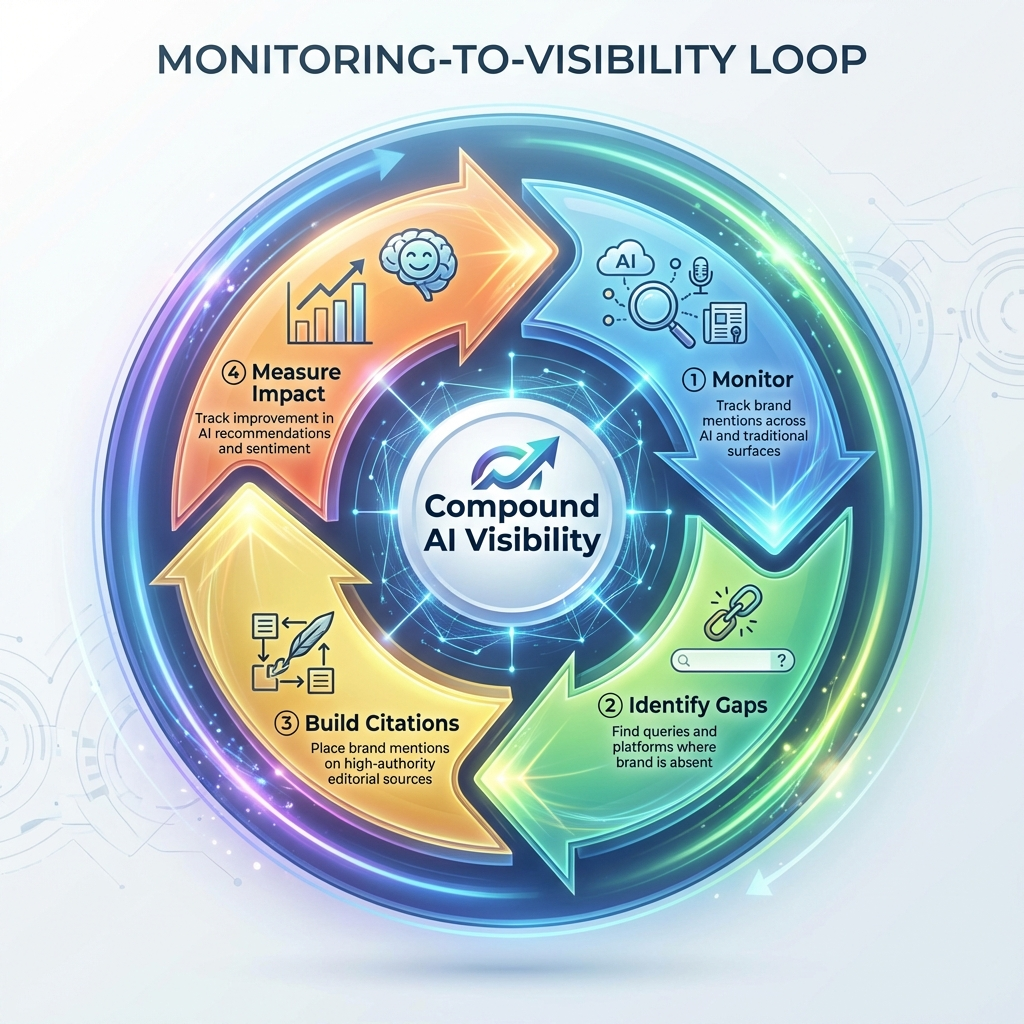
The Connection Between Monitoring and Visibility Strategy Tightened
Forward-thinking brands now treat monitoring data as the input to their AI visibility strategy. The loop works like this: monitor where you’re absent → build citations in those contexts → track improvement → refine. This cycle, running continuously, compounds AI discoverability over time.
Frequently Asked Questions
What is the difference between brand monitoring and social listening?
Brand monitoring tracks specific mentions of your brand name, products, and executives across digital channels. Social listening analyzes broader industry conversations, audience sentiment, and cultural trends to understand context and motivations. Monitoring detects signals; listening provides strategic interpretation.
Do brand monitoring services track AI search results?
Some do, but most traditional social listening tools do not. Tracking brand mentions in AI search results requires specialized tools or services that query AI platforms and log whether your brand appears in generated responses. This category is growing rapidly in 2026.
How much do brand monitoring services cost?
Costs vary widely. Free tools like Google Alerts cover basic web mentions. Paid social listening platforms range from $100 to $1,000+ per month depending on scale and features. Enterprise-grade monitoring suites with AI visibility tracking, cybersecurity surveillance, and managed services can run $2,000 to $10,000+ monthly. Pricing depends on source coverage, alert volume, and whether the service includes action support like takedowns or content placement.
Can brand monitoring improve SEO?
Yes. Monitoring reveals unlinked brand mentions that can be converted into backlinks, identifies content gaps where competitors outperform you, and tracks brand sentiment signals that correlate with search performance. Additionally, monitoring your AI visibility helps guide an entity-building strategy that strengthens both SEO and AI discoverability.
How often should brand monitoring be reviewed?
High-severity alerts (brand impersonation, crisis indicators) need immediate review. Social sentiment and reputation data should be reviewed at least weekly. AI visibility monitoring is most useful on a bi-weekly or monthly cadence, since AI model outputs change less frequently than social conversation volume.
Moving From Monitoring to Competitive Advantage
Brand monitoring services in 2026 serve three distinct functions: protecting your reputation, defending against fraud, and building visibility in AI-driven search. The brands that treat monitoring as an intelligence system — not a passive alert feed — turn it into a competitive advantage.
The highest-leverage move is connecting your monitoring data directly to your AI visibility strategy. When you know exactly where your brand is absent from AI recommendations, you can invest strategically in the editorial citations and entity-building work that close those gaps.
If you’re unsure where your brand stands across AI search platforms, start with a focused audit. See what ChatGPT, Perplexity, and Gemini say about your category — and whether your brand appears in those answers.
See where your brand stands in AI search. Get a free AI visibility audit to find out what AI assistants say about your brand — and your competitors.