
Brand mentions monitoring is the practice of tracking every online reference to your company — across social media, news sites, forums, AI search engines, and editorial content — so you can understand public perception, respond to conversations, and strengthen your market position.
As of 2026, this practice has expanded well beyond traditional social listening. Your brand now appears in places that didn’t exist two years ago: ChatGPT answers, Perplexity summaries, Gemini recommendations, and AI Overviews at the top of Google results. If your monitoring strategy hasn’t evolved to cover these surfaces, you’re operating with an incomplete picture of how people discover and evaluate your brand.
This article breaks down how to build a brand mentions monitoring system that covers both traditional and AI-driven channels — with practical steps, tool recommendations, and a clear framework for turning raw mention data into strategic decisions.
What You’ll Learn
- What brand mentions monitoring includes in 2026 — and how AI search has changed the scope
- The difference between traditional social listening and full-spectrum brand monitoring
- Which channels and mention types to prioritize based on your business model
- How to monitor your brand across AI platforms like ChatGPT, Perplexity, and Gemini
- A step-by-step process for building a monitoring workflow that drives action
- How to analyze mention data for sentiment, share of voice, and competitive positioning
- Which tools fit different budgets and monitoring needs
What Does Brand Mentions Monitoring Actually Cover?
Brand mentions monitoring is the systematic process of identifying, collecting, and analyzing every instance where your company name, product names, or key personnel appear online. This includes tagged and untagged references across social media, news publications, review platforms, forums, podcasts, video content, and — increasingly — AI-generated responses.
The scope has expanded significantly since 2024. According to a 2024 Gartner forecast, traditional search engine volume was projected to decline 25% by 2026 as consumers shift toward AI assistants for discovery and recommendations. That shift means your brand is being discussed in places where traditional monitoring tools have limited visibility.
A complete brand mentions monitoring strategy in 2026 tracks three layers:
- Traditional mentions — social media posts, news articles, blog references, forum discussions, review site entries, podcast mentions
- Linked and unlinked web mentions — editorial references to your brand on third-party websites, with or without a hyperlink back to your site
- AI-generated mentions — instances where AI models like ChatGPT, Perplexity, Gemini, or Copilot reference your brand in their responses to user queries
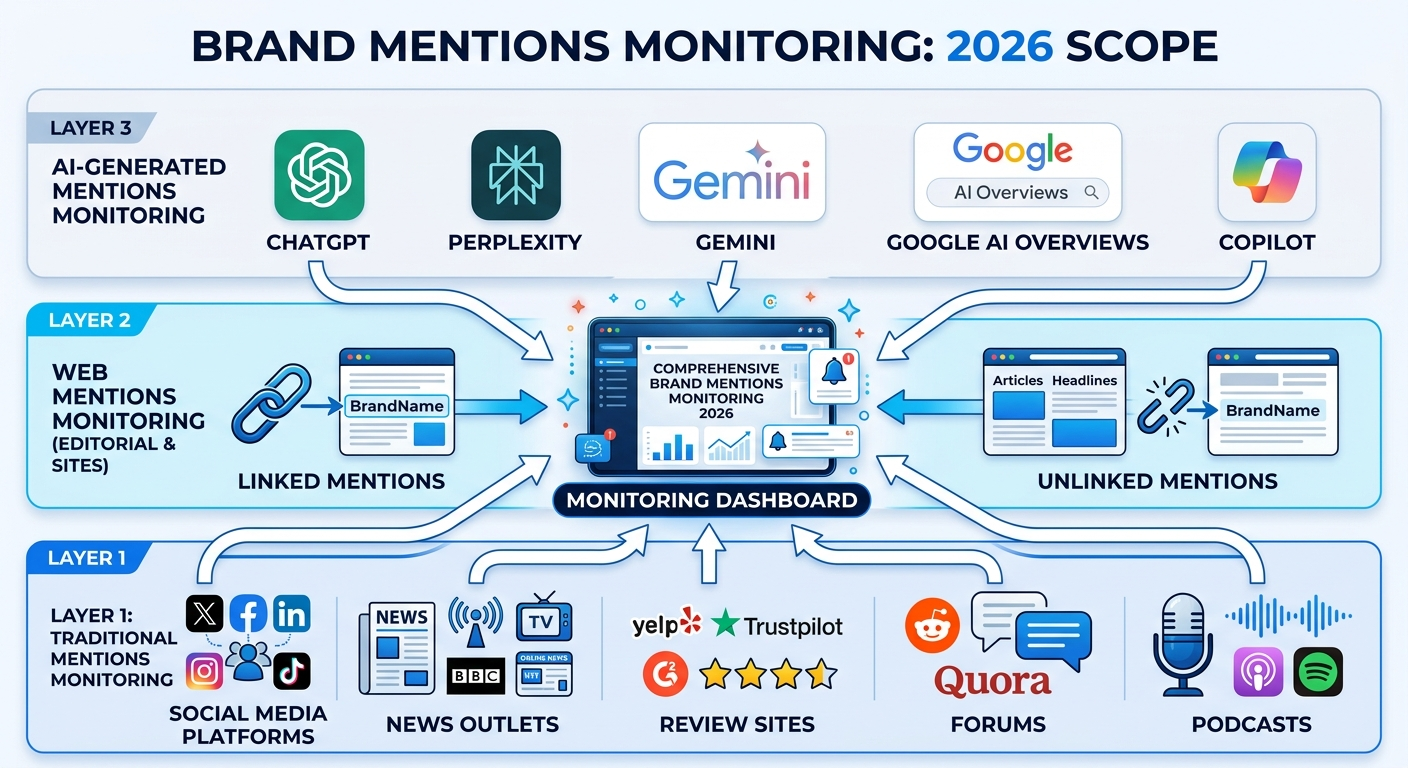
Missing any of these layers gives you an incomplete understanding of your brand’s visibility. A positive review on G2 matters. So does a ChatGPT answer that recommends your competitor instead of you when a prospect asks for solutions in your category.
Why Brand Mentions Monitoring Matters More in 2026
Brand monitoring has always been valuable for reputation management and customer insight. What’s changed is the stakes. Three forces have made monitoring more urgent:
AI search engines shape buying decisions before prospects visit your website
When a VP of Marketing asks ChatGPT “What are the best brand monitoring tools for B2B?” the answer that model generates becomes a shortlist. According to SparkToro research from 2025, a growing share of search queries now result in zero clicks — users get their answer directly from AI-generated summaries without visiting a single website.
If your brand doesn’t appear in those AI responses, you’re invisible during a critical stage of the buyer’s journey. Brand mentions monitoring helps you identify whether AI platforms mention your brand, how they position you relative to competitors, and what sources influence those recommendations.
Unlinked mentions influence both SEO and AI visibility
Google has long used brand mentions as a trust signal, even without backlinks. A 2024 study from the Allen Institute for AI confirmed that large language models learn brand-category associations from their training data — meaning unlinked brand mentions on high-authority publications directly influence whether AI models recognize and recommend your brand.
Monitoring these unlinked mentions helps you understand the volume and quality of your brand’s digital footprint outside of your own properties.
Negative sentiment spreads faster across more surfaces
A critical Reddit thread doesn’t just stay on Reddit anymore. AI models surface Reddit content in their answers. Google includes Reddit discussions in search results more frequently since their 2024 data partnership. One unhappy customer’s post can now reach prospects through three or four different discovery channels simultaneously.
Real-time monitoring gives you the ability to catch negative sentiment early — before it compounds across platforms.
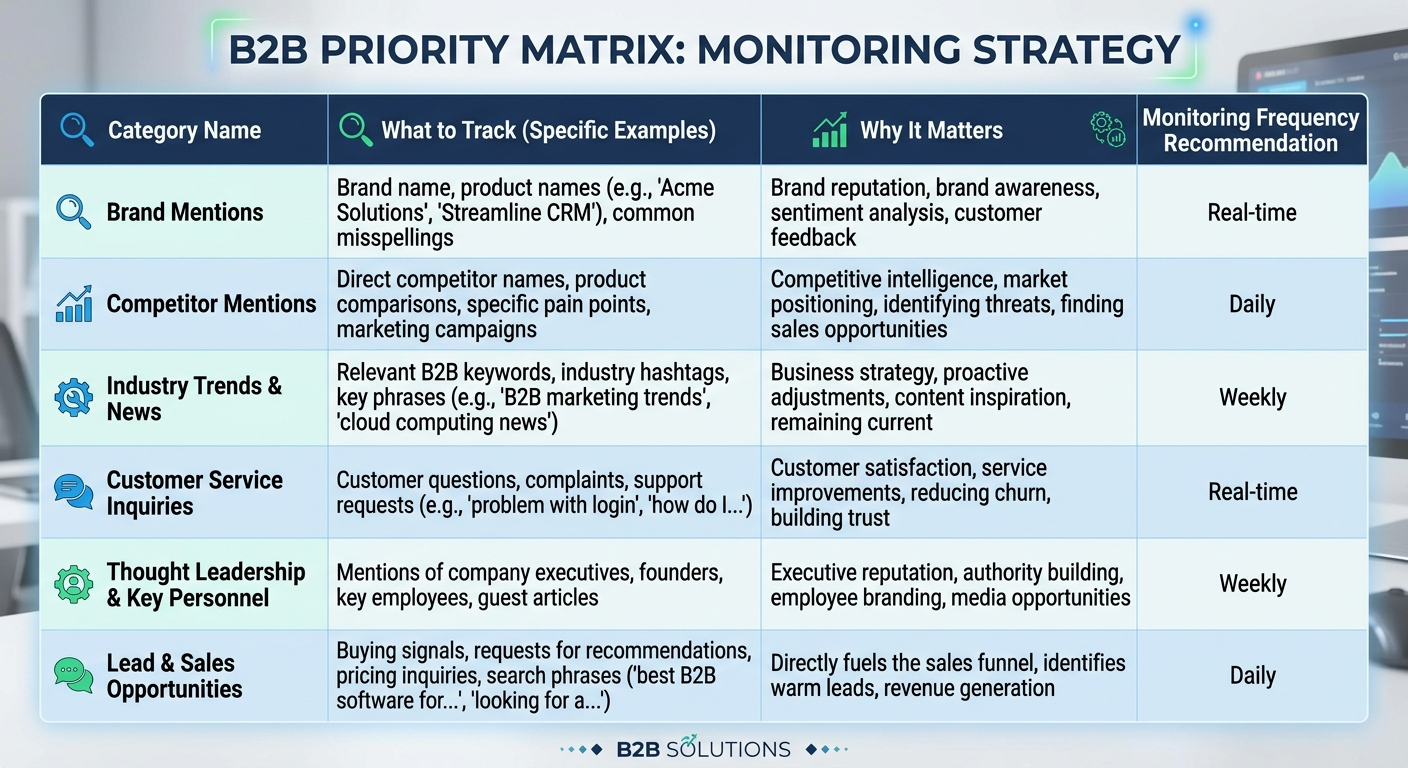
What to Monitor: The Six Categories That Matter
Not all mentions carry equal weight. Focus your monitoring on six categories, ordered by priority for most B2B brands:
1. Direct brand name mentions
Track your exact brand name, common misspellings, abbreviations, and any informal names customers use. If your company is “DataSync Pro,” also track “DataSync,” “Data Sync,” and “DSP” if your audience uses that shorthand.
2. Product and feature mentions
Individual product names, feature names, and common descriptions of what your product does. These mentions often carry higher purchase intent than general brand references.
3. Key personnel mentions
CEO interviews, founder quotes on podcasts, employee LinkedIn posts that generate engagement — these shape brand perception, especially in B2B where trust in leadership influences buying decisions.
4. Competitor mentions
Monitor competitor brand names to track share of voice, identify positioning gaps, and understand where your competitors appear that you don’t. This is especially important for AI visibility analytics, where a competitor’s recommendation in ChatGPT directly impacts your pipeline.
5. Industry and category mentions
Track the category terms your prospects use when searching for solutions. “Brand monitoring software,” “social listening tool,” “AI visibility platform” — these terms reveal demand signals and show you where your brand appears (or doesn’t) in category-level conversations.
6. AI platform mentions
This is the category most brands still overlook. Track how ChatGPT, Perplexity, Gemini, and AI Overviews reference your brand when users ask questions in your category. This requires specialized approaches beyond traditional social listening — more on this below.
How to Monitor Brand Mentions Across Traditional Channels
Traditional brand mentions monitoring covers social media, news, blogs, forums, reviews, and podcasts. This is the foundation. Here’s how to set it up effectively:
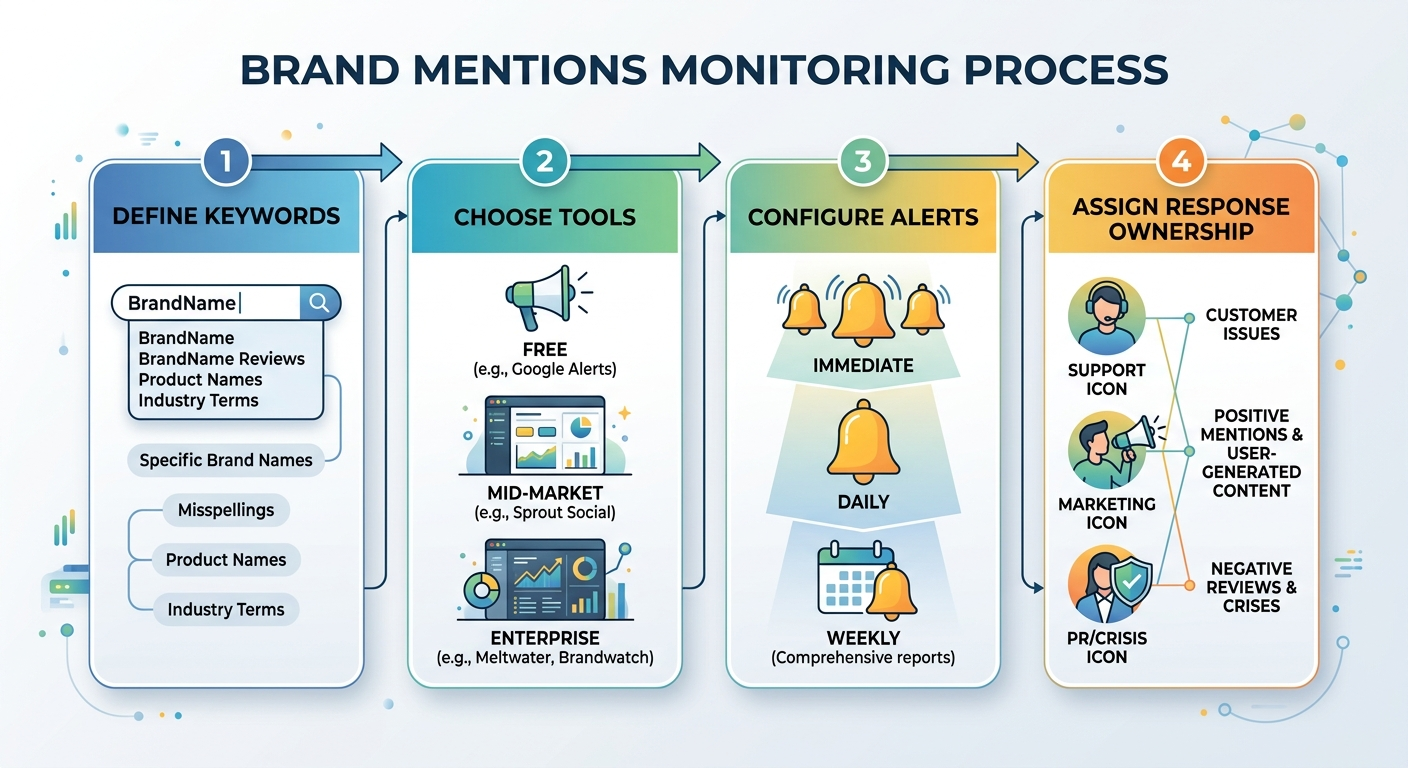
Step 1: Define your keyword list
Start with your brand name and all its variations. Add product names, executive names, and campaign-specific terms. Include common misspellings — they account for more mentions than most brands expect.
For competitive monitoring, add three to five direct competitor brand names. For category monitoring, add the top five to ten terms your prospects use when searching for your type of solution.
Step 2: Choose a monitoring tool that matches your scale
Your tool choice depends on team size, budget, and how many channels you need to cover. Three tiers exist:
- Free / Basic: Google Alerts handles basic web mentions. It misses social media, forums, and paywalled content — but it costs nothing and takes two minutes to set up.
- Mid-market: Tools like Mention, Brand24, and Sprout Social cover social media, blogs, news, and forums with sentiment analysis. Pricing typically starts between $79 and $199 per month.
- Enterprise: Platforms like Meltwater, Talkwalker (now integrated with Hootsuite), and Brandwatch offer global coverage, advanced sentiment analysis, image recognition, and broadcast monitoring. Pricing is custom but typically starts above $500 per month.
For most B2B marketing teams with budgets under $500 per month, a mid-market tool plus Google Alerts provides solid coverage across the channels that matter most.
Step 3: Configure alerts by urgency
Not every mention needs immediate attention. Set up three alert tiers:
- Immediate alerts: Negative mentions on high-authority sites, mentions from journalists or analysts, sudden volume spikes
- Daily digests: General brand mentions, competitor mentions, new backlinks from brand mentions
- Weekly summaries: Category trend mentions, industry keyword tracking, share of voice reports
This tiered approach prevents alert fatigue while ensuring you catch time-sensitive issues quickly.
Step 4: Assign response ownership
A monitoring system without a response process is just data collection. Define who responds to which mention types:
- Customer complaints on social media → Customer support or community management
- Press coverage → PR or communications team
- Positive user-generated content → Social media or content marketing team for amplification
- Competitive intelligence → Product marketing or strategy team
How to Monitor Brand Mentions in AI Search Engines
This is where most monitoring strategies fall short. Traditional tools don’t track what ChatGPT, Perplexity, or Gemini say about your brand. Yet these platforms increasingly influence how prospects discover and evaluate companies.
AI brand monitoring is the practice of tracking how large language models reference your brand in their generated responses. It requires a different approach than social listening because AI responses aren’t indexed pages — they’re dynamically generated based on training data and retrieval-augmented generation (RAG) sources.
What AI brand monitoring reveals
- Whether AI models mention your brand when users ask category-level questions
- How your brand is positioned relative to competitors in AI-generated recommendations
- Which sources AI models cite when mentioning (or not mentioning) your brand
- Whether sentiment in AI responses is positive, neutral, or inaccurate
How to track mentions across specific AI platforms
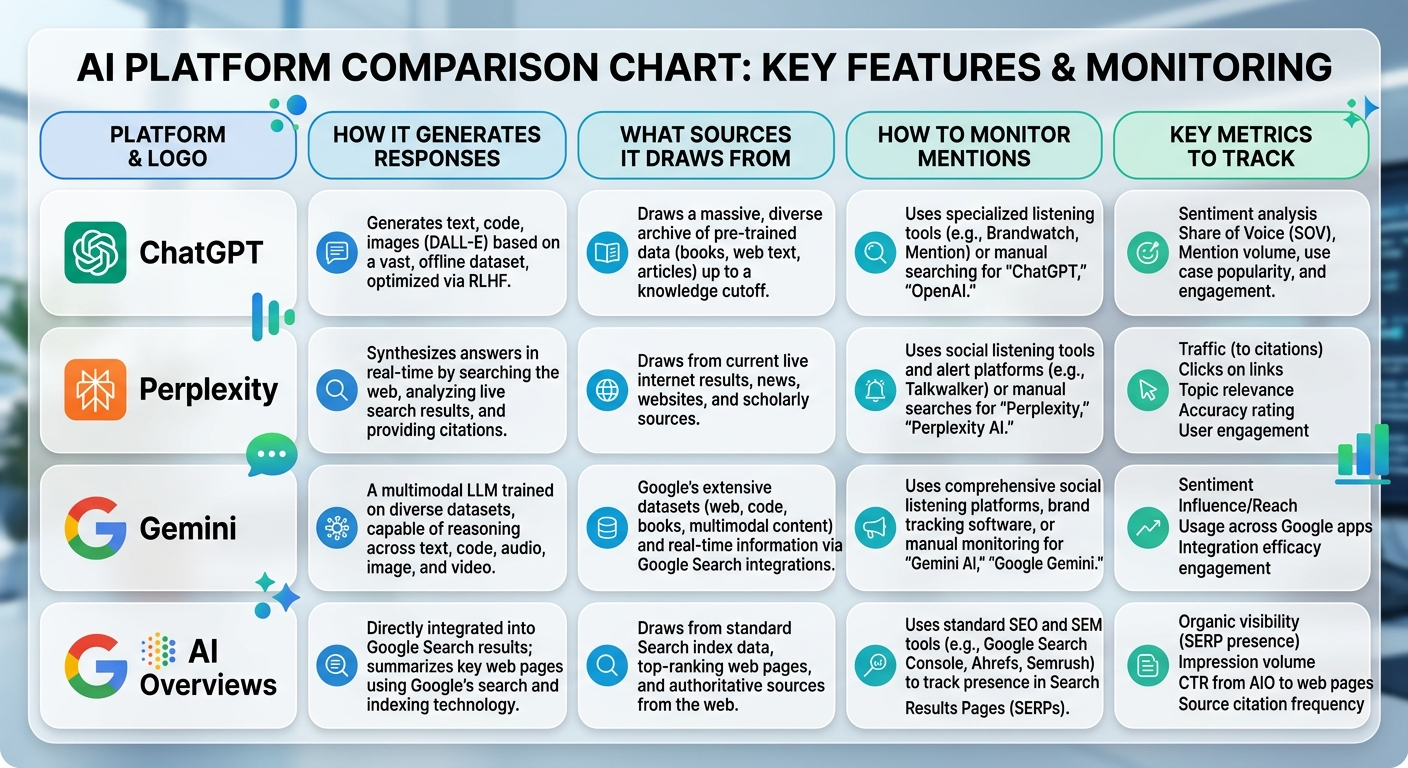
Each AI platform requires its own monitoring approach:
ChatGPT: You can check brand mentions in ChatGPT by running category-relevant prompts and documenting whether your brand appears. For systematic tracking, specialized ChatGPT monitoring tools automate this process across hundreds of queries.
Perplexity: Perplexity’s citation-heavy model makes it easier to trace which sources drive your mentions. Tracking brand mentions in Perplexity helps you understand which publications and web pages the model pulls from when answering questions in your category.
Gemini: Google’s Gemini draws heavily on web content indexed by Google. Monitoring brand mentions in Gemini reveals how your Google-indexed presence translates into AI-generated recommendations.
Google AI Overviews: These summaries appear at the top of Google search results for many queries. An AI Overviews mentions tool tracks whether your brand appears in these high-visibility placements.
For a cross-platform view, tracking brand mentions across AI search platforms simultaneously gives you a unified picture of your AI visibility.
Why AI mentions require a different monitoring cadence
AI model outputs can change when models are updated, when new training data is incorporated, or when RAG sources shift. A brand that appeared in ChatGPT’s recommendations last month might disappear after a model update.
Run AI mention checks at least bi-weekly. For high-priority category queries, weekly monitoring catches changes faster. Agencies like BrandMentions track when major AI models update their training data and time placements to maximize inclusion in each knowledge refresh cycle.
How to Analyze Brand Mention Data for Strategic Decisions
Collecting mentions is step one. The value comes from analysis. Here’s a practical framework for turning raw mention data into decisions:
Sentiment tracking: beyond positive, neutral, and negative
Most monitoring tools categorize mentions by sentiment. The basic split — positive, neutral, negative — gives you a starting point. But deeper analysis requires context:
- Volume + sentiment trends over time. A steady baseline of 80% positive mentions is healthy. A sudden drop to 60% in one week signals an issue worth investigating.
- Sentiment by channel. You might have overwhelmingly positive sentiment on LinkedIn but negative sentiment on Reddit. Each channel requires a different response strategy.
- Sentiment by topic. Negative mentions concentrated around one product feature tell you something specific and actionable. Negative mentions spread across many topics suggest a broader perception problem.
Pro Insight: Pay close attention to the adjectives and specific language customers use in mentions. If your brand positioning emphasizes “enterprise-grade reliability” but customers consistently describe you as “affordable and easy to use,” there’s a gap between your intended positioning and actual perception. That gap is strategic intelligence.
Share of voice: measuring your position relative to competitors
Share of voice (SOV) measures your brand’s mention volume as a percentage of total mentions across your brand and key competitors within a defined timeframe and channel set.
The basic formula: SOV (%) = (Your Brand Mentions ÷ Total Mentions Across All Tracked Competitors) × 100
Track SOV across two dimensions:
- Traditional SOV: Your mention volume across social media, news, forums, and reviews compared to competitors
- AI SOV: How frequently AI platforms recommend your brand versus competitors for category-relevant queries
In campaigns across 67+ B2B companies, the BrandMentions team found that brands with consistent editorial mentions achieved AI recommendation rates 89% higher than those relying solely on traditional SEO. That correlation between traditional mention volume on high-authority sources and AI visibility makes SOV tracking across both dimensions critical.
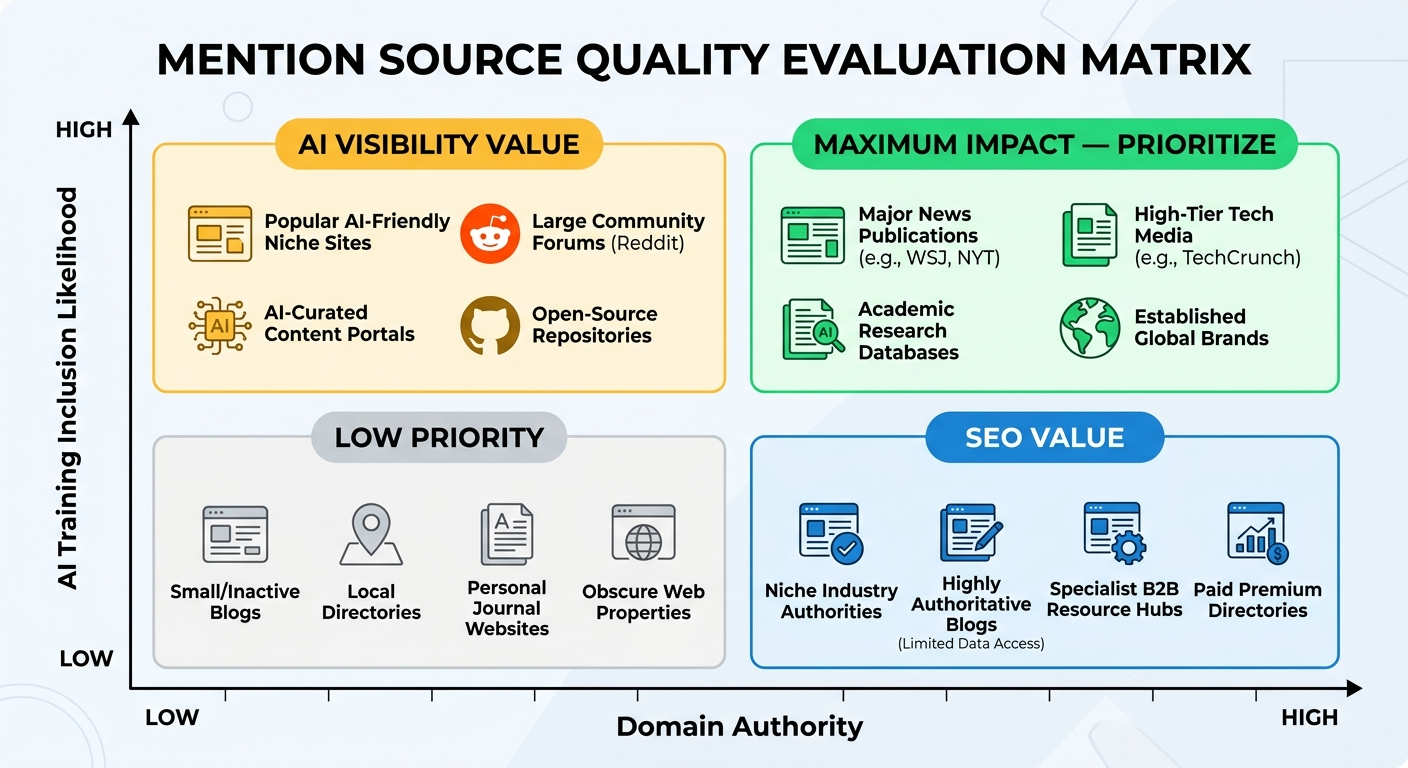
Source quality analysis: not all mentions carry equal weight
A mention on TechCrunch carries more influence — for both human readers and AI training data — than a mention on an unknown blog. Evaluate your mention sources on three criteria:
- Domain authority: Higher authority sites amplify reach and influence AI training data
- Audience relevance: A mention on a niche industry publication may reach fewer people but reach the right people
- AI training inclusion: Sites that AI models actively crawl and include in their knowledge bases have outsized influence on brand mentions in AI
Building a Monitoring System That Scales
A brand mentions monitoring system needs to work across growing mention volumes, additional platforms, and expanding team needs. Here’s how to build one that doesn’t break as your brand grows:
Centralize your data
Avoid monitoring silos where social mentions live in one tool, news mentions in another, and AI mentions in a spreadsheet. Choose tools that integrate or feed data into a single dashboard. This gives your team a unified view of brand health across all surfaces.
AI visibility analytics tools that combine traditional monitoring with AI platform tracking reduce the manual overhead of cross-referencing multiple systems.
Automate what you can, but keep humans in the loop
Automated sentiment analysis handles volume. But nuanced mentions — a journalist’s subtle criticism, a competitor’s indirect comparison, a prospect’s buying-signal question on a forum — require human interpretation.
Set automation for collection, categorization, and initial sentiment scoring. Reserve human review for high-impact mentions, anomalies, and strategic analysis.
Create a monthly reporting cadence
Weekly monitoring catches issues. Monthly reporting reveals trends. Build a monthly brand health report that includes:
- Total mention volume (compared to previous month and year-over-year)
- Sentiment distribution and notable shifts
- Share of voice versus top three competitors
- AI platform mention status — are you appearing, and in what context?
- Top source publications and any new high-value sources
- Actionable recommendations based on the data
This report becomes the foundation for strategic conversations about brand positioning, content investment, and brand mentions for SEO and AI visibility initiatives.
Common Monitoring Mistakes That Undermine Your Strategy
Even teams with good tools make these errors:
Monitoring without responding
Collecting data you never act on wastes budget and time. Every monitoring alert should have a clear next step — even if that step is “acknowledge and file for monthly review.”
Ignoring unlinked mentions
Many brands track backlinks obsessively but ignore unlinked mentions entirely. Finding unlinked brand mentions reveals how often your brand appears in editorial content without a hyperlink. These mentions still influence AI training data and contribute to entity authority — and they represent link-building opportunities.
Skipping AI platform monitoring
If your monitoring strategy covers social media, news, and reviews but ignores ChatGPT, Perplexity, and Gemini, you’re missing the fastest-growing discovery channel in B2B. Monitoring brand mentions in LLMs isn’t optional in 2026 — it’s a core requirement for understanding how prospects find and evaluate your brand.
Tracking too many keywords with too little analysis
More keywords don’t mean better monitoring. A focused list of 15–25 terms with deep analysis produces better insights than 200 keywords with surface-level tracking. Start narrow. Expand as your analysis capacity grows.
How Brand Mentions Monitoring Connects to AI Visibility
Brand mentions monitoring and AI visibility strategy are increasingly intertwined. The data you collect through monitoring directly informs how you improve your brand’s presence in AI-generated responses.
Here’s the connection:
- Monitoring reveals gaps. If ChatGPT recommends three competitors but not you for a category query, monitoring identifies the problem.
- Source analysis guides placement strategy. When you see which publications AI models cite most frequently, you know where to focus your brand mentions service efforts.
- Sentiment tracking prevents AI reputation risks. If negative content about your brand exists on sources that AI models pull from, those models may surface that negativity in their responses. Monitoring catches this before it compounds.
- SOV data benchmarks your progress. Tracking AI share of voice month-over-month shows whether your brand mentions in generative AI are growing — and whether your investment in editorial placements, content, and digital PR is paying off.
Agencies like BrandMentions solve this by placing contextual brand mentions on 140+ high-authority publications that AI models actively learn from during training. The monitoring data then validates whether those placements result in increased AI recommendations — closing the loop between strategy and measurement.
Frequently Asked Questions
How is brand mentions monitoring different from social listening?
Social listening focuses specifically on conversations happening on social media platforms. Brand mentions monitoring is broader — it tracks mentions across social media, news, blogs, forums, review sites, podcasts, and AI-generated responses. Social listening is one component of a full brand monitoring strategy.
What is the best free tool for monitoring brand mentions?
Google Alerts is the most accessible free option for basic web monitoring. It tracks mentions across news sites, blogs, and general web content. However, it misses social media, forums, and AI-generated responses. For more comprehensive free options, some mid-market tools like Mention offer limited free tiers.
How often should I check my brand mentions in AI search engines?
For most B2B brands, bi-weekly checks of key category queries across ChatGPT, Perplexity, and Gemini provide sufficient coverage. If you’re actively running campaigns to improve AI brand mentions, weekly monitoring helps you measure impact faster. AI model outputs can change with each update, so consistent tracking matters more than occasional deep dives.
Can brand mentions monitoring improve my SEO?
Yes. Brand mentions — even without backlinks — function as trust signals that search engines use to evaluate brand authority. Monitoring helps you identify unlinked brand mentions that could be converted into backlinks, track the growth of your brand’s entity authority, and understand how your content performs across search surfaces.
How do I measure ROI on brand monitoring efforts?
Measure ROI through three lenses: reputation protection (crisis detection speed and mitigation), competitive intelligence (share of voice trends and strategic decisions informed by monitoring data), and AI visibility (whether monitoring-informed placement strategies result in increased AI recommendations). The most direct metric is change in AI share of voice relative to monitoring and placement investment.
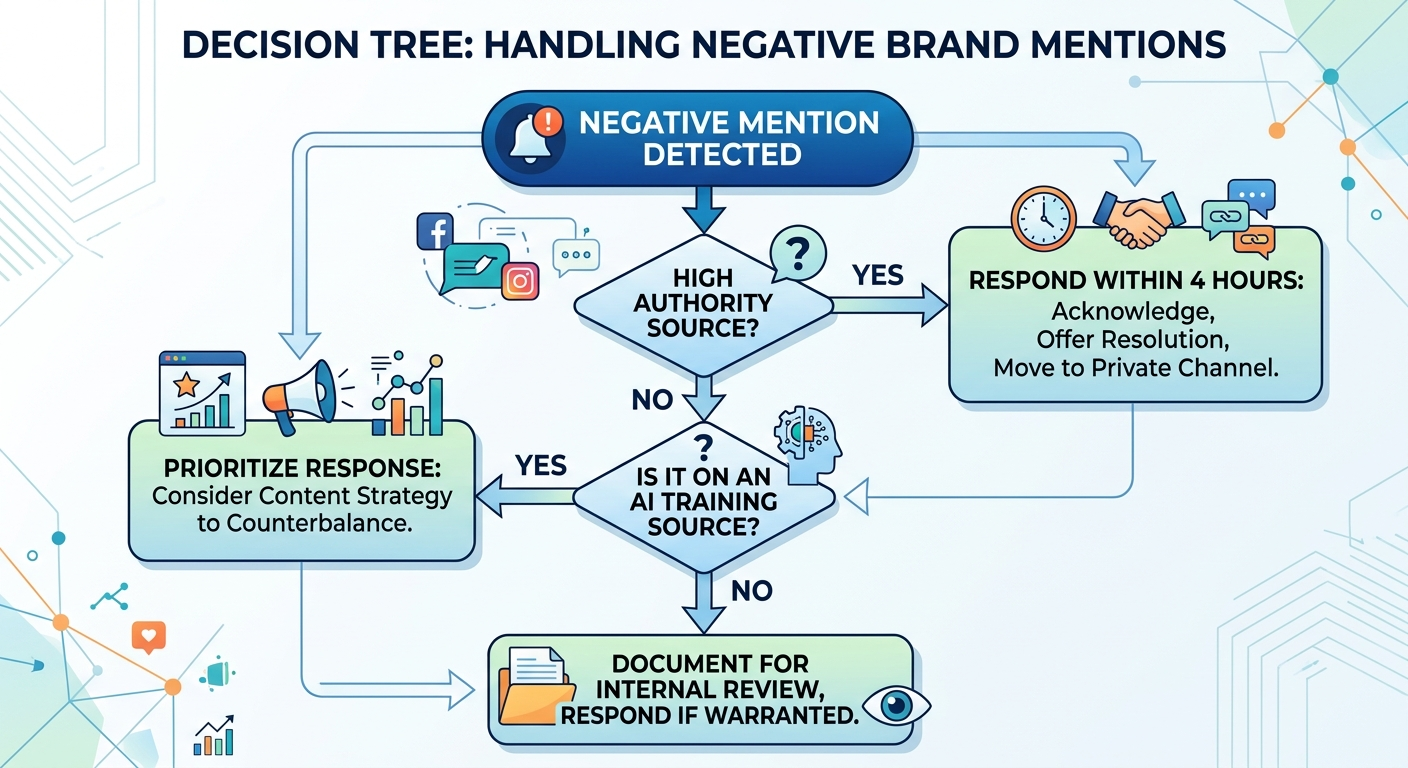
What should I do when I find a negative brand mention?
Evaluate the source’s reach and authority before responding. For high-visibility negative mentions, respond promptly and constructively — acknowledge the issue, offer a resolution, and take the conversation to a private channel when appropriate. For lower-visibility complaints, document the feedback for product or service improvements. Never ignore negative mentions on sources that AI models are likely to include in their training data, as these can influence AI-generated recommendations.
Your Next Step: From Monitoring to Action
Brand mentions monitoring generates the most value when it connects directly to decisions — adjusting your content strategy, prioritizing which publications to target for editorial placements, responding to customer feedback, and benchmarking your AI visibility against competitors.
Start with a focused keyword list. Choose tools that match your budget and channel priorities. Build a response process so mentions don’t pile up unread. And extend your monitoring to cover AI platforms — because in 2026, the conversations that shape your brand’s discoverability happen as much inside ChatGPT and Perplexity as they do on social media.
If you want to see how your brand currently appears across AI search engines — and where the gaps are — get a free AI visibility audit to understand your starting point.