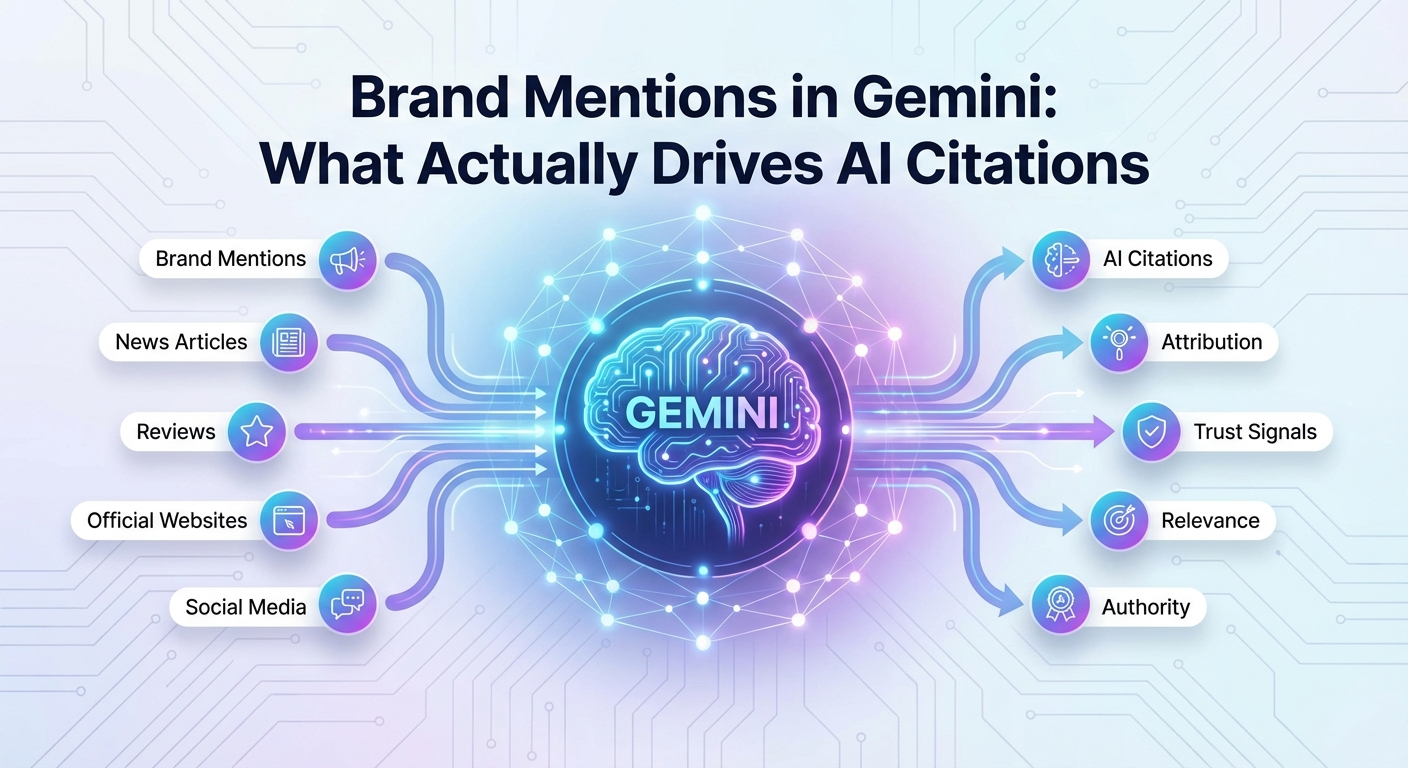
Brand mentions in Gemini shape how millions of users discover, compare, and choose products every day. Google’s AI assistant powers AI Overviews, AI Mode, and a standalone conversational experience used by over 650 million people monthly. When someone asks Gemini for a recommendation in your category, your brand is either part of the answer — or invisible.
Unlike traditional search results, Gemini doesn’t return a list of links for users to browse. It synthesizes a single response, often naming specific brands. If yours isn’t among them, no amount of organic ranking guarantees you’ll be seen in this growing discovery channel.
This article breaks down how brand mentions in Gemini actually work in 2026, what influences whether your brand gets cited, and the specific actions that strengthen your presence across Google’s AI surfaces.
What You’ll Learn
- How Gemini selects which brands to mention — and why traditional SEO alone isn’t enough
- The difference between brand mentions, product citations, and category references in Gemini responses
- Which content signals Gemini prioritizes when building answers in 2026
- How to structure pages so Gemini can extract and cite your brand confidently
- Practical steps to track and measure your Gemini visibility over time
- What’s changed since 2024–2025 in how Google’s AI handles brand recommendations
How Gemini Decides Which Brands to Mention
Gemini doesn’t maintain a static list of approved brands. Every response is assembled dynamically — pulling from Google’s live index, structured data, and the model’s trained knowledge to construct an answer tailored to the user’s query and context.
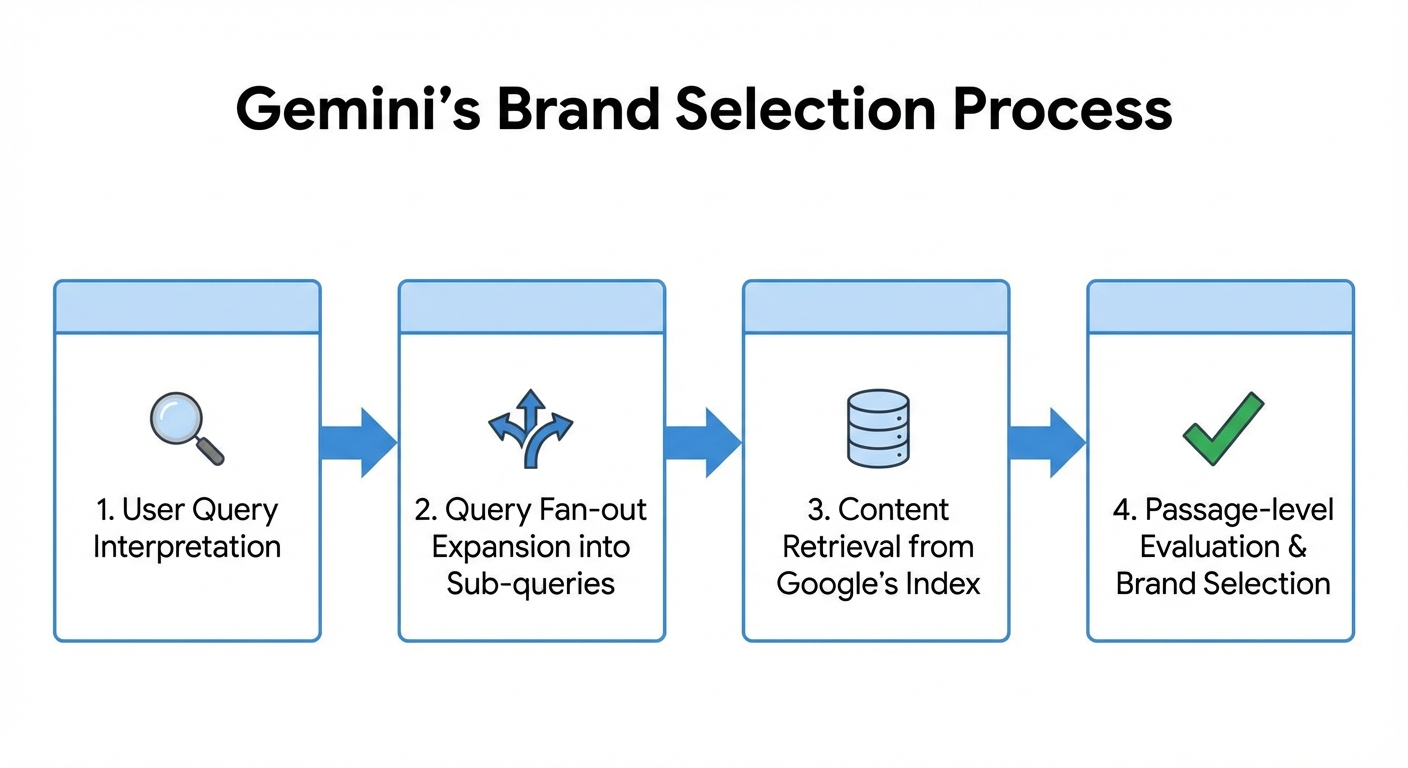
The selection process works through multiple stages. First, Gemini interprets the user’s intent using its large language model. Then it retrieves relevant content from Google’s index through a process called query fan-out — expanding the original query into dozens of related sub-queries to build a comprehensive picture. Finally, it evaluates retrieved passages against each other to decide which brands, claims, and sources deserve inclusion.
Several factors influence whether your brand makes the cut:
- Content clarity — Direct, well-structured answers to specific questions rank higher in Gemini’s passage-level evaluation
- Entity recognition — Gemini needs to clearly understand what your brand is, what category it belongs to, and what problems it solves
- Source authority — Trusted domains with strong backlink profiles, consistent editorial mentions, and recognized expertise get retrieved more often
- Freshness — Updated content with recent timestamps signals relevance, especially for fast-moving categories
- Topical depth — Brands with consistent coverage across related subtopics demonstrate category authority that Gemini rewards
A critical distinction: Gemini doesn’t just look at your website. It evaluates your brand’s presence across the entire web — editorial mentions, review platforms, community discussions, documentation, and third-party references all contribute to whether Gemini considers you a credible recommendation.
Types of Brand Mentions in Gemini Responses
Not every mention carries the same weight. Understanding the different types helps you prioritize where to focus your efforts.
Direct Brand Mentions
A direct brand mention is any instance where Gemini includes your exact company name in its response. This is the strongest form of AI visibility — users see your brand explicitly named as relevant to their query.
Example: A user asks “What tools help B2B companies track AI visibility?” and Gemini responds with a list that includes your brand by name.
Product Mentions
Gemini sometimes references a specific product or feature without broader brand context. These appear most often in implementation-focused or comparison queries where the model is answering a narrow, technical question.
Category Mentions Without Brand Attribution
This is the gap that matters most. Gemini describes a solution that matches exactly what your product does — but doesn’t name you. These category mentions represent direct opportunities. Your product fits the description, but the model didn’t associate your brand strongly enough with that category to include you.
Recommendations vs. Neutral References
A recommendation carries explicit endorsement: “BrandX is a strong option if you need multi-platform tracking.” A neutral reference is factual but non-committal: “Platforms such as BrandX also offer this capability.”
Early data from AI visibility campaigns suggests that explicit recommendations correlate with 2–3x higher conversion rates compared to neutral references, based on experiments conducted in 2025 across B2B SaaS categories. Tracking this distinction matters because it reveals not just whether you’re visible — but how persuasively Gemini positions your brand.
What Changed in 2026: Gemini’s Evolving Citation Behavior
Gemini’s approach to brand citations has shifted meaningfully since its initial rollout. If your strategy is based on 2024-era assumptions, you’re likely missing opportunities — or optimizing for signals that no longer carry the same weight.
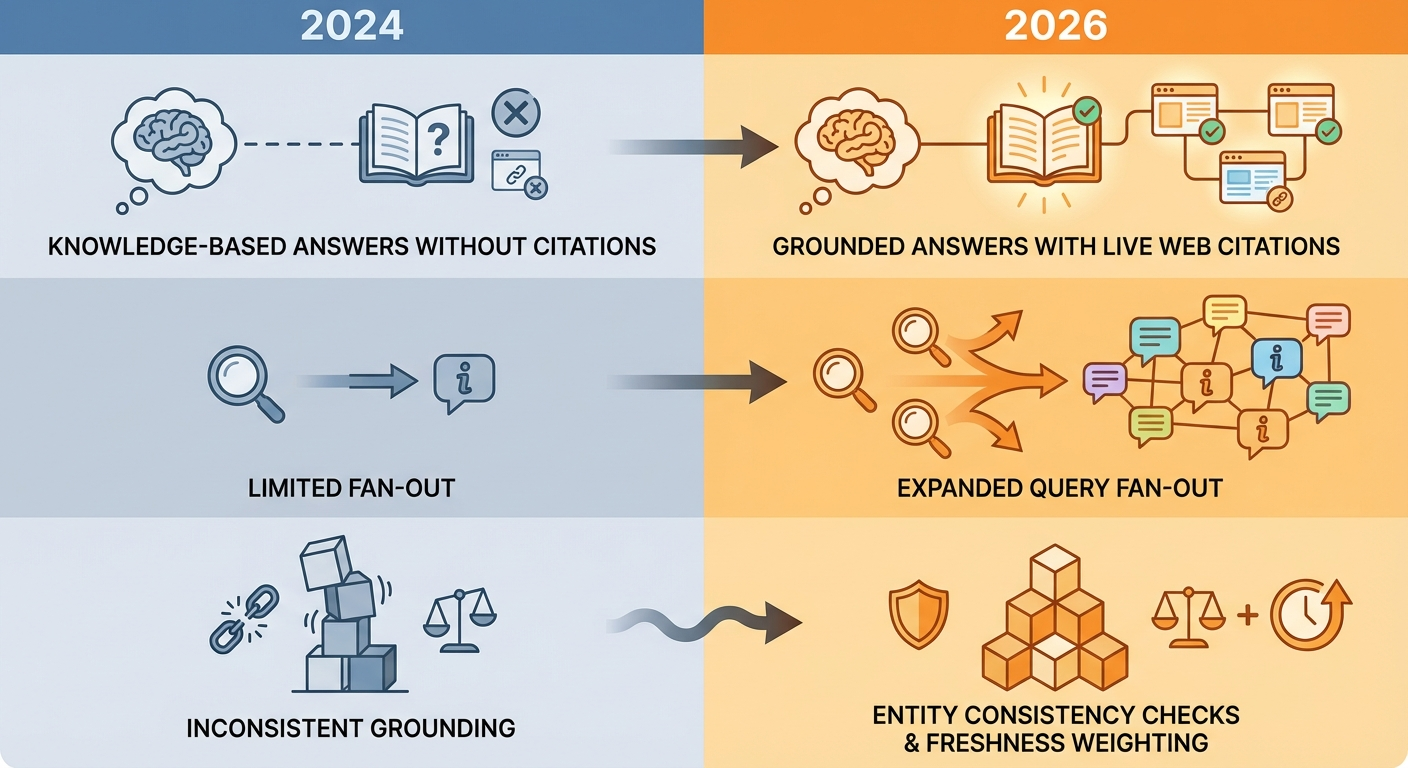
Grounded Answers Are Now the Default
In 2024, Gemini frequently generated answers from its trained knowledge without citing specific sources. As of 2026, grounded answers — responses that pull from and cite live web content — are the default for most commercial and informational queries. This means your indexed content now has a direct path into Gemini’s responses, but only if it meets the retrieval and quality thresholds.
Query Fan-Out Has Expanded
According to analysis of Google’s algorithm behavior published by AIOSEO and corroborated by the 2024 Google Content Warehouse API leak, Google’s systems now expand queries into significantly more sub-variations than they did 18 months ago. A single user prompt can generate dozens of internal sub-queries. Your content needs to address these expanded variations — not just the surface-level keyword.
Entity Consistency Matters More Than Ever
Google’s NLP models, including BERT-based entity recognition, now cross-reference your brand identity across your website, structured data, third-party profiles (G2, Crunchbase, LinkedIn), and editorial mentions. Inconsistent naming, descriptions, or category positioning across these surfaces weakens the signal Gemini uses to classify your brand.
Freshness Signals Are Weighted More Heavily
The leaked Google Content Warehouse API revealed fields like lastSignificantUpdate and contentFirstSeen, confirming that Google tracks both initial publication and meaningful updates. Pages that haven’t been updated in months are increasingly deprioritized in Gemini’s retrieval, especially for categories where information changes frequently.
How to Strengthen Your Brand Mentions in Gemini
Getting mentioned isn’t about a single tactic. It requires coordinated work across content, technical SEO, entity signals, and third-party presence. Here’s what moves the needle in 2026.
Build Content Around Specific Questions Your Buyers Ask
Gemini is prompt-driven. It responds to natural-language questions, not keyword strings. Your content should mirror the way real users phrase queries to AI assistants.
Start by identifying the specific questions your ideal customers ask when researching your category. These aren’t generic keywords — they’re detailed prompts like “What’s the best way to track whether AI search engines recommend my brand?” or “How do I improve my company’s visibility in Google’s AI answers?”
For each question, create content that:
- Opens with a direct, clear answer in the first 1–3 sentences
- Expands with supporting detail, examples, and evidence
- Uses question-style H2 or H3 headings that match how users phrase prompts
- Keeps one idea per content block so Gemini can evaluate each passage independently
Tools like SparkToro and BuzzSumo help you understand where your audience discusses these topics and what language they use — which directly informs the vocabulary your content should adopt.
Cover Fan-Out Queries Systematically
When a user asks Gemini about your category, the system doesn’t just process that single query. It expands it into dozens of related variations — comparisons, integration questions, pricing filters, compliance requirements, use-case-specific angles.
Your content is only retrieved if it aligns with one or more of these expanded sub-queries. A single broad page about your category won’t cover enough variations. Instead, build content clusters:
- A pillar page covering the core topic comprehensively
- Supporting articles that address specific sub-queries: comparisons, implementation guides, pricing breakdowns, industry-specific applications
- Internal links connecting these pages so Gemini sees topical depth across your domain
For example, if your category is “AI visibility,” your cluster might include pages on tracking brand mentions across AI search results, comparing specific platforms, measuring ROI, and addressing industry-specific use cases like SaaS brand mentions or fintech visibility.
Structure Content for Passage-Level Evaluation
Gemini evaluates content at the passage level — not the page level. Each section of your content competes independently against passages from other pages. This means every H2 or H3 block needs to stand on its own as a complete, useful answer.
Practical guidelines:
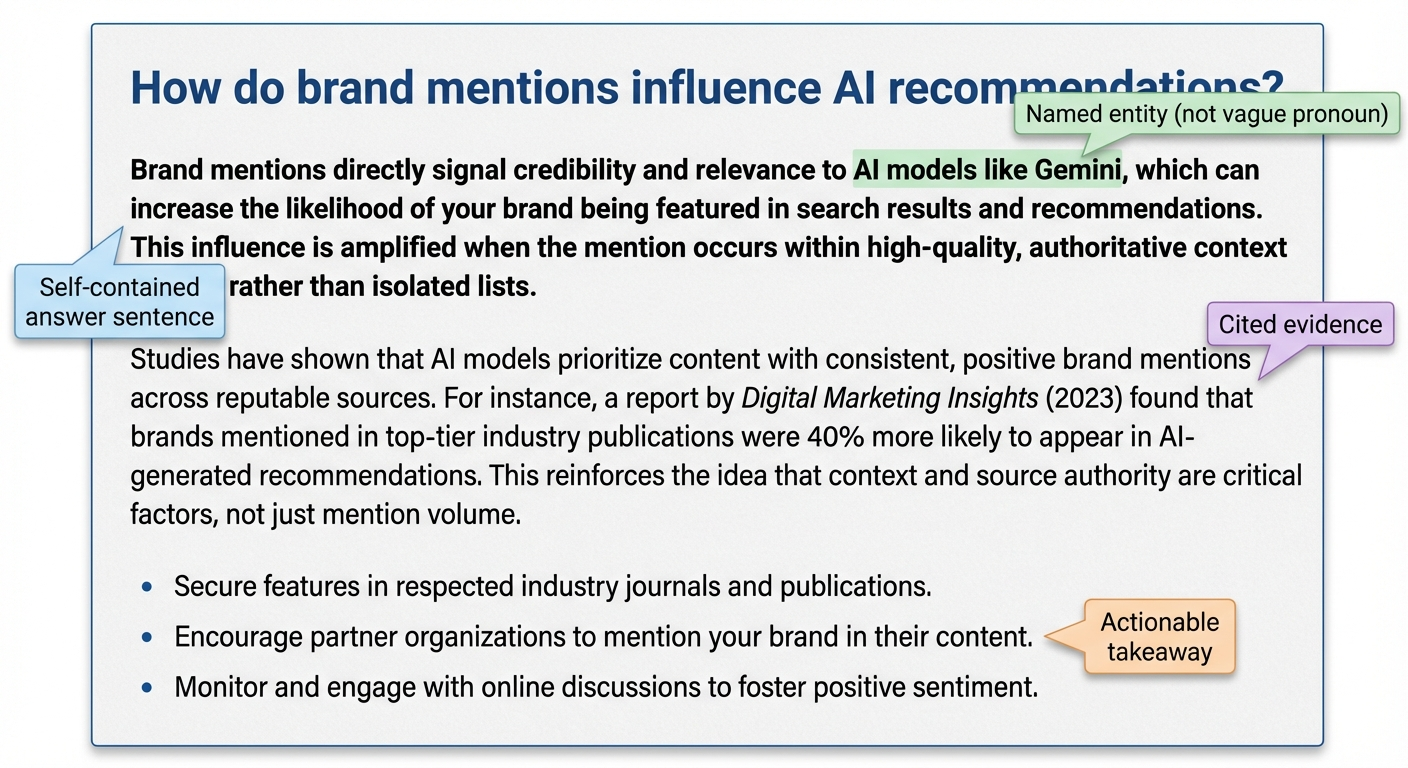
- Lead each section with a self-contained statement that Gemini can extract directly. (“Brand mentions on high-authority publications influence Gemini’s recommendations because the model learns brand-category associations from editorially curated content.”)
- Use concrete details — specific feature names, metrics, integration partners, compliance standards — instead of vague descriptions
- Avoid vague pronouns in key sentences. Write “Gemini evaluates passage quality” instead of “It evaluates quality.” Named entities help the model understand exactly what you’re claiming.
- Include evidence or sources for important claims. Sourced statements score higher in Gemini’s confidence evaluation.
Strengthen Entity Signals Across the Web
An entity signal is any data point that helps Gemini understand what your brand is, what category it belongs to, and how authoritative it is within that category. These signals come from multiple sources — not just your website.
To build strong entity recognition:
- Use consistent naming across your website, documentation, G2 profile, Crunchbase listing, LinkedIn page, and all marketing assets. If your brand name appears differently across platforms, Gemini may not consolidate those signals into a single entity.
- Add Organization and SoftwareApplication schema with sameAs fields linking to your authoritative external profiles
- Earn editorial mentions on publications that AI models trust. Agencies like BrandMentions place contextual brand mentions on 140+ high-authority publications that AI models actively learn from — strengthening the entity associations Gemini relies on during retrieval.
- Run Named Entity Recognition checks on your key pages using tools like TextRazor to see what entities Google detects and where signals are thin
The goal is to make it easy for Gemini to classify your brand correctly. When it sees your company name alongside consistent category descriptors, product names, and third-party validation, it builds stronger associations that surface in relevant queries.
Invest in Third-Party Presence and Digital PR
Gemini doesn’t just pull information from your website. It retrieves and synthesizes content from across the web — review platforms, industry publications, community forums, partner blogs, and curated resource lists.
This means your off-site presence directly influences whether Gemini mentions your brand. Content strategies that focus exclusively on owned properties miss a critical input to AI visibility.
Effective approaches include:
- Earning mentions in product roundups and comparison articles on trusted publications
- Contributing expert commentary to industry blogs and media outlets
- Maintaining active profiles on review platforms (G2, Capterra, TrustRadius) with recent, authentic reviews
- Participating in community discussions on Reddit, Quora, and industry-specific forums where your expertise adds genuine value
In campaigns across 67+ B2B companies, the BrandMentions team found that brands with consistent editorial mentions achieved AI recommendation rates 89% higher than those relying solely on traditional SEO. The combination of on-site optimization and strategic off-site presence creates the compound signal that Gemini needs to confidently recommend your brand.
Apply Structured Data and Technical Foundations
Clean technical foundations help Gemini crawl, parse, and trust your content. Without them, even excellent content may never enter the retrieval pipeline.
- JSON-LD schema: Apply Article, FAQ, HowTo, Product, Organization, and SoftwareApplication schema to relevant pages. Structured data makes your content’s purpose explicit and machine-readable.
- Accurate XML sitemaps with <lastmod> tags: This helps Google recrawl updated pages faster so fresh content enters Gemini’s retrieval pipeline sooner.
- Crawlable HTML: Keep meaningful content in standard HTML. Information hidden behind JavaScript tabs, interactive widgets, or CSS-only visibility toggles may not be reliably rendered.
- Core Web Vitals: Since INP replaced FID in 2024, Google expects good responsiveness as a baseline quality signal for pages eligible for AI surfaces.
- Don’t block AI crawlers: Verify your robots.txt allows access for Googlebot and associated AI crawlers. If bots can’t access your content, it can’t appear in Gemini’s answers.
How to Track Brand Mentions in Gemini
You can’t improve what you can’t measure. Tracking your Gemini visibility requires a different approach than traditional rank tracking because AI-generated answers don’t have fixed positions, consistent formatting, or reliable click attribution.
Why Google Search Console Isn’t Enough
Google Search Console tracks clicks and impressions from Gemini-powered AI experiences — but only when users actually click through. Unlinked mentions — where Gemini names your brand without linking to your site — don’t appear in Search Console at all. Since many Gemini responses mention brands without providing clickable links, Search Console gives you an incomplete picture of your actual AI visibility.
Manual Tracking as a Starting Point
For teams just beginning to monitor Gemini visibility, manual testing provides useful baseline data:
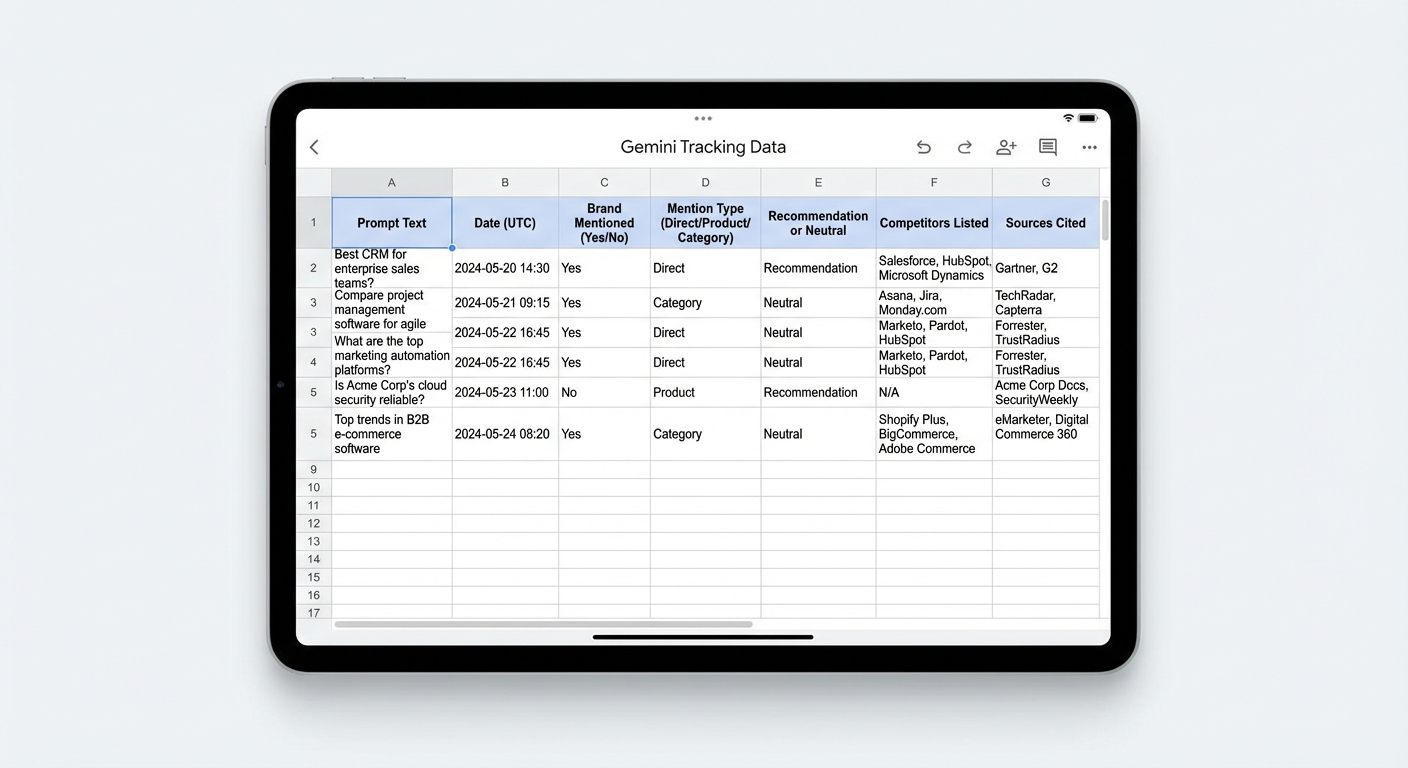
- Build a prompt library of 20–50 queries reflecting how your buyers actually search. Include “best [category] tools,” “[your brand] vs [competitor],” “alternatives to [competitor],” and specific use-case prompts.
- Standardize testing conditions — same language, region, account state, and time window for each run.
- Log each response systematically: prompt text, date/time (UTC), output snippet, mention type, competitors mentioned, and any cited sources.
- Calculate basic metrics after 4–6 weeks: mention rate, recommendation rate, competitive share of voice, and prompt coverage.
For a detailed walkthrough of manual and automated approaches, see our guide on how to track brand mentions in Gemini.
Automated Tracking at Scale
Once you exceed 50 prompts or need to track multiple brands across regions, manual methods break down. Dedicated AI visibility platforms simulate your prompt set on a scheduled cadence, capture responses across Gemini and other AI models, classify mentions automatically, and generate trend reports.
Key metrics to track consistently:
| Metric | What It Measures | Why It Matters |
|---|---|---|
| Mention rate | Percentage of prompts where your brand appears | Baseline visibility across your category |
| Recommendation rate | Percentage of prompts where Gemini explicitly endorses your brand | Strongest signal of conversion potential |
| Share of voice | Your mentions vs. total brand mentions in your prompt set | Competitive positioning within your category |
| Prompt coverage | Percentage of query categories where you appear at least once | Breadth of visibility across buyer journey stages |
| Volatility | How frequently your mention status changes across runs | Stability of your AI visibility position |
For a broader view across multiple AI platforms, explore the best ways to track brand mentions in AI search and dedicated AI rank trackers for brand mentions.
What You Can’t Reliably Measure
Transparency about limitations prevents misguided optimization. As of 2026, these remain inherently opaque in Gemini:
- Exact ranking position: Bullet point order in Gemini responses isn’t stable. It changes per run and per user. There’s no “#1 slot” equivalent.
- Attribution logic: Gemini doesn’t explain why it chose one brand over another. The decision process is a black box.
- Impression counts: Unlike Search Console, Gemini provides no data on how many users saw your brand mentioned in AI answers.
- Perfect repeatability: Studies show outputs change in 30–50% of repeated tests under identical conditions, according to experiments tracked across AI visibility platforms in 2025. Patterns stabilize over 10+ repetitions, but single-instance results are unreliable.
Pro Insight: Track Gemini visibility over time using statistical patterns, not individual response snapshots. Weekly monitoring at a consistent cadence (same day, same time window) produces the most reliable trend data.
Gemini, AI Mode, and AI Overviews: One System, One Strategy
A common misconception is that Gemini chat, Google AI Mode, and AI Overviews in search require separate optimization approaches. They don’t.
All three surfaces run on the same underlying pipeline. They pull from the same index, use the same retrieval steps, and rely on the same reasoning model to decide what information to surface. The interfaces look different, but the system evaluating your content is identical across all three.
This means the work you do to strengthen your brand mentions in Gemini — clear content, strong entity signals, consistent naming, editorial third-party presence, and solid technical foundations — improves your visibility everywhere Google’s AI shows up.
For B2B teams, this consolidation is practical. You don’t need three separate budgets or strategies. A unified approach to brand mentions in AI covers the full surface area of Google’s AI-powered discovery.
How Gemini Differs from ChatGPT and Perplexity
While the core principles of AI visibility apply across platforms, Gemini has distinct characteristics that influence strategy.
| Dimension | Gemini | ChatGPT | Perplexity |
|---|---|---|---|
| Data source | Google’s live index + trained knowledge | Pre-trained data + optional Bing browsing | Own real-time web search engine |
| Citation behavior | Grounded answers with web citations (default in 2026) | Varies by mode; often summarizes without links | Almost always shows explicit source citations |
| Personalization | Heavy — uses account history, location, language, prior queries | Limited personalization | Minimal personalization |
| Integration surface | Search, Workspace, Android, Chrome | Standalone + API integrations | Standalone search engine |
| SEO overlap | Strong — directly tied to Google’s ranking signals | Moderate — uses Bing’s index when browsing | Moderate — independent crawler |
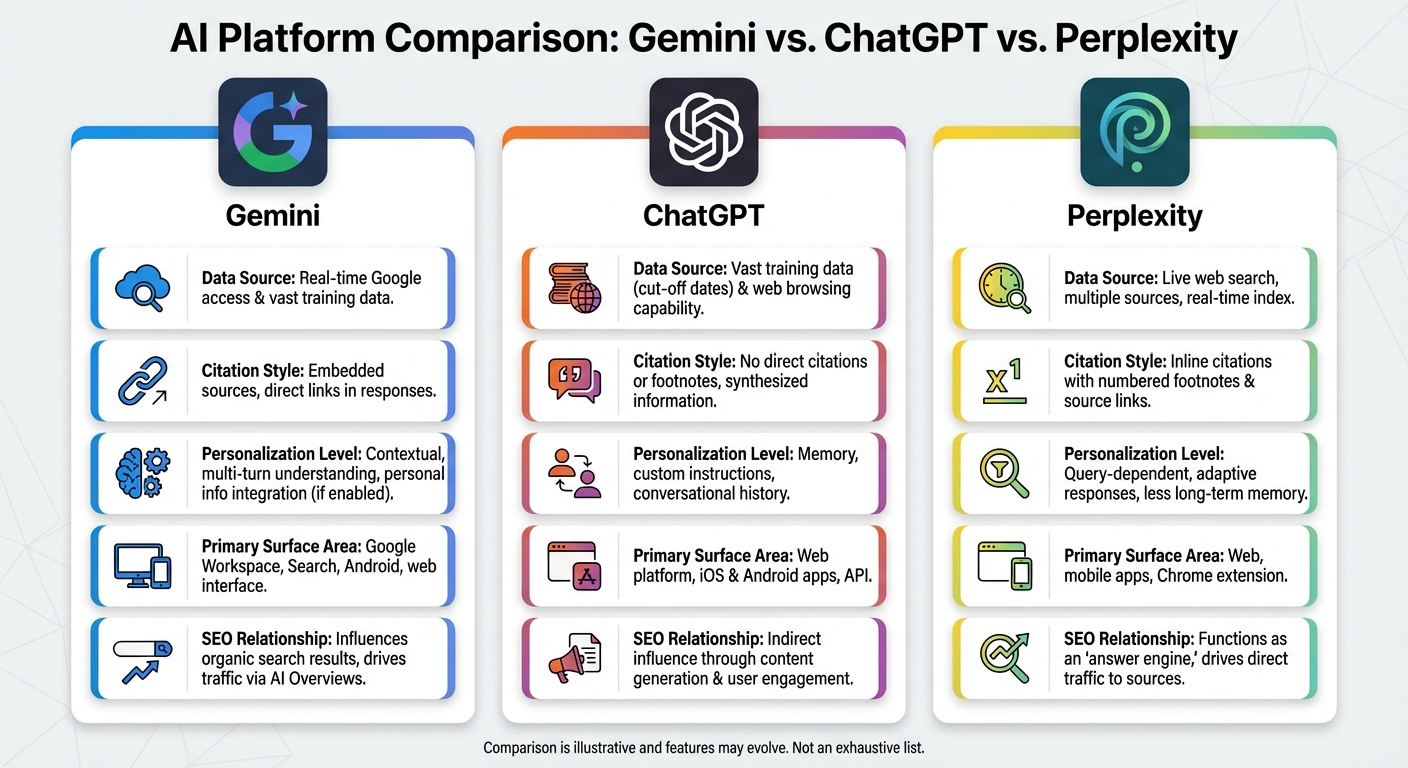
The key strategic implication: because Gemini is deeply integrated with Google’s index, your traditional SEO performance has a stronger correlation with Gemini visibility than with any other AI platform. Brands that rank well on Google have a structural advantage in Gemini — but ranking alone doesn’t guarantee mention. You still need the entity signals, content structure, and third-party presence that help Gemini select you confidently.
For a cross-platform perspective, see how visibility strategies differ when you monitor brand mentions in ChatGPT or track brand mentions in Perplexity.
A Practical Framework for Building Gemini Visibility
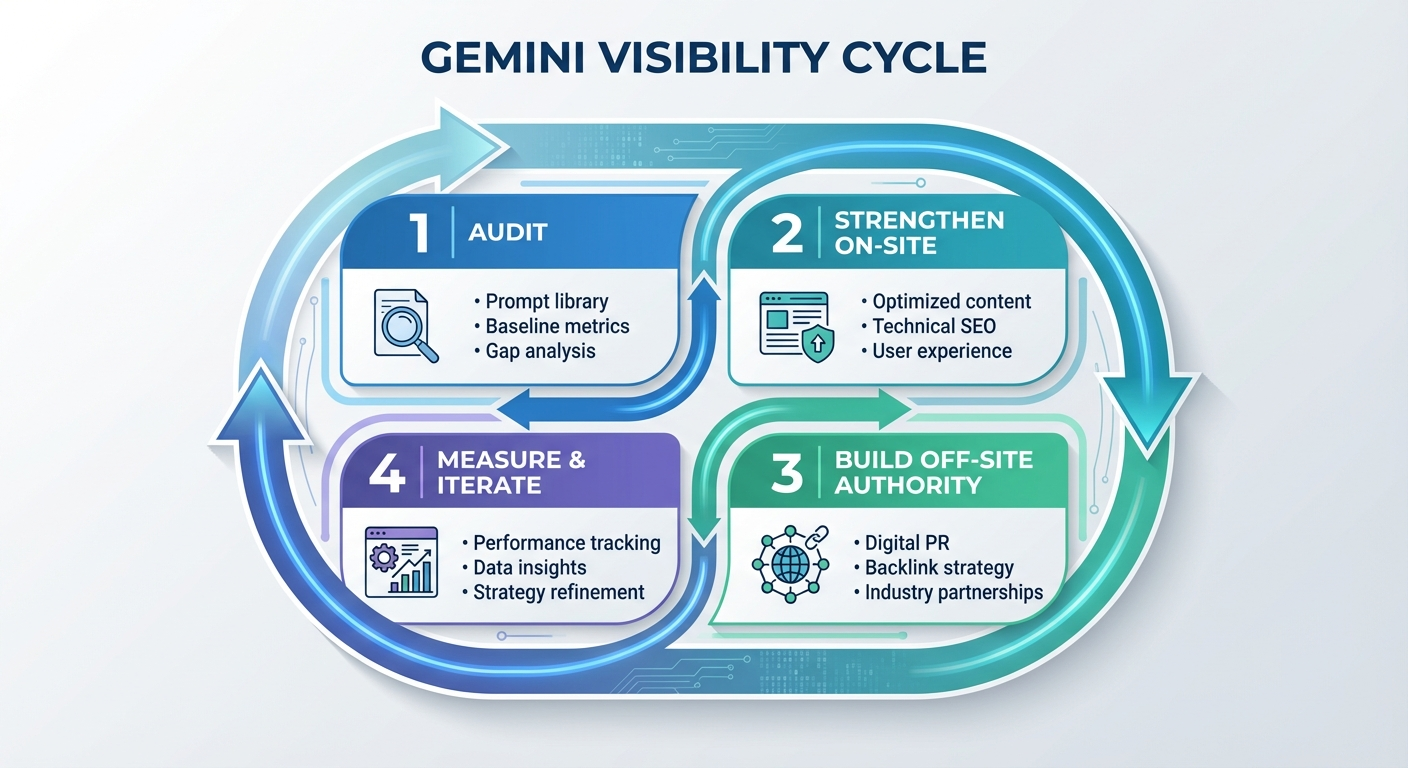
Rather than treating Gemini optimization as a one-time project, approach it as an ongoing cycle with four phases. This reflects the reality that AI-generated answers shift as models update, user behavior evolves, and competitive landscapes change.
Phase 1: Audit Your Current Visibility
Before changing anything, establish a baseline. Run 30–50 category-relevant prompts through Gemini and log where your brand appears, how it’s described, and which competitors are mentioned alongside you. Identify the gaps — queries where your product is relevant but Gemini doesn’t include you.
Phase 2: Strengthen On-Site Signals
Address the content and technical gaps your audit reveals:
- Create or update pages that directly answer the queries where you’re missing
- Restructure existing content for passage-level evaluation — one clear idea per section, self-contained answer sentences, concrete evidence
- Implement schema markup on all key templates
- Ensure consistent entity naming across your entire site
Phase 3: Build Off-Site Authority
Strengthen the third-party signals Gemini relies on:
- Secure editorial mentions on publications in your industry
- Update and maintain review platform profiles with recent customer evidence
- Contribute expert insights to relevant community discussions and media outlets
- Ensure your brand appears alongside your target category terms across multiple trusted sources
BrandMentions tracks when major AI models update their training data and times placements to maximize inclusion in each knowledge refresh cycle — a strategy that’s especially effective for building Gemini visibility because of the platform’s reliance on Google’s live index.
Phase 4: Measure, Iterate, Repeat
Re-run your prompt library on a weekly cadence. Compare results against your baseline. Watch for:
- New queries where you’ve gained visibility
- Queries where competitors have displaced you
- Shifts in mention type (neutral reference → explicit recommendation, or vice versa)
- Changes in cited sources — which of your pages Gemini is pulling from
Update your content based on what the data shows. Gemini’s responses evolve continuously, and brands that treat AI visibility as an ongoing program — not a one-time optimization — build compound advantages over time.
Common Mistakes That Reduce Gemini Visibility
Understanding what hurts your chances matters as much as knowing what helps.
- Inconsistent brand naming across platforms. If your website says “AcmeTech,” your G2 profile says “Acme Technologies,” and your LinkedIn says “Acme Tech Inc.,” Gemini struggles to consolidate these into a single entity. Pick one name and use it everywhere.
- Blocking AI crawlers in robots.txt. When Gemini can’t access your content, it can’t cite it. Verify that Googlebot and associated crawlers have access to your key pages.
- Publishing broad, shallow content instead of specific, deep answers. A 500-word overview of your entire product category won’t compete with a focused, detailed page that answers a specific buyer question.
- Ignoring off-site presence. Brands that optimize only their own website miss the third-party signals that Gemini weighs heavily when assessing authority.
- Treating AI visibility as a one-time project. Gemini’s responses change with model updates, retrieval refreshes, and competitive content shifts. Brands that stop monitoring and iterating lose ground to those that don’t.
- Optimizing for keywords instead of prompts. Gemini responds to natural-language questions, not keyword strings. Content structured around traditional keyword targeting often doesn’t match the way AI fan-out queries expand.
Frequently Asked Questions
Does ranking first on Google guarantee a Gemini mention?
No. While strong Google rankings correlate with Gemini visibility (approximately 0.6 correlation based on a 2025 study by Seer Interactive), they don’t guarantee inclusion. Gemini evaluates content clarity, entity signals, freshness, and third-party authority independently. A competitor with clearer, more structured content may be cited even if they rank lower in traditional organic results.
How often does Gemini change which brands it mentions?
Frequently. Research from AI visibility tracking platforms shows that Gemini’s brand mention patterns shift in 30–50% of repeated identical queries. Model updates, retrieval layer refreshes, and changes to competing content all cause fluctuations. Weekly monitoring at a consistent cadence is the minimum needed to distinguish real trends from random variation.
Can unlinked brand mentions in Gemini drive business results?
Yes. Even when Gemini mentions your brand without linking to your site, users often search for your brand name directly in Google or type your URL into their browser. Track branded search volume and direct traffic as proxy metrics — increases in both typically correlate with growing AI mention frequency. For more on how unlinked brand mentions influence discovery, see our detailed breakdown.
Is there a difference between optimizing for Gemini vs. Google AI Overviews?
No meaningful difference. As of 2026, Gemini, AI Mode, and AI Overviews all run on the same underlying system. They use the same index, the same retrieval logic, and the same reasoning model. Optimizing for one optimizes for all three.
How long does it take to see improvements in Gemini mentions?
Most brands see measurable changes within 4–8 weeks of implementing content restructuring and entity signal improvements. Building off-site authority through editorial mentions typically compounds over a longer timeframe — 3–6 months — as those publications get indexed, crawled, and incorporated into Gemini’s retrieval pool.
Should I track Gemini visibility separately from other AI platforms?
Yes. Each AI platform has different data sources, citation behaviors, and personalization models. Your brand may appear consistently in Gemini but be absent from ChatGPT or Perplexity, or vice versa. Cross-platform tracking gives you the full picture. Explore AEO tools for brand mentions to find solutions that cover multiple platforms simultaneously.
Your Next Step: Know Where You Stand
Brand mentions in Gemini aren’t a future consideration — they’re a current reality shaping how your buyers discover and evaluate solutions in 2026. The brands building visibility now are establishing the compound advantage that makes them the default AI recommendation in their category.
Start with what you can do immediately: run 30 prompts through Gemini relevant to your category. Log where your brand appears — and where it doesn’t. That gap analysis becomes your roadmap.
For a structured assessment of your current AI visibility across Gemini and other platforms, see where your brand stands in AI search.