Brand awareness measurement tools give your marketing team the ability to track how well your audience recognizes, recalls, and talks about your brand — across traditional search, social media, and increasingly, AI-driven platforms. In 2026, measuring awareness is no longer optional. It directly shapes budget decisions, competitive positioning, and your brand’s visibility inside AI-generated recommendations.
But here’s the challenge: most teams either measure the wrong things or use tools that only capture a fraction of where their brand actually appears. The landscape has shifted. AI assistants now recommend brands by name. Share of voice extends beyond social feeds into ChatGPT, Perplexity, and Google AI Overviews. And the tools built to track all of this have evolved significantly since 2024.
This article breaks down the categories of brand awareness measurement tools available in 2026, explains what each type actually tracks, and helps you build a measurement stack that connects visibility to business outcomes — including the emerging AI search layer that most guides still ignore.
What You’ll Learn
- The five categories of brand awareness measurement tools and what each one captures
- How AI search visibility tracking has become a critical measurement layer in 2026
- Which metrics matter most at each stage — from recall surveys to revenue attribution
- How to build a measurement stack that connects awareness signals to pipeline growth
- Where traditional tools fall short and what fills the gap
- Practical guidance for choosing tools based on your budget, team size, and growth stage
Why Brand Awareness Measurement Has Changed Since 2024
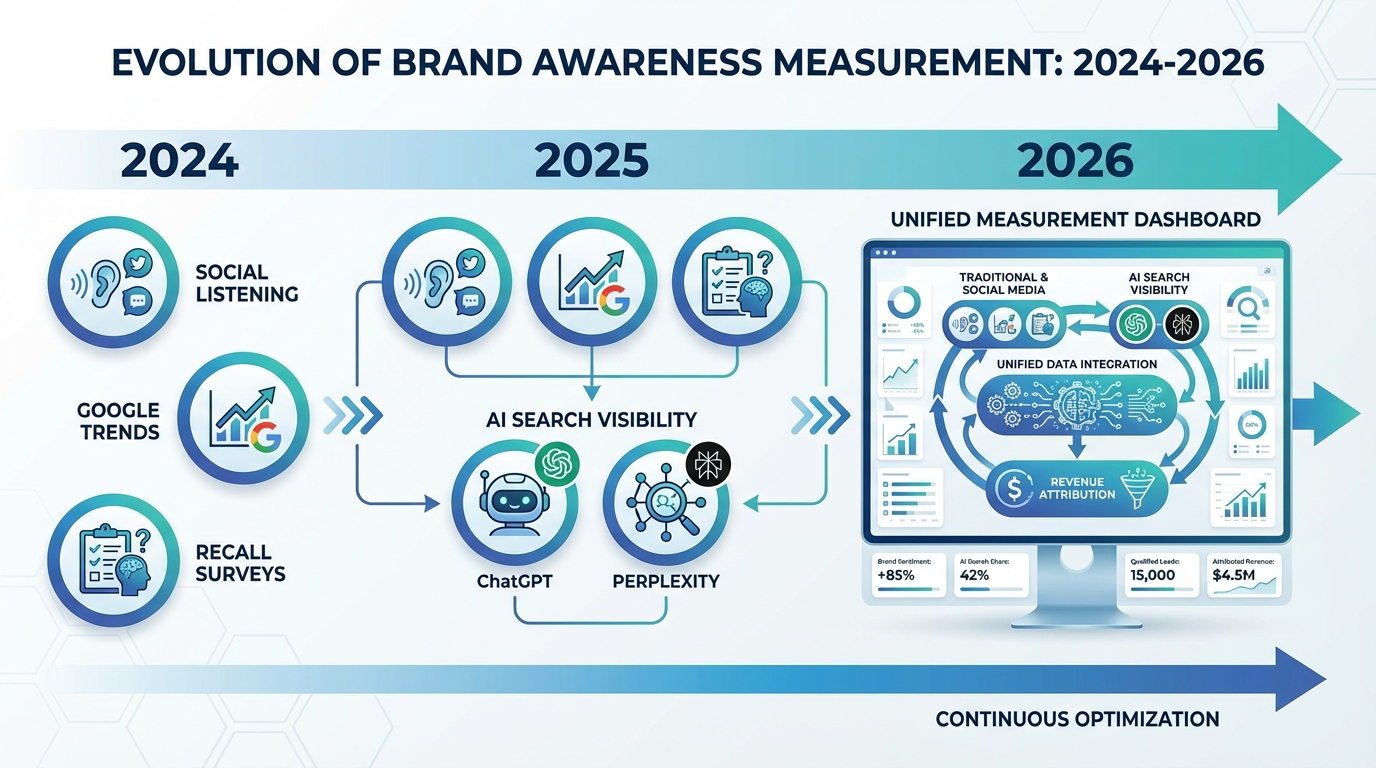
Two years ago, measuring brand awareness meant tracking social mentions, running recall surveys, and monitoring branded search volume. Those methods still matter. But the environment they operate in has shifted underneath them.
Three forces reshaped the measurement landscape between 2024 and 2026:
AI search became a primary discovery channel. According to a 2025 Gartner forecast, traditional search engine traffic was projected to decline 25% by 2026 as consumers shifted queries to AI assistants. That shift is now visible in analytics dashboards across industries. Brands that appear in ChatGPT, Gemini, or Perplexity responses reach buyers at a new decision point — one that most traditional awareness tools don’t track.
Share of voice expanded beyond social media. Share of voice now includes how often AI models mention your brand when answering category-level questions. A brand with strong social SOV but zero AI mentions has a blind spot that grows more expensive every quarter.
Attribution expectations tightened. CMOs and boards expect brand awareness data to connect to pipeline and revenue, not just impressions. Tools that only report reach without conversion signals lost credibility. The measurement tools gaining adoption in 2026 link awareness metrics to demand generation outcomes.
Five Categories of Brand Awareness Measurement Tools
Brand awareness measurement tools fall into five distinct categories. Each captures different signals. Most teams need at least three categories working together for an accurate picture.
1. Survey and Brand Tracking Platforms
Survey-based measurement captures what no passive tool can: whether real people recall your brand unprompted, recognize it when prompted, and associate it with the right attributes.
What they measure:
- Unaided brand recall — the percentage of your target audience who name your brand spontaneously when asked about your category
- Aided brand recognition — the percentage who recognize your brand from a list
- Top-of-mind awareness (TOMA) — whether your brand is mentioned first
- Brand attribute association — what qualities people connect to your brand
Key tools in this category: Qualtrics Brand Tracker, SurveyMonkey, YouGov BrandIndex, Attest, and Ipsos Brand Health Tracking. These range from enterprise-grade longitudinal trackers to self-serve survey builders accessible to startups.
Survey data provides the most direct awareness signal. A consumer telling you they recall your brand is stronger evidence than any proxy metric. The limitation: surveys capture a snapshot, not a real-time signal. They require consistent methodology over time to reveal trends.
Pro Insight: Run unaided recall questions before aided ones in every brand awareness survey. Presenting your brand name first contaminates the spontaneous recall data that matters most for measuring organic awareness growth.
2. Social Listening and Media Monitoring Tools
Social listening platforms track how often your brand is mentioned across social media, forums, news outlets, and blogs. They measure conversation volume, sentiment, and your share of voice relative to competitors.
What they measure:
- Brand mention volume across social platforms, news, and forums
- Net sentiment — whether conversations skew positive, negative, or neutral
- Social share of voice — your brand’s percentage of total category conversation
- Earned media reach and engagement
Key tools in this category: Brandwatch, Meltwater, Sprout Social, Talkwalker, and Mention. For budget-conscious teams, Google Alerts provides basic mention tracking at no cost.
These tools excel at capturing real-time awareness signals. A spike in brand mentions after a campaign launch or PR hit shows up immediately. The limitation: mention volume measures visibility, not recall. Someone seeing your name in a news article doesn’t mean they’ll remember your brand next week. Combine social listening with survey data to bridge that gap.
For a deeper look at monitoring options, explore brand monitoring tools available in 2026.
3. Search and SEO Analytics Platforms
Search analytics tools measure branded search volume — how many people search for your brand by name. This behavioral signal indicates genuine recall. Someone typing your brand name into Google has awareness strong enough to drive action.
What they measure:
- Branded search volume over time
- Share of search — your branded queries as a percentage of total category search volume
- Branded organic click-through rate
- Backlink growth from earned editorial mentions
Key tools in this category: Google Search Console (free), Google Trends (free), Semrush, Ahrefs, and Moz. These platforms overlap significantly with SEO workflows, which means most marketing teams already have access to branded search data.
According to Ahrefs’ 2024 search traffic study, 45.7% of Google searches are branded — meaning nearly half of all search activity starts with a specific brand in mind. Tracking your share of that branded search volume reveals whether awareness translates into active interest.
Tools like Ahrefs and Semrush also help you find unlinked brand mentions — instances where publications reference your brand without linking to your site. These unlinked mentions still contribute to awareness and, importantly, to how AI models learn brand-category associations from their training data.
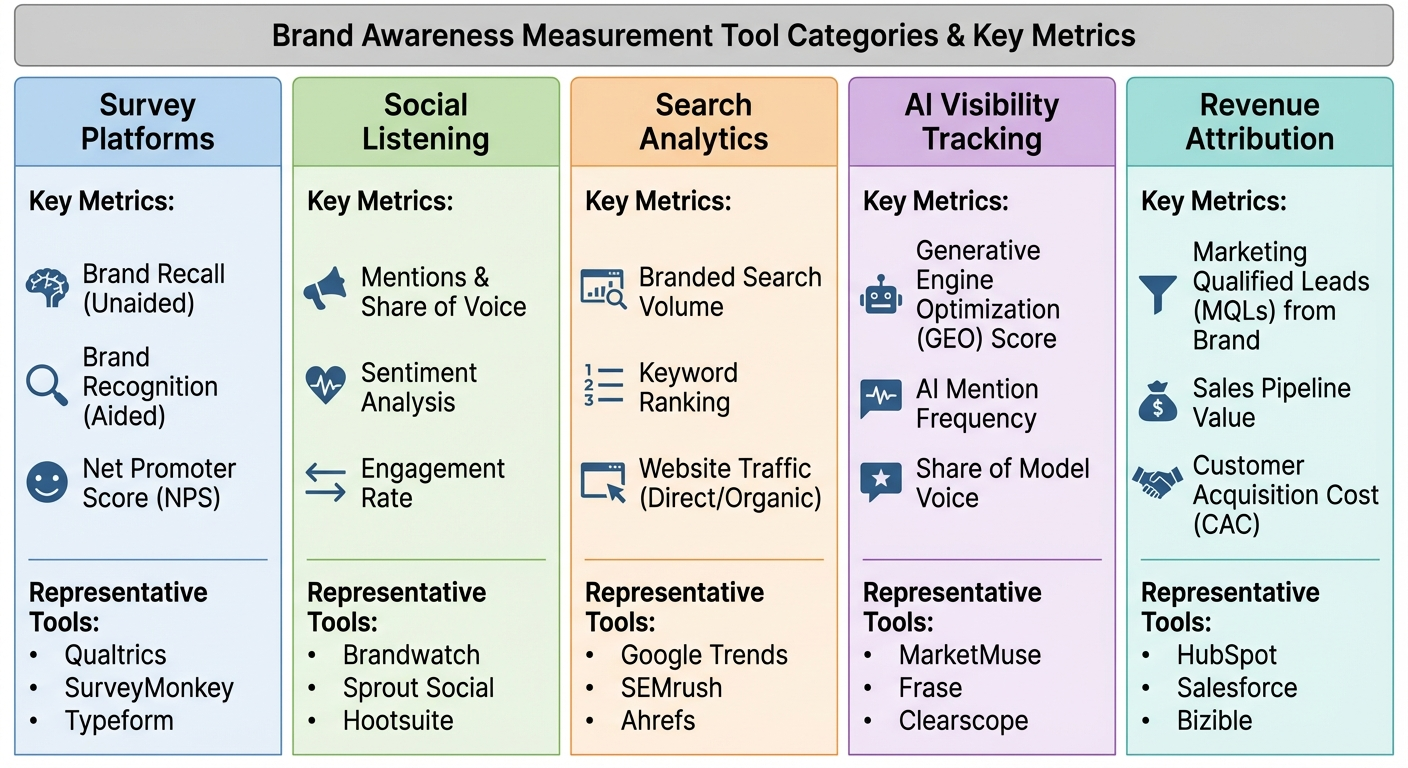
4. AI Visibility and Citation Tracking Tools
AI visibility tracking is the newest and fastest-growing category of brand awareness measurement. These tools monitor whether AI assistants — including ChatGPT, Google Gemini, Perplexity, Claude, and Microsoft Copilot — mention, recommend, or cite your brand when users ask category-relevant questions.
What they measure:
- AI citation frequency — how often your brand appears in AI-generated answers
- AI sentiment — whether AI models describe your brand positively, neutrally, or negatively
- AI share of voice — your brand’s mentions relative to competitors within AI responses
- Citation source tracking — which publications AI models reference when mentioning your brand
This category barely existed in 2024. As of 2026, it has become essential for any brand that wants a complete awareness picture. When a potential buyer asks ChatGPT “What are the best project management tools for remote teams?” and your brand doesn’t appear in the response, you have an awareness gap that traditional tools won’t detect.
Agencies like BrandMentions address this gap by placing contextual brand mentions on 140+ high-authority publications that AI models actively learn from during training. But measuring whether those placements translate into AI citations requires dedicated tracking tools.
To understand how this tracking works across specific platforms, see guides on monitoring ChatGPT brand mentions, tracking brand mentions in Gemini, and tracking Perplexity mentions.
Key Definition: AI visibility refers to how frequently and favorably a brand appears in responses generated by large language models (LLMs) when users ask questions related to the brand’s category. Unlike traditional search rankings, AI visibility depends on the brand-category associations AI models learn from their training data and retrieval sources.
5. Revenue Attribution and Marketing Mix Platforms
Attribution platforms connect awareness signals to business outcomes. They answer the question every executive asks: “Is our awareness spending driving revenue?”
What they measure:
- Awareness-to-demand conversion rate — the lag between awareness growth and pipeline activity
- Customer acquisition cost (CAC) by awareness level — whether aware prospects cost less to convert
- Incremental brand lift from controlled experiments
- Marketing mix contribution — how brand awareness investment contributes to total revenue
Key tools in this category: Keen Decision Systems, Nielsen Brand Lift, Kantar Brand Lift Insights, and various marketing mix modeling (MMM) platforms. These tend to serve mid-market and enterprise teams with the data volume and budget to support sophisticated modeling.
For earlier-stage teams, simpler attribution comes from connecting Google Analytics direct traffic trends and branded search growth to CRM pipeline data. The sophistication of the tool matters less than the discipline of connecting awareness metrics to revenue signals consistently.
How to Match Tools to Your Growth Stage
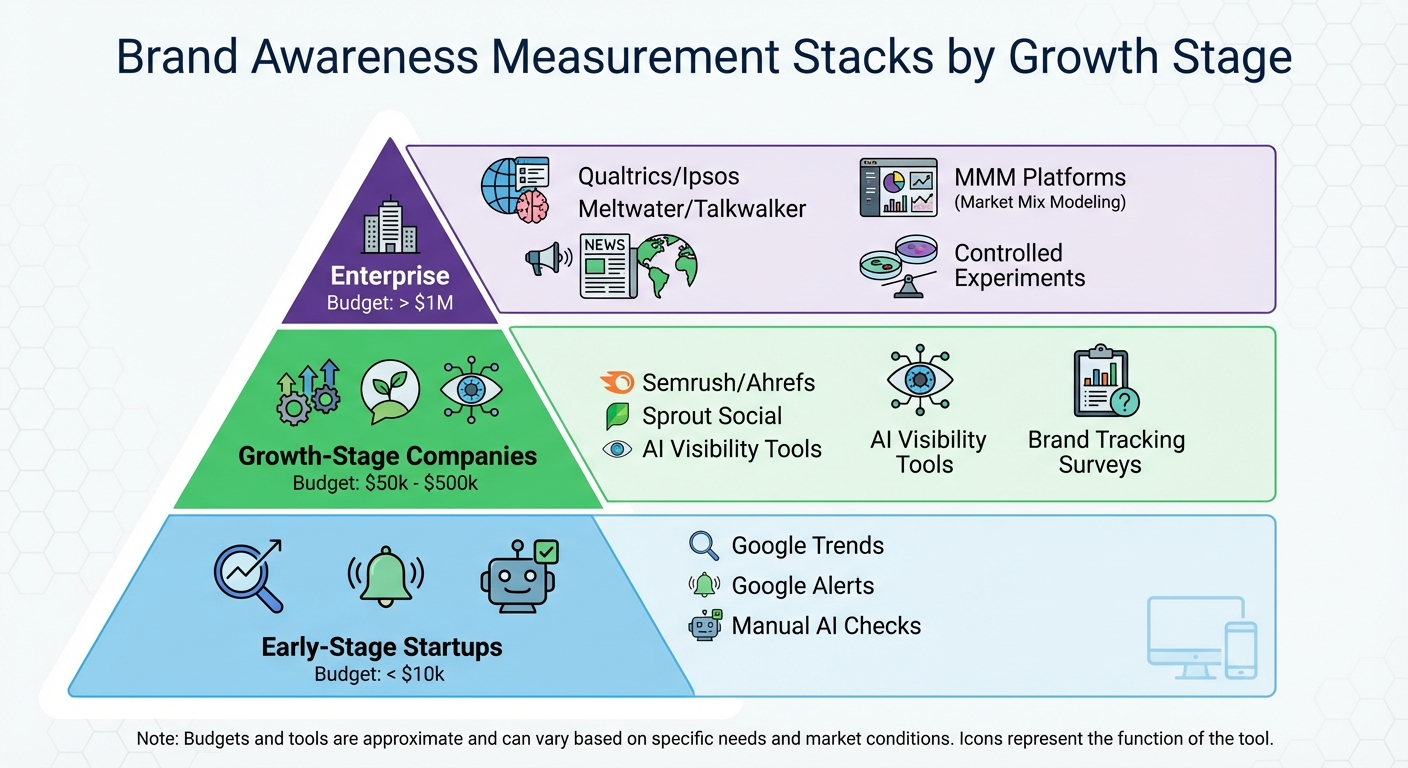
The right measurement stack depends on your company’s size, budget, and the channels where your buyers discover you. Here’s a practical breakdown by growth stage.
Early-Stage Startups (Pre-Series B, Limited Budget)
At this stage, you need awareness signals without enterprise software costs. Focus on free and low-cost tools:
- Google Search Console + Google Trends: Track branded search volume growth over time. Rising branded queries are the clearest signal that awareness campaigns work.
- Google Alerts: Monitor brand mentions across the web at no cost. Limited in depth, but catches major earned media coverage.
- SurveyMonkey or Typeform: Run quarterly brand recall surveys targeting your core audience. Even a sample of 200 respondents reveals recall trends.
- Manual AI query checks: Ask ChatGPT, Gemini, and Perplexity category questions monthly. Record whether your brand appears. This manual process scales poorly but costs nothing.
For startup-specific strategies, explore startup visibility solutions designed for brands building awareness from the ground up.
Growth-Stage Companies (Series B+, Dedicated Marketing Team)
With a marketing team and budget, add layers of depth:
- Semrush or Ahrefs: Track branded search share relative to competitors. Monitor backlink growth from earned media.
- Sprout Social or Brandwatch: Measure social share of voice and sentiment at scale.
- AI visibility tracking tool: Automate monitoring of brand citations across ChatGPT, Gemini, Perplexity, and Claude. Manual checks no longer scale at this stage.
- Quarterly brand tracking surveys: Use Attest or YouGov BrandIndex Lite for consistent longitudinal measurement.
This is also the stage where connecting awareness data to pipeline outcomes becomes critical. Integrate your CRM with your analytics stack to track whether rising awareness correlates with lower CAC and shorter sales cycles.
Enterprise Teams (Established Brand, Multi-Channel Investment)
Enterprise measurement stacks need comprehensiveness and attribution rigor:
- Qualtrics or Ipsos: Continuous brand health tracking with segmented analysis across markets, demographics, and buyer roles.
- Meltwater or Talkwalker: Full-spectrum media monitoring including news, broadcast, social, and podcast mentions.
- AI visibility monitoring at scale: Track brand mentions across all major LLMs with automated sentiment analysis and competitive benchmarking. See AI visibility analytics tools for platform options.
- Keen or Nielsen: Marketing mix modeling that quantifies how brand awareness investment contributes to incremental revenue.
- Controlled experiments: Run geo-lift tests or holdout groups to isolate the causal impact of awareness campaigns on demand.
The AI Visibility Measurement Gap Most Teams Miss
Here’s a pattern that repeats across B2B companies in 2026: a brand invests heavily in content marketing, PR, and social media. Their Brandwatch dashboard shows strong mention volume. Their Google Trends line slopes upward. Their quarterly survey shows improving aided recognition.
But when a potential buyer asks ChatGPT or Perplexity “What are the top [category] solutions for [use case]?”, their brand doesn’t appear.
Traditional brand awareness measurement tools were designed for a world where discovery happened through search engines and social feeds. They were never built to track how AI models form brand-category associations from training data, retrieval-augmented generation (RAG) sources, and high-authority editorial content.
This creates a measurable gap. In campaigns across 67+ B2B companies, the BrandMentions team found that brands with consistent editorial mentions on high-authority publications achieved AI recommendation rates 89% higher than those relying solely on traditional SEO. Yet most of those brands had no way to track their AI visibility before adding dedicated measurement tools.
The implication: if your measurement stack doesn’t include AI citation tracking, you’re measuring awareness in the channels where you’ve always been visible — while missing the channel where a growing share of buyer discovery now happens.
To understand how AI search engines use brand mentions to form recommendations, read how brand mentions impact visibility in AI search.
Twelve Metrics That Actually Connect Awareness to Revenue
Not all awareness metrics carry equal weight. Some look impressive in slide decks but don’t correlate with business outcomes. Others appear modest but predict pipeline growth months in advance.
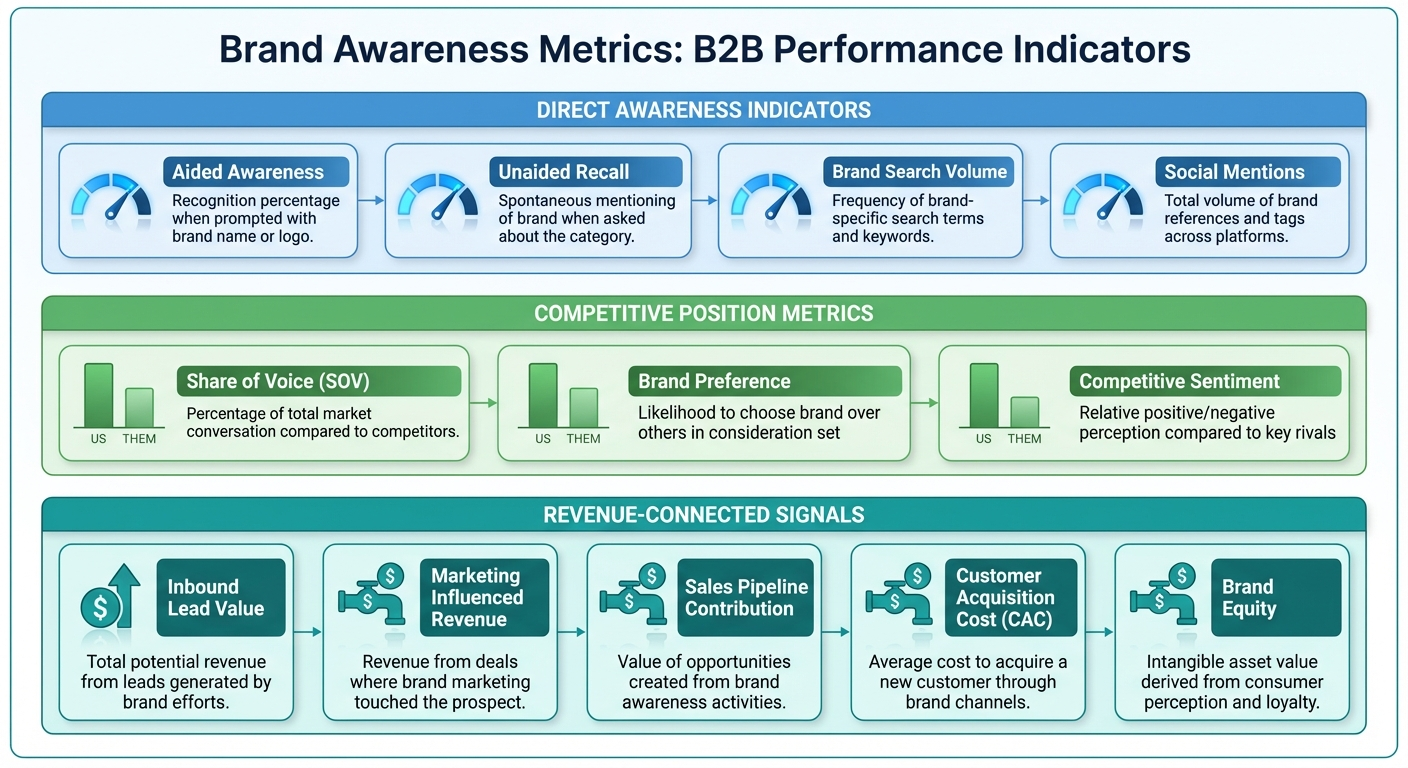
Here are twelve metrics organized by signal strength — from direct awareness indicators to revenue-connected outcomes.
Direct Awareness Indicators
- Unaided brand recall rate: The percentage of your target audience that names your brand spontaneously. This is the gold standard for awareness measurement. Track quarterly.
- Top-of-mind awareness (TOMA): The percentage who name your brand first. TOMA correlates strongly with market share, according to research from the Ehrenberg-Bass Institute.
- Branded search volume growth: Month-over-month change in branded search queries. Rising branded search is a behavioral signal of growing recall.
- AI citation frequency: How often your brand appears in AI-generated responses to category queries. This metric didn’t exist in standard dashboards before 2025 — it’s now essential.
Competitive Position Metrics
- Share of search: Your branded search volume divided by total category search volume. This metric, championed by Les Binet’s research at the IPA, correlates with market share changes more reliably than most other awareness proxies.
- Social share of voice: Your brand’s percentage of total category conversation across social platforms. Combine with brand sentiment analysis to distinguish between visibility and favorability.
- AI share of voice: Your brand’s mention rate in AI responses compared to competitors. Track this across ChatGPT, Gemini, Perplexity, and Claude separately — each model has different training data and citation behavior.
Revenue-Connected Signals
- Awareness-to-consideration conversion rate: What percentage of people aware of your brand include it in their active consideration set? This bridges awareness and demand.
- Direct traffic growth rate: Users who navigate to your site by typing your URL. This behavioral metric proves recall strong enough to drive action.
- CAC by awareness segment: Compare customer acquisition costs between prospects who arrived through branded channels (already aware) versus unbranded channels. The delta quantifies the financial value of awareness.
- Referral traffic from earned media: Traffic from publications that mention your brand editorially. Rising referral traffic validates that awareness campaigns translate into site visits.
- Incremental brand lift: The measured difference in awareness, consideration, or conversion between a group exposed to your brand marketing and a control group that wasn’t. This is the clearest causal evidence that brand investment drives results.
How to Build a Measurement System That Works Together
Individual tools produce individual data points. A measurement system produces insight. The difference matters because brand awareness signals are inherently multi-layered — no single metric or tool tells the full story.
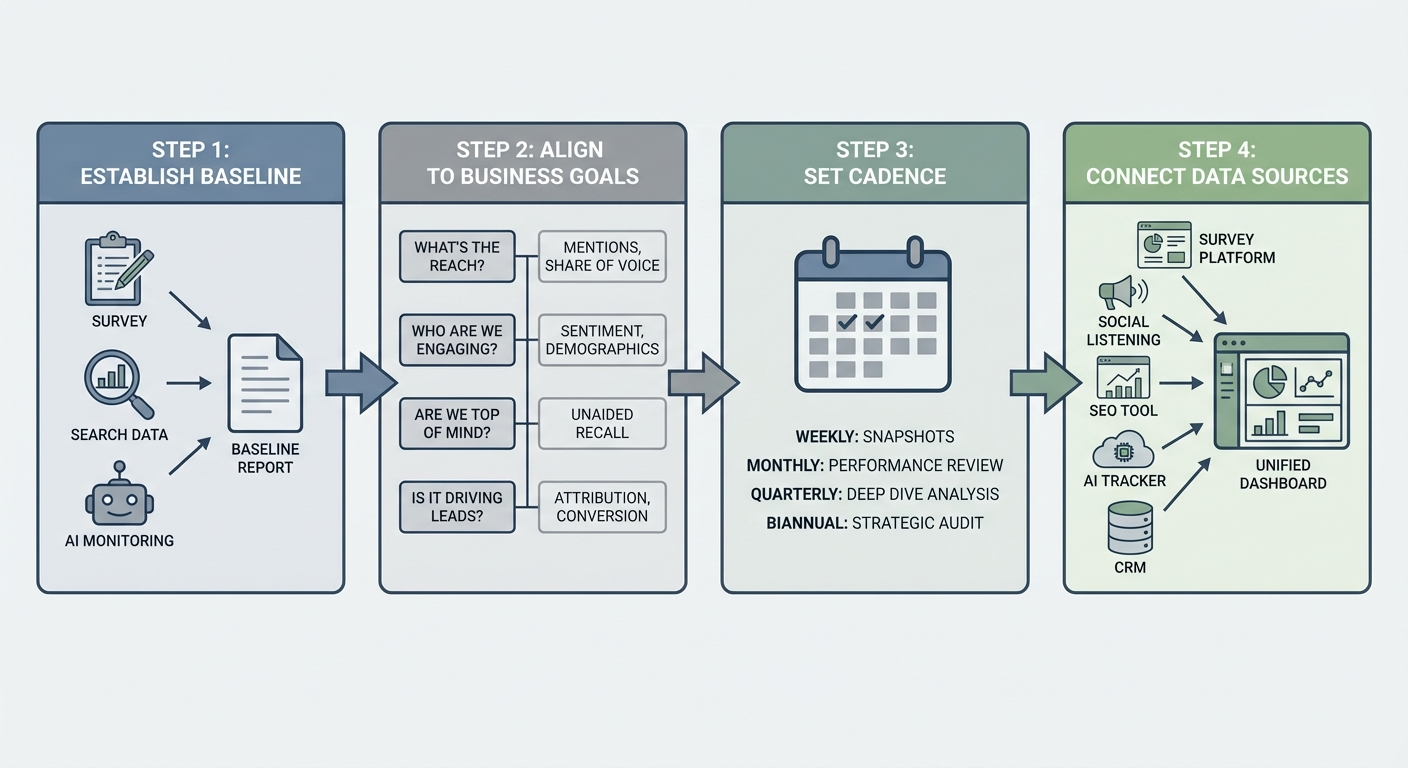
Step 1: Establish Your Baseline
Before optimizing anything, document where you stand today. Run an initial brand tracking survey targeting your ideal customer profile. Record your current branded search volume, social SOV, and AI citation frequency. This baseline becomes the reference point for every future measurement.
Without a baseline, you can’t distinguish between organic market growth and the impact of your campaigns. A 15% increase in branded search means nothing if the entire category grew 20%.
Step 2: Align Metrics to Business Goals
Map each metric to a specific business question:
- “Are more people aware of us?” → Unaided recall, branded search volume, AI citation frequency
- “Are we gaining ground on competitors?” → Share of search, social SOV, AI share of voice
- “Is awareness translating into demand?” → Awareness-to-consideration rate, direct traffic, CAC by segment
- “Is our brand investment generating ROI?” → Incremental brand lift, marketing mix contribution
If a metric doesn’t answer a question your leadership team actually asks, reconsider whether it belongs in your dashboard. Measurement debt — tracking metrics nobody acts on — wastes time and obscures the signals that matter.
Step 3: Set Measurement Cadence by Signal Type
Not every metric needs the same frequency:
- Weekly: Branded search volume, social mentions, AI citation spot-checks
- Monthly: Share of search trends, social SOV, referral traffic, direct traffic
- Quarterly: Brand recall surveys, brand sentiment deep-dives, AI visibility competitive analysis
- Biannually: Incremental brand lift studies, CAC-by-segment analysis, marketing mix modeling updates
For a comprehensive overview of tracking approaches, see brand tracking tools that support ongoing measurement.
Step 4: Connect Your Data Sources
The most common failure point is disconnected data. Your survey platform, social listening tool, SEO analytics, AI visibility tracker, and CRM each hold one piece of the picture. Without integration — even a simple shared spreadsheet updated monthly — you’ll never see how awareness signals relate to each other or to revenue.
Practical integration approaches:
- Export monthly data from each tool into a unified dashboard (Looker Studio, Databox, or even Google Sheets)
- Use CRM tags to segment leads by awareness source — branded search, AI referral, earned media, paid campaigns
- Overlay awareness trend data against pipeline creation dates to identify lag patterns
The goal isn’t a perfect attribution model. It’s a working system that shows directional relationships between awareness investment and business outcomes.
Common Measurement Mistakes That Waste Budget
After reviewing how B2B teams approach brand awareness measurement, patterns of failure emerge consistently. Avoiding these saves both money and strategic clarity.
Measuring reach instead of recall. Impressions tell you how many screens displayed your brand. They say nothing about whether anyone remembers it. A campaign that generates 10 million impressions and zero change in unaided recall produced visibility without awareness. Always pair reach metrics with recall measurement.
Ignoring the AI discovery layer. As of 2026, a growing percentage of B2B buyers use AI assistants during research. If your brand doesn’t appear when buyers ask ChatGPT or Perplexity category questions, you have an awareness gap that social listening and branded search data won’t reveal. Check whether AI mentions your brand before assuming your awareness numbers tell the complete story.
Tracking too many metrics. A dashboard with thirty awareness metrics creates noise, not insight. Focus on 6–8 metrics that your team reviews and acts on monthly. Retire any metric that hasn’t influenced a decision in the past quarter.
Running surveys with inconsistent methodology. Changing question wording, competitive sets, or sample composition between survey waves creates artificial variation. Document your methodology on day one. Maintain it across every wave so you’re comparing equivalent data.
Treating awareness as a standalone metric. Awareness matters because it leads to consideration, which leads to conversion. If you track awareness without also tracking the downstream conversion signals, you can’t demonstrate ROI — and your budget becomes vulnerable to reallocation.
What a Complete Brand Awareness Stack Looks Like in 2026
Pulling everything together, here’s a practical measurement stack that covers the full awareness spectrum — from recall to revenue, including the AI visibility layer.
| Measurement Layer | What It Captures | Recommended Tools (by Budget) |
|---|---|---|
| Direct awareness (recall and recognition) | Whether people remember and recognize your brand | SurveyMonkey or Typeform (low budget); Attest or YouGov BrandIndex Lite (mid); Qualtrics or Ipsos (enterprise) |
| Social and media visibility | How often your brand is discussed and how it’s perceived | Google Alerts (free); Mention or Sprout Social (mid); Brandwatch, Meltwater, or Talkwalker (enterprise) |
| Search-based awareness signals | Branded search volume, share of search, backlink growth | Google Search Console + Google Trends (free); Semrush or Ahrefs (mid-to-enterprise) |
| AI visibility and citation tracking | Brand mentions in ChatGPT, Gemini, Perplexity, Claude responses | Manual query checks (free); dedicated AI monitoring platforms (mid-to-enterprise) |
| Revenue attribution | Connection between awareness investment and pipeline/revenue outcomes | Google Analytics + CRM integration (low-to-mid); Keen or Nielsen (enterprise) |
Not every team needs every layer on day one. Start with the layers that match your current growth stage, then add depth as budget and team capacity grow.
For organizations exploring how AI visibility specifically drives measurable business outcomes, see brand mentions in AI for a deeper analysis of the mechanism.
Frequently Asked Questions
How often should you measure brand awareness?
Track behavioral proxies like branded search volume and social mentions weekly or monthly. Run formal brand recall surveys quarterly. Conduct deeper studies — brand lift experiments, marketing mix analyses — biannually. The cadence should match your investment level. Brands spending heavily on awareness campaigns need more frequent measurement to optimize in real time.
Can you measure brand awareness without a big budget?
Yes. Google Search Console, Google Trends, and Google Alerts are free and capture branded search growth and web mentions. A quarterly survey using SurveyMonkey’s free tier or Google Forms provides recall data. Manual AI query checks — asking ChatGPT and Perplexity category questions and recording results — cost nothing but your time. These won’t match enterprise tools in depth, but they establish a baseline you can build on.
What is the single most important brand awareness metric?
Unaided brand recall among your target audience. It measures whether people think of your brand spontaneously when they have a need in your category. Research from the Ehrenberg-Bass Institute consistently shows that mental availability — captured through unaided recall — is the strongest predictor of market share growth. Every other metric supports or contextualizes this foundational signal.
Do brand mentions in AI search actually affect awareness?
They do, and the effect is growing. When an AI assistant recommends your brand in response to a buyer’s question, it functions as a trusted referral. Research on how brand mentions impact AI search visibility shows that brands consistently mentioned across high-authority publications develop stronger AI citation patterns over time. As AI-assisted research becomes more common, this channel will represent an increasing share of how buyers first encounter brands.
How do you connect brand awareness to revenue?
Track three conversion signals: (1) awareness-to-consideration rate from your brand tracking surveys, (2) CAC differences between branded-channel leads and unbranded-channel leads in your CRM, and (3) direct traffic growth correlated with pipeline creation over time. For enterprise teams, controlled geo-lift experiments and marketing mix models provide causal evidence. The key is measuring awareness and demand in the same system, not in separate dashboards.
Where to Go from Here
Brand awareness measurement in 2026 demands more than a single dashboard or a quarterly survey. It requires a system that captures recall, tracks visibility across both traditional and AI-driven channels, and connects those signals to the metrics your leadership team cares about — pipeline, revenue, and competitive position.
Start with your biggest blind spot. If you’ve never measured unaided recall, run a survey this quarter. If you don’t know whether AI assistants mention your brand, check your AI visibility today. If you track awareness metrics but can’t connect them to demand, integrate your survey data with your CRM.
Each layer you add makes the picture sharper. And the brands that measure accurately are the ones that invest wisely — building awareness that compounds into category authority, AI discoverability, and sustainable growth.
Want to see where your brand stands in AI search — and how it compares to competitors? Get your free AI visibility audit from BrandMentions.