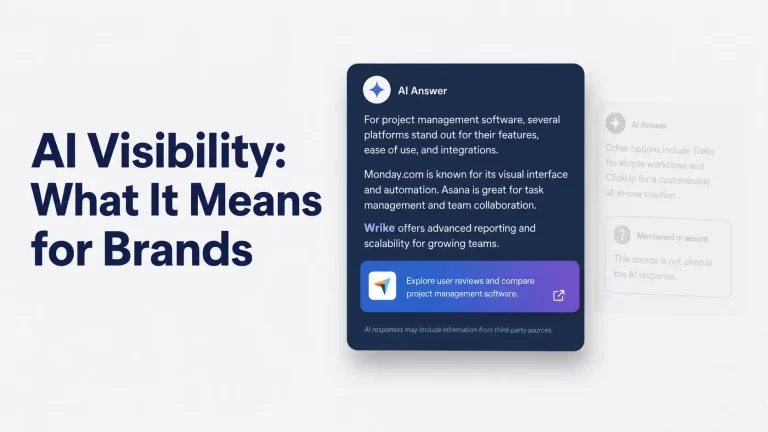

A buyer opens ChatGPT and asks for the best agent in their target neighborhood. The model names three brokerages and one agent, then explains why. Your firm isn’t in the answer, and you’ll never see that lost lead in your CRM.
AI visibility for real estate decides whether ChatGPT, Gemini, Perplexity and Google AI Overviews name your agents, brokerage or listings when buyers, renters and sellers ask for recommendations. It’s broader than ranking on Google, because a page can rank and still never be chosen by the model. Below you’ll find how engines pick names, a prompt log you can copy, and the fair housing limits that apply only to this industry.
Real estate is a local, trust-heavy category, so engines lean hard on signals they can verify outside your own site. That’s good news for firms with real reviews and real market coverage. It’s bad news for firms with a polished site and a thin footprint. For how other sectors compare, see AI visibility by industry.
What AI Visibility for Real Estate Is
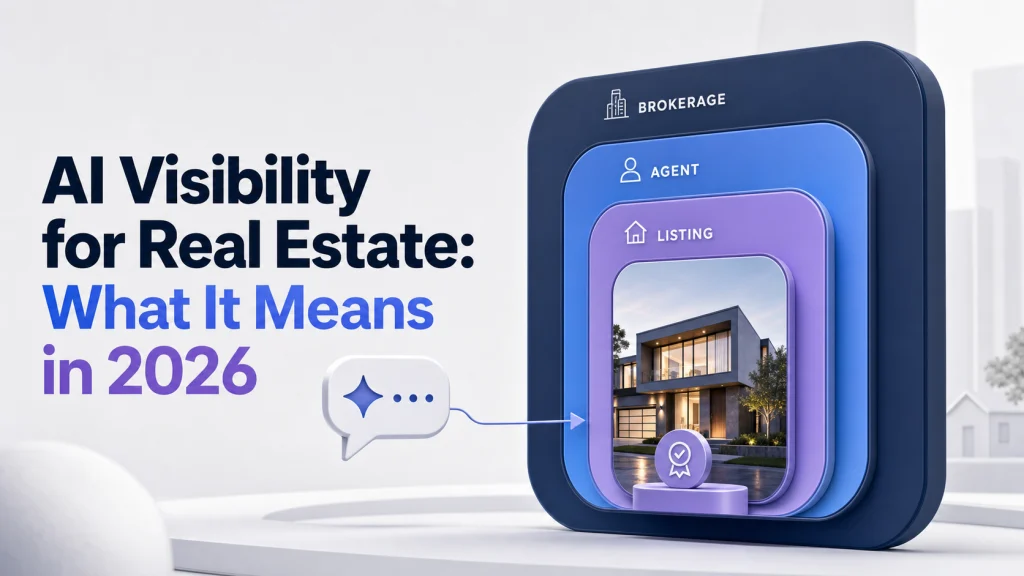
AI visibility for real estate covers four separate entities: the brokerage brand, the individual agent, the property management firm and the single listing. Each one can be named, cited or skipped inside answers from ChatGPT, Gemini, Perplexity and Google AI Overviews. It isn’t one ranking. It’s a presence across the sources those engines trust.
Those entities succeed or fail independently. One firm can be named for “best brokerage in Austin” and still be absent from “3-bedroom homes near Mueller,” because the listing entity is weaker than the brand.
AI visibility differs from traditional search in what counts as a win. Ranking places a page in a list of blue links. Visibility means being selected and named in a generated answer that the reader treats as the recommendation. A page can rank first and never get cited, and a profile that ranks nowhere can get named because the model trusts the entity behind it.
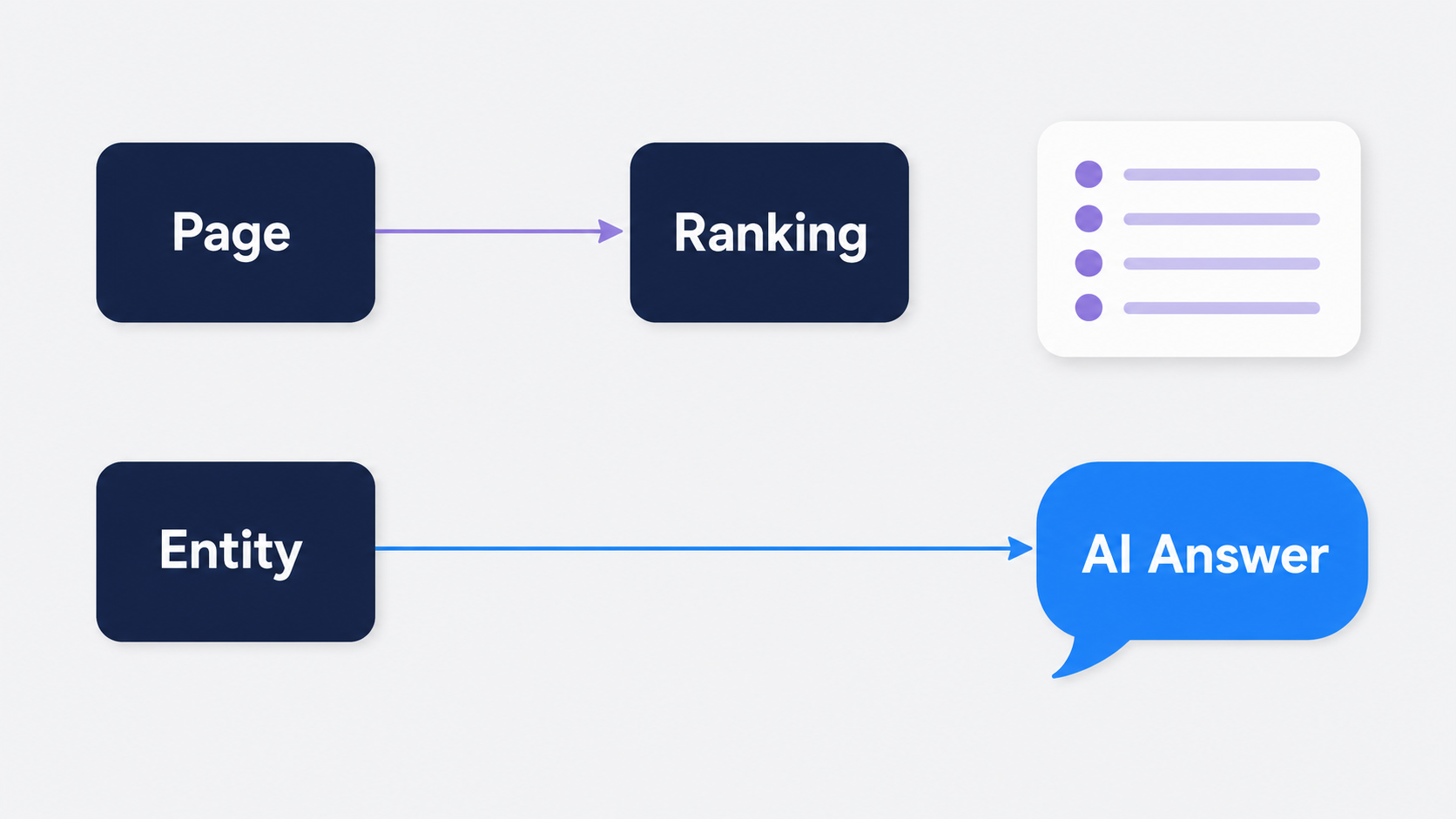
Consider three queries that surface differently. A buyer asks “best real estate agent in Denver.” A renter asks “pet-friendly 2-bedroom rentals near Capitol Hill.” A seller asks “which brokerage gets the highest sale price in my zip code.” Each pulls from different signals, and a brand strong on one can be invisible on the others. The difference between traditional ranking and AI selection is worth understanding in full, which we cover in AI visibility vs SEO metrics.
Why AI Visibility Matters for Real Estate Lead Flow
Buyers and renters increasingly ask AI assistants for shortlists, neighborhood comparisons and agent recommendations in plain language. A named answer carries weight with the reader. If your brand isn’t in that answer, you aren’t in the consideration set.
Local recommendation surfaces shape who gets considered first. When a model assembles a shortlist of agents or brokerages for a market, it leans on what it can verify across reviews, profiles, directories, and editorial mentions. A firm with thin or inconsistent signals gets skipped, even one with strong sales numbers, because the model cannot confidently connect the brand to the market.
That entity-confidence problem is the real risk. If an AI engine cannot tie your name to a specific service area, property type, or price band, it leaves you out rather than guess wrong. Weak entity signals are how a well-known local brand becomes invisible in the surface buyers now use first.
The business impact lands in a few places:
- Lead generation, because AI answers route inquiries to the named agents and firms.
- Market trust, because being recommended by a neutral-seeming engine carries weight a paid ad does not.
- Listing exposure, because individual properties can surface in renter and buyer queries.
- Brand recall, because repeated citations train the reader to expect your name in the category.
Visibility weighs differently by firm type. An independent agent competes on name consistency and neighborhood depth. A multi-location brokerage competes on clear service areas across markets, and a property management firm competes on listing detail and review volume.
Which Level to Fix First
Fix the level that matches how your clients ask for you. If clients ask for an agent by name, start with the agent level: bios, portal profiles and reviews that tie the agent to neighborhoods. If they ask about homes or rentals, start with the listing level. Brokerages with weak listings rarely gain lead flow by polishing the brand level further.
| Your situation | Fix first | Why |
|---|---|---|
| Solo or team agent | Agent level | Clients ask for a person tied to a neighborhood |
| Multi-office brokerage | Brand level, per market | Engines need each office tied to its service area |
| Property manager or leasing team | Listing level | Renters ask about units, pets, amenities and price |
How AI Engines Decide What Real Estate Information to Surface
AI engines assemble an answer from many signals rather than pulling one winning page. The sequence below shows where visibility is won or lost. The mechanics are covered in depth in how AI crawlers actually pick sources.
1. Source Selection
The engine favors information it can verify across multiple independent sources. A claim that appears only on your own website carries less weight than one echoed by reviews, directories, and editorial coverage.
2. Entity Recognition
The system has to understand who you are. It connects the brokerage name, the agents, and the markets into a recognizable entity before it can recommend any of them.
3. Content Clarity
Unambiguous service areas, property types, and market coverage help the engine judge relevance. Vague “we serve the greater metro area” copy gives it nothing to anchor to.
4. Authority Signals
Reviews, local mentions, citations, and consistent branding reinforce that you are a trustworthy answer to the query.
5. Freshness and Consistency
Engines lean toward current information that lines up across your site, your profiles, and your listings. Conflicting details across surfaces erode confidence.
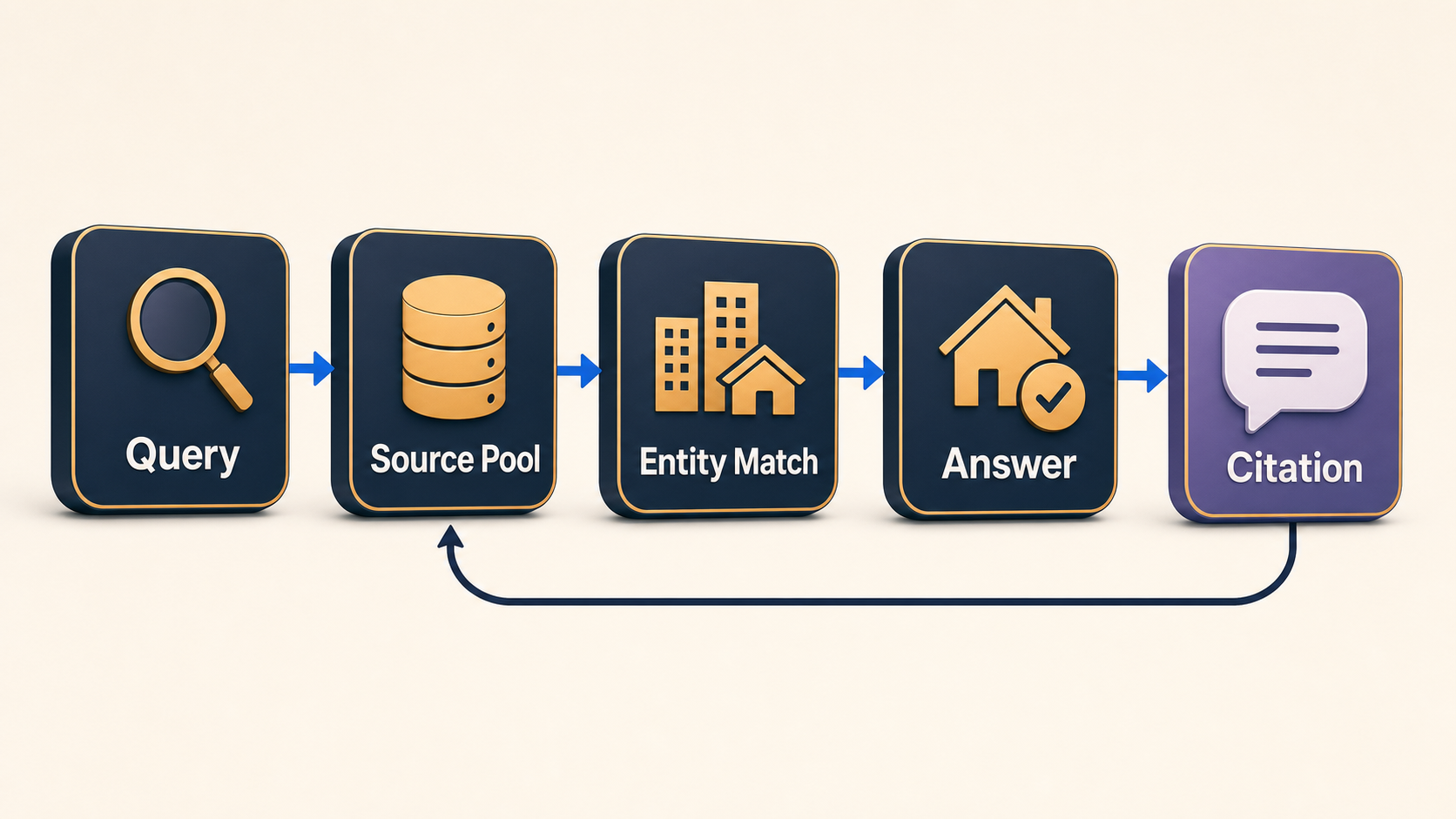
Each surface weights these signals differently. Perplexity leans on citable web sources, Google AI Overviews draws on Google’s index and local data, and ChatGPT blends training data with live retrieval. The common thread is verification: every surface rewards a brand it can confirm from more than one place. Entity recognition is the load-bearing piece, which we explain in entity SEO.
The Signals That Build AI Visibility for Real Estate
Visibility is assembled at three levels, and a brand can be strong at one while weak at another. The table below maps the main signals by entity type so you can see where your gaps sit.
| Signal area | Brand level | Agent level | Listing or property level |
|---|---|---|---|
| Identity | Consistent name, service-area clarity, Google Business Profile strength | Consistent name usage, bios, credentials across trusted sites | Detailed listing copy, amenity clarity, property type |
| Trust | Review quality, local media or directory citations | Awards, neighborhood expertise, client testimonials | Neighborhood context, FAQs, structured data |
| Authority | Repeated coverage across the market | Profiles on platforms engines already trust | Schema markup that parses price band and location |
A few of these carry more weight than the rest, so they deserve a closer look.
Google Business Profile and Reviews
Your Google Business Profile, the local profile that powers map results, is one of the strongest entity anchors an engine reads for a local brand. Review quality and volume feed into whether a model trusts you as a recommendation. Consistent, recent, specific reviews are exactly the multi-source verification engines look for, and the same logic applies to third-party review sites, covered in how Trustpilot shows up in AI citations.
Entity Consistency Across the Web
Entity consistency means your name, address, and phone, plus your service areas and specialties, match across your site, your profiles, directories, and listing platforms. Conflicting details, an old brokerage name on one directory, a different phone on another, lower the model’s confidence and quietly suppress your visibility.
Schema Markup
Schema markup, also called structured data, is machine-readable code that labels what is on a page. For real estate it lets an engine parse property details, service areas, and business information without guessing. It does not earn a citation by itself, but it removes ambiguity that would otherwise cost you one.
Citations and Topical Authority
Citations and mentions support entity confidence even when they send zero direct traffic, because the model treats an external reference as a vote that you exist and matter in the market. Topical authority compounds when you cover neighborhoods, property types, pricing bands, and recurring market questions repeatedly, so the engine associates your brand with the subject.
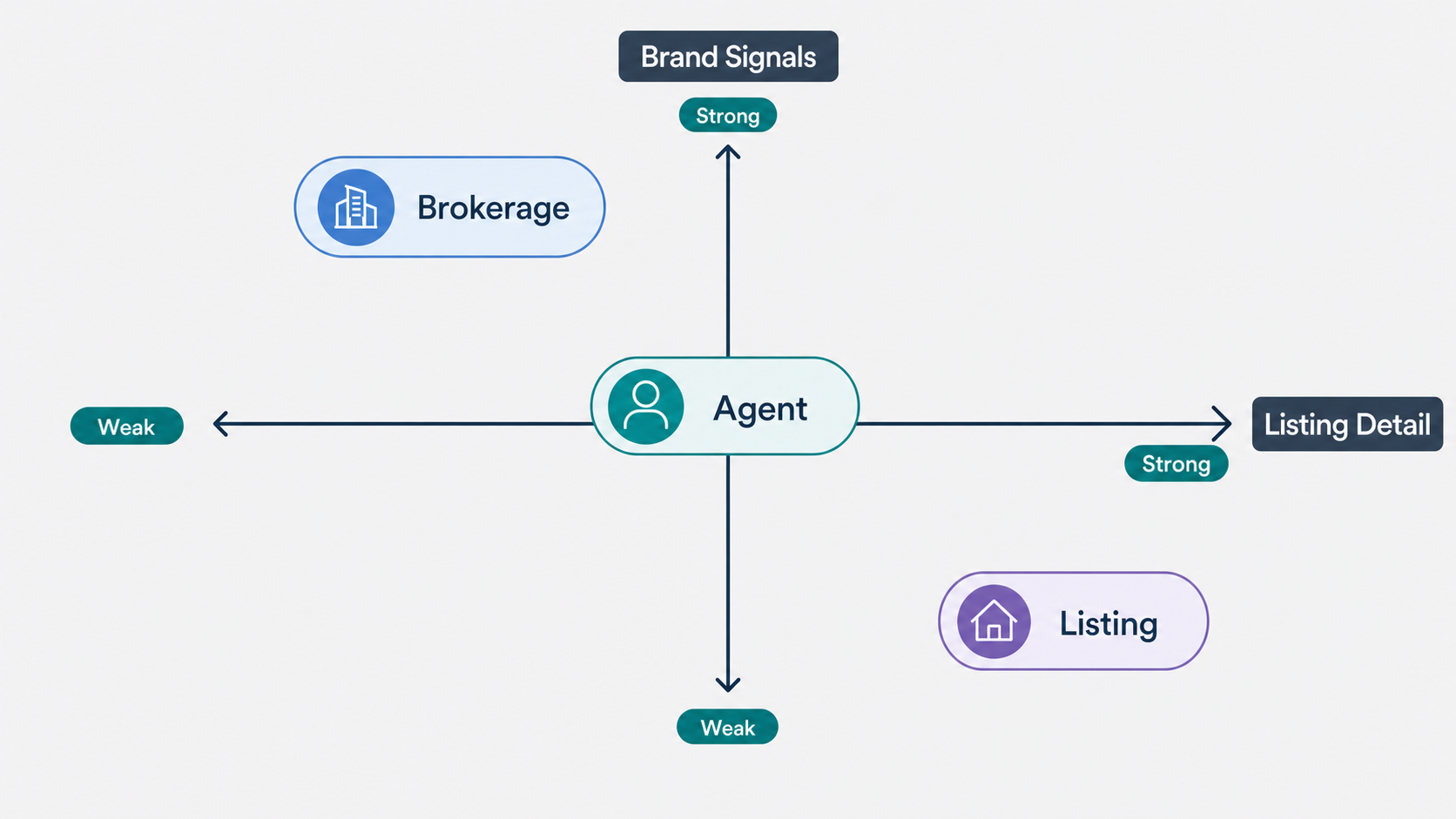
The pattern shows up constantly: a brokerage with a polished brand and strong reviews gets named for “best firm in the city,” yet its individual listings never surface for specific property queries because the listing copy is thin and unstructured. The brand-level entity is recognized. The listing-level entity is not. Fixing one does not fix the other.
See where AI answers put your brand
Twenty minutes with a senior strategist: where the major engines point buyers in your category, who gets named instead of you, and a straight read on what a programme would change.
Book a strategy callWhat Real Estate Teams Get Wrong About AI Visibility
Most missteps come from treating AI visibility as a renamed version of something familiar. The table below separates the common belief from what holds.
| The myth | The reality |
|---|---|
| AI visibility is just SEO with a new label | It rewards entity confidence and verification, not page rankings alone, so the playbook differs |
| Targeting more keywords is the path in | Engines read entities, locations, and trust signals, so keyword volume without entity clarity stalls |
| Promotional copy on your own site earns citations | Self-published claims carry little weight without independent reviews, mentions, and coverage |
| One strong homepage is the whole strategy | Local pages, profile data, and listing detail usually move visibility more than a single homepage |
| Traffic is the success metric | Whether a model names, cites, or recommends you matters more than session counts |
The keyword trap deserves a flag. Teams pour effort into ranking terms while ignoring whether engines can connect their name to a market, a specialty, and a track record. The split between the old keyword mindset and the entity mindset is laid out in AI search optimization is not SEO with a new label.
The most common failure is quieter than any of these. A team publishes more content every month and still earns no citations, because the entity footprint stays thin. The fix is building real external signals, not adding pages, which we walk through in how to increase brand mentions in AI search results.
How to Check Where Your Brokerage Stands in AI Answers
A brokerage checks its AI visibility by asking the engines the questions its clients ask, market by market, and recording who gets named. You don’t need software to start. A spreadsheet and an afternoon will show you the gaps.
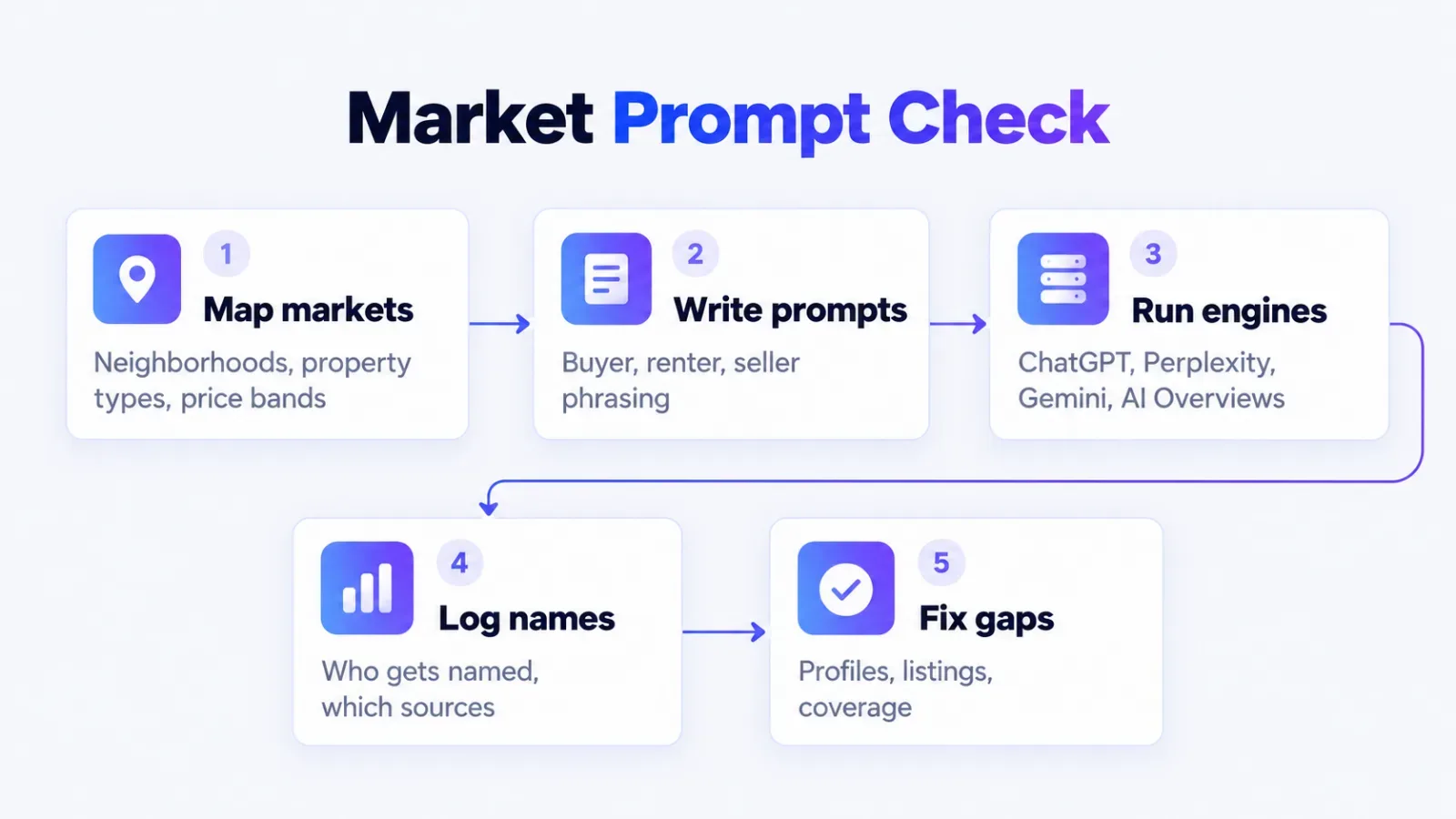
- List your markets as buyers describe them: neighborhoods, property types and price bands, not just the city name.
- Write 10 to 15 prompts in buyer, renter and seller phrasing, such as “best agent for condos in Capitol Hill.”
- Run each prompt in ChatGPT, Perplexity, Gemini and Google AI Overviews, and note that answers shift between runs.
- Log every agent and brokerage named, plus the sources each engine cites.
- Compare the cited sources with your own profiles on Google Business Profile, Zillow and Realtor.com, and fix mismatched names, areas or specialties first.
The cited sources matter more than the names. They show which directories, review sites and local publications an engine trusts in your market, and that’s where your footprint needs to grow.
A Prompt Log You Can Copy
A prompt log works best with one row per prompt and engine. The rows below are an illustrative template, not real results; replace them with your own runs.
| Prompt | Engine | Names given | Sources cited | Are you named? |
|---|---|---|---|---|
| Best agent for condos in [neighborhood] | ChatGPT | Record each agent or firm | Portals, review sites, local press | Yes or no |
| Pet-friendly 2-bedroom rentals near [area] | Perplexity | Record each listing or manager | Listing sites, manager pages | Yes or no |
| Which brokerage should sell my home in [zip code] | Google AI Overviews | Record each brokerage | Google Business Profile, reviews | Yes or no |
Rerun the same prompts monthly. A single run tells you little, but a trend across three months shows whether your fixes are being picked up.
Does Fair Housing Law Affect AI Visibility Content?
Fair housing law applies to the neighborhood content you publish to win AI visibility, just as it applies to your ads. The federal Fair Housing Act bars steering buyers or renters by race, religion, national origin, sex, disability, familial status or color. Engines summarize your pages, so wording such as “great for young families” or “a safe area” can be repeated in an AI answer.
Describe places through facts: commute times, school district names, amenities, housing stock and price bands. That kind of copy is safer and more specific, and specific facts are easier for an engine to cite. This is general information, not legal advice, so have your broker or counsel review neighborhood pages.
Your First Move: Run a Market Prompt Check
Real estate brands win AI visibility by becoming easier for engines to understand, trust and recommend. That comes from consistent entity signals, clear local relevance, structured listings and real coverage in your market.
Start this week with the prompt check above for your three most important neighborhoods. The gaps it shows will be specific: a stale portal profile, an agent bio missing a specialty, a listing page with no structured data. A checklist for preparing pages for these surfaces lives in the AI Overview optimization checklist.
Treat AI visibility as a discovery layer you manage alongside SEO, not a replacement for it. If you’re weighing outside help, what AI visibility programmes cost explains what drives the price.
Frequently asked questions
How does AI visibility work in real estate?
AI visibility works by getting an engine to recognize, trust, and name your brand, agent, or listing in a generated answer. The engine pulls from sources it can verify across reviews, profiles, directories, and editorial mentions, then connects them into an entity it can confidently recommend for a specific market or query.
Is AI visibility just local SEO for AI search?
No, though local SEO feeds it. Local SEO aims at map-pack and search rankings, while AI visibility aims at being selected and cited inside generated answers. A firm can hold a strong local ranking yet still be skipped by an AI engine that cannot verify its entity across enough independent sources.
What helps a real estate agent show up in ChatGPT or Google AI Overviews?
Consistent name usage, a complete bio with credentials, profiles on trusted platforms, strong reviews, and clear neighborhood specialization help most. Imagine an agent who lists the same name, market, and specialty identically across their site, their Google Business Profile, and three directories. That consistency is exactly what an engine needs to name them confidently.
Do reviews and Google Business Profile affect AI visibility?
Yes, both are major signals. Your Google Business Profile is a primary entity anchor for local brands, and review quality and recency act as the multi-source verification engines look for. Thin or inconsistent profiles weaken the confidence a model needs to recommend you.
How can a brokerage improve AI recommendations without rebuilding its whole website?
Start with the entity layer, not the site rebuild. Align your name, address, and service areas across every profile and directory, strengthen your Google Business Profile, earn fresh reviews, and add structured data to existing listing and location pages. These fixes raise entity confidence faster than a full redesign.
Do Zillow and Realtor.com profiles affect AI visibility?
What should a brokerage do if an AI answer gets its details wrong?
Correct the source the engine cites, not the answer itself. Wrong phone numbers, closed offices or an agent’s former brokerage usually trace back to a stale portal or directory profile. Fix that profile, then rerun the prompt over the next few weeks. Persistent negative or false answers need a fuller response, covered in AI search reputation crisis management.
Is AI visibility for real estate different from other industries?
Yes, because real estate is local and listing-driven. Visibility has to be earned for every neighborhood and property, and fair housing rules limit how neighborhoods can be described. Retail works differently, as AI visibility for ecommerce brands shows, where product data drives the answers.
Yes, portal profiles act as third-party confirmation of who you are and where you work. Engines cross-check your name, service area and specialties against them. An outdated portal profile with an old brokerage name or phone number weakens that confidence, so keep it aligned with your site and Google Business Profile.