AI brand mentions are the new front door to your business. When someone asks ChatGPT, Perplexity, or Google’s AI Mode for a recommendation in your category, your brand either appears in the answer — or it doesn’t. As of 2026, these AI-generated responses influence buying decisions before a prospect ever visits your website, reads a review, or clicks an ad. Understanding how AI brand mentions work, why they matter, and how to earn them consistently is now a core growth function for B2B companies.
This article breaks down the mechanics behind AI brand mentions, the factors that determine which brands get cited, and a practical system for building the kind of visibility that compounds across every major AI platform.
What You’ll Learn
- What an AI brand mention actually is — and how it differs from a citation or a traditional backlink
- Why AI platforms recommend certain brands and ignore others, based on how retrieval and ranking systems work
- The specific signals that correlate most strongly with inclusion in AI-generated answers
- A step-by-step approach to building AI brand mentions that hold up across ChatGPT, Perplexity, Gemini, and Google AI Overviews
- How to measure whether your efforts are working — and what to fix when they aren’t
- What has changed since 2024–2025 and where AI brand visibility is heading next
What Is an AI Brand Mention?
An AI brand mention is any instance where a large language model names your company in a generated response — whether as a recommendation, a comparison, or a contextual reference. This can happen in ChatGPT, Perplexity, Google AI Overviews, Gemini, Claude, or Microsoft Copilot.
AI brand mentions differ from traditional web mentions in three important ways:
- No click required. The user reads your brand name inside the AI’s answer. They may never visit a search results page or your website.
- Context shapes perception. A mention framed as “top pick for enterprise teams” carries more weight than a passing reference in a long list.
- Consistency matters more than any single appearance. AI models synthesize information from thousands of sources. Showing up once is noise. Showing up repeatedly, across authoritative contexts, is a signal.
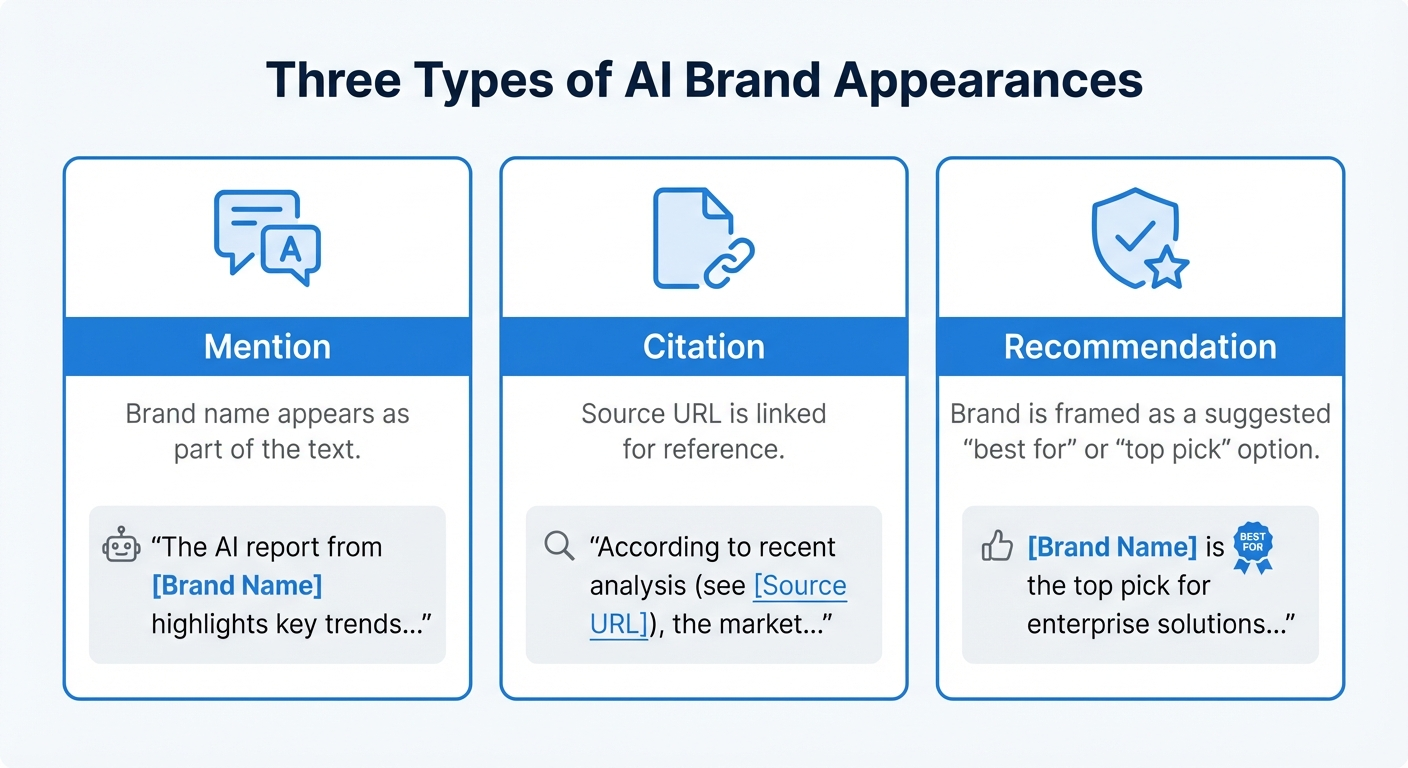
Mentions vs. Citations vs. Recommendations
These terms get used interchangeably, but they describe different outcomes — and your strategy should treat them differently.
- Mention: Your brand name appears somewhere in the response. This builds awareness but doesn’t guarantee positive framing.
- Citation: The AI links to or attributes information to a specific source — sometimes your domain, sometimes a third-party page that references you. Citations lend credibility to the mention.
- Recommendation: The AI positions your brand as a suggested solution (“best for,” “top choice,” “worth considering”). This is the highest-value outcome because it directly influences buying decisions.
Tracking all three separately gives you a clearer picture of where you stand. A brand that gets mentioned frequently but rarely recommended has a different problem than one that never appears at all. Tools designed for tracking brand mentions in AI search results can help you distinguish between these outcomes across platforms.
How AI Platforms Decide Which Brands to Mention
AI assistants don’t pull brand names from a ranked list. They synthesize answers from training data, real-time web retrieval, and internal relevance scoring. Understanding this process reveals why some brands appear consistently while others remain invisible.
Step 1: Data Retrieval
When a user asks a question like “What’s the best project management tool for remote teams?”, the AI doesn’t rely solely on pre-trained knowledge. Most platforms in 2026 — including ChatGPT with browsing, Perplexity, and Google AI Mode — query external sources in real time.
These retrieval systems pull from web pages, news articles, review sites, directories, forums, and documentation. The initial pool can include hundreds of potential brands and sources.
Step 2: Relevance Scoring and Filtering
The retrieval system applies two layers of filtering:
- Sparse retrieval (keyword matching): Algorithms like BM25 score documents based on how closely their text matches the query terms. If your website, product pages, and third-party mentions contain the exact phrases users search for, you pass this filter.
- Dense retrieval (semantic matching): Neural models convert content into vector embeddings and measure conceptual similarity. This is how “leading agency” matches “top company” even without identical words. It also means your content needs topical depth — not just keyword repetition.
Most AI platforms combine both methods. A weighted scoring system merges keyword-level precision with semantic understanding to produce a ranked shortlist.
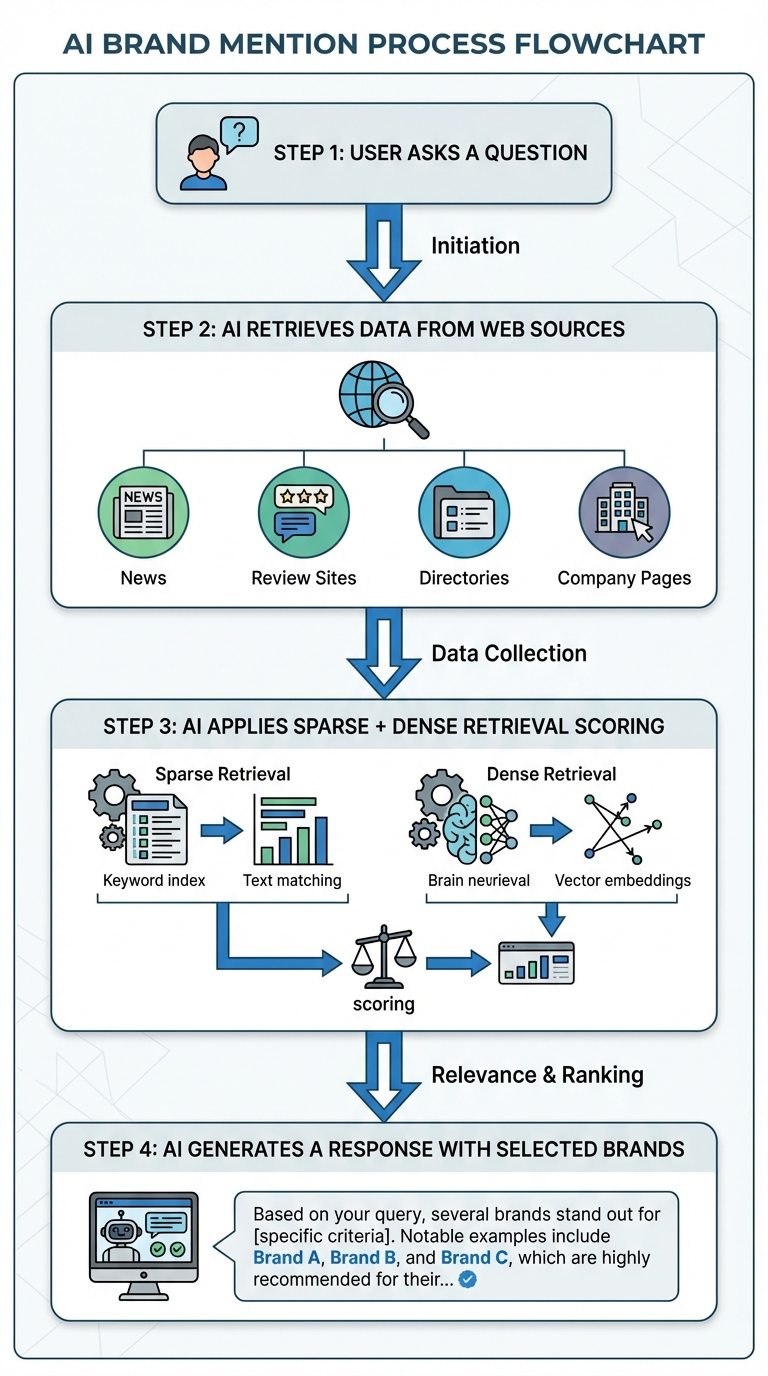
Step 3: Response Generation
The language model synthesizes the filtered information into a natural-language response. At this stage, additional signals influence which brands make the final answer:
- Frequency of mention across sources: Brands discussed on many independent, high-authority pages get stronger signals.
- Sentiment: Positive framing across sources increases the likelihood of a favorable recommendation.
- Recency: Fresh content from recent months often carries more weight than older material, especially for product categories that evolve quickly.
- Entity clarity: Brands with clear, consistent descriptions across the web are easier for AI to classify and recommend confidently.
Key insight: AI brand mentions are not earned by optimizing a single page. They’re earned by building a pattern of authoritative, consistent, contextually relevant references across the web — the kind of pattern that retrieval systems and language models treat as a trust signal.
What Drives AI Brand Mention Frequency: The Evidence
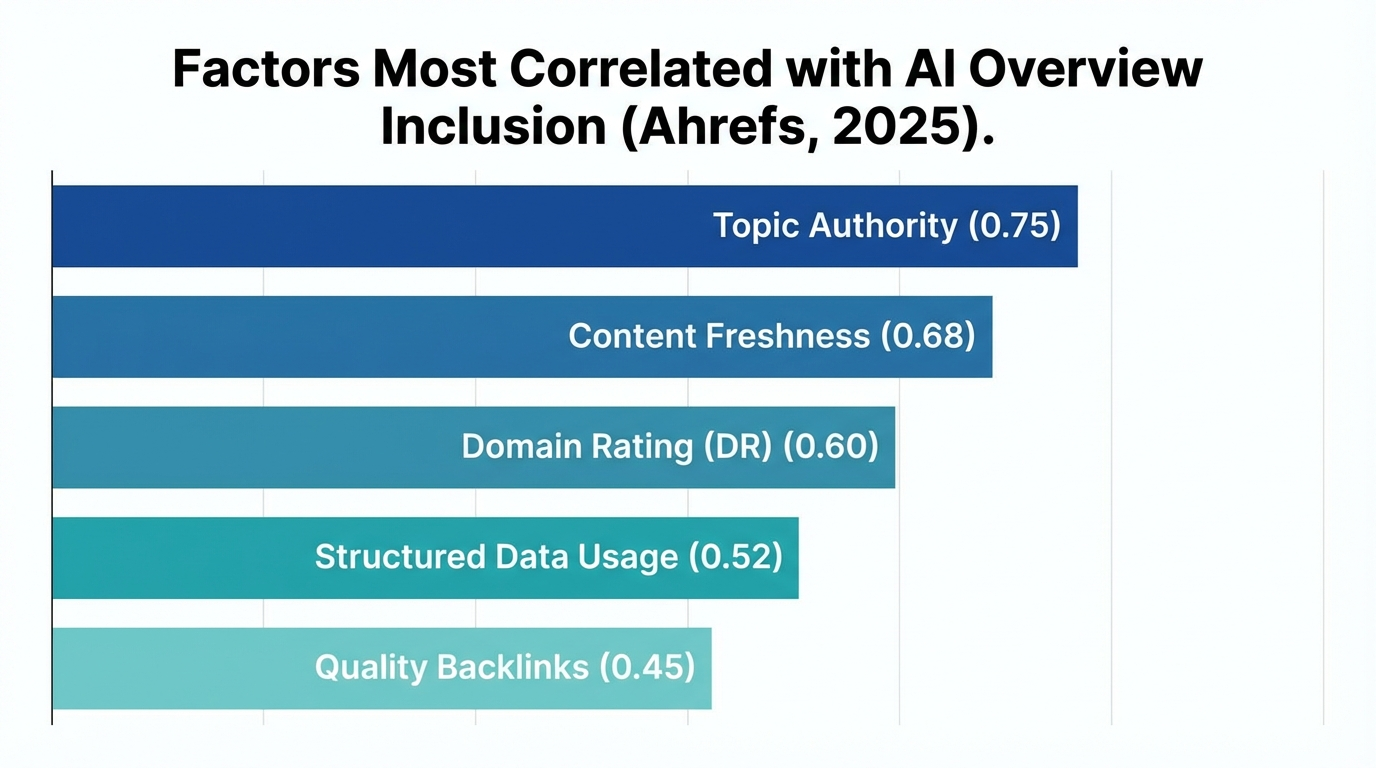
A comprehensive study by Ahrefs, published in 2025, analyzed 75,000 brand mentions across Google AI Overviews and measured which factors correlated most strongly with inclusion. The findings provide a data-backed roadmap for any brand working to improve AI visibility.
The Strongest Correlations
- Branded web mentions (0.664 correlation): How often your brand name appears across third-party websites, blogs, and news outlets. This was the single strongest predictor.
- Branded anchor text (0.527): Hyperlinked references to your brand on external sites.
- Branded search volume (0.392): The number of people searching for your brand name directly — a proxy for demand and recognition.
- Domain authority (0.326): Higher-authority domains were more likely to have their brands included.
- Referring domain count (0.295): A broad, diverse backlink profile contributed meaningfully.
The study also found that 26% of brands had zero mentions in AI Overviews — confirming that inclusion is far from automatic, even for established companies.
The 10X Gap Between Top and Bottom Brands
The same Ahrefs analysis segmented brands into quartiles based on web mention frequency. The results were dramatic:
- Bottom 25%: 0 AI Overview mentions
- 25–50%: 3 mentions
- 50–75%: 14 mentions
- Top 25%: 169 mentions (median)
Brands in the top quartile for web mentions earned over 10 times more AI mentions than the next tier down. The takeaway is clear: every additional high-quality third-party mention moves the needle on AI discoverability.
This data aligns with what Kevin Indig, organic growth advisor, observed in a 2025 analysis: “Brand search volume is the biggest predictor for visibility in ChatGPT… The number of AI chatbot mentions and brand search volume have a correlation of .334.”
Understanding how these signals relate to traditional SEO is essential. Brand mentions and SEO have always been connected — but in 2026, the connection extends directly into AI-generated answers.
How to Build AI Brand Mentions That Compound Over Time
Earning consistent AI brand mentions requires a system, not a single campaign. The brands that show up reliably across ChatGPT, Perplexity, Gemini, and Google AI Overviews share a common playbook: they build authoritative mentions on the publications AI models actively learn from, then reinforce those mentions with strong entity signals and on-site content.
1. Publish Contextual Mentions on High-Authority Sites
The most direct path to AI brand mentions is getting your company discussed on the websites that AI retrieval systems pull from most often. These include:
- Industry-specific publications and editorial sites
- Product roundup and comparison pages on high-authority domains
- News outlets and digital PR placements
- Expert-driven directories and review platforms
The key qualifier is editorial context. A mention on a trusted, editorially curated page carries far more weight than a mention on a low-traffic blog or user-generated directory. AI models assess source authority as part of their retrieval scoring.
Agencies like BrandMentions solve this by placing contextual brand mentions on 140+ high-authority publications that AI models actively learn from during training and real-time retrieval. The BrandMentions citation network is built specifically around the sources that feed into AI-generated answers.
Pro insight: Not all publications carry equal weight in AI systems. Focus on sites that already appear as citations in AI-generated responses for your category. These are the sources AI platforms trust — and where your brand needs to be present.
2. Strengthen Your Entity Signals
AI models need to understand what your brand is, what category it belongs to, and what makes it distinct. Weak entity signals lead to ambiguity — and ambiguity leads to exclusion.
Strengthen your entity clarity by:
- Standardizing your brand name across all web properties — website, social profiles, documentation, and third-party listings.
- Maintaining a clear, structured About page that defines your company, category, and core value proposition in plain language.
- Using consistent product naming everywhere your brand appears. If you call your product “Platform X” on your site but “Tool X” in guest posts, you’re splitting your entity signal.
- Applying Schema.org markup (Organization, Product, FAQPage) to help search engines and AI systems classify your brand correctly.
Entity signals compound. The more consistently your brand is described across independent sources, the more confidently AI systems include it in answers.
3. Create Content That AI Systems Want to Reference
Your own website plays a supporting role in AI brand mentions. While third-party mentions carry more weight for retrieval scoring, your site content influences how AI models describe your brand when they do mention it.
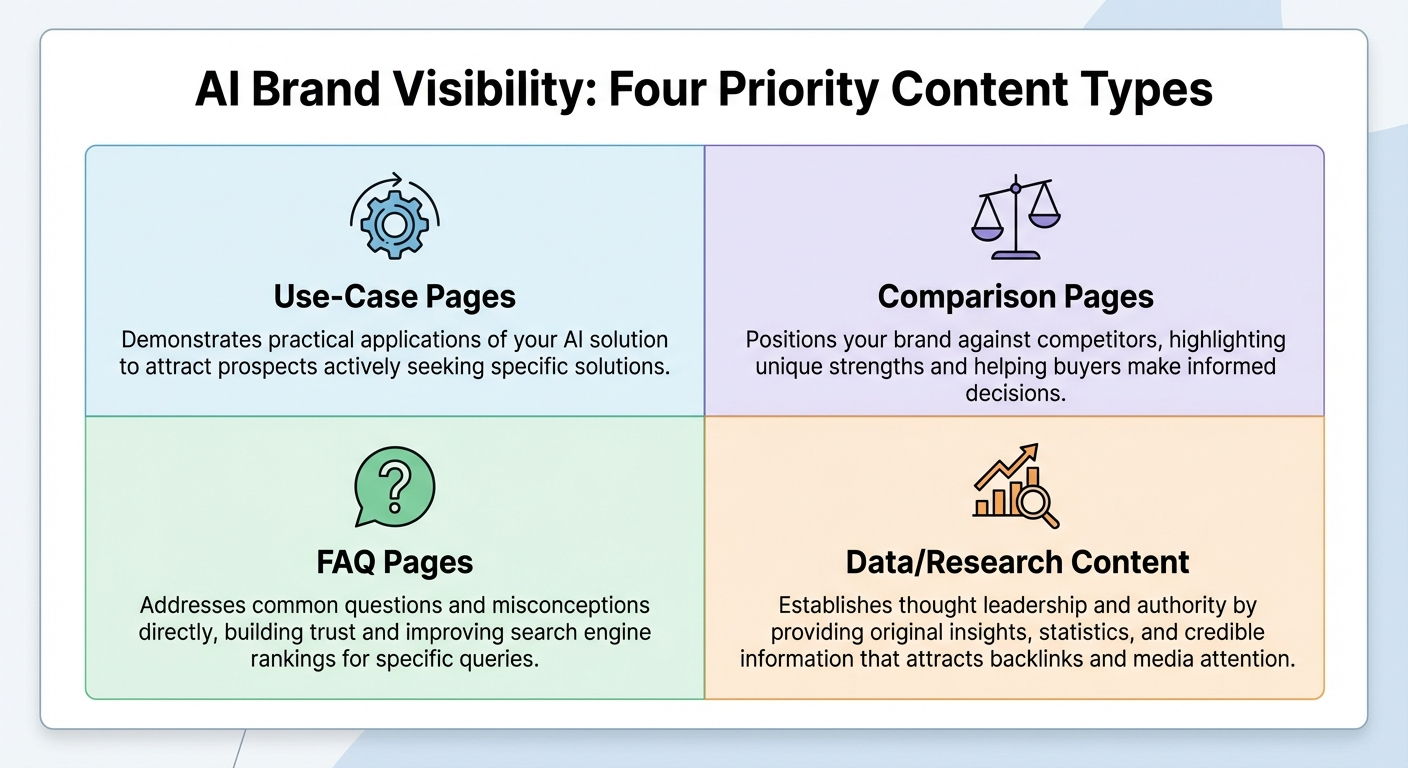
Prioritize these content types:
- Use-case pages: Dedicated pages for each audience or problem you solve. These give AI systems specific context for matching your brand to user queries.
- Comparison and alternatives pages: When users ask AI “What are alternatives to [Competitor]?”, the model looks for comparison content. Own that conversation.
- FAQ pages with structured data: Question-and-answer formats match the conversational queries users ask AI assistants. Use clear, self-contained answers.
- Data and research content: Original data, benchmarks, or case studies give AI systems a reason to cite your domain directly.
4. Build Branded Search Volume
Branded search volume — the number of people searching for your company name directly — is a meaningful signal for AI systems. It reflects real-world demand and recognition, which retrieval algorithms use as a quality indicator.
Tactics that build branded search volume include:
- Thought leadership content that associates your brand with a specific category or expertise area
- Digital PR campaigns that generate news coverage and discussion
- Podcast appearances and industry event visibility
- Social media presence that drives name recognition
This isn’t about running brand awareness ads (though those can help). It’s about earning the kind of recognition that makes people search for you by name — which in turn signals to AI that your brand matters in your category.
5. Earn Diverse, High-Quality Backlinks with Branded Anchors
Backlinks with branded anchor text remain a strong signal, both for traditional search and for AI retrieval. A diverse backlink profile from independent, authoritative domains tells AI systems that multiple trusted sources vouch for your brand.
Focus on:
- Guest contributions on high-authority industry sites
- Digital PR that earns editorial links from news and media outlets
- Requesting brand attribution where your company is referenced but not linked — converting unlinked brand mentions into proper backlinks
Measuring AI Brand Mentions: What to Track and How
You can’t improve what you don’t measure. AI brand mention tracking requires different tools and metrics than traditional SEO because AI-generated responses don’t produce standard pageviews or click data.
The Three Metrics That Matter
- Share of Answer: The percentage of relevant prompts where your brand appears in the AI-generated response. This is the closest analog to share of voice in traditional marketing.
- Mention Quality: Whether your brand is recommended, neutrally listed, or mentioned negatively. A weighted score (recommendation > neutral > negative) gives you a clearer picture than raw mention counts.
- Citation Rate: The percentage of prompts where your domain is linked as a source. This matters for traffic and authority signaling.
How to Track AI Brand Mentions Across Platforms
Manual tracking — typing prompts into ChatGPT and Perplexity one by one — works for quick checks but doesn’t scale. For systematic monitoring, you need tools that run prompt libraries across multiple AI engines on a recurring schedule.
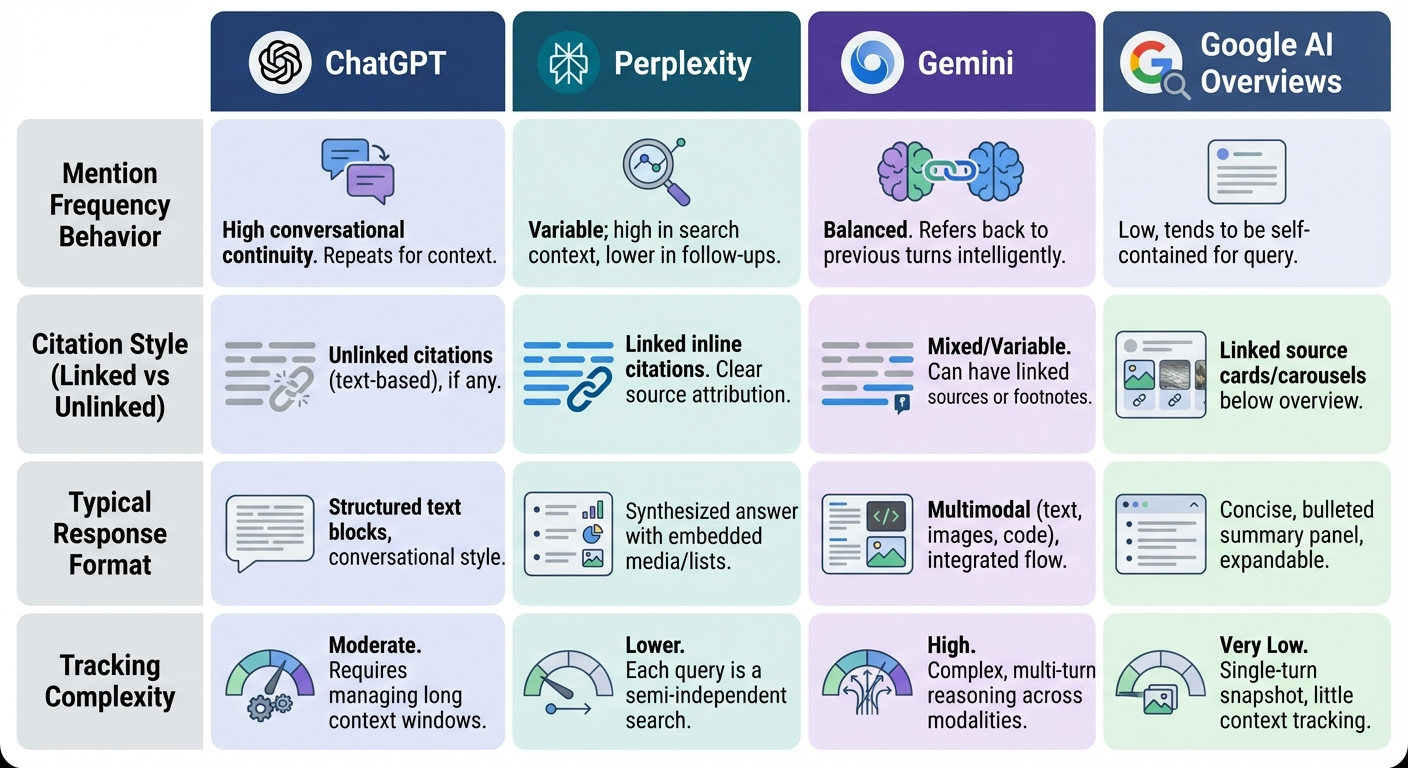
The approach for each platform differs slightly:
- ChatGPT: Responses vary based on prompt phrasing and model version. Track a consistent set of canonical prompts plus variants. Learn how to monitor brand mentions in ChatGPT effectively.
- Perplexity: Provides more citations per response but mentions brands less frequently — only about 1 in 5 answers include brand references, according to a 2025 BrightEdge analysis. See how to track mentions in Perplexity specifically.
- Gemini: Google’s model pulls from both its search index and training data, creating different mention patterns. A dedicated guide covers tracking brand mentions in Gemini.
- Google AI Overviews: These appear in 13%+ of search result pages as of early 2025 (per Semrush data), with that number continuing to grow through 2026.
For a broader comparison of tracking approaches, the best ways to track brand mentions in AI search guide covers the full landscape.
Avoiding False Positives
AI mention tracking can produce inflated numbers if you don’t control for:
- Name collisions: Your brand name matches a common word, person, or unrelated product.
- Prompted mentions: If your prompt includes your brand name (“Is BrandX good?”), you’ll always get a “mention.” That’s not organic visibility.
- Neutral or negative context: A mention in a warning (“avoid BrandX for enterprise use”) is not the same as a recommendation.
Apply a validation rule: a mention only counts as genuine if your domain is cited, your product name co-occurs with the brand name, or the answer clearly references your category positioning.
What Has Changed Since 2024–2025
AI brand visibility has evolved rapidly. If your strategy was built in 2024, several shifts require attention:
- Real-time retrieval is now standard. In 2024, many AI models relied primarily on static training data. By 2026, ChatGPT, Perplexity, Gemini, and Google AI Mode all use live web retrieval for most queries. This means fresh content matters more than it did even 12 months ago.
- AI Overviews have expanded significantly. Google’s Liz Reid described AI Mode as “the future of Google Search.” The percentage of queries triggering AI-generated summaries continues to climb, making AI visibility a direct competitor to traditional organic rankings.
- Citation behavior varies more across platforms. Perplexity provides 5+ citations per answer. ChatGPT links sources in roughly 2 out of 10 mentions. Google AI Overviews blend citation and recall. A platform-specific strategy is now necessary — a single approach doesn’t cover all surfaces.
- Entity disambiguation has become more important. As AI systems process more brands and more queries, clarity in entity signals separates brands that get consistently mentioned from those that get confused with competitors or unrelated entities.
In campaigns across 67+ B2B companies, the BrandMentions team found that brands with consistent editorial mentions across high-authority publications achieved AI recommendation rates 89% higher than those relying solely on traditional SEO.
Common Mistakes That Block AI Brand Mentions
Most brands that struggle with AI visibility aren’t doing the wrong things — they’re missing foundational steps.
Relying on Your Website Alone
Your site content influences how AI describes your brand, but third-party mentions on independent, authoritative sources are what get your brand into the conversation in the first place. If you’re investing only in on-site content and ignoring external visibility, you’re addressing half the equation.
Inconsistent Brand Presentation
If your brand name, product names, or positioning differ across your website, social profiles, directories, and third-party mentions, AI systems can’t build a clear entity profile. Consistency is the foundation of entity authority.
Ignoring Platform-Specific Differences
A strategy that works for Google AI Overviews may not translate to ChatGPT or Perplexity. Each platform has different retrieval mechanisms, citation behaviors, and response formats. Monitor each separately and adjust your approach accordingly. AI rank trackers for brand mentions can help automate cross-platform monitoring.
Chasing Mentions Without Measuring Quality
Raw mention counts mean little without context. A brand that appears in 50 AI responses but is never recommended has a positioning problem, not a visibility problem. Always measure mention quality alongside frequency.
A Practical System for AI Brand Mentions in 2026
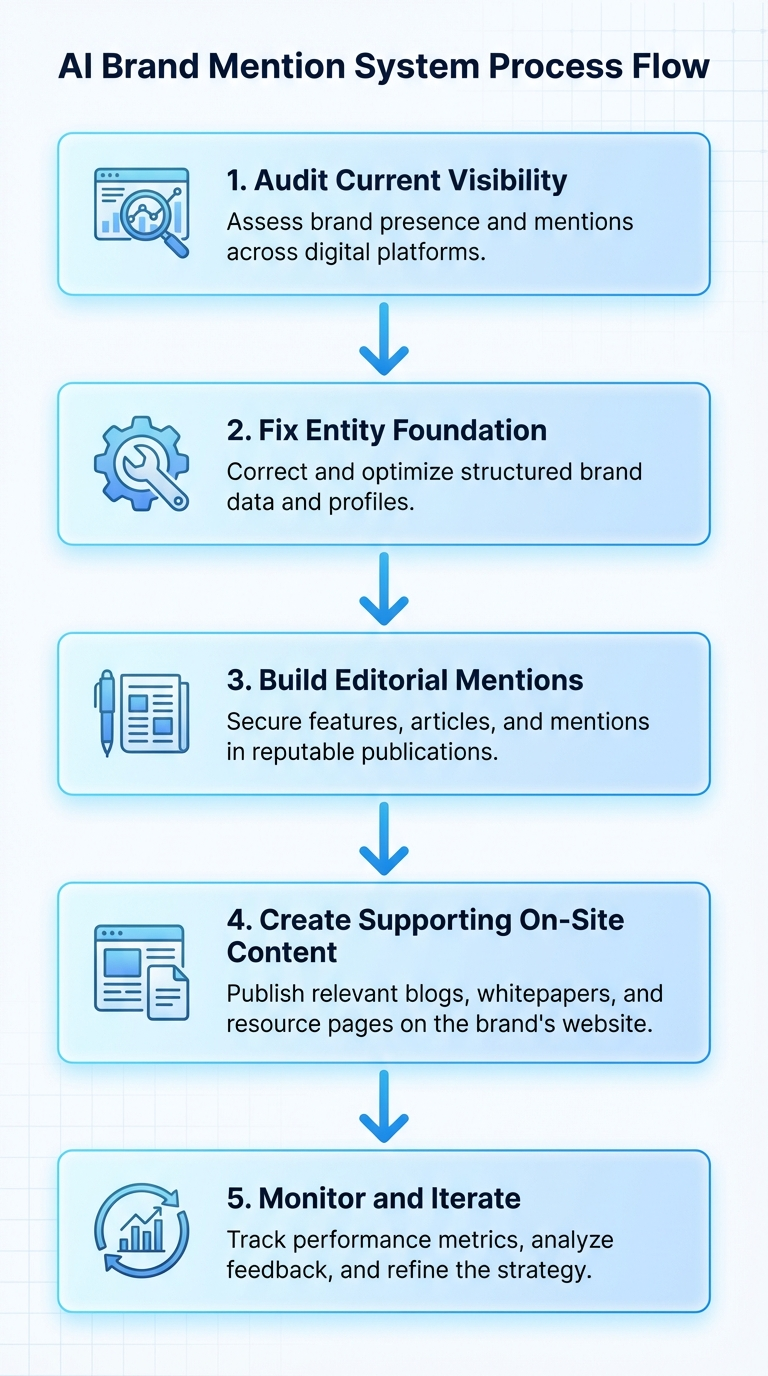
Here’s the sequence that works, whether you’re a growth-stage startup or an established B2B brand:
- Audit your current visibility. Run 25–50 high-intent prompts across ChatGPT, Perplexity, Gemini, and Google AI Overviews. Document where your brand appears, in what context, and who your competitors are in those answers.
- Fix your entity foundation. Standardize brand naming, update your About page, apply structured data, and ensure consistency across all web properties.
- Build editorial mentions on high-authority publications. This is the highest-leverage activity. Target the sites that AI retrieval systems already trust for your category. The AI brand mentions solution at BrandMentions is built around exactly this step.
- Create on-site content that supports AI referencing. Use-case pages, comparisons, FAQs, and original research give AI models the raw material to describe your brand accurately when they do include it.
- Monitor, validate, and iterate. Track share of answer, mention quality, and citation rate monthly. Re-run your prompt library after major content or placement campaigns. Adjust based on what the data shows.
This system compounds. Each editorial mention strengthens the signal for future AI retrieval. Each on-site content improvement makes AI responses more accurate when your brand is included. Over months, the cumulative effect creates a durable competitive advantage.
Frequently Asked Questions
How long does it take to start appearing in AI-generated answers?
Most brands see initial changes within 8–12 weeks of a focused editorial mention campaign, with meaningful compound effects emerging over 4–6 months. The timeline depends on your starting visibility, category competitiveness, and the authority of publications where mentions are placed.
Do AI brand mentions replace traditional SEO?
No. AI brand mentions complement traditional SEO — they don’t replace it. Many of the same signals that drive search rankings (backlinks, entity authority, content depth) also influence AI visibility. The most effective brands in 2026 invest in both traditional search performance and AI-specific visibility.
Can I control what AI says about my brand?
You can influence it, but not control it directly. AI systems synthesize information from across the web. By ensuring your brand is accurately and positively described on high-authority sources, you shape the input data that models draw from. Correcting outdated or inaccurate information on prominent third-party sites is one of the most effective interventions.
Which AI platform matters most for B2B brands?
In 2026, ChatGPT and Google AI Overviews generate the most volume for B2B research queries. Perplexity is growing rapidly among technical and research-oriented buyers. The right priority depends on where your specific audience conducts their research — which is why cross-platform tracking is essential.
Is there a difference between AI visibility for SaaS companies versus other B2B businesses?
The principles are the same, but SaaS brands often benefit from more frequent comparison and “alternatives to” queries in AI platforms. SaaS brand mention strategies typically emphasize product-level entity signals and competitive positioning content more heavily than broader B2B approaches.
Where AI Brand Mentions Are Heading
AI-generated answers are becoming the primary discovery channel for B2B buyers. According to a 2025 Gartner forecast, traditional search traffic will decline 25% by 2027 as AI-powered discovery channels absorb a growing share of research activity. That shift is already visible in 2026.
The brands that build strong AI mention profiles now are creating an advantage that will be difficult for competitors to replicate later. AI visibility compounds — each mention reinforces the next, each authoritative citation strengthens entity signals, and each consistent appearance across platforms deepens the association between your brand and your category.
The question isn’t whether AI brand mentions matter for your business. The question is whether you’re building them deliberately — or leaving them to chance.
See where your brand stands in AI search. Get your free AI visibility audit and find out what ChatGPT, Perplexity, and Gemini say about your brand — and your competitors.