
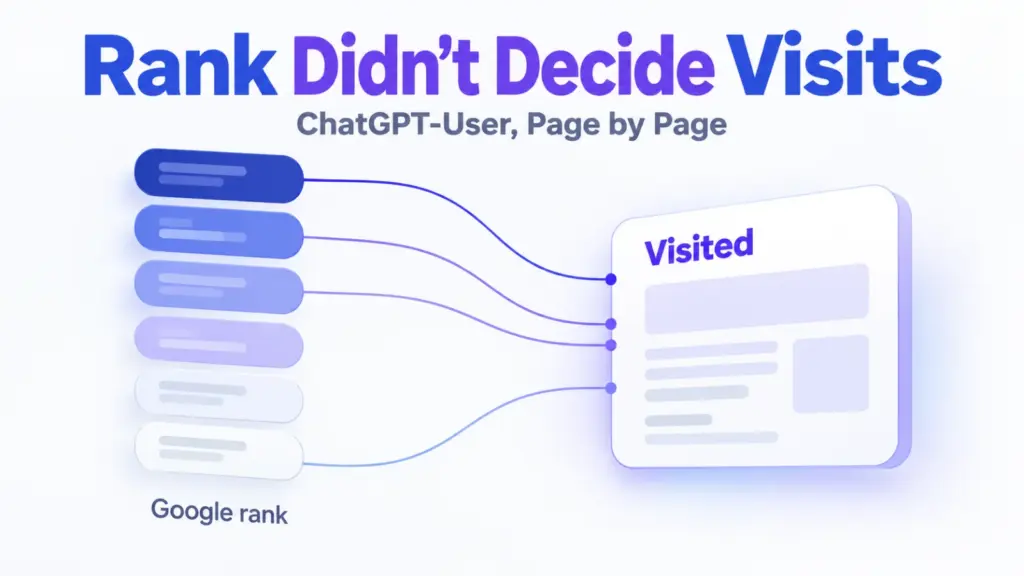

In 14 days, ChatGPT-User made 227 visits to our site, and pages in Google’s top 10 weren’t visited more often than pages ranked 11 to 40. Page demand predicted visits better than rank did.
ChatGPT-User is the name OpenAI’s fetcher gives itself when a person’s chat sends it to read a page. We matched its visits against Search Console, page by page.
Here’s how we counted, what it asked for, where rank stopped mattering, and what the numbers can’t tell you.
What We Measured
Fourteen full days, 22 September to 5 October 2026, from the web server’s access log, joined to 90 days of Search Console data.
- Visit: page fetches grouped, with a new visit after a 10-minute gap.
- Counted: successful fetches of pages, not scanner paths or errors.
- Rank: a page’s average Google position, weighted by impressions.
- Demand: a page’s Google impressions over the 90 days.
The user agent is the name a visitor’s software gives itself. It’s the only identity this log holds, so every count is a count of requests carrying the name.

What ChatGPT-User Asked For
The 270 page fetches grouped into 227 visits. Of those, 101 touched the homepage, on every one of the 14 days, and 88 asked for nothing else.
The other 164 visits went to 88 different pages out of 293 published. One page, our guide to Ahrefs brand mentions, took 19 of them across 9 days.
Three pages never matched a published URL, so we left them out. Dropping the most-visited page doesn’t change any result below.
Rank Didn’t Predict Visits
Pages in Google’s top 10 got about the same visits per page as pages ranked 11 to 40. The table divides each band’s visits by the number of pages in it.
| Google position | Pages | Visited | Visits per page |
|---|---|---|---|
| Top 10 | 38 | 17 | 0.82 |
| 11 to 20 | 48 | 17 | 0.90 |
| 21 to 40 | 68 | 27 | 0.75 |
| Beyond 40 | 64 | 18 | 0.41 |
| No impressions | 75 | 9 | 0.17 |
The gap between the top 10 and ranks 11 to 40 is a hundredth of a visit per page. Resampling the pages 5,000 times puts the difference between minus 0.52 and plus 0.53, so zero sits well inside it.
Visits only fall away past position 40, and for pages Google never showed at all.
Page Demand Predicted Them Better
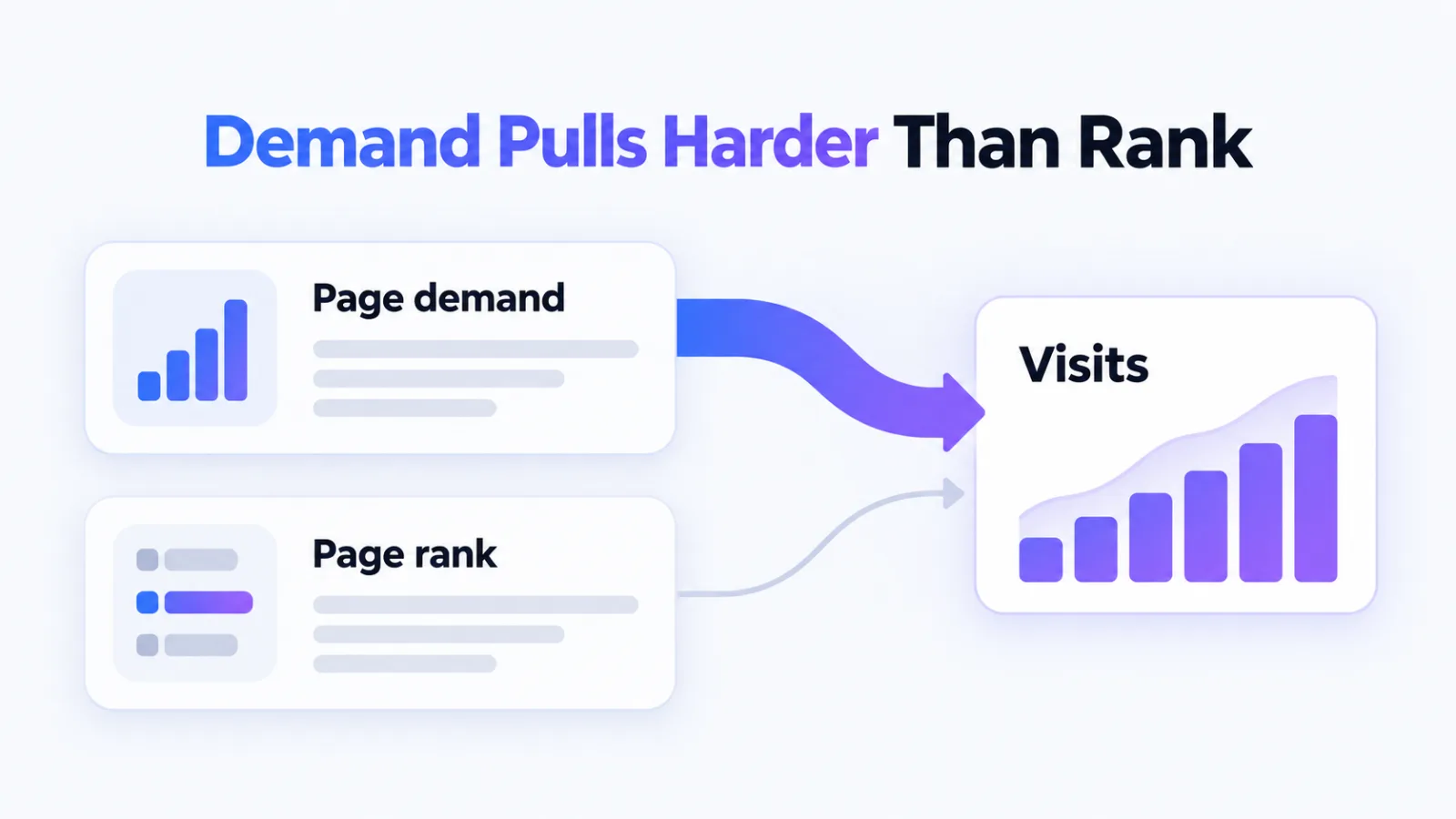
We split the pages that had impressions into three equal groups by the impressions they earned. Visits per page climbed with each group.
- Lowest third: 0.25 visits per page.
- Middle third: 0.63 visits per page.
- Highest third: 1.19 visits per page.
Inside the highest third, rank still didn’t sort the pages. Top-10 pages averaged 1.43 visits, ranks 11 to 20 averaged 1.76 and ranks 21 to 40 averaged 1.50. Only pages beyond position 40 fell, to 0.52.
A page earns Google impressions when people search for its topic. They may also be the topics people ask ChatGPT about, which would explain why the two move together.
Older pages were visited more
Pages under 90 days old drew 7 visits across 47 pages. Older pages drew 157 across 244.
We can’t separate age from demand here, because new pages also have fewer Google impressions. The data shows the pattern, not the cause.
Visits didn’t need a fresh crawl
OpenAI’s search crawler, OAI-SearchBot, fetched 26 of the 88 visited pages in the same 14 days. The other 62 were visited without a recent crawl in this window.
Claude-User and Perplexity-User
Claude-User made 48 clean page fetches on 28 pages, and 15 of those pages were also visited by ChatGPT-User.
Perplexity-User sent 96 requests in the window and none was a clean page fetch. Every one was a scanner path or an error, so the name told us nothing about real visits.
What the Numbers Don’t Prove
Four limits, and the first two matter most.
- Names can be copied: every logged address is Cloudflare’s, so we can’t verify the sender.
- A visit isn’t a citation: nothing here shows which pages ChatGPT quoted.
- Demand may not cause visits: a topic’s popularity can drive both.
- One site, 14 days: that’s a case study, not a survey.
The first limit matters because requests wearing AI-crawler names have included fake AI crawlers hunting for secrets. We removed scanner paths and failed requests before counting, and a name still proves nothing on its own.
What to Do With It
Don’t read a top-10 ranking as a promise that ChatGPT will fetch the page. On this site it didn’t raise the odds.
Check demand first. Pages on topics people search for were visited more, wherever they ranked.
For a wider view of which crawlers reach you, see server logs for AI search. To see who asks for your llms.txt file, read who reads llms.txt.
How to Check Your Own Log
You need the access log for a stretch of complete days and a Search Console export.
- Filter by name: keep ChatGPT-User, successful responses only.
- Drop scanner paths: remove .env, .git and similar requests.
- Group into visits: start a new visit after a 10-minute gap.
- Join to Search Console: match each URL to its impressions and position.
- Divide by pages: compare visits per page in each band, not total visits.
The last step is the one that matters. Our first count suggested mid-ranked pages were visited twice as often, until we divided by the number of pages in each band. To find which AI bots reach you at all, follow which AI bots reach your site.
Frequently Asked Questions
What is ChatGPT-User
ChatGPT-User is the user agent OpenAI’s fetcher sends when a person’s chat asks it to read a web page. It’s separate from the crawlers that build a search index.
Does ranking higher in Google get more ChatGPT-User visits
Not on our site. Top-10 pages averaged 0.82 visits per page and pages ranked 11 to 20 averaged 0.90, over 14 days.
What predicted ChatGPT-User visits
Page demand did better than rank. The third of pages with the most Google impressions averaged 1.19 visits per page, against 0.25 for the lowest third.
Is a ChatGPT-User visit the same as a citation
No. A visit shows a page was fetched, not that ChatGPT quoted it or linked to it in an answer.
How do I count ChatGPT-User visits in my log
You count them by filtering your access log for the ChatGPT-User name and successful responses, dropping scanner paths, and grouping requests into visits with a 10-minute gap. Divide by pages before you compare groups.
Divide by Pages Before You Trust the Pattern
On this site 227 ChatGPT-User visits tracked page demand and ignored the difference between a top-10 and a rank-30 page.
Run the count on your own last 14 days, divided by the number of pages in each band, before you decide what a ranking is worth.