
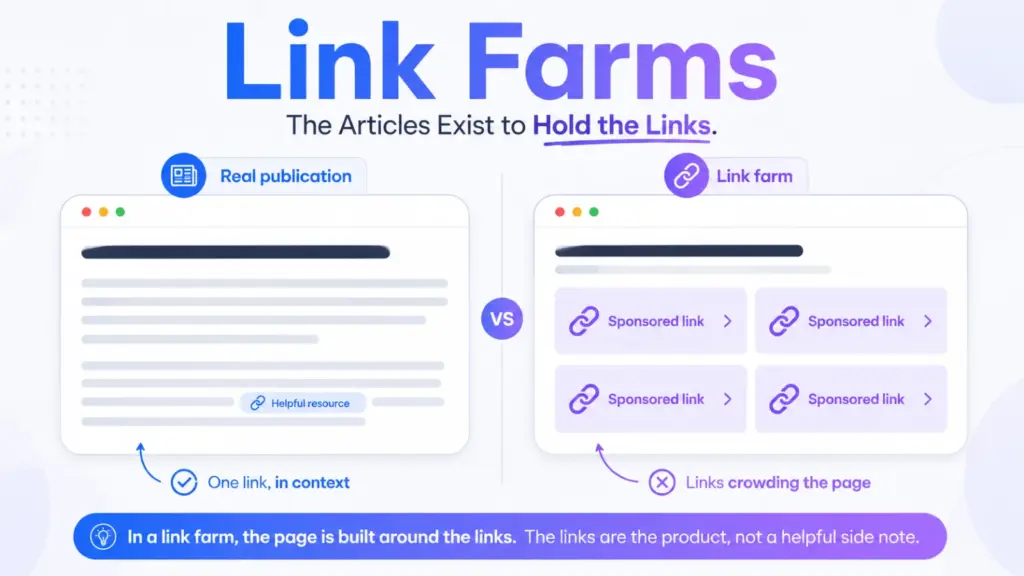

A link farm is a site that exists to sell links, dressed up as a publication. The articles are there to hold the links, not the other way round, and that inversion is what you’re looking for.
Link farms are cheapest to deal with at the point of purchase rather than afterwards. Once a placement is bought and live, your options narrow to asking for removal or writing it off.
So the useful skill isn’t cleanup. It’s reading a vendor’s site list well enough to decline the bad half before money moves.
What Separates a Link Farm From a Small Publisher
Legitimate sites are often small, ugly and thinly staffed. That isn’t the test, and treating it as one rules out placements worth having.
The test is whether the site would still exist if it could not sell links. A small trade blog with three readers and a real point of view passes. A site with forty categories and no reader passes nothing.
Signals that travel together
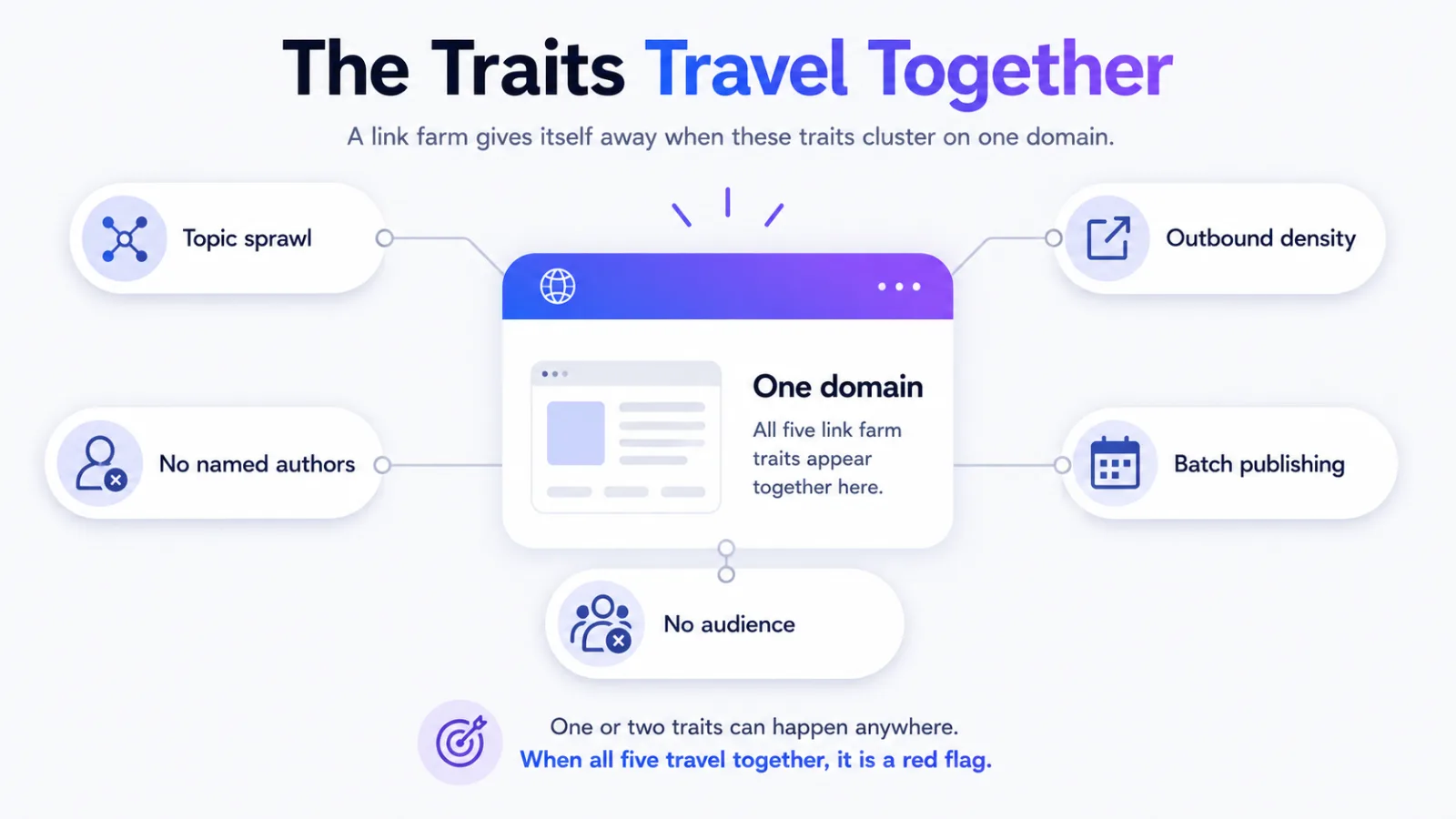
No single signal settles it. The pattern is what gives a link farm away, because these traits cluster on the same domains.
- Topic sprawl. Finance beside pet care beside casino beside dentistry, all on one domain, because the inventory follows whoever paid.
- Outbound density. Almost every article carries a commercial link to an unrelated business, often in the second paragraph.
- No named humans. Authors are stock names with no history, no other bylines and no way to contact them.
- Publication rhythm. Nothing for two months, then eleven posts in a day, which is a batch of orders being fulfilled.
- Audience absence. No comments, no shares, no newsletter, no traffic worth the word.
Two of those on their own prove nothing. Four together are a description of the business model.
How to Read a Vendor’s Site List
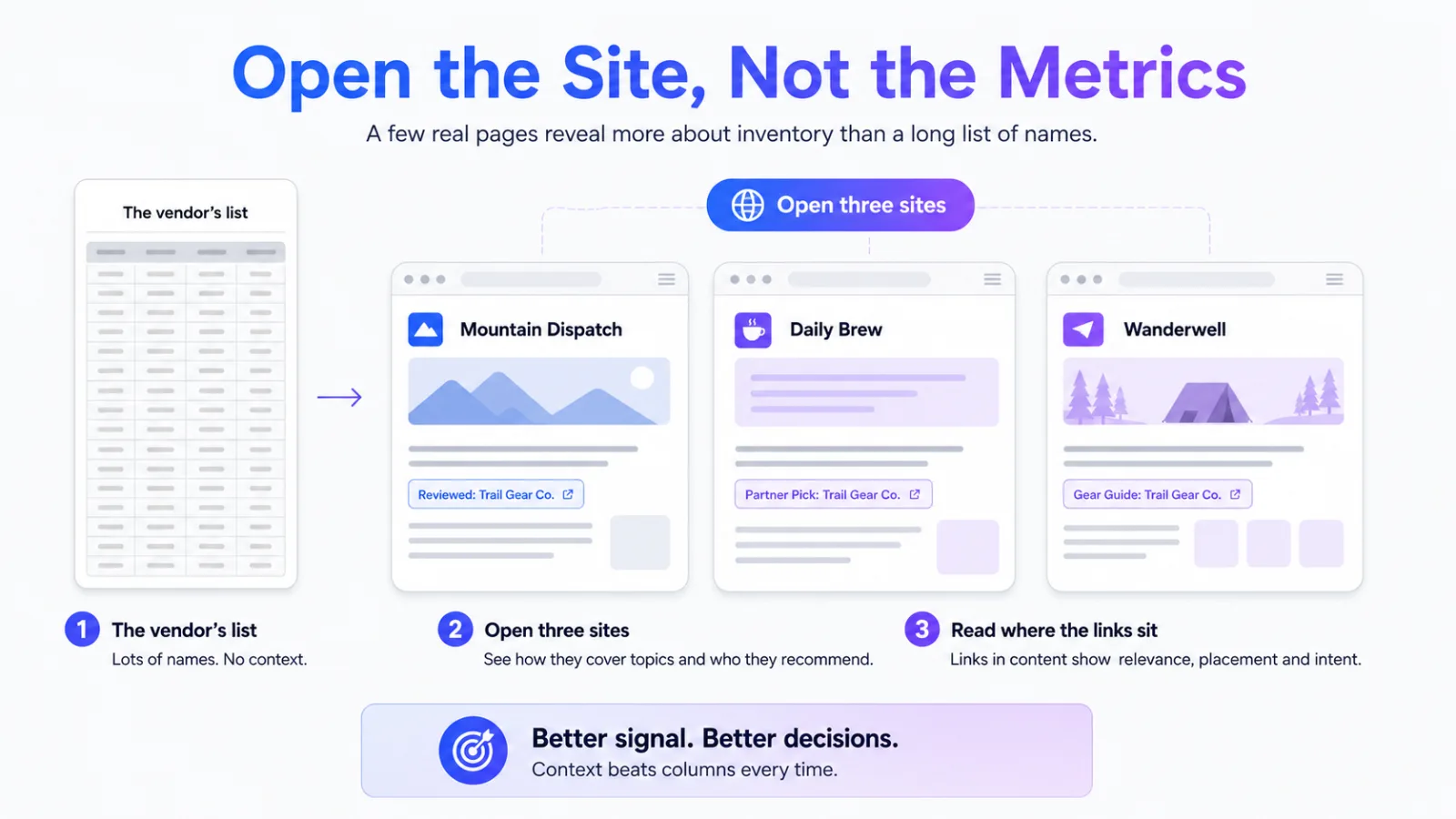
You get the answer faster by opening three sites properly than by scanning eighty in a spreadsheet.
Open the site, not the metrics
Pull up the homepage and the category menu before you look at a single authority number. The sprawl shows itself in the navigation, and it takes about ten seconds.
Read the most recent five articles
Look at where the links sit and who they point to. On a real publication the outbound links serve the reader’s question, and on a farm they arrive early and point somewhere commercial.
Search the site for your own vertical
If a supposed home and garden site has nine articles about offshore banking, the inventory is telling you what it sells. That check works on any domain in seconds.
Why Link Farms Are the Case That Does Carry Risk
They carry risk because you commissioned them. Google discounts most spam that merely happens to a site, and that leniency does not extend to a pattern the site owner paid to create.
That’s the distinction worth holding. Links you did not build are ordinarily ignored, and a scheme you funded is the category manual actions exist for.
The mechanics are set out in what is link building, which covers where paid schemes sit against editorial placement.
Questions That Get a Straight Answer
Vendors answer vague questions vaguely. These are specific enough that evasion is itself informative.
| Ask this | What a good answer sounds like |
|---|---|
| Can I see the exact target URLs before you place? | Yes, with the page addresses, not domains alone |
| Do you own or control any of these sites? | A direct no, or a direct yes with the list |
| How did you get the relationship with this publisher? | A story about a person, not a marketplace |
| What happens if the publisher removes the link? | A stated replacement policy with a window |
| Will this site publish anything for anyone? | A description of what they turn down |
The last one is the sharpest. A publisher that has never refused a pitch is not a publisher.
A vendor who cannot describe a rejection is describing a farm, whatever the pitch deck says. Blogger outreach service covers the same vetting from the buyer’s side.
The Cost That Is Not the Penalty
Most link farm spend never triggers anything. It simply buys nothing, which is the outcome people plan for least.
A placement on a site with no readers sends no referral traffic and puts your brand in front of nobody. It leaves you with no relationship you can use again, and the invoice matches a real placement.
The opportunity cost is the real bill. Ten cheap placements on farms cost what one earned placement on a read publication costs, and only one of those two is still working for you next year.
What a real placement leaves behind
An editor who published you once will read your next pitch. A page with actual readers keeps sending people long after the link stops being novel.
Neither of those shows up in a backlink count, which is why buying to a count is how budgets end up here in the first place.
What to Do With a Placement You Already Bought
Ask the publisher for removal first, because a removed link is cleaner than a disavowed one and costs you nothing but an email.
Where removal fails and the pattern is small, the usual right move is to leave it and stop buying from that source. One placement on a weak site is not the thing holding a domain back.
Where you inherited a large pattern from a previous agency, that’s a different conversation, and a link building consultant can size it before anyone touches a disavow file.
Frequently Asked Questions
Are link farms and PBNs the same thing
They overlap without matching. A private blog network is owned by one operator to serve their own sites, and a link farm sells to anyone. The signals you read on the page are close to identical.
Can one link farm placement hurt my site
One placement on its own is unlikely to. The risk sits in the pattern, so a single weak link matters far less than a habit of buying them.
How do I tell a link farm from a small niche blog
You ask whether the site would exist if it could not sell links. A small blog with a narrow topic and a real author passes that question, and a forty-category domain with anonymous bylines does not.
Do vendors know when they are selling link farm placements
The good ones do, which is why the specific questions work. A vendor who cannot name what a publisher turns down has not looked.
Should I disavow link farm links I bought
Try removal first. Disavow is worth reaching for where the pattern is large and you commissioned it, which is the narrow case that tool was built for.
Open Three Sites Before You Open the Spreadsheet
Every check here costs less than the placement does. The vendors worth keeping expect the questions, and the ones that flinch have answered you already.