
Most blogger outreach services sell you the same thing wrapped in different packaging. Manual outreach. Editorial placements. DA 50+ sites. Real traffic. The promises are identical, yet some agencies deliver genuinely useful links, some deliver mediocre ones, and some deliver links you’ll quietly ask Google to disavow in six months. This guide covers what real blogger outreach service work looks like, how to evaluate blogger outreach agencies, and where most providers fall short of their pitch.
A blogger outreach service is an agency that pitches your content or brand to independent blog owners to earn editorial placements and contextual backlinks on their sites. The good ones run real relationships with real publishers. The bad ones resell the same 200 sites everyone else is reselling. This guide shows you how to tell them apart before you sign a contract.
The short test for a real blogger outreach service is three questions:
- Can it show five live placements from the last 90 days?
- Does it name the publishers before you pay?
- Does it replace a link that’s removed?
A vendor that can’t answer yes to all three is likely reselling someone else’s inventory.
The sections below show you how to check each one.
What You’ll Learn
- The five signals that separate real blogger outreach from repackaged link networks
- Realistic 2026 pricing: what $100, $300, and $800 per link actually buys you
- How to vet a vendor’s sample placements in under 15 minutes
- The red flags most buyers miss until month three
- When blogger outreach is the wrong call, and what to do instead
What a Blogger Outreach Service Actually Does
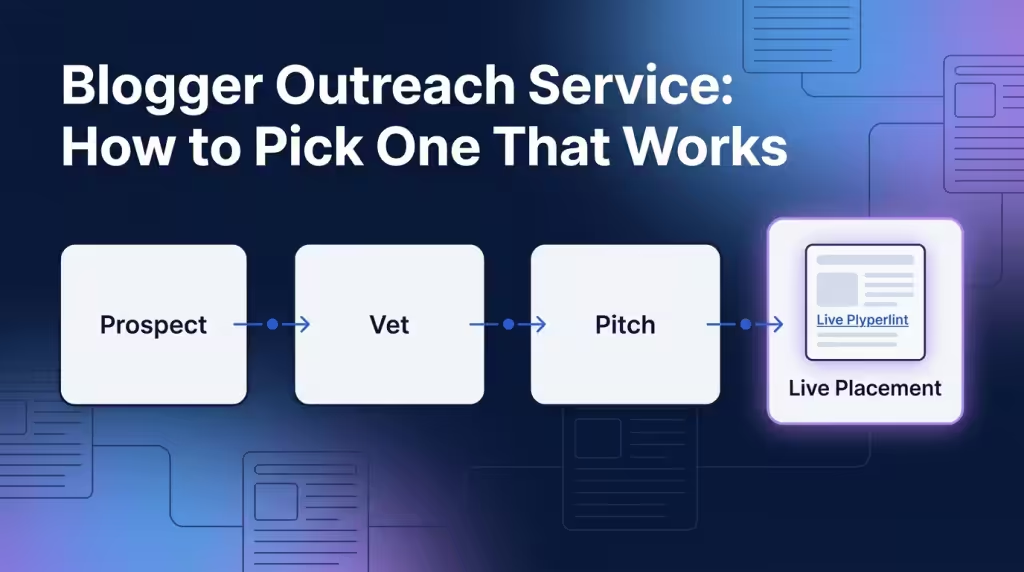
Strip away the marketing language and the work breaks into four parts: find relevant blogs, confirm they’re real, pitch a placement, and deliver the link inside a piece of editorial content. That’s it. Every pricing tier, every “premium package,” every “AI-powered” dashboard is built on top of those four steps.
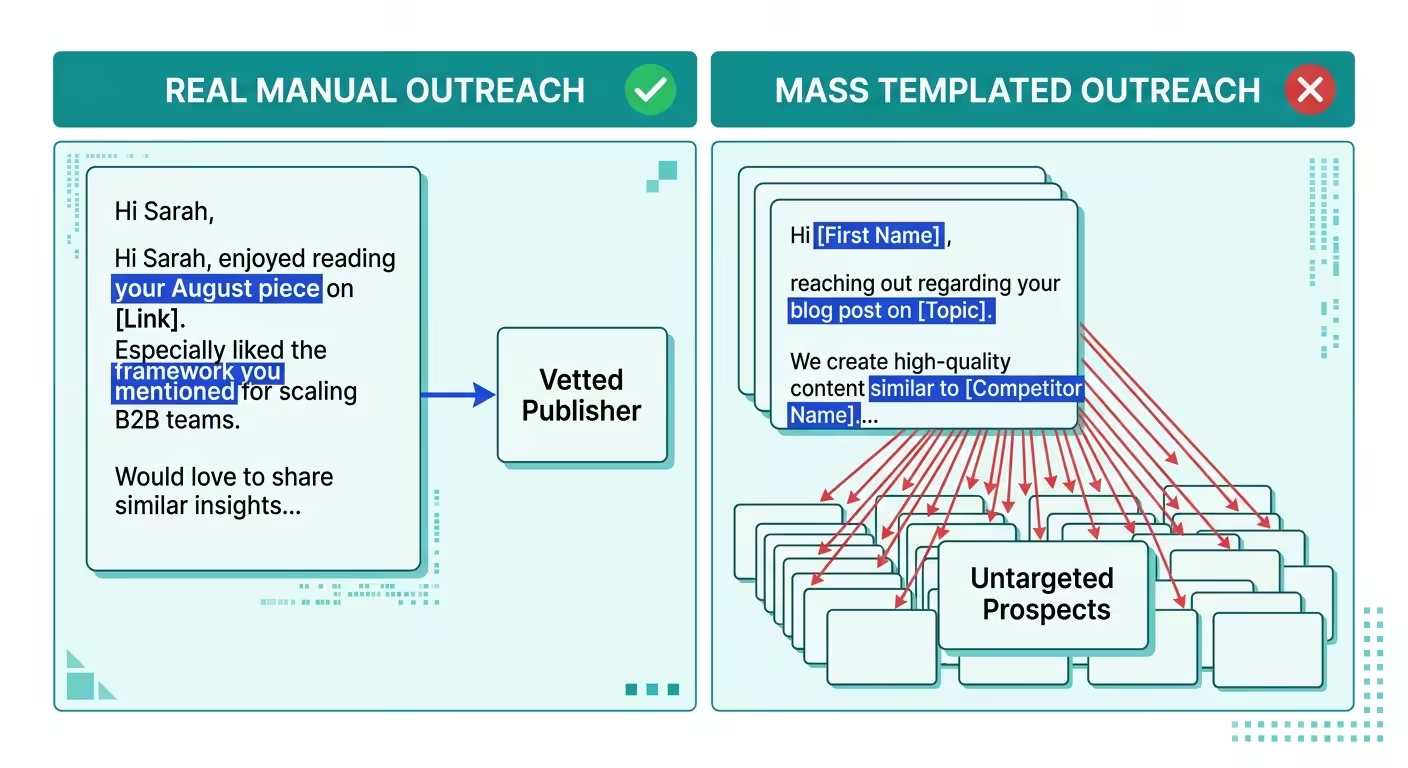
The difference between a $75 link and a $750 link isn’t the process, it’s the quality of the inputs. A cheap service runs the same outreach playbook against a pre-built list of accept-anything sites. A good one spends real hours qualifying publishers, matching topical relevance, and writing pitches a human editor actually responds to.
The Four Real Deliverables
Before you compare vendors, know what you’re actually buying:
1. Prospecting
The list of blogs the agency believes fit your niche, authority threshold, and audience.
2. Qualification
The check that each blog has organic traffic, a real editor, clean outbound link patterns, and relevance to your category.
3. Pitch and Negotiation
The email exchange that lands the placement, including topic approval and content guidelines.
4. Content and Placement
The article the link sits inside, either written by the agency, by you, or by the publisher’s contributors.
Some agencies bundle all four. Some sell prospecting only. Some hand you a “guest post” and skip the qualification entirely. Ask which parts are included before you compare prices. A $150 placement that includes content creation is a different product from a $150 placement that asks you to supply the article.
Why Most Blogger Outreach Services Disappoint
Across hundreds of client engagements we’ve audited before building their citation strategy, the pattern repeats: the buyer paid for “editorial links” and got something that looked editorial from a distance and fell apart on inspection. Three things usually went wrong.
The publisher list was recycled. The agency pitched the same 300 blogs to every client in the portfolio. You can spot this in the link graph, once you see your “editorial” placement sitting next to a dentist, a payday loan site, and a crypto affiliate in the same publisher’s outbound links, the illusion is over.
The content was thin. Editorial links require editorial content. Most cheap services pay a contractor $25 to write a 600-word filler post, drop your link in paragraph four, and call it editorial. Google’s systems got good at recognizing this pattern years ago. So did readers.
The traffic was fake. The agency sent you a screenshot showing 40,000 monthly visits. When you checked the same site in Ahrefs a month later, organic traffic was 600. Some publishers buy traffic to sell links. Others rank for branded queries that inflate numbers without bringing real readers.
You don’t need to become a link auditor to avoid this. You just need to vet sample placements before you sign anything.
How to Vet a Blogger Outreach Service in 15 Minutes
Ask for five sample placements the agency delivered in the last 90 days. Not case studies. Not testimonials. Five live URLs. Then run this check on each one.
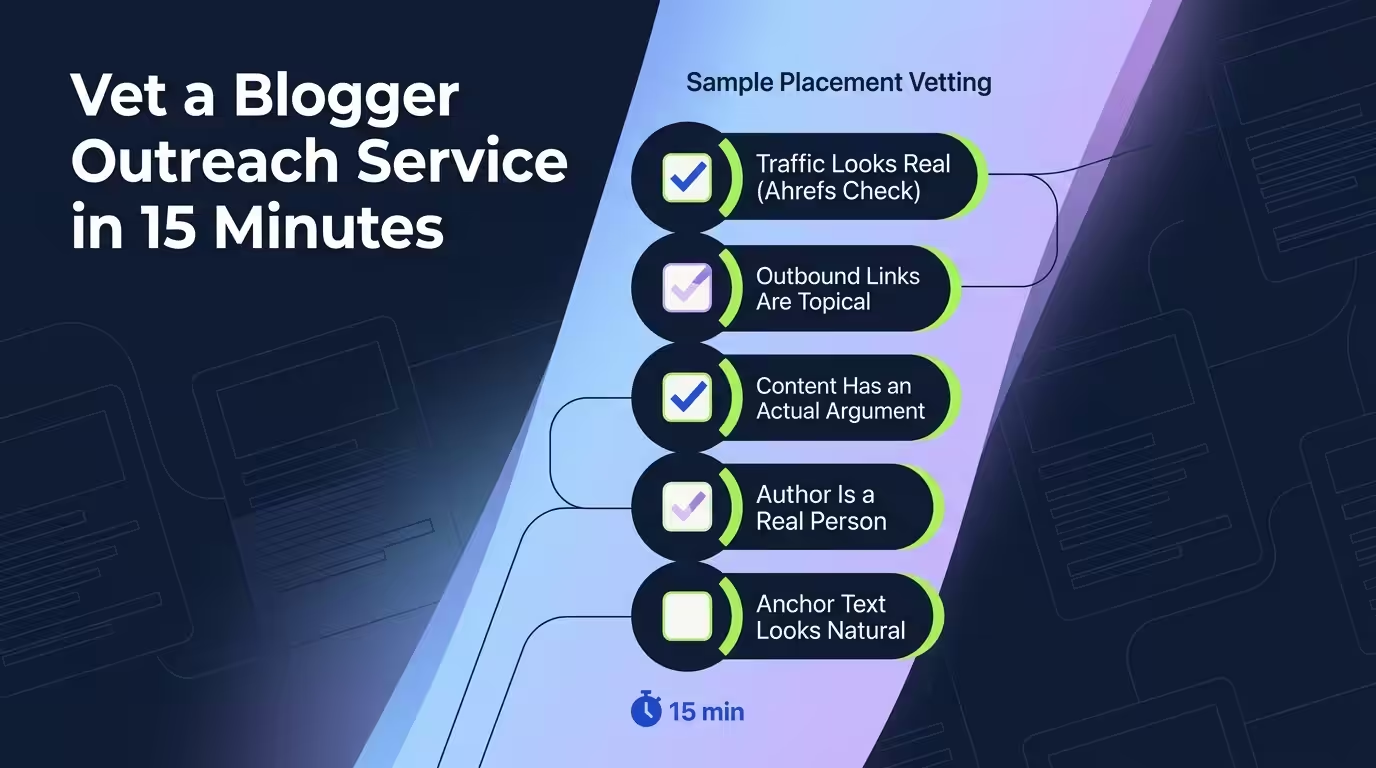
1. Does the Traffic Look Real?
Open the publisher’s domain in Ahrefs or Semrush. You want to see organic traffic from the last 90 days that matches the content type, a cooking blog ranking for recipe queries, a SaaS blog ranking for category terms. If the traffic graph is flat, vertical, or driven entirely by branded searches for obscure companies, something’s off.
As a rule of thumb, a healthy independent blog sits between 3,000 and 80,000 monthly organic visits. Much less and the site probably won’t move the needle. Much more and you’re likely looking at a content farm that accepts every placement for a fee.
2. Are the Outbound Links Topical?
Pull the publisher’s recent outbound external links in Ahrefs. Scan the anchor text. If a lifestyle blog is linking to a VPN service, a CBD brand, a SaaS tool, and a casino in the same month, it’s a link farm in a fresh coat of paint. Good editorial publishers have a topical gravity, their outbound links cluster around the same themes their content covers.
3. Does the Content Have an Actual Argument?
Read the article. Not skim, read. A real editorial piece has a point of view, a structure, and examples. A link insertion pretending to be editorial reads like it was written to hit 800 words around your keyword. Your link will look exactly like the link farm it sits inside. Google notices. So do AI models that cite sources.
4. Is the Author a Real Person?
Click the author byline. Real bloggers have a history, other posts, a LinkedIn profile, sometimes a Twitter account, sometimes a podcast. Fake author profiles have a stock photo, a generic bio, and ten articles published in the same week across unrelated topics. If three of the five sample placements have the same phantom author pattern, you’re looking at a PBN.
5. Does the Anchor Text Look Natural?
Anchor text should read like something a human writer would link. “This framework from Asana,” “a recent study from HubSpot,” or the brand name itself. If the anchor is an exact-match commercial keyword on every sample placement, you’re buying a footprint Google’s spam systems recognized years ago.
If you’d rather start from a shortlist, put the providers in our list of blogger outreach services through this same check.
Real 2026 Pricing, What Each Tier Actually Buys
Pricing for blogger outreach services ranges wildly because the product ranges wildly. Here’s what you can reasonably expect at each price point in 2026.
| Price per Link | What You’re Actually Buying | Typical Publisher |
|---|---|---|
| $50 to $150 | Templated outreach against a recycled publisher list. Thin content. Minimal qualification. | Accept-anyone sites, often with inflated traffic metrics. |
| $200 to $400 | Semi-manual outreach with basic qualification. Decent content. Mixed publisher quality. | Niche blogs with real but modest traffic, some content farms. |
| $500 to $900 | Manual outreach against vetted prospects. Editorial-quality content. Relationship-based placements. | Established niche blogs, industry publications, occasional mid-tier media. |
| $1,000+ | Digital PR crossover. Data pitches, expert commentary, journalist relationships. | Trade publications, top-tier industry media, occasional tier-one coverage. |
The $50 to $150 tier is where most buyers get burned. The math looks great, 20 links for $2,000, but half of them will be on sites that either don’t move rankings or actively hurt you. At the $500 to $900 tier, one good link usually outperforms ten cheap ones, but only if the vendor is honestly manual. Some sellers price at this tier and deliver the sub-$200 product. That’s why vetting sample placements matters more than comparing rate cards.
Questions That Separate Real Agencies From Repackagers
Send these questions to any vendor before you sign. The ones who answer clearly and specifically are worth your time. The ones who dodge or recite marketing copy aren’t.
1. What’s Your Publisher Qualification Process
You want a real answer, traffic thresholds, relevance checks, outbound link review, editor verification. “We vet every site” isn’t an answer.
2. Can You Show Me Five Placements From the Last 90 Days in My Niche
If they only show placements from two years ago, the current product has changed.
3. How Many Clients Do You Place on Each Publisher per Year
Good agencies cap this to protect the site’s link profile. Bad ones stuff every client onto the same 50 blogs.
4. Who Writes the Content
In-house editors, freelance network, or offshore content mill? Price signals this, but ask directly.
5. What’s Your Refund Policy If a Link Is Removed Within 90 Days
Links disappear. Real agencies have a replacement policy. Fly-by-night sellers don’t.
6. Do You Disclose the Publisher List Upfront or After the Placement
Upfront disclosure is a good sign. Post-placement reveals protect recycled inventory.
7. What Anchor Text Distribution Do You Recommend for My Site
A real answer references your current backlink profile. A bad one says “whatever you want.”
When Blogger Outreach Is the Wrong Call
Not every brand needs a blogger outreach service. Three situations where you should skip it or delay it.
Your content isn’t ready. Links point to pages. If your key pages are thin, unstructured, or don’t serve the searcher, new links won’t fix that. You’ll spend $5,000 on placements pointing to a page that still doesn’t rank because the page itself is the problem. Fix on-page first.
You’re in a niche with no real blogs. Some B2B categories, industrial equipment, niche compliance software, regional trade services, don’t have independent bloggers worth pitching. The publishers that exist are either corporate content hubs or paid placement networks. In these cases, digital PR, trade media, and expert commentary beat blogger outreach every time.
You need results in under 60 days. Blogger outreach compounds slowly. Even a well-run campaign usually takes 30 to 90 days to produce its first placements and 4 to 6 months before the link velocity affects rankings. If you need pipeline next quarter, paid search, partnerships, and owned-channel content will move faster.
How to Brief a Blogger Outreach Service Well
The best agencies still struggle with bad briefs. If you want your outreach campaign to land placements you’d actually brag about, send the vendor these inputs before the engagement starts.
Target Pages
The specific URLs you want to build authority to, ideally 3-5 priority pages, not a homepage dump.
Anchor Text Guidance
A mix: 40% branded, 30% natural/generic (“this guide,” “their framework”), 20% partial-match, 10% exact-match. Adjust based on your existing profile.
Publisher Exclusion List
Sites you’ve already placed on, competitors, or publications you don’t want associated with your brand.
Topical Angles
Three to five content angles that connect your target pages to topics publishers in your niche actually cover.
Brand Do’s and Don’ts
How you talk about yourself, what claims you avoid, what competitors you don’t mention by name.
A vendor that pushes back on a thin brief and asks for these inputs is a vendor that cares about the output. One that says “just send us a URL and we’ll handle it” is a vendor that’s about to deliver a generic placement.
See where AI answers put your brand
Twenty minutes with a senior strategist: where the major engines point buyers in your category, who gets named instead of you, and a straight read on what a programme would change.
Book a strategy callRed Flags to Walk Away From
A pattern we see almost every time a client comes to us after a disappointing engagement: the warning signs were there in the sales call. They were just easy to ignore when the price looked good.
Walk away if the vendor:
- Guarantees a specific Domain Rating or Domain Authority without explaining how, DR is a moving target and real editorial placements don’t come with DR guarantees
- Won’t show you sample placements from the last 90 days in your vertical
- Offers “permanent links” with no replacement policy, real publishers occasionally remove posts; vendors who pretend otherwise are selling PBN links
- Pitches placement on sites with outbound links to casinos, loans, adult content, or CBD (unless that’s your category)
- Has no written policy on how many clients they place per publisher
- Uses only Trustpilot reviews as social proof and has zero case studies with named clients
- Quotes you a turnaround of under two weeks for “editorial” placements, real editorial calendars don’t move that fast
How to Measure Whether the Service Is Actually Working
Most buyers measure blogger outreach by link count. That’s the wrong metric. Link count tells you what you paid for, not what you got. Here’s what to track instead.
| Metric | What It Tells You | Healthy Benchmark |
|---|---|---|
| Referring domain growth on target pages | Whether the links are pointing where you asked | 70%+ of new links hit target URLs |
| Organic traffic to target pages (90-day lag) | Whether the links are moving rankings | Measurable lift in 90-180 days |
| Average Ahrefs DR of placement sites | Publisher quality tier | DR 30+ for most B2B; DR 50+ for competitive niches |
| Placement retention at 90 days | Whether the links are sticky | 90%+ still live |
| Referral traffic from placements | Whether real readers exist on the publisher | Some referral traffic within 30 days |
If a vendor delivers 20 links in a quarter and your referring domain growth on target pages is flat, the links aren’t reaching the pages you care about. If organic traffic doesn’t move at all within six months, the placement quality isn’t there. Don’t let a dashboard full of DR 40+ badges distract you from the two numbers that matter: traffic and rankings on the pages you actually want to grow.
Marketplace or Managed Outreach?
A blogger outreach marketplace lists inventory and lets you pick placements yourself, faster and cheaper per link, with the vetting burden on you. A managed service runs prospecting, pitching, and quality control for you. Marketplaces suit experienced buyers who can read a site’s real traffic; managed delivery suits teams buying outcomes rather than placements.
Frequently Asked Questions
How much should I pay per link from a blogger outreach service in 2026?
Expect to pay $300 to $700 per link for genuinely manual outreach to vetted niche blogs. Anything under $150 usually means templated outreach to recycled publisher lists. Anything over $1,000 typically signals digital PR crossover, journalist pitches, data-led campaigns, or tier-one media placements.
How long does a blogger outreach campaign take to show results?
First placements usually land within 30 to 90 days. Ranking impact on target pages typically shows up between months 4 and 6, assuming the links point to the right URLs and the on-page content is strong. If you’re still seeing no movement after six months of consistent placement, either the publisher quality is too low or the target pages themselves need work before more links will help.
Is blogger outreach safe for SEO in 2026?
Genuine editorial outreach to real publishers is safe, but any link you pay for needs a sponsored or nofollow attribute under Google’s policy, however good the publisher. Paid placements on link networks, sites that sell to anyone, or publishers with no real audience aren’t safe: they’ve been a Google penalty risk since 2012. The risk lives in the vendor quality, not the tactic.
What’s the difference between blogger outreach and guest posting?
Guest posting is a specific tactic, writing and placing a full article on another site. Blogger outreach is the broader category that includes guest posts, link insertions into existing content, expert quotes, product reviews, and other editorial placements. Most modern blogger outreach services offer a mix, though the dominant deliverable is usually still guest posts.
Should I hire a blogger outreach service or build outreach in-house?
In-house outreach works well if you have a dedicated marketer with 20+ hours a week to invest, existing publisher relationships, and patience to build the system over 6-12 months. An agency makes sense if you need scale, don’t have those hours to spare, or want access to relationships that take years to build. The worst outcome is half-hearted in-house outreach that produces nothing, hire the agency or commit real internal resources.
How do I know if a blogger outreach service is using PBNs?
Check three signals on sample placements: authors with no LinkedIn or publishing history elsewhere, outbound link patterns that jump across unrelated commercial niches in the same month, and near-identical site templates across multiple “different” publishers. If two of those three show up, you’re looking at a private blog network wearing an editorial costume.
The Real Test
The best blogger outreach engagement you’ll ever run won’t feel like buying links. It’ll feel like paying someone to do the relationship work you’d do yourself if you had another 30 hours a week. Pitches that sound like you wrote them. Placements on blogs you already read. Content that gets shared because it’s actually good.
If that’s not what the vendor is describing on the sales call, keep looking. The tactic still works in 2026, the market is just full of agencies selling the costume instead of the craft.
Want to see how editorial authority compounds beyond blogger outreach? Read our guide to editorial link building or explore how contextual link building services fit into a full authority strategy.