
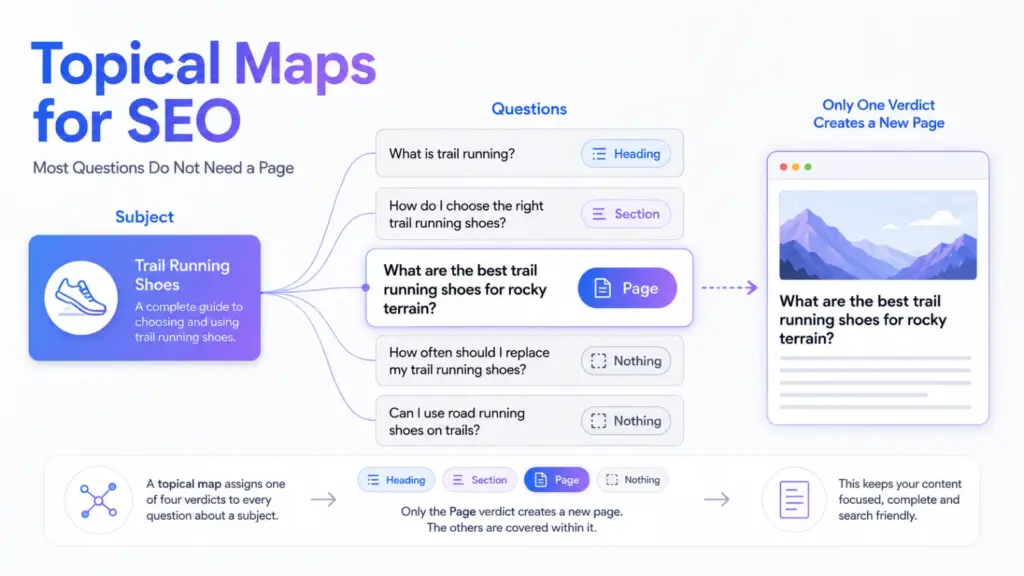

A topical map is most useful as a stop list. It tells you which pages a subject genuinely needs, so it’s also telling you which ones it doesn’t.
Topical maps for SEO are usually sold the other way round, as a spreadsheet of forty titles with an implied instruction to write them all.
The version worth building answers a narrower question: what does this subject require, and what is already answered somewhere you own?
What a Topical Map Is
A topical map is a picture of one subject broken into the questions a reader asks, with a decision attached to each one. The decision is the part that gets skipped.
Without it you’ve got a keyword list in a nicer layout. Every node on a useful map carries one of four verdicts: it needs a page, a heading, a section, or nothing.
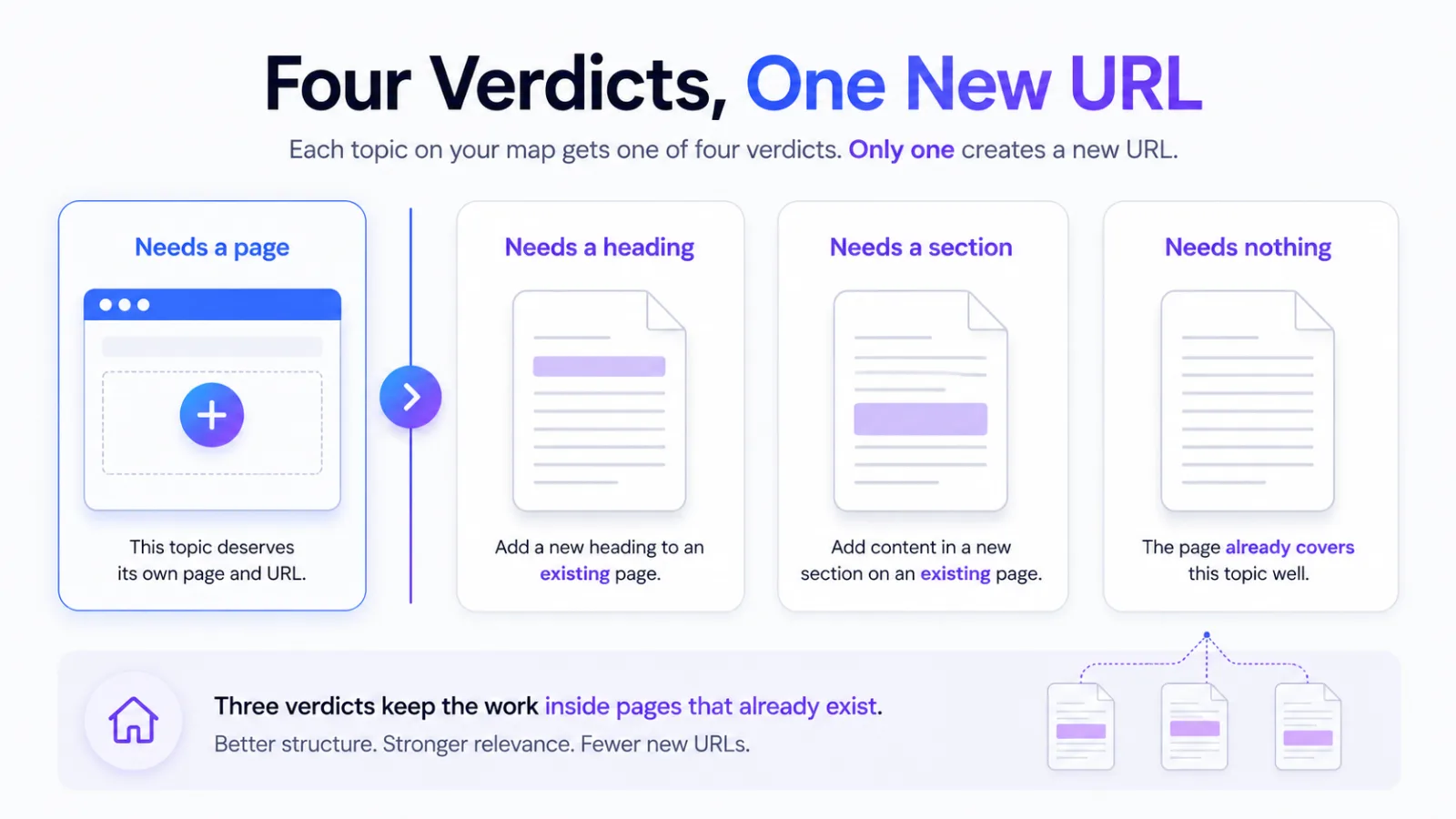
Three of those four verdicts do not produce a new URL. That ratio is the whole point, and it’s why an honest map shrinks a content plan rather than growing it.
How to Build One Without It Turning Into a Backlog
You start from the subject rather than the keyword tool, because a tool hands you every phrase and none of the structure. That’s the wrong end.
Write the questions before the keywords
List what somebody deciding about this subject needs settled, in plain language, in the order they’d hit it. That order is the map’s spine, and it rarely matches search volume.
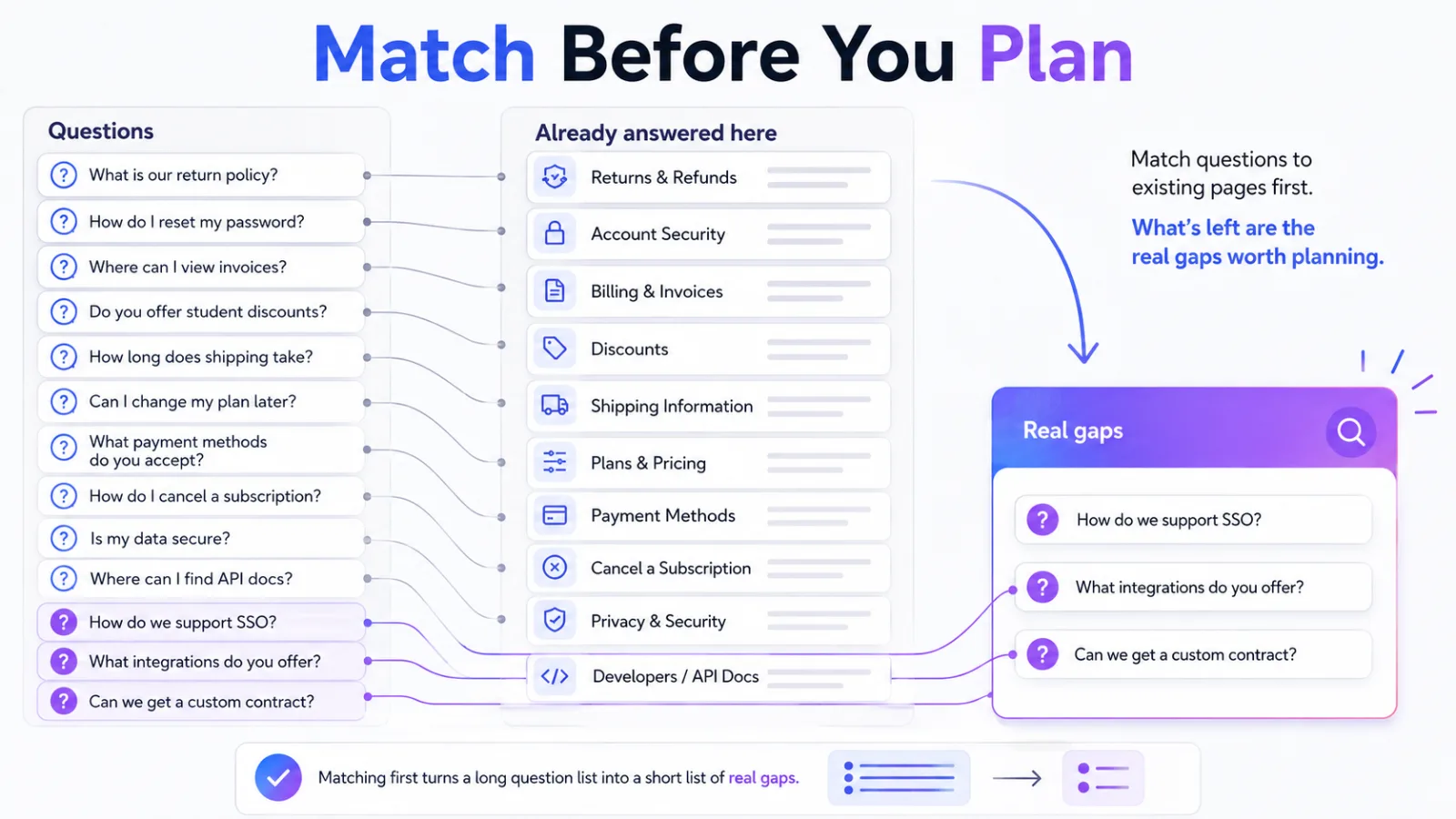
Attach an existing URL to every question you can
Go through the questions and name the page that already answers each one. Most subjects arrive with more coverage than anyone remembers, scattered across pages written for other reasons.
Give each remaining question a verdict
Only now decide what the gaps need. A question with its own demand and its own answer shape needs a page.
A question that’s a wrinkle on an existing answer needs a heading on that page, and nothing more.
Where the Boundary Sits
You’ll find the hard calls at the edges, and four tests settle most of them.
| Test | Needs its own page | Belongs on an existing page |
|---|---|---|
| Intent | Someone searching this wants a different outcome | Same outcome, narrower wording |
| Answer shape | The answer is a procedure or a comparison of its own | The answer is a paragraph |
| Overlap | Under a third of the answer already exists elsewhere | Most of it is already written |
| Linking | You can say what would link to it and why | Nothing would link to it but the map |
The last row catches more bad pages than the other three combined. A page nothing would ever link to is a page nobody asked for.
Same subject, different intent
Two questions can share every keyword and still need separate pages, because the reader wants a different thing from each. Merging on subject alone is how sites end up with pages that compete against each other, and that isn’t a ranking problem you can nudge.
The reverse trap is worse. Splitting one intent across four near-identical pages divides the signals that would have made one page rank.
Why Maps Drift Into Backlogs
It happens because a map with forty nodes looks like more work delivered than a map with six. The artefact rewards volume even when the strategy does not.
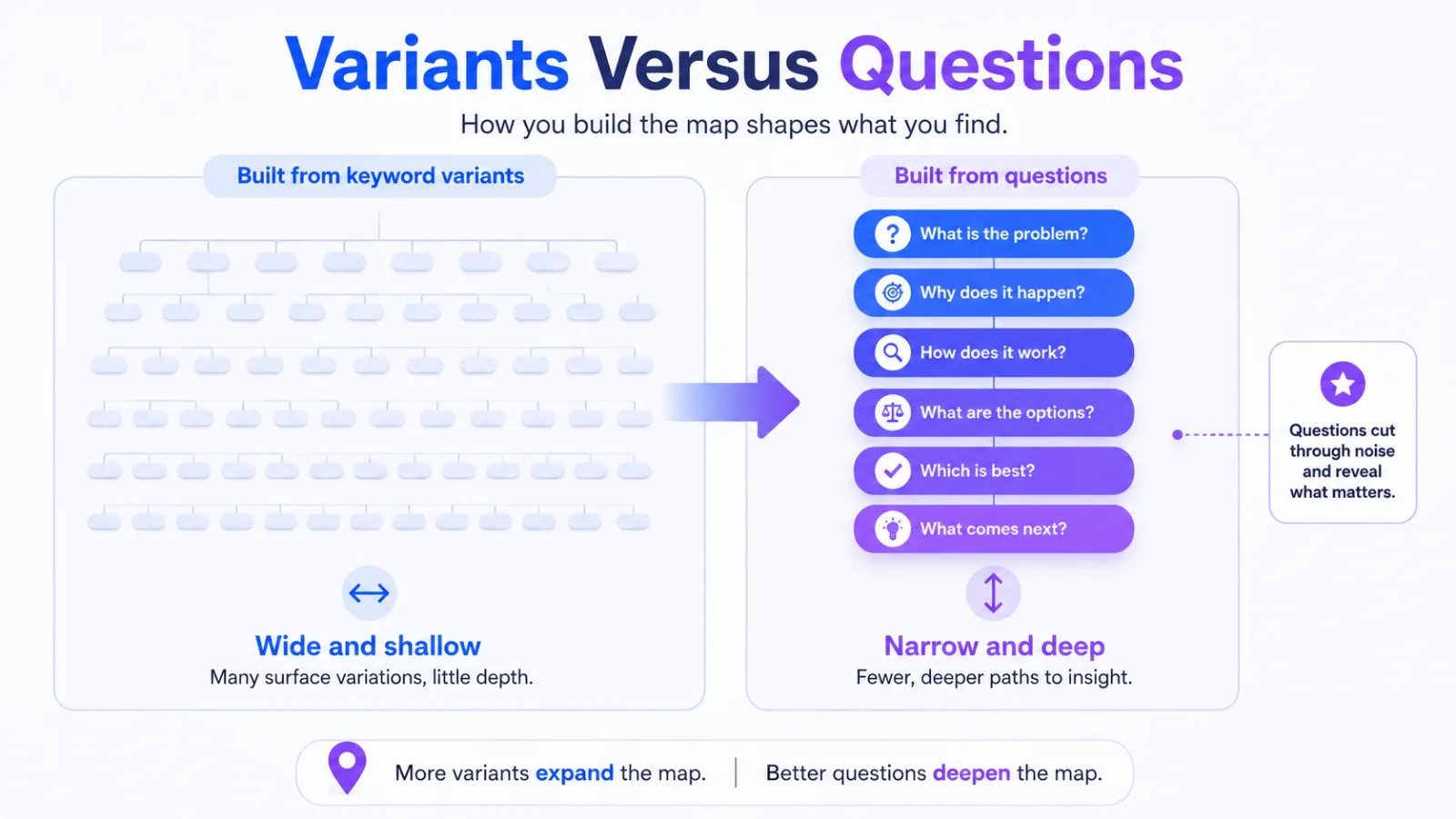
Two habits cause most of it. Nodes get created from keyword variants rather than distinct questions, and no node is ever assigned the verdict of nothing.
A map where every node became a page was not a map. It was a content calendar with a diagram attached.
What the Map Is For After It Exists
The finished map earns its keep as a filter for incoming requests. When somebody proposes a post, the map says whether the subject has a home already.
That’s a faster conversation than opinion, because you’re pointing at a decision rather than arguing about one.
It also tells you where internal links belong, because the structure you drew is the structure a reader moves through. That connection is set out in entity SEO, which covers how clustering reinforces the relationships a search engine reads.
And it shows which pages carry the weight, which is where earned links do the most good. Pointing authority at a hub beats spreading it across leaves, and contextual link building is one route to putting it there.
The Questions a Map Cannot Settle
A map decides what deserves to exist. It doesn’t promise any of it will rank.
Demand and competition sit outside the document entirely, so a node marked as needing a page can still land against three better resources. The map got the structure right and the market decided the rest.
It also says nothing about whether the page is any good. A correct verdict badly executed is still a weak page, and no amount of structure rescues it.
Treat it as a record, not a forecast
What a map gives you is a written reason for each decision, which is worth more six months later than the decision itself. When a page underperforms you can see what it was for.
That’s also how you avoid rebuilding the same argument every quarter, because the reasoning is on the page rather than in somebody’s memory.
Frequently Asked Questions
How large should a topical map be
You cannot know before you build it, and a map that names a target number in advance has decided the answer before doing the work. Most subjects need fewer pages than the first draft suggests.
Is a topical map the same as a content cluster
They overlap. A cluster is a published structure of pages that link to a hub, and a map is the decision document that determines whether those pages should exist. The map comes first.
Do I need a keyword tool to build one
Not to start. The questions come from knowing the subject and the buyer, and a tool is useful afterwards for checking which questions have demand attached.
What do I do with a question nothing on my site answers
Give it a verdict rather than a slot in a calendar. It needs a page only when the intent and the answer shape are genuinely its own, and a heading otherwise.
How often should a topical map be revisited
When the subject moves or the site does. Rebuilding it on a schedule turns a decision tool back into a backlog.
Build the Map to Say No
A map that only ever adds is measuring your ambition rather than the subject. The one worth keeping is the one you can point at when somebody asks why a page does not exist.