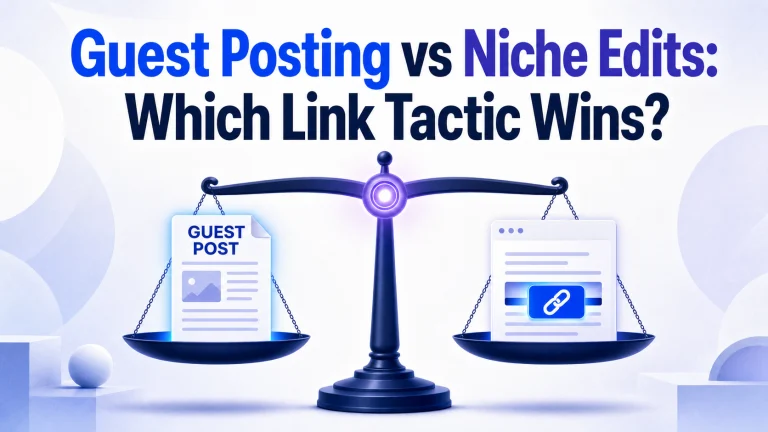

If you are choosing between performance based and fixed fee link building, you are really choosing between lower payment risk and greater execution control. Neither model wins universally: performance-based pricing reduces your upfront risk, while fixed-fee pricing usually buys better predictability, quality control, and strategic flexibility. This is a pricing-model decision, not a tactics debate, so the right answer depends on your budget, your tolerance for variance, and how tightly you can define what a “result” actually means. Get the definitions right first, and the comparison gets much easier.
What Performance Based vs Fixed Fee Link Building Means
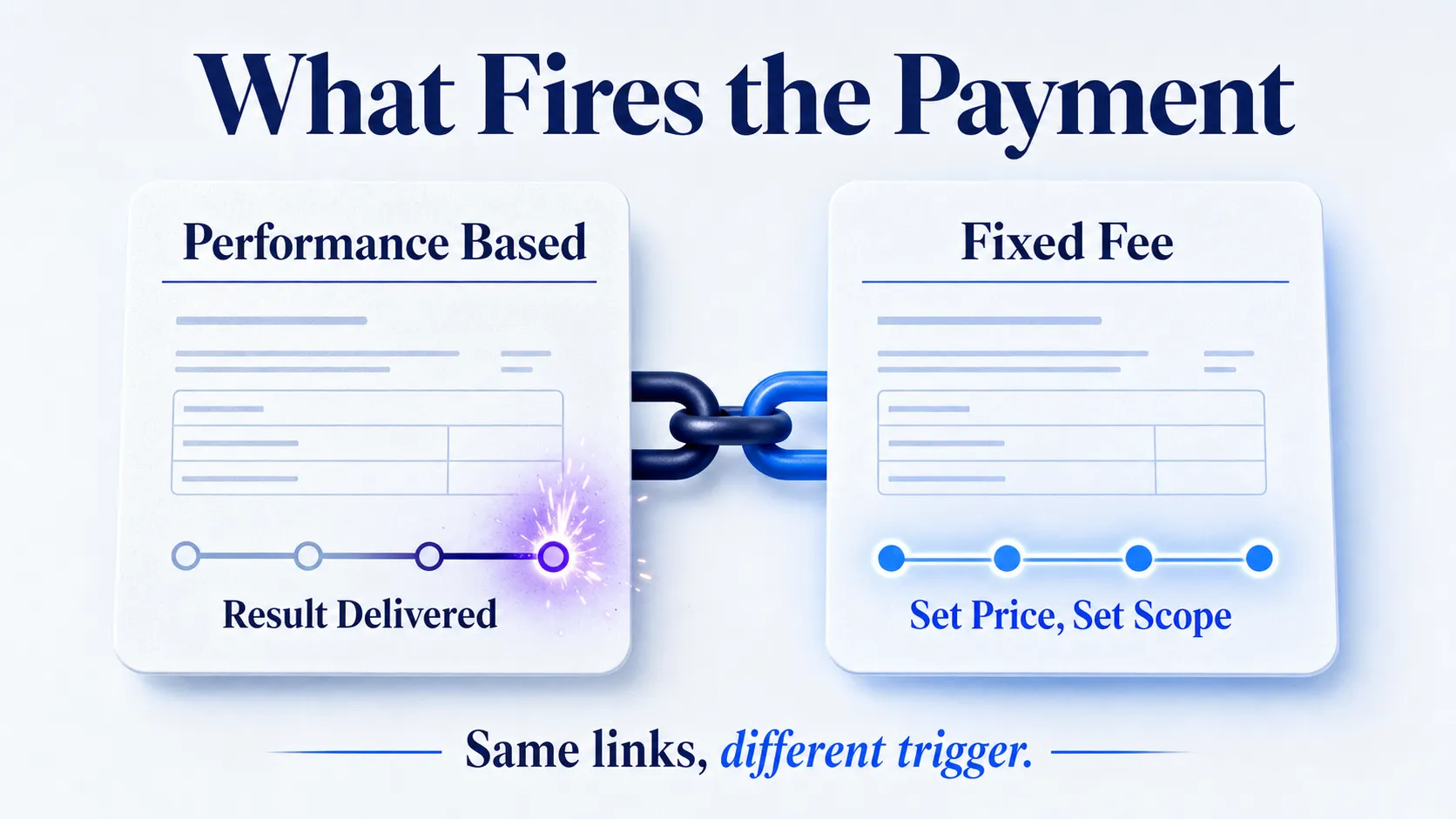
Performance-based link building charges you only when a pre-agreed result is delivered, while fixed-fee link building charges a set price regardless of whether any single outcome threshold is hit. That one difference in the billing trigger drives everything else: who absorbs the downside, how you forecast spend, and how the provider behaves week to week.
Performance-based pricing, sometimes called pay-on-results or outcome-based pricing, ties your payment to a specific delivered thing. The catch sits in the word “result.” A result has to be defined in the contract before work starts, because a vague definition is where disputes live. Most agencies frame the result as a live, indexed placement on a site that meets agreed criteria.
Fixed-fee pricing, also called flat-fee or set-fee billing, charges a predetermined amount for a scope of work. You pay for the campaign process and the strategic effort, not a guaranteed count of accepted links. That sounds riskier on paper, and in one narrow sense it is, but it also frees the provider to chase quality instead of chasing acceptance.
One point matters before you go further: pricing model and link quality are not the same thing. Neither model guarantees white-hat execution. You can buy spammy links on a flat fee, and you can buy safe editorial placements on a performance deal. The billing structure shapes incentives, but it never replaces vetting.
Buyers compare these two because they want one of four things: budget protection, clearer accountability, easier forecasting, or tighter control over placement standards. In buyer conversations, the real issue is usually whether they are paying for delivered links, a campaign process, or a strategic outcome. Those are three different purchases wearing similar labels.
Watch the vocabulary too. A monthly retainer is a fixed-fee arrangement, but so is a per-link flat fee, and the two behave differently. Hybrid pricing sits between the pure models, a base fee plus outcome incentives. If you want the retainer-versus-one-off angle specifically, the retainer versus project pricing breakdown covers that structure in depth.
Evaluation Criteria Buyers Should Use to Compare Them
Before you judge price alone, judge both models against the same scorecard. Buyers who skip a scorecard usually compare proposals that are priced differently but structured very differently, then pick the cheaper headline number and inherit the worse deal.
Here is the set of criteria worth scoring, and what each one really asks.
| Criterion | What it measures | Why it matters |
|---|---|---|
| Cost predictability | How easily you forecast monthly and total spend | Finance and planning depend on stable numbers |
| Risk distribution | Who absorbs the downside if results are slow | Decides whose money is on the line |
| Accountability | How clearly the provider is held to deliverables and reporting | Loose terms invite disputes later |
| Link quality | Relevance, traffic, editorial context, durability | Low-quality links carry long-term risk |
| Speed to launch | How fast the campaign can start producing | Definition-heavy deals launch slower |
| Scalability | How easily you grow volume without renegotiating | Growth plans need headroom |
| Placement control | Guardrails on site type, topic, language, geography | Brand safety and relevance depend on it |
| Business-stage fit | Suitability for startup, SMB, enterprise, regulated | The right model shifts by maturity |
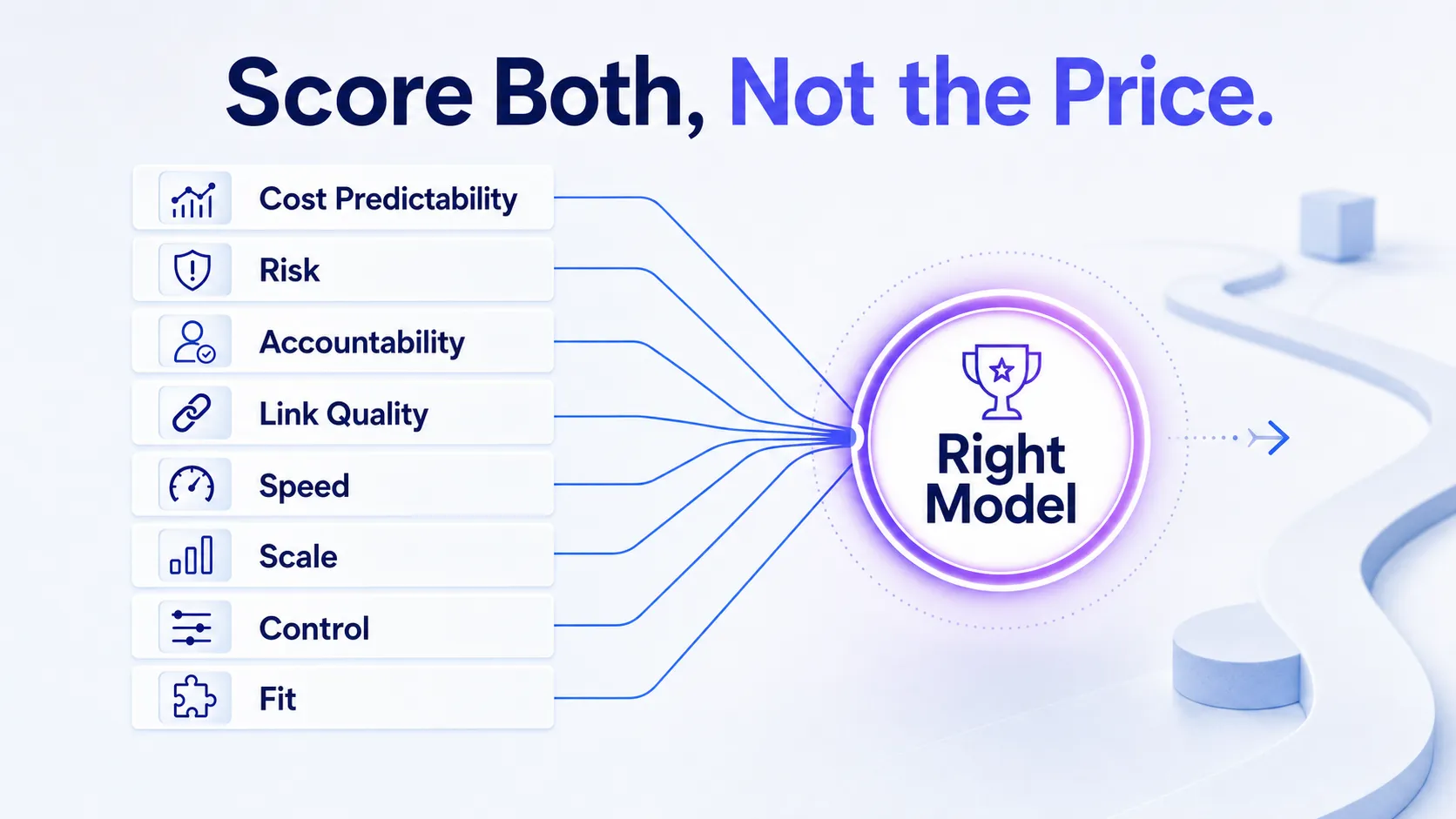
Score both models against every row before you look at the number on the invoice. A proposal that looks cheap on cost predictability might collapse on link quality, and that trade is easy to miss when you compare headline prices instead of structures.
Cost and Budget Control
Fixed-fee pricing gives you the cleaner budget, while performance-based pricing can look cheaper at the start and drift more expensive as results get harder to win. The headline number rarely tells the whole story, so the comparison lives in the fine print.
Fixed-fee pricing is easier to plan around when your team needs stable monthly numbers. You know the spend, you slot it into the budget, and you stop thinking about it. That predictability has real value for finance teams and for anyone reporting spend upward.
Performance-based pricing rewards you when results come easily and punishes you when they do not. If the result definition is narrow, or the accepted placements are genuinely hard to earn in your niche, the per-result cost can climb past what a flat fee would have cost you for the same output.
| Cost factor | Performance based | Fixed fee |
|---|---|---|
| Monthly forecast | Variable, depends on results delivered | Stable and known |
| Upfront commitment | Often lower | Set from the start |
| Cost when results are easy | Can be very efficient | Same regardless |
| Cost when results are hard | Rises per accepted link | Unchanged |
| Hidden add-ons | Content fees, minimums, acceptance rules | Usually bundled in scope |
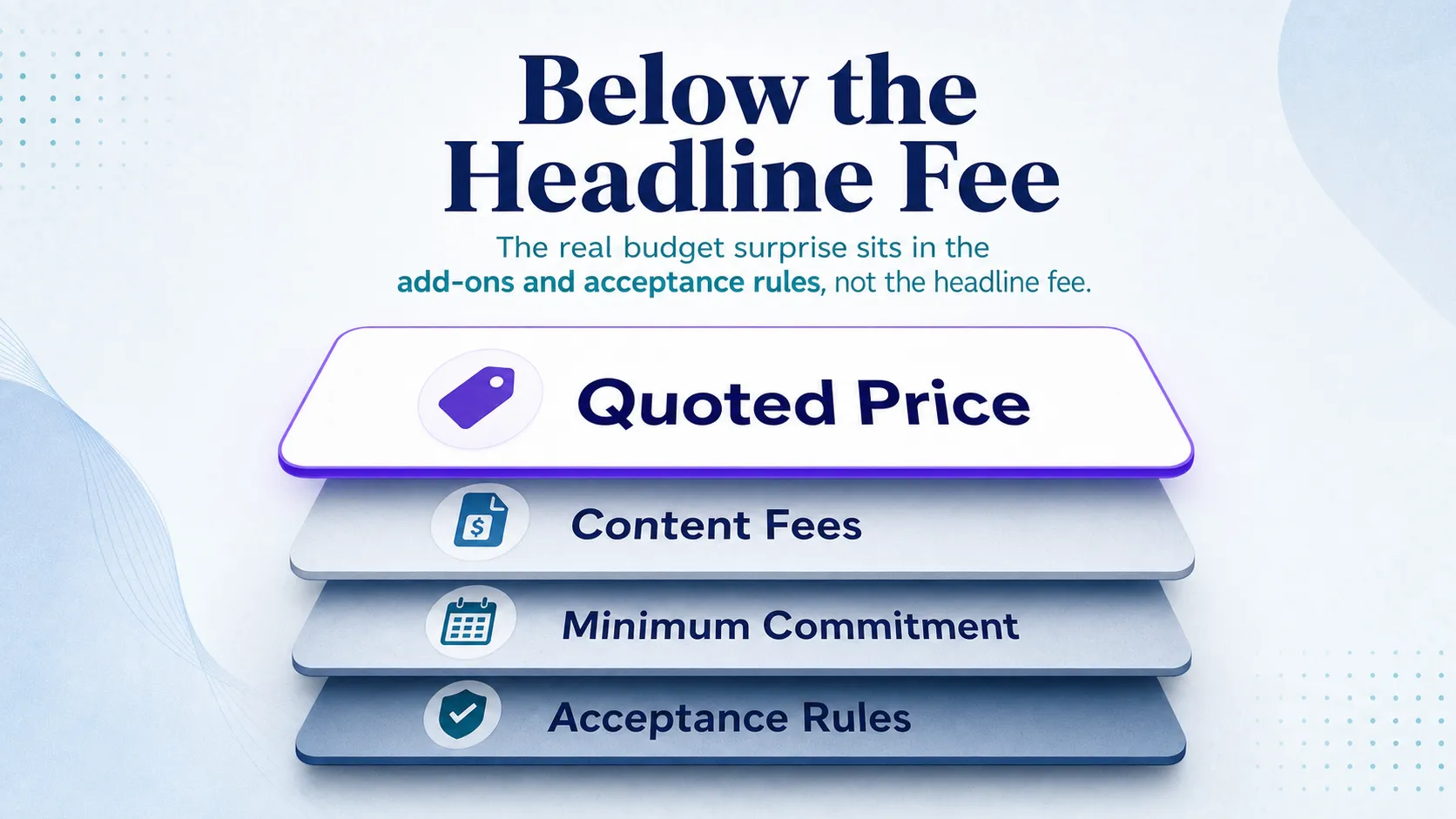
The hidden cost drivers are where buyers get caught. Content fees, revision cycles, replacement policies, and minimum monthly commitments all move the true cost. Per-result billing can also nudge a provider to optimize for whatever counts as an accepted deliverable rather than broad campaign efficiency.
The most common budget surprise is not the headline fee. It is the cost of meeting the acceptance rules for a valid result. “Cheaper per link” does not always mean cheaper per qualified placement, and a qualified placement is the only kind worth paying for. If budgeting the whole program is your focus, the guide to budgeting and managing outsourced link building walks through the full cost picture.
Risk, Accountability, and Disputes
Performance-based pricing shifts more financial risk to the provider, while fixed-fee pricing shifts more risk to you. That single fact reshapes incentives, contract language, and where arguments break out.
Under performance pricing, the provider only earns when they deliver, so they carry the downside of a slow campaign. Under fixed fee, you pay for effort and strategy whether or not a given month produces the count you hoped for. Both are legitimate. They just move the risk to different sides of the table.
Most disputes come from a handful of predictable friction points. Knowing them before you sign is worth more than any price negotiation.
What Counts as a Result
The definition of a valid result is the single biggest source of conflict in performance deals. Does a placement count if it is nofollow? If the linking page has thin traffic? If the topical relevance is loose? Write these answers into the contract, because an undefined result is an argument waiting to happen.
How Long a Placement Must Stay Live
A link that vanishes two weeks after billing was never a real result. Good contracts specify a minimum live window and a replacement policy if a placement is pulled. Without that clause, you can pay for links that quietly disappear.
How Each Model Handles Underperformance
Performance-based contracts handle a bad month naturally: no result, no charge. Fixed-fee contracts need explicit remedies written in, such as make-goods, credits, added placements, or termination rights. Read the underperformance clause before the pricing line, because that clause is what protects you when a campaign stalls.
The Metric-Gaming Risk
Performance-based models can invite metric gaming if the provider is rewarded for narrow outcomes only. If the contract pays per accepted link and stays silent on quality, the incentive points toward whatever passes acceptance fastest, not what serves your rankings best. Tie the reward to defined quality standards, not just delivery.
The pattern under all of this is simple. Most disputes happen when the buyer thought they were buying quality and the provider thought they were being paid for quantity. Close that gap in writing and most fights never start.
Link Quality and Editorial Standards
Neither pricing model determines link quality on its own, but incentives shape behavior, and loose contracts let quality slip under either model. The billing structure is a lever on behavior, not a guarantee of standards.
Performance-based pricing can pressure a provider to prioritize accepted placements over genuine editorial fit when the contract is too loose. If acceptance is the only thing that triggers payment, the fastest path to acceptance wins, and the fastest path is not always the most relevant or durable one.
Fixed-fee pricing can support deeper prospect research, stricter publisher vetting, and more strategic outreach, because the provider is not racing to hit an acceptance count to get paid. The effort is bought, so it can go toward quality rather than toward speed of delivery.
These are the quality markers worth judging any placement against, whichever model you pick.
Topical Relevance
A link earns its value when the linking page and your page share a subject. A relevant placement passes context an AI engine and a search crawler both read; an irrelevant one is close to noise.
Traffic and Audience Fit
A placement on a page real people visit carries more weight than one on a dormant site with a flattering authority score. Ask for traffic evidence, not just a domain metric.
Editorial Review and Durability
Placements that pass a genuine editorial review tend to last, and durability is what compounds over time. A link that survives a year is worth several that get scrubbed in a quarterly content cleanup.

Address the white-hat question head on: low-risk billing does not mean safe links. A performance deal can still deliver placements from link networks or manipulative schemes if you never set standards. If a contract only rewards delivery, quality gets negotiated away unless you set non-negotiable standards up front. The breakdown of white hat versus grey hat tradeoffs is worth reading before you write those standards.
See where AI answers put your brand
Twenty minutes with a senior strategist: where the major engines point buyers in your category, who gets named instead of you, and a straight read on what a programme would change.
Book a strategy callSpeed, Scale, Transparency, and Best Fit by Business Type
Fixed-fee campaigns usually launch faster and scale more smoothly, while performance-based campaigns need more upfront definition and can slow when acceptance criteria are strict. Operational reality often decides the model more than price does.
Fixed-fee campaigns launch quickly once scope is agreed, because there is less to negotiate about what triggers payment. Performance-based arrangements need tracking rules, result definitions, and acceptance criteria settled first, which adds time before the first placement lands.
Scaling follows the same logic. A fixed-fee retainer is usually better for steady, repeatable campaigns where you want consistent monthly volume. Performance-based campaigns can stall if acceptance criteria are strict or if publisher inventory in your niche is thin, because the provider cannot force a result that the market will not give.
Transparency differs by model too. Fixed-fee reporting often shows broader outreach and campaign activity, so you see the work in progress. Performance-based reporting tends to focus on accepted outcomes, so you see results but less of the effort behind them.
| Buyer type | Leans toward | Why |
|---|---|---|
| Startup, tight budget | Performance based or hybrid | Lower upfront risk, pay as results land |
| SMB needing steady volume | Fixed fee | Predictable spend and consistent output |
| Enterprise with governance needs | Fixed fee | Scope control, reporting, brand oversight |
| Regulated or brand-sensitive | Fixed fee with strict standards | Compliance and placement guardrails |
| Growth team wanting alignment | Hybrid | Base stability plus outcome incentive |
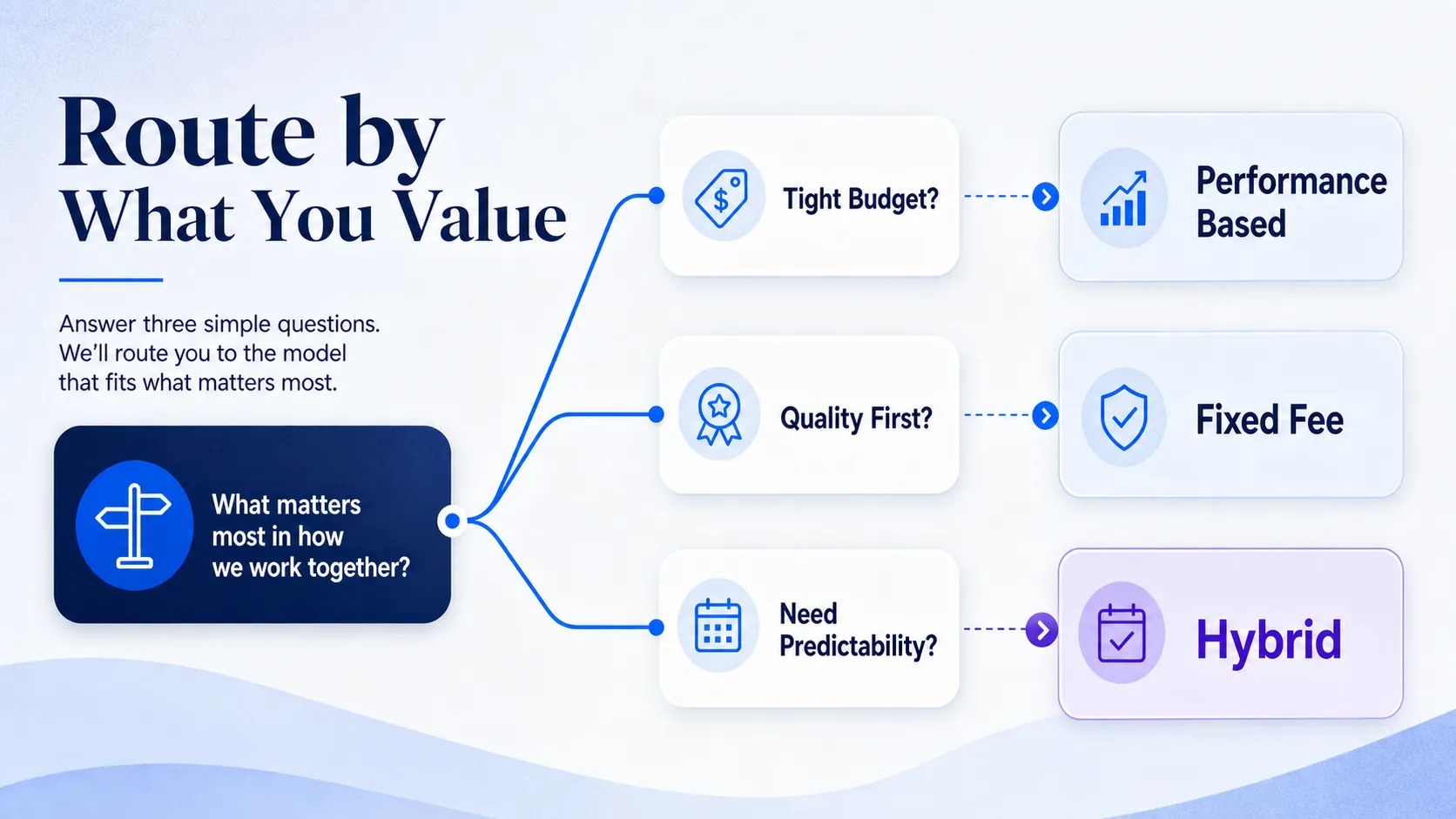
Hybrid pricing often solves the real-world tension between predictable spend and outcome alignment. A base fee funds the work and keeps quality standards intact, while an outcome incentive keeps the provider motivated to deliver. Hybrid pricing is often the practical compromise when you want accountability without sacrificing placement quality or campaign speed. If you are weighing provider types as well as models, the agency versus marketplace comparison covers how the buying channel shifts these tradeoffs.
Verdict by Use Case
The best model is the one that matches your tolerance for variance, not the one that sounds cheapest. Here is how the scenarios break down.
- Choose performance-based pricing if you want lower upfront risk and can accept a tight, written result definition.
- Choose fixed-fee pricing if you want predictable spend, stronger strategic control, and closer quality oversight.
- Choose hybrid pricing if you want a base fee plus outcome incentives or milestone-based billing.
The decision rule is simple. If you care most about payment risk, compare result definitions line by line, because that is where a performance deal is won or lost. If you care most about execution quality, compare scope and standards instead, because that is where a fixed-fee deal earns its premium. Match the model to your budget, your risk tolerance, and your growth goals, and the pricing debate resolves itself.
Frequently Asked Questions
Is performance based link building cheaper than fixed fee link building?
Not reliably. Performance-based pricing often looks cheaper upfront because you pay only for delivered results, but the per-result cost can rise sharply when placements are hard to win in your niche. Fixed fee costs more in a slow month and less in a productive one. The cheaper model depends on how easily results come and how narrowly the result is defined.
Does performance based link building guarantee better results?
No. Paying only for delivered links guarantees you pay for delivery, not for quality. A loose result definition can hand you nofollow or low-relevance placements that technically qualify but do little for your rankings. Results improve when you tie payment to defined quality standards, not just to a count of accepted links.
What is the biggest risk with fixed fee link building?
The biggest risk is paying full price for a month that underdelivers. Because you fund effort rather than outcomes, a slow campaign still bills at the agreed rate. Protect yourself with a clear scope, defined deliverables, a reporting cadence, and written remedies such as make-goods or credits when the provider misses agreed targets.
Is a hybrid link building pricing model better than either pure model?
Often, yes, for buyers who want both stability and alignment. A hybrid model pays a base fee that funds real quality work and adds an outcome incentive that keeps the provider motivated. It avoids the acceptance-gaming pressure of pure performance pricing and the pay-regardless exposure of pure fixed fee. The tradeoff is a more complex contract to draft.
How do I compare link building proposals fairly?
Score every proposal against the same criteria before you look at price: cost predictability, risk distribution, accountability, link quality, speed, scale, placement control, and business-stage fit. Two proposals can carry similar prices but very different structures, so a shared scorecard is the only way to compare like with like and avoid buying the worse deal by accident.
The honest reality is that most buyers regret the pricing model less than the vague contract behind it. Both models work when the result definition, the quality standards, and the underperformance remedies are written down before anyone signs. Before you commit to a provider, compare your next link building proposal against these criteria, and see how a transparent brand mention program prices its work as a reference point.