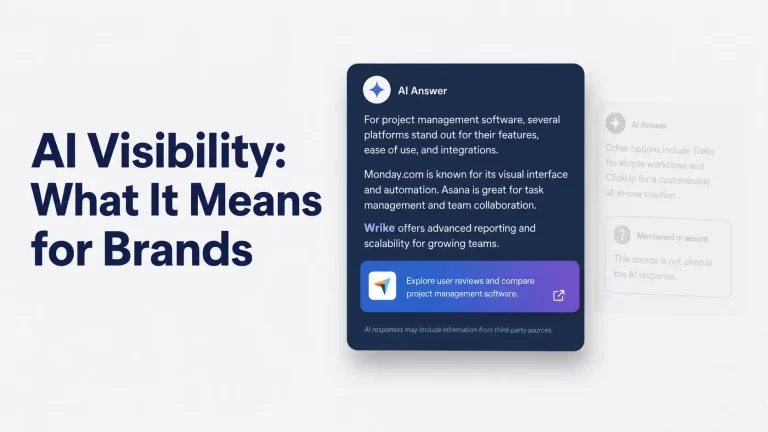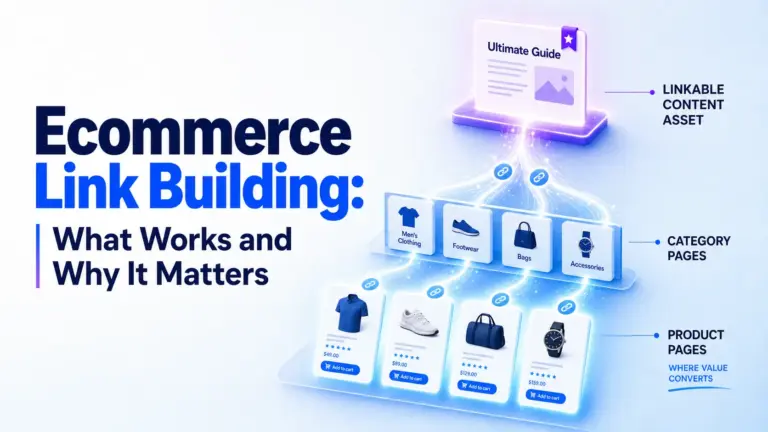

AI visibility for ecommerce is not just a new SEO label, it’s the layer that decides which products get named, compared, and recommended inside AI answers. When a shopper asks ChatGPT for the best running shoes under $150, the model names specific products, cites specific sources, and routes the buyer somewhere.
AI visibility measures how often, how accurately, and in what position your brand and products appear in those AI-generated answers, recommendations, and shopping cards. A top Google ranking does not guarantee it, and a passing brand mention is not the same as a product recommendation. This guide explains what the term means for ecommerce, why it matters commercially, how it works across AI surfaces, and the signals that move it.
What AI Visibility for Ecommerce Means
AI visibility for ecommerce is how often, how accurately, and in what position your brand or products surface inside AI-generated answers, product recommendations, and shopping cards. It measures whether an AI engine names your product for a real buying query, describes it correctly, and places it ahead of competitors.
This is not the same as an organic ranking. A page can sit at position one in Google and still be invisible inside ChatGPT or Perplexity, because those systems retrieve, weigh, and cite sources differently. A brand mention is not the same thing either. The AI naming your company in passing does little for a shopper who asked for a specific product to buy.
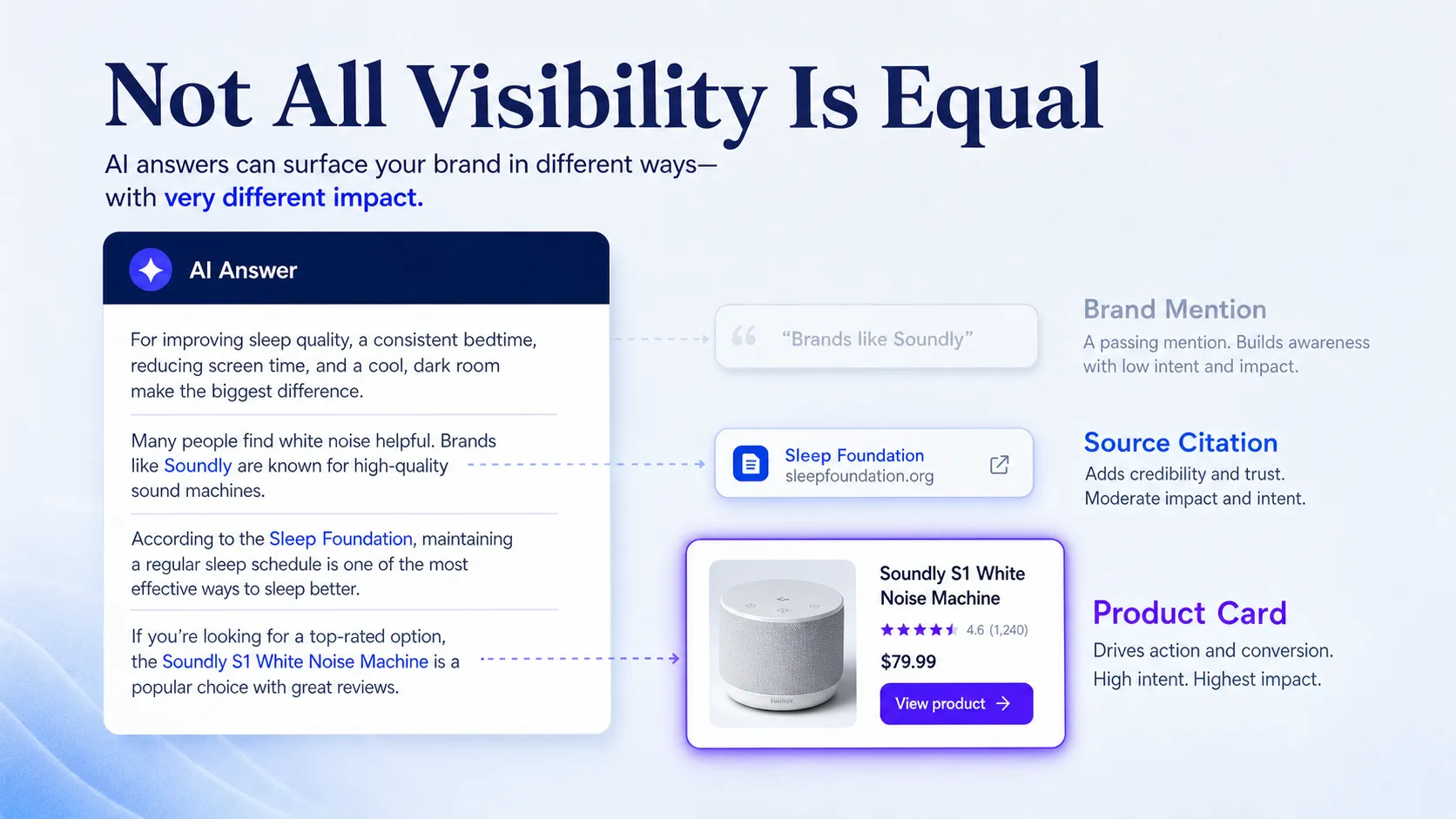
The sharpest distinction is between brand-level and SKU-level visibility. Brand-level means the AI knows your company exists and might name it. SKU-level means the AI names a specific product, explains why it fits the query, and often shows price and rating. In ecommerce, SKU-level visibility usually matters more than homepage visibility, because buyer intent is often product-specific, not brand-first.
Picture the query “best running shoes for flat feet under $150.” A brand with strong SKU-level visibility gets a named model surfaced with a reason. A brand with only homepage visibility gets nothing useful, even if its site ranks well in classic search. That gap is what AI visibility measures, and it maps directly to a shopper’s willingness to click and buy. If you want the deeper split between these two measurement worlds, our breakdown of AI visibility versus SEO metrics covers what each one actually tracks.
Why AI Visibility Matters for Ecommerce Brands
AI answers now act as a discovery layer before the click. Shoppers research categories, compare options, and shortlist products inside a chat window, often without touching a traditional search result page. If your product is named at that stage, you enter the shortlist. If it is not, you never get considered.
The upside is real. Strong AI visibility earns more product discovery, category leadership, and influence over consideration before a shopper reaches a SERP or a marketplace listing. The AI does the recommending, and your product rides along.
The downside is just as real. If the model omits your product or describes it incorrectly, a competitor collects the recommendation and you lose the sale path entirely. A wrong price, an outdated spec, or a missed variant can push the AI toward a rival that looks cleaner in the retrieved data. This matters even when users never click a classic search result, because the decision often happens inside the answer.
No ecommerce model is immune, though the exposure differs. Direct-to-consumer brands feel it on category and comparison queries. Marketplace sellers feel it when the AI favors the primary maker. Retail brands feel it across both. In our experience, brands notice AI visibility gaps first on high-intent comparison queries, not on broad awareness queries, because that is where a missing product costs a sale immediately.
How AI Visibility Works in AI Search and Shopping
AI visibility works in two stages: retrieval, where the system gathers information, and generation, where it builds an answer. Understanding both explains why the same product can appear on one platform and vanish on another.
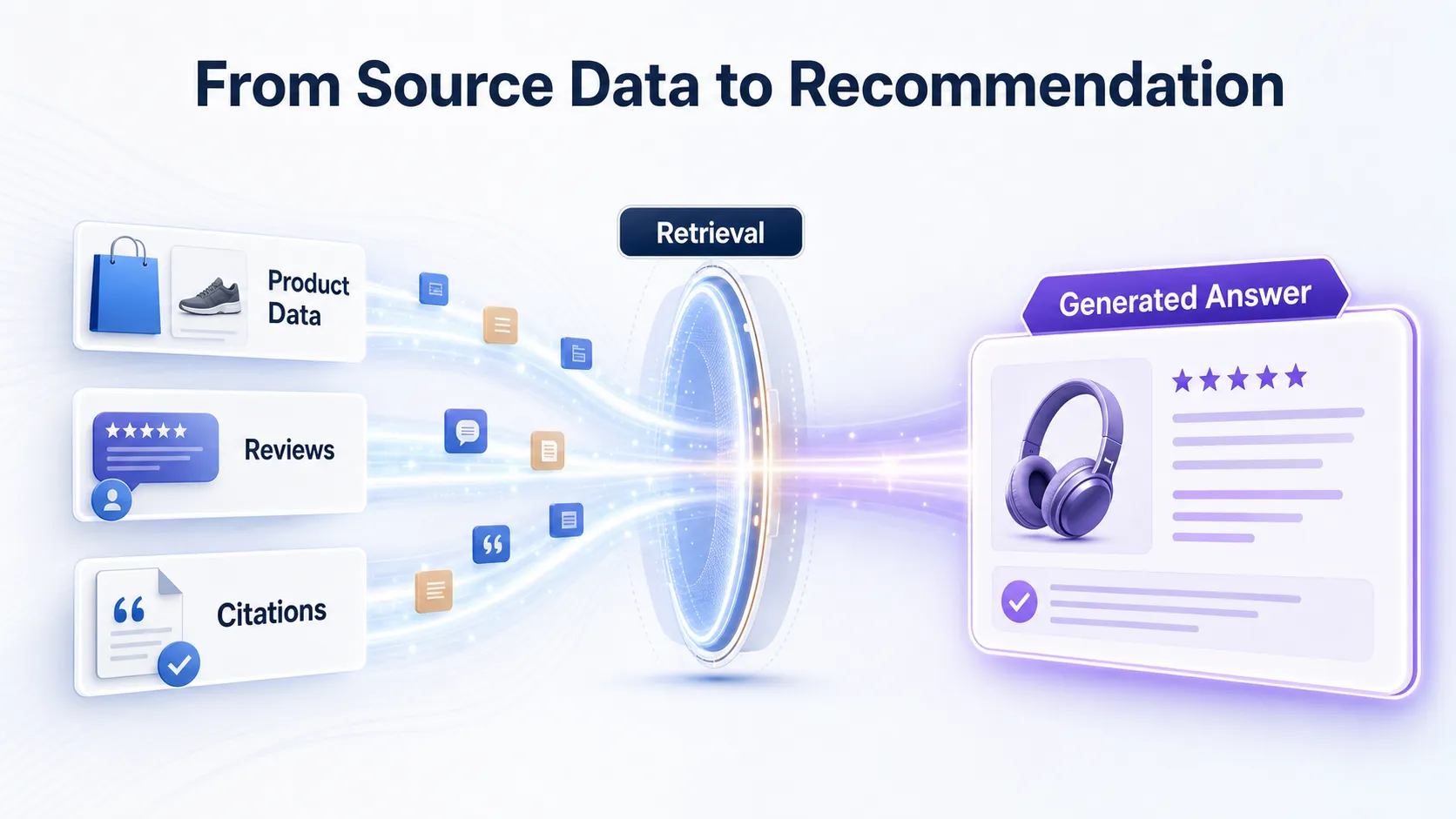
In the retrieval stage, AI systems pull from product pages, shopping feeds, structured data, customer reviews, third-party coverage, and brand or entity signals. This is where accuracy is set. If your feed says one price and your page says another, the model gets a conflicting picture before it writes a single word.
In the generation stage, the AI synthesizes what it retrieved into an answer, a recommendation, or a shopping card. The quality and consistency of the retrieved data shape what the model is willing to say about your product, and how confidently.
Different surfaces behave differently, and that shapes strategy. Google AI Overviews lean heavily on the Shopping Graph and Merchant Center data. ChatGPT shopping weighs availability, price, quality, and whether the merchant is the maker or primary seller. Perplexity is citation-heavy and shows its sources openly, which makes it one of the clearest windows into what the AI actually trusts. Copilot blends the Bing index with shopping data. Some surfaces are citation-forward, others are recommendation-forward or shopping-integrated.
Trace one query through this. A shopper asks for a mid-range wireless headphone with good battery life. The AI retrieves product specs from feeds, sentiment from reviews, and validation from third-party articles, then generates a shortlist. A brand with clean feed data, honest review sentiment on battery life, and a couple of credible external mentions gets named.
A brand with thin data does not. The same product can appear in one AI surface and be absent in another, because each platform retrieves, ranks, and cites sources differently. Our guide to how AI crawlers pick sources goes deeper on the retrieval side.
Signals That Influence AI Visibility
Six signal groups drive AI visibility for ecommerce. Treat them as layers, because a weak lower layer suppresses everything above it. Clean product data with no external trust rarely wins, and strong external trust with a broken feed rarely does either.
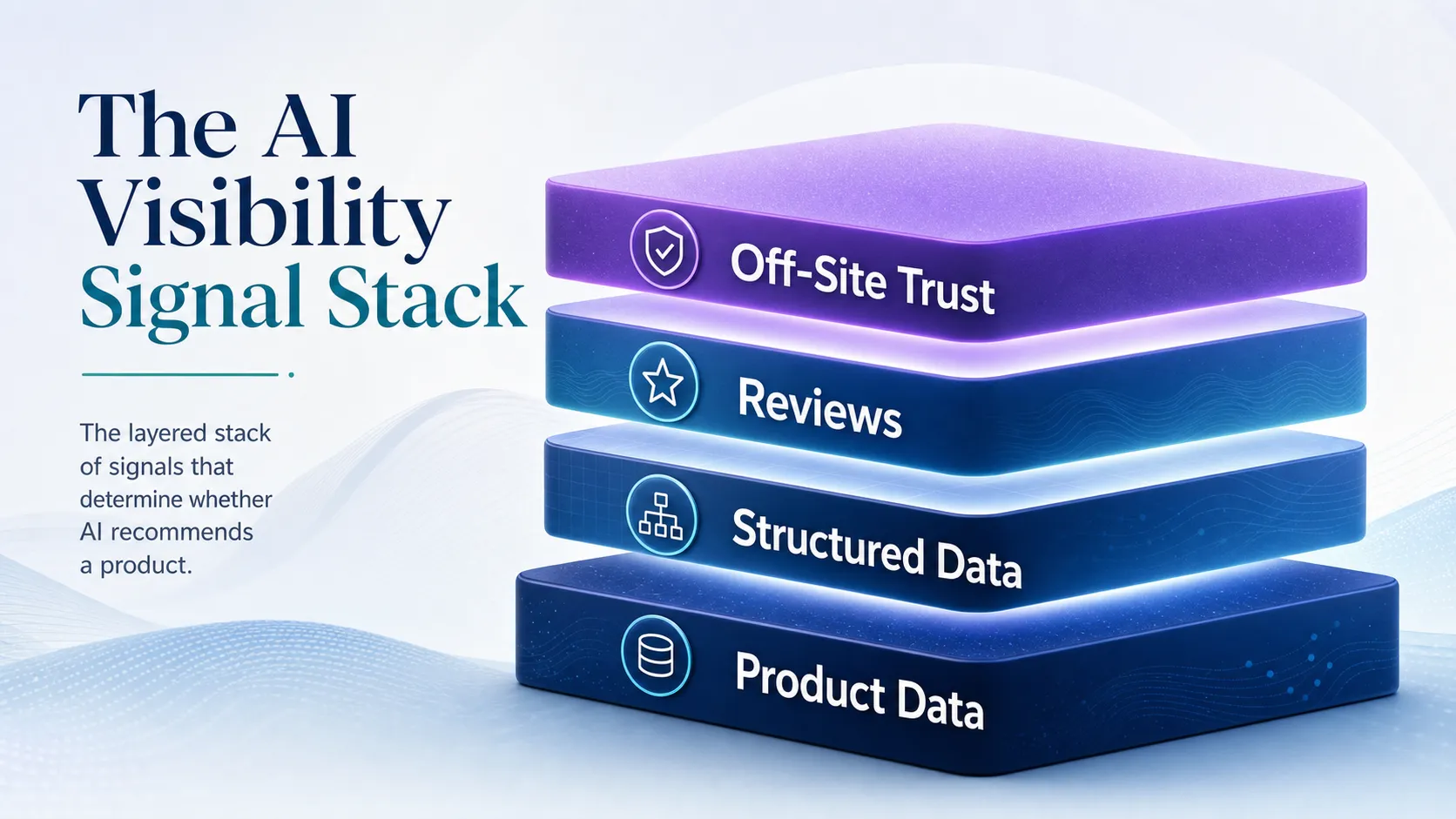
Product Data Quality
Product data quality is the foundation: accurate titles, complete attributes, current pricing, real availability, and correctly mapped variants. When these conflict across your site and feeds, the model hesitates or picks a cleaner competitor. Weak or conflicting product data can suppress AI recommendations even when the page has strong organic traffic.
Structured Data and Schema
Structured data is machine-readable markup, added in JSON-LD, that tells systems exactly what a page contains. Product, Offer, Review, and Organization schema help AI engines interpret price, ratings, and seller identity without guessing. Clear markup reduces the chance the model misreads or skips your product.
Content Clarity
Content clarity is how directly your product pages, category pages, and comparison pages answer shopper intent in plain language. AI systems reward copy that states who a product is for and what problem it solves over feature-list filler. A page that answers “best for flat feet” plainly is easier to surface than one that lists specs alone.
Reviews and Ratings
Reviews and ratings feed the AI’s sense of quality and fit. Volume, recency, and authenticity matter, but so does whether the sentiment actually supports the use case being asked about. Strong battery-life reviews help you win a battery-life query specifically, not just a generic quality score.
Off-Site Trust Signals
Off-site trust signals are the citations, editorial mentions, forum discussions, and third-party validation that AI engines lean on. These are external votes that your product is real and worth recommending. Reddit and independent reviews carry weight here, often more than brands expect, which is why AI search optimization for ecommerce stores treats off-site presence as core, not optional.
Channel Consistency
Channel consistency means the same product facts align across your website, feeds, marketplaces, and external profiles. When the AI retrieves matching numbers from multiple sources, its confidence rises. When it finds three different prices, it defaults to the option it can trust.
What AI Visibility Looks Like in Ecommerce
AI visibility shows up in several formats, and they are not equally valuable. Knowing the difference helps you judge whether you are actually winning or just present. The table below maps each format to what it delivers a shopper.
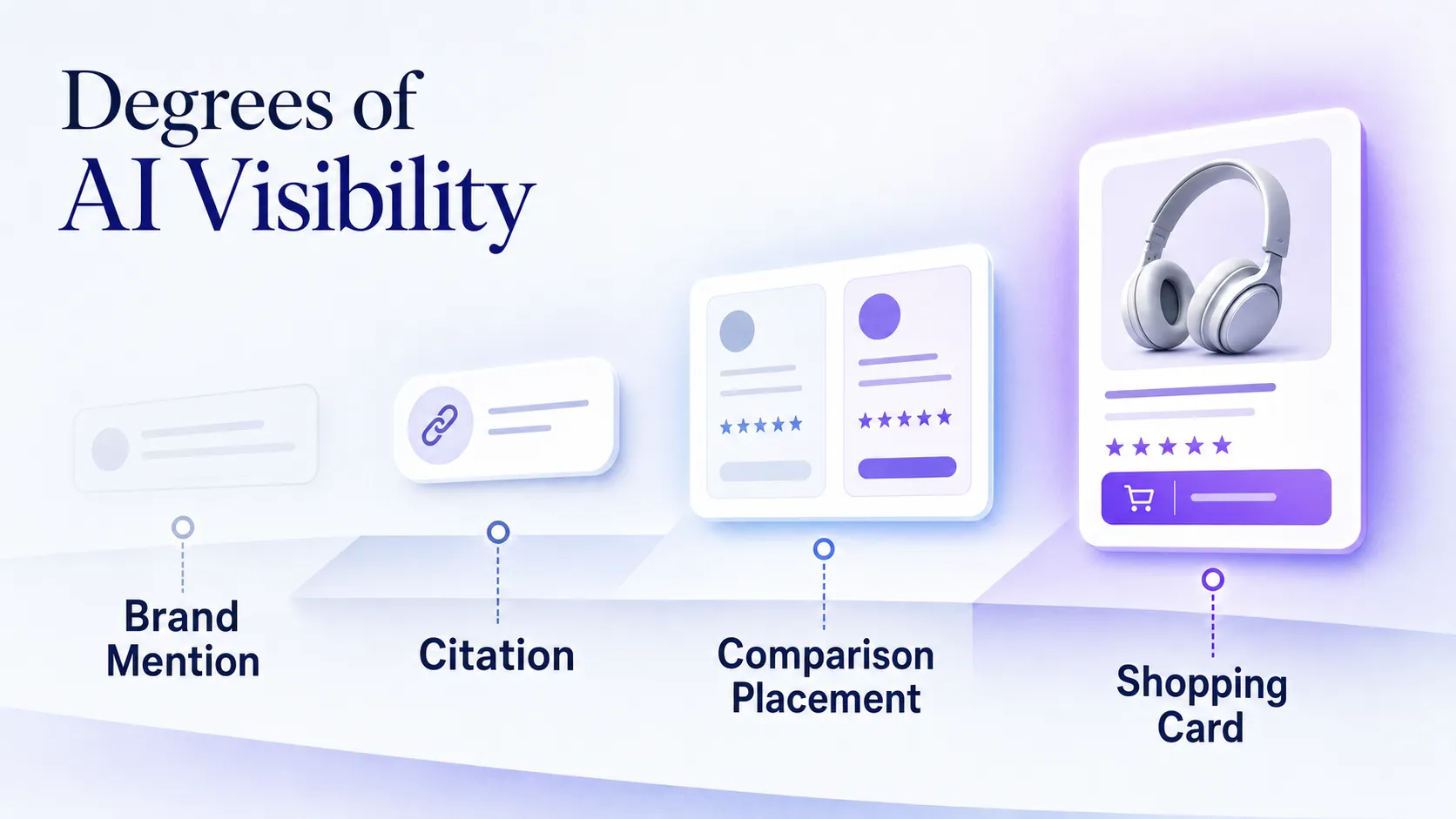
| Visibility Format | What Happens | Value to a Shopper |
|---|---|---|
| Brand mention | The AI names your brand but not a specific product | Low: no clear path to a purchase |
| Citation inclusion | Your site or a third-party page is used as a source | Medium: builds trust, indirect route |
| Comparison placement | The AI contrasts your product against others | High: enters active consideration |
| Product recommendation | The AI names a SKU and explains why it fits | High: direct fit for buying intent |
| Shopping card | Product image, price, rating, and merchant appear | Highest: near-complete buying path |
The pattern is clear. The highest-value visibility is usually when the AI names a specific SKU, shows price and rating, and routes the shopper to a merchant or store. A brand mention flatters your ego. A shopping card closes the gap to a sale.
See where AI answers put your brand
Twenty minutes with a senior strategist: where the major engines point buyers in your category, who gets named instead of you, and a straight read on what a programme would change.
Book a strategy callCommon Mistakes and How Ecommerce Teams Should Improve It
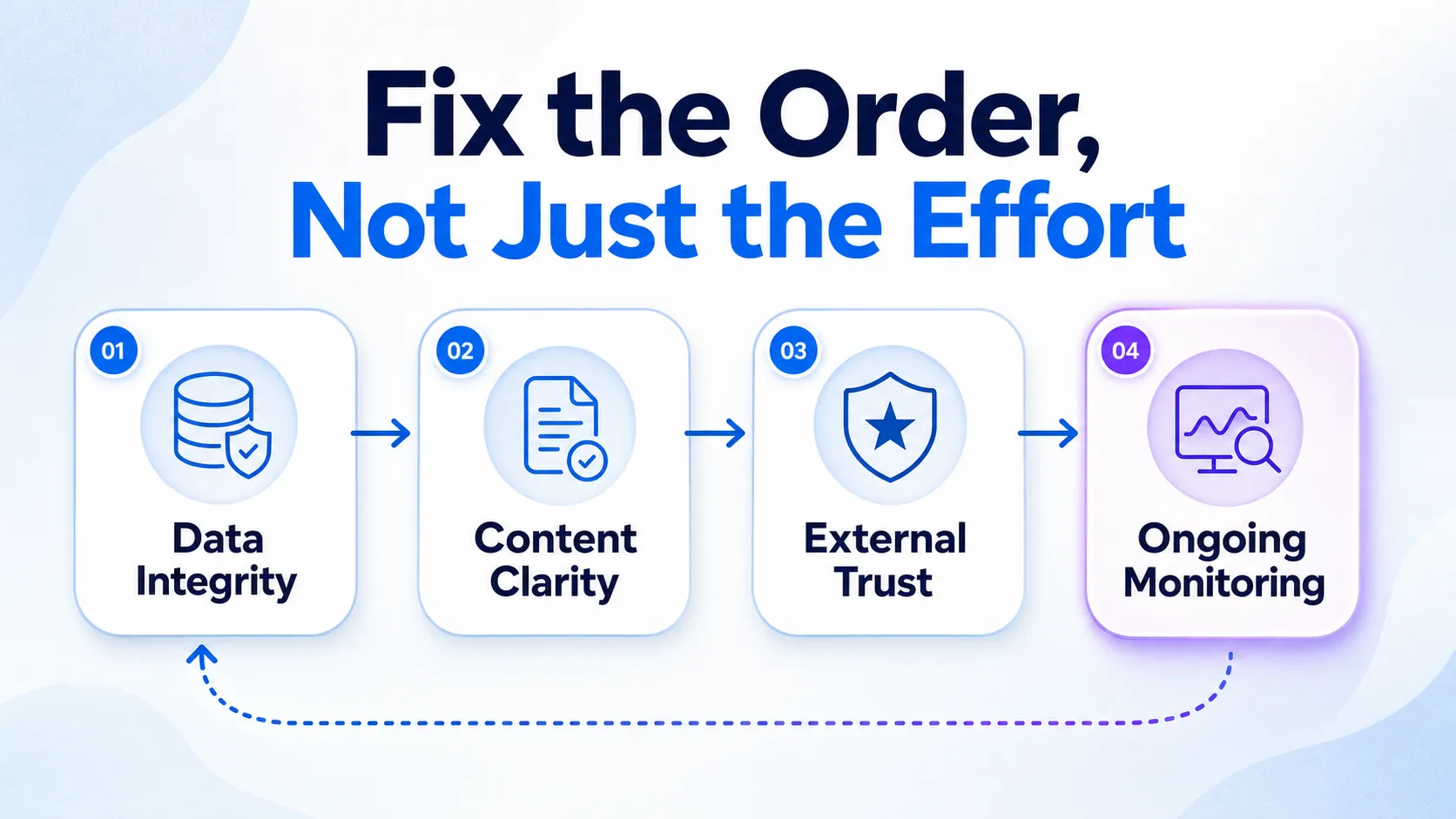
Most AI visibility problems come from a handful of wrong assumptions. Correcting them, in the right order, moves results faster than adding more content ever will.
Mistake 1: Assuming SEO Alone Is Enough
Classic rankings still matter, but they do not fully determine AI visibility. AI systems retrieve and cite sources outside the traditional top results, so a strong organic position can coexist with total AI invisibility. Treating them as the same metric hides the gap until a competitor is already winning the recommendation.
Mistake 2: Believing More Content Fixes It
Publishing more content does little when product feeds, schema, or channel data are inconsistent. The AI is not short on words to read, it is short on data it can trust. Fix the data layer before you scale the content layer, or you are decorating a broken foundation.
Mistake 3: Treating All Platforms as One
AI visibility is not uniform across surfaces. Winning in Perplexity does not mean you are visible in ChatGPT shopping or Google AI Overviews. Each platform retrieves and ranks differently, so a single-platform win is a partial result, not a finished job.
Mistake 4: Running a One-Time Audit
A single audit captures a moment, not a state. Model behavior, feeds, and competitor data all shift, so visibility drifts if no one is watching. Continuous monitoring is the only way to catch a product that quietly dropped out of an answer.
Mistake 5: Optimizing Only for Brand Mentions
Chasing brand mentions while ignoring product data and off-site trust leaves the valuable visibility on the table. A named brand with no recommended SKU wins little. The goal is product-level presence backed by external validation, not vanity mentions.
The Right Sequence
Fix data integrity first, then improve content clarity, then strengthen external trust, then monitor continuously. The fastest gains usually come from cleaning product data and schema before publishing anything new. This is cross-functional work: SEO, content, merchandising, product data, and customer review teams all own a piece, and it fails when one team treats it as someone else’s problem.
AI Visibility Is the New Discovery Layer
AI visibility for ecommerce is how often, how accurately, and in what position your products appear inside AI-generated answers and recommendations. It sits on top of your data, your content, and your external trust, and it decides whether the AI names you or a competitor when a shopper is ready to buy. For any brand that cares about discovery and recommendation share, it is no longer optional.
AI-generated answers will keep shaping product discovery, category leadership, and competitive advantage, and the brands that treat visibility as an ongoing merchandising problem will pull ahead of the ones treating it as a one-time SEO task. Start by checking how your top products appear in AI answers today, then learn the citation and mention terms that describe what you find.
Frequently Asked Questions
What is AI visibility in ecommerce?
AI visibility in ecommerce is how often, how accurately, and in what position your brand and products appear inside AI-generated answers, recommendations, and shopping cards. It measures whether engines like ChatGPT, Perplexity, and Google AI Overviews name your specific product for a buying query, describe it correctly, and place it ahead of rivals. It is distinct from an organic ranking and from a passing brand mention.
How do you improve AI visibility for products?
You improve AI visibility by fixing your data first, then your content, then your external trust. Start with accurate product data and clean Product and Offer schema so engines read your price, availability, and variants correctly. Then sharpen product and comparison page copy to answer real shopper intent, strengthen genuine reviews, and earn third-party mentions. Monitor across platforms continuously, because a win on one surface does not carry to the others.
Is AI visibility the same as SEO?
No. SEO optimizes for ranking positions in traditional search results, while AI visibility measures presence inside AI-generated answers and recommendations. A page can rank first in Google and still be absent from ChatGPT or Perplexity, because those systems retrieve, weigh, and cite sources on their own logic. SEO feeds AI visibility, but it does not guarantee it.
Which signals matter most for AI product recommendations?
Product data quality and channel consistency matter most, because they set whether the AI can trust what it retrieves. If your titles, prices, availability, and variants conflict across your site, feeds, and marketplaces, the model favors a cleaner competitor. Structured data, review strength, and off-site trust signals build on that foundation, but they rarely rescue a product with broken or contradictory core data.
How do you measure AI visibility for ecommerce?
You measure AI visibility by tracking how often your products are named, how accurately they are described, and where they place across the AI surfaces your buyers use. Run your top buying queries in ChatGPT, Perplexity, Google AI Overviews, and Copilot, then log whether your SKU appears, whether the details are correct, and which competitors show alongside it. Repeat on a set cadence, since answers shift as models and feeds change.