Semrush Brand Monitoring tracks web and social mentions of your brand inside the Semrush ecosystem, and it’s fine for a light SEO workflow. But it’s rarely the best option once your mentions spread into Reddit threads, news, review sites or AI answers.
The strongest replacements are Octolens, Brandwatch, Talkwalker, Brand24, Mention, Google Alerts, BuzzSumo and SE Ranking, each winning on a different axis: technical-community coverage, enterprise depth, budget, review sites, a free baseline, PR context or AI search visibility.
Semrush’s mention tracking is convenient if you already pay for the suite, but limiting if mentions are your priority. This list ranks the alternatives by where your mentions appear and how fast you need to see them.
What does the Semrush Brand Monitoring tool do?
Semrush Brand Monitoring is an add-on app that watches the web and social media for mentions of your brand, competitors or chosen keywords. It groups mentions into a feed with sentiment and estimated reach, so you can spot coverage worth answering.
For an SEO team, the useful part is spotting unlinked mentions you can turn into links or relationships. The app is priced on top of a core Semrush plan, so check Semrush’s App Center for the current price.
Where Semrush Brand Monitoring Falls Short
Semrush Brand Monitoring wasn’t built as a listening platform, so it’s thinner on forums, review sites and multilingual coverage. And it doesn’t show whether ChatGPT, Perplexity or Google AI Overviews name your brand. The Semrush brand mention settings guide covers how to get the most from the native feature before you switch.
How to Choose a Semrush Brand Monitoring Alternative
The best Semrush brand monitoring alternative is the tool that watches the channels where your brand gets talked about and surfaces those mentions as actionable alerts, not raw volume. Score every option against six factors: source coverage, alert speed, sentiment quality, AI or LLM visibility, integrations, and price.
No single tool wins all six, so start from your channel mix and work backward.
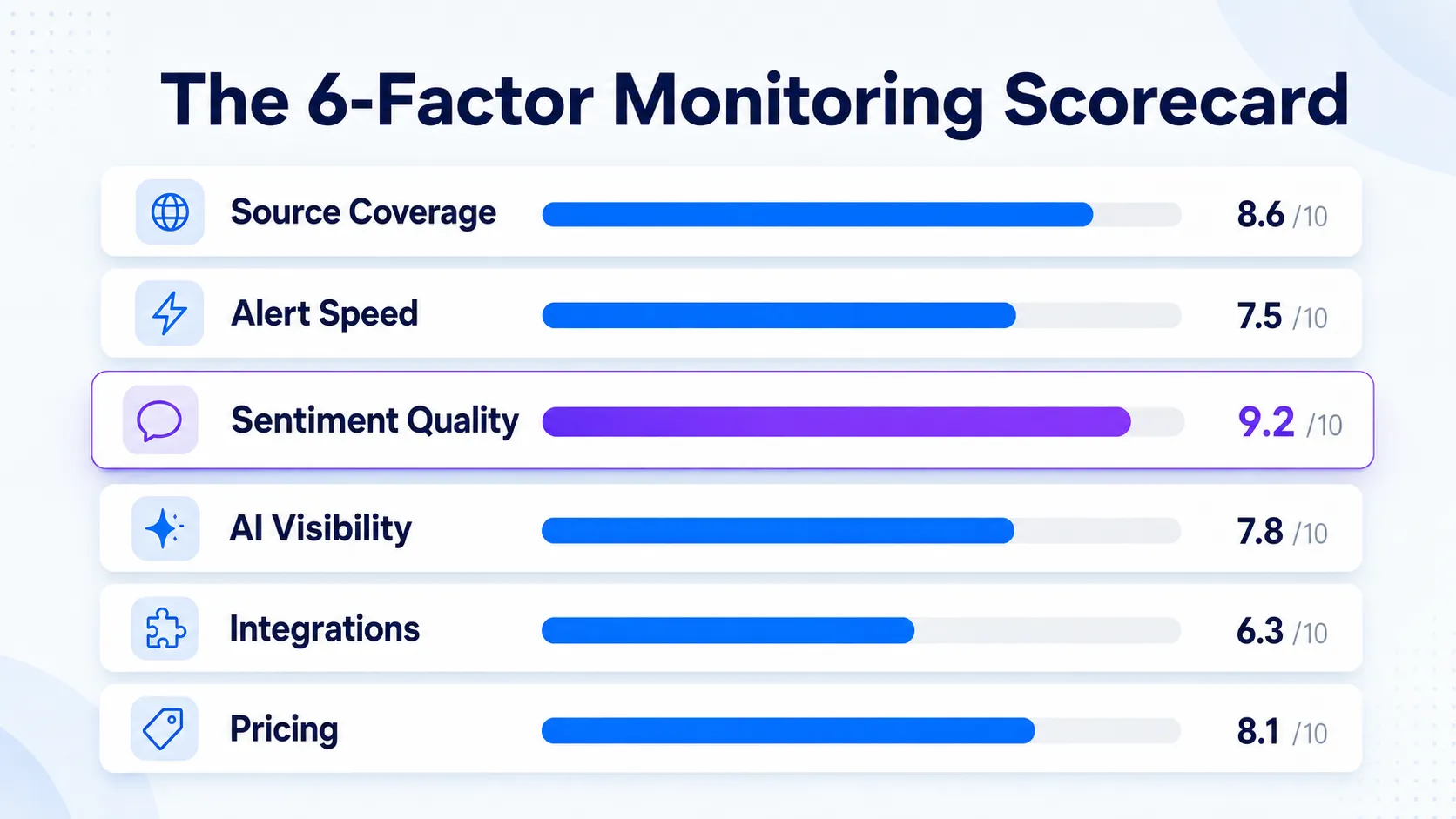
Some tools win on breadth, pulling from a hundred million sources. Others win on relevance, speed, or a single channel like Reddit, review sites, or news.
Breadth sounds impressive on a sales page, but raw mention volume is rarely the problem. It’s noisy, duplicated alerts that bury the three mentions that matter this week.
SEO-only suites earn a spot here only when they can genuinely monitor mentions, not just keywords. A rank tracker that watches your homepage position isn’t a brand monitoring tool.
So the practical question is simple: where do your mentions happen, and how fast do you need to know about them? Answer that before you compare feature lists.
The biggest buying mistake is picking the tool with the most sources instead of the one with the most useful alerts. For the wider category, the guide to choosing B2B brand monitoring tools covers the field in depth.
8 Best Semrush Brand Monitoring Alternatives
These eight tools replace or outperform Semrush’s brand monitoring feature for specific teams, budgets, and channel mixes. Each item names what it is, who it serves, and the one advantage that earns its place, so you can build a shortlist fast.
1. Octolens: Best for B2B SaaS and Dev-Tool Teams
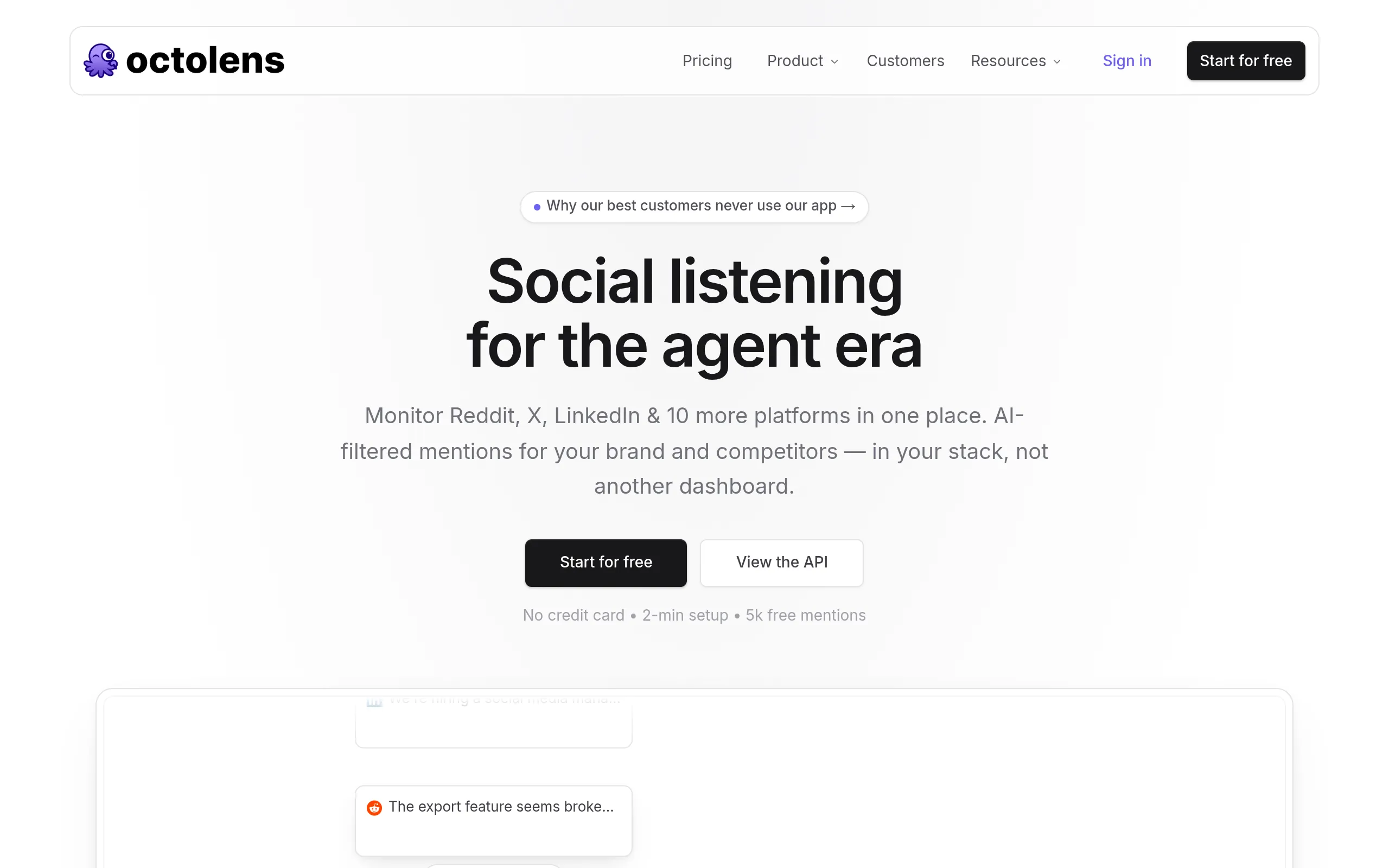
Octolens is a brand monitoring platform built for B2B SaaS and developer-tool teams that need mentions from technical communities plus the open web.
Its edge over Semrush is where it looks and how it filters: it covers Reddit, Hacker News, GitHub, and Stack Overflow across 15 platforms and more than 150,000 news outlets, then scores each mention for relevance.
That relevance scoring is the real differentiator, because a dev-tool brand doesn’t need every stray forum post, it needs the threads where buyers are actually deciding. The tradeoff is focus: this isn’t a consumer-brand or B2C listening tool.
- Best for: B2B SaaS and dev-tool teams tracking technical communities
- Starting price: See the Octolens pricing page for current plans (7-day free trial)
- Free tier or trial: 7-day free trial on Pro
- Standout feature: API-first architecture with relevance scoring, webhooks, and MCP server
2. Brandwatch: Best for Enterprise Consumer Intelligence

Brandwatch is the enterprise-grade option for large brands that need deep historical coverage, AI segmentation, and analyst-level reporting across more than 100 million sources. Compared with Semrush, Brandwatch wins decisively on scale and governance: it’s built for teams with dedicated analysts running consumer intelligence, not for a marketer checking mentions between other tasks.
That power comes at a cost. It’s much more expensive and far less approachable, so it belongs on your shortlist only when budget and enterprise depth genuinely matter.
- Best for: Global consumer brands with dedicated analyst teams
- Starting price: Custom, quote-based enterprise pricing
- Standout feature: Deep historical archive and large-scale consumer intelligence
3. Talkwalker: Best for Multilingual and Visual Monitoring
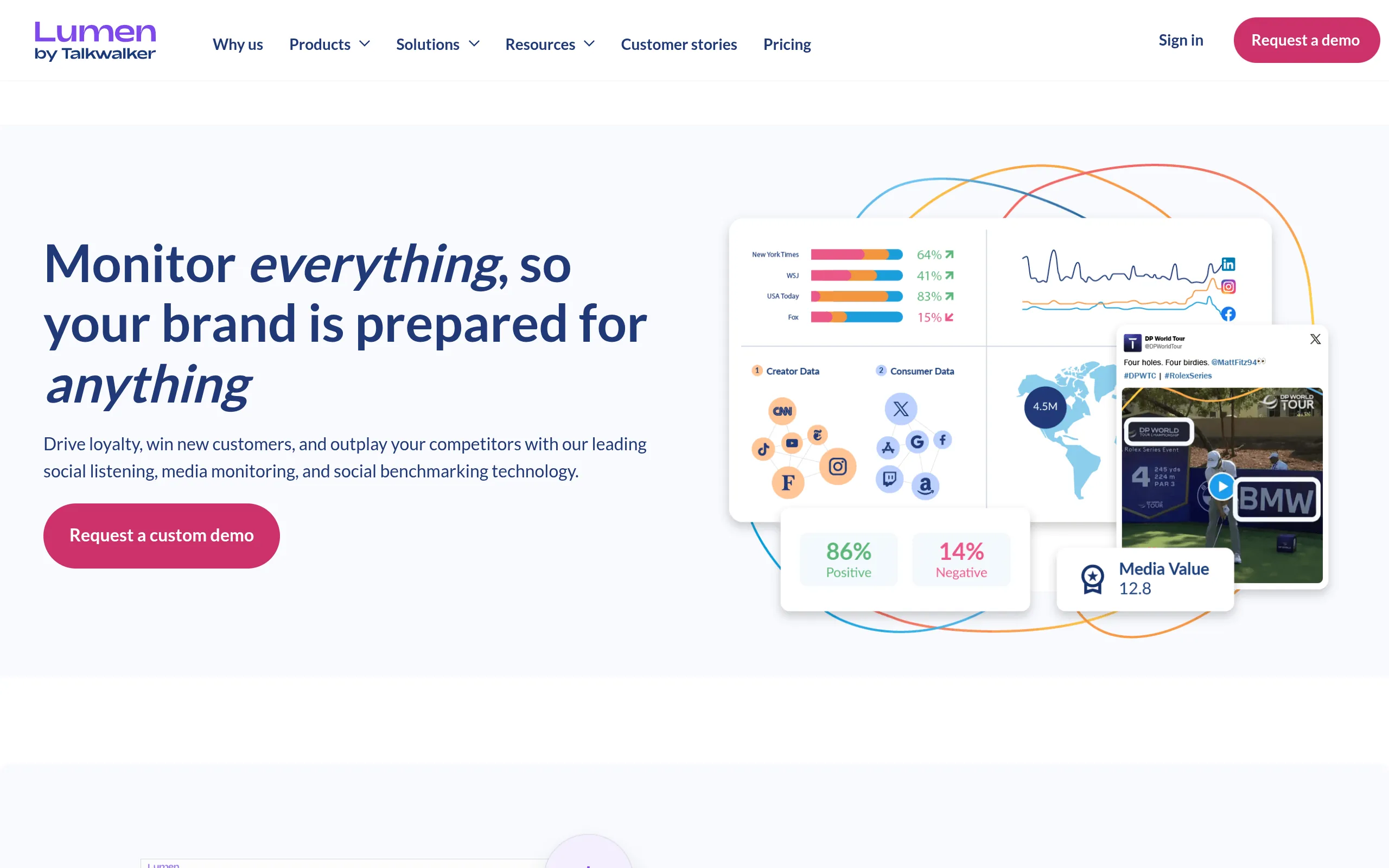
Talkwalker is the choice for global brands that monitor many languages and need visual recognition, covering roughly 150 million sources across 187 languages. It beats Semrush when the job is broad consumer intelligence across regions and formats, not simple mention tracking, thanks to image and logo recognition plus predictive analytics through its Blue Silk AI.
If your brand shows up in photos, screenshots, and product shots as often as in text, that visual layer is a real advantage. Like the other enterprise platforms, it runs on custom pricing and an enterprise-sales process, so expect a slower buying cycle.
- Best for: Global brands monitoring many languages and visual mentions
- Starting price: Custom, quote-based enterprise pricing
- Standout feature: Blue Silk AI for image recognition and predictive analytics
4. Brand24: Best for Budget-Conscious Teams

Brand24 is the budget-friendly alternative for teams that want real-time alerts, sentiment, and share-of-voice tracking without enterprise complexity. Against Semrush, the advantage is obvious: lower cost and a simpler setup you can run in an afternoon.
The clean interface and mobile app with push notifications make it genuinely usable for a small marketing team, not just a data analyst. The tradeoff is depth.
You get lighter analytics and less historical reach than a premium suite, which is a fair trade if your goal is catching mentions fast rather than running quarterly intelligence reports.
- Best for: Small teams and agencies on a budget
- Starting price: See the Brand24 pricing page for current plans
- Free tier or trial: 14-day free trial
- Standout feature: Clean interface plus mobile app with push notifications
5. Mention: Best for Review-Site Coverage
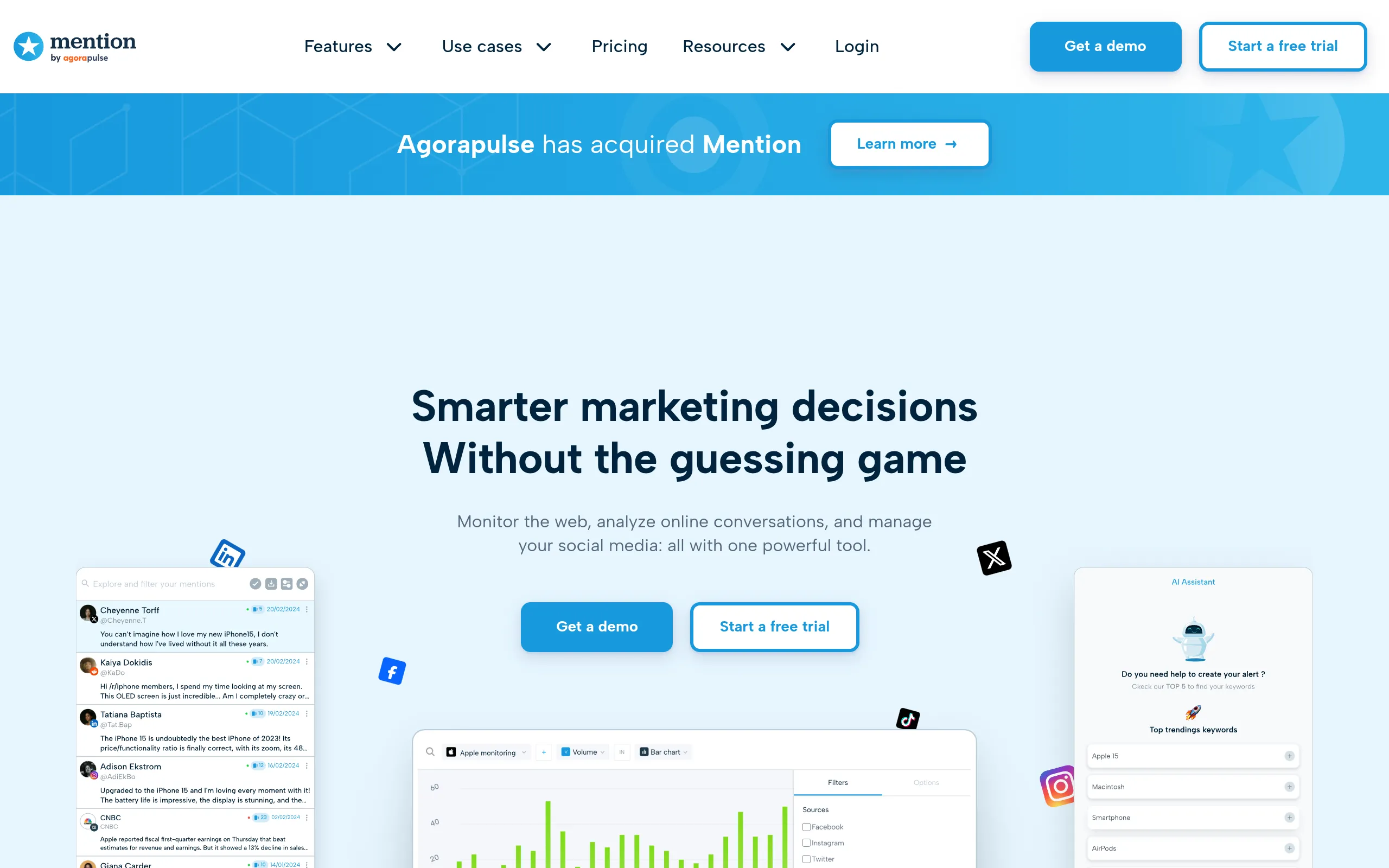
Mention is the pick for reputation-sensitive brands that care what customers say on third-party review platforms, tracking more than a billion sources and over 75 review sites. It’s stronger than Semrush for review-source monitoring and broad web mentions, which matters if your buyers read G2, Capterra, or Trustpilot before they buy.
Where it lags is AI and LLM visibility: it isn’t built to tell you whether ChatGPT or Perplexity names your brand. The basic plan is affordable, but advanced workflows and larger teams push you toward its higher Company tier.
- Best for: B2C and review-conscious brands watching third-party platforms
- Starting price: See the Mention pricing page for current plans
- Free tier or trial: Limited trial
- Standout feature: Coverage of 75+ review platforms and 1 billion+ sources
6. Google Alerts: Best Free Baseline
Google Alerts is Google’s free email alert service for new pages matching a word or phrase, and it’s the zero-cost baseline for basic web monitoring. Against Semrush, its only advantage is price: it takes two minutes to set up and costs nothing.
The limits are real. You get no sentiment, no social coverage, no dashboard and no AI answer tracking, and delivery is slower than paid tools, so treat it as a safety net rather than a replacement.
- Best for: Founders and solo marketers who only need Google-indexed mentions
- Starting price: Free
- Free tier or trial: Free with a Google account
- Standout feature: Instant setup with source, language and region filters
7. BuzzSumo: Best for PR and Content Teams

BuzzSumo is the option for PR and content teams whose mention tracking needs to connect to journalist discovery, influencer outreach, and content performance. It isn’t a full social listening suite, and it doesn’t pretend to be.
What it does better than Semrush for PR-led work is context: it ties a mention to the content and the person behind it, so you can see which journalists, publications, and influencers are talking and act on it. Alerts for specific journalists and publications make it a working PR tool rather than a passive tracker.
The tradeoff is a limited trial and no free plan.
- Best for: Content marketing and digital PR teams
- Starting price: See the BuzzSumo pricing page for current plans
- Free tier or trial: Limited trial, no free plan
- Standout feature: Journalist and influencer database with content-performance context
8. SE Ranking: Best for SEO-Led Teams Wanting AI Visibility

SE Ranking is the strongest SEO-first alternative for teams that want brand monitoring alongside AI search visibility and broader search workflows in one platform. It isn’t as deep as a dedicated listening tool for social coverage, so don’t buy it expecting Brandwatch-level intelligence.
Its advantage over Semrush is the combination: rank tracking, audits, agency reporting, and an AI Results Tracker that watches brand visibility across ChatGPT, Gemini, Perplexity, and Google AI Overviews.
For an agency or mid-market team that lives in rankings and reporting but also needs to see AI mentions, that consolidation is worth more than a slightly wider social net. If AI answers are your priority, the workflow to track brand mentions in AI search results pairs well with this kind of tracker.
- Best for: Agencies and mid-market SEO teams wanting AI visibility in one place
- Starting price: See the SE Ranking pricing page for current Pro and AI Search add-on pricing
- Free tier or trial: 14-day free trial
- Standout feature: AI Results Tracker across major AI engines
Comparison Summary Table
Use this table to shortlist by budget and channel fast. “Custom” means quote-based enterprise sales, so expect a longer buying cycle and a demo before pricing.
| Tool | Best for | Starting price |
|---|---|---|
| Octolens | B2B SaaS and dev-tool teams | See Octolens pricing page |
| Brandwatch | Enterprise consumer intelligence | Custom |
| Talkwalker | Multilingual and visual monitoring | Custom |
| Brand24 | Budget-conscious teams | $49/mo |
| Mention | Review-site coverage | $41/mo |
| Google Alerts | Free baseline web alerts | Free |
| BuzzSumo | PR and content teams | $199/mo |
| SE Ranking | SEO-led teams wanting AI visibility | $119/mo |
These eight made the list on channel coverage, alert usefulness, AI or LLM visibility support, and budget fit, drawn from the tools that consistently show up as brand monitoring options rather than pure keyword suites. Where a tool wins on one clear axis, that axis defines who should buy it.
A head-to-head breakdown of overlapping tools sits in the brand mention monitoring tools compared head-to-head for readers weighing two finalists.
What to Choose Based on Your Use Case
Pick by where your mentions live and how fast you need them, not by which brand is biggest. Choose Octolens if you run a B2B SaaS or developer tool and buyers debate you on Reddit, Hacker News, or GitHub.
Choose Brandwatch or Talkwalker if you’re an enterprise brand with the budget and analysts to use them, and Talkwalker specifically if you monitor many languages or visual mentions.
Choose Brand24 if you’re budget-conscious and want fast alerts over deep reporting, or Google Alerts if you need a free baseline. Choose Mention if review sites shape your reputation, and BuzzSumo if PR and content are the point.
Choose SE Ranking if you’re an SEO-led team that also wants AI search visibility in one workflow. Semrush isn’t the only option, and it’s rarely the best one once your mentions spread past a simple SEO workflow.
Pick the tool that matches where your mentions actually appear, then run both it and your current setup on a 7-day trial before you switch. That side-by-side week tells you more than any feature list, because it shows you which tool surfaces the mentions you would have acted on.
Frequently asked questions
Is Semrush Brand Monitoring included in a Semrush subscription?
Semrush Brand Monitoring is sold as a separate app on top of a core Semrush plan. Check the price in the Semrush App Center before comparing, because the add-on cost changes how it stacks up against Brand24 or Mention.
Is there a free alternative to Semrush brand monitoring?
Google Alerts is the free alternative, and it’s worth running for basic web mentions. It has no sentiment, social coverage or AI tracking. Most paid tools on this list offer a trial, so you can test real coverage before paying.
Which Semrush alternative is best for social listening?
Brandwatch and Talkwalker lead for enterprise social listening, while Brand24 covers social affordably for small teams. Semrush is weakest here because its mention tracking sits inside an SEO suite.
Can these tools track brand mentions in ChatGPT or Perplexity?
SE Ranking’s AI Results Tracker watches ChatGPT, Gemini, Perplexity and Google AI Overviews, but most listening tools don’t monitor AI answers directly. Treat AI visibility as a separate requirement and confirm it in the trial. The guide to monitoring brand mentions in LLMs explains what to measure.
Does Semrush Brand Monitoring work well for PR teams?
Semrush Brand Monitoring is passable for PR teams already on the suite, but it lacks journalist and influencer context. BuzzSumo is the stronger PR pick because it ties each mention to the people and content behind it.