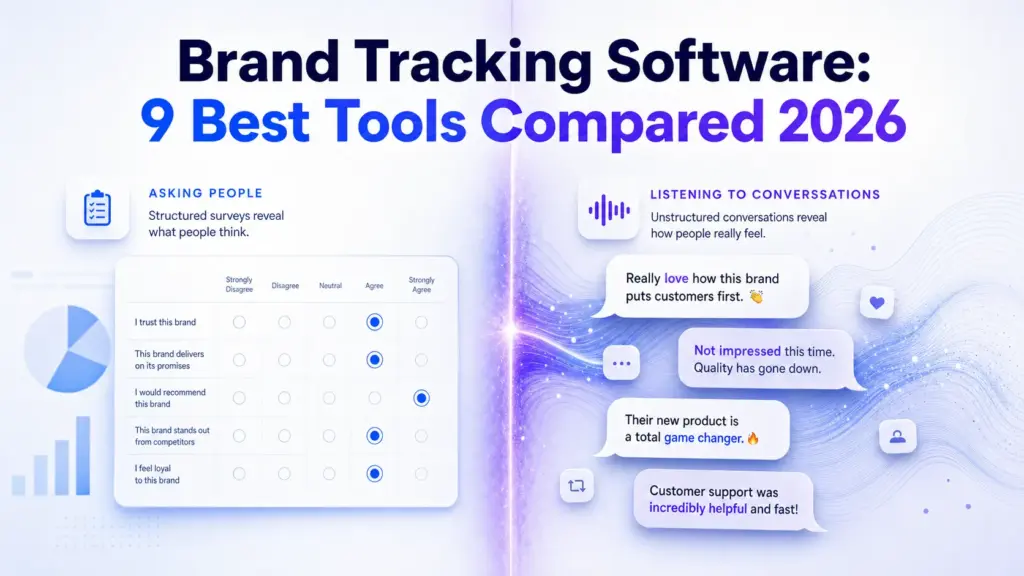

Brand tracking software isn’t one category, and the best tool for you depends on whether you need survey data, social listening, or AI visibility coverage.
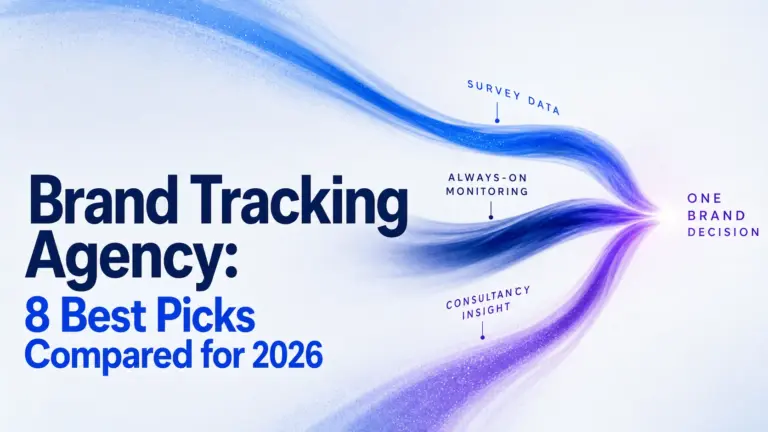
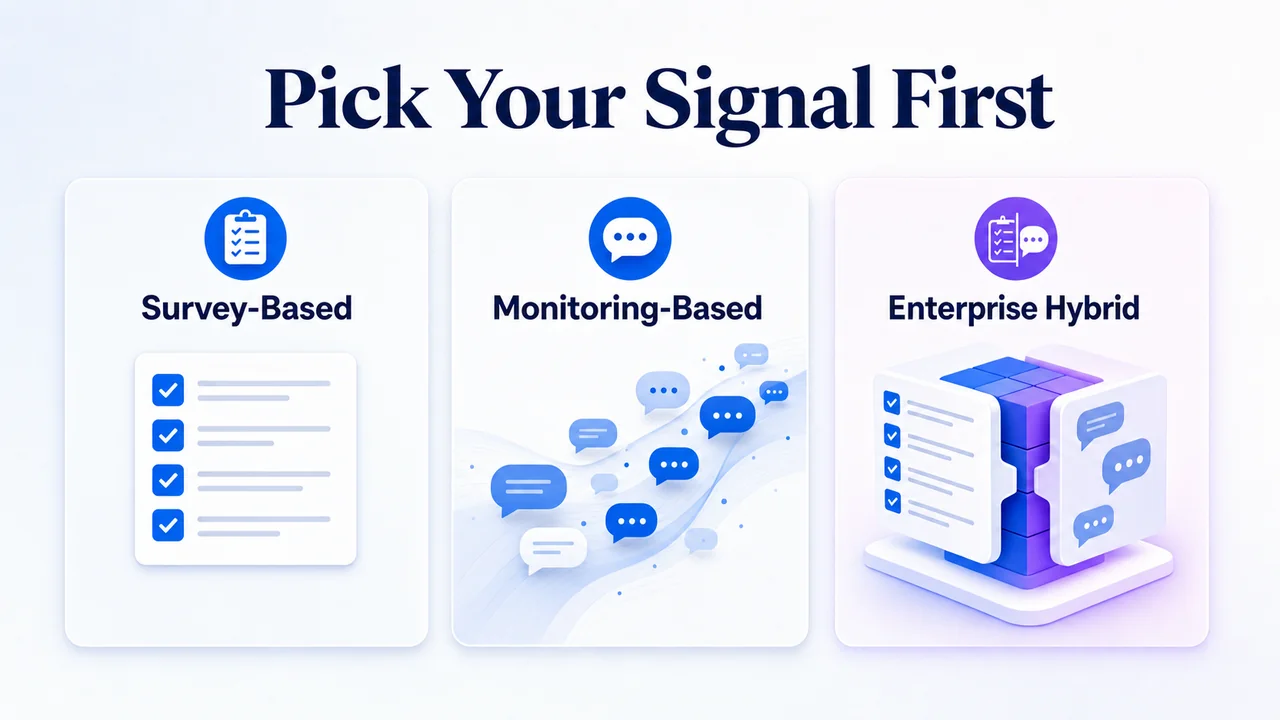
The market splits into three groups: survey-based platforms that ask real people what they think, always-on monitoring tools that listen to public conversations, and enterprise hybrids that do both at scale. Pick the wrong group and no feature list will save the purchase.
This roundup compares 9 tools by data source, budget, and the job each one does best, so you can shortlist fast instead of demoing ten platforms that measure the wrong thing.
For a no-cost baseline first, the free AI visibility checker scores your presence across four engines.
Key Criteria for Selecting Brand Tracking Software
The single decision that shapes everything else is your data source. Survey-based tools measure perception directly by asking a sampled audience about awareness, consideration, and brand equity.
Monitoring tools listen to mentions, sentiment, and share of voice across social, news, and forums. Most bad software purchases start with the wrong data source, not the wrong interface.
Once you know which signal you need, these factors separate a good fit from an expensive mistake:
- Data source coverage: surveys, panels, social listening, or media intelligence
- Automation and update frequency, from one-off studies to always-on tracking
- Analytics depth and reporting you can actually share with leadership
- Alerting that flags spikes and reputation risks early
- Competitor benchmarking and share of voice analysis
- Pricing transparency and setup effort
- Fit for SMB speed versus enterprise governance and multi-market support
One newer consideration belongs on the list: AI visibility. A handful of platforms now track how your brand appears inside AI answers from tools like ChatGPT and Perplexity.
Treat it as a real factor only if a vendor genuinely covers those sources, not as a checkbox added to a marketing page. If your buyers research you through AI search, where your brand stands in AI search starts to matter as much as where it ranks.
The best tool depends on the job to be done. Enterprise buyers usually need governance, multi-market consistency, and board-ready reporting. SMB and mid-market teams usually need fast setup, clear pricing, and alerts that are useful on day one.
9 Best Brand Tracking Software Tools
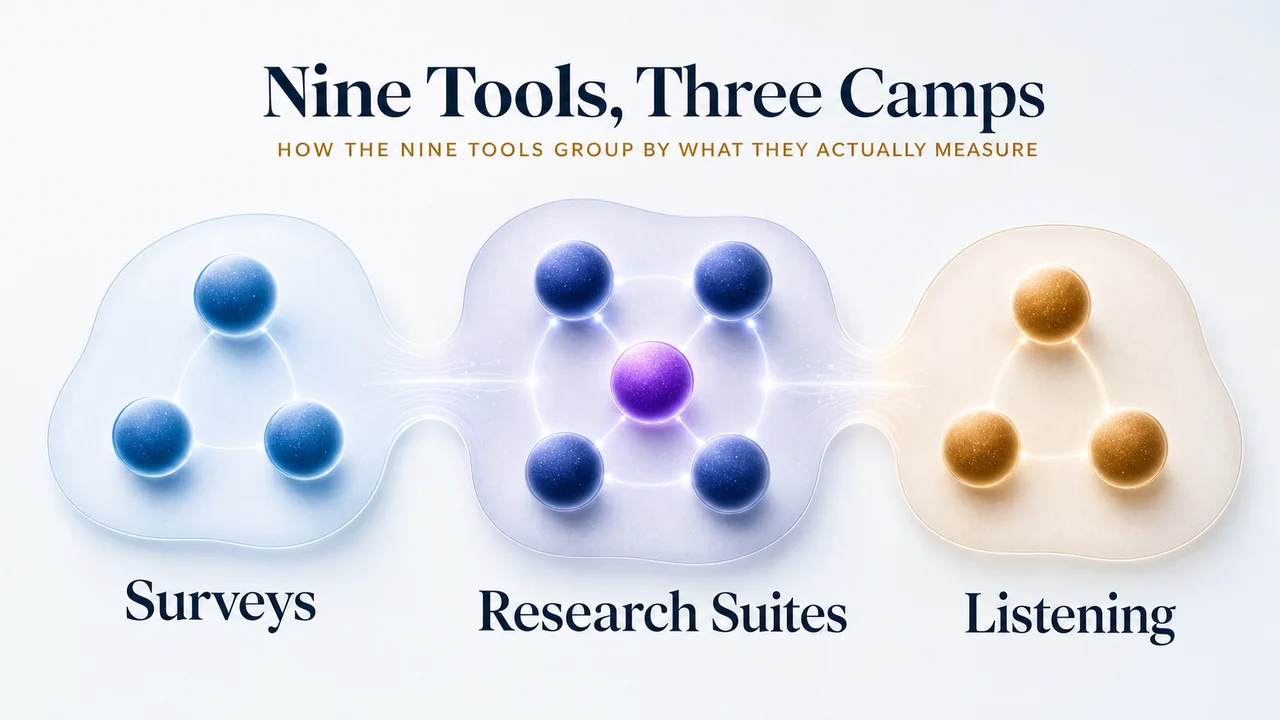
These nine tools are ordered by measurement method, starting with direct survey-based platforms, then enterprise research, then social listening and monitoring. Shortlist decisions usually come down to three things in order: measurement method first, then budget, then workflow fit. Every entry below names the data source so you can sort fast.
1. Pollfish
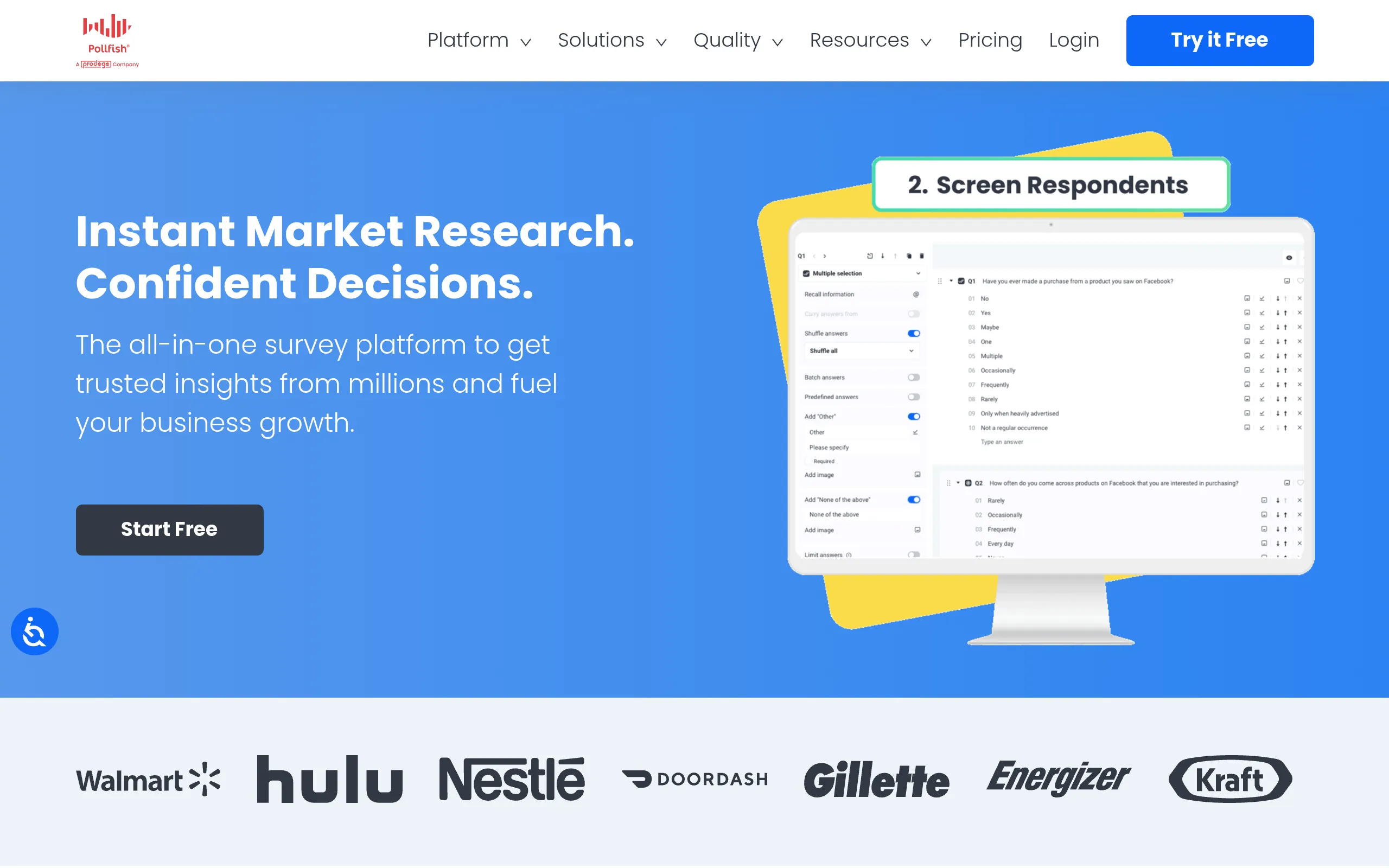
Pollfish is a DIY survey platform for brand tracking and market research, built for teams that want to measure awareness, perception, and brand lift through first-party survey responses. It’s the most direct option on this list for primary research without a full research operation.
The appeal is speed and simplicity. You design a survey, target an audience, and read results in hours to days rather than weeks.
The honest tradeoff is scope: this is survey-led tracking, so it won’t catch live mentions, share of voice, or a reputation flare-up on social. Pair it with a monitoring tool if you need both signals.
- Best for: SMBs and lean insights teams wanting survey-based tracking without enterprise complexity
- Data source: First-party survey panel
- Pricing model: Pay-per-response, starting around $0.95 per completed response
- Standout strength: Fast survey setup and audience targeting
2. Qualtrics
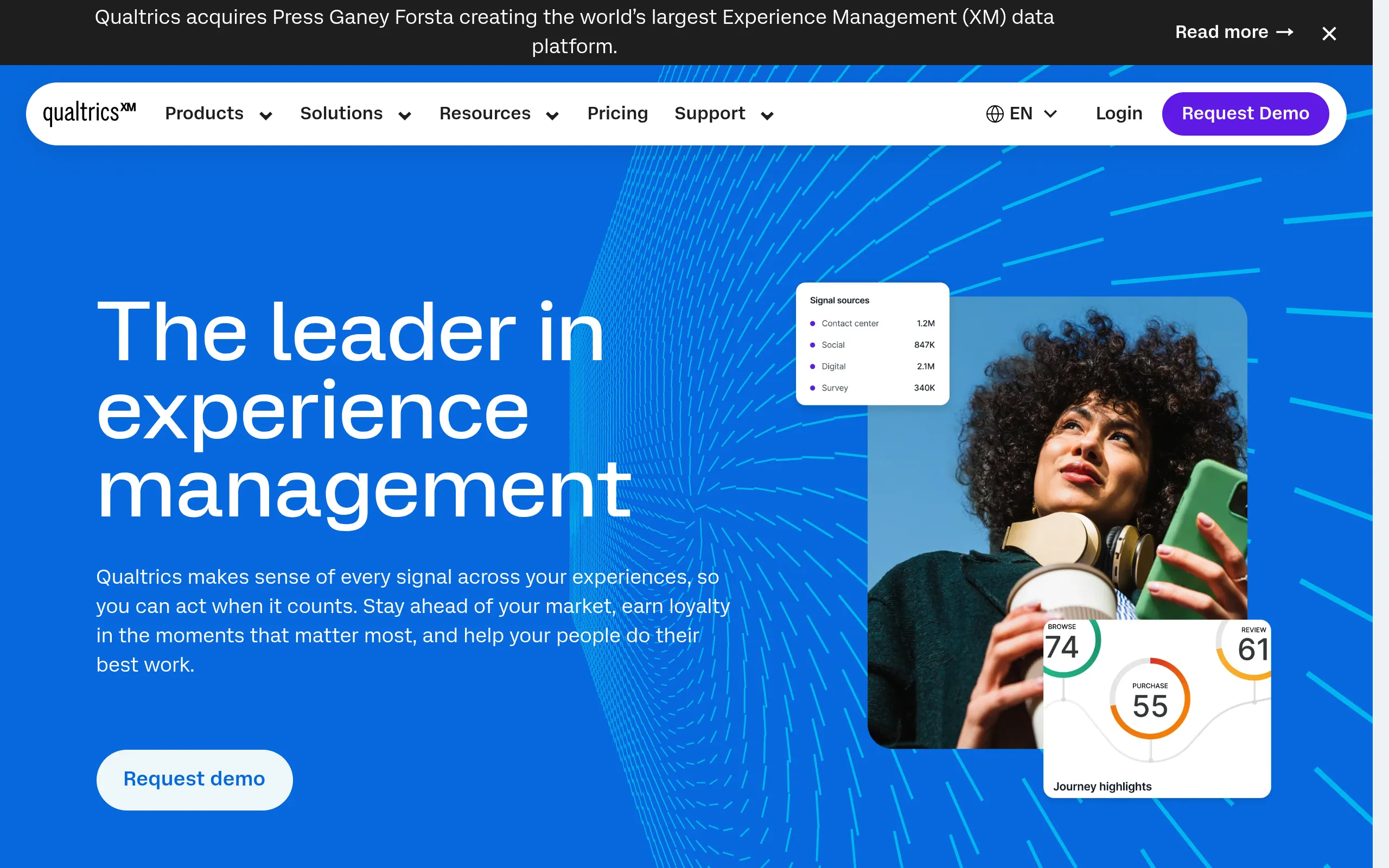
Qualtrics is an enterprise research and experience management platform with strong brand tracking built into a much wider stack. It suits teams that need deep survey logic, advanced analysis, and program governance across the business.
This is the choice when the survey is one part of a larger experience program and you need control over branching, weighting, and reporting. The flip side is weight: if your only goal is lightweight brand measurement, Qualtrics is more platform than you need, and the ramp-up reflects that.
- Best for: Enterprise buyers and research teams with complex tracking requirements
- Data source: Survey and experience management data
- Pricing model: Custom enterprise quote
- Standout strength: Advanced survey design and program governance
3. Tracksuit
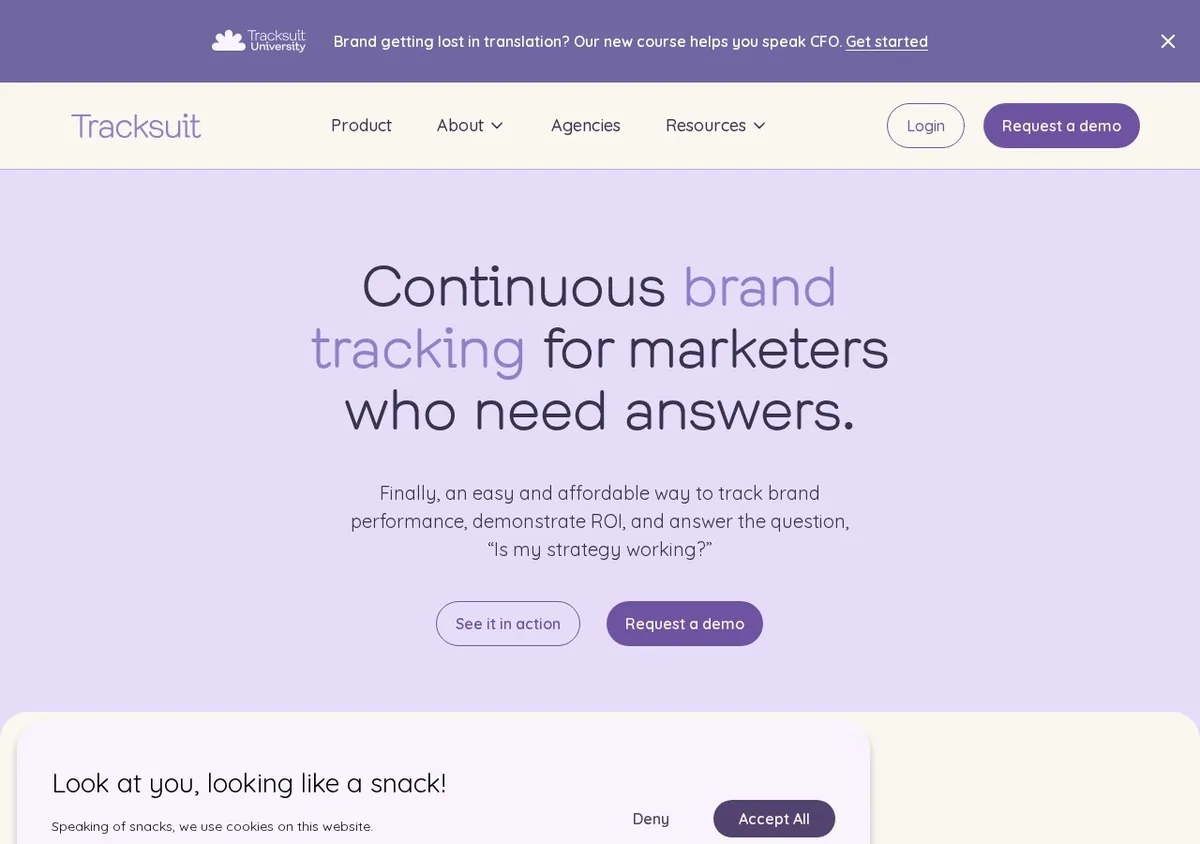
Tracksuit is an always-on brand tracking platform built for continuous brand health measurement. It fits teams that want recurring tracking without rebuilding a research program every month.
The win here’s automation plus a clean view of brand health and campaign movement over time. You see funnel metrics trend without managing fieldwork yourself.
Because it’s opinionated by design, advanced custom survey work is more limited than a full research suite, which is a fair trade for most growth teams that want signal, not survey administration.
- Best for: Mid-market brands and growth teams wanting regular tracking with less manual work
- Data source: Continuous survey-based tracking
- Pricing model: Subscription tied to scope and markets
- Standout strength: Always-on brand health trends
4. Quantilope
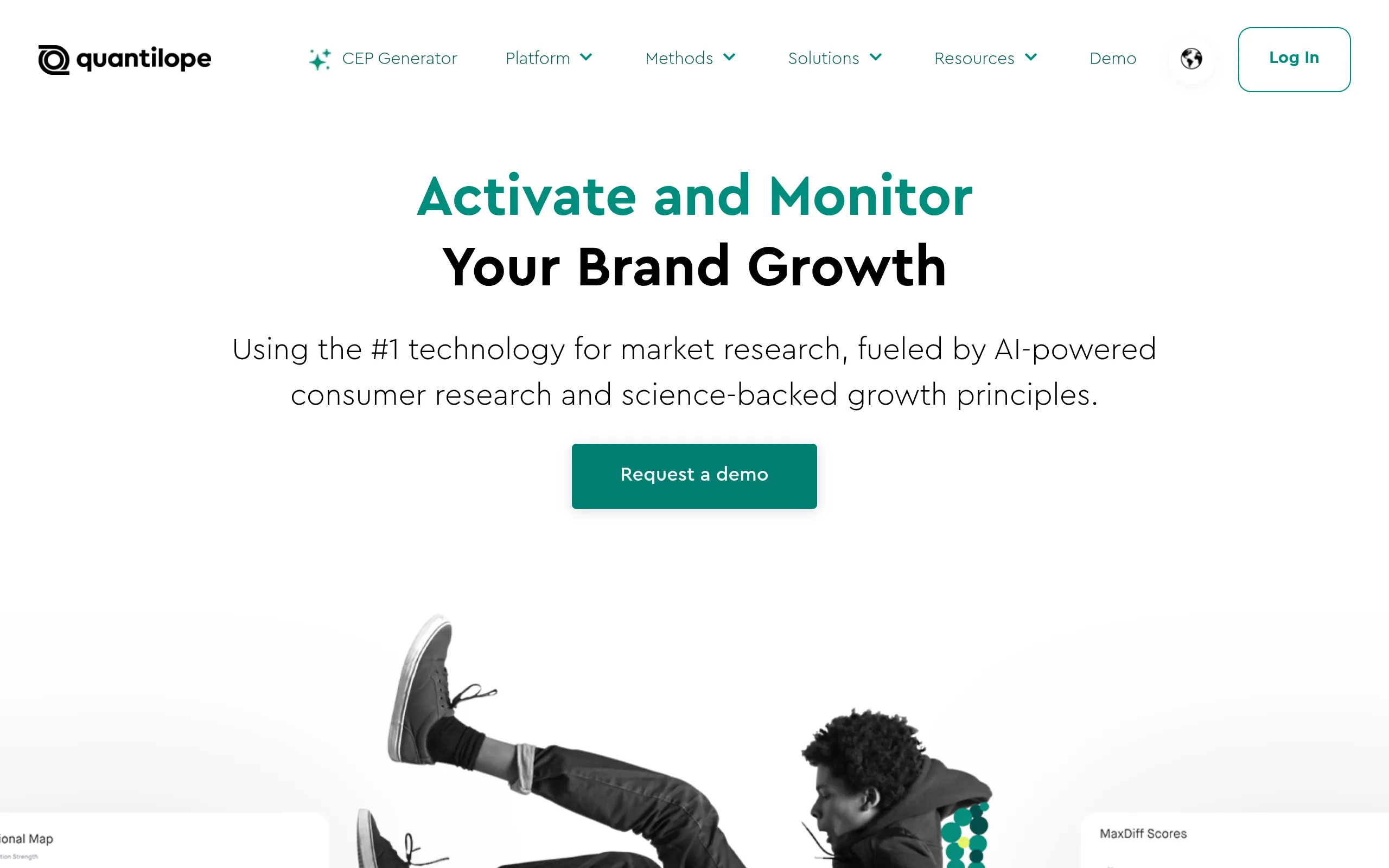
Quantilope is an automated research platform that supports advanced brand tracking and consumer insights workflows. It bridges traditional survey research and faster, more automated insight generation.
It earns its place when you want more sophisticated analysis than a basic survey tool gives, without commissioning full agency-led research each cycle. The platform leans on automated methods to cut turnaround.
That power is also the catch: it’s more capable than a simple tracker and more complex than an entry-level tool, so it rewards teams that run tracking studies regularly.
- Best for: Insights teams running regular tracking studies across multiple markets
- Data source: Automated survey research and panels
- Pricing model: Custom quote, tiered by research volume
- Standout strength: Advanced automated research methods
5. Kantar
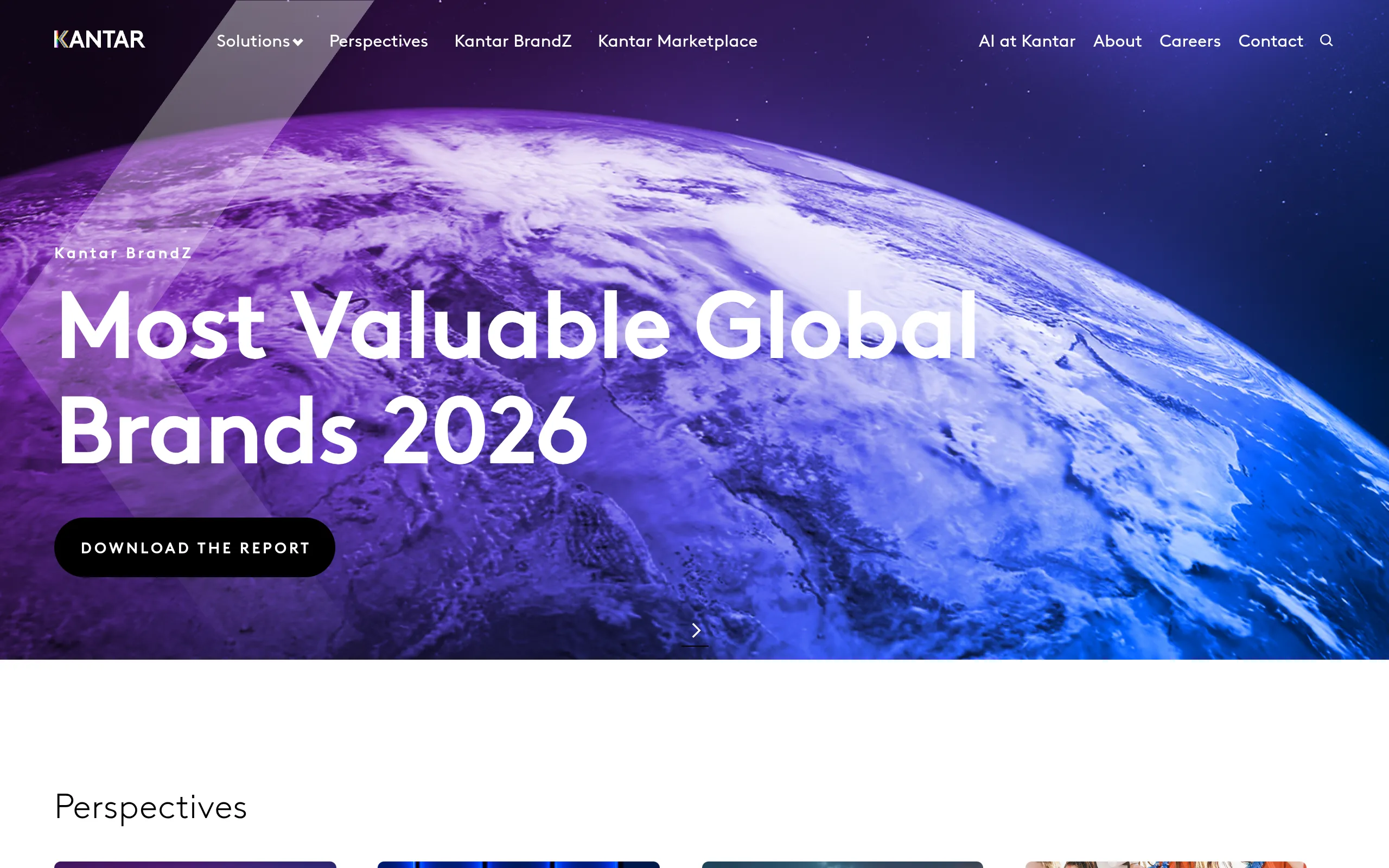
Kantar is a global market research and brand measurement provider used for large-scale brand tracking. It’s the option when multi-market consistency, benchmark depth, and research credibility outrank speed.
For organizations operating across regions, Kantar offers broad coverage and standardized measurement that holds up in a boardroom. The reality of that scale is process: more setup, more cost, and more implementation overhead than a self-serve tool. You’re buying rigor and reach, not a quick dashboard.
- Best for: Large multinational brands and mature insights organizations
- Data source: Global survey panels and research
- Pricing model: Custom quote
- Standout strength: Multi-market scale and benchmark depth
6. Attest
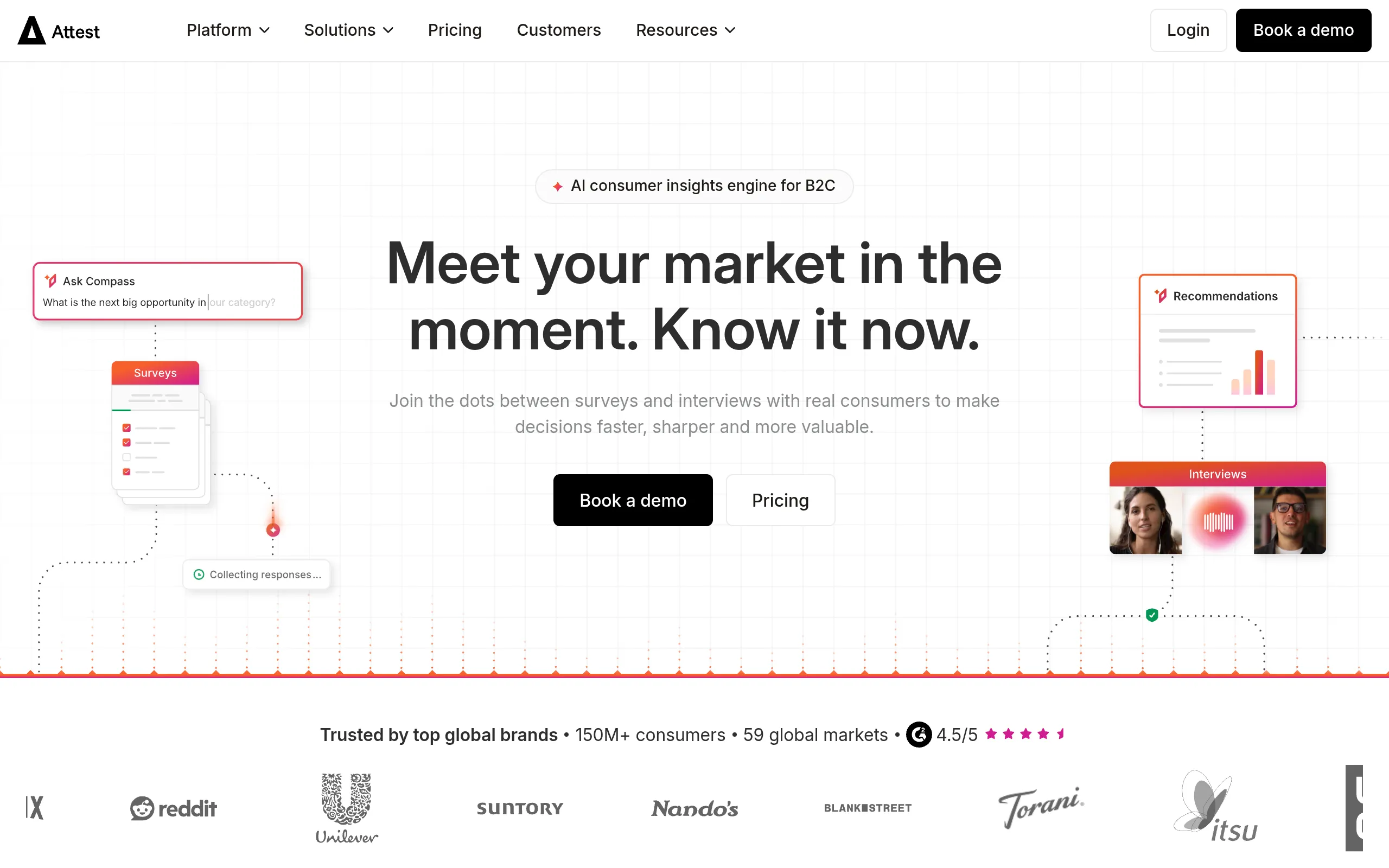
Attest is a survey research platform built for fast consumer insights and brand tracking. It gives teams a clean way to run recurring brand studies without heavy operational lift.
The balance of speed, usability, and research flexibility is what stands out. It sits between a bare survey tool and a full enterprise suite, which makes it a comfortable mid-market pick. Like the other survey platforms here, it isn’t a substitute for social monitoring or PR intelligence, so scope it to perception measurement.
- Best for: Mid-market consumer brands and lean insights teams
- Data source: Survey panel across multiple countries
- Pricing model: Package or quote-based by usage
- Standout strength: Fast, flexible recurring surveys
7. Brandwatch
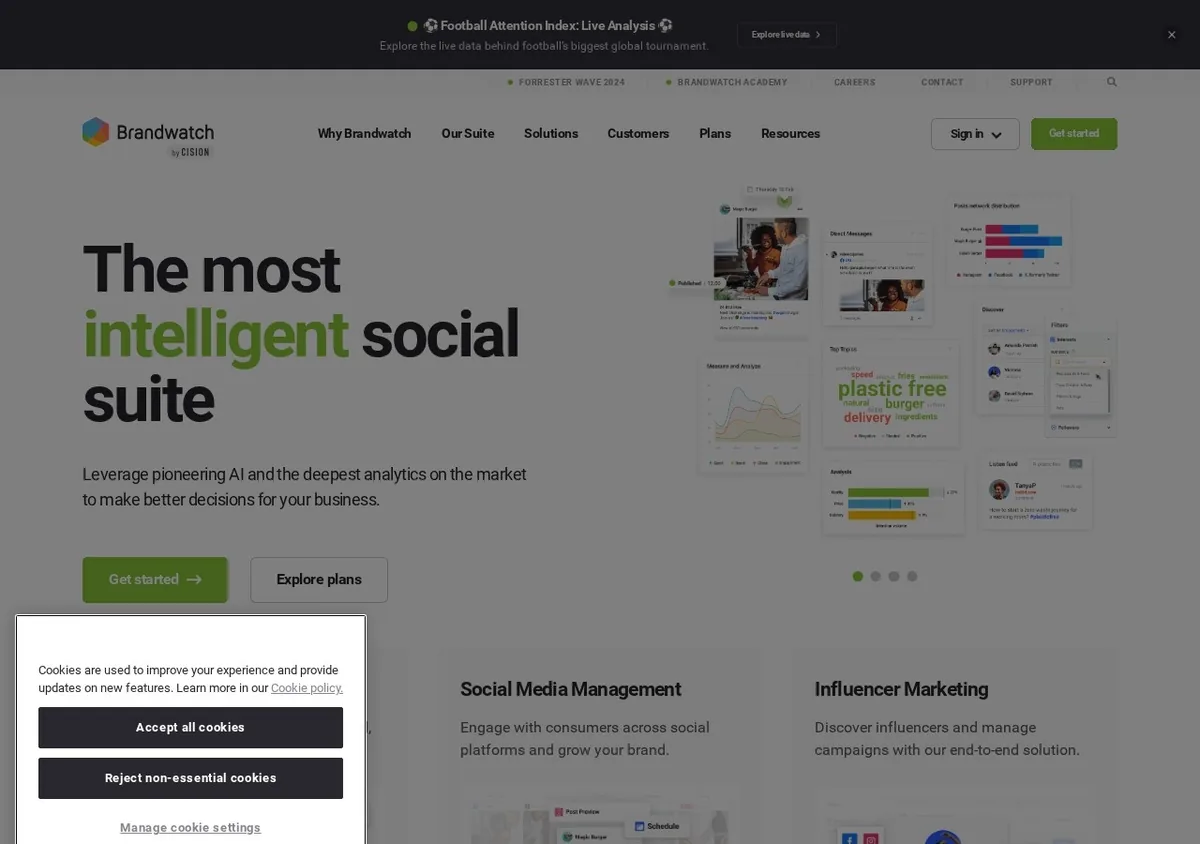
Brandwatch is an enterprise social listening and consumer intelligence platform. This is brand tracking in the monitoring sense: mentions, sentiment, themes, and share of voice across public conversations.
It shines when you need broad coverage and deeper analysis of how people talk about your brand online. The depth is real, and so is the catch.
For a small team that only wants basic mention alerts, Brandwatch is more capability and more cost than the job requires. Match it to teams that will actually use the analysis layer.
- Best for: Enterprise marketing, PR, and reputation teams
- Data source: Social listening across public conversations
- Pricing model: Custom enterprise quote
- Standout strength: Deep conversation analysis and themes
8. Talkwalker
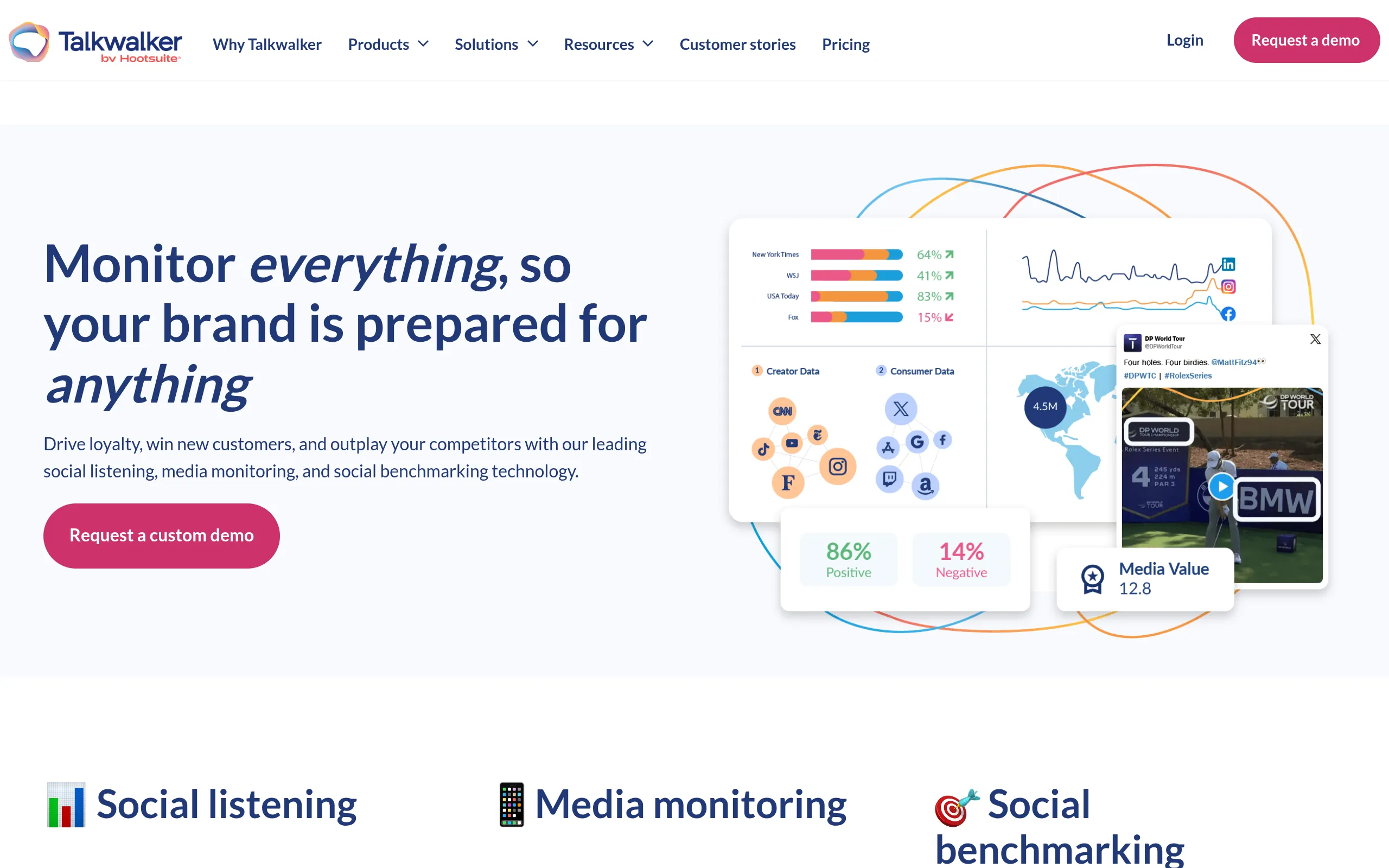
Talkwalker is a global social listening and media intelligence platform. It’s valuable when you need wide coverage across social, news, and many languages at once.
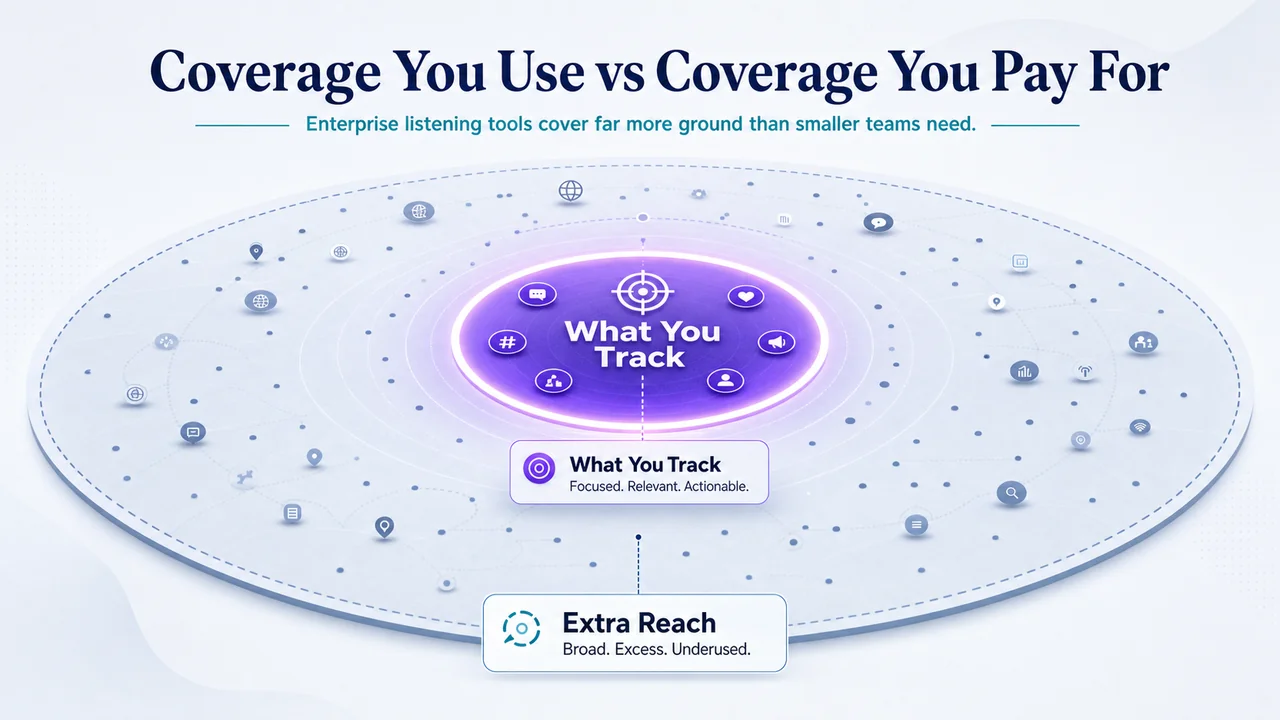
For international brands, the breadth across markets and source types is the draw, and it covers monitoring well beyond a single region. The same breadth becomes overkill for a focused, single-market team that just needs a tidy monitoring tool.
If most of your audience sits in one country, you may be paying for reach you won’t use.
- Best for: Global brands and enterprise communications teams
- Data source: Multilingual social and media intelligence
- Pricing model: Custom enterprise quote
- Standout strength: Wide multilingual source coverage
9. Brand24
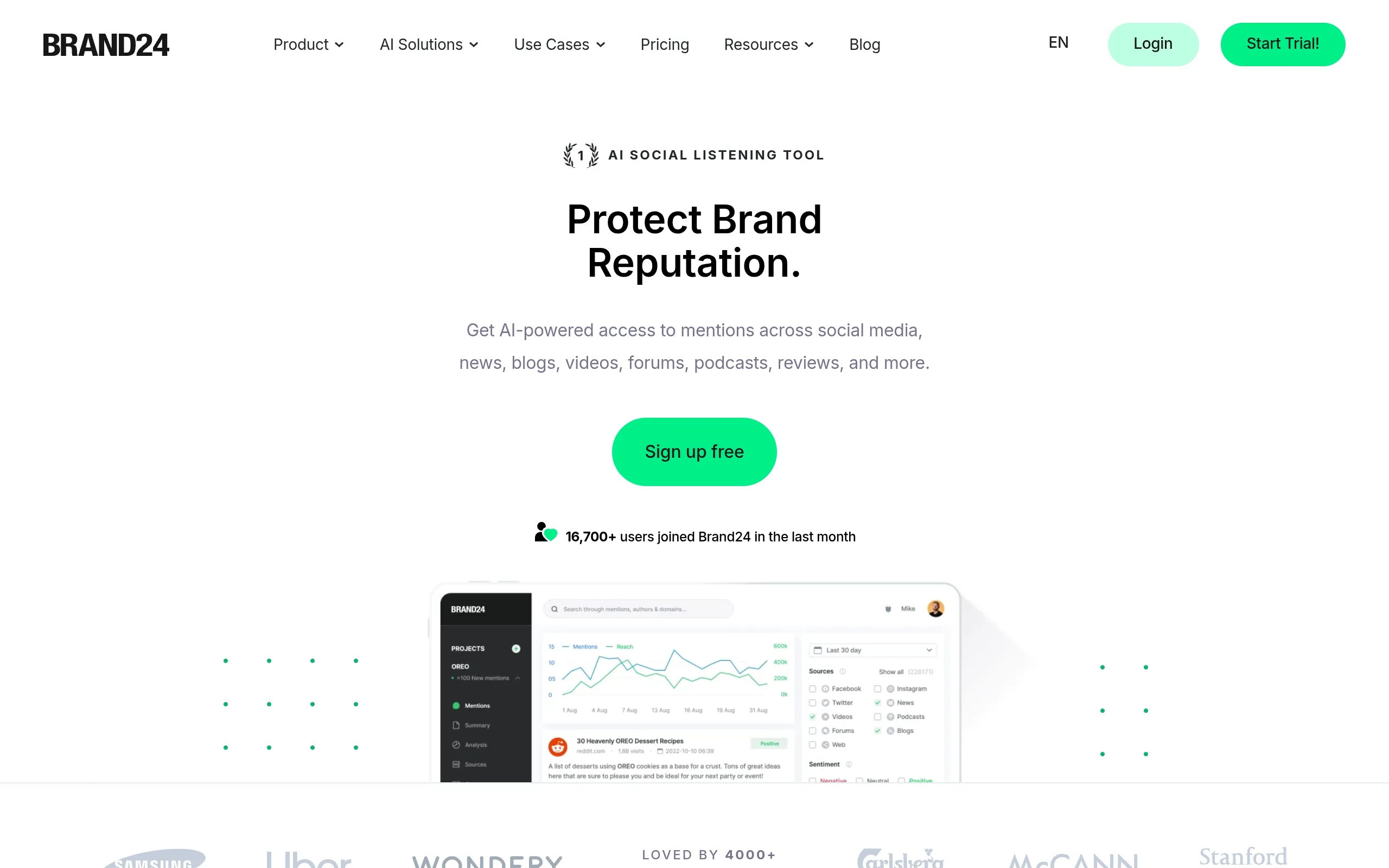
Brand24 is a more affordable brand monitoring and mention tracking tool. It gives smaller teams a lower-cost way to track mentions, sentiment, and share of voice without enterprise overhead.
It earns a spot on the shortlist for SMBs that want practical monitoring and useful alerts at a price they can defend. Setup is quick and the dashboard is approachable.
What it isn’t: a replacement for enterprise research platforms or deep survey-based brand tracking. Treat it as a sharp monitoring tool, not a perception-measurement suite.
- Best for: SMBs, agencies, and lean marketing teams
- Data source: Social listening and online mentions
- Pricing model: Public subscription, with starting tiers
- Standout strength: Affordable monitoring with alerts
See where AI answers put your brand
Twenty minutes with a senior strategist: where the major engines point buyers in your category, who gets named instead of you, and a straight read on what a programme would change.
Book a strategy callComparison Summary Table
The fastest shortlist comes from comparing source type and team size, not feature count. Use this to narrow the field in one scan.
| Tool | Best For | Data Source | Pricing Model |
|---|---|---|---|
| Pollfish | SMB survey tracking | Survey panel | Pay-per-response |
| Qualtrics | Enterprise research | Survey and experience | Custom quote |
| Tracksuit | Mid-market always-on | Continuous survey | Subscription |
| Quantilope | Multi-market insights teams | Automated research | Custom quote |
| Kantar | Global enterprise brands | Global panels | Custom quote |
| Attest | Mid-market consumer brands | Survey panel | Package or quote |
| Brandwatch | Enterprise PR and reputation | Social listening | Custom quote |
| Talkwalker | Global comms teams | Media intelligence | Custom quote |
| Brand24 | SMB and agencies | Social listening | Public subscription |
We grouped these nine by measurement method first, then weighted them for fit across SMB, mid-market, and enterprise buyers. Selection criteria were data source, automation, analytics depth, pricing transparency, and team fit. Where a vendor doesn’t publish pricing, the table marks it as a custom quote rather than guessing a number.
How to Choose the Right Brand Tracking Software
Work the decision in order, and the shortlist writes itself. The most common buying mistake is choosing a platform that tracks the wrong signal for your actual goal.
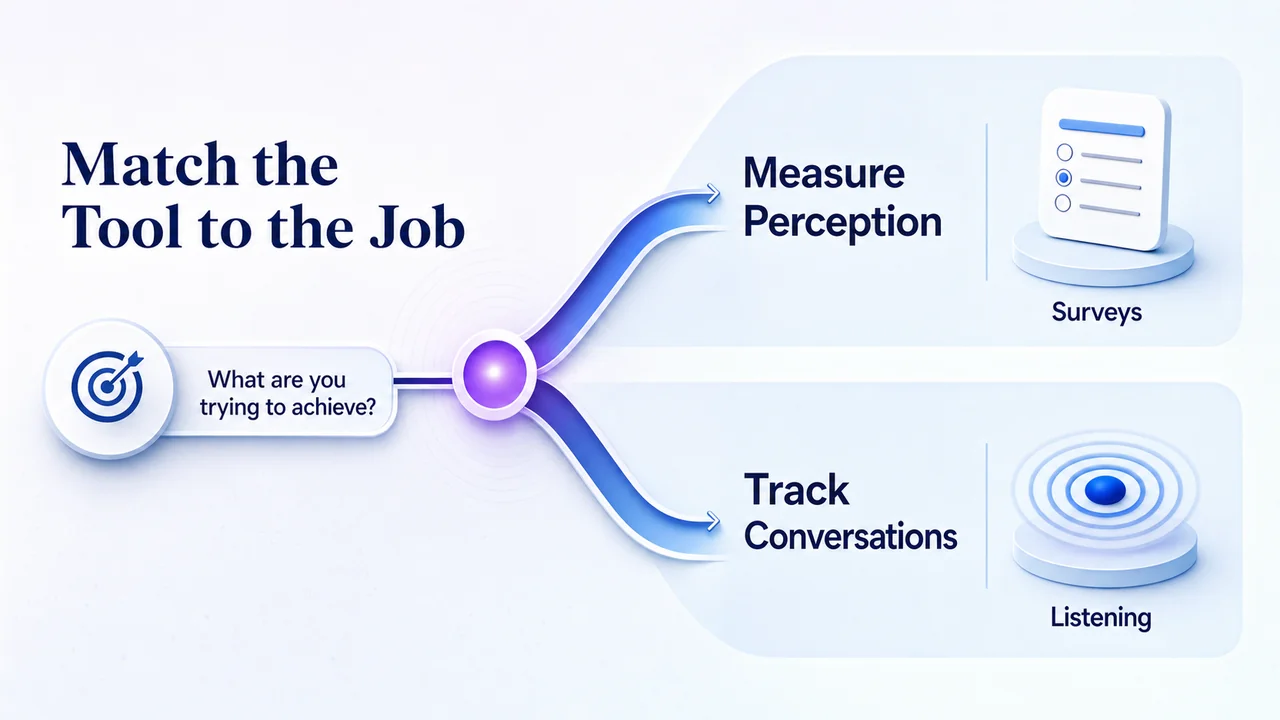
Step 1: Name the Signal You Need
Decide whether you need perception or presence. If you want awareness, consideration, brand equity, or campaign impact, you need survey-based tracking.
If you want always-on mentions, sentiment, share of voice, or reputation coverage, you need a monitoring platform. This single answer eliminates more than half the list.
Step 2: Match the Tool to Your Team Size
Enterprise buyers should prioritize multi-market support, governance, dashboards, and collaboration workflows, because the tool has to survive scrutiny across regions and teams. SMB and mid-market teams should prioritize setup speed, pricing clarity, and alert usefulness, because a tool nobody adopts is wasted budget. Team size narrows your shortlist to two or three names.
Step 3: Pressure-Test the Finalists Before You Buy
Ask each finalist for a sample dashboard, the historical depth they can show, a live alert demo, and a real trial report against your own brand. Marketing pages all look strong.
A trial report on your actual category is the only evidence that survives a procurement conversation. If AI visibility matters to your buyers, ask specifically which AI sources the platform tracks, and treat a vague answer as a no.
FAQ
What’s the difference between brand tracking software and social listening software?
Brand tracking software measures perception by surveying a sampled audience about awareness, consideration, and brand equity, while social listening software monitors live public mentions, sentiment, and share of voice. One asks people directly; the other reads what people already say.
Many teams need both, because survey data tells you what people believe and listening tells you what they’re saying right now.
Which brand tracking software is best for small businesses?
For small businesses, a lower-cost monitoring tool like Brand24 or a DIY survey platform like Pollfish usually fits best. The deciding factor is your signal: pick Brand24 if you want mention and sentiment alerts, and pick Pollfish if you want to measure awareness and perception directly.
Both keep setup fast and pricing manageable for a lean team.
Is survey-based brand tracking better than monitoring-based tracking?
Neither is better in the abstract; they answer different questions. Survey-based tracking measures what people think and feel about your brand, which is hard to fake.
Monitoring-based tracking measures what people are publicly saying and how that changes over time. If you’ve to choose one, match it to the decision you’re trying to make, not the feature list.
How often should brand tracking data be updated?
It depends on the method. Always-on monitoring tools update continuously, which suits reputation watching and campaign launches.
Survey-based tracking runs on a cadence, often monthly or quarterly, because each wave needs fresh fieldwork. Continuous trackers like Tracksuit blur that line by running rolling surveys, giving you trend data without manual study setup.
What features should I compare before buying brand tracking software?
Compare data source first, then automation, analytics depth, alerting, competitor benchmarking, pricing transparency, and setup effort. After that, weigh fit for your team size, since enterprise governance needs and SMB speed needs pull in opposite directions.
Ask for a trial report on your own brand before committing, because that’s the only test that reflects your real category.
Choosing by What You Actually Need to Measure
The best brand tracking software depends entirely on whether you need surveys, monitoring, or enterprise research depth, and no single platform wins on every criterion. Survey-first teams look at Pollfish, Tracksuit, or Attest.
Monitoring-first teams look at Brand24 or Brandwatch. Global enterprises lean toward Kantar, Qualtrics, or Talkwalker.
Shortlist your top three by data source, budget, and team size, then test the finalists against your own brand data before you buy. See what AI visibility tracking adds if your buyers now research you through AI search, or compare dedicated Semrush brand monitoring alternatives if you’re outgrowing an SEO-suite add-on.