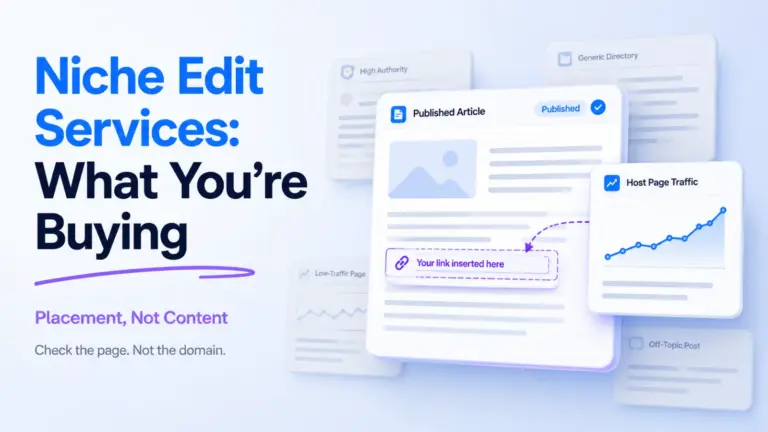

Guest posting and niche edits can both earn links, but they win for different reasons. Niche edits usually win on speed and cost, while guest posts usually win on control, brand value, and long-term durability. Neither is the universal answer. The right pick depends on whether your campaign needs authority building, quick movement, or tightly controlled placements. This comparison judges both tactics by the criteria that actually decide outcomes, so you can match the method to your goals instead of following whichever one a service page is selling.
What We’re Comparing and Why It Matters
Guest posting means publishing a new article on another site with a contextual backlink inside the content. You write the piece, you place the link, and the article goes live as a fresh asset on someone else’s domain.
Niche edits, also called link insertions, mean adding your link to a page that already exists. The page already has authority, topical relevance, or traffic, and your link slots into the body where it fits.
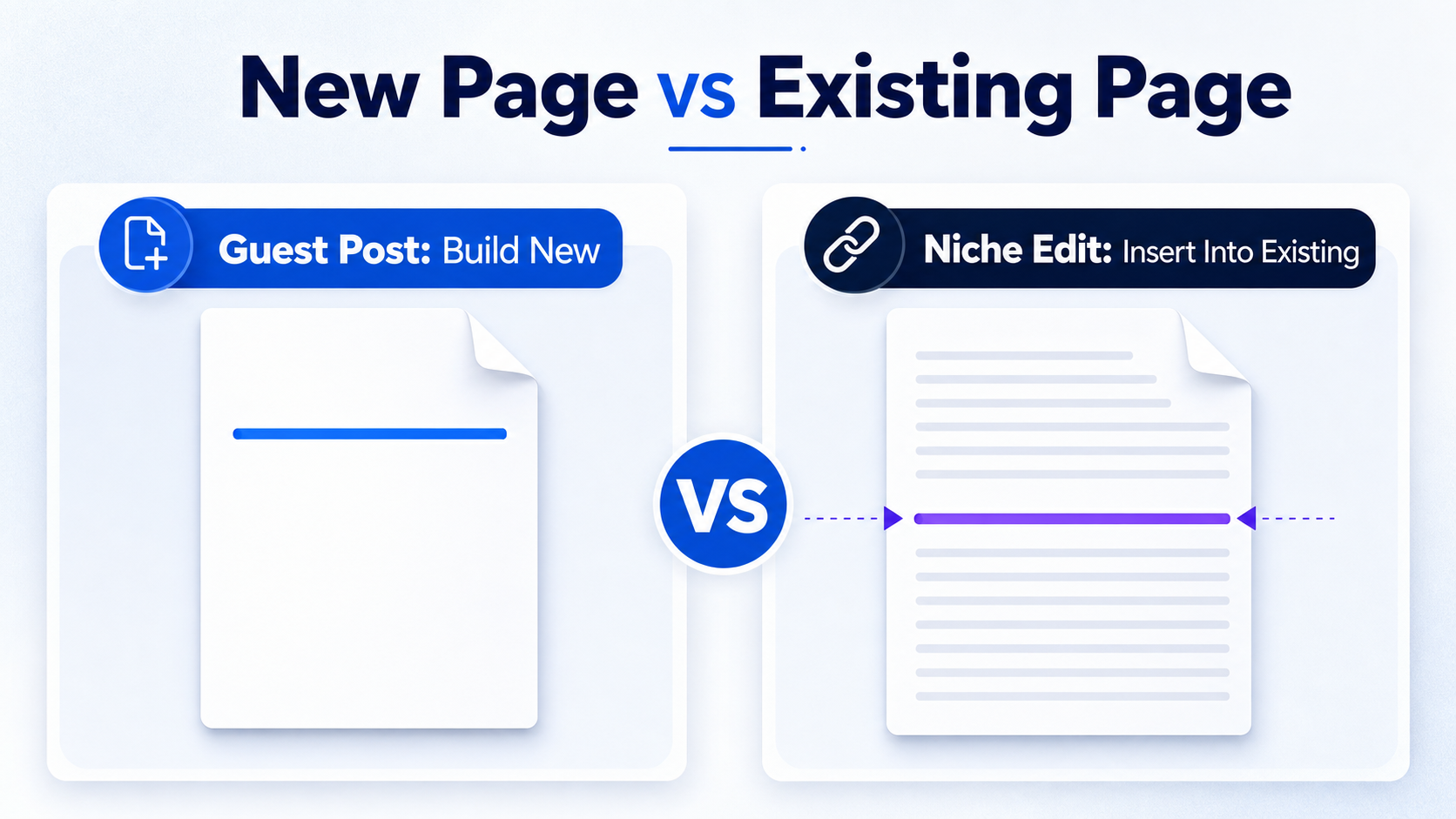
The real question is not “what are they?” Most people searching this already know. The question is which one fits a specific situation: a tight timeline, a fixed budget, a competitive niche, or a low tolerance for risk.
Both tactics work. They solve different problems inside a broader link building program. One builds standalone assets you control. The other borrows authority that already lives on a page. Judging them by ideology or by which service a vendor pushes leads to the wrong call. Judging them by decision criteria leads to the right one.
The Criteria That Decide the Winner
Before any side-by-side comparison, you need to know what you are measuring. Most link decisions go wrong because teams optimize for the cheapest link instead of the best-fit link. These eight criteria decide which tactic wins for you.
1. Speed
How fast you can execute and how quickly results show up.
2. Cost
Total spend across content, outreach labor, and placement fees.
3. Control
How much say you get over the surrounding copy, anchor text, and framing.
4. Topical Relevance
Whether the link sits in content that genuinely matches your niche.
5. Durability
How long the link survives and stays live without being removed or buried.
6. Risk and Compliance
Exposure to link-scheme scrutiny, disclosure expectations, and devaluation.
7. Scalability
How fast you can repeat the tactic across many placements.
8. Brand Value
Exposure, credibility, and referral traffic beyond the link itself.
These matter more than generic domain rating or domain authority claims. A high-DR link inside an irrelevant page does less for you than a mid-DR link inside content your buyers actually read. Judge links by outcome, not by placement type or a single vanity metric.
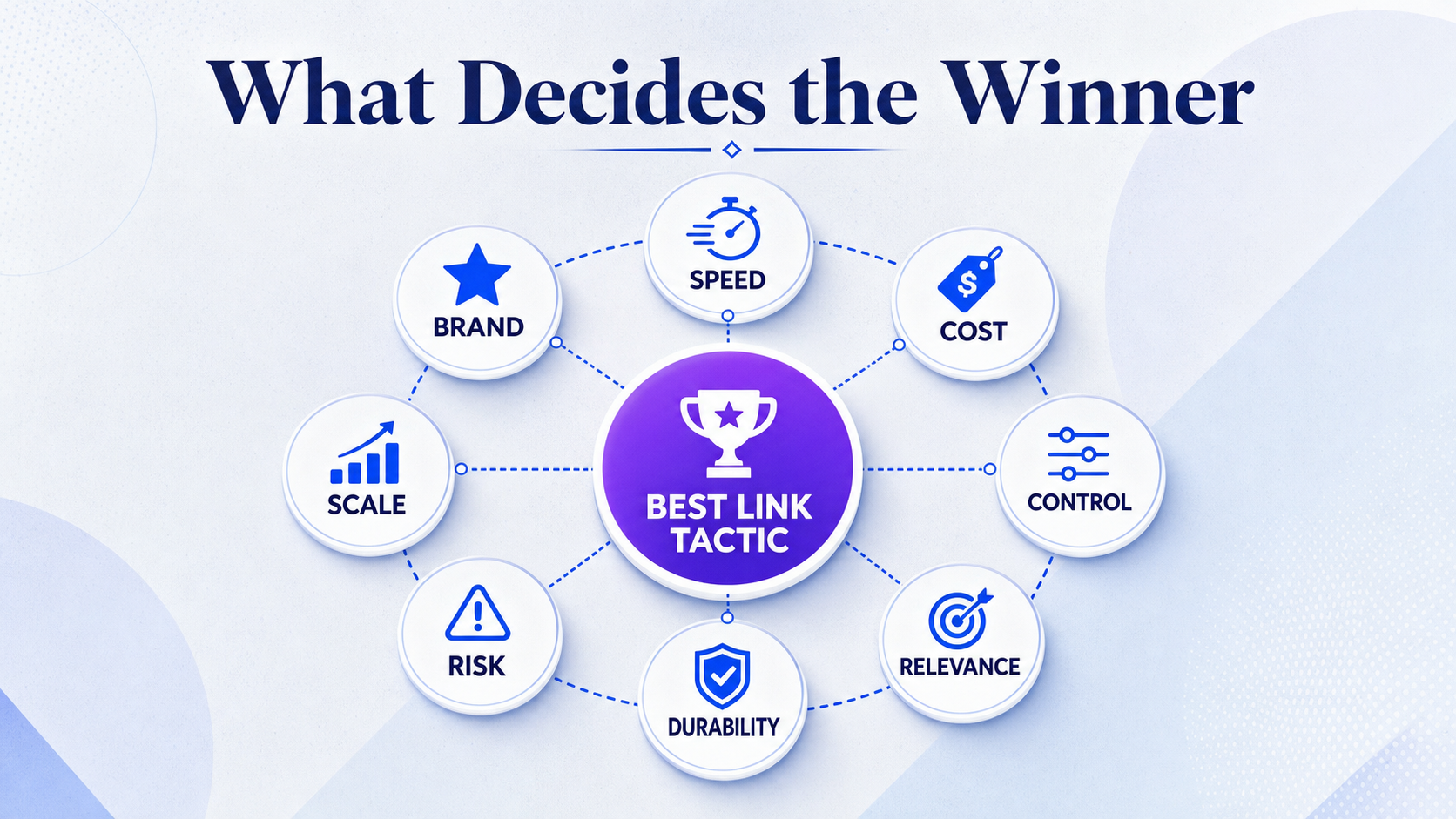
The best tactic changes with budget, timeline, niche competitiveness, and risk tolerance. A funded startup chasing brand authority answers these criteria differently than a lean affiliate site chasing quick movement. The rest of this article runs both tactics through this same framework.
Guest Posting vs Niche Edits: Side-by-Side Comparison
Here is the fast verdict across each criterion before the deeper breakdowns. Niche edits tend to win on turnaround and placement efficiency. Guest posts tend to win on content control, contextual precision, and brand building.
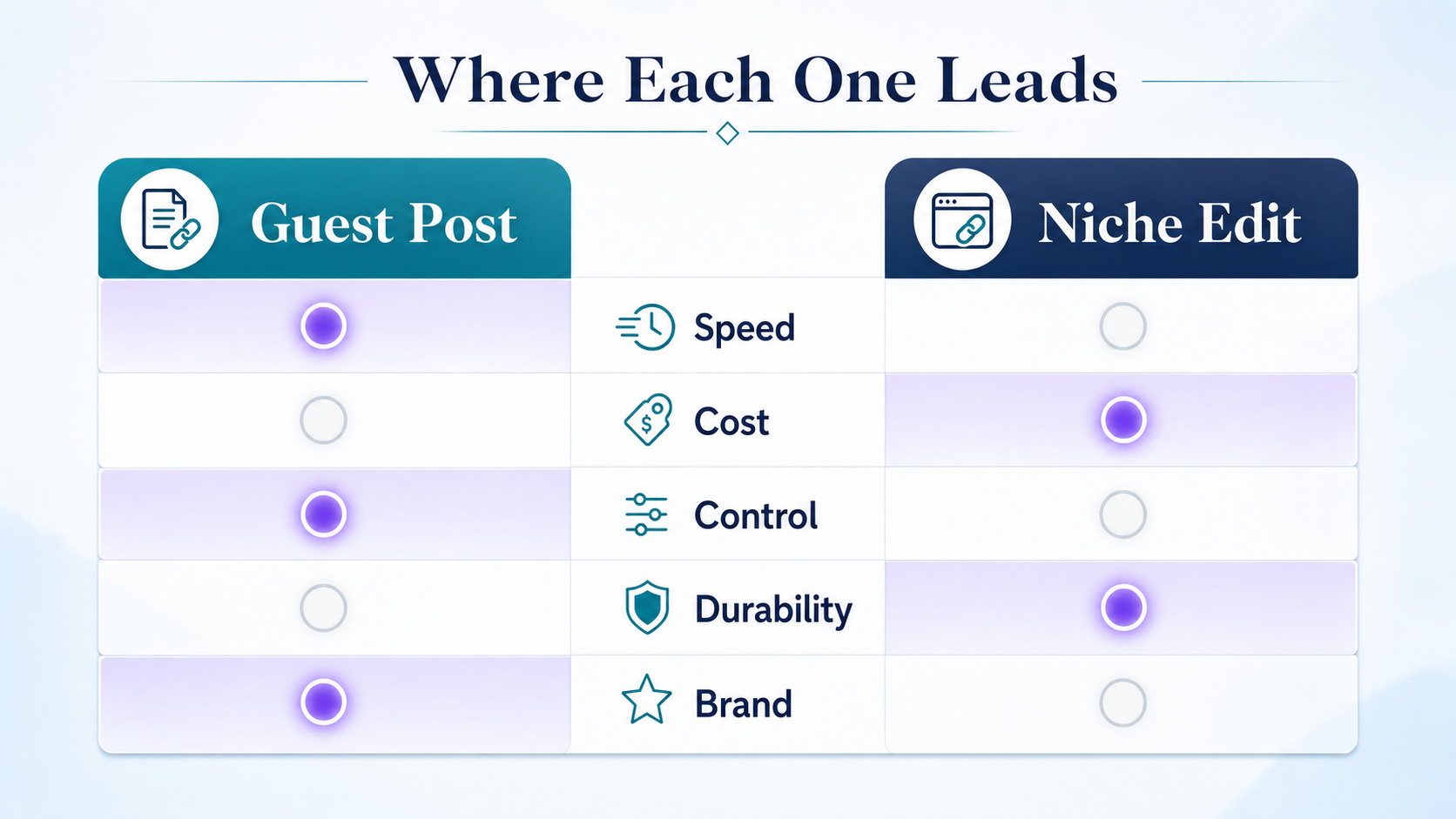
| Criterion | Guest Posts | Niche Edits | Practical Takeaway |
|---|---|---|---|
| Speed | Slower: prospect, pitch, write, edit, publish | Faster: page exists, only insertion needs approval | Pick niche edits when you need movement in weeks |
| Cost | Higher: content plus outreach plus placement | Lower: you pay mainly for placement | Lower price can hide weaker context |
| Control | High: you control copy, anchor, and framing | Limited: you rely on the existing page | Choose guest posts when framing matters |
| Topical relevance | You build the relevance yourself | Depends on the host page already | Vet the page before any insertion |
| Durability | More stable as a standalone asset | Can be removed or buried if the page changes | Guest posts age better when the host stays live |
| Risk | Editorial scrutiny, disclosure on paid spots | Looks unnatural if the page is link-stuffed | Both risk devaluation when they look manipulated |
| Scalability | Slower to repeat, but reusable as assets | Scales faster across many pages | Niche edits fill volume, guest posts build depth |
| Brand impact | Strong: exposure, credibility, referral traffic | Weak: mostly a tactical link play | Guest posts do more than pass equity |
The bottom line: the winner depends on what your campaign is optimizing for. Fast-moving link campaigns often lean toward niche edits. Brand-led SEO programs usually need guest posts in the mix. Neither table row crowns a permanent champion.
Speed, Cost, and Scalability
Niche edits feel faster and cheaper for a simple reason: the hard part is already done. The page exists, it is indexed, and someone has to approve only the insertion. There is no writing, no editing cycle, no publication lag.
Guest posting carries the full production weight. You prospect for sites, pitch an angle, write the article, run it through edits, and wait for it to go live. That cycle often runs weeks longer than a niche edit. The trade is that you end up with an asset you shaped from the ground up.

Cost splits along the same line. A guest post bundles four expenses: content creation, outreach labor, editorial fees, and the placement itself. A niche edit usually charges for placement alone. On paper, niche edits look cheaper every time.
The paper math hides a catch. A cheap niche edit on a page with thin relevance or a crowded link section buys you less than a guest post built around your exact topic. Lower price sometimes means lower control and weaker context. Price the outcome, not the line item.
Scalability tilts toward niche edits for raw volume. You can secure many insertions across many existing pages faster than you can produce many original articles. Guest posts scale slower, but each one becomes a repeatable authority-building asset that can earn traffic and secondary links on its own. Different link building methods trade speed against depth, and this pair sits at the sharp end of that trade.
Control, SEO Value, and Risk
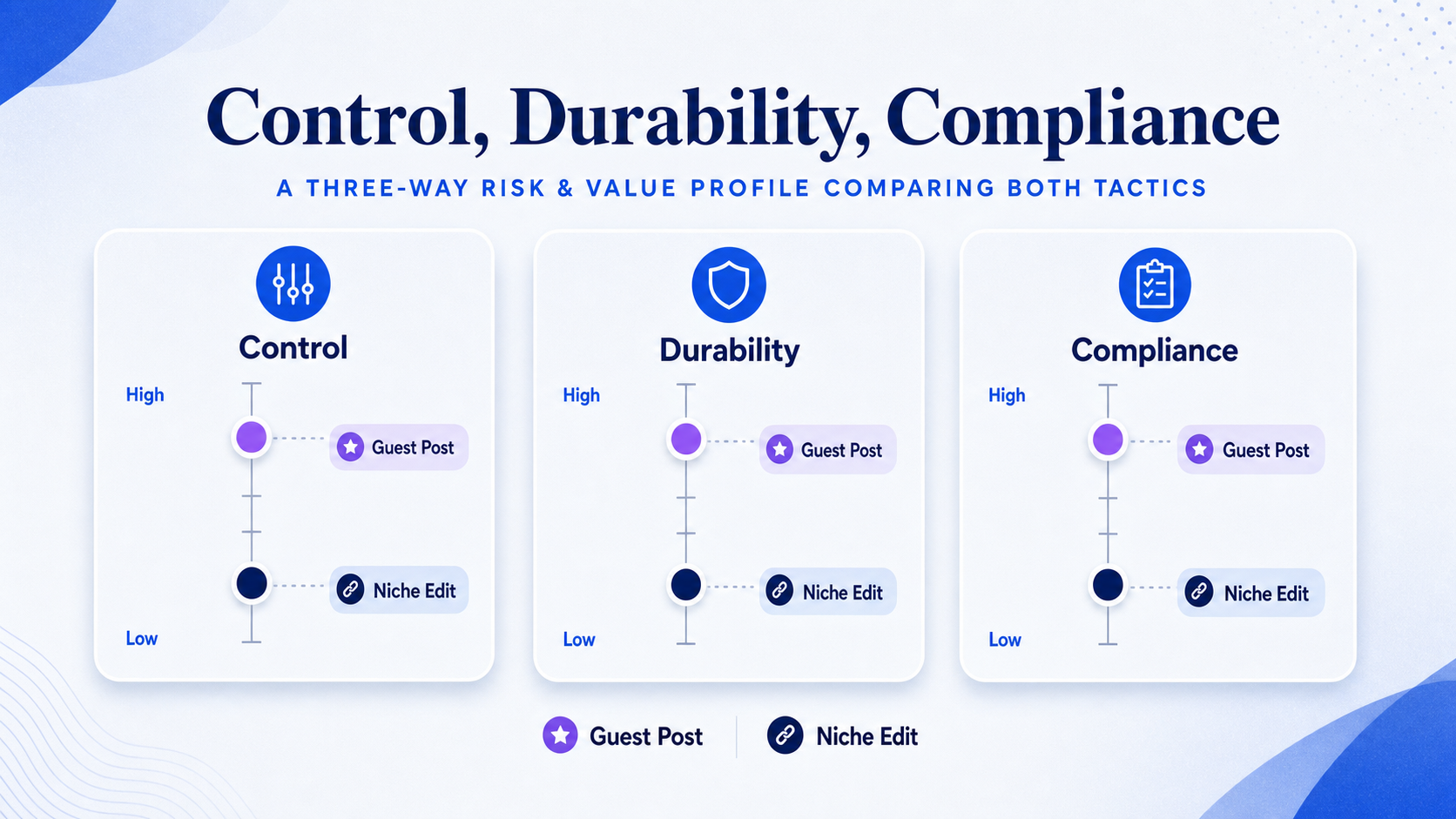
Control is where guest posts pull ahead and rarely lose. You decide the surrounding copy, the anchor text, the topical framing, and where the link sits in the flow. That control lets you place the link inside an argument that supports your page, with anchor language that reads naturally.
Niche edits hand much of that control to the host page. You inherit its writing, its context, and its existing link profile. A strong, relevant page makes the insertion powerful. A page stuffed with outbound links or only loosely related to your topic weakens it, and you cannot rewrite the page to fix that.
Link Durability
Guest posts tend to age better when the host site stays live. The link is woven into content that was created around it, so a routine page update rarely strips it. Niche edits live on someone else’s existing page, which means an editor can remove your link during a refresh, or the page can lose its own rankings and drag your link’s value down with it.
That said, durability is not automatic. A guest post on a thin site that later collapses is no more stable than a niche edit on a strong, well-maintained page. Site quality and editorial care matter more than the tactic label.
SEO Value
Both tactics pass value when the link sits on a relevant, quality page. The context around the link matters more than which method placed it. A contextual link building approach works for either tactic, because the link earns its weight from topical fit and editorial quality, not from the mechanism that put it there. The extractable rule: relevance matters more than format, and a paid link needs a sponsored or nofollow attribute either way.
Risk and Compliance
Both tactics carry risk when they look manipulated. Paid guest posts that skip disclosure and niche edits dropped onto link-stuffed pages both invite scrutiny and possible devaluation. The risk isn’t in the format itself, though Google’s link spam policy covers any paid link that passes ranking credit. The rest is in execution that ignores relevance, disclosure expectations, and editorial standards.
Guest posts are easier to defend when a brand wants editorial visibility, because the placement reads as a contributed piece on a topic the brand knows. Niche edits are better when the job is pure link efficiency and the host page is genuinely strong. Editorial link building that earns real authority sets the standard either way: the link should look earned, because the safest link is one that would survive a manual review.
Brand and Traffic Benefits
Guest posts do work a niche edit cannot. A bylined article on a respected site builds exposure, credibility, and referral traffic. Readers click through, and the piece can establish your brand as a voice in the space. Niche edits are tactical by nature. They reinforce a link profile, but they rarely send meaningful referral traffic or build name recognition.
See where AI answers put your brand
Twenty minutes with a senior strategist: where the major engines point buyers in your category, who gets named instead of you, and a straight read on what a programme would change.
Book a strategy callVerdict by Use Case and Hybrid Strategy
The right tactic depends on who you are and what the campaign needs. Here is the call by scenario.
1. Startups Building Credibility
Lean guest posts. Early-stage brands need thought leadership and editorial visibility more than raw link volume. A guest post on a respected site does double duty as proof and as a link. A blogger outreach service that works can make this repeatable when you lack the time to pitch yourself.
2. B2B SaaS and Competitive Niches
Lean guest posts with niche edits as support. You want topical control and content assets that can earn traffic on their own. In a crowded niche, the framing you control inside a guest post is worth the extra cost.
3. Limited Budgets and Quick Wins
Lean niche edits. When speed and placement efficiency matter more than content ownership, insertions move the needle faster for less. Vet each host page so you are not buying a link in junk content.
4. Local Businesses and Mature Sites
Use a cautious mix. You need both authority and efficient link volume, so blend a few guest posts for depth with niche edits for velocity.
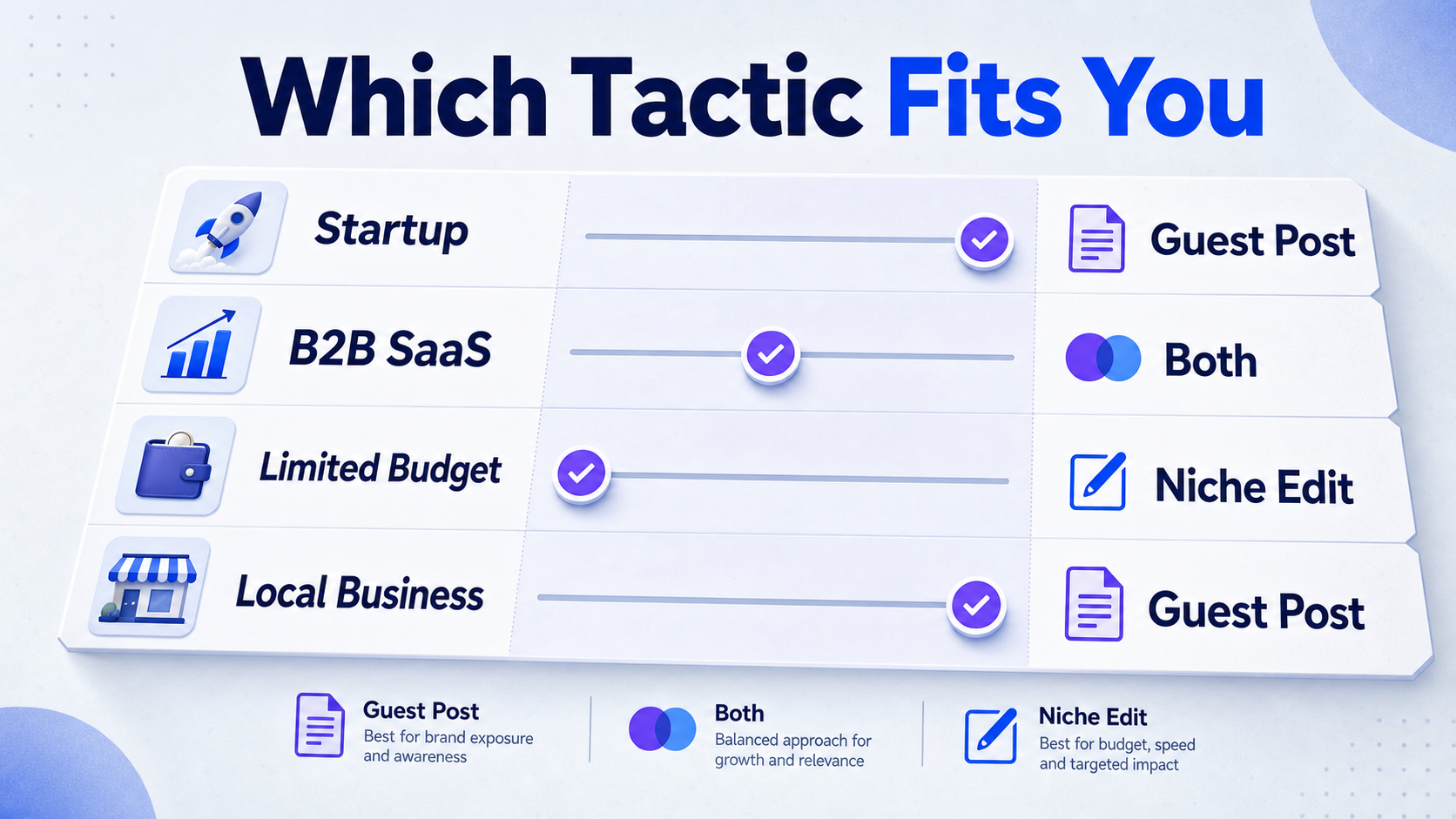
The hybrid model is where most strong campaigns land. Use guest posts to build credibility and topical depth. Use niche edit link insertion placements to fill gaps, diversify the profile, and accelerate impact between guest post cycles. A mix suits sites that need both authority and velocity.
The rule of thumb: if the campaign needs long-term positioning, lean guest posts. If it needs rapid, contextual reinforcement, lean niche edits. Most sites need both at different moments.
Choosing the Tactic That Matches Your Campaign
Niche edits are usually faster and cheaper. Guest posts usually give more control, brand value, and longer-term utility. There is no universal winner, only a better fit for your goals, budget, timeline, and risk tolerance. The strongest campaigns choose the tactic that serves the objective in front of them, not the one that sounds better on a sales page. Map your priority, then pick. Choose the link tactic that matches your timeline, budget, and risk tolerance before you build the rest of the campaign.
A Data Point for This Decision
Source authority matters more than placement type. Raw link count tracks AI visibility poorly. In Ahrefs’ study of AI Overview brand visibility factors, backlinks correlated with AI Overview visibility at 0.218, against 0.664 for branded web mentions. That applies equally to guest posts and niche edits. What decides it is whether the placement gets your brand mentioned on pages the web already links to. In a separate Ahrefs study, those mentions tracked AI Overview visibility closely but barely registered in ChatGPT, and it’s correlation only.
For a full ranked comparison of guest posting providers specifically, see best guest posting services.
Frequently Asked Questions
Which is better for SEO, guest posting or niche edits?
Neither is universally better for SEO. Guest posts give you content control and brand exposure, while niche edits give you speed and placement efficiency. The better choice depends on whether your campaign needs authority and traffic or fast, contextual link volume. Match the tactic to the goal rather than chasing a single winner.
Are niche edits safer than guest posts?
Not inherently. Both carry less risk on relevant, quality pages with natural anchors, but a paid link of either kind needs a sponsored or nofollow attribute. Both grow risky when they look manipulated: a niche edit on a link-stuffed page or a paid guest post without disclosure invites the same scrutiny. The risk lives in execution, not in the tactic label.
Do guest posts stick longer than niche edits?
Guest posts often age better because the link is built into content created around it, so a routine update rarely strips it. Niche edits can be removed during a page refresh or weakened if the host page loses rankings. But a guest post on a weak site that collapses is no more durable than a niche edit on a strong, well-maintained page.
Are niche edits cheaper than guest posts?
Usually, yes. A niche edit charges mainly for placement, while a guest post bundles content creation, outreach labor, editorial fees, and the placement itself. The lower price can hide weaker context, though. A cheap insertion on a thinly relevant page often delivers less than a guest post built around your exact topic.
Should I use both guest posts and niche edits?
For most sites, yes. A hybrid approach uses guest posts to build credibility and topical depth, then niche edits to fill gaps, diversify the link profile, and accelerate impact between guest post cycles. A mix suits sites that need both authority and velocity.