
If you’re searching for the best contextual link building services, there’s no single winner, because the right service is the one that proves topical relevance, editorial quality, and transparent reporting for your specific niche and budget. A ranked list of vendors is the wrong tool for this decision.
The provider that suits a Series A SaaS team is rarely the one that suits a law firm or an agency reselling placements.
This guide gives you the evaluation framework instead: the eight criteria that separate a defensible contextual link from a liability, the provider categories worth shortlisting, and the red flags that should end a sales call early.
Most buyers waste money here by optimizing for one metric, usually Domain Rating, while ignoring whether the link actually sits inside a topic-matched article. That single habit is the difference between links that compound and links that get devalued.
The Short Version
- The best contextual link building service is the one that shows you sample placements and reporting structure before you commit, not after.
- Relevance beats raw authority: a link inside a topic-matched article on a smaller site usually outperforms a high-DR placement on an unrelated page.
- Match the provider type to your stage: managed services for hands-off delivery, marketplace models for scale and comparison, boutique outreach agencies for niche-sensitive campaigns.
- Walk away from anyone selling on DR alone, refusing sample URLs, or promising guaranteed rankings.
This article assumes you already know what a contextual link is: a link placed inside the body of a relevant article. It focuses entirely on how to buy one well.
Why a Ranked Vendor List Is the Wrong Way to Choose
The roundup pages dominating this search term share one structural flaw: they rank providers as if “best” were a fixed property of the vendor rather than a function of your campaign.
It isn’t.
A contextual link earns its value from three things at once: the topical match between the linking page and your target page, the editorial standard of the publisher, and the way the link is placed inside genuine content. None of those are captured by a numbered list that crowns a single champion.
The same provider can deliver an excellent placement for one client and a weak one for another, depending entirely on whether their publisher pool overlaps with your niche. That’s why this guide teaches you to evaluate, not to copy someone else’s ranking.
The 8 Criteria That Separate Strong Services From Risky Ones
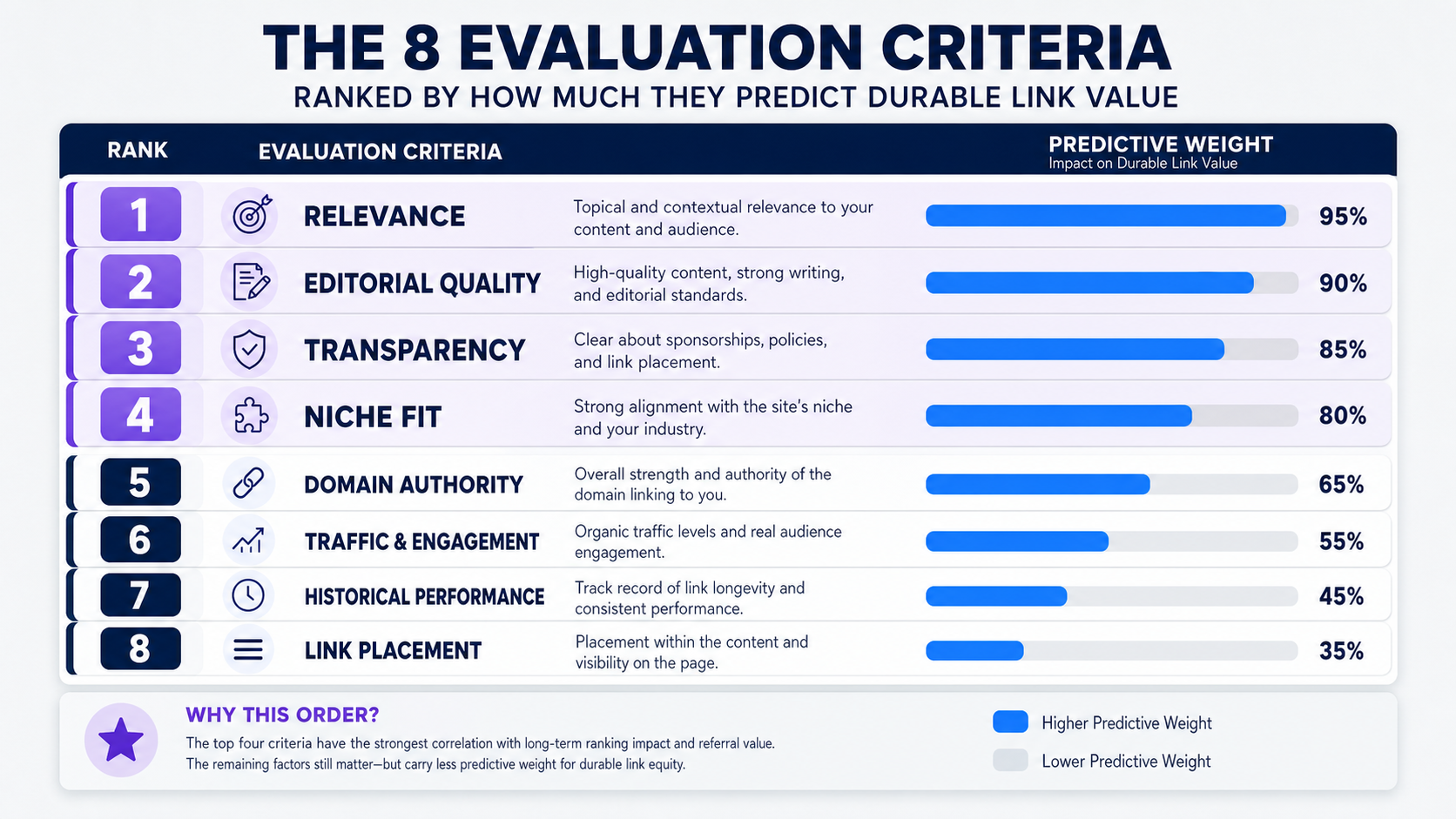
Score every provider you consider against these eight criteria before you compare price. The first four carry the most weight, because they predict whether the links survive future algorithm updates.
1. Link Relevance
Relevance means the link sits inside an article on the same topic as your target page, not just on a high-authority domain. A finance link on a finance article beats a finance link buried in a generic lifestyle blog, every time. Ask the provider how they match publisher topics to client pages, and require examples.
2. Editorial Quality
Editorial quality covers human review, real content standards, and the absence of obvious link farms or thin pages. Read a sample article end to end. If it reads like filler written only to host links, the placement carries little durable value.
3. Transparency
Transparency means you see sample URLs, placement examples, and reporting format before the campaign starts. Providers confident in their work show it early. Our piece on editorial link building that earns real authority explains why editorial proof matters more than promises.
4. Niche Fit
Niche fit is whether the provider has genuine reach in your industry. A service strong in ecommerce may have almost no relevant publishers in cybersecurity or fintech. Ask directly which verticals their network covers best.
5. Pricing Clarity
Pricing clarity means you understand what you pay per placement or per month and what that includes. Some services use custom quotes, others run marketplace pricing, and others sell fixed packages. None of these models is inherently better, but vague pricing is a warning sign.
6. Turnaround
Turnaround is how long placements take from order to live link. Honest providers quote ranges in weeks, not instant delivery. Anyone promising same-day live editorial links is usually selling something other than editorial links.
7. Reporting
Reporting should show you live URLs, anchor text, publisher metrics, and placement dates in a format you can audit. If reporting is a screenshot or a vague summary, you can’t verify what you bought.
8. Risk Profile
Risk profile is the provider’s stance on link schemes, anchor over-optimization, and link velocity. A service that talks openly about pacing and natural anchor distribution is managing your risk. One that ignores it is creating it.
Provider Categories Worth Shortlisting
Rather than naming a winner, sort the market into the categories that actually map to buyer needs. Most services fall cleanly into one of these, and knowing the category tells you what tradeoffs to expect.
Managed Done-for-You Services
These handle prospecting, outreach, content, and placement for you. They suit teams that want relevance and editorial screening without running outreach internally. Expect higher per-link cost in exchange for less operational work, and confirm reporting depth before ordering.
Marketplace-Style Platforms
Marketplace models give you a wide publisher pool and let you compare placements across sites. They favor buyers who want scale and the ability to vet inventory directly. The tradeoff is that quality varies across the marketplace, so sample-URL vetting matters more, not less.
Boutique Outreach Agencies
Boutique agencies run custom, niche-sensitive campaigns with tighter targeting and fewer one-size-fits-all deliverables. They fit SaaS, B2B, and specialized industries where topical match is hard.
Custom work takes longer and needs a clear brief from you. Our guide on hiring a link building consultant who delivers covers how to brief this kind of partner.
Enterprise and Digital PR Services
These pursue authority-style links through linkable content and earned media rather than packaged placements. They suit larger budgets and teams that want link building integrated with broader SEO and brand strategy. They reward patience over instant volume.
White-Label Providers for Agencies
If you resell links to clients, white-label delivery, consistency, and clean reporting matter more than brand recognition. Our overview of white label link building services for agencies walks through what to demand from a reseller partner.
How to Choose by Budget, Niche, and Risk
Use this decision path to route yourself from your situation to the right provider category.
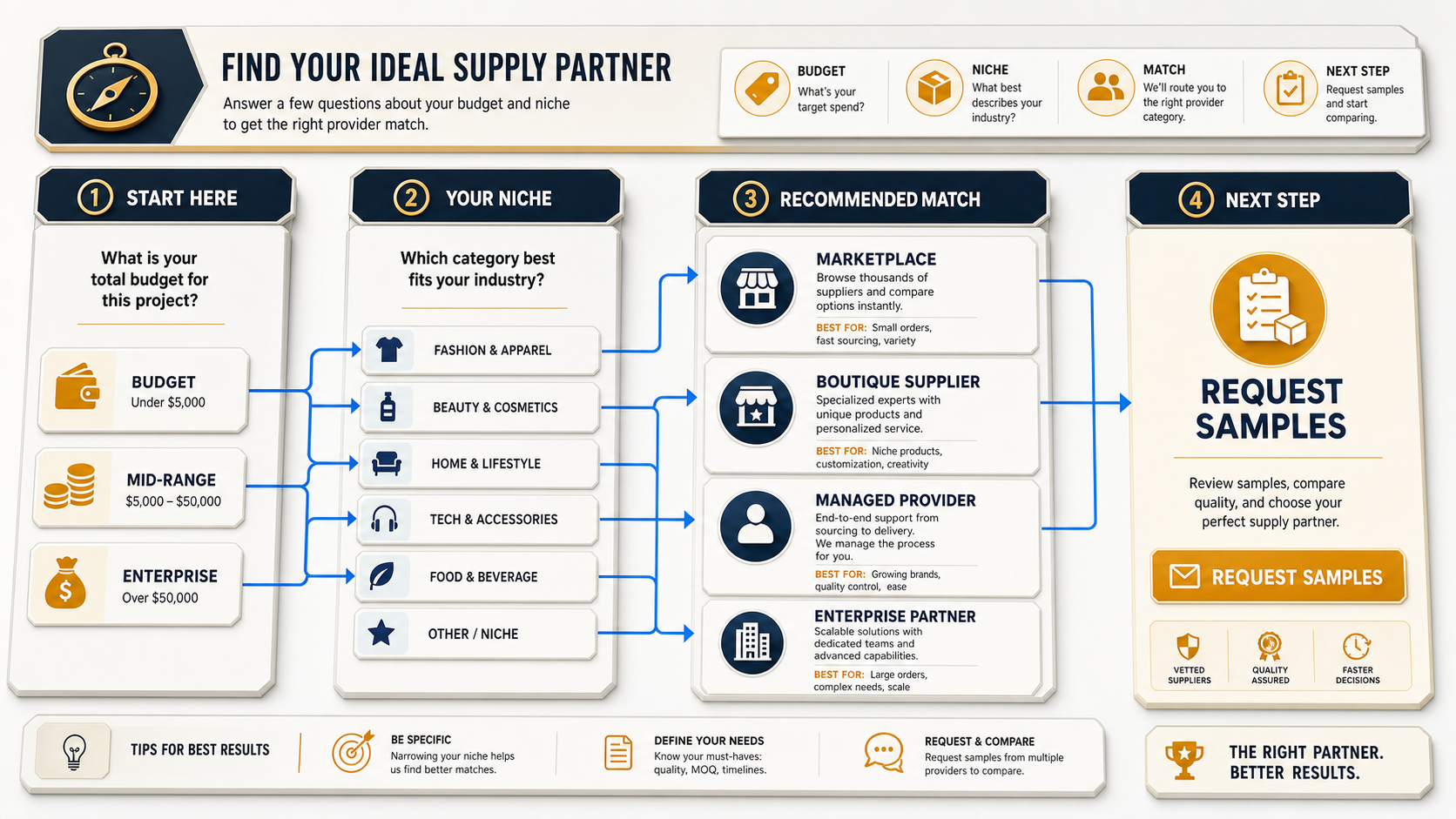
If budget is tight, prioritize any provider that shows real sample placements and clear reporting before you pay, regardless of category. A cheaper service with verifiable samples beats an expensive one selling on reputation alone.
If your brand is SaaS or B2B, prioritize niche fit and editorial context over raw Domain Rating. A boutique outreach agency with reach in your vertical usually outperforms a generalist marketplace. Our breakdown of the best link building agencies for B2B shows what specialized fit looks like in practice.
If you operate in an enterprise or high-risk space such as fintech, healthcare, or legal, prioritize transparency, content standards, and campaign control above speed. Enterprise and digital PR services manage that risk better than fast-turnaround marketplaces.
If you’re an agency or reseller, prioritize white-label options, delivery consistency, and reporting clarity so you can stand behind the links to your own clients.
What Contextual Link Building Actually Costs in 2026
Pricing in this space has calcified into three clear tiers, and the tier tells you more about the service than the sales page ever will.
| Price per link | What you’re actually buying | Typical outcome |
|---|---|---|
| $50 to $150 | Marketplace placement on a site that exists to sell links. DR inflated through other paid links. Little to no organic traffic. | Indexed sometimes. Moves rankings rarely. Risk of manual action if stacked. |
| $200 to $500 | Mixed inventory, some legitimate mid-tier publications, some marketplace sites dressed up as editorial. Depends entirely on vendor selectivity. | Works for some niches, fails in others. Quality varies link-to-link even within the same order. |
| $500 to $1,500+ | Actual editorial outreach to real publications with organic traffic and independent editorial standards. Slower turnaround, fewer links per month. | Consistent ranking movement in 3-6 months. Links stay live. Survives algorithm updates. |
A 2022 Authority Hacker survey of 755 link builders put the average placement fee for a paid backlink at $83. That sounds encouraging until you realize the average paid backlink also does roughly nothing. The useful number isn’t the average, it’s the floor below which quality stops being possible. In 2026, that floor sits around $200 to $250 per placement, and even that requires a vendor who’s willing to say no to publications that don’t meet their standard.
Why Cheap Contextual Links Stopped Working
The $50 contextual link isn’t a 2026 problem, Google’s been discounting networked placements since the Penguin era. What changed is how visible the discounting became. Sites that existed purely to sell links used to at least rank for their own niche keywords. Now most of them don’t rank for anything. Their traffic is referral from Upwork gigs. Google knows what these sites are, and a link from one is worth what you paid for it: nothing in ranking terms, a tax deduction at best.

If a service is selling contextual links at volume for $75 each, they’re either buying from the same handful of networks everyone else buys from, or they’re running their own. Either way, the links aren’t editorial, they’re inventory.
Red Flags That Should End the Conversation
Treat any one of these as a reason to walk away, no matter how polished the pitch.
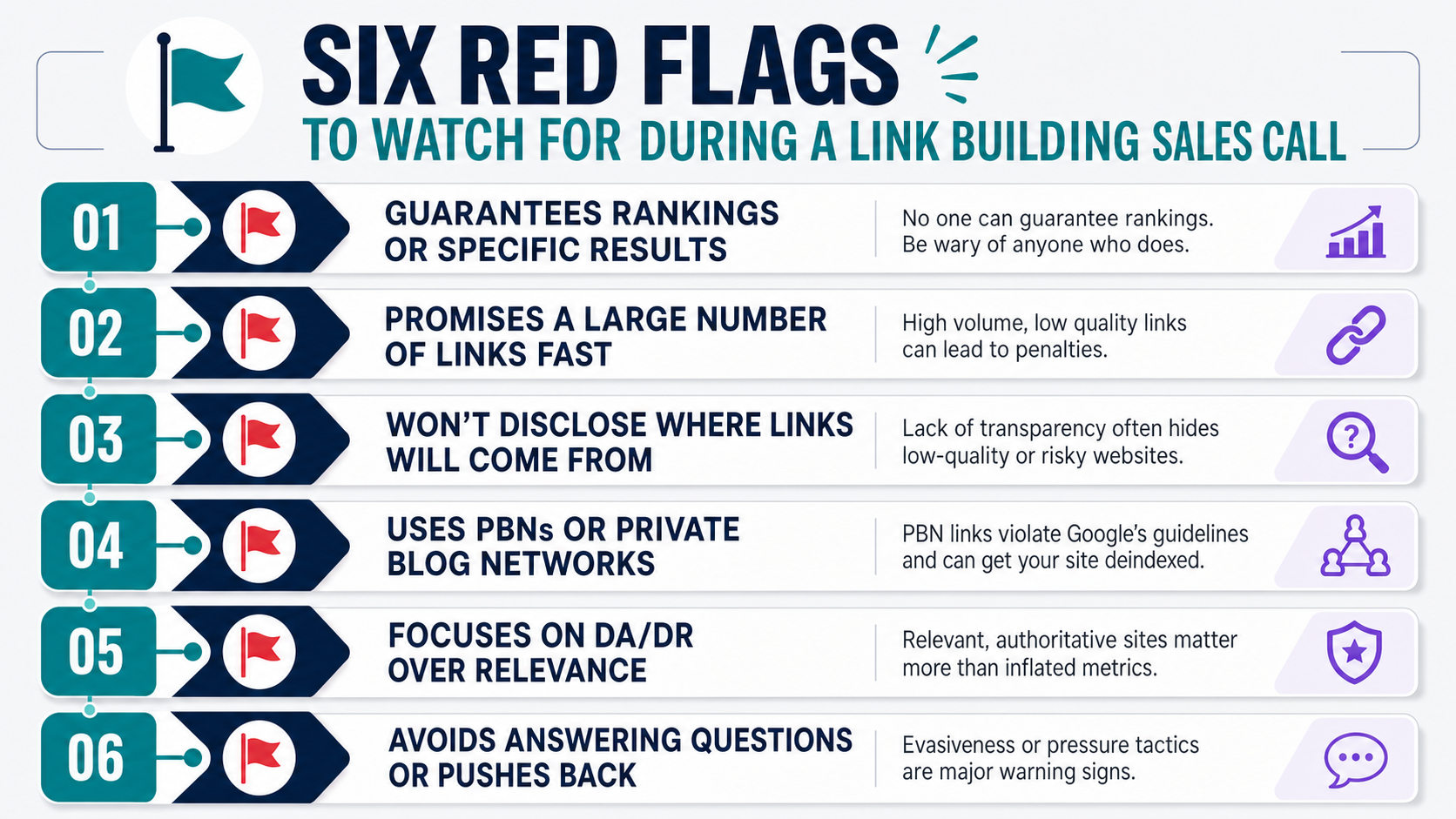
- No sample URLs offered, or samples shown only after you sign.
- Selling on Domain Rating or Domain Authority alone, with no talk of topical relevance.
- Vague turnaround like “fast delivery” with no week range.
- No placement examples from your specific industry.
- Reporting limited to screenshots rather than auditable live URLs.
- Any promise of guaranteed rankings, which no honest provider can make.
The presence of strong metrics doesn’t cancel out these flags. A provider can show DR 70 inventory and still place your link in a thin, irrelevant article that ages badly.
What to Ask in the First Sales Call
Bring these questions to any provider before you discuss price. The quality of the answers tells you more than any case study.
Ask how they match publisher topics to client target pages, and request two live examples from your niche.
Ask what their content standards are and who reviews placements before they go live.
Ask how they handle anchor text distribution and link velocity across a campaign.
Ask exactly what their report shows and how often you receive it.
Ask what happens if a link is removed or the publisher takes the page down.
See where AI answers put your brand
Twenty minutes with a senior strategist: where the major engines point buyers in your category, who gets named instead of you, and a straight read on what a programme would change.
Book a strategy callProvider Categories Compared
| Category | Best for | Pricing model | Relevance control | Turnaround | Choose if |
|---|---|---|---|---|---|
| Managed done-for-you | Hands-off teams | Per link or retainer | Medium to high | Weeks | You want delivery without running outreach |
| Marketplace platform | Scale and comparison | Pay per placement | Variable, buyer-vetted | Days to weeks | You can vet inventory yourself |
| Boutique outreach agency | SaaS, B2B, niche fields | Custom quote | High | Several weeks | Topical match is hard in your niche |
| Enterprise and digital PR | Large budgets | Retainer | High, earned | Longer campaigns | You want links tied to brand and SEO strategy |
| White-label provider | Agencies and resellers | Wholesale per link | Medium to high | Weeks | You resell to your own clients |
2026 Data: Why Context Quality Now Outweighs Link Count
Google’s entity systems and AI retrieval models increasingly weight the surrounding context of a mention over the mention itself. That is why a contextual link embedded in data-rich, topically relevant content tends to earn more than one dropped into thin filler: the sentences around it are what an engine can quote.
When evaluating a service, ask to see the actual surrounding content, not just the domain metrics of where links land.
Buying Contextual Links Versus Earning Them
When people search for a way to buy contextual links, they want a link placed inside a relevant article. How that link gets there matters more than what it costs.
Google’s link spam policies list buying or selling links for ranking purposes as a violation. A provider that sells links from a price list sits closer to that line than one that earns a placement by pitching an editor.
One question sorts the two: who decided the link belongs on that page?
If the publisher’s editor decided after reading a pitch, you earned it. If the page already existed and a link was added for a fee, you bought inventory.
Earned placements take longer, and they’re the ones you can defend in an audit. If that’s the route you want, start with our guide to editorial link building services.
Monthly Plans and Link Insertion Wording
Two buying notes. A monthly contextual backlinks service is a subscription wrapper on the same work, useful when you want a steady placement cadence and one invoice, wasteful if your need is a one-off batch.
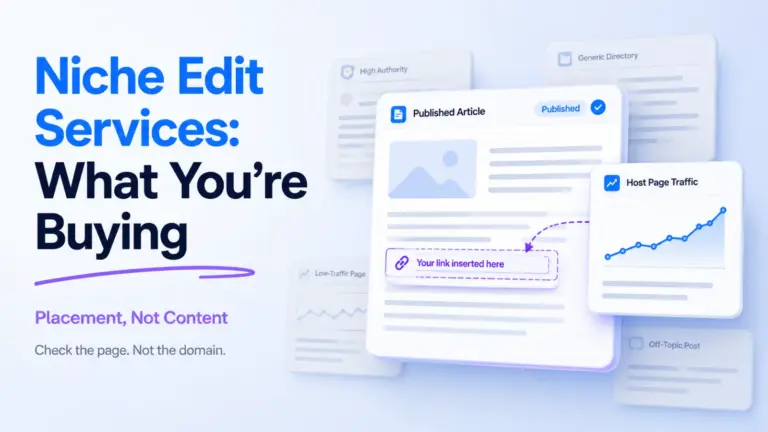
And when a vendor says contextual link insertion service, it means the same thing as a niche edit: your link added into an existing, already-indexed page.
A 20-Minute Vendor-Audit Routine to Run This Week
Everything above is a buying framework. This is how you use it on a vendor you’re already paying. The eight criteria earlier in this guide are the test, and five live placements are enough to run it.
Pull the five most recent links a vendor has delivered for you. For each one, check the host site against the eight criteria: does it rank for real commercial keywords in your niche, is the organic traffic genuine, is its own backlink profile mostly other paid placements, does the page hosting your link rank for anything itself. Then read the article around your link. If it reads like it was written to hold a link rather than to be read, you’ve got your answer.
Twenty minutes gets you through all five. A vendor who clears the criteria on four or five is worth keeping and worth paying more. One who clears two is selling you volume you’ll pay someone else to remove later. Take the questions from “What to Ask in the First Sales Call” into your next review call and ask them about the placements that failed.
Want to see how link quality compares to earned brand mentions in your mix? Read our breakdown of brand mentions vs. backlinks and how they compound differently in 2026.
Frequently Asked Questions
What are contextual link building services?
Contextual link building services place links to your site inside relevant, in-content sections of editorial articles on other websites. The defining feature is that the link sits within topic-matched content rather than in a footer, sidebar, author bio, or directory listing, which is what gives it durable SEO value.
How much do contextual link building services cost?
Pricing varies widely by publisher authority, niche difficulty, and service model, ranging from roughly USD 100 to over USD 1,500 per link based on figures reported across the link building market. Marketplace placements sit at the lower end, while managed and digital PR campaigns command retainers.
Treat unusually cheap pricing as a quality warning rather than a bargain.
Are contextual backlinks safe for SEO?
Contextual backlinks are among the safer link types when they’re genuinely editorial, topically relevant, and acquired without manipulative anchor over-optimization. Risk rises sharply when links are placed in thin content, follow unnatural velocity, or use exact-match anchors at scale. The safety comes from the quality of execution, not the label.
What’s the difference between contextual links and guest posts?
A guest post is a full article you contribute to a publisher, which usually contains a contextual link back to your site. A contextual link is the link itself, which can come from a guest post, a niche edit inside an existing article, or a digital PR placement.
Guest posts are one delivery method; contextual links are the outcome.
How do I choose the best contextual link building service?
Score providers against the eight criteria in this guide, with relevance, editorial quality, transparency, and niche fit weighted highest. Request sample placements from your industry, confirm the reporting format, and match the provider category to your stage and risk tolerance before you compare price.
The Honest Take
The best contextual link building service isn’t the one with the biggest metric claims or the top spot on someone else’s roundup. It’s the one that proves relevance first, shows you real samples, and reports in a format you can audit.
Shortlist two or three providers across the categories that fit your stage. Request sample placements from your exact niche, run them against the eight criteria, and choose the partner that demonstrates topical fit and transparency before you pay.
If a service can’t prove relevance up front, no price is low enough to justify the risk. For how a structured program ties links to broader visibility, see how our brand mention programme works.