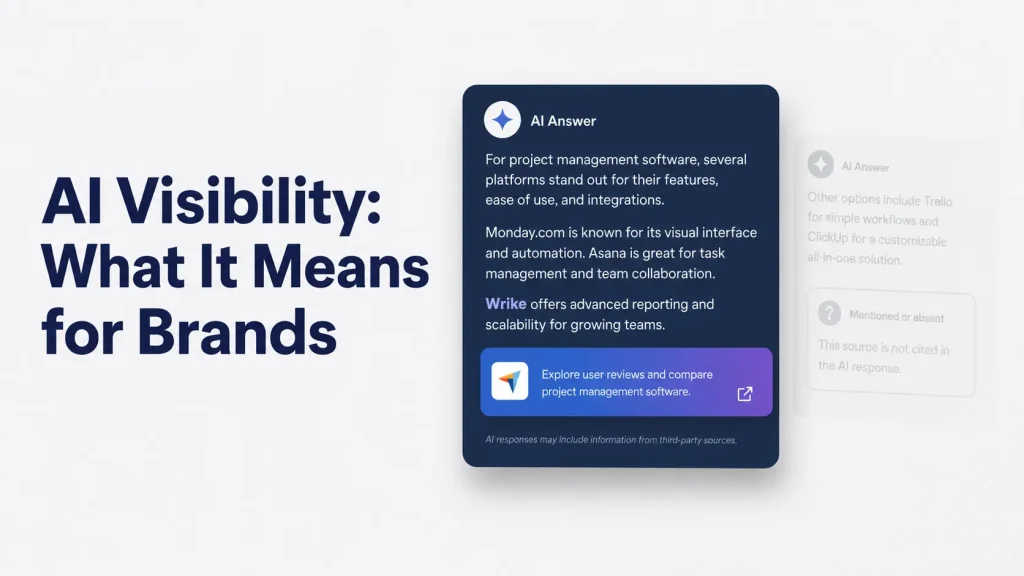
Capterra AI visibility is how often Capterra shows up in ChatGPT, Perplexity, Gemini, and AI Overviews, and what that means for software brands.
Jordan Ellis Updated June 16, 2026 11 min read 2,045 words
When a buyer asks ChatGPT which software to trust, Capterra can show up as a cited source, a passing mention, or not at all. That variation is what people mean by Capterra AI visibility: the degree to which Capterra pages, reviews, and category listings get surfaced by AI engines when someone researches software. It’s not a single score, and it’s not the same as ranking on Google. It’s prompt-dependent, uneven across engines, and mostly indirect. This article explains what the term covers, why it matters to software brands, and what you can realistically expect from AI search.
What Capterra AI Visibility Actually Means
Capterra AI visibility is the degree to which AI engines like ChatGPT, Perplexity, Gemini, and Google AI Overviews mention, cite, or surface Capterra when people ask software-research questions. That’s the whole definition. It covers brand-level mentions, review-page citations, and category or comparison references.
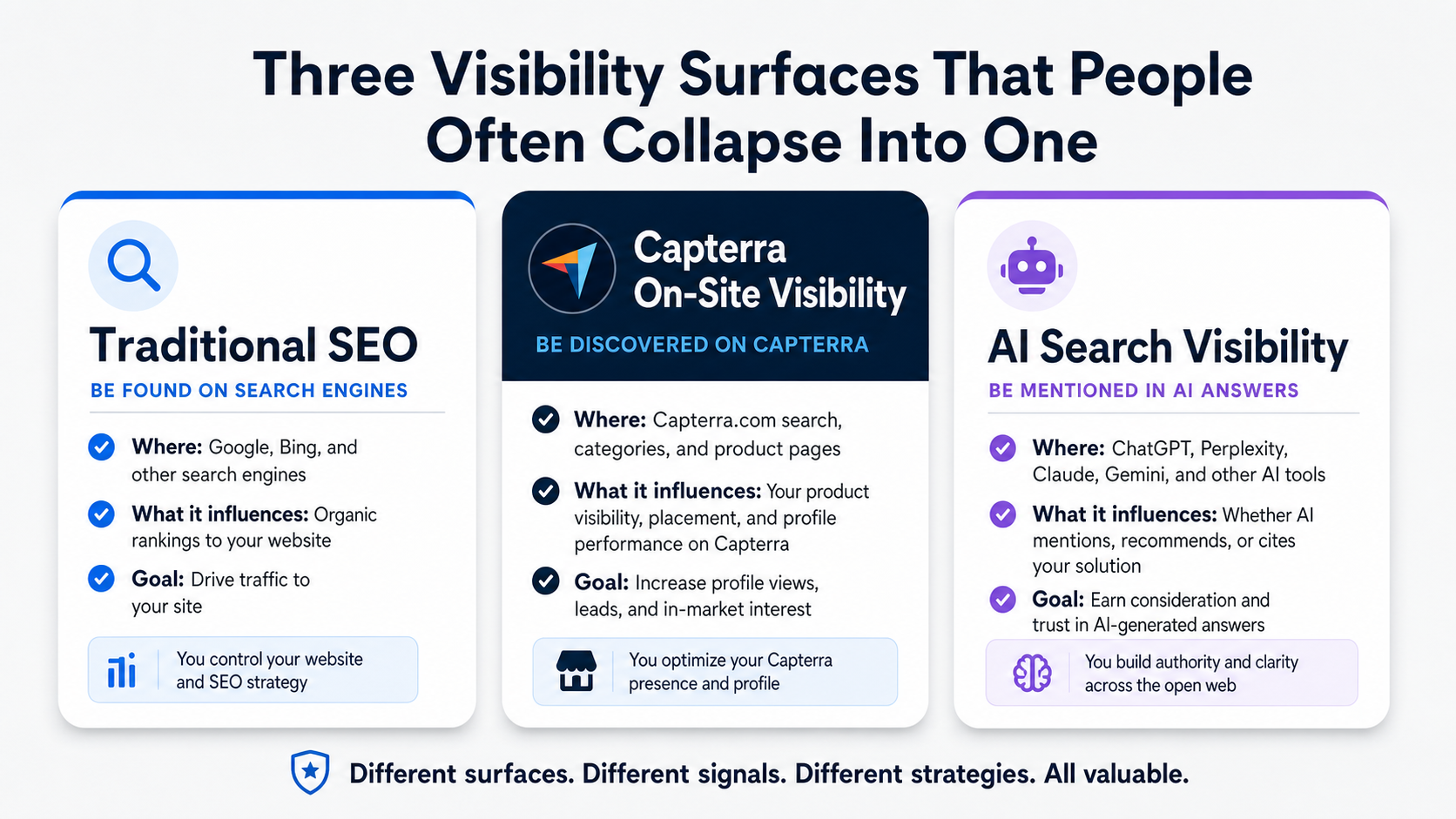
This is not the same thing as ranking on Google.
Three separate surfaces. Strength in one does not transfer to the others.
It’s also not the same as ranking inside Capterra’s own search, or winning placement on a Capterra category page. Those are separate outcomes with separate mechanics.
In plain English: AI visibility is about being part of the answer, not just being in the index. A page can sit in Google’s index for years and never get pulled into an AI-generated response. Capterra AI visibility measures the second thing, not the first.
One more wrinkle worth naming early. The same company can be highly visible in one AI engine and nearly absent in another. Capterra might anchor a Perplexity answer about review platforms and barely register in a Gemini answer to the same question. That’s normal. Treating “AI visibility” as one universal number hides this, which is why prompt-by-prompt, engine-by-engine reading beats a single score.
In audits, teams often confuse “being listed on Capterra” with “being cited by AI.” Those are different outcomes. A vendor can have a complete Capterra profile and still never appear when an AI engine answers a buyer’s shortlist question.
Why This Matters for Software Brands and Buyers
Capterra AI visibility matters because AI answers increasingly shape the shortlist before a buyer ever clicks a traditional search result. If an engine names three vendors and skips yours, you’re already losing ground in the research phase.
Capterra plays a specific role here. It packages reviews, categories, and comparisons into structured, crawlable content, which makes it a convenient trust signal for AI systems pulling together an answer.
How the business impact shows up
The impact lands in three stages of the buyer journey.
Brand discovery comes first. When a buyer asks an open question like “what software helps with X,” an AI engine may name categories and surface Capterra as a place those vendors are reviewed.
Comparison-stage influence comes next. Prompts like “X vs Y” or “best tool for Z” are where review platforms carry the most weight, because the model wants proof points and structured comparisons.
Credibility reinforcement comes last. Even when Capterra isn’t the final source a buyer clicks, a model referencing it can nudge consideration by signaling that real users have reviewed a category.
Buyers who start in AI answers often reach comparison-stage questions earlier than buyers who start in a search box. That timing shift makes review platforms disproportionately important in evaluation prompts, where they show up far more than in broad awareness prompts.
This matters most for brands selling into research-heavy, multi-stakeholder B2B journeys. If your category involves long evaluation cycles and committee buying, the AI-shaped shortlist is where you either make the cut or quietly disappear.
How AI Systems Pull and Synthesize Capterra Content
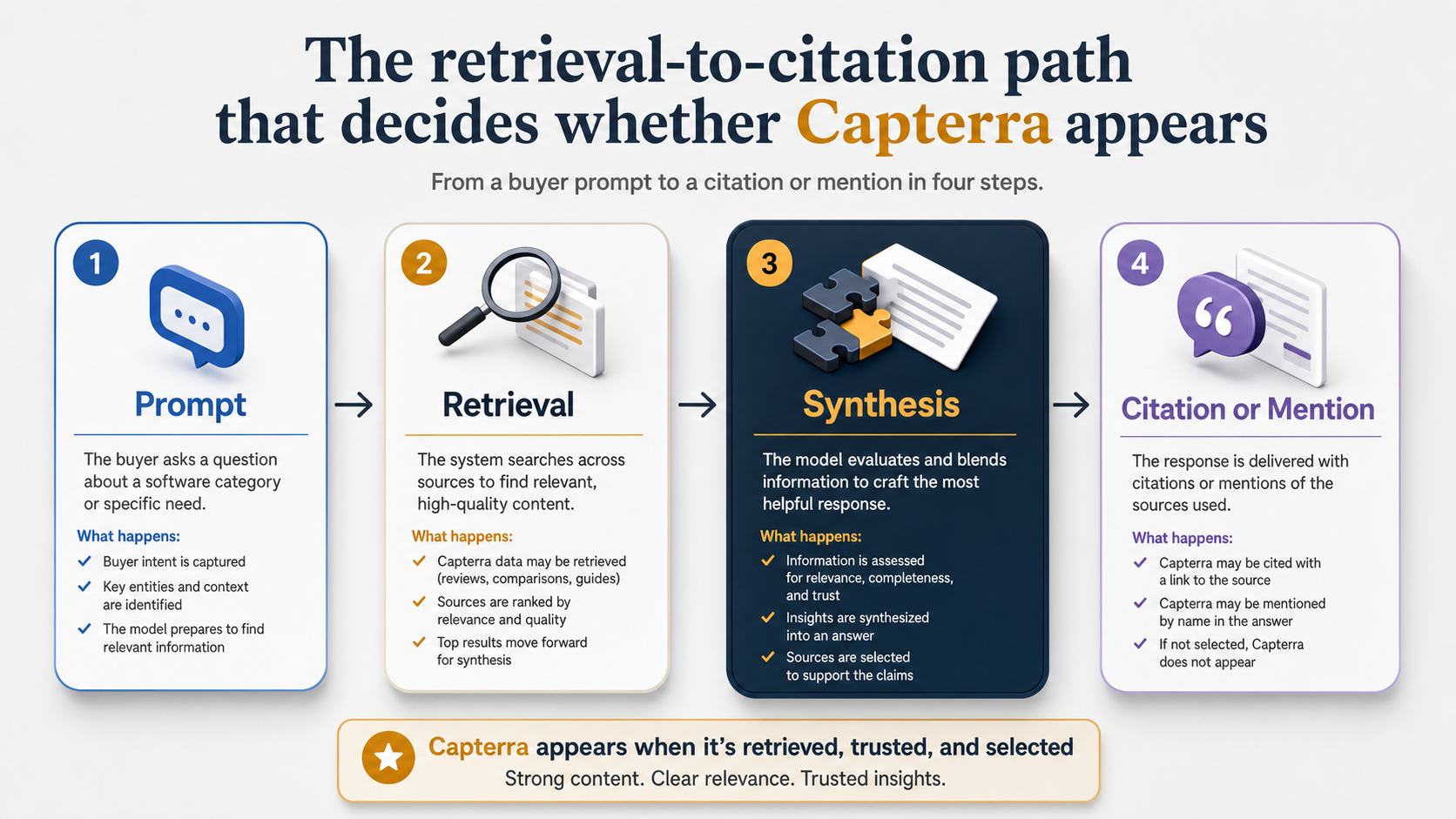
AI systems surface Capterra by retrieving and synthesizing from crawlable sources, then assembling an answer. They pull from review text, category pages, comparison pages, and third-party mentions, then stitch the relevant parts into a response. There’s no single ranking slot Capterra “wins.” There’s a retrieval-and-synthesis process it either fits into or doesn’t.
This is why structured, indexable content does well. A clean review page with clear sentiment and a recognizable brand entity is easier for a model to retrieve and reuse than a thin or fragmented page. The same logic governs which sources any AI engine reaches for, and you can dig deeper into that in our breakdown of how AI crawlers pick sources.
Capterra’s influence is usually indirect. It works through review volume, brand and entity clarity, and content a model can parse cleanly, not through a direct switch that forces a citation.
Model behavior also varies by engine, by how the prompt is worded, and by how fresh the source is. The same query phrased two ways can surface Capterra once and skip it the next time.
Reviews are one signal here. They’re not a guaranteed pass to a citation. A vendor can have hundreds of reviews on Capterra and still lose the citation to a source the model trusts more for that specific question.
Capterra appears when its content fits cleanly into the retrieval and synthesis steps.
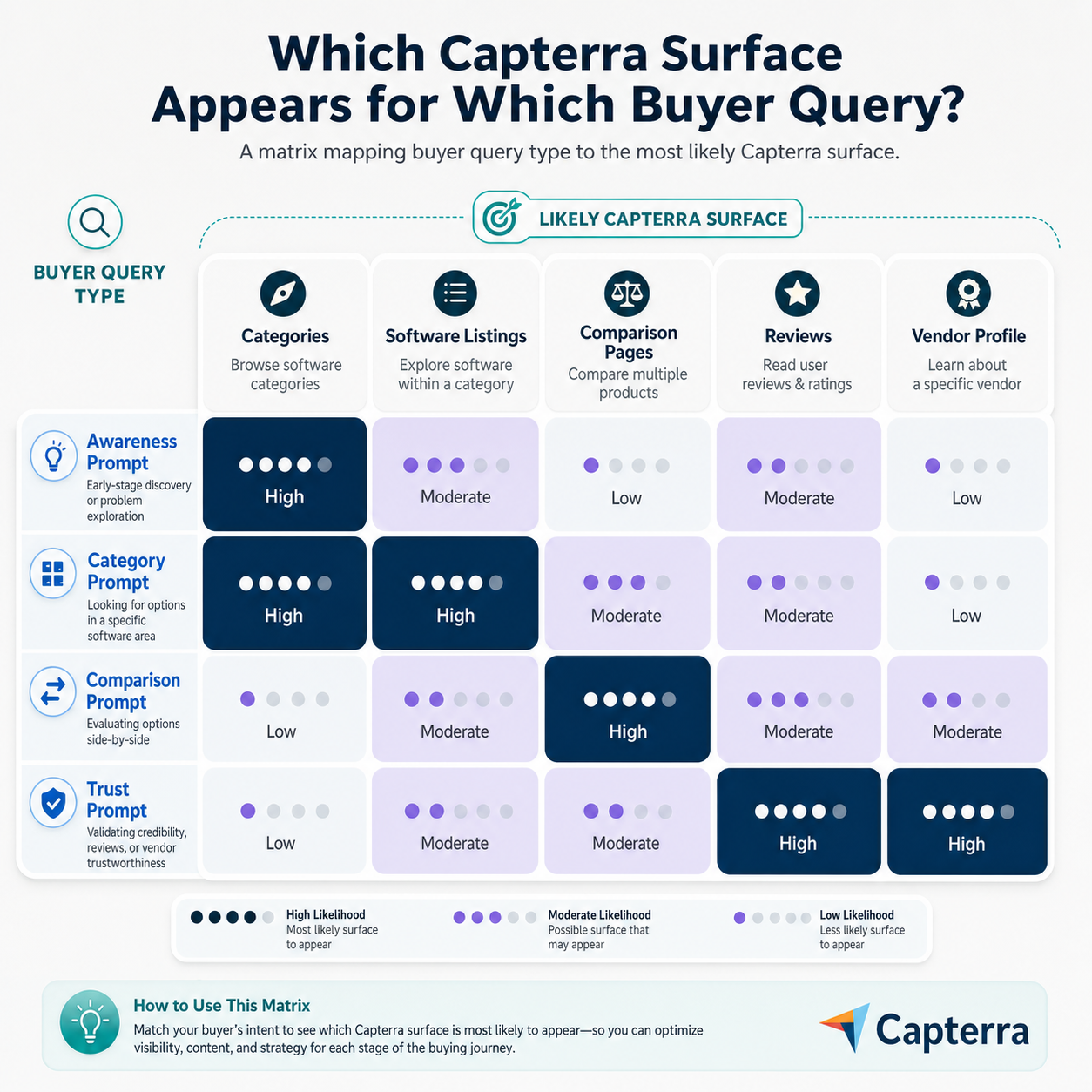
In real audits, comparison and evaluation prompts surface review platforms far more often than broad discovery prompts do. If you want the bigger picture on which signals to track instead of chasing raw mention counts, our guide on AI visibility versus SEO metrics covers what’s worth measuring in 2026.
The Main Ways Capterra Shows Up in AI Answers
Capterra appears in AI answers through five distinct surfaces, and each one means something different. Lumping them into a single visibility number erases the part that’s actually useful: knowing which prompts trigger which surface.
Comparison and trust prompts give Capterra its best shot at a citation.
Visibility type
When it surfaces
What it tells you
Review-page visibility
The model needs proof points, sentiment, or user feedback
Capterra is being used as social proof, not a vendor list
Category-page visibility
The user asks about software types or vendor lists
Capterra is being treated as a directory source
Comparison-query visibility
Prompts like “X vs Y” or “best software for Z”
The strongest chance for Capterra to be cited directly
Brand and entity visibility
The model recognizes Capterra as a trusted review destination
Capterra is named even without a specific page citation
Citation visibility
The answer links or attributes a claim to Capterra
Capterra is the cited source, not just referenced in passing
The difference between the last two matters most. Sometimes Capterra is the cited source with a link. Other times it’s only referenced inside the body of the answer with no attribution. Those carry different weight, and a visibility read that doesn’t separate them is missing the point.
Audit patterns usually show stronger Capterra presence in comparison and trust prompts than in open-ended awareness prompts. That’s consistent with how review platforms function: they answer “which is better” far better than “what should I even look at.”
Common Myths About Capterra AI Visibility
The biggest mistakes here come straight from SEO and review-platform habits that don’t transfer to AI search. Here’s what’s true and what isn’t.
Myth: More reviews automatically guarantee AI visibility
Reality: review volume is one input, not a guarantee. A high count helps a model trust Capterra as a source, but it doesn’t force a citation in any given answer. Relevance to the specific prompt, freshness, and how the brand entity is recognized all factor in.
Myth: AI visibility is the same as SEO rankings
Reality: they share inputs but produce different outcomes. Good crawlable content helps both. But ranking first on Google doesn’t mean a model pulls you into an answer, and getting cited by Perplexity doesn’t require a top Google position. The mechanics overlap. The results don’t.
Myth: Capterra directly controls how AI engines answer
Reality: Capterra doesn’t decide what ChatGPT or Gemini say. It controls its own pages. AI engines decide independently which sources to retrieve and how to weight them. Capterra is one trust input among many, not the final authority.
Myth: High review volume equals universal citations
Reality: strong presence in one prompt class doesn’t carry across all prompts and engines. Freshness, context, and external corroboration can outweigh sheer volume on a given query. A category with stale reviews can lose to a smaller source with recent, specific feedback.
A common failure pattern is strong review presence paired with weak AI citation presence. It usually traces back to inconsistent brand and entity signals outside the platform. If the model can’t cleanly recognize the entity across the web, the Capterra reviews don’t get connected to it. The same entity-recognition logic shows up across review platforms, which is why our look at the signals AI models read from a G2 page applies just as well to Capterra.
What Software Brands Should Realistically Expect
Capterra AI visibility is a trust-and-retrieval problem, not a single ranking problem. The useful question isn’t “are we on Capterra,” it’s “which buyer questions cause Capterra to appear, and where does it disappear.”
Care most about whether Capterra shows up in the prompts your buyers actually use. A citation on a query no one asks is worth less than a mention on the comparison prompt your category lives and dies on.
The honest assessment is prompt-by-prompt visibility across engines, not one vanity number. Read where Capterra appears, what type of mention it earns, and which engines skip it entirely.
And remember Capterra is one piece of a wider entity and citation ecosystem. It’s a strong trust signal, not the whole strategy. Visibility stays uneven by engine, by prompt type, and by source mix, and that unevenness is the data, not a flaw in the measurement. If you want a structured way to read all of this, our AI visibility diagnostic framework walks through the full picture.
Frequently Asked Questions
Do Capterra reviews matter for AI visibility?
Yes, Capterra reviews matter, but as a trust input rather than a direct lever. AI engines treat review volume and sentiment as a signal that a source is credible for software questions. That makes Capterra more likely to be retrieved, but it doesn’t force a citation in any specific answer. Relevance to the prompt, freshness, and consistent brand recognition decide whether the reviews actually get pulled in.
Does Capterra show up in ChatGPT or Perplexity answers?
Capterra shows up in both, but unevenly. Perplexity tends to cite source-linked review platforms more openly because it surfaces its citations, while ChatGPT may reference Capterra in the body of an answer without a visible link. The likelihood rises sharply on comparison and “best software for” prompts and falls on broad awareness questions.
Is Capterra AI visibility the same as SEO?
No. They share content inputs like crawlable, structured pages, but the outcomes differ. SEO is about ranking in a search results list. AI visibility is about being pulled into a generated answer. A page can rank well on Google and never appear in an AI response, and the reverse happens too.
Can Capterra improve visibility in Google AI Overviews?
Capterra can appear in Google AI Overviews when its category or comparison pages are relevant and indexable, since AI Overviews draw from the same systems that power regular Search. But appearance is prompt-dependent and not guaranteed. Capterra influences this indirectly through structured review content and brand clarity, not through a setting it can flip on.
Why does Capterra appear in some AI answers but not others?
Capterra appears in some answers and not others because retrieval depends on the prompt wording, the engine, the freshness of the source, and how the question maps to Capterra’s strengths. Comparison and trust prompts favor it. Open-ended awareness prompts often skip it. The same brand can be cited on one query and absent on a near-identical one, which is why prompt-by-prompt reading beats a single score.
The Honest Read
Most teams check whether they’re on Capterra, see the profile, and assume the AI visibility box is ticked. It isn’t. The brands that get this right read where Capterra actually surfaces across real buyer prompts, engine by engine, before treating any of it as a ranking issue. Want a clearer picture of where your brand stands? Book a strategy call and see which prompts surface you, and which leave you out.
Jordan Ellis is an AI search visibility specialist and content strategist with over 8 years of experience in B2B digital marketing. Focused on the intersection of content strategy and large language model optimization, Jordan writes about how brands can build lasting presence in AI-generated recommendations. Before specializing in AI visibility, Jordan led SEO and content programs for SaaS and FinTech companies across the US and Europe.
Twenty minutes with a senior strategist: where the major engines point buyers in your category, who gets named instead of you, and a straight read on what a programme would change. No pitch deck.