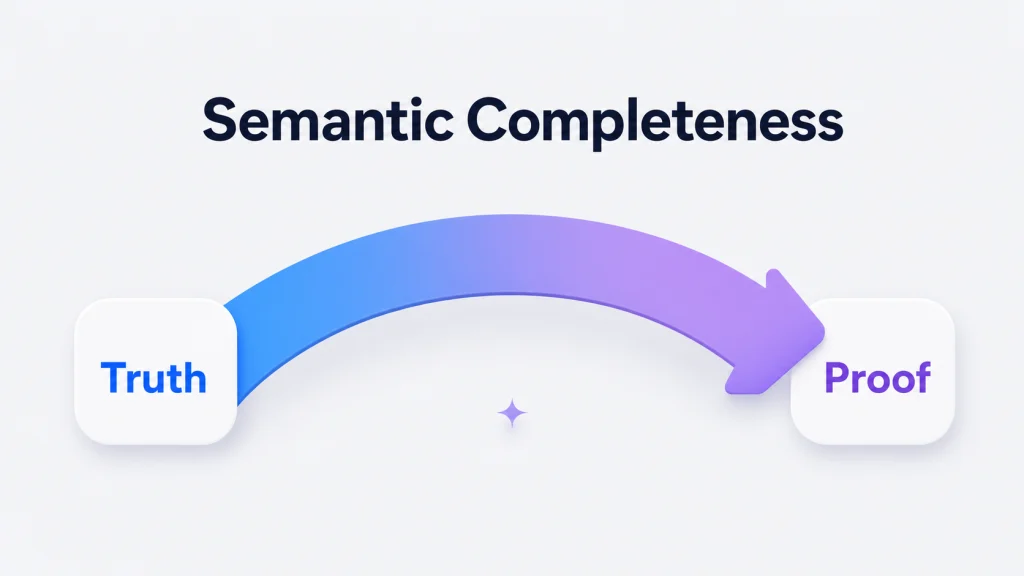

Semantic completeness scoring is not a standard term in logic, but the idea behind it is simple: a proof system is semantically complete when every valid statement can be proved inside it. The phrase reads like a metric, a number you tune. It isn’t. Semantic completeness is a property of a logic, written as the claim that if a formula holds in every model, then the proof system can derive it. In symbols, if Γ ⊨ φ then Γ ⊢ φ. That single direction is what the rest of this piece unpacks.
What Semantic Completeness Means
A deductive system is semantically complete when every formula that is true in all of its models is derivable in the system.
People often arrive at the phrase “semantic completeness scoring” expecting a dial. The honest framing is that completeness is a theorem property, not a score. A logic either has it relative to a given semantics, or it doesn’t.
Two pieces of notation carry the rest of the discussion.
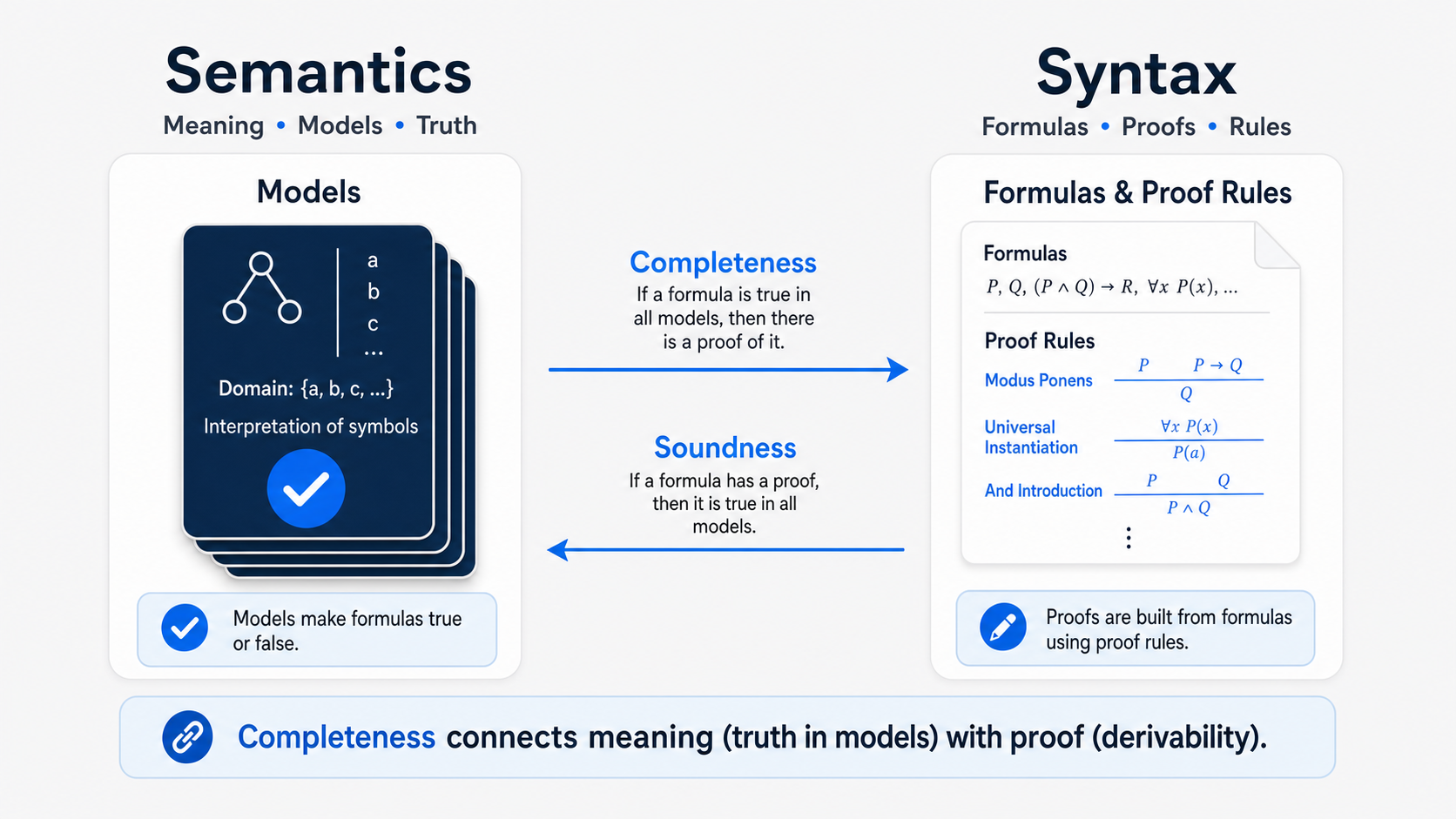
Γ ⊨ φ means semantic entailment: every model that satisfies the premises in Γ also satisfies φ.
Γ ⊢ φ means provability: φ can be derived from Γ using the system’s rules.
Completeness is always stated relative to a semantics and a proof system, never as a free-floating value. You don’t score a logic’s completeness. You prove, once, that the two relations above line up in the direction from truth to proof.
So the search phrase “semantic completeness scoring” is best read as a question: how complete is this logic with respect to its semantics? The answer is binary at the level of the logic, and it comes from a completeness theorem.
A short classical example grounds this. The formula p ∨ ¬p is true under every truth assignment, so it’s valid. A semantically complete calculus for propositional logic can derive it. That’s completeness doing its one job.
Why the Property Matters
Semantic completeness matters because it guarantees that a proof system can reach every truth the semantics declares, leaving no valid statement out of reach.
That guarantee is a trust relationship. If you know a logic is complete, then any statement that’s semantically valid is, in principle, derivable. You never have to worry that the semantics knows something the proof rules can’t capture.
The Trust It Buys You
Completeness connects model truth to formal derivation, and that connection is what makes a proof system worth using.
Without it, a proof system could be correct yet weak: everything it proves is true, but valid statements slip through the cracks because no derivation exists for them. Completeness rules that gap out.
Soundness alone is not enough here. A sound system never proves anything false, which is reassuring but limited. A sound-but-incomplete system can still miss valid consequences of its own semantics. Completeness is what makes the system expressive enough to match its intended meaning.
Where It Shows Up in Practice
Completeness underpins automated theorem proving, formal verification, and logic-based parts of artificial intelligence.
A theorem prover for a complete logic can, given enough resources, find a derivation for any valid formula. A verification tool built on a complete calculus won’t quietly fail to confirm a property that genuinely holds. The completeness theorem is the formal license behind those guarantees.
There’s a sharp distinction worth holding onto. “Can prove all valid formulas” is a far stronger claim than “can prove some useful formulas.” Completeness asserts the strong version, and that strength is exactly why logicians care whether a system has it.
How Semantic Completeness Works
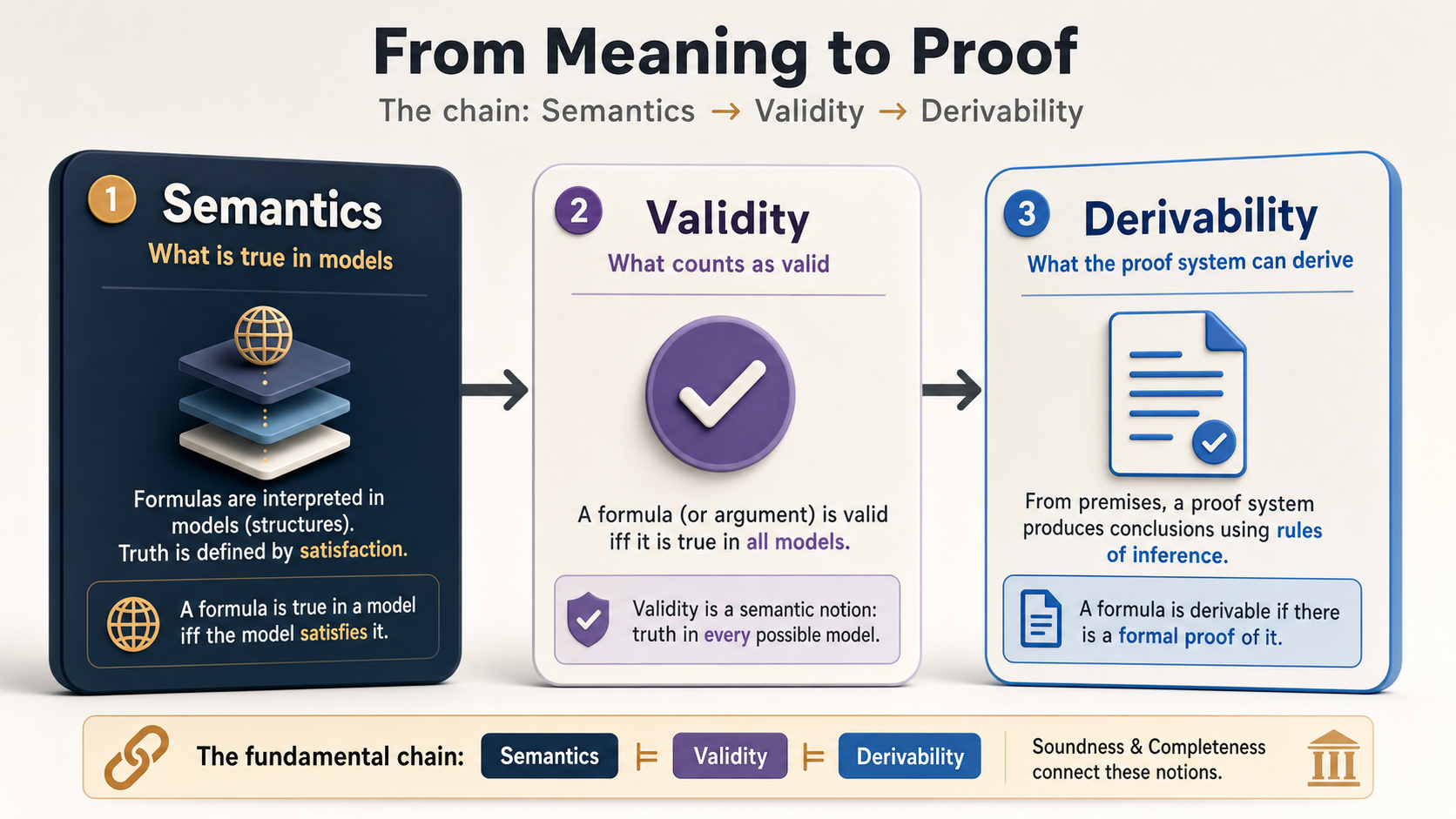
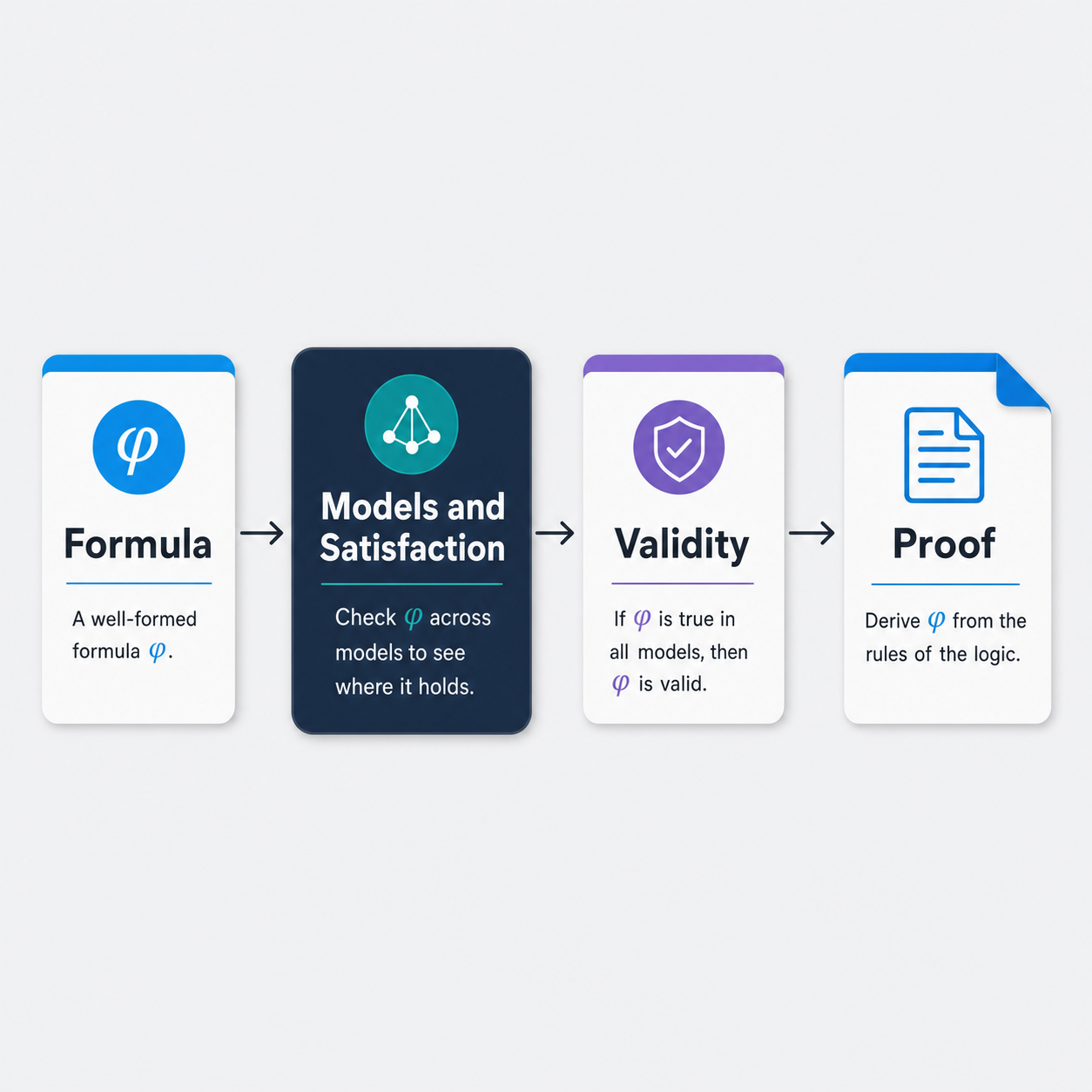
Semantic completeness works by pairing a semantics, which decides truth in models, with a proof system, which decides what’s derivable, and then proving the two agree on the direction from validity to provability.
The moving parts come in order. Formulas are the syntactic objects. Interpretations or models assign meaning. Satisfaction says when a model makes a formula true. Validity says a formula is true in every model. Entailment extends that to premises. Proof rules generate derivations.
The Two Directions
Two theorems usually travel together, and they point in opposite directions.
Soundness is the first: if Γ ⊢ φ, then Γ ⊨ φ. Anything you can prove is genuinely valid.
Completeness is the second: if Γ ⊨ φ, then Γ ⊢ φ. Anything valid can be proved.
| Property | Direction | Plain reading |
|---|---|---|
| Soundness | Provable implies valid | The system never proves something false in all models. |
| Semantic completeness | Valid implies provable | The system can prove everything true in all models. |
A completeness theorem says the proof system captures every semantically valid consequence relative to the chosen semantics. The phrase “relative to the chosen semantics” carries weight: change the semantics, and the completeness question changes with it.
A Toy Example
Take propositional logic with truth-table semantics and a standard natural deduction system.
The formula p → p is true under both assignments of p, so it’s valid. A complete proof system derives it from no premises at all. You don’t need to walk the full completeness proof to see the idea: every truth-table tautology has a derivation, and that’s what completeness asserts for this pairing.
First-order logic is the classic setting where this gets famous. Gödel’s completeness theorem establishes that first-order logic is semantically complete: every logically valid first-order formula is provable. That result is the reference point for the whole concept.
Related Concepts You’ll Confuse It With
The word “completeness” is overloaded in logic, and most of the confusion around semantic completeness comes from neighboring properties that share the name.
The cleanest way to keep them straight is to ask, for each one, whether it lives in proof theory (about derivations) or model theory (about structures), and what exactly it claims.
| Property | What it claims | Lives in |
|---|---|---|
| Semantic completeness | Every semantically valid formula is provable. | Bridges semantics and proof theory |
| Syntactic completeness | For every sentence, either it or its negation is provable. | Proof theory |
| Soundness | Everything provable is semantically valid. | Bridges proof theory and semantics |
| Strong completeness | If a premise set entails a conclusion, that conclusion is derivable from those premises. | Bridges semantics and proof theory |
| Refutation completeness | Every unsatisfiable set of formulas can derive a contradiction. | Proof theory |
| Model completeness | A model-theoretic property of a theory about elementary embeddings. | Model theory |
Strong completeness deserves a note because it’s easy to read as a synonym for semantic completeness. It isn’t. Plain semantic completeness covers valid formulas, the ones true in all models. Strong completeness extends the claim to derivability from arbitrary premise sets, which is the more demanding version.
Refutation completeness shows up in automated reasoning. A resolution system, for instance, is refutation complete: hand it an unsatisfiable set, and it derives a contradiction. That’s a different target than deriving every valid formula directly.
Model completeness is the outlier on the list. It’s a property of theories studied in model theory, tied to elementary embeddings between models, and it has nothing to do with whether a proof system captures all valid formulas. Sharing the word “completeness” is the only thing it has in common with the rest.
See where AI answers put your brand
Twenty minutes with a senior strategist: where the major engines point buyers in your category, who gets named instead of you, and a straight read on what a programme would change.
Book a strategy callCommon Mistakes and Misconceptions
Most errors about semantic completeness come from blurring it together with consistency, with syntactic completeness, or with Gödel’s incompleteness theorem. Each one deserves a clean correction.
It Is Not the Same as Consistency
Semantic completeness and consistency are separate properties.
Consistency means a system can’t derive a contradiction. A system can be perfectly consistent and still fail to be syntactically complete, because there can be sentences where neither the sentence nor its negation is provable. Consistency is about avoiding contradiction. Completeness is about reaching truths. Different jobs.
It Is Not Syntactic Completeness
Semantic completeness and syntactic completeness answer different questions.
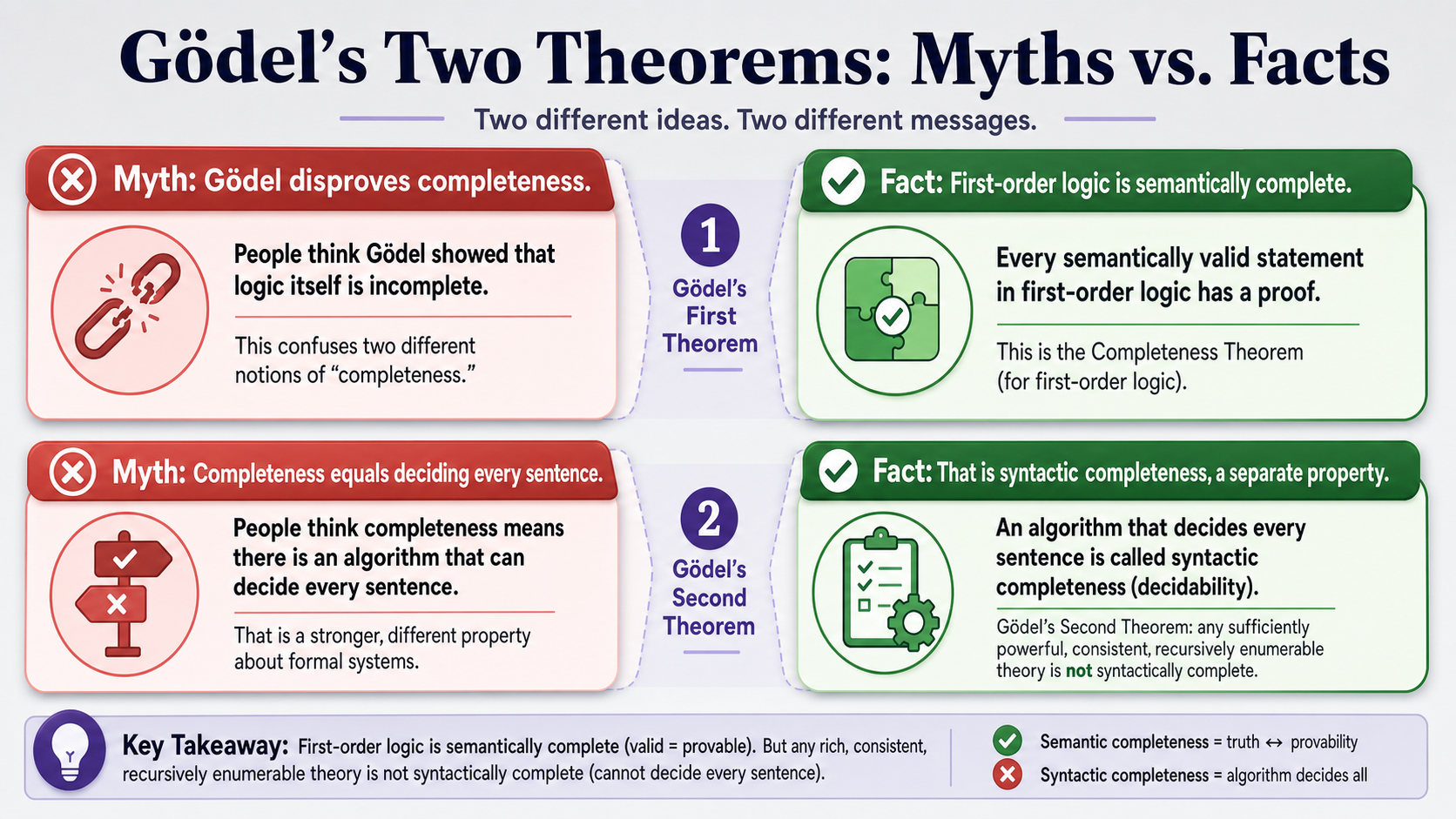
Semantic completeness asks whether every valid formula is provable. Syntactic completeness asks whether, for every sentence, the system proves either that sentence or its negation. The first is about validity flowing into proof. The second is about the system deciding every sentence one way or the other. A logic can have one without the other.
Gödel’s Incompleteness Theorem Does Not Disprove It
Gödel’s incompleteness theorem does not disprove the semantic completeness of first-order logic.
This is the misconception that trips up the most readers. The two Gödel results point at different targets. Gödel’s completeness theorem says first-order logic is semantically complete. Gödel’s incompleteness theorem says something narrower: sufficiently strong, consistent, recursively axiomatizable theories, like formal arithmetic, can’t be syntactically complete.
First-order logic itself stays semantically complete even though many specific theories expressed within it are syntactically incomplete. The distinction to hold onto is “completeness of a logic” versus “completeness of a particular theory.” They’re not the same claim, and the incompleteness theorem only touches the second one.
For readers building out a working vocabulary of these terms, the AI visibility glossary keeps adjacent definitions in one place, and the wider frameworks and guides collection is the next stop for related concepts.
Frequently Asked Questions
What is semantic completeness in logic?
Semantic completeness is the property that every formula true in all models of a logic is provable in its proof system. Stated in notation, if Γ ⊨ φ then Γ ⊢ φ. It guarantees the proof rules can reach every truth the semantics declares, which is what makes a deductive system trustworthy for finding valid statements.
What is the difference between semantic completeness and syntactic completeness?
Semantic completeness says every valid formula is provable, while syntactic completeness says that for every sentence, either the sentence or its negation is provable. The first is about validity flowing into derivation. The second is about the system deciding every sentence one way or the other. A logic can hold one property without holding the other.
Does Gödel’s incompleteness theorem disprove semantic completeness?
No. Gödel’s completeness theorem establishes that first-order logic is semantically complete. Gödel’s incompleteness theorem applies to sufficiently strong, consistent, recursively axiomatizable theories like formal arithmetic, and it shows those theories can’t be syntactically complete. The two results target different things, so the incompleteness theorem leaves the semantic completeness of first-order logic untouched.
What is strong completeness in logic?
Strong completeness is the property that if a set of premises semantically entails a conclusion, then that conclusion is derivable from those premises. It extends plain semantic completeness, which covers only formulas valid in all models, to derivability from arbitrary premise sets. Strong completeness is the more demanding of the two claims.
How is semantic completeness different from consistency?
Consistency means a system can’t derive a contradiction, while semantic completeness means every valid formula is provable. One is about avoiding contradiction, the other about reaching all truths. A system can be consistent yet fail to be complete in the syntactic sense, since there can be sentences where neither the sentence nor its negation is derivable.
The Mental Model to Keep
Strip away the overloaded vocabulary and one line holds: in a semantically complete system, semantic validity and provability line up. Everything true under the intended semantics can be proved inside the system. That’s the whole claim. The contrast that gives it meaning is the gap it closes, the gap between what’s true in every model and what a proof system can actually derive.
Completeness is what makes a logic capable of fully representing its own semantics, and it’s why “valid implies provable” is worth proving in the first place. For the neighboring terms, the next move is the glossary entries on soundness, validity, and entailment.