
Guest post outreach is not one email and a prayer. It’s a repeatable workflow for earning placements, links, and referral traffic from sites your audience already reads. The process works when you define a goal, qualify the right sites, personalize each pitch, and follow up with a content idea the editor actually wants. Skip any of those four and you get silence, low-quality placements, or a spreadsheet full of “asking for payment” replies. This guide walks the full workflow, from the inputs you set up before the first send to the metrics you check after a post goes live.
Most published guides treat outreach as a numbers game: blast a thousand emails, hope for a handful of yeses. That approach burns your domain reputation and your time. The version below is built around targeting and relevance, because a smaller list of well-matched prospects beats a bloated one every time.
What You Need Before You Start Guest Post Outreach
Before you send a single pitch, set up the campaign so success is measurable. The inputs are simple, but skipping them is the most common reason outreach stalls after the first week.
You need six things in place: a target topic or keyword, a clear content angle, a prospect list, a dedicated outreach inbox, a tracking sheet, and a basic site-quality checklist. Define what a win looks like first. That might be backlinks earned, positive replies, referral traffic, brand exposure, or a mix. Campaigns fail when teams define their metrics after outreach begins, because by then they’re already measuring the wrong things.
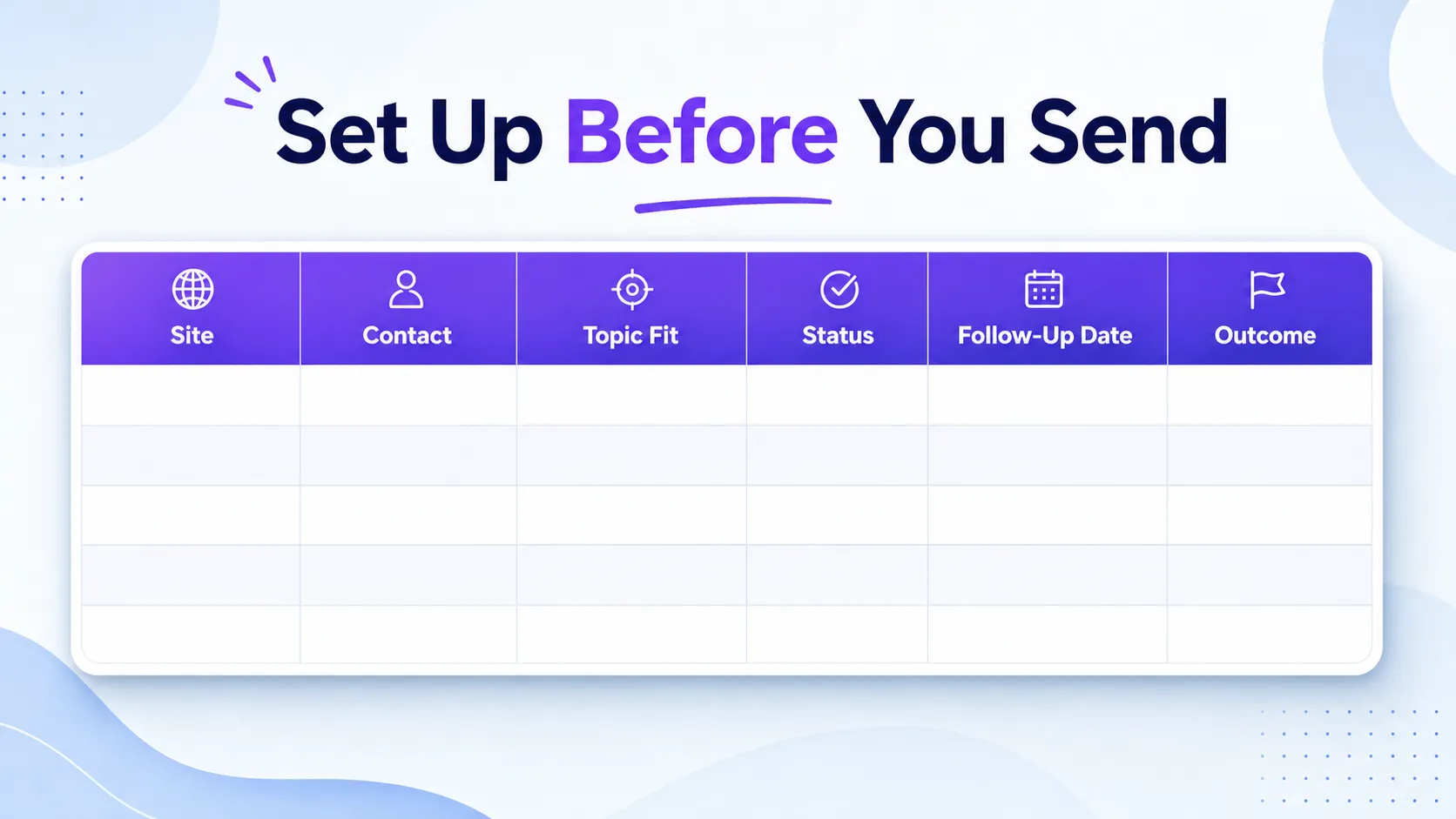
Here’s the minimum setup, mapped to why each piece matters.
| Input | Why it matters |
|---|---|
| Target topic or keyword | Keeps every pitch tied to a theme you actually want to rank or be cited for |
| Content angle | Gives editors a reason to say yes instead of a generic “we’d love to contribute” |
| Prospect list | Turns outreach into a planned campaign, not random one-off emails |
| Dedicated outreach inbox | Protects your main domain reputation and keeps replies organized |
| Tracking sheet | Shows reply rates, follow-up dates, and which prospects are worth more effort |
| Site-quality checklist | Stops you wasting pitches on sites that hurt more than they help |
If you already run a manual link building workflow, adapt that same tracking system here. The columns are nearly identical, and reusing a system you trust beats building a new one from scratch.
Step 1: Define Your Goal and Target Site Profile
Your campaign goal decides which sites belong on your list. Pick the wrong goal and you’ll pitch sites that can never deliver what you actually need.
Guest post outreach usually serves one of three goals: backlinks for authority, referral traffic from an engaged audience, or brand exposure in front of a new readership. Each goal changes the ideal site profile. Chasing links pushes you toward topically relevant, well-indexed publishers. Chasing traffic pushes you toward sites with genuine readership and engaged comment sections. Chasing exposure pushes you toward sites your buyers trust, even if the link is nofollow.

Set non-negotiables for any target site: niche relevance, audience fit, topical authority, real editorial standards, and evidence of actual traffic. Domain rating alone should never decide prospect quality. A DR 60 site that publishes anything for a fee sends a weaker signal than a DR 35 site with a sharp editorial voice and a real readership. In what we see, relevance and audience fit predict both acceptance rate and downstream traffic more reliably than raw authority metrics.
Use a fast good-fit versus bad-fit read so you can qualify prospects in seconds.
| Good fit | Bad fit |
|---|---|
| Publishes in your exact niche | Covers any topic for any client |
| Has a named editor or contact | Generic “submit here” form only |
| Recent posts get shares or comments | No engagement signals anywhere |
| Visible organic traffic on real keywords | Traffic that looks bought or empty |
| Clear editorial guidelines | “Pay $X per post” as the only rule |
Step 2: Build a Qualified Prospect List
A strong prospect list is dozens of well-matched sites, not thousands of random ones. The filtering work you do here saves you from wasted pitches later.
Start by finding opportunities, then narrow hard. Five sourcing methods cover most campaigns.
- Run search operators like
intitle:"write for us","guest post guidelines","become a contributor","submit an article", and your topic paired with “guest post.” - Mine competitor backlink profiles to find publishers already linking to similar brands in your space.
- Check contributor pages, author bios, and recurring writers to spot sites that genuinely accept outside contributions.
- Look for content gaps where a publisher has stale coverage and clearly needs a fresh angle or an update.
- Filter aggressively, keeping only sites with clear relevance, recent publishing activity, a reachable editor, and visible audience signals.
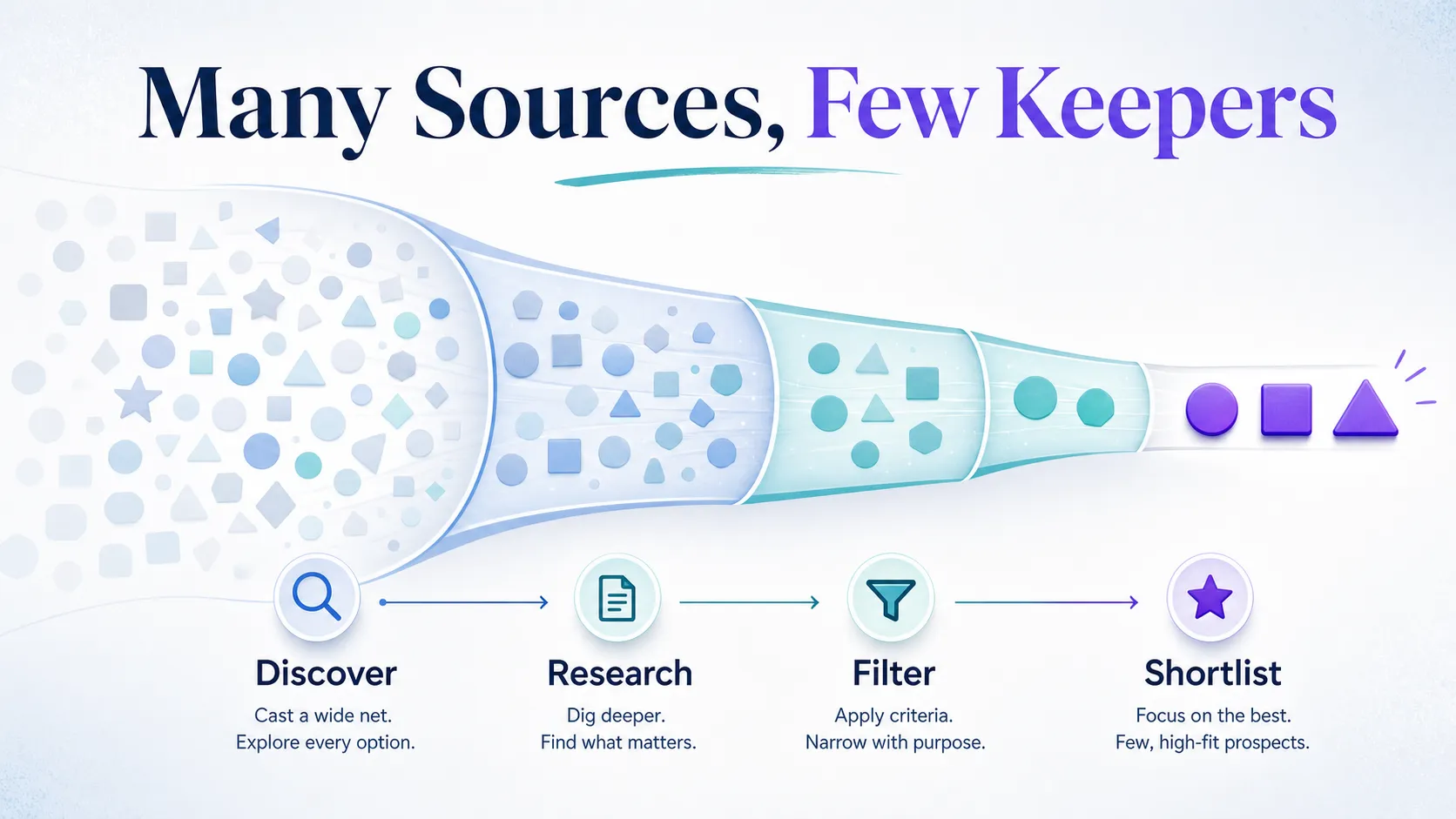
Competitor backlink research deserves extra attention. If three sites already link to a direct competitor, they accept your kind of content and care about your topic. That signal beats a cold “write for us” page every time. The same logic powers resource page link building, where you target pages that already curate links in your niche.
Resist the urge to pad the list. A campaign of 40 high-fit prospects produces more placements than 400 scraped domains, because you can research and personalize each one properly.
Step 3: Research Each Target Before You Pitch
Pitches win when they sound like you read the site, not before you found it. Research is what separates a reply from the trash folder.
Spend a few minutes on each prospect before writing anything. Read the last ten published posts to learn the tone, depth, and topics the publisher favors. Identify the audience they serve and the problems that audience actually cares about. Read the submission guidelines line by line and pull out any required word count, link policy, or topic restriction. Capture one concrete personalization signal: a recent article you can reference, a recurring contributor, a specific point of view the site holds, or a content gap you can fill.

Note the editorial tone explicitly. A site that writes in a dry, technical register will reject a breezy, marketing-heavy pitch on sight. Match the temperature of your email to the temperature of their content. The single best predictor of a reply is whether the editor can tell, in the first two lines, that you actually know their site.
Step 4: Craft a Pitch That Gets Replies
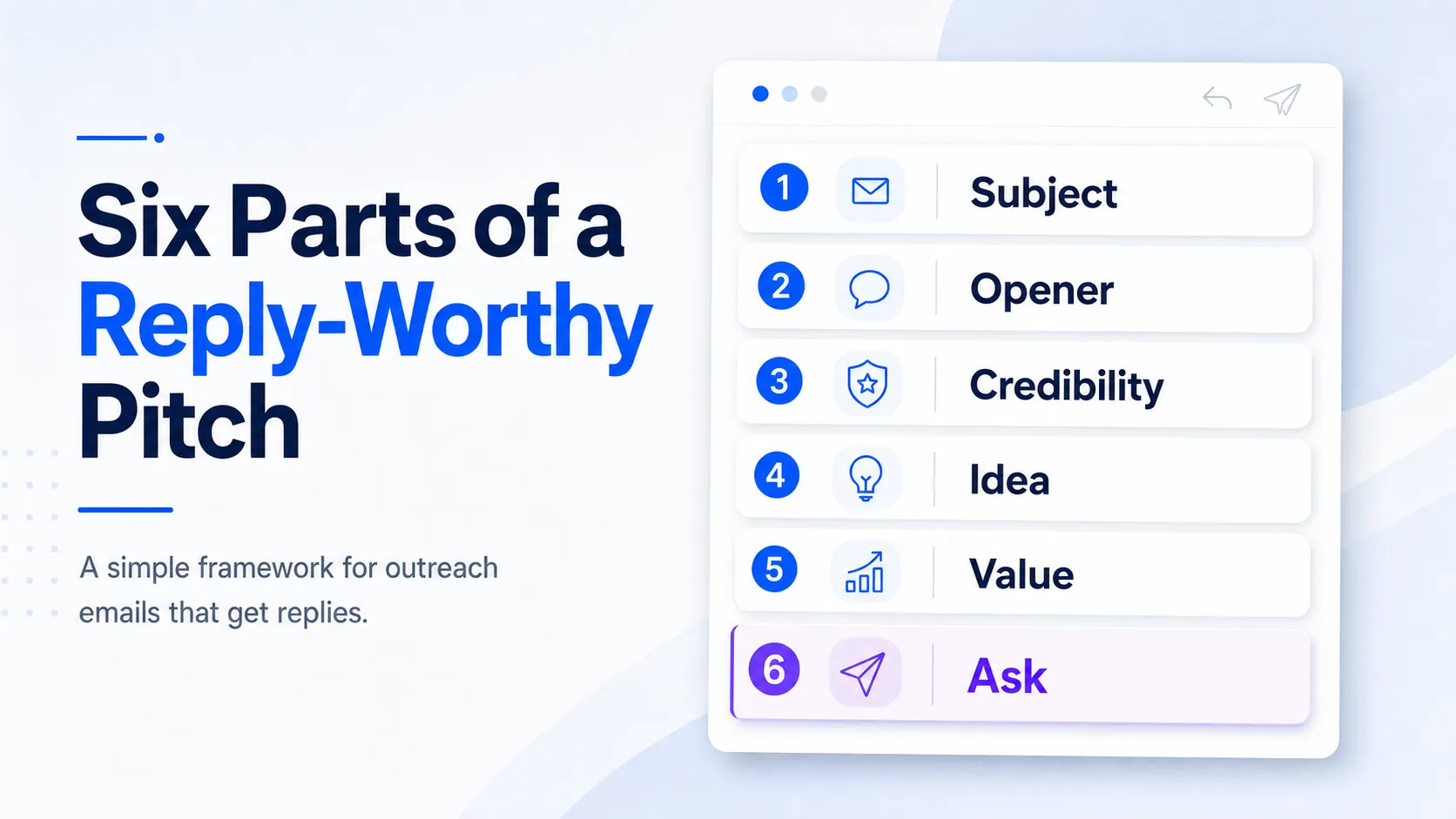
An effective pitch has six parts, and each one earns its place. The whole email stays short, because editors skim.
The six parts in order: a specific subject line, a personalized opener, a credibility signal, a topic idea, a value proposition, and one clear call to action. Lead with the personalization, prove you can deliver, propose something concrete, then ask. Keep the first email focused on the publisher’s audience, not on your link.
Three subject line formulas tend to land without tripping spam filters:
- “Guest post idea: [specific angle] for [their audience]”
- “Noticed your piece on [topic], one addition?”
- “Contributing on [topic] for [site name]”
Here’s a cold outreach template you can adapt for a site you have no prior contact with:
Subject: Guest post idea: [angle] for [their audience]
Hi [name], I read your recent piece on [specific topic] and noticed you haven’t covered [gap]. I write about [your area] and could put together a [word count] piece on [proposed angle], tailored to your readers. I’ve published on [credibility signal]. Want me to send a quick outline?
And a topic-gap template, for when your competitor research surfaced something the site is missing:
Subject: Noticed your [topic] coverage is missing [angle]
Hi [name], your guide on [topic] is the most thorough I found, but it skips [specific gap your audience asks about]. I could write a standalone piece that fills it and links back to your existing guide. Here are two headline options: [A] and [B]. Useful?
Avoid the moves that get pitches deleted: long biographies, dumping your link in the first line, talking about anchor text, and generic “we’d love to guest post on your site” openers. Short, specific pitches outperform credential-heavy emails because they respect the editor’s time and prove relevance fast.
Step 5: Follow Up Without Sounding Spammy
Many positive replies arrive after one follow-up, not from the first send. A light cadence captures those replies without making you a nuisance.
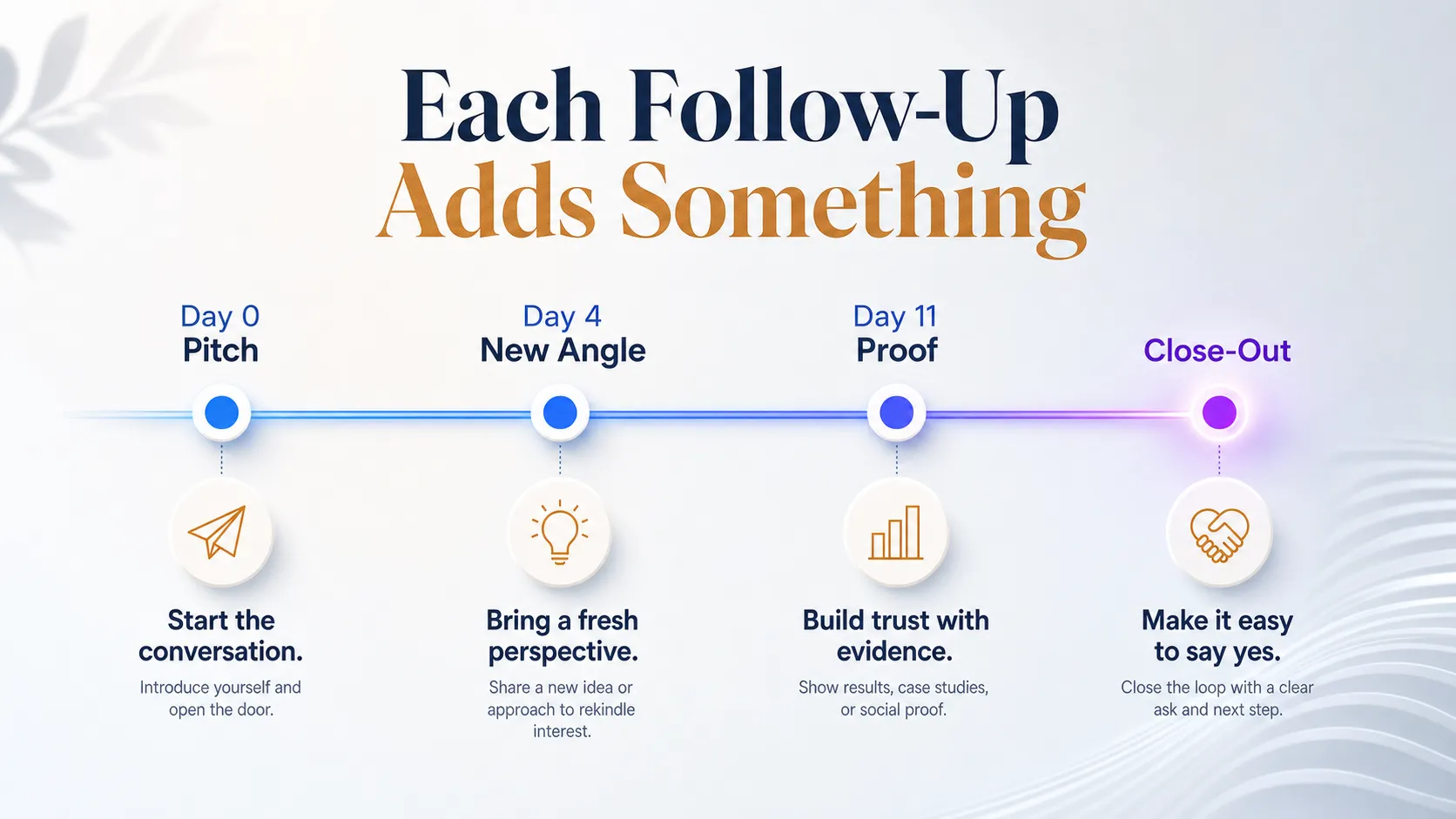
Send the initial email, then two to three follow-ups spaced over one to two weeks. Each follow-up must add something, never just nudge.
- First follow-up, after three to four days: add a new angle or a sharper topic idea than the original.
- Second follow-up, after another week: offer a quick proof point, like a similar piece you published elsewhere.
- Final follow-up: a polite, brief close-out that leaves the door open without pressure.
Keep every follow-up threaded to the original email so the editor has context in one place. After three or four touches with no reply, move the prospect into a recycle bucket and revisit in a few months with a fresh angle. Never send a repetitive “just checking in” with nothing new attached. That message trains editors to ignore you, and it’s the fastest way to land in a spam folder. This same disciplined cadence underpins any strong link building outreach campaign.
Step 6: Turn Interest Into Approval and a Live Placement
A “maybe” becomes a “yes” when you reduce friction for the editor. The faster you give them something to approve, the faster they say yes.
The moment an editor shows interest, send a strong outline. Include two or three headline options, a clear angle, a proposed structure, and proof of expertise on the topic. If they request a draft, deliver one that follows their style and guidelines closely, with a relevant anchor suggestion and a topic that aligns with their recent coverage. Editors approve faster when the pitch arrives with a ready-to-review outline instead of a vague idea, because you’ve done the thinking for them.
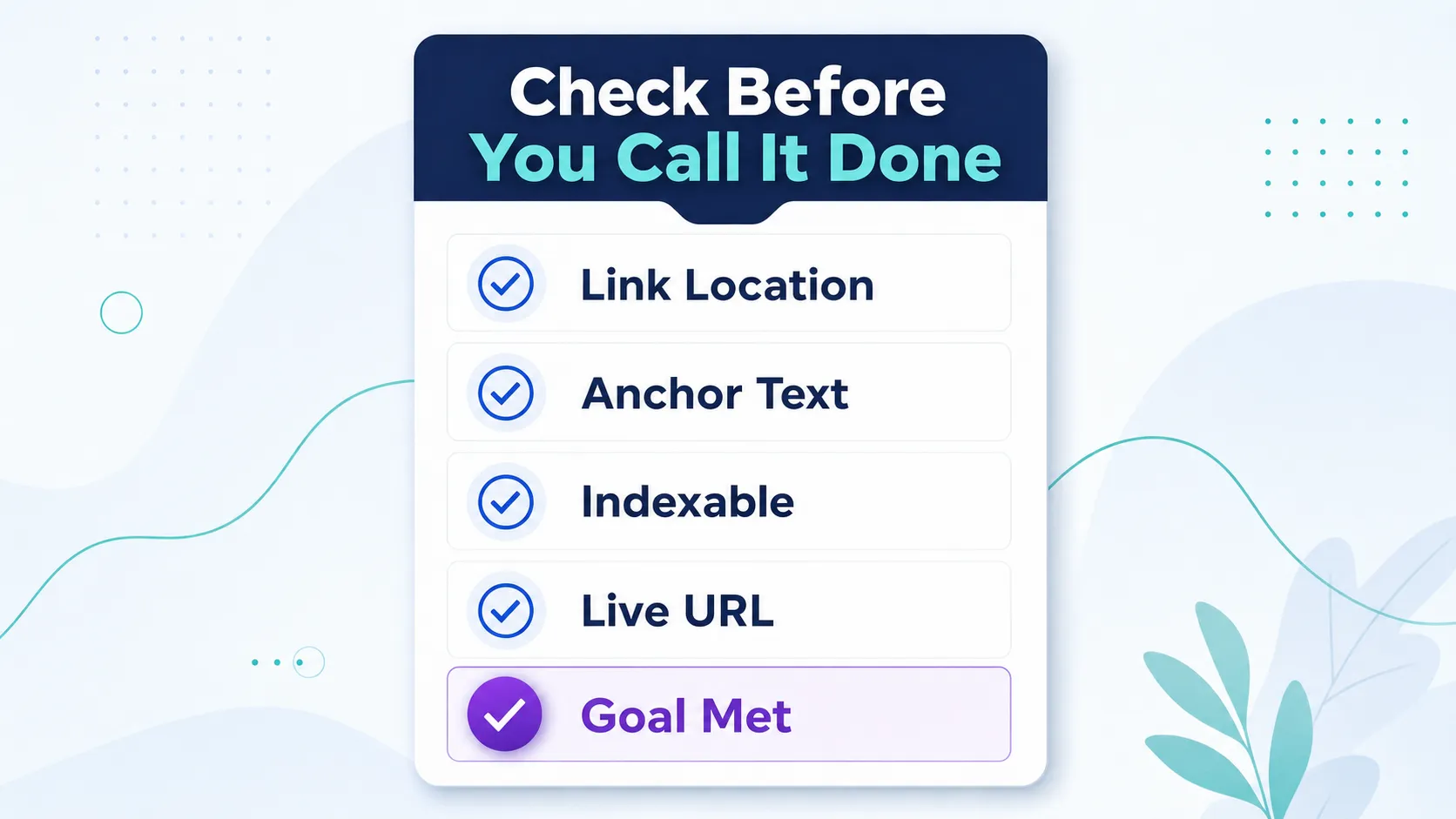
Once the post goes live, verify it before logging the win. Confirm the link sits inside the body content, not buried in a footer. Check the anchor text matches what you agreed. Confirm the live URL resolves and the page is indexable. Then track the metrics that tie back to your original goal: referral traffic, click quality, and whether the placement moved the needle on the outcome you set in Step 1. A live link that drives no relevant traffic and earns no authority is a placement that missed its goal, even if it published.
Tips, Common Pitfalls, and What Success Should Look Like
Guest post outreach works through quality targeting and persistence, not volume alone. The teams that win treat each prospect as a relationship, not a row in a scraper.
Three practices separate strong campaigns from weak ones:
- Prioritize relevance and audience fit over vanity metrics like raw domain rating.
- Personalize at scale by keeping a variables sheet, so each email feels individual without taking an hour to write.
- Keep pitches short, because editors decide in the first few lines.

The common mistakes mirror those practices. Blasting generic emails kills your reply rate and your sender reputation. Targeting low-quality sites earns links that do nothing or actively hurt. Pitching weak, overused topic ideas gets you ignored. And chasing metrics over editorial fit fills your profile with irrelevant placements. If your campaign isn’t working, the cause is almost always one of these four, not the tactic itself.
Set realistic expectations. A solid campaign produces a modest reply rate, a fair number of polite rejections, a few “we charge for posts” requests, and a smaller set of genuine wins. Replies arrive in waves, and most campaigns need several sends before the placements add up. If you want a clearer picture of how outreach stacks against other tactics, compare it against guest posting versus niche edits before committing your full effort. For a wider view of the discipline, the practitioner guide to link building covers where outreach fits in a full program.
If you’d rather compare established providers than run outreach yourself, see best guest posting services.
Frequently Asked Questions
How do I find websites that accept guest posts?
Use search operators, competitor backlink research, and contributor pages. Search strings like intitle:"write for us" or your topic plus “guest post guidelines” surface sites with open submission pages. Mining the backlinks of a competitor reveals publishers already linking to your kind of brand, which are warmer prospects than cold “write for us” pages. Filter every result for niche relevance and real traffic before adding it to your list.
What should I include in a guest post outreach email?
Include six things: a specific subject line, a personalized opener, a credibility signal, a concrete topic idea, a clear value proposition for their audience, and one direct call to action. Keep it short. An editor should be able to read the whole email in under thirty seconds and understand exactly what you’re offering and why it fits their site.
How many follow-up emails should I send?
Send two to three follow-ups spaced over one to two weeks, each adding something new. A typical sequence is the initial pitch, a follow-up with a fresh angle after three or four days, a proof-point follow-up a week later, and a polite close-out. Many yeses arrive on the first follow-up, so the sequence matters more than the first send. After that, recycle the prospect rather than keep pushing.
Is guest post outreach worth it for SEO?
Yes, when you target relevant sites and earn editorial placements rather than buying them. A contextual link from a topically relevant site with real readership passes authority and can drive qualified referral traffic. The value collapses when you chase low-quality sites or pay for placements that editors mark as sponsored, because those signals carry little weight and add risk.
Are you buying guest posts or doing outreach?
Doing outreach earns stronger, more durable results than buying posts. Paid placements often sit on sites that sell links to anyone, which dilutes the signal and raises risk. Genuine outreach secures editorial placements where a real editor chose to publish your work, and that editorial choice is exactly what makes the link valuable. Build relationships, not transactions.
Build your prospect list this week and send the first 20 personalized pitches. The campaign compounds: better targeting and consistent follow-up turn a handful of early wins into a repeatable channel. Outreach rewards the operators who stay specific and stick with it, not the ones chasing volume. See where your brand stands in AI search and find the placements worth pitching first.